Proceedings of the 55th Annual Meeting of the Association for Computational Linguistics- Student Research Workshop, pages 75–81 Proceedings of the 55th Annual Meeting of the Association for Computational Linguistics- Student Research Workshop, pages 75–81
Word Embedding for Response-To-Text Assessment of Evidence
Haoran Zhang
Department of Computer Science University of Pittsburgh
Pittsburgh, PA 15260
Diane Litman
Department of Computer Science & LRDC University of Pittsburgh
Pittsburgh, PA 15260
Abstract
Manually grading the Response to Text Assessment (RTA) is labor intensive. Therefore, an automatic method is being developed for scoring analytical writing when the RTA is administered in large numbers of classrooms. Our long-term goal is to also use this scoring method to provide formative feedback to students and teachers about students’ writing qual-ity. As a first step towards this goal, in-terpretable features for automatically scor-ing the evidence rubric of the RTA have been developed. In this paper, we present a simple but promising method for improv-ing evidence scorimprov-ing by employimprov-ing the word embedding model. We evaluate our method on corpora of responses written by upper elementary students.
1 Introduction
In Correnti et al. (2013), it was noted that the 2010 Common Core State Standards emphasize the ability of young students from grades 4-8 to interpret and evaluate texts, construct logi-cal arguments based on substantive claims, and marshal relevant evidence in support of these claims. Correnti et al.(2013) relatedly developed the Response to Text Assessment (RTA) for as-sessing students’ analytic response-to-text writing skills. The RTA was designed to evaluate writing skills in Analysis, Evidence, Organization, Style, and MUGS (Mechanics, Usage, Grammar, and Spelling) dimensions. To both score the RTA and provide formative feedback to students and teach-ers at scale, an automated RTA scoring tool is now being developed (Rahimi et al.,2017).
This paper focuses on the Evidence dimension of the RTA, which evaluates students’ ability to
find and use evidence from an article to support their position. Rahimi et al.(2014) previously de-veloped a set of interpretable features for scoring the Evidence rubric of RTA. Although these fea-tures significantly improve over competitive base-lines, the feature extraction approach is largely based on lexical matching and can be enhanced.
The contributions of this paper are as follows. First, we employ a new way of using the word em-bedding model to enhance the system of Rahimi et al.(2014). Second, we use word embeddings to deal with noisy data given the disparate writing skills of students at the upper elementary level.
In the following sections, we first present re-search on related topics, describe our corpora, and review the interpretable features developed by
Rahimi et al.(2014). Next, we explain how we use the word embedding model for feature extraction to improve performance by addressing the limita-tions of prior work. Finally, we discuss the results of our experiments and present future plans.
2 Related Work
Most research studies in automated essay scor-ing have focused on holistic rubrics (Shermis and Burstein, 2003; Attali and Burstein, 2006). In contrast, our work focuses on evaluating a sin-gle dimension to obtain a rubric score for stu-dents’ use of evidence from a source text to sup-port their stated position. To evaluate the content of students’ essays, Louis and Higgins(2010) pre-sented a method to detect if an essay is off-topic.
Xie et al. (2012) presented a method to evaluate content features by measuring the similarity be-tween essays.Burstein et al.(2001) andOng et al.
(2014) both presented methods to use argumen-tation mining techniques to evaluate the students’ use of evidence to support claims in persuasive es-says. However, those studies are different from
this work in that they did not measure how the es-say uses material from the source article. Further-more, young students find it difficult to use sophis-ticated argumentation structure in their essays.
Rahimi et al. (2014) presented a set of inter-pretable rubric features that measure the related-ness between students’ essays and a source article by extracting evidence from the students’ essays. However, evidence from students’ essays could not always be extracted by their word matching method. There are some potential solutions us-ing the word embeddus-ing model. Rei and Cum-mins(2016) presented a method to evaluate topical relevance by estimating sentence similarity using weighted-embedding. Kenter and de Rijke(2015) evaluated short text similarity with word embed-ding. Kiela et al. (2015) developed specialized word embedding by employing external resources. However, none of these methods address highly noisy essays written by young students.
3 Data
Our response-to-text essay corpora were all col-lected from classrooms using the following pro-cedure. The teacher first read aloud a text while students followed along with their copy. After the teacher explained some predefined vocabu-lary and discussed standardized questions at des-ignated points, there is a prompt at the end of the text which asks students to write an essay in re-sponse to the prompt. Figure1shows the prompt ofRT AM V P
Two forms of the RTA have been developed, based on different articles that students read be-fore writing essays in response to a prompt. The first form is RT AM V P and is based on an arti-cle fromTime for Kidsabout the Millennium Vil-lages Project, an effort by the United Nations to end poverty in a rural village in Sauri, Kenya. The other form isRT ASpace, based on a developed ar-ticle about the importance of space exploration. Below is a small excerpt from theRT AM V P ar-ticle. Evidence from the text that expert human graders want to see in students’ essays are in bold.
“Today, Yala Sub-DistrictHospital has medicine,free of charge,for all of the most common diseases. Water is con-nected to the hospital, which also has a
generator for electricity.Bed nets are usedin every sleeping site in Sauri.”
Space M V PL M V PH
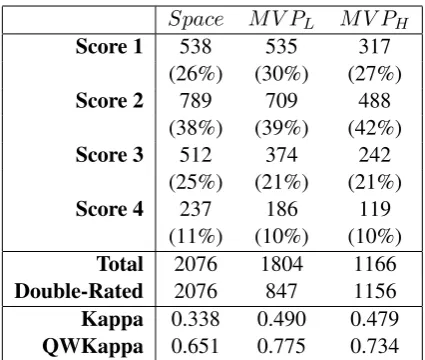
Score 1 538 535 317
(26%) (30%) (27%)
Score 2 789 709 488
(38%) (39%) (42%)
Score 3 512 374 242
(25%) (21%) (21%)
Score 4 237 186 119
(11%) (10%) (10%)
Total 2076 1804 1166
Double-Rated 2076 847 1156
Kappa 0.338 0.490 0.479
[image:2.595.310.523.60.240.2]QWKappa 0.651 0.775 0.734
Table 1: The distribution of Evidence scores, and grading agreement of two raters.
Two corpora of RT AM V P from lower and higher age groups were introduced in Correnti et al.(2013). One group included grades 4-6 (de-noted by M V PL), and the other group included grades 6-8 (denoted byM V PH). The students in each age group represent different levels of writing proficiency. We also combined these two corpora to form a larger corpus, denoted by M V PALL. The corpus of the RT ASpace is collected only from students of grades 6-8 (denoted bySpace).
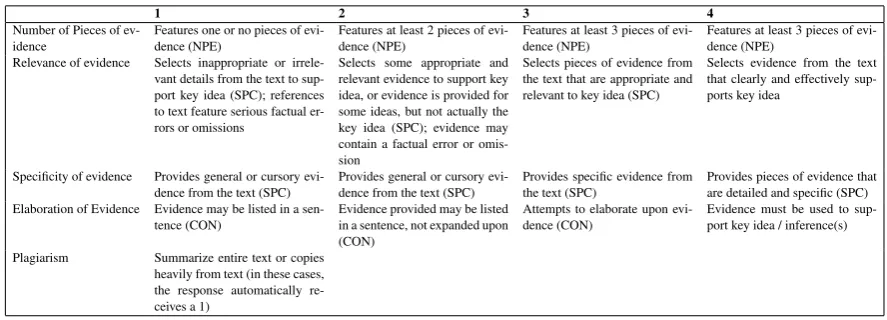
Based on the rubric criterion shown in Table2, the essays in each corpus were annotated by two raters on a scale of 1 to 4, from low to high. Raters are experts and trained undergraduates. Ta-ble 1 shows the distribution of Evidence scores from the first rater and the agreement (Kappa, and Quadratic Weighted Kappa) between two raters of the double-rated portion. All experiment perfor-mances will be measured by Quadratic Weighted Kappa between the score from prediction and the first rater. The reason to only use the score of the first rater is that the first rater graded more essays. Figure1shows an essay with a score of 3.
4 Rubric Features
Based on the rubric criterion for the evidence di-mension,Rahimi et al. (2014) developed a set of interpretable features. By using this set of fea-tures, a predicting model can be trained for auto-mated essay scoring in the evidence dimension.
arti-1 2 3 4
Number of Pieces of
ev-idence Features one or no pieces of evi-dence (NPE) Features at least 2 pieces of evi-dence (NPE) Features at least 3 pieces of evi-dence (NPE) Features at least 3 pieces of evi-dence (NPE) Relevance of evidence Selects inappropriate or
irrele-vant details from the text to sup-port key idea (SPC); references to text feature serious factual er-rors or omissions
Selects some appropriate and relevant evidence to support key idea, or evidence is provided for some ideas, but not actually the key idea (SPC); evidence may contain a factual error or omis-sion
Selects pieces of evidence from the text that are appropriate and relevant to key idea (SPC)
Selects evidence from the text that clearly and effectively sup-ports key idea
Specificity of evidence Provides general or cursory evi-dence from the text (SPC)
Provides general or cursory evi-dence from the text (SPC)
Provides specific evidence from the text (SPC)
Provides pieces of evidence that are detailed and specific (SPC) Elaboration of Evidence Evidence may be listed in a
sen-tence (CON) Evidence provided may be listedin a sentence, not expanded upon (CON)
Attempts to elaborate upon
evi-dence (CON) Evidence must be used to sup-port key idea / inference(s)
[image:3.595.77.521.60.220.2]Plagiarism Summarize entire text or copies heavily from text (in these cases, the response automatically re-ceives a 1)
Table 2: Rubric for the Evidence dimension of RTA. The abbreviations in the parentheses identify the corresponding feature group discussed in the Rubric Features section of this paper that is aligned with that specific criteria (Rahimi et al.,2017).
cle. Then, they use a simple window-based algo-rithm with a fixed size window to extract this fea-ture. If a window contains at least two words from the topic list, they consider this window to contain evidence related to a topic. To avoid redundancy, each topic is only counted once. Words from the window and crafted list will only be considered a match if they are exactly the same. This feature is an integer to represent the number of topics that are mentioned by the essay.
Concentration (CON): Rather than list all the topics in the essay, a good essay should explain each topic with details. The same topic word list and simple window-based algorithm are used for extracting the CON feature. An essay is concen-trated if the essay has fewer than 3 sentences that mention at least one of the topic words. Therefore, this feature is a binary feature. The value is 1 if the essay is concentrated, otherwise it is 0.
Specificity (SPC):A good essay should use rel-evant examples as much as possible. For matching SPC feature, experts manually craft an example list based on the article. Each example belongs to one topic, and is an aspect of a specific detail about the topic. For each example, the same window-based algorithm is used for matching. If the win-dow contains at least two words from an example, they consider the window to mention this exam-ple. Therefore, the SPC feature is an integer vec-tor. Each value in the vector represents how many examples in this topic were mentioned by the es-say. To avoid redundancy, each example is only to be counted at most one time. The length of the vector is the same as the number of categories of examples in the crafted list.
Word Count (WOC): The SPC feature can capture how many evidences were mentioned in the essay, but it cannot represent if these pieces of evidence support key ideas effectively. From pre-vious work, we know longer essays tend to have higher scores. Thus, they use word count as a po-tentially helpful fallback feature. This feature is an integer.
5 Word Embedding Feature Extraction Based on the results ofRahimi et al.(2014), the in-terpretable rubric-based features outperform com-petitive baselines. However, there are limitations in their feature extraction method. It cannot ex-tract all examples mentioned by the essay due to the use of simple exact matching.
First, students use their own vocabularies other than words in the crafted list. For instance, some students use the word “power” instead of “electric-ity” from the crafted list.
Second, according to our corpora, students at the upper elementary level make spelling mis-takes, and sometimes they make mistakes in the same way. For example, around 1 out of 10 stu-dents misspell “poverty” as “proverty” instead. Therefore, evidence with student spelling mistakes cannot be extracted. However, the evidence di-mension of RTA does not penalize students for misspelling words. Rahimi et al. (2014) showed that manual spelling corrections indeed improves performance, but not significantly.
Prompt: The author provided one spe-cific example of how the quality of life can be improved by the Millennium Vil-lages Project in Sauri, Kenya. Based on the article, did the author provide a con-vincing argument that winning the fight against poverty is achievable in our life-time? Explain why or why not with 3-4 examples from the text to support your answer.
Essay: In my opinion I think that they will achieve it in lifetime. During the years threw2004 and 2008 they made progress. People didnt have the money to buy the stuff in 2004. The hospital was packed with patientsand they didnt have alot of treatment in 2004. In 2008 it changed the hospital had medicine,
free of charge, andfor all the common dieases. Water was connected to the hospitaland has agenerator for electric-ity.Everybody has netin their site.The hunger crisis has been addressed with
fertilizer and seeds, as well as thetools needed to maintain the food.The school has no feesandthey serve lunch. To me thats sounds like it is going achieve it in the lifetime.
Figure 1: The prompt ofRT AM V P and an exam-ple essay with score of 3.
For example, “went” is the past tense of “go”, but stemming would miss this conjugation. Therefore, “go” and “went” would not be considered a match. To address the limitations above, we introduced the Word2vec (the skip-gram (SG) and the con-tinuous bag-of-words (CBOW)) word embedding model presented by Mikolov et al. (2013a) into the feature extraction process. By mapping words from the vocabulary to vectors of real numbers, the similarity between two words can be calcu-lated. Words with high similarity can be consid-ered a match. Because words in the same context tend to have similar meaning, they would therefore have higher similarity.
We use the word embedding model as a sup-plement to the original feature extraction process, and use the same searching window algorithm pre-sented byRahimi et al.(2014). If a word in a
stu-dent’s essay is not exactly the same as the word in the crafted list, the cosine similarity between these two words is calculated by the word embed-ding model. We consider them matching, if the similarity is higher than a threshold.
In Figure 1, the phrases in italics are exam-ples extracted by the existing feature extraction method. For instance, “water was connected to the hospital” can be found because “water” and “hos-pital” are exactly the same as words in the crafted list. However, “for all the common dieases” can-not be found due to misspelling of “disease”. Ad-ditional examples that can be extracted by the word embedding model are in bold.
6 Experimental Setup
We configure experiments to test several hypothe-ses: H1) the model with the word embedding trained on our own corpus will outperform or at least perform equally well as the baseline (denoted byRubric) presented byRahimi et al.(2014). H2) the model with the word embedding trained on our corpus will outperform or at least perform equally well as the model with off-the-shelf word embed-ding models. H3) the model with word embedembed-ding trained on our own corpus will generalize better across students of different ages. Note that while all models with word embeddings use the same features as the Rubric baseline, the feature ex-traction process was changed to allow non-exact matching via the word embeddings.
We stratify each corpus into 3 parts: 40% of the data are used for training the word embedding models; 20% of the data are used to select the best word embedding model and best threshold (this is the development set of our model); and another 40% of data are used for final testing.
For word embedding model training, we also add essays not graded by the first rater (Space has 229, M V PL has 222, M V PH has 296, and M V PALL has 518) to 40% of the data from the corpus in order to enlarge the training corpus to get better word embedding models. We train multi-ple word embedding models with different param-eters, and select the best word embedding model by using the development set.
includes 400 dimensions, with the context window size of 5, 10 negative samples and subsampling.
We use 10 runs of 10-fold cross validation in the final testing, with Random Forest (max-depth = 5) implemented in Weka (Witten et al.,2016) as the classifier. This is the setting used byRahimi et al.
(2014). Since our corpora are imbalanced with re-spect to the four evidence scores being predicted (Table 1), we use SMOTE oversampling method (Chawla et al.,2002). This involves creating “syn-thetic” examples for minority classes. We only oversample the training data. All experiment per-formances are measured by Quadratic Weighted Kappa (QWKappa).
7 Results and Discussion
We first examine H1. The results shown in Table3
partially support this hypothesis. The skip-gram embedding yields a higher performance or per-forms equally well as the rubric baseline on most corpora, except forM V PH. The skip-gram em-bedding significantly improves performance for the lower grade corpus. Meanwhile, the skip-gram embedding is always significantly better than the continuous bag-of-words embedding.
Second, we examine H2. Again, the results shown in Table 3 partially support this hypoth-esis. The skip-gram embedding trained on our corpus outperform Baroni’s embedding onSpace and M V PL. While Baroni’s embedding is sig-nificantly better than the skip-gram embedding on M V PH andM V PALL.
Third, we examine H3, by training models from one corpus and testing it on 10 disjointed sets of the other test corpus. We do it 10 times and av-erage the results in order to perform significance testing. The results shown in Table 4 support this hypothesis. The skip-gram word embedding model outperform all other models.
As we can see, the skip-gram embedding out-performs the continuous bag-of-words embedding in all experiments. One possible reason for this is that the skip-gram is better than the continu-ous bag-of-words for infrequent words (Mikolov et al., 2013b). In the continuous bag-of-words, vectors from the context will be averaged before predicting the current word, while the skip-gram does not. Therefore, it remains a better represen-tation for rare words. Most students tend to use words that appear directly from the article, and only a small portion of students introduce their
own vocabularies into their essays. Therefore, the word embedding is good with infrequent words and tends to work well for our purposes.
In examining the performances of the two off-the-shelf word embeddings, Mikolov’s embed-ding cannot help with our task, because it has less preprocessing of its training corpus. There-fore, the embedding is case sensitive and contains symbols and numbers. For example, it matches “2015” with “000”. Furthermore, its training cor-pus comes from newspapers, which may contain more high-level English that students may not use, and professional writing has few to no spelling mistakes. Although Baroni’s embedding also has no spelling mistakes, it was trained on a corpus containing more genres of writing and has more preprocessing. Thus, it is a better fit to our work compared to Mikolov’s embedding.
In comparing the performance of the skip-gram embedding and Baroni’s embedding, there are many differences. First, even though the skip-gram embedding partially solves the tense prob-lem, Baroni’s embedding solves it better because it has a larger training corpus. Second, the larger training corpus contains no or significantly fewer spelling mistakes, and therefore it cannot solve the spelling problem at all. On the other hand, the skip-gram embedding solves the spelling prob-lem better, because it was trained on our own corpus. For instance, it can match “proverty” with “poverty”, while Baroni’s embedding can-not. Third, the skip-gram embedding cannot ad-dress a vocabulary problem as well as the Ba-roni’s embedding because of the small training corpus. Baroni’s embedding matches “power” with “electricity”, while the skip-gram embedding does not. Nevertheless, the skip-gram embedding still partially addresses this problem, for example, it matches “mosquitoes” with “malaria” due to re-latedness. Last, Baroni’s embedding was trained on a corpus that is thousands of times larger than our corpus. However, it does not address our prob-lems significantly better than the skip-gram em-bedding due to generalization. In contrast, our task-dependent word embedding is only trained on a small corpus while outperforming or at least per-forming equally well as Baroni’s embedding.
Off-the-Shelf On Our Corpus
Corpus Rubric(1) Baroni(2) Mikolov(3) SG(4) CBOW(5)
Space 0.606(2) 0.594 0.606(2) 0.611(2,5) 0.600(2) M V PL 0.628 0.666(1,3,5) 0.623 0.682(1,2,3,5) 0.641(1,3) M V PH 0.599(3,4,5) 0.593(3,4,5) 0.582(5) 0.583(5) 0.556 M V PALL 0.624(5) 0.645(1,3,4,5) 0.634(1,5) 0.634(1,5) 0.614
Table 3: The performance (QWKappa) of the off-the-shelf embeddings and embeddings trained on our corpus compared to the rubric baseline on all corpora. The numbers in parenthesis show the model numbers over which the current model performs significantly better. The best results in each row are in bold.
Off-the-Shelf On Our Corpus
Train Test Rubric(1) Baroni(2) Mikolov(3) SG(4) CBOW(5)
[image:6.595.102.499.62.146.2]M V PL M V PH 0.582(3) 0.609 (1,3,5) 0.555 0.615(1,2,3,5) 0.596(1,3) M V PH M V PL 0.604 0.629(1,3,5) 0.620(1,5) 0.644(1,2,3,5) 0.605
Table 4: The performance (QWKappa) of the off-the-shelf embeddings and embeddings trained on our corpus compared to the rubric baseline. The numbers in parenthesis show the model numbers over which the current model performs significantly better. The best results in each row are in bold.
the prompt asks students “Did the author provide a convincing argument that winning the fight against poverty is achievable in our lifetime?”. Conse-quently, students may mention this example by only answering “Yes, the author convinced me.”. However, the skip-gram embedding can extract this implicit example.
8 Conclusion and Future Work
We have presented several simple but promising uses of the word embedding method that improve evidence scoring in corpora of responses to texts written by upper elementary students. In our re-sults, a task-dependent word embedding model trained on our small corpus was the most helpful in improving the baseline model. However, the word embedding model still measures additional information that is not necessary in our work. Im-proving the word embedding model or the feature extraction process is thus our most likely future endeavor.
One potential improvement is re-defining the loss function of the word embedding model, since the word embedding measures not only the simi-larity between two words, but also the relatedness between them. However, our work is not helped by matching related words too much. For exam-ple, we want to match “poverty” with “proverty”, while we do not want to match “water” with “elec-tricity”, even though students mention them to-gether frequently. Therefore, we could limit this
measurement by modifying the loss function of the word embedding. Kiela et al.(2015) presented a specialized word embedding by employing an ex-ternal thesaurus list. However, it does not fit to our task, because the list contains high-level English words that will not be used by young students.
Another area for future investigation is improv-ing the word embeddimprov-ing models trained on our corpus. Although they improved performance, they were trained on a corpus from one form of the RTA and tested on the same RTA. Thus, another possible improvement is generalizing the model-from one RTA to another RTA.
Acknowledgments
We would like to show our appreciation to every member of the RTA group for sharing their pearls of wisdom with us. We are also immensely grate-ful to Dr. Richard Correnti, Deanna Prine, and Zahra Rahimi for their comments on an earlier ver-sion of the paper.
[image:6.595.89.511.215.273.2]References
Yigal Attali and Jill Burstein. 2006. Automated essay scoring with e-raterR v. 2. The Journal of
Technol-ogy, Learning and Assessment4(3).
Marco Baroni, Georgiana Dinu, and Germ´an Kruszewski. 2014. Don’t count, predict! a systematic comparison of context-counting vs. context-predicting semantic vectors. In ACL (1). pages 238–247.
Jill Burstein, Karen Kukich, Susanne Wolff, Chi Lu, and Martin Chodorow. 2001. Enriching automated essay scoring using discourse marking. .
Nitesh V Chawla, Kevin W Bowyer, Lawrence O Hall, and W Philip Kegelmeyer. 2002. Smote: synthetic minority over-sampling technique. Journal of artifi-cial intelligence research16:321–357.
Richard Correnti, Lindsay Clare Matsumura, Laura Hamilton, and Elaine Wang. 2013. Assessing stu-dents’ skills at writing analytically in response to texts. The Elementary School Journal114(2):142– 177.
Tom Kenter and Maarten de Rijke. 2015. Short text similarity with word embeddings. InProceedings of the 24th ACM International on Conference on Infor-mation and Knowledge Management. ACM, pages 1411–1420.
Douwe Kiela, Felix Hill, and Stephen Clark. 2015. Specializing word embeddings for similarity or re-latedness. InEMNLP. pages 2044–2048.
Annie Louis and Derrick Higgins. 2010. Off-topic es-say detection using short prompt texts. In Proceed-ings of the NAACL HLT 2010 Fifth Workshop on In-novative Use of NLP for Building Educational Ap-plications. Association for Computational Linguis-tics, pages 92–95.
Tomas Mikolov, Kai Chen, Greg Corrado, and Jef-frey Dean. 2013a. Efficient estimation of word representations in vector space. arXiv preprint arXiv:1301.3781.
Tomas Mikolov, Ilya Sutskever, Kai Chen, Greg S Cor-rado, and Jeff Dean. 2013b. Distributed representa-tions of words and phrases and their compositional-ity. InAdvances in neural information processing systems. pages 3111–3119.
Nathan Ong, Diane Litman, and Alexandra
Brusilovsky. 2014. Ontology-based argument mining and automatic essay scoring. In Pro-ceedings of the First Workshop on Argumentation Mining. pages 24–28.
Zahra Rahimi, Diane Litman, Richard Correnti, Elaine Wang, and Lindsay Clare Matsumura. 2017. As-sessing students use of evidence and organization in response-to-text writing: Using natural language
processing for rubric-based automated scoring. In-ternational Journal of Artificial Intelligence in Edu-cationpages 1–35.
Zahra Rahimi, Diane J Litman, Richard Correnti, Lind-say Clare Matsumura, Elaine Wang, and Zahid Kisa. 2014. Automatic scoring of an analytical response-to-text assessment. InInternational Conference on Intelligent Tutoring Systems. Springer, pages 601– 610.
Marek Rei and Ronan Cummins. 2016. Sentence sim-ilarity measures for fine-grained estimation of top-ical relevance in learner essays. arXiv preprint arXiv:1606.03144.
Mark D Shermis and Jill C Burstein. 2003. Auto-mated essay scoring: A cross-disciplinary perspec-tive. Routledge.
Ian H Witten, Eibe Frank, Mark A Hall, and Christo-pher J Pal. 2016. Data Mining: Practical machine learning tools and techniques. Morgan Kaufmann. Shasha Xie, Keelan Evanini, and Klaus Zechner. 2012.