Proceedings of the 57th Annual Meeting of the Association for Computational Linguistics, pages 1399–1408 1399
ARNOR: Attention Regularization based Noise Reduction for
Distant Supervision Relation Classification
Wei Jia, Dai Dai, Xinyan Xiao and Hua Wu Baidu Inc., Beijing, China
{jiawei07, daidai, xiaoxinyan, wu hua} @baidu.com
Abstract
Distant supervision is widely used in rela-tion classificarela-tion in order to create large-scale training data by aligning a knowledge base with an unlabeled corpus. However, it also introduces amounts of noisy labels where a contextual sentence actually does not express the labeled relation. In this paper, we propose ARNOR, a novel Attention Regularization basedNOiseReduction framework for distant supervision relation classification. ARNOR assumes that a trustable relation label should be explained by the neural attention model. Specifically, our ARNOR framework itera-tively learns an interpretable model and uti-lizes it to select trustable instances. We first introduce attention regularization to force the model to pay attention to the patterns which explain the relation labels, so as to make the model more interpretable. Then, if the learned model can clearly locate the relation patterns of a candidate instance in training set, we will select it as a trustable instance for further train-ing step. According to the experiments on NYT data, our ARNOR framework achieves significant improvements over state-of-the-art methods in both relation classification perfor-mance and noise reduction effect.
1 Introduction
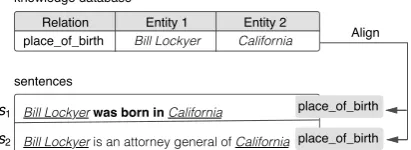
Relation Classification (RC) is a fundamental task in natural language processing (NLP) and is par-ticularly important for knowledge base construc-tion. The goal of RC (Zelenko et al.,2003) is to identify the relation type of a given entity pair in a sentence. Generally, a relation should be ex-plicitly expressed by some clue words. See the first sentence in Figure1. The phrase “was born in” explains the relation type “place of birth” for “Bill Lockyer” and “California”. Such indicating words is calledpatterns(Hearst,1992;Hamon and Nazarenko,2001).
knowledge database
sentences Relation
place_of_birth Bill Lockyer California
Entity 1 Entity 2
Bill Lockyer was born inCalifornia
Bill Lockyer is an attorney general of California
[image:1.595.315.521.228.303.2]place_of_birth place_of_birth Align
Figure 1: Two relation instances generated by distant supervision. The bold words “was born in” ins1is the pattern that explains the relation type “place of birth”. Hence, this instance is correctly labeled. However, the second instance is noisy due to the lack of correspond-ing relation pattern.
Before
Enity1 Entity 1 Between Entity 2 Entity 2After
0.0 0.1 0.2 0.3 0.4 0.5 0.6
A
ve
ra
ge
A
tt
en
ti
on
Figure 2: Average attention weights of BiLSTM+ATT model across five parts in the sentences on our test set. This model is trained using noisy data generated by dis-tant supervision. It mainly pays attention to the input entity pair and ignores other words which might ex-press the real relation. It also happens in Figure 1. This result comes from the fact that DS method only depends on entities for labeling data.
In order to cheaply obtain a large amount of la-beled RC training data, Distant Supervision (DS) (Mintz et al., 2009) was proposed to automati-cally generate training data by aligning a knowl-edge base with an unlabeled corpus. It is built on a weak assumption that if an entity pair have a re-lationship in a knowledge base, all sentences that contain this pair will express the corresponding re-lation.
[image:1.595.318.503.410.485.2]performance of an RC model. There may be no explicit relation pattern for identifying the rela-tion. See the second sentence in Figure1 for ex-ample. Mintz et al.(2009) reports that distant su-pervision may lead to more than 30% noisy in-stances. On the other hand, based on these noisy data, attention-based neural models often only at-tend to entity words but fail to atat-tend to patterns (See Figure2).
There are mainly three kinds of methods for dealing with such noise problem. First, multi-instance learning (Riedel et al., 2010; Lin et al.,
2016; Surdeanu et al., 2012; Zeng et al., 2015) relaxes the DS assumption as at-least-one. In a bag of sentences that mention the same entity pair, it assumes that at least one sentence expresses the relation. Multi-instance learning carries out classification on bag-level and often fails to per-form well on sentence-level prediction (Feng et al.,
2018b). Secondly, in order to reduce noise for sentence-level prediction, researchers then resort to reinforcement learning or adversarial training to select trustable data (Feng et al., 2018b; Qin et al., 2018a;Han et al., 2018; Xiangrong et al.,
2018; Qin et al., 2018b). This line of research selects confident relation labels by matching the predicted label of the learned model with DS-generated label. As the model is also learned from DS data, it might still fail when model predictions and DS-generated labels are both wrong. The third method relies on relation patterns. Pattern-based extraction is widely used in information extrac-tion (Hearst,1992;Hamon and Nazarenko,2001). Among them, the generative model (Takamatsu et al., 2012) directly models the labeling process of DS and finds noisy patterns that mistakenly la-bel a relation. Data programming (Ratner et al.,
2016,2017) fuses DS-based labels and manual re-lation patterns for reducing noise.
In this paper, we propose ARNOR, a novel at-tention regularization based framework for noise reduction. ARNOR aims to train a neural model which is able to clearly explain the relation pat-terns through Attention Regularization (AR), and at the same time reduce noise based on an as-sumption: the clearer the model explain the re-lation in an instance, the more trustable this in-stance is. Specifically, our ARNOR framework it-eratively learns the interpretable model and selects trustable instances. We first use attention regu-larization on the neural model to focus on
rela-tion patterns (Secrela-tion 3.4 will introduce the pat-terns construction). Then, if the learned model can dicover patterns for candidate instances, we will select these candidates as correct labeled data for further training step. These two steps are mutually reinforced. The more interpretable the model is, the better training data is selected, and vice versa. In addition, most previous DS-based RC models are evaluated approximately on the test set which is split from the training set and thus is also full of noisy data. We argue that this might not be the best choice. Instead, we use a recently released sentence-level test set (Ren et al.,2017) for evalu-ation. However, there also exist several problems in this test set (see Sec. 4.1). We come up with a revised version that is larger and more precise.
Overall, the contribution is as follows:
1. We propose a novel attention regularization method for reducing the noise in DS. Our method forces the model to clearly explain the relation patterns in terms of attention, and selects trustable instances if they can be ex-plained by the model.
2. Our ARNOR framework achieves significant improvement over state-of-the-art noise re-duction methods, in terms of both RC perfor-mance and noise reduction effect.
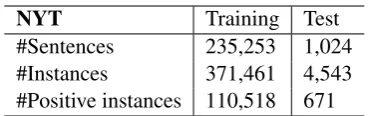
3. We publish a better manually labeled sentence-level test set1for evaluating the per-formance of RC models. This test set con-tains 1,024 sentences and 4,543 entity pairs, and is carefully annotated to ensure accuracy.
2 Related Work
We deal with DS-based RC in this paper. For RC task, various models are recently proposed based on different neural architectures, such as convolu-tional neural networks (Zeng et al., 2014, 2015) and recurrent neural network (Zhang et al.,2015;
Zhou et al.,2016). To automatically obtain a large training dataset, DS has been proposed (Mintz et al.,2009). However, DS also introduces noisy data, making DS-based RC more challenging.
Previous studies make attempts on kinds of methods to solve the noise problem. The first widely studied method is based on multi-instance
1The dataset used in this paper is on https:
Embeddings BiLSTM Attention
Relation Output
FC
Bi
ll
b
o
rn in
C
lif
o
rn
ia
w
a
s
L
o
ckye
r .
Target Attention
Target Attention
Dataset Pattern Set
Epoch k-1
Epoch k Dataset
Pattern Set
Confident
New Confident New
Confident
Confident Unconfident
Training
Attention Regularization
Attention Based Confidence Calculation
[image:3.595.87.510.64.246.2]Instances Selecting
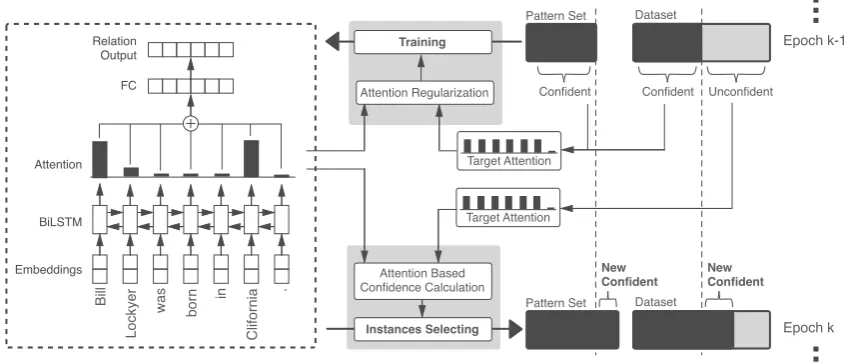
Figure 3: An overview of our ARNOR framework. It is based on a BiLSTM with attention mechanism and utilizes attention regularization to force the model to attend the corresponding relation patterns. Then, an instance selector calculates a confidence score for each training instance to generate a new redistributed training set and a new trustable pattern set. These two steps are run iteratively to form a bootstrap learning procedure.
learning (Riedel et al.,2010;Lin et al.,2016; Sur-deanu et al., 2012;Zeng et al., 2015). However, it models noise problem on a bag of instances and is not suitable for sentence-level prediction. The second kind of approach utilizes RL (Feng et al., 2018b;Xiangrong et al., 2018; Qin et al.,
2018b) or adversarial training (Qin et al., 2018a;
Han et al.,2018) to select trustable instances. The third research line relies on patterns (Hearst,1992;
Hamon and Nazarenko, 2001). Takamatsu et al.
(2012) directly models the labeling process of DS to find noisy patterns. Ratner et al. (2016,2017) proposes to fuse DS-based labels and manual re-lation patterns for reducing noise. Feng et al.
(2018a) presents a pattern extractor based on RL and uses extracted patterns as features for RC.
3 The ARNOR Framework
In this paper, we reduce DS noise and make the model more interpretable according to the obser-vation that a relation should be expressed by its sentence context. Generally, RC classifier should rely on relation patterns to decide the relation type for a pair of entities. Thus, for a training instance, if such an interpretable model cannot attend to the pattern that expresses the relation type, it is possi-ble that this instance is a noise.
Our ARNOR Framework consists of two parts: attention regularization training and instance se-lection. First, we hope the model is capable of locating relation patterns. Thus, attention regu-larization is applied to guide the training of the
model, forcing it to pay attention to given pat-tern words. Then, we select instances by check-ing whether the model can give a clear explanation for the relation label generated by DS. These two steps will be repeated in a bootstrap procedure. We illustrate our method in Figure3.
3.1 Attention-based BiLSTM Encoder
In order to capture the key feature words for iden-tifying relations, we apply an attention mechanism over a BiLSTM Encoder, which is first introduced in (Zhou et al.,2016) for RC. The model architec-ture is illustrated on the left side of Figure3.
Input Embeddings. The input embeddings con-sist of three parts: word embedding, position bedding, and entity type embedding. Position em-bedding is first proposed by Zeng et al. (2014) to incorporate position information of input entity pair and has been widely used in the following RC models. We also introduce entity type information by looking up an entity type embedding matrix. The final input embeddings are a concatenation of these embeddings, and are fed to a bidirectional Long Short Term Memory (BiLSTM) with an at-tention mechanism to generate sentence represen-tation.
Attention-based BiLSTM.LetH={hi}denotes
these vectors,
M= tanh(H)
a=softmax(wTM)
u=HaT
(1)
where wT is a trained parameter vector. It is demonstrated that attention mechanism is helpful in capturing important features for classification tasks. However, for noisy data generated by dis-tant supervision, it almost only focuses on enti-ties, but neglects relation patterns which are more informative for RC.
3.2 Training with Attention Regularization
Attention Regularization (AR) aims to teach the model to attend to the relation patterns for iden-tifying relations. Given a T-word sentence s =
{xi}Ti=1, a pair of entities (e1, e2) in the s, a
re-lation label y, and a relation patterns m that ex-plains the relation y of e1 and e2. (Section 3.4
will introduce the construction of relation patterns
m). We are able to calculate an attention guid-ance valueam, according to pattern mention sig-nificance functionq(z|s, e1, e2, m)conditional on
the inputm. Herez represents the pattern words in a sentence. We hope that the classifier can ap-proximate its attention distribution as = p(z|s)
toam, where p represents the classifier network. Intuitively, we apply KL (Kullback–Leibler diver-gence) as the optimized function, which describes the differences between distributions:
KL(am||as) =Xamloga
m
as (2)
What is more, the Equation 2 can be further re-duced as following:
lossa=
X
amloga
m
as
=X(amlogam−amlogas)
(3)
wherelossa represents the loss of attention
regu-larization. Becauseam contains fixed values, the equation is equal to
lossa=−
X
amlogas (4)
Therefore, we adaptlossainto classification loss
lossc to regularize attention learning. The final
lossis
loss=lossc+βlossa (5)
whereβ is a weight forlossa, which is generally
set as 1 in our experiments.
In this paper, we implement a fairly simple function to generateam.
bi =
(
1 xi ∈ {e1, e2, m}
0 else
am =
( bk
PT
i=1bi
)T
k=1
(6)
Hereb denotes that whether xi belongs to entity
words and relation pattern words.
3.3 Instance Selection with Attention from Model
Based on attention mechanism, a trained RC model can tells us the importance of each word for identifying the relation type. For a training in-stance, if the relation pattern words that the model focuses on do not match the patternm which ex-plains the relation type, this instance is probably a false positive. Here we still apply KL to measure the probability that an instance is a false positive. Given the attention weightsasfrom the RC model andam calculated by Equation 6, the confidence scorecof an instance is normalized by
c= 1
1 +KL(am||as) (7)
The highercis, the more confident an instance is. We calculate the confidence score for all instances in the training set and select instances whose score is more than a thresholdct, which is a
hyperparam-eter.
3.4 Bootstrap Learning Procedure
In our ARNOR framework, an important problem is how to acquire relation patterns m in model training and instance selecting step. In the model training step, we need more precise patterns in or-der to guide the model to attend to important evi-dence for RC. While in the instance selection step, more various patterns are required so as to select more trustable data as well as to discover more confident relation patterns. Here we will simply define the process of the bootstrap learning steps. In model training, given 1) a pattern extractorE
Algorithm 1The ARNOR Framework
Require: DS dataset D, a relation classifier C
with parametersθθθ
1: Collect high frequency patterns from D into
M
2: RedistributeDbyM
3: loop
4: Train classifierCwithDandM
5: Update parameters θθθ by Attention Regu-larization
6: Get confident scorecbyCforD 7: UpdateMby high scorecfromD
8: RedistributeDby newM 9: end loop
we redistribute training datasetDbased onM (de-scribed below). Then, the RC model is trained for epochs only usingm inM. Next, instance selec-tion is run onDto select more confident training data. These new trustable instances are fed toE
to figure out new trustable patterns and put them intoM. We repeat such a bootstrap procedure un-til the F1 score on dev set does not increase. This bootstrap procedure is detailed in Algorithm1.
Relation Pattern Extraction. Another problem is how to build a relation pattern extractor E to ex-tract a pattern from an instance. However, we find it is not quite critical. Even though we use a very simple method, we still achieve considerable im-provement. It is certain that a more complicated and well-performed extractor will bring additional improvement. This will be one of our future work. Our pattern extractorEsimply takes the words be-tween two entities as a relation pattern. For the building of the initial pattern setM, we extract re-lation patterns from all instances in original train-ing dataset and count them up. Mis initially built by selecting patterns with occurrences. We retain top 10% (maximum 20) patterns for each relation type.
Data Redistribution. After the trustable pattern setMis built, datasetD will be redistributed us-ing these patterns. All positive instances that are not matched these patterns will be put into the neg-ative set, revising their relation label to ‘None’. We will explain the reason for data redistributing in our experiment section.
NYT Training Test
#Sentences 235,253 1,024
#Instances 371,461 4,543
[image:5.595.324.510.60.118.2]#Positive instances 110,518 671
Table 1: Statistics of the dataset in our experiments.
NYT Training Test
#/location/location/contains 60,215 317
#/people/person/nationality 8,349 66
#/location/country/capital 7,959 13
#/people/person/place lived 7,438 148
#/business/person/company 5,788 84
#/location/nei.../neighborhood of 5,737 1
#/people/person/place of birth 3,279 14
#/people/person/place of death 2,002 9
#/business/company/founders 827 11
[image:5.595.315.519.151.265.2]#/people/person/children 523 8
Table 2: The 10 relation types we retain and statistics of them in the dataset. The distribution of some relation types are distinct in test set because they are much more noisy.
4 Experiments
4.1 Dataset and Evaluation
We evaluate the proposed ARNOR framework on a widely-used public dataset: NYT, which is a news corpus sampled from 294k 1989-2007 New York Times news articles and is first presented in (Riedel et al., 2010). Most previous work com-monly generates training instances by aligning en-tity pairs from Freebase and adopt held-out evalua-tion to evaluate without costly human annotaevalua-tion. Such an evaluation can only provide an approxi-mate measure due to the noisy test set that is also generated by distant supervision. In contrast,Ren et al.(2017) publishes a training set which is also generated by distant supervision, but a manually-annotated test set that contains 395 sentences from
Hoffmann et al.(2011). However, we find that this test set was annotated with only one entity pair for one sentence. Not all of the triplets in these sentences are marked out. In addition, although there are enough test instances (3,880 including “None” type), the number of positive ones is rela-tively small (only 396). Moreover, the test set only contains half of the relation types of the training set.
con-Method Dev Test
Prec. Rec. F1 Prec. Rec. F1
CNN (Zeng et al.,2014) 38.32 65.22 48.28 35.75 64.54 46.01
PCNN (Zeng et al.,2015) 36.09 63.66 46.07 36.06 64.86 46.35
BiLSTM 36.71 66.46 47.29 35.52 67.41 46.53
BiLSTM+ATT 37.59 64.91 47.61 34.93 65.18 45.48
PCNN+SelATT (Lin et al.,2016) 46.01 30.43 36.64 45.41 30.03 36.15 CNN+RL1 (Qin et al.,2018b) 37.71 52.66 43.95 39.41 61.61 48.07
CNN+RL2 (Feng et al.,2018b) 40.00 59.17 47.73 40.23 63.78 49.34
[image:6.595.111.488.61.200.2]ARNOR (Ours) 62.45 58.51 60.36 65.23 56.79 60.90
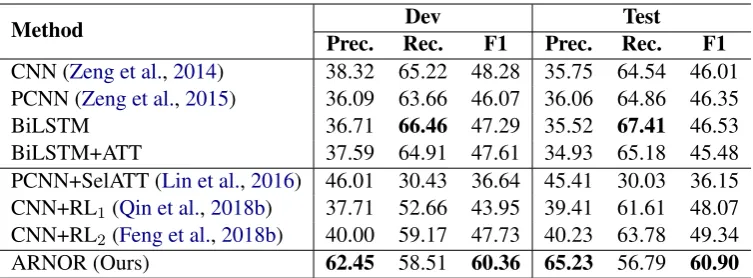
Table 3: Comparison of our method and other baselines. The first three methods are normal RC model, and the middle three baselines are models for distant supervision RC.
tains annotated named entity types. Firstly, we re-vise mislabeled instances on the original 395 test-ing sentences. Then, about 600 sentences are sam-pled and removed from the original training set. We carefully check their labels and merge them into the test set. We also remove some of the re-lation types which are overlapping and ambiguous or are too noisy to obtain a non-noise test sample. The details of this dataset and the relation types we used is shown in Table1and Table2.
For evaluation, we evaluate our framework on sentence-level (or instance-level). Sentence-level prediction is more friendly with comprehend sen-tence tasks, like question answering and seman-tic parsing (Feng et al., 2018b). Different from commonly-used bag-level evaluation, a sentence-level evaluation compute Precision (Prec.), Recall (Rec.) and F1 metric directly on all of the indi-vidual instances in the dataset. We think such an evaluation is more intuitive and suitable for a real-world application.
4.2 Baselines
We compare our ARNOR framework with several strong baselines for noise reduction as follows:
PCNN+SelATT (Lin et al., 2016) is a bag-level RC model. It adopts an attention mechanism over all sentences in a bag and thus can reduce the weight of noise data.
CNN+RL2 (Feng et al., 2018b) is a novel
rein-forcement learning (RL) based model for RC from noisy data. It jointly trains a CNN model for RC as well as an instance selector to remove unconfident samples.
CNN+RL1(Qin et al.,2018b) also introduces RL
to heuristically recognize false positive instances. Different from Feng et al. (2018b), they
redis-tribute false positives into negative samples in-stead of removing them.
Meanwhile, to demonstrate the effectiveness of RC after denoising, several non-denoising meth-ods are also used for comparison.
CNN(Zeng et al.,2014) is a widely-used architec-ture for RE. It introduces position embeddings to represent the location of an input entity pair.
PCNN (Zeng et al., 2015) is a revision of CNN which uses piecewise max-pooling to extract more relation features.
BiLSTM (Zhang et al., 2015) is also commonly used for RE with the help of position embeddings.
BiLSTM+ATT(Zhou et al.,2016) adds an atten-tion mechanism into BiLSTM to capture the most important features for identifying relations. It is the base model used in our ARNOR framework.
4.3 Implementation Details
Model Prec. Rec. F1
BiLSTM+ATT 34.93 65.18 45.48
+ IDR 70.95 40.57 51.63
+ ART 68.70 50.99 58.52
[image:7.595.315.515.62.105.2]+ BLP 65.23 56.79 60.90
Table 4: Evaluation of components in our framework. BiLSTM+ATT is the base model without reducing noise. IDR stands for initial data redistributing using initial confident pattern set. ART denotes attention reg-ularization training for the first loop. BLP stands for bootstrap learning procedure.
Model Prec. Rec. F1
CNN 35.75 64.54 46.01
CNN+RL2 40.23 63.78 49.34
CNN+IDR 84.87 39.94 54.32
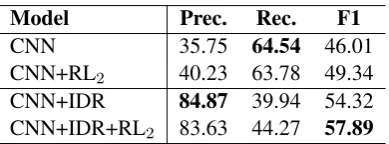
CNN+IDR+RL2 83.63 44.27 57.89
Table 5: Results of CNN+RL2 (Feng et al., 2018b) starts with a pre-trained CNN model using initial data redistributing (IDR). CNN+IDR is the model trained on initially redistributed data and CNN+IDR+RL2applies RL2on pre-trained CNN+IDR model.
in 5 loops. For CNN-based baselines, we use the same embedding settings. The window size of the convolution layer is set to 3 and the number of the filter is set to 230. All the baselines for noise re-duction were implemented with the source codes released by their authors.
4.4 Main Results
We compare the results of ARNOR with non-denoising baselines and non-denoising baselines. As shown in Table 3, ARNOR significantly outper-forms all of the baselines in both precision and F1 metric, obtaining about 11% F1 improvement over the state-of-the-art CNN+RL2. Note that
our model achieves a tremendous improvement on precision without too much decline of recall. This demonstrates the proposed framework can ef-fectively reduce the impact of noisy data. Be-sides, PCNN+SelATT performs the worst among all of the baselines. We think that it is because PCNN+SelATT is a bag-level method and is not suitable for sentence-level evaluation, which is consistent withFeng et al.(2018b).
Noise Reduction Prec. Rec. F1
CNN+RL2 40.58 96.31 57.10
[image:7.595.87.276.62.132.2]ARNOR 76.37 68.13 72.02
Table 6: Comparison of effectiveness on noise reduc-tion. We randomly sample 200 sentences (529 in-stances) from the training set. After manually check-ing, 213 of them are not noise. We use these samples to evaluate the capability of reducing noise.
5 Analysis and Discussion
5.1 Effects of components
In order to find which component contributes to our framework, we evaluate our model by adding each of the components. The results are shown in Table 4. BiLSTM+ATT is the baseline model that is trained by original noisy data. After us-ing the initial redistributed dataset, which is gen-erated by the method described in the above sec-tion, the BiLSTM+ATT model achieves about 6% improvement in F1. And the precision sharply in-creases by about 26%. This demonstrates that the DS dataset contains a large proportion of noise. Even such a simple filtering noise method can ef-fectively improve model performance. However, this simple method seriously affects recall. On the one hand, amounts of true positives with long-tail patterns will be mistakenly regarded as false neg-atives. And we guess some relation patterns in training data are too rare to make the model learn to attend them. Therefore, after we add attention regularization to the model, the recall increases by about 10% with only 2% decline in precision. As a result, our model achieves another 7% F1 im-provement. We believe this is the power of guid-ing the model to understand which words are more crucial for identifying relations. After we obtain an initial model trained by attention regularization, we continue the bootstrap learning procedure and finally achieve 2.4% F1 improvement. In this pro-cedure, ARNOR will collect more confident long-tail patterns to improve the recall of the model.
5.2 Start with small clean or large noisy data
[image:7.595.85.280.238.310.2]Jim Kimsey , a founder of AOL ; Jack Valenti , former head …
0.36 0.19
Entity 1: AOL Entity 2: Jim Kimsey Relation: /business/company/founders
BiLSTM+ATT
Jim Kimsey , a founder of AOL ; Jack Valenti , former head …
0.12 0.13 0.14 0.12
ARNOR
… said Senomyx ’s chief executive , Kent Snyder .
0.30 0.03 0.31
… said Senomyx ’s chief executive , Kent Snyder .
0.15 0.15 0.13 0.13 0.11
[image:8.595.73.521.66.132.2]Entity 1: Kent Snyder Entity 2: Senomyx Relation: /business/person/company
Table 7: Here is attention cases with a heat map. These cases have shown our model’s ability to locating relation indicators. Based on attention supervision, our model can concentrate on relation patterns and entities.
High Frequency
Pattern
Long Tail
/people/person/children #Occ
7 e2 , the son of e1
4 e2 , daughter of e1
1 e1 's youngest son , e2
1 e2 , the son of Secretary General e1
1 e2 , a daughter of Representative e1
High Frequency
Pattern
Long Tail
/business/person/company #Occ
74 e2 secretary general , e1
68 e1 , the chairman of e2
67 e1 , chief executive of e2
4 e1 , the secretary general of the e2
3 e1 , the chief executive of the e2
3 e1 , the oil minister of e2
2 e1 , the former chief executive of e2
2 e1 , the vice chairman of e2
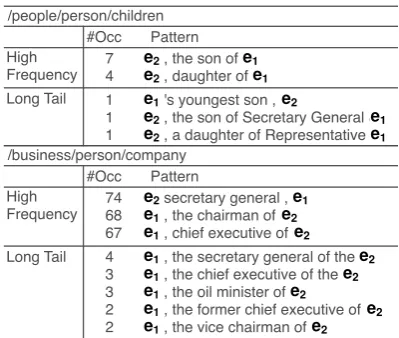
Table 8: Pattern set cases. This table has shown some high frequency and top long tail patterns discovered by our model in pattern bootstrap.
better choice? In order to figure it out, we use the same initial redistributed dataset to pre-train the CNN which is used in the CNN+RL2 and then
apply RL2 procedure for noise reduction on the
original noisy dataset. We report the results in Ta-ble5. The pre-trained PCNN also achieves a sig-nificant improvement, and after further denoising by RL2, CNN+RL2 finally obtain 57.89% in F1,
which is still 3% lower than the performance of our model. Therefore, we consider that starting the model with a small but clean dataset might be a choice for noise reduction.
5.3 Effects of Noise Reduction
The instance selector in our ARNOR framework calculates a confidence score for each instance in the training set by checking whether the attention weights matches a given pattern. Then we utilize this confidence score to reduce noise. In order to verify the capability of reducing noise, we ran-domly sample 200 sentences to annotate whether they are noise and use them to evaluate the accu-racy of noise reduction. We compare the results with CNN+RL2 in Table 6. The ARNOR
signif-icantly outperforms CNN+RL2 on percision and
obtains a 14.92% F1 improvement.
5.4 Case Study
Our ARNOR is able to make the RC model more interpretable through attention regulariza-tion training. To verify this point, we select some instances from the test set and visualize their atten-tion weights for a case study. As shown in Table7, BiLSTM+ATT which is trained on original noisy data only focuses on the entity pairs, and makes wrong predictions on these cases. This is probably because the model does not learn the key evidence for RC. While ARNOR can perfectly capture the important features and correctly predict the rela-tion.
In addition, we also check the confident pat-terns which are discovered in bootstrap learning. As presented in Table8, the high-frequency pat-terns can be easily obtained by initially build-ing of confident pattern set, and after bootstrap learning, we can discover more long-tail patterns, most of which are representative and meaningful. More importantly, some of these additional pat-terns are not similar in literal terms, demonstrat-ing the model might learn the semantic correlation among related feature words.
6 Conclusion
[image:8.595.80.280.187.356.2]significant improvements on both relation classifi-cation and noise reduction. In addition, we publish a better manually labeled test set for sentence-level evaluation.
In the future, we hope to improve our work by the utilization of better model-based pattern ex-tractor, and resorting to latent variable model (Kim et al.,2018) for jointly modeling instance selector. What is more, we also hope to verify the effective-ness of our method on more tasks, including open information extraction and event extraction, and also overlapping relation extraction models (Dai et al.,2019).
Acknowledgments
This work was supported by the Natural Science Foundation of China (No. 61533018).
References
Dai Dai, Xinyan Xiao, Yajuan Lyu, Qiaoqiao She, Shan Dou, and Haifeng Wang. 2019. Joint extraction of entities and overlapping relations using position-attentive sequence labeling. In Thirty-Third AAAI Conference on Artificial Intelligence (AAAI 2019), Honolulu, USA, January 27, 2019.
Jun Feng, Minlie Huang, Yijie Zhang, Yang Yang, and Xiaoyan Zhu. 2018a. Relation mention extrac-tion from noisy data with hierarchical reinforcement learning.arXiv preprint arXiv:1811.01237.
Jun Feng, Minlie Huang, Li Zhao, Yang Yang, and Xi-aoyan Zhu. 2018b. Reinforcement learning for rela-tion classificarela-tion from noisy data. InProceedings of AAAI.
Thierry Hamon and Adeline Nazarenko. 2001. Detec-tion of synonymy links between terms: experiment and results. Recent advances in computational ter-minology, 2:185–208.
Xu Han, Zhiyuan Liu, and Maosong Sun. 2018. De-noising distant supervision for relation extraction via instance-level adversarial training. arXiv preprint arXiv:1805.10959.
Marti A. Hearst. 1992. Automatic acquisition of hy-ponyms from large text corpora. InCOLING 1992 Volume 2: The 15th International Conference on Computational Linguistics.
Raphael Hoffmann, Congle Zhang, Xiao Ling, Luke Zettlemoyer, and Daniel S Weld. 2011. Knowledge-based weak supervision for information extraction of overlapping relations. InProceedings of the 49th Annual Meeting of the Association for Computa-tional Linguistics: Human Language Technologies-Volume 1, pages 541–550. Association for Compu-tational Linguistics.
Yoon Kim, Sam Wiseman, and Alexander M Rush. 2018. A tutorial on deep latent variable models of natural language. arXiv preprint arXiv:1812.06834.
Yankai Lin, Shiqi Shen, Zhiyuan Liu, Huanbo Luan, and Maosong Sun. 2016. Neural relation extraction with selective attention over instances. In Proceed-ings of the 54th Annual Meeting of the Association for Computational Linguistics (Volume 1: Long Pa-pers), volume 1, pages 2124–2133.
Mike Mintz, Steven Bills, Rion Snow, and Dan Juraf-sky. 2009. Distant supervision for relation extrac-tion without labeled data. In Proceedings of the Joint Conference of the 47th Annual Meeting of the ACL and the 4th International Joint Conference on Natural Language Processing of the AFNLP: Vol-ume 2-VolVol-ume 2, pages 1003–1011. Association for Computational Linguistics.
Pengda Qin, Weiran Xu, and William Yang Wang. 2018a. Dsgan: Generative adversarial training for distant supervision relation extraction. arXiv preprint arXiv:1805.09929.
Pengda Qin, Weiran Xu, and William Yang Wang. 2018b. Robust distant supervision relation extrac-tion via deep reinforcement learning. arXiv preprint arXiv:1805.09927.
Alexander Ratner, Stephen H Bach, Henry Ehrenberg, Jason Fries, Sen Wu, and Christopher R´e. 2017. Snorkel: Rapid training data creation with weak su-pervision. Proceedings of the VLDB Endowment, 11(3):269–282.
Alexander J Ratner, Christopher M De Sa, Sen Wu, Daniel Selsam, and Christopher R´e. 2016. Data pro-gramming: Creating large training sets, quickly. In
Advances in neural information processing systems, pages 3567–3575.
Xiang Ren, Zeqiu Wu, Wenqi He, Meng Qu, Clare R Voss, Heng Ji, Tarek F Abdelzaher, and Jiawei Han. 2017. Cotype: Joint extraction of typed entities and relations with knowledge bases. InProceedings of the 26th International Conference on World Wide Web, pages 1015–1024. International World Wide Web Conferences Steering Committee.
Sebastian Riedel, Limin Yao, and Andrew McCallum. 2010. Modeling relations and their mentions with-out labeled text. In Joint European Conference on Machine Learning and Knowledge Discovery in Databases, pages 148–163. Springer.
Shingo Takamatsu, Issei Sato, and Hiroshi Nakagawa. 2012. Reducing wrong labels in distant supervi-sion for relation extraction. In Proceedings of the 50th Annual Meeting of the Association for Compu-tational Linguistics: Long Papers-Volume 1, pages 721–729. Association for Computational Linguis-tics.
Zeng Xiangrong, Liu Kang, He Shizhu, Zhao Jun, et al. 2018. Large scaled relation extraction with rein-forcement learning.
Dmitry Zelenko, Chinatsu Aone, and Anthony Richardella. 2003. Kernel methods for relation ex-traction. Journal of machine learning research, 3(Feb):1083–1106.
Daojian Zeng, Kang Liu, Yubo Chen, and Jun Zhao. 2015. Distant supervision for relation extraction via piecewise convolutional neural networks. In Pro-ceedings of the 2015 Conference on Empirical Meth-ods in Natural Language Processing, pages 1753– 1762.
Daojian Zeng, Kang Liu, Siwei Lai, Guangyou Zhou, and Jun Zhao. 2014. Relation classification via con-volutional deep neural network. In Proceedings of COLING 2014, the 25th International Conference on Computational Linguistics: Technical Papers, pages 2335–2344.
Shu Zhang, Dequan Zheng, Xinchen Hu, and Ming Yang. 2015. Bidirectional long short-term memory networks for relation classification. InProceedings of the 29th Pacific Asia Conference on Language, Information and Computation, pages 73–78.