48
Analysing Representations of Memory Impairment in a Clinical Notes
Classification Model
Mark Ormerod, Jes ´us Mart´ınez del Rinc´on, Neil Robertson Bernadette McGuinness, Barry Devereux
Queen’s University Belfast
{mormerod01, j.martinez-del-rincon, n.robertson, b.mcguinness, b.devereux}@qub.ac.uk
Abstract
Despite recent advances in the application of deep neural networks to various kinds of med-ical data, extracting information from unstruc-tured textual sources remains a challenging task. The challenges of training and interpret-ing document classification models are ampli-fied when dealing with small and highly tech-nical datasets, as are common in the clitech-nical domain. Using a dataset of de-identified clini-cal letters gathered at a memory clinic, we con-struct several recurrent neural network mod-els for letter classification, and evaluate them on their ability to build meaningful represen-tations of the documents and predict patients’ diagnoses. Additionally, we probe sentence embedding models in order to build a human-interpretable representation of the neural net-work’s features, using a simple and intuitive technique based on perturbative approaches to sentence importance. In addition to showing which sentences in a document are most in-formative about the patient’s condition, this method reveals the types of sentences that lead the model to make incorrect diagnoses. Fur-thermore, we identify clusters of sentences in the embedding space that correlate strongly with importance scores for each clinical diag-nosis class.
1 Introduction
While the majority of clinical data is made up of structured information (Jee and Kim, 2013), which can often be readily integrated into data models for research, there is a significant amount of semi-structured and unstructured data which is increasingly being targeted by machine learn-ing practitioners for analysis. As a general rule, this unstructured data is more difficult to analyse due to an absence of a standardised data model (Ann Alexander and Wang, 2018). Unstructured clinical data includes a variety of media, such as video, audio, image and text-based data, with the majority of such data being made up of text
and images. Recently, there has been a series of breakthroughs in the application of machine learn-ing techniques for medical imaglearn-ing data in or-der to achieve expert-level performance on diag-nosis tasks (Rajpurkar et al.,2017). However, ma-chine learning models using semi-structured and unstructured textual data from the clinical domain have received less attention and to date have not seen the same degree of successful application. Examples of unstructured medical data featuring “free text” include discharge summaries, nursing reports and progress notes. Historically, one of the challenges of applying natural language pro-cessing (NLP) methods to clinical data has been the often limited amount of data available, which has traditionally necessitated a reliance on manual feature engineering and relatively shallow textual features (Shickel et al.,2018).
Taking a novel dataset of labelled clinical letters compiled at a memory clinic as the target data do-main, we build state-of-the-art deep learning mod-els for the task of clinical text classification, and evaluate them on their ability to predict a clin-ician’s diagnosis of the patient. However, deep learning models generally require very large train-ing datasets. Our approach to the problem there-fore incorporates transfer learning, and we make use of embedding data from pre-trained models trained on large corpora. In order to investigate the relative usefulness of word-level and sentence-level information, we train and evaluate several models, including a ULMFiT model (Howard and Ruder, 2018) and two long short-term mem-ory (LSTM) (Hochreiter and Schmidhuber,1997) models: one trained on word embedding repre-sentations of the documents and one trained on sentence embedding representations (Basile et al., 2012).
being uninterpretable to humans. To shed light on how a recurrent neural network models clini-cal documents in order to correctly predict a pa-tient’s diagnosis, we investigate two complemen-tary approaches to model interpretation. Firstly, we develop a simple measure of sentence impor-tance and demonstrate its effectiveness in inter-preting a complex LSTM model’s decision mak-ing process. Secondly, we discover clusters in the high-dimensional space of the sentence embed-ding model and test their correlation with feature importance scores for a given diagnosis class. This analysis yields insights into a model’s representa-tion of the clinical notes, allowing us to automat-ically extract clusters of sentences that are most relevant to the model’s predictions.
2 Related Work
Document classification is a well-researched task in NLP that has been tackled using a wide vari-ety of machine learning models, such as support-vector machines (SVMs) (Manevitz and Yousef, 2001), convolutional neural networks (CNNs) (Conneau et al., 2016) and recurrent neural net-works (RNNs) (Yogatama et al., 2017). In the clinical domain, document classification models have been used in diverse tasks such as predicting cancer stage information in clinical records (Yim et al.,2017), extracting patient smoker-status from health records (Wang et al.,2019) and classifying radiology reports by their ICD-9CM code (Garla and Brandt, 2013). The problem of categorising clinical free text documents is closely related to several subtasks in the area of Electronic Health Record (EHR) analysis, including information ex-traction and representation learning. Information extraction is an umbrella term that covers diverse subtasks such as expanding abbreviations using contextual information, and the automatic anno-tation of temporal events (e.g. mapping from in-puts such as “The patient was given stress dose steroids prior to his surgery” to output “[stress dose steroids] BEFORE [his surgery]” (Sun et al., 2013). Other NLP problems in this field that are relevant to free text analysis are outcome predic-tion and de-identificapredic-tion.
There are many ways to construct a represen-tation of the input data that can be provided to a document classification model. A popular al-ternative to older approaches to text representa-tions, such as bag-of-words (BoW), is to
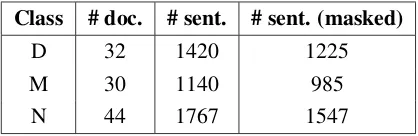
em-Class # doc. # sent. # sent. (masked)
D 32 1420 1225
M 30 1140 985
[image:2.595.312.521.62.130.2]N 44 1767 1547
Table 1: Number of documents and sentences in the clinical notes dataset. D: Dementia,M: MCI,N: Non-impaired.
bed the input tokens in a high-dimensional vec-tor space, resulting in each word being mapped to a list of real-valued numbers (a “word embed-ding”). One simple method of extracting word em-beddings involves concatenating the hidden layer activations observed in a trained language model after processing all words up to the target word. As language models automatically learn rich se-mantic and syntactic features of words, these em-beddings can provide valuable input features for downstream information extraction tasks. While the dimensions in the embedding space can cor-respond to interpretable features, this is not gen-erally the case. However, a major motivation for using word embeddings is the ability to re-use pre-trained embeddings, essentially resulting in a form of transfer learning (Pan et al.,2010). In this study we use 300-dimensional fastText word embed-dings (Bojanowski et al., 2017) which were pre-trained on the Common Crawl dataset using the skipgram schema (Mikolov et al.,2013), which in-volves predicting a target word based on nearby words.
Similar to word embeddings, sentence embed-dings are high-dimensional vectors that can rep-resent features of a sequence of words. Our use of sentence embeddings is motivated by the fact that, for small amounts of data, it may be more difficult for a recurrent neural network to capture diagnosis-relevant dependencies over many word vectors than it is to classify a document made up of a smaller number of semantically richer sentence vectors. In this study we use 4096-dimensional InferSent embeddings (Conneau et al.,2017) that were extracted from a model pre-trained on the Common Crawl dataset.
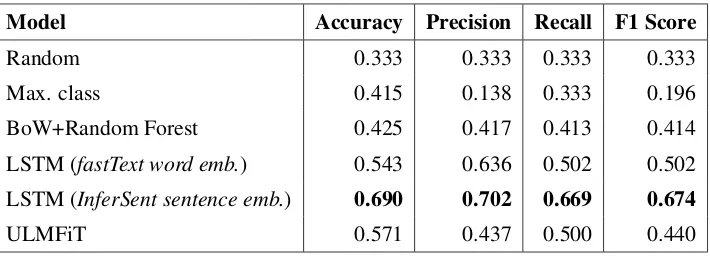
Model Accuracy Precision Recall F1 Score
Random 0.333 0.333 0.333 0.333
Max. class 0.415 0.138 0.333 0.196
BoW+Random Forest 0.425 0.417 0.413 0.414
LSTM (fastText word emb.) 0.543 0.636 0.502 0.502
LSTM (InferSent sentence emb.) 0.690 0.702 0.669 0.674
[image:3.595.123.478.61.190.2]ULMFiT 0.571 0.437 0.500 0.440
Table 2: Results (average over 5 folds) for the diagnosis classification task for the masked dataset. Precision, recall and F1 score are macro-averaged across the classes.
3 Data
We collected a corpus of consultation reports com-piled by clinicians at a memory clinic to use as the data domain for the document classification task. Each report is anonymised and describes the clin-ican’s review of a patient who suffers from mem-ory or cognitive issues. Each report is labelled by one of three classes, corresponding to the di-agnoses of dementia, mild cognitive impairment (MCI)andnon-impaired. The documents can be considered semi-structured, as they are made up of free-text details that follow a loose narrative trajectory. The notes typically begin with a de-scription of the patient’s history and symptoms, and ultimately conclude with recommendations on how to proceed which may include scheduling a follow-up appointment, arranging further tests, or organising a treatment course based on the avail-able evidence.
From this corpus, we build a version of the notes in which explicit diagnostic information is masked out. For example, the sentence“We would recom-mend commencing on a Rivastigmine patch 4.6 mg for 24 hours and then to be increased to 9.5 mg for 24 hours once daily if tolerated.”would not be included in the masked diagnosis dataset, as the drug Rivastigmine is used to treat mild to mod-erate Alzheimer’s disease and Parkinson’s, and so its mention here trivially identifies the diagnosis. In this work, we are interested in the ability to make predictions from more subtle diagnostic sig-nals, requiring our model to build semantic repre-sentations of cognitive impairment that go beyond counting the occurrence of single words. Table1 presents summary metrics of the datasets.
Deep learning models are generally trained and
tested on very large datasets, in contrast to the small corpus of demential letters that we have gathered, and in contrast to clinical note databases generally. This motivates our use of transfer learn-ing.
Tackling the problems of training and interpret-ing models trained on datasets of this scale is di-rectly relevant to the real world challenges of us-ing natural language processus-ing to support clin-ical decisions, such as identifying patients who may be applicable to participate in a clinical trial (Sarmiento and Dernoncourt, 2016). Annotating gold-standard training examples for such prob-lems is resource intensive (Savkov et al., 2016). We would therefore like to build robust and gen-eral models given a small amount of samples. Re-cent work on training large language models on massive amounts of data thus has much poten-tial for zero-shot classification of natural language documents (Yogatama et al.,2017).
4 Models and Evaluation
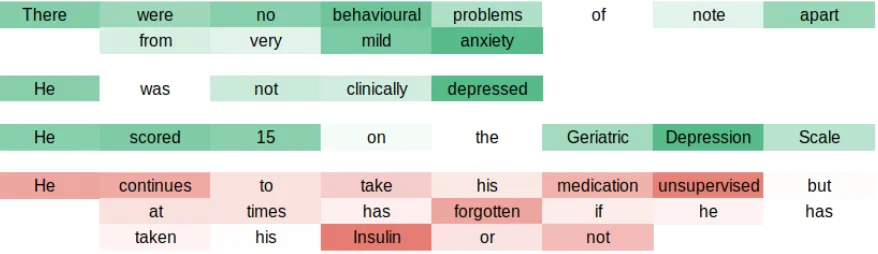
Figure 1: Visualisation of sentence importance with respect to the successful classification ofnon-impairedfor a subset of a document. Sentences that were found to be important for the classification ofnon-impairedare coloured green while a sentence that increases the chance of a misclassification (i.e. an incorrectMCIdiagnosis) is coloured red. The saturation of the colours corresponds to how much a given word contributes to a sentence’s InferSent embedding
the dataset, ensuring that the class distribution is equal across all folds. The ULMFiT model is pre-trained on the Wikitext-103 dataset (Merity et al., 2017) and fine-tuned using default hyperparam-eters (fine-tuning epochs=25, fine-tuning batch size=8, fine-tuning learning rate=0.004, train-ing epochs=50, traintrain-ing batch size=32, traintrain-ing learning rate=0.01) which have been shown to be robust across various tasks (Howard and Ruder, 2018). The LSTM model’s hyperparameters were chosen by a grid-search. Both the sentence em-bedding LSTM and the word emem-bedding LSTM were made up of one hidden layer with 256 hid-den units.
The classification results for the models for the masked dataset are presented in Table 2. Each of our three models perform significantly better than chance and better than the random forest baseline model, with the LSTM model trained with sentence-embedding sequential input achiev-ing the best performance. For this amount of training data, we would expect models that are trained on shorter sequences of more semantically enriched pre-trained vectors (i.e. sentence em-beddings) to perform better than much longer se-quences of vectors with less dimensions (i.e. word embeddings). This is because much of the work of combining word-level tokens into a contextual representation that is relevant to a statistical model of human language has already been done when training with pretrained representations extracted at the sentence-level. Somewhat surprisingly, the model trained on sentence embeddings outper-formed the fine-tuned ULMFiT. Future work may shed light on how the amount of training samples
can affect the choice of whether to use fine-tuning or pre-trained embedding representations as model input.
5 Model Interpretability: Calculating Sentence Importance Scores
After demonstrating the effectiveness of using pre-trained sentence embeddings to classify the clinical documents, we investigated model inter-pretability by calculating a measure of the impor-tance of each sentence in the sequence of sen-tences to the model’s prediction for a document. We propose a measure of feature importance based on perturbative approaches to variable importance (Breiman, 2001), which estimate the importance of variables by iteratively randomly perturbing each variable and observing the change in loss. This technique is similar to measuring informa-tion gain (Quinlan,1986), but rather than selecting important components of fixed input, we rate the importance of a sentence vector in the sequence of sentence vectors presented to our sequential LSTM classifier. For example, in order to gener-ate the importance score for the first sentence in a document made up ofmsentence embeddings, we construct an augmented version of the document containing all but the first sentence, and examine the resulting change in the prediction for that doc-ument. More formally, for sentencen, we gener-ate the following version of the documentd(with ground truth labelc) with sentencenremoved:
dn= [s0, s1, . . . , sn−1, sn+1, . . . , sm−1]
Ratio Sentence
-3.469 “He and his wife both report agitation disinhibition and irritability” 0.078 “He would say that he feels depressed at times”
0.149 “She was tremulous which<NAME>felt was most likely due to anxiety”
. . .
[image:5.595.108.490.60.195.2]2.108 “He had an equivalent score of 19 / 30 on the MMSE” 8.105 “He had an equivalent score of 29 / 30 on the MMSE” 12.887 “He had an equivalent score of 22 / 30 on the MMSE”
Table 3: Sentences sorted by feature importance for a correct diagnosis of non-impaired. Sentences with low scores do not support a prediction ofnon-impairedwithin the context of the corresponding clinical letter.
from Section 3, which achieved an accuracy of 73%) and we measure the network’s output logit for the correct class. The importance score is cal-culated as the ratio of the model’s output for the correct class excluding the sentence to the model’s output for the correct class including a given sen-tence.
ration=
logit(c|dn) logit(c|d)
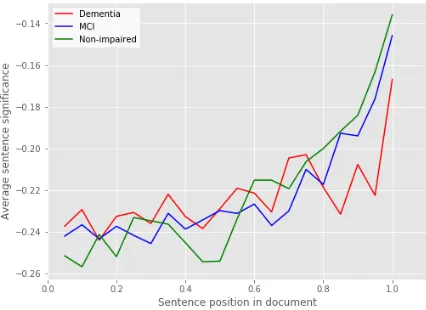
The most important sentences minimise this ra-tio. When the ratio is over 1, the inclusion of the sentence in the document leads to a smaller probability of selecting the correct class, and so sentences that maximise the ratio are the most misleading sentences with respect to the correct classification. Examples of highly important and highly misleading sentences across the corpus for a diagnosis ofnon-impaired are presented in Ta-ble3. The average sentence importance trajectory over each class was also investigated and is pre-sented in in Figure2.
Figure 1 presents a section of a clinical letter for a patient with a diagnosis of non-impaired, with sentences coloured green or red depending on whether they increase or decrease the chance of correctly classifying the document. Within each sentence, the contribution of a word to the InferSent sentence embedding is visualised by colour saturation. We can see that the importance measure provides intuitive insights into how the recurrent neural network models the document. For example, the final sentence in Figure 1 de-creases the chance of classifying the document asnon-impaired because it states that the patient sometimes forgets to take their medicine – in iso-lation this sentence could naively be considered to imply a diagnosis of memory impairment, but as the model processes the full document it is able to
Figure 2: Average sentence importance over each class, as a function of sentences’ position in the texts. Sen-tence importance ratios are normalised within each document and split by in-document position into 20 bins. For each class, we plot the negative of the av-erage for each bin.
accumulate evidence and predict the correct diag-nosis. By examining the contribution of each word to the InferSent vectors, we can see that negat-ing words such as “not” are handled appropriately within the sentence embedding (e.g. “not clini-cally depressed” increases the probability of a cor-rectnon-impaired classification). Our model in-terpretation technique therefore demonstrates how the LSTM sentence embedding model improves on the simple bag-of-words baseline, where the word “depressed” would be incorrectly taken as negative evidence for a non-impaired diagnosis.
6 Cluster Analysis
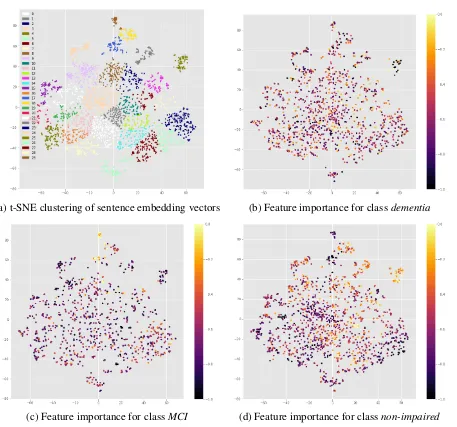
[image:5.595.304.517.252.407.2](a) t-SNE clustering of sentence embedding vectors (b) Feature importance for classdementia
[image:6.595.69.526.57.484.2](c) Feature importance for classMCI (d) Feature importance for classnon-impaired
Figure 3: 2-dimensional projection of sentence embedding vectors. (a): 30 clusters were identified and labelled using mean shift clustering. (b) - (d): Heat maps of sentence vectors coloured by sentence importance for each class reveal clusters of sentences that are relevant to a given diagnosis. Colour scales indicate normalised values; brighter colours indicate more important sentences.
to two dimensions using t-SNE (van der Maaten and Hinton,2008). We used the mean shift clus-tering technique (Yizong Cheng, 1995), an algo-rithm that does not require the number of clusters to be specified in advance, to discover clusters of similarly represented sentences in this space (Fig. 3(a)). Sentences that are important for the model’s classification of a specific diagnosis are visualised by colouring the sentences using the correspond-ing importance score. This step was performed for each of the three classes (Fig.3(b)-(d)).
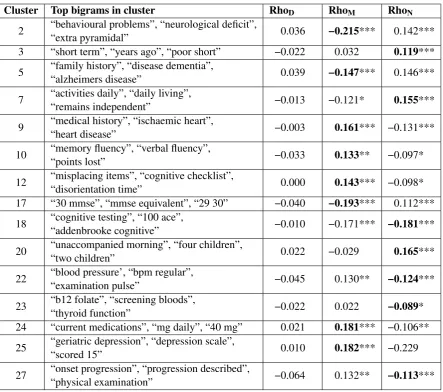
Correlation tests were used to investigate the re-lationship between sentence clusters and their im-portance to a model’s prediction for each class.
in the model’s decision making.
To assist in interpreting the information cap-tured by each cluster, we depict the clusters using the most frequent bigrams across all of that clus-ter’s sentences (Table4). For example, one cluster (corresponding to cluster 20 in Figure 3(a)) con-tains sentences that mention the individual’s fam-ily (significantly positively associated with a non-impaireddiagnosis), while cluster 22 corresponds to sentences about the patient’s blood pressure and heart rate (significantly negatively associated with a non-impaired diagnosis). Again, these results show the utility of combining sentence importance measures with sentence embeddings to reveal the clinically relevant detail in the documents.
7 Discussion
The results presented in Table 3 demonstrate the sentences that are most significant and most mis-leading for the LSTM InferSent model with re-spect to the diagnosis of non-impairment. We can see that the most significant sentences are those that refer to patients’ mood and anxiety disorders. These types of sentences are over-represented in thenon-impaired group. The types of sentences that are most misleading to the di-agnosis of non-impaired are those of the format “[pronoun] had an equivalent score of [score] / 30 on the MMSE”. An obvious question regarding this result is whether information about MMSE scores can be represented by the InferSent em-beddings in such a way as to distinguish it from other sentences that differ only, but importantly, by a single integer value. We can see that the rela-tionship between the significance of the sentence to the actual results in the sentence is non-linear. The 84 mentions of the Mini-Mental State Exami-nation (MMSE) test are equally divided across the 3 classes; as there are more non-impaired docu-ments in the dataset overall, the model benefits from learning not to predict this diagnosis when it encounters any sentence embedding in the MMSE cluster (cluster 17 in Figure 3(a); the correspond-ing points in Figure 3(d) indicate their decreased importance for this category). Further analysis may include usingdiagnostic classifiers(Hupkes et al.,2018) to test whether a model can accurately decide whether the first of two given sentence em-beddings reports a larger score.
Figure 2 shows the average sentence signifi-cance across the documents for each of the three
classes. For all classes, we can see that the im-portance of sentences tends to increase with their in-document position. This trend may correspond to the semi-structured nature of the documents, re-flecting information becoming more relevant to a diagnosis towards the end of a document. An-other possible explanation could be that the re-current neural network is unable to capture long-distance dependencies given the small amount of samples in the dataset, resulting in a kind of re-cency bias in the model’s processing (since the model only makes its prediction at the end of the sequence of sentences). Further work may involve systematically changing the position of each sen-tence within each document in order to investigate the effect that this has on the importance scores associated with each sentence.
Table4shows that no clusters were significantly correlated with the class dementia, with all re-ported clusters being significantly correlated with at least one of MCI or non-impaired. Exclud-ing cluster 18, all of the clusters that are signif-icant for bothMCI andnon-impaired form pairs of negative vs. positive correlations between these two classes, suggesting that the model learns pri-marily to discriminate between these classes. Ex-amining the confusion matrix for the model, we found that the model has a true positive rate of 1.0 and 0.89 forMCIandnon-impaired, and min-imises the amount of false positives between these two classes. However, the model performs poorly when the actual document corresponds to a di-agnosis of dementia (with a true positive rate of 0.29). This is consistent with the observation that none of the clusters significantly correlate with this class. While this insight could be gained from examining the confusion matrix alone, the advan-tage of employing the interpretation methods de-veloped in this paper is that they allow us to gain an understanding of how the model’s processing of sentences over time leads to these inequalities, suggesting avenues of attack for constructing more accurate representations of the documents going forward.
Cluster Top bigrams in cluster RhoD RhoM RhoN
2 “behavioural problems”, “neurological deficit”,
“extra pyramidal” 0.036 −0.215*** 0.142***
3 “short term”, “years ago”, “poor short” −0.022 0.032 0.119***
5 “family history”, “disease dementia”,
“alzheimers disease” 0.039 −0.147*** 0.146***
7 “activities daily”, “daily living”,
“remains independent” −0.013 −0.121* 0.155***
9 “medical history”, “ischaemic heart”,
“heart disease” −0.003 0.161*** −0.131***
10 “memory fluency”, “verbal fluency”,
“points lost” −0.033 0.133** −0.097*
12 “misplacing items”, “cognitive checklist”,
“disorientation time” 0.000 0.143*** −0.098*
17 “30 mmse”, “mmse equivalent”, “29 30” −0.040 −0.193*** 0.112***
18 “cognitive testing”, “100 ace”,
“addenbrooke cognitive” −0.010 −0.171*** −0.181***
20 “unaccompanied morning”, “four children”,
“two children” 0.022 −0.029 0.165***
22 “blood pressure’, “bpm regular”,
“examination pulse” −0.045 0.130** −0.124***
23 “b12 folate”, “screening bloods”,
“thyroid function” −0.022 0.022 −0.089*
24 “current medications”, “mg daily”, “40 mg” 0.021 0.181*** −0.106**
25 “geriatric depression”, “depression scale”,
“scored 15” 0.010 0.182*** −0.229
27 “onset progression”, “progression described”,
[image:8.595.79.523.59.451.2]“physical examination” −0.064 0.132** −0.113***
Table 4: Automatically discovered sentence clusters that significantly correlate with sentence importance for at least one class. For each cluster and for each class, we use Spearman’s Rho to test the correlation between a sentence’s importance with respect to the class of interest, and whether or not the sentence is in the given cluster. The most frequent within-cluster bigrams were extracted after removing stop words from the sentences.*p<0.05,
**p<0.01,***p<0.001, Bonferroni corrected.D: Dementia,M: MCI,N: Non-impaired.
to a larger corpus in order to further use feature extraction to build and understand meaningful se-mantic representations of cognitive impairment as described by clinicians. As part of this work, we aim to examine how models trained on the writ-ing style of one clinician apply to those written by others, as the corpus used in this study was sourced from a small number of clinicians. We suspect that analysing a model’s inter- and intra-clinician performance metrics will yield useful in-sights into how well the model has generalised, and how clinicians may differ in terms of the sub-tle but diagnosis-relevant information they include in the documents.
8 Conclusion
By reviewing the most frequent bigrams in each cluster and examining the sign of Spearman’s Rho for each corresponding correlated class, we can interpret how differential processing of sentence vectors within each cluster can lead to class im-balances in the model’s predictions, demonstrating the power of our approach for model interpretabil-ity and evaluation.
Acknowledgements
We would like to thank the three anonymous re-viewers, Stuart Millar, and Steven Derby for their feedback and suggestions. This work was part-funded by a Data Analytics Dementia Pathfinder Programme Grant from the Northern Ireland HSCB eHealth Directorate.
References
Cheryl Ann Alexander and Lidong Wang. 2018. Big Data and Data-Driven Healthcare Systems. Journal of Business and Management Sciences, 6(3):104– 111.
Pierpaolo Basile, Annalina Caputo, and Giovanni Se-meraro. 2012. A Study on Compositional Semantics of Words in Distributional Spaces. In2012 IEEE Sixth International Conference on Semantic Com-puting, pages 154–161. IEEE.
Piotr Bojanowski, Edouard Grave, Armand Joulin, and Tomas Mikolov. 2017. Enriching Word Vectors with Subword Information. Transactions of the Associa-tion for ComputaAssocia-tional Linguistics, 5:135–146.
Leo Breiman. 2001. Random Forests.Machine Learn-ing, 45(1):5–32.
Alexis Conneau, Douwe Kiela, Holger Schwenk, Loic Barrault, and Antoine Bordes. 2017. Supervised Learning of Universal Sentence Representations from Natural Language Inference Data. arXiv preprint arXiv:1705.02364.
Alexis Conneau, Holger Schwenk, Lo¨ıc Barrault, and Yann Lecun. 2016. Very deep convolutional networks for text classification. arXiv preprint arXiv:1606.01781.
Jacob Devlin, Ming-Wei Chang, Kenton Lee, and Kristina Toutanova. 2018. Bert: Pre-training of deep bidirectional transformers for language understand-ing. arXiv preprint arXiv:1810.04805.
Vijay N Garla and Cynthia Brandt. 2013. Knowledge-based biomedical word sense disambiguation: an evaluation and application to clinical document clas-sification. Journal of the American Medical Infor-matics Association, 20(5):882–886.
Sepp Hochreiter and J¨urgen Schmidhuber. 1997. Long short-term memory. Neural computation, 9(8):1735–1780.
Jeremy Howard and Sebastian Ruder. 2018. Universal Language Model Fine-tuning for Text Classification.
Proceedings of the 56th Annual Meeting of the As-sociation for Computational Linguistics (Volume 1: Long Papers), 1:328–339.
Dieuwke Hupkes, Sara Veldhoen, and Willem Zuidema. 2018. Visualisation and ’diagnostic classi-fiers’ reveal how recurrent and recursive neural net-works process hierarchical structure. Journal of Ar-tificial Intelligence Research.
Kyoungyoung Jee and Gang-Hoon Kim. 2013. Poten-tiality of Big Data in the Medical Sector: Focus on How to Reshape the Healthcare System. Healthcare Informatics Research, 19(2):79.
Laurens van der Maaten and Geoffrey Hinton. 2008.
Visualizing Data using t-SNE. Journal of Machine Learning Research, 9(Nov):2579–2605.
Larry M Manevitz and Malik Yousef. 2001. One-class SVMs for document classification. Journal of ma-chine Learning research, 2(Dec):139–154.
Stephen Merity, Nitish Shirish Keskar, and Richard Socher. 2017. Regularizing and Optimiz-ing LSTM Language Models. arXiv preprint arXiv:1708.02182.
Tomas Mikolov, Kai Chen, Greg Corrado, and Jeffrey Dean. 2013. Efficient Estimation of Word Represen-tations in Vector Space.preprint arXiv:1301.3781.
Sinno Jialin Pan, Qiang Yang, and Others. 2010. A survey on transfer learning. IEEE Transactions on knowledge and data engineering, 22(10):1345– 1359.
Matthew E Peters, Mark Neumann, Mohit Iyyer, Matt Gardner, Christopher Clark, Kenton Lee, and Luke Zettlemoyer. 2018. Deep contextualized word rep-resentations. arXiv preprint arXiv:1802.05365.
J. R. Quinlan. 1986. Induction of decision trees. Ma-chine Learning, 1(1):81–106.
Pranav Rajpurkar, Jeremy Irvin, Kaylie Zhu, Bran-don Yang, Hershel Mehta, Tony Duan, Daisy Ding, Aarti Bagul, Curtis Langlotz, Katie Shpanskaya, Matthew P. Lungren, and Andrew Y. Ng. 2017.
CheXNet: Radiologist-Level Pneumonia Detection on Chest X-Rays with Deep Learning. arXiv preprint arXiv:1711.05225.
Aleksandar Savkov, John Carroll, Rob Koeling, and Jackie Cassell. 2016. Annotating patient clinical records with syntactic chunks and named entities: the harvey corpus. Language resources and eval-uation, 50(3):523–548.
Benjamin Shickel, Patrick James Tighe, Azra Biho-rac, and Parisa Rashidi. 2018. Deep EHR: A Sur-vey of Recent Advances in Deep Learning Tech-niques for Electronic Health Record (EHR) Analy-sis. IEEE Journal of Biomedical and Health Infor-matics, 22(5):1589–1604.
Weiyi Sun, Anna Rumshisky, and Ozlem Uzuner. 2013.
Temporal reasoning over clinical text: the state of the art. Journal of the American Medical Informat-ics Association : JAMIA, 20(5):814–9.
Yanshan Wang, Sunghwan Sohn, Sijia Liu, Feichen Shen, Liwei Wang, Elizabeth J. Atkinson, Shreyasee Amin, and Hongfang Liu. 2019. A clinical text clas-sification paradigm using weak supervision and deep representation. BMC Medical Informatics and De-cision Making, 19(1):1.
Wen-Wai Yim, Sharon W Kwan, Guy Johnson, and Meliha Yetisgen. 2017. Classification of hepatocel-lular carcinoma stages from free-text clinical and ra-diology reports. AMIA ... Annual Symposium pro-ceedings. AMIA Symposium, 2017:1858–1867.
Yizong Cheng. 1995. Mean shift, mode seeking, and clustering. IEEE Transactions on Pattern Analysis and Machine Intelligence, 17(8):790–799.