235
Effective Dimensionality Reduction for Word Embeddings
Vikas Raunak
Carnegie Mellon University
Vivek Gupta
University of Utah
Florian Metze
Carnegie Mellon University
Abstract
Pre-trained word embeddings are used in several downstream applications as well as for constructing representations for sentences, paragraphs and documents. Recently, there has been an emphasis on improving the pre-trained word vectors through post-processing algorithms. One improvement area is re-ducing the dimensionality of word embed-dings. Reducing the size of word embed-dings can improve their utility in memory constrained devices, benefiting several real-world applications. In this work, we present a novel technique that efficiently combines PCA based dimensionality reduction with a recently proposed post-processing algorithm (Mu and Viswanath,2018), to construct effective word embeddings of lower dimensions. Empirical evaluations on several benchmarks show that our algorithm efficiently reduces the embed-ding size while achieving similar or (more of-ten) better performance than original embed-dings. To foster reproducibility, we have re-leased the source code along with paper1.
1 Introduction
Word embeddings such as Glove (Pennington et al., 2014) and word2vec Skip-Gram (Mikolov et al., 2013) obtained from unlabeled text cor-pora can represent words in distributed dense real-valued low dimensional vectors which geometri-cally capture the semantic ‘meaning’ of a word. These embeddings capture several linguistic regu-larities such as analogy relationships. Such em-beddings are of a pivotal role in several natural language processing tasks.
Recently, there has been an emphasis on apply-ing post-processapply-ing algorithms on the pre-trained word vectors to further improve their quality. For example, algorithm in (Mrkˇsic et al., 2016) tries
1 https://github.com/vyraun/Half-Size
to inject antonymy and synonymy constraints into vector representations, while (Faruqui et al.,2015) tries to refine word vectors by using relational in-formation from semantic lexicons such as Word-Net (Miller, 1995). (Bolukbasi et al., 2016) tries to remove the biases (e.g. gender biases) present in word embeddings and (Nguyen et al., 2016) tries to ‘denoise’ word embeddings by strength-ening salient information and weakstrength-ening noise. In particular, the post-processing algorithm in (Mu and Viswanath,2018) tries to improve word embeddings by projecting the embeddings away from the most dominant directions and consider-ably improves their performance by making them more discriminative. However, a major issue re-lated with word embeddings is their size (Ling et al.,2016), e.g., loading a word embedding ma-trix of 2.5 M tokens takes up to 6 GB memory (for300-dimensional vectors, on a64-bit system). Such large memory requirements impose signifi-cant constraints on the practical use of word em-beddings, especially on mobile devices where the available memory is often highly restricted. In this work we combine the simple dimensionality re-duction technique, PCA with the post processing technique of (Mu and Viswanath, 2018), as dis-cussed above.
In Section2, we first explain the post processing algorithm (Mu and Viswanath,2018) and then our novel algorithm and describe with an example the choices behind its design. The evaluation results are presented in section3. In section4, we discuss the related works, followed by the conclusion.
2 Proposed Algorithm
2.1 Post-Processing Algorithm
(Mu and Viswanath,2018) presents a simple post-processing algorithm that renders off-the-shelf word embeddings even stronger, as measured on a number of lexical-level and sentence-level tasks. The algorithm is based on the geometrical obser-vations that the word embeddings (across all rep-resentations such as Glove, word2vec etc.) have a large mean vector and most of their energy, after subtracting the mean vector is located in a sub-space of about 8 dimensions. Since, all dings share a common mean vector and all embed-dings have the same dominating directions, both of which strongly influence the representations, elim-inating them makes the embeddings stronger. De-tailed description of the post-processing algorithm is presented in Algorithm1(PPA).
Algorithm 1:Post Processing Algorithm PPA(X, D) Data:Word Embedding Matrix X, Threshold Parameter
D
Result:Post-Processed Word Embedding Matrix X /* Subtract Mean Embedding */ 1 X = X - X ;
/* Compute PCA Components */ 2 ui= PCA(X), where i = 1,2,. . .,d. ;
/* Remove Top-D Components */ 3 forallv in Xdo
4 v=v−PDi=1(uTi ·v)ui 5 end
Figure 1 demonstrates the impact of the post-processing algorithm (PPA, with D= 7) as ob-served on wiki pre-trained Glove embeddings (300-dimensions). It compares the fraction of variance explained by the top 20 principal com-ponents of the original and post-processed word vectors respectively2. In the post-processed word embeddings none of the top principal components are disproportionately dominant in terms of ex-plaining the data, which implies that the post-processed word vectors are not as influenced by the common dominant directions as the original embeddings. This makes the individual word vec-tors more‘discriminative’, hence, improving their quality, as validated on several benchmarks in (Mu and Viswanath,2018).
2.2 Proposed Algorithm
This section explains our algorithm,2 that effec-tively uses the the PPA algorithm, along with PCA for constructing lower dimensional embeddings.
[image:2.595.307.531.61.219.2]2 the total sum of explained variances over the 300 principal components is equal to1.0
[image:2.595.310.525.289.447.2]Figure 1: Comparison of the fraction of variance ex-plained by top 20 principal components of the Original and Post-Processing (PPA) applied Glove embeddings (300D).
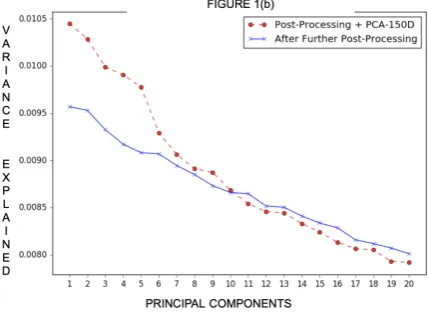
Figure 2: Comparison of the fraction of variance ex-plained by top 20 principal components of the PPA + PCA-150D baseline and Further Post-Processed Glove embedding (150D).
We first apply the algorithm1 (PPA) of (Mu and Viswanath, 2018) on the original word embed-ding, to make it more ‘discriminative’. We then construct a lower dimensional representation of the post processed‘purified’word embedding us-ing Principal Component Analysis (PCA (Shlens, 2014)) based dimensionality reduction technique. Lastly, we again‘purify’the reduced word embed-ding by applying the algorithm1(PPA) of (Mu and Viswanath,2018) on the reduced word embedding to get our final word embeddings.
[image:2.595.72.290.314.440.2]embed-dings to 150 dimensions with PCA (labeled as Post-Processing + PCA); against a further post-processed version by again applying the Algo-rithm 1 (PPA) of the reduced word embeddings
3. We observe that even though PCA has been
applied on post-processed embeddings which had their dominant directions eliminated, the variance in the reduced embeddings is still explained dis-proportionately by a few top principal compo-nents. The re-emergence of this geometrical be-havior implies that further post-processing (Al-gorithm1 (PPA)) could improve the embeddings further. Thus, for constructing lower-dimensional word embeddings, we apply the post-processing algorithm on either side of a PCA dimensionality reduction of the word vectors in our algorithm.
Finally, from Figures 1 and 2, it is also ev-ident that the extent to which the top principal components explain the data in the case of the re-duced embeddings is not as great as in the case of the original300dimensional embeddings. Hence, multiple levels of post-processing at different lev-els of dimensionality will yield diminishing re-turns as the influence of common dominant direc-tions decreases on the word embeddings. Details of reduction technique is given in Algorithm2.
Algorithm 2:Dimensionality Reduction Algorithm Data:Word Embedding Matrix X, New Dimension N,
Threshold Parameter D
Result:Word Embedding Matrix of Reduced Dimension N: X
/* Apply Algorithm 1 (PPA) */ 1 X = PPA(X, D) ;
/* Transform X using PCA */ 2 X = PCA(X) ;
/* Apply Algorithm 1 (PPA) */ 3 X = PPA(X, D) ;
3 Experimental Results
In this section, we evaluate our proposed algo-rithm on standard word similarity benchmarks and across a range of downstream tasks. For all our experiments, we used pre-trained Glove embed-dings of dimensions 300, 200 and 100, trained on Wikipedia 2014 and Gigaword5corpus (400K vocabulary) (Pennington et al., 2014) 4 and fast-Text embeddings of 300 dimensions trained on Wikipedia using the Skip-Gram model described in (Bojanowski et al.,2017) (with2.5M
vocabu-3
the total sum of explained variances over the 150 principal components is equal to 1.0
4 nlp.stanford.edu/projects/glove/
lary)5. The next subsection also presents results using word2vec embeddings trained on Google News dataset6.
3.1 Word Similarity Benchmarks
We use the standard word similarity benchmarks summarized in (Faruqui and Dyer,2014) for eval-uating the word vectors.
Dataset: The datasets (Faruqui and Dyer, 2014) have word pairs (WP) that have been assigned sim-ilarity rating by humans. While evaluating word vectors, the similarity between the words is calcu-lated by the cosine similarity of their vector repre-sentations. Then, Spearman’s rank correlation co-efficient (Rho×100) between the ranks produced by using the word vectors and the human rankings is used for the evaluation. The reported metric in our experiments is Rho × 100. Hence, for bet-ter word similarity, the evaluation metric will be higher.
Baselines:To evaluate the performance of our al-gorithm, we compare it against different schemes of combining the post-processing algorithm with PCA7as following baselines:
• PCA: Transform word vectors using PCA.
• P+PCA: Apply PPA (Algorithm1) and then transform word vectors using PCA.
• PCA+P: Transform word vectors using PCA and then apply PPA.
These baselines can also be regarded as ab-lations on our algorithm and can shed light on whether our intuitions in developing the algorithm were correct. In the comparisons ahead, we rep-resent our algorithm as Algo-N ,where N is the reduced dimensionality of word embeddings. We use the scikit-learn (Pedregosa et al., 2011) PCA implementation.
Evaluation Results: First we evaluate our algo-rithm on the same embeddings against the3 base-lines, we then evaluate our algorithm across word embeddings of different dimensions and different types. In all the experiments, the threshold param-eterDin the PPA algorithm was set to7 and the new dimensionality after applying the dimension-ality reduction algorithms,N was set to d2, where
5 github.com/facebookresearch/fastText/ 6
Table 1: Performance (Rho×100) of Algo. 2on different embedding and dimensions across multiple datasets. Bold represent the best value in each column.
Dataset M WS M VE WS RW Men RG MC Sim WS YP
Turk 353 Turk RB -353 Stan -TR -65 -30 Lex -353 -130 -771 SIM -287 -143 -ALL ford -3K -999 -Rel
Glove-300D 65.01 66.38 63.32 30.51 60.54 41.18 73.75 76.62 70.26 37.05 57.26 56.13 PCA-150D 52.47 52.69 56.56 28.52 46.52 27.46 63.35 71.71 70.03 27.21 41.82 36.72 P+PCA-150D 65.59 70.03 63.38 39.04 66.23 43.17 75.34 73.62 69.21 36.71 62.02 55.42 PCA-150D+P 63.86 70.87 64.62 40.14 66.85 40.79 75.37 74.27 72.35 33.81 60.5 50.2
Algo-150D 64.58 71.61 63.01 42.24 67.41 42.21 75.8 75.71 74.8 35.57 62.09 55.91 FastText-300D 66.89 78.12 67.93 39.73 73.69 48.66 76.37 79.74 81.23 38.03 68.21 53.33 Algo-150D 67.29 77.4 66.17 34.24 73.16 47.19 76.36 80.95 86.41 35.47 69.96 50.9 Glove-200D 62.12 62.91 61.99 28.45 57.42 38.95 71.01 71.26 66.56 34.03 54.48 52.21
Algo-100D 61.99 68.43 63.55 36.82 65.41 39.8 74.44 71.53 69.83 34.19 61.56 49.94 Glove-100D 58.05 60.35 61.93 30.23 52.9 36.64 68.09 69.07 62.71 29.75 49.55 45.43 Algo-50D 58.85 66.27 64.09 33.04 62.05 36.64 70.93 64.56 68.79 29.13 59.55 41.95
dis the original dimensionality. The value of pa-rameter D was set to 7, because from Figure 1, we observe that the top7components are dispro-portionately contributing to the variance. Choos-ing a lower D will not eliminate the disproportion-ately dominant directions, while choosing a higher D will eliminate useful discriminative information from the word vectors. We choose N = d2 as we observed that going below half the dimensions (N < d2) significantly hurts performance of all embeddings.
Results Across Different Baselines: Table 1 shows the results of different baselines on the12
datasets. As expected from discussions in Sec-tion 2, our algorithm achieves the best results on
6 out of 12 datasets when compared across all other baselines. In particular, the150-dimension word embeddings constructed with our algorithm performs better than the 300-dimension embed-dings in7 out of12 datasets with an average im-provement of 2.74% across the 12 datasets, thus performing significantly better than PCA, PCA+P baselines and beating P+PCA baseline in8out of the12tasks.
Results Across Different Embeddings: Table1 also shows the results of our algorithm on 300 -dimension fastText embeddings, 100-dimension Glove embeddings and200-dimension Glove em-beddings. In fastText embeddings, the 150 -dimension word vectors constructed using our al-gorithm gets better performance on 4 out of 12
datasets when compared to the300-dimension em-beddings. Overall, the 150-dimension word vec-tors have a cumulative score of765.5against the
771.93 of the 300-dimension vectors. The per-formance is similar to the 300-dimension em-beddings with an average performance decline of
0.53% across the 12 datasets. With Glove em-beddings of 100 and 200 dimensions, our algo-rithm leads to significant gains, with average per-formance improvements of2.6% and3% respec-tively over the original embeddings and achieves much better performance on8and10datasets re-spectively. Another observation is the embeddings generated by reducing Glove-200D to100 dimen-sions using our algorithm outperform the original Glove-100D embeddings, with an average perfor-mance improvement of6% across all12datasets. Hence, empirical results validate that our algo-rithm is effective in constructing lower dimension word embeddings, while maintaining similar or better performance than the original embeddings.
3.2 Downstream Tasks
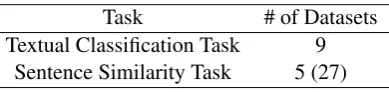
[image:4.595.319.514.714.760.2]Embeddings obtained using the proposed dimen-sionality reduction algorithm can be used as direct features for downstream supervised tasks. We ex-perimented with textual similarity tasks (27 data-sets) and text classification tasks (9 data-data-sets) to show the effectiveness of our algorithm. We used the SentEval (Conneau and Kiela,2018) toolkit for all our experiments. In all cases, sentences were represented as the mean of their words’ embed-dings and in the classification tasks, logistic re-gression was used as the classifier. Table 2 give an overview of the downstream tasks we evaluated our reduced representation.
Table 2: Downstream Task Overview
Task # of Datasets
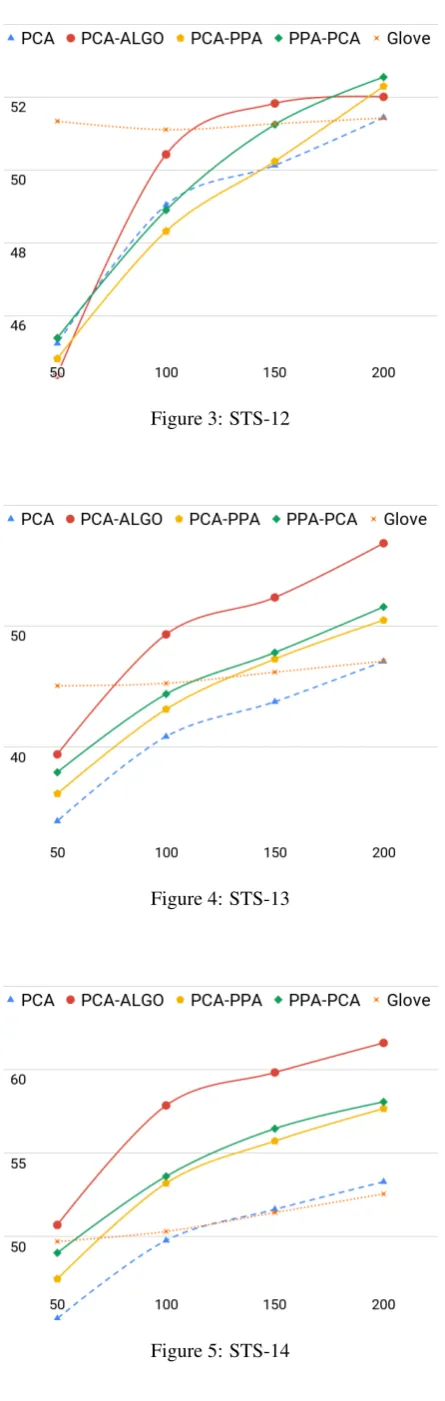
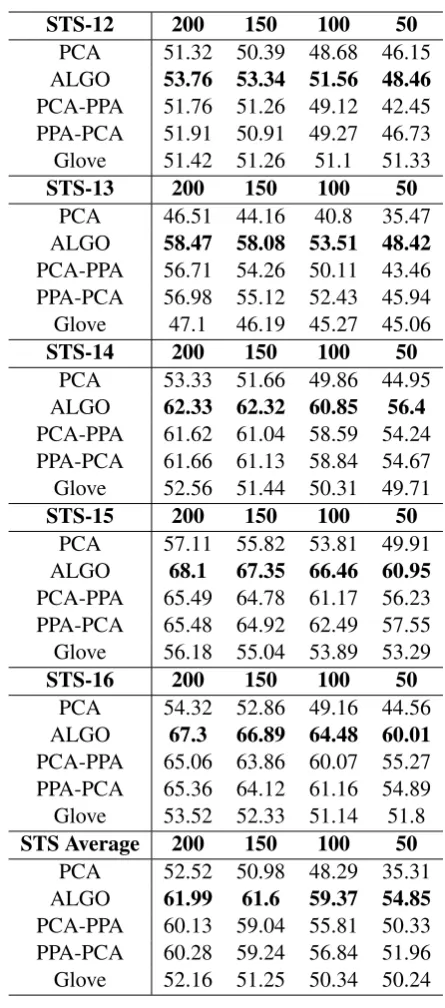
Sentence Similarity Task: We further evaluate our algorithm against the baselines on the Se-mEval dataset (2012-2016) which involved27 se-mantic textual similarity (STS) tasks (2012 - 2016) (Agirre et al.,2012), (Agirre et al.,2013), (Agirre et al., 2014), (Agirre et al., 2015), and (Agirre et al.,2016). The objectives of these tasks are to predict the similarity between two sentences. We used the average Spearmans rank correlation coef-ficient (Rho×100) between the predicted scores and the ground-truth scores as the evaluation met-ric. Table 4 show performance of all reduction methods with varying reduction dimensions. Fig-ure 3 - 8 compare performance of all reduction methods with varying reduction dimensions (in all these figures, X-axis represents the number of dimensions of reduced embeddings while Y-axis represents the score: Rho×100). Similar to pre-vious observations8 our reduction technique out-performs all other baselines.
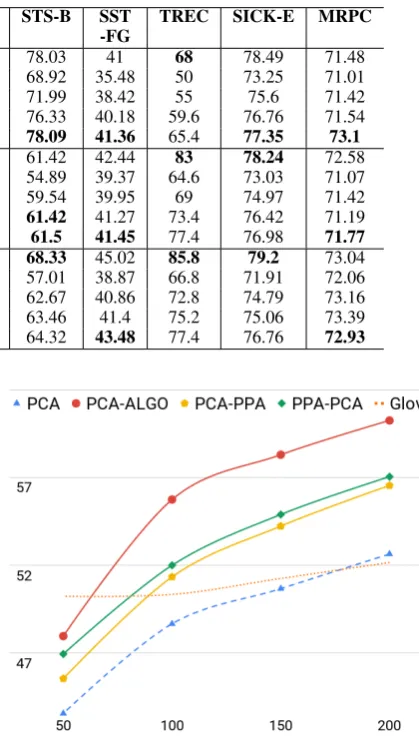
Textual Classification Task: We also performed the experiments on several textual classifica-tion tasks using SentEval (Conneau and Kiela, 2018) toolkit, which includes binary classification (MR, CR, SUBJ, MPQA), multiclass classification (SST-FG, TREC), entailment (SICK-E), seman-tic relatedness (STS-B) and Paraphrase detection (MRPC) tasks, across a range of domains (such as sentiment, product reviews etc). We observe that our embedding is effective on downstream clas-sification tasks and can effectively reduce the in-put size and the model parameters without distinc-tively reducing the performance (<=1.0%). Ta-ble 3 compares the accuracy of reduced embed-dings for multiple dimensions to the original em-beddings on classification for several datasets. It can be clearly seen that the reduced embeddings at 200-D perform comparable to the orignal em-beddings. The results confirm that9 one can ef-fectively reduce the input size and the model pa-rameters without distinctively reducing the perfor-mance (<=1.0%).
3.3 Analysis and Discussion
The performance of reduced embeddings matches that of unreduced embeddings in a range of word
8
We only report the results with Glove embedding, how-ever we obtain similar observations with other embeddings such as fasttText and word2vec. 9 We used the com-monly used pre-trained 300 dimensional embeddings trained on wikipedia for our experiments. Lower-dimensional pre– trained embeddings trained on wikipedia were unavailable for most embedding types.
Figure 3: STS-12
[image:5.595.306.529.65.767.2]Figure 4: STS-13
Table 3: Comparison of performance (in terms of test accuracy) on several classification datasets with original embeddings and the reduced embeddings obtained using the proposed algorithm. Bold represents the reduced embeddings performance with is within<= 1%of the original300D dimensional embeddings.
Model MR CR SUBJ MPQA STS-B SST TREC SICK-E MRPC
-FG
Glove-300D 75.59 78.31 91.58 86.88 78.03 41 68 78.49 71.48 Algo-50D 66.52 70.49 85.6 77.5 68.92 35.48 50 73.25 71.01 Algo-100D 70.43 75.34 88.31 82.3 71.99 38.42 55 75.6 71.42 Algo-150D 73.45 77.43 89.86 85.59 76.33 40.18 59.6 76.76 71.54 Algo-200D 75.23 78.17 90.61 86.51 78.09 41.36 65.4 77.35 73.1 word2vec-300D 77.65 79.26 90.76 88.3 61.42 42.44 83 78.24 72.58
Algo-50D 71.84 72.79 88.1 83.53 54.89 39.37 64.6 73.03 71.07 Algo-100D 73.89 75.65 89.56 84.81 59.54 39.95 69 74.97 71.42 Algo-150D 75.88 77.06 90.01 86.13 61.42 41.27 73.4 76.42 71.19 Algo-200D 76.77 77.88 90.15 86.9 61.5 41.45 77.4 76.98 71.77 fastText-300D 78.23 80.4 92.52 87.67 68.33 45.02 85.8 79.2 73.04 Algo-50D 71.23 75.36 87.88 82.25 57.01 38.87 66.8 71.91 72.06 Algo-100D 73.94 77.64 89.88 84.34 62.67 40.86 72.8 74.79 73.16 Algo-150D 75.52 78.2 90.96 86.18 63.46 41.4 75.2 75.06 73.39 Algo-200D 77.18 79.76 91.6 86.64 64.32 43.48 77.4 76.76 72.93
[image:6.595.303.513.105.480.2]Figure 6: STS-15
Figure 7: STS-16
Figure 8: STS Average
[image:6.595.89.515.113.469.2]STS-12 200 150 100 50
PCA 51.32 50.39 48.68 46.15
ALGO 53.76 53.34 51.56 48.46 PCA-PPA 51.76 51.26 49.12 42.45 PPA-PCA 51.91 50.91 49.27 46.73 Glove 51.42 51.26 51.1 51.33
STS-13 200 150 100 50
PCA 46.51 44.16 40.8 35.47
ALGO 58.47 58.08 53.51 48.42 PCA-PPA 56.71 54.26 50.11 43.46 PPA-PCA 56.98 55.12 52.43 45.94 Glove 47.1 46.19 45.27 45.06
STS-14 200 150 100 50
PCA 53.33 51.66 49.86 44.95
ALGO 62.33 62.32 60.85 56.4 PCA-PPA 61.62 61.04 58.59 54.24 PPA-PCA 61.66 61.13 58.84 54.67 Glove 52.56 51.44 50.31 49.71
STS-15 200 150 100 50
PCA 57.11 55.82 53.81 49.91
ALGO 68.1 67.35 66.46 60.95 PCA-PPA 65.49 64.78 61.17 56.23 PPA-PCA 65.48 64.92 62.49 57.55 Glove 56.18 55.04 53.89 53.29
STS-16 200 150 100 50
PCA 54.32 52.86 49.16 44.56
ALGO 67.3 66.89 64.48 60.01 PCA-PPA 65.06 63.86 60.07 55.27 PPA-PCA 65.36 64.12 61.16 54.89 Glove 53.52 52.33 51.14 51.8
STS Average 200 150 100 50
PCA 52.52 50.98 48.29 35.31
[image:7.595.68.291.57.562.2]ALGO 61.99 61.6 59.37 54.85 PCA-PPA 60.13 59.04 55.81 50.33 PPA-PCA 60.28 59.24 56.84 51.96 Glove 52.16 51.25 50.34 50.24
Table 4: Performance in terms of (Rho × 100) be-tween the predicted scores and the ground-truth scores for STS tasks.
information which is decorrelated with principal components (or the amount of variance explained) leads to decline in performance, since those prop-erties of the embedding space are lost upon dimen-sionality reduction.
Another interesting analysis is to compare the performance of the reduced embeddings against state-of-the-art neural techniques on each of the datasets in Tables 3 and 4. In particular, the per-formance of the reduced embeddings of 200
di-mensions (using Glove) obtained using the pro-posed algorithm suffers from an average drop of 4.1% in Spearman’s Rank correlation scores (x 100) across the five sentence similarity datasets in Table 4, when compared against 4096(20X more) dimensional sentence encoding obtained using In-ferSent 10 (Conneau et al., 2017). In the 9
sen-tence classification datasets, described in Table 3, the 200 dimensional reduced embeddings lead to an average drop of 7.3% in accuracy scores when compared against the 4096 dimensional Infersent encodings. If we exclude TREC (on which all pre-trained embeddings perform poorly), then the 200 dimensional embeddings lead to an average drop of 5.4% when compared against the 4096 dimen-sional InferSent encodings, across the remaining 8 sentence classification tasks in Table 3.
4 Comparison with Related Work
Most of the existing work on word embedding size reduction focuses on quantization (e.g. (Lam, 2018), which requires retraining with a different training objective), compression or limited preci-sion training. In particular, (Ling et al., 2016) tries to reduce the embeddings’ memory footprint by using limited precision representation during word embedding use and training while (Andrews, 2016) tries to compress word embeddings using different compression algorithms and (Shu and Nakayama, 2017) uses compositional coding ap-proach for constructing embeddings with fewer parameters. There hasn’t been much study on di-mensionality reduction for word embeddings, with a general consensus on the use of publicly re-leased pre-trained word embeddings of 300 di-mensions, trained on large corpora (Yin and Shen, 2018). A recent work (Yin and Shen, 2018) has addressed the issue of exploring optimal dimen-sionality by changing the training objective, in-stead of dimensionality reduction. However, in this paper we mainly focus on the dimensionality reduction of the widely used pre-trained word em-beddings (word2vec, Glove, fastText) and show that we can half the standard dimensionality by effectively exploiting the geometry of the embed-ding space. Therefore, our work is the first to extensively explore directly reducing the dimen-sionality of existing/pre-trained word embeddings, making it both different and complementary to the existing methods.
5 Conclusions and Future Work
Empirical results show that our method is effec-tive in constructing lower dimension word embed-dings, having similar or (more often) better perfor-mance than the original embeddings. This could allow the use of word embeddings in memory-constrained environments. In future, an interest-ing area to explore would be the application of compressed and limited precision representations on top of dimensionality reduction to further re-duce the size of the word embeddings. Deriv-ing an algorithm to choose D, N and the lev-els of post-processing automatically, while opti-mizing for performance could also make the di-mensionality reduction pipeline simpler for down-stream applications. Further, owing to the growing popularity of contextualized embeddings such as ElMo (Peters et al.,2018) and BERT (Devlin et al., 2018), it would be interesting to explore whether the geometric intuitions used for developing the proposed algorithm for word embedding dimen-sionality reduction could be leveraged for contex-tualized embeddings as well.
References
Eneko Agirre, Carmen Banea, Claire Cardie, Daniel Cer, Mona Diab, Aitor Gonzalez-Agirre, Weiwei Guo, Inigo Lopez-Gazpio, Montse Maritxalar, Rada Mihalcea, et al. 2015. Semeval-2015 task 2: Seman-tic textual similarity, english, spanish and pilot on interpretability. In(SemEval 2015), pages 252–263.
Eneko Agirre, Carmen Banea, Claire Cardie, Daniel Cer, Mona Diab, Aitor Gonzalez-Agirre, Weiwei Guo, Rada Mihalcea, German Rigau, and Janyce Wiebe. 2014. Semeval-2014 task 10: Multilin-gual semantic textual similarity. In(SemEval 2014), pages 81–91.
Eneko Agirre, Carmen Banea, Daniel Cer, Mona Diab, Aitor Gonzalez-Agirre, Rada Mihalcea, German Rigau, and Janyce Wiebe. 2016. Semeval-2016 task 1: Semantic textual similarity, monolingual and cross-lingual evaluation. In(SemEval-2016), pages 497–511.
Eneko Agirre, Daniel Cer, Mona Diab, Aitor Gonzalez-Agirre, and Weiwei Guo. 2013. * sem 2013 shared task: Semantic textual similarity. In (SemEval 2013), volume 1, pages 32–43.
Eneko Agirre, Mona Diab, Daniel Cer, and Aitor Gonzalez-Agirre. 2012. Semeval-2012 task 6: A pilot on semantic textual similarity. In (SemEval 2012), pages 385–393. Association for Computa-tional Linguistics.
Martin Andrews. 2016. Compressing word embed-dings. In International Conference on Neural In-formation Processing, pages 413–422. Springer.
Piotr Bojanowski, Edouard Grave, Armand Joulin, and Tomas Mikolov. 2017. Enriching word vectors with subword information. Transactions of the Associa-tion of ComputaAssocia-tional Linguistics, 5(1):135–146.
Tolga Bolukbasi, Kai-Wei Chang, James Y Zou, Venkatesh Saligrama, and Adam T Kalai. 2016. Man is to computer programmer as woman is to homemaker? debiasing word embeddings. In Ad-vances in Neural Information Processing Systems, pages 4349–4357.
Alexis Conneau and Douwe Kiela. 2018. Senteval: An evaluation toolkit for universal sentence representa-tions.arXiv preprint arXiv:1803.05449.
Alexis Conneau, Douwe Kiela, Holger Schwenk, Loic Barrault, and Antoine Bordes. 2017. Supervised learning of universal sentence representations from natural language inference data. arXiv preprint arXiv:1705.02364.
Jacob Devlin, Ming-Wei Chang, Kenton Lee, and Kristina Toutanova. 2018. Bert: Pre-training of deep bidirectional transformers for language understand-ing.arXiv preprint arXiv:1810.04805.
Manaal Faruqui, Jesse Dodge, Sujay Kumar Jauhar, Chris Dyer, Eduard Hovy, and Noah A Smith. 2015. Retrofitting word vectors to semantic lexicons. In NAACL-HLT 2015, pages 1606–1615.
Manaal Faruqui and Chris Dyer. 2014. Improving vec-tor space word representations using multilingual correlation. InProceedings of the 14th Conference of the European Chapter of the Association for Com-putational Linguistics, pages 462–471.
Maximilian Lam. 2018. Word2bits-quantized word vectors.arXiv preprint arXiv:1803.05651.
Shaoshi Ling, Yangqiu Song, and Dan Roth. 2016. Word embeddings with limited memory. In Pro-ceedings of the 54th Annual Meeting of the Associa-tion for ComputaAssocia-tional Linguistics (Volume 2: Short Papers), volume 2, pages 387–392.
Goutam Majumder, Partha Pakray, Alexander Gelbukh, and David Pinto. 2016. Semantic textual similarity methods, tools, and applications: A survey. Com-putaci´on y Sistemas, 20(4):647–665.
Tomas Mikolov, Ilya Sutskever, Kai Chen, Greg S Cor-rado, and Jeff Dean. 2013. Distributed representa-tions of words and phrases and their compositional-ity. InAdvances in neural information processing systems, pages 3111–3119.
Nikola Mrkˇsic, Diarmuid OS´eaghdha, Blaise Thom-son, Milica Gaˇsic, Lina Rojas-Barahona, Pei-Hao Su, David Vandyke, Tsung-Hsien Wen, and Steve Young. 2016. Counter-fitting word vectors to lin-guistic constraints. InProceedings of NAACL-HLT, pages 142–148.
Jiaqi Mu and Pramod Viswanath. 2018. All-but-the-top: Simple and effective postprocessing for word representations. In International Conference on Learning Representations.
Kim Anh Nguyen, Sabine Schulte im Walde, and Ngoc Thang Vu. 2016. Neural-based noise filtering from word embeddings. InProceedings of COLING 2016, the 26th International Conference on Compu-tational Linguistics: Technical Papers, pages 2699– 2707.
Fabian Pedregosa, Ga¨el Varoquaux, Alexandre Gram-fort, Vincent Michel, Bertrand Thirion, Olivier Grisel, Mathieu Blondel, Peter Prettenhofer, Ron Weiss, Vincent Dubourg, et al. 2011. Scikit-learn: Machine learning in python. Journal of machine learning research, 12(Oct):2825–2830.
Jeffrey Pennington, Richard Socher, and Christopher Manning. 2014. Glove: Global vectors for word representation. InProceedings of the 2014 confer-ence on empirical methods in natural language pro-cessing (EMNLP), pages 1532–1543.
Matthew E Peters, Mark Neumann, Mohit Iyyer, Matt Gardner, Christopher Clark, Kenton Lee, and Luke Zettlemoyer. 2018. Deep contextualized word rep-resentations. arXiv preprint arXiv:1802.05365.
Jonathon Shlens. 2014. A tutorial on principal compo-nent analysis. arXiv preprint arXiv:1404.1100.
Raphael Shu and Hideki Nakayama. 2017. Com-pressing word embeddings via deep compositional code learning. InInternational Conference on Neu-ral Information Processing, page arXiv:1711.01068. arXiv preprint.