Proceedings of the Fourteenth Workshop on Innovative Use of NLP for Building Educational Applications, pages 264–274 264
Evaluation of automatic collocation extraction methods for language
learning
Vishal Bhalla Department of Informatics Technical University of Munich
Arcisstraße 21, 80333 M¨unchen, Germany [email protected]
Klara Klimcikova
Department of English and American Studies Ludwig Maximilian University of Munich
Schellingstrae 3, 80799 M¨unchen, Germany [email protected]
Abstract
A number of methods have been proposed to automatically extract collocations, i.e., con-ventionalized lexical combinations, from text corpora. However, the attempts to evaluate and compare them with a specific applica-tion in mind lag behind. This paper com-pares three end-to-end resources for colloca-tion learning, all of which used the same cor-pus but different methods. Adopting a gold-standard evaluation method, the results show that the method of dependency parsing outper-forms regex-over-pos in collocation identifica-tion. The lexical association measures (AMs) used for collocation ranking perform about the same overall but differently for individual col-location types. Further analysis has also re-vealed that there are considerable differences between other commonly used AMs.
1 Introduction
Collocations, as the most common manifestation of formulaic language, have attracted a great deal of research in the last decade (Wray,2012). Most of the research on collocations has been connected to their definition (section2.1) and extraction (sec-tion2.2), but also to their acquisition, and conse-quently teaching. Herbst and Schmid (2014) ar-gue, “Any reflection upon what is important in the learning and, consequently, also in the teaching of a foreign language will have to take into ac-count the crucial role of conventionalized but un-predictable collocations. Any attempt by a learner to achieve some kind of near-nativeness will have to include facts of language such as the fact that it islayorset the tablein English, butTisch decken in German, andmettre la tablein French” (p. 1).
Collocation learning comes down to three main benefits for language learners: accurate produc-tion, efficient comprehension and increased flu-ency of processing (e.g.,Men,2017;Durrant and
Mathews-Aydınlı, 2011). To increase their lan-guage proficiency, beginners and advanced learn-ers often look up for words and it’s common col-locates online, using a mobile app or web browser and it benefits to provide personalized items, tai-lored to the user’s interest and proficiency. Exam-ples of using collocations for building educational applications include question generation (e.g.,Lin et al.,2007), distractor generation (e.g.,Liu et al., 2005;Lee and Seneff, 2007) for multiple choice cloze items and an online collocation writing as-sistant - Collocation Inspector (Wu et al., 2010a) in the form of a web service.
Despite their widely recognized importance and ubiquity in language use, collocations pose a great challenge for language learners thanks to their arbitrary nature and the learner’s insuffi-cient experience with the target language (Ellis, 2012). Thus, there is a pressing need to create re-sources for language learners to support their ex-plicit collocation learning. Given the vast amount of collocations and the different goals of lan-guage learners, various methods have been pro-posed to extract them automatically from text. Yet it is still not conclusive which one performs the best for language learning and “the selection of one or another seems to be somewhat arbitrary” (Gonz´alez Fern´andez and Schmitt,2015) (p. 96).
This paper1 attempts to evaluate three end-to-end resources of collocations built for lan-guage learning: Sketch Engine2(Kilgarriff et al., 2014), Flexible Language Acquisition (FLAX)3 (Wu, 2010) and Elia (Bhalla et al., 2018). They use the same British Academic Written English (BAWE) corpus (Nesi,2011), but different
meth-1
Code, data and evaluation results are avail-able at https://github.com/vishalbhalla/ autocoleval
2
https://www.sketchengine.eu/
ods for collocation identification, i.e., regex-over-pos, n-grams combined with regex-over-pos and dependency parsing, respectively, and also differ-ent association measures for collocation ranking, i.e., Log Dice, raw frequency and Formula Teach-ing Worth (FTW). On top of that, we compare other widely used lexical association measures of MI, MI2, MI3, t-score, log-likelihood, Salience and Delta P using the data from the best perform-ing candidate identification method as a baseline. For our evaluation, we use the expert-judged Aca-demic Collocation List (ACL) (Ackermann and Chen,2013) as a reference set (section 3.1), and calculate the recall and precision metrics sepa-rately for collocation identification and ranking.
2 Theoretical Background
2.1 Notion of Collocation
Among the many different interpretations of collo-cations in the literature, three leading approaches can be distinguished: psychological, phraseologi-cal and distributional (Men,2017).
The psychological approach envisages colloca-tions as lexical associacolloca-tions in the mental lexi-con of language users underlying their fluent and meaningful language use (e.g.,Ellis et al.,2008). This perspective on collocations is supported by the evidence from psycholinguistic research using reaction time tasks, free associations tasks, self-paced reading and eye-tracking which suggests that collocations are holistically stored as chunks and thus processed faster (Wray,2012). However, as found out by Meara (2009), the storage of word associations in the mental lexicon of native speak-ers is different from that of nonnative speakspeak-ers.
The phraseological approach focuses predomi-nantly on delimiting collocations (call a meeting) from free word combinations with a predictable meaning (call a doctor), on the one hand, and fixed idioms with an unpredictable meaning (call it a day) on the other (e.g.,Cowie,1998) by defin-ing a set of criteria related to the compositionality of meaning and fixedness of form. Schmitt (2010) argues that such approach is rather problematic for the identification task as it is not clear how to op-erationalize such criteria without making it subjec-tive and labor-intensive.
The distributional approach, also called Firthian or frequency-based, shifts the focus from the se-mantic aspects of collocations to structural. As Sinclair (1991) put it, “Collocation is the
co-occurrence of two or more words within a short space of each other in a text. The usual mea-sure of proximity is a maximum of four words intervening” (p. 170). Following this definition, various criteria have been considered for identify-ing collocation, e.g., distance, frequency, exclusiv-ity, directionalexclusiv-ity, dispersion, type-token distribu-tion and connectivity (Brezina et al.,2015). How-ever, some researchers (e.g.,Bartsch,2004) argue that because of the little account of syntactic fea-tures of the words, it fails to capture certain col-locations, e.g., the collocation collect stamps in the sentenceThey collect many things, but chiefly stamps, or vice versa, captures false collocations, such asthings but.
Despite the obvious differences, there is con-siderable overlap between the three approaches as Durrant and Mathews-Aydnl (2011) rightly point out, “Non-compositionality and high frequency of occurrence can both be cited as evidence for holistic mental storage, and non-substitutability of parts can be evidenced in terms of co-occurrence frequencies in a corpus” (p. 59). It is precisely this extended notion of two-word collocations which was adopted by the collocation references under investigation in this study.
2.2 Automatic Extraction of Collocations
The task of collocation extraction is usually split into two steps, that of candidate identification which automatically generates a list of potential collocations from a text according to some crite-ria, and that of candidate ranking, which ranks the list to keep the best collocations on top according to some association measure (Seretan,2008).
2.2.1 Candidate Identification
In the candidate identification step, four prominent methods can be distinguished based on the prox-imity of words and the amount of linguistic infor-mation used: window, n-gram, regex-over-pos and parsing. The first two are based on linear ity whereas the other two are on syntactic proxim-ity.
appli-cation of these two methods can vary along sev-eral dimensions, e.g., the nature of words consid-ered, such as word forms, lemmas or word fam-ilies (Seretan, 2008), the context span on the left and right or the number of grams, part-of-speech filtering, etc. However, due to the lack of linguis-tic information used, these methods are prone to many recall and precision errors (for a detailed dis-cussion, seeLehmann and Schneider,2009).
In contrast to the previous two methods, the regex-over-pos method takes into account the grammatical relations between words (e.g., Wu, 2010). It identifies collocations in text via regular expressions over part-of-speech tags which match a certain grammatical pattern of the collocation. An alternative, though less frequent, method iden-tifies collocations in a syntactic relation via pars-ing (Seretan,2008), and thus accounts for the syn-tactic flexibility feature of collocations. Bartsch and Evert (2014) found out that collocation extrac-tion using parsing method improved the results in comparison to the window method. However, they also caution that the success depends on the accu-racy of the parser and the set of grammatical rela-tions used.
2.2.2 Candidate Ranking
The next step of candidate ranking entails mea-suring the strength of association between the two words, hence association measure (AMs). In prin-ciple, AMs compare the observed and expected frequencies of collocations in different ways, and thus differ in how much they highlight or down-play different features of collocations (for a de-tailed overview, see Pecina, 2010). There is no single best performing AM but rather the choice of an appropriate measure depends on the particular purpose and theoretical criteria. In language learn-ing research and practice, the followlearn-ing AMs have received most attention: raw frequency, MI, MI2, MI3, Log Dice, t-score, log-likelihood, Salience, FTW and Delta P.
The Mutual Information (MI) measure prior-itizes rare exclusivity of collocations which is strongly linked to predictability (Gablasova et al., 2017). However, it is also biased towards low-frequency combinations which can be circum-vented by setting a minimum frequency threshold or giving extra weight to the collocation frequency by squaring (MI2) or cubing (MI3).
The Log Dice score is similar to MI2 and high-lights the exclusivity of word combinations
with-out putting too much weight to rare combinations. However, Log Dice, in contrast to MI2, is suitable for comparing scores from different corpora and has been described as a “lexicographer-friendly association score” (Rychl`y, 2008, p. 6-9). An-other measure adjusted for lexicographic purposes is Salience, the forerunner of Log Dice, which combines the strengths of MI and log frequency (Kilgarriff and Tugwell,2002).
The t-score represents the strength of associa-tion between words by calculating the probability that a certain collocation will occur without con-sidering the level of significance (Pecina,2010). It prioritizes the frequency of the whole collocation, and hence there is a tendency for frequent colloca-tions to rank higher.
The only measure created specifically for ped-agogical purposes is the Formula Teaching Worth (FTW) which is again a combined measure of MI and the raw frequency with more weight given to the former. It was derived from an empirical re-search using both statistical measures and instruc-tor judgments. Basically, the score represents “a prediction of how instructors would judge their teaching worth” (Simpson-Vlach and Ellis,2010, p. 496).
In contrast to the previous measures, log-likelihood is a statistic which determines whether the word combination occurs more frequently than chance or not. In particular, the score does not provide information on “how large the difference is” but rather “whether we have enough evidence in the data to reject the null hypothesis” (Brezina et al.,2015, p. 161).
The last measure is Delta P which takes direc-tionality into account and calculates the strength of the attraction between two words for each word separately. Therefore, in contrast to all the pre-vious measures, it does not treat the collocational relationship as symmetrical (Gries,2013).
3 Methodology
3.1 Reference Set
The recently compiled Academic Collocation List (ACL) (Ackermann and Chen,2013) was selected as the reference set (gold standard) to be compared against the test sets. Five main considerations drove this decision: First, it needed to be in line with the nature of the BAWE4corpus that was
cho-4https://www.coventry.ac.uk/
sen as a source input for extracting collocations. BAWE contains around 3000 good-standard stu-dent assignments (with 6,506,995 words), evenly distributed across four broad disciplinary areas (Arts and Humanities, Social Sciences, Life Sci-ences and Physical SciSci-ences) and across four lev-els of study (undergraduate and taught masters level). Since BAWE is a collection of academic writing of university students, the baseline set should also consist of academic collocations. Sec-ond, it should contain collocations consisting of two words as all the three resources focus on two-word collocations. Third, the collocations should preferably be grouped into collocation types based on their word classes or syntactic functions as in the test sets. Fourth, the reference set should be human-made or human-judged to ensure the qual-ity of collocations. And finally, it should be com-piled for pedagogical purposes.
The ACL comprises of 2,469 lexical colloca-tions in written academic English and is based on a written part of the Pearson International Corpus of Academic English (PICAE) of around 25 million words. It was carefully compiled using the combi-nation of automatic computational analysis to sure an adequate recall and human judgment to en-sure the quality and relevance of the collocations for pedagogical purposes. Consisting of the most frequent and pedagogically relevant entries, ACL can therefore be immediately operationalized by English for Academic Purposes (EAP) teachers and students. By highlighting the most impor-tant cross-disciplinary collocations, the ACL can help learners increase their collocational compe-tence and thus their proficiency in academic En-glish. The collocations are grouped into eight col-location types: adjective + noun, noun + noun, verb + noun, verb + adjective, adverb + verb, verb + adverb, adverb + verb past participle, adverb + adjective.
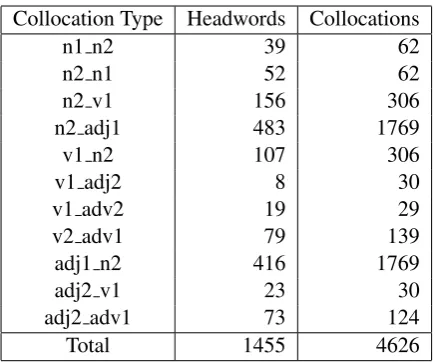
To make it comparable to the test sets, we lem-matized all its inflected word forms using an au-tomatic lemmatization tool from SpaCy5and then manually checked all the errors. Next, it was orga-nized by headwords with the POS tagsnoun, ad-jectiveandverb, grouped by possible collocation types, and with the respective collocates appended resulting in a list of 1,455 headwords, 11 colloca-tion types and 4,626 collocacolloca-tions as presented in
current-projects/2015/
british-academic-written-english-corpus-bawe/
5https://spacy.io/
Collocation Type Headwords Collocations
n1 n2 39 62
n2 n1 52 62
n2 v1 156 306
n2 adj1 483 1769
v1 n2 107 306
v1 adj2 8 30
v1 adv2 19 29
v2 adv1 79 139
adj1 n2 416 1769
adj2 v1 23 30
adj2 adv1 73 124
Total 1455 4626
Table 1: Reference set grouped by collocation types starting with a headword where noun isn, adjective is
adj, verb isv, adverb isadvand the numbers1and2
indicate their positions in the collocation pair.
Table1. For example, the notation of the colloca-tion typen2 adj1indicates that the headword is a noun (n) in the2ndposition in the collocation pair, and the collocate is an adjective (adj) in the1st po-sition, so when the learner searches the adjectival collocates for the word feature, it gives him the collocatedistinguishingamong others.
3.2 Tests sets
3.2.1 Sketch Engine
Sketch Engine (SE) is an online corpus software with a wide range of functions and preloaded cor-pora which can be used for pedagogical purposes either indirectly, in the creation of textbooks and dictionaries, or directly in the classroom (Kilgar-riff et al.,2014). One of its functions is the Word Sketch for extracting collocations in a range of grammatical patterns, and one of its corpora is BAWE. The corpus is automatically POS-tagged using CLAWS 76and the collocations are identi-fied with the help of their embedded Sketch Gram-mar7 which is a set of regular expressions over POS tags. The retrieved collocates are then or-ganized based on the grammatical relation to the headword and within each relation sorted by the Log Dice measure (alternatively, raw frequency).
The SE collocations were extracted using web scraping wherein, firstly, the URL was built
us-6https://www.sketchengine.eu/
[image:4.595.308.526.60.241.2]ACL Sketch Engine FLAX Elia n1 n2 modifies n-nn NOUN + NOUN n2 n1 modifier n-nn NOUN + NOUN n2 v1 object of n-vn VERB + NOUN n2 adj1 modifier n-an ADJ + NOUN
v1 n2 object v-vn VERB + NOUN
v1 adj2
adj comp
np adj comp v-vppa VERB + ADJ v1 adv2 modifier v-vr VERB + ADV v2 adv1 modifier v-rv VERB + ADV adj1 n2 modifies a-an ADJ + NOUN
adj2 v1
adj comp of
[image:5.595.166.434.60.253.2]np adj comp of a-vppa VERB + ADJ adj2 adv1 modifier a-ra ADV + ADJ
Table 2: Mapping of collocation types between the reference set (ACL) and test sets (Sketch Engine, FLAX, Elia)
ing the lemma and POS tag of each word and then the eleven collocation types from the reference set were mapped to the collocation types used at SE to pickup the collocations of interest (Table2). Pick-ing up all the headwords (lemmas) from the refer-ence set, the count and score of each collocate was stored in an intermediate file for each lemma in order to generate SE files8for the final evaluation.
3.2.2 FLAX
FLAX (Flexible Language Acquisition) is an on-line library and tool specifically created for col-location learning (Wu,2010). It consists of large collections of collocations and phrases extracted from different corpora, one of which is BAWE, and can be used for searching collocations for a particular word or for automatic generation of a variety of collocation exercises and games. The collocations are extracted using the combination of n-gram and regex over-pos methods which in-volved the following steps. Firstly, n-grams (n=5) are extracted from the corpus and tagged with the OpenNLP9 tagger. The tagged 5-grams are then matched against a set of regular expressions based on predefined collocation types10. Finally, the individual collocations organized by collocation types are then sorted by raw frequency within each collocation type (Wu,2010, p. 98).
For the evaluation, all FLAX collocations11
8
Code and data in the ‘sketchengine’ folder of the Sup-plementary Material.
9
http://opennlp.apache.org/ 10
For a full list of the collocation types with examples, see Wu et al. (2010b, p. 9).
11Code and data in the ‘flax’ folder of the Supplementary
Material.
were extracted using the same web scraping pro-cess as for SE. However, as FLAX operates on word forms in contrast to the reference set oper-ating on lemmas, all lemmas from the reference set had to be converted to their word forms using Pattern12(Smedt and Daelemans,2012) to get the corresponding collocations from FLAX for each headword in the reference set and then remapped back to its lemma to continue with the same eval-uation flow as in SE.
3.2.3 Elia
Elia13 is an intelligent personal assistant for lan-guage learning which provides immediate assis-tance for English learners when they use English online (Bhalla et al.,2018). One of its design fea-tures is to provide a learner with a list of collo-cates for a given word, which are in line with the learner’s proficiency level. It is based on BAWE where, firstly, all the dependency relations using the SpaCy parser14are extracted and mapped to a predefined set of 15 collocation types and then run for the Academic Vocabulary List (Gardner and Davies, 2013) of 20,000 most frequent academic words from the Corpus of Contemporary Ameri-can English (COCA)15. Subsequently, the collo-cations are organized for each headword (lemma)
12https://github.com/clips/pattern 13
Elia is not available online yet, however, the code to generate the database of collocations can be accessed athttps://drive.google.com/open?id=1FGFy_ yp797saphx8-wzcLkMxQbkCVZlp
14
https://spacy.io/usage/ linguistic-features# section-dependency-parse
and collocation type and ranked according to the Teaching Worth Formula (Simpson-Vlach and El-lis,2010).
For the evaluation, only the collocations for the headwords and collocation type present in the ref-erence set were filtered out from Elia after running the code from the link shared previously. On run-ning this setup, intermediate files for each head-word containing all its collocates along with the chosen metric were generated. These are in line with the web scraping files from Sketch Engine and FLAX in order to generate the final evaluation files16.
4 Results and Discussion
For the comparative evaluation of the three test sets, the standard metric recall and precision were calculated separately for identification and ranking of collocations grouped into collocation types. On top of that, additional evaluation was performed on the best performing test set as a baseline to compare different collocation ranking measures introduced in section2.2.2.
4.1 Candidate Identification
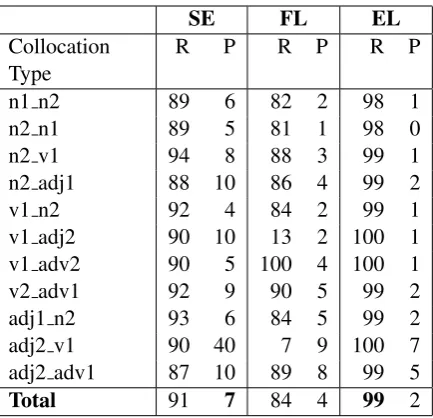
Table 3 clearly shows that the method of depen-dency parsing used by Elia resulted in higher over-all recover-all (99%) than the method of regex-over-pos used by Sketch Engine (91%) and FLAX (84%). It seems that some dependency parsers have reached a sufficiently high accuracy to be used for collo-cation extraction or other NLP tasks (Levy et al., 2015). At the same time, there are obvious differ-ences between Sketch Engine and FLAX, despite using the same method (regex-over-pos), which leads to the conclusion that manual mappings of collocation types and syntactic patterns might be as important as the method itself. Another plausi-ble explanation could be the fact that FLAX used regex patterns over 5-grams extracted from the corpus whereas Sketch Engine over full sentences. Turning to individual collocation types (CTs), all of them achieved a high recall of above 80% in all three test sets, except forv1 adj2andadj2 v1 in FLAX with a recall of only 13% and 7% re-spectively. Tempting as it might seem, this does not explain the lowest overall recall for FLAX as they account for only 7% (54 out of 710) of all missed collocations. FLAX performed especially
16Code and data in the ‘elia’ folder of the Supplementary
Material.
SE FL EL
Collocation Type
R P R P R P
n1 n2 89 6 82 2 98 1
n2 n1 89 5 81 1 98 0
n2 v1 94 8 88 3 99 1
n2 adj1 88 10 86 4 99 2
v1 n2 92 4 84 2 99 1
v1 adj2 90 10 13 2 100 1
v1 adv2 90 5 100 4 100 1
v2 adv1 92 9 90 5 99 2
adj1 n2 93 6 84 5 99 2
adj2 v1 90 40 7 9 100 7
adj2 adv1 87 10 89 8 99 5
[image:6.595.309.526.61.270.2]Total 91 7 84 4 99 2
Table 3: Candidate identification comparison of Sketch Engine (SE), FLAX (FL) and Elia (EL) across collocation types with the recall (R) and precision (P) values in percentages.
well forv1 adv2(100%) in comparison to its other CTs starting from 90% (v2 adv1) downwards to 7%(adj2 v1). On the other hand, the results for Sketch Engine are rather consistent across indi-vidual CTs ranging from 87%(adj2 adv1)to 94% (n2 v1). The same applies for Elia ranging from 98% (n1 n2, n2 n1) to 100% (v1 adj2, adj2 v1, v1 adv2).
Looking closer at the results for Elia, we found out that exactly one half (19) of all the missed col-locations (38) was due to parsing or tagging er-rors whereas the other half was due to different type classification; for example, the collocation learning activitywas grouped undern2 adj1in the reference set whereas, in Elia, it was assigned to n1 n2, and thus missed. This might as well be the case for some of the missed collocations in Sketch Engine and FLAX.
The precision, on the other hand, is very low for all (the highest 7% reached by Sketch Engine) at the expense of high recall. This, however, is not that important at this stage since the next step of ranking should shift all the irrelevant collocations to the bottom.
4.2 Candidate Ranking
Top 4,626 Top 14,550 Top 29,100
SE FL EL SE FL EL SE FL EL
Collocation Type
R=P R=P R=P R P R P R P R P R P R P
n1 n2 19 15 10 58 10 52 8 37 6 77 8 73 6 68 5
n2 n1 31 23 19 69 10 61 7 56 7 82 8 68 4 69 4
n2 v1 42 44 48 73 15 70 14 83 16 87 10 75 8 90 9
n2 adj1 36 41 39 50 18 52 19 50 18 68 13 66 12 65 12
v1 n2 37 31 35 55 16 47 14 52 15 68 10 57 8 64 9
v1 adj2 47 0 43 73 28 3 4 63 24 80 17 7 5 73 14
v1 adv2 48 34 34 86 13 86 13 83 13 90 8 97 8 86 7
v2 adv1 46 52 37 81 15 79 15 80 14 91 11 86 9 90 8
adj1 n2 36 43 44 40 18 47 21 49 20 57 13 61 14 64 14
adj2 v1 70 3 33 90 29 7 9 97 15 90 29 7 9 100 10
adj2 adv1 37 54 28 80 16 82 17 80 14 87 11 85 11 89 8
[image:7.595.69.530.62.282.2]Total 37 41 40 51 17 52 17 54 17 67 12 65 11 68 11
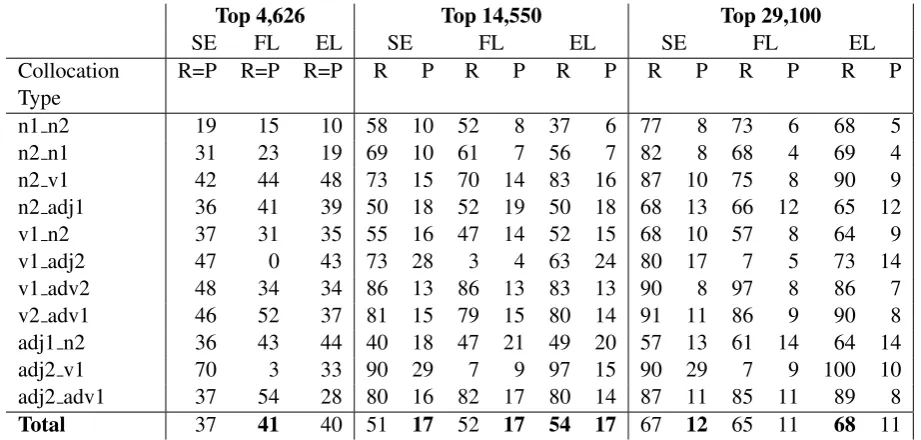
Table 4: Candidate ranking comparison of Sketch Engine (SE), FLAX (FL) and Elia (EL) across collocation types for three samples: Top 4,626 (n-best collocates per headword wheren refers to the number of collocations per headword in the reference set), Top 14,550 (10-best collocates per headword) and Top 29,100 (20-best collocates per headword) with the recall (R) and precision (P) values in percentages. Note that the recall and precision results for the top 4,626 are the same (i.e. R=P) because the number of missed collocations (false negatives) and unwanted collocations (false positives) is the same. And this is because the number of the TOP collocations in the first test sample (4,626) is the same as the total number of collocations in the reference set (4,626).
per each headword in the reference set, Top 14,550 to the 10-best collocates per headword, and Top 29,100 to the 20-best collocates per headword.
As illustrated in Table 4, the association mea-sure Log Dice used by Sketch Engine performed slightly worse (37%) overall than Elia (40%) us-ing FTW, a combination of MI and frequency, and FLAX (41%) using raw frequency for the Top 4,626 sample. As the sample increased to 14,550, Elia with a recall of 54% outperformed FLAX (52%) and Sketch Engine (51%). In the even larger sample of 29,100, Elia was still marginally better reaching 68% whereas Sketch Engine out-performed FLAX with a recall of 67% and 65% respectively. It seems that Log Dice improves its performance as more of the data is examined whereas raw frequency acts in quite the opposite way. However, it should also be pointed out that the differences between all of the scores are very subtle, less than 4% in all the samples. This is even more pronounced in the overall precision re-sults which, for all three resources, are the same (17%) in Top 14,550 and almost the same (12%, 11%, 11%) in Top 29,100.
Looking at the individual CTs, an interesting picture of differences emerges. Sketch Engine’s
measure performed consistently better for n1 n2, n2 n1, v1 n2 and v1 adj2 in all three samples. Elia’s measure performs consistently better for n2 v1andadj1 n2. FLAX seems to perform bet-ter only forv2 adv1andadj2 adv1for Top 4,626 but it is not consistent for the other samples. Vari-ability can be found not only among individual re-sources but also among individual CTs within one resource. For example, in Top 4,626, Sketch En-gine reaches a recall of 19% for n1 n2and of as high as 70% for adj2 v1. Recall values for Elia range from 37% (n1 n2) to 97% (adj2 v1) and for FLAX from 7% (adj2 v1) to 86% (v1 adv2) in Top 14,550. The syntactic structure underlying collo-cations seems to have a great impact on the results, and thus should always be considered and speci-fied as already suggested in some previous studies (e.g., Evert and Krenn, 2001;Bartsch and Evert, 2014).
Figure 1: Comparison of different association measures (AMs) using Elia as a baseline.
reached 43% as compared to 0% by FLAX. This could have been caused by the low recall (13%) of FLAX in the identification part. The issue with credit assignment is that it is not clear how much of the success can be attributed to the identification method discussed in the previous section and how much to the metric itself. To exclude the identifi-cation method as a factor, we decided to perform another analysis: the comparison of different AMs using the best-performing data from the candidate identification step, that is Elia, as a baseline to find out the differences when all things being equal.
4.2.1 Comparison of Different AMs with Elia as a Baseline
Using Elia collocations as a baseline, we have computed recall and precision for ten different ranking measures described in section 2.2.2. As in the previous section, we have computed it sep-arately for the three samples of Top 4,626, Top 14,550 and Top 29,100, however, this time not for all individual CTs separately. The formulas used to compute each of the different AMs can be found in Brezina et al. (2015, p. 169-170).
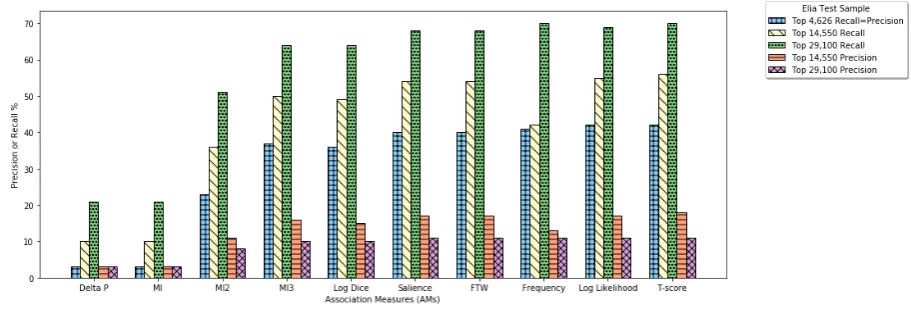
The results on candidate ranking, arranged pro-gressively by the best measures in Figure1, show that recall curves for all AMs increase whereas precision curves decrease with the increased sam-ple sizes as expected. In terms of coverage, the best performing measures are t-score and log like-lihood across all samples with the recall values of 42%, 56%, 70% and 42%, 55%, 69% respec-tively. They are followed by Salience and FTW with the same values of 40%, 54%, 68%. All of these four measures exhibit a consistent behavior increasing by about 14% with the increased sam-ples. On the other hand, the raw frequency
mea-sure, even though reaching similarly high scores for Top 4,262 (41%) and Top 29,100 (70%), in-creases only by 1% for Top 14,550. The next two measures MI3 and Log Dice lag slightly behind with the scores of 36%, 50%, 64% and 36%, 49%, 64% respectively, consistently increasing by about 14%. The MI2 score performs significantly worse with a recall of 23%, 36%, 51%. The most col-locations are missed by the measures Delta P and MI both reaching only a recall of 3%, 10%, 21%.
The precision values defining quality of the col-locations point to very similar tendencies with t-score and log likelihood reaching the highest pre-cision in all three samples with the scores of 42%, 18%, 11% and 42%, 17%, 11% respectively and with the FTW and Salience measures right be-hind, both with 40%, 17%, 11%. MI3 and Log Dice performs about the same with 37%, 16%, 10% and 36%, 15%, 10% respectively. Again, the MI2 score misses significantly more collocations than the previous measures reaching a precision of 23%, 11%, 8%. Surprisingly enough, MI and Delta P, both reached the lowest precision score of 3% for all samples. Thus, it can be concluded that the sample size does not affect the precision of the MI and Delta P association measures which, in the case of MI, is consistent with the previous findings by Evert and Krenn (2001).
that the reference list did not indicate the direction of attraction for collocations, which is the under-lying assumption of the Delta P measure, which might be the reason for the poor results. On the other hand, there are only subtle differences be-tween some of the best-performing measures, such as log likelihood and t-score or FTW and Salience.
5 Conclusion
The aim of this study was to evaluate three collo-cation learning resources namely Sketch Engine, FLAX and Elia on a pedagogical reference - Aca-demic Collocational List, where all of them use the same corpus of academic writings of univer-sity students but different methods for colloca-tion identificacolloca-tion and different lexical associacolloca-tion measures for collocation ranking.
The findings indicate that using dependency parsing (Elia) for collocation identification led to much better results than using regular expressions over tagged corpus (Sketch Engine and FLAX). However, the success does not depend on the spe-cific method entirely, but also on the quality of the set of syntactic structures. Using the same method with differently designed collocation types might lead to very different results, as was the case for Sketch Engine and FLAX.
The evaluation of collocation ranking has re-vealed that, overall, some of the association mea-sures perform equally well, such as t-score, log-likelihood, FTW (used by Elia) and Salience. Raw frequency (used by FLAX) was also found to per-form well but acting inconsistently across differ-ent sample sizes. The Log Dice measure (used by Sketch Engine) worked best for the majority of individual collocation types in comparison to raw frequency and FTW. On the other hand, the widely used MI and newly introduced Delta P were rela-tively poor in comparison to other AMs, but exhib-ited consistency in precision across varying sam-ple sizes.
It has also become apparent that there are con-siderable differences between individual colloca-tion types, and therefore should always be consid-ered as a factor in collocation extraction. How-ever, a future line of work is required to substan-tiate the consistency of these results on different reference lists and corpora.
Acknowledgments
We would like to thank Mrs. Wu for her in-sights on FLAX extraction, Aisulu for preparing the COCA list, Ivet for the help in large scale experiments and all the anonymous reviewers for their critical feedback.
References
Kirsten Ackermann and Yu-Hua Chen. 2013. Develop-ing the Academic Collocation List (ACL)–A corpus-driven and expert-judged approach. Journal of En-glish for Academic Purposes, 12(4):235–247.
Sabine Bartsch. 2004. Structural and functional prop-erties of collocations in English: A corpus study of lexical and pragmatic constraints on lexical co-occurrence. Gunter Narr Verlag.
Sabine Bartsch and Stefan Evert. 2014. Towards a Firthian notion of collocation. Network Strategies, Access Structures and Automatic Extraction of Lex-icographical Information. 2nd Work Report of the Academic Network Internet Lexicography, OPAL– Online publizierte Arbeiten zur Linguistik. Institut f¨ur Deutsche Sprache, Mannheim, to appear.
Vishal Bhalla, Klara Klimcikova, and Aisulu Rakhme-tullina. 2018. The missing link between learners’ language use and their language learning - Elia. In
Proceedings of the 13th Teaching and Language Corpora Conference.
Vaclav Brezina, Tony McEnery, and Stephen Wattam. 2015. Collocations in context: A new perspective on collocation networks. International Journal of Corpus Linguistics, 20(2):139–173.
Anthony Paul Cowie. 1998. Phraseology: Theory, analysis, and applications. OUP Oxford.
Philip Durrant and Julie Mathews-Aydınlı. 2011. A function-first approach to identifying formulaic lan-guage in academic writing. English for Specific Pur-poses, 30(1):58–72.
Nick C Ellis. 2012. Formulaic language and second language acquisition: Zipf and the phrasal teddy bear. Annual Review of Applied Linguistics, 32:17– 44.
Nick C Ellis, RITA Simpson-Vlach, and Carson May-nard. 2008. Formulaic language in native and second language speakers: Psycholinguistics, cor-pus linguistics, and TESOL. Tesol Quarterly, 42(3):375–396.
Dana Gablasova, Vaclav Brezina, and Tony McEnery. 2017. Collocations in Corpus-Based Language Learning Research: Identifying, Comparing, and Interpreting the Evidence. Language Learning, 67(S1):155–179.
Dee Gardner and Mark Davies. 2013. A new academic vocabulary list. Applied Linguistics, 35(3):305–327.
Beatriz Gonz´alez Fern´andez and Norbert Schmitt. 2015. How much collocation knowledge do L2 learners have? ITL-International Journal of Applied Linguistics, 166(1):94–126.
Stefan Th Gries. 2013. 50-something years of work on collocations. International Journal of Corpus Lin-guistics, 18(1):137–166.
Thomas Herbst, Hans-J¨org Schmid, and Susen Faul-haber. 2014. Constructions Collocations Patterns, volume 282. Walter de Gruyter GmbH & Co KG.
Adam Kilgarriff, V´ıt Baisa, Jan Buˇsta, Miloˇs Jakub´ıˇcek, Vojtˇech Kov´aˇr, Jan Michelfeit, Pavel Rychl`y, and V´ıt Suchomel. 2014. The Sketch En-gine: ten years on.Lexicography, 1(1):7–36.
Adam Kilgarriff and David Tugwell. 2002. Sketching words. Lexicography and natural language process-ing: a festschrift in honour of BTS Atkins, pages 125–137.
John Lee and Stephanie Seneff. 2007. Automatic gen-eration of cloze items for prepositions. In Eighth Annual Conference of the International Speech Communication Association.
Hans Martin Lehmann and Gerold Schneider. 2009. Parser-based analysis of syntax-lexis interactions.
Language and computers studies in practical lin-guistics, 68:477.
Omer Levy, Yoav Goldberg, and Ido Dagan. 2015. Im-proving distributional similarity with lessons learned from word embeddings. Transactions of the Associ-ation for ComputAssoci-ational Linguistics, 3:211–225.
Yi-Chien Lin, Li-Chun Sung, and Meng Chang Chen. 2007. An automatic multiple-choice question gen-eration scheme for english adjective understanding. InWorkshop on Modeling, Management and Gener-ation of Problems/Questions in eLearning, the 15th International Conference on Computers in Educa-tion (ICCE 2007), pages 137–142.
Chao-Lin Liu, Chun-Hung Wang, Zhao-Ming Gao, and Shang-Ming Huang. 2005. Applications of lexical information for algorithmically composing multiple-choice cloze items. InProceedings of the second workshop on Building Educational Applica-tions Using NLP, pages 1–8. Association for Com-putational Linguistics.
Paul Meara. 2009. Simulating word associations in an l2: approaches to lexical organisation. International Journal of English Studies, 7(2):1–20.
Haiyan Men. 2017. Vocabulary Increase and Collo-cation Learning: A Corpus-Based Cross-sectional Study of Chinese Learners of English. Springer.
Hilary Nesi. 2011. BAWE: An introduction to a new resource. New trends in corpora and language learning, pages 213–228.
Pavel Pecina. 2010. Lexical association measures and collocation extraction. Language resources and evaluation, 44(1-2):137–158.
Pavel Rychl`y. 2008. A lexicographer-friendly asso-ciation score. Proceedings of Recent Advances in Slavonic Natural Language Processing, RASLAN, 2008:6–9.
Norbert Schmitt. 2010.Researching vocabulary: A vo-cabulary research manual. Springer.
Violeta Seretan. 2008.Collocation extraction based on syntactic parsing. Ph.D. thesis, Ph. D. thesis, Uni-versity of Geneva.
Rita Simpson-Vlach and Nick C Ellis. 2010. An aca-demic formulas list: New methods in phraseology research.Applied linguistics, 31(4):487–512.
John Sinclair. 1991. Corpus, concordance, colloca-tion. Oxford University Press.
Frank A Smadja and Kathleen R McKeown. 1990. Au-tomatically extracting and representing collocations for language generation. InProceedings of the 28th annual meeting on Association for Computational Linguistics, pages 252–259. Association for Com-putational Linguistics.
Tom De Smedt and Walter Daelemans. 2012. Pattern for python. Journal of Machine Learning Research, 13(Jun):2063–2067.
Alison Wray. 2012. What do we (think we) know about formulaic language? An evaluation of the current state of play. Annual Review of Applied Linguistics, 32:231–254.
Jian-Cheng Wu, Yu-Chia Chang, Teruko Mitamura, and Jason S Chang. 2010a. Automatic collocation suggestion in academic writing. In Proceedings of the ACL 2010 Conference Short Papers, pages 115– 119. Association for Computational Linguistics.
Shaoqun Wu. 2010. Supporting collocation learning. Ph.D. thesis, University of Waikato.
Shaoqun Wu, Margaret Franken, and Ian H Witten. 2010b. Supporting collocation learning with a dig-ital library. Computer assisted language learning, 23(1):87–110.
A Formulas
B Supplemental Material
The authors have also released the code, reference data, evaluation results and plots with a Readme document on Github at https://github.
com/vishalbhalla/autocoleval to
assist the incremental research in the ACL-NLP community. It contains the code for web scraping of both Sketch Engine and FLAX, as well as extracting the filtered collocations for Elia. Since, the Data and Evaluation files for all the three test sets (Sketch Engine, FLAX and Elia) are large, these files can be accessed from https://drive.google. com/open?id=17eydi0KkviG2VxB12l_