14
Computational Analysis of the Historical Changes in Poetry and Prose
Amitha Gopidi IIIT, Hyderabad
Aniket Alam IIIT, Hyderabad
Abstract
The esoteric definitions of poetry are insuffi-cient in enveloping the changes in poetry that the age of mechanical reproduction has wit-nessed with the widespread proliferation of the use of digital media and artificial intelli-gence. They are also insufficient in distin-guishing between prose and poetry, as the con-tent of both prose and poetry can be poetic. Using quotes as prose considering their po-etic, context-free and celebrated nature, stylis-tic differences between poetry and prose are delved into. Grammar and meter are justified as distinguishing features. Datasets of popular prose and poetry spanning across 1870-1920 and 1970-2019 have been created, and multi-ple experiments have been conducted to prove that prose and poetry in the latter period are more alike than they were in the former. The accuracy of classification of poetry and prose of 1970-2019 is significantly lesser than that of 1870-1920, thereby proving the convergence of poetry and prose.
1 Introduction
Language is the mathematics of expression. It is a mathematics because one stitches together an al-gorithm of concepts in the world, that we iden-tify through words. This world of words is akin to dealing with numbers, because both in their atomic or denotative sense convey very little. But when they combine, they have unlimited potential of justifying profound concepts of time and space. In this mathematical world of language, how-ever, the origin and definitions of poetry as put forth by philosophers are esoteric in nature with little verifiability. And most of these esoteric defi-nitions, though exotic, can be applied just as well to prose. Plato, in Republic, Book X, writes that poetry has the power to transform its audience, and poets therefore should be held accountable for what they write given this transformative power.
Aristotle (Golden, 1968), differentiates between different artforms but his discussion of poetry as being mainly tragedy or comedy explains that po-etry since then has become a much wider artform. Kant (1952) expounded that a “poem may be very neat and elegant, but without spirit” if it lacks imagination, while the same may be said about prose. Shelley (2009) insists that poets are the “unacknowledged legislators of the World” and poetry to him is the “expression of the imagina-tion” which he opines comes naturally to mankind. He also gives a restricted definition of poetry as follows:
Poetry in a mere restricted sense ex-presses those arrangements of language, and especially metrical language, which are created by that imperial faculty, whose throne is curtained within the in-visible nature of man.
However, as pointed out by Gioia (2003), poetry is a rapidly changing art. He writes that “the gen-eral term poetry, for example, now encompasses so many diverse and often irreconcilable artistic enterprises that it often proves insufficient to dis-tinguish the critical issues at stake.” Admittedly then, the definition of a poem in the state of the situation is the poem itself. And this causes a prob-lem because anything goes in the name of poetry.
using artificial intelligence, with many computa-tional poetry generators spewing poetry.
Whatever one thinks of the artistic qual-ity of the new poetic forms, one must concede that at the very least they reas-suringly demonstrate the abiding human need for poetry.
(Dana Gioia)
1.1 Prose and Poetry - Differentiating features
In the attempt to learn how poetry has changed over the last 150 years, the features that are nor-mally attributed to poetry were studied. How-ever, it was noticed that semantic features such as imagery, metaphors, sentiment, choice of words, themes, topics and associations were not strictly ascribed to poetry. All of these features can also be found in prose, and it is for this reason that prose is also called ‘poetic’, as corroborated by Eagle-ton (2007). Toni Morrison, for instance, is called a highly ‘poetic’ writer (Beaulieu,2003). While we see that many works of prose are poetic, choosing entire novels would cause a lot of noise in the data. It is for this reason that we carefully chose quotes from popular novels as our prose, because quotes are the touchstones of books, are contextually in-dependent of the situation in the book and hence make sense in a stand alone manner.
The visual difference between a quote and a poem are the line breaks.
A poem is a fictional, verbally inventive moral statement in which it is the author, rather than the printer or word processor, who decides where the lines should end.
(Terry Eagleton)
This, however, is also to say that a quote can be converted to a poem by an individual’s decisions as to where to split the sentences into new lines. For this reason, line breaks were avoided as a fea-ture.
Grammar, however, was identified as an impor-tant differentiator between poetry and prose by the authors by manual evaluation of the prose and poetry datasets. Within grammar, different types of inversions of word orders in sentences such as verb-subject inversion, along with dependent clauses, questions and conjunctions were chosen as features and are justified under section 2.2.
Meter was also considered as a feature, because as explained by Boulton (2014), meter is only a subsection of rhythm, and meter consists of the most identifiable rhythms. It is also important to note that she makes it abundantly clear that “free verse is not some glorious revolutionary emanci-pation of poetry, allowing sincerities never before possible.” But that it is the kind of poetry with a meter that is neither traditional nor recognizable. And inversions are mentioned to be used in or-der to enforce a metrical structure in a poem, and therefore, it made all the more sense to consider meter as a feature.
Rhyme, however, was only used in comparing poetry of the two chosen periods and is also aided by inversion.
1.2 Related Work
Classification approaches between poetry and prose have been done by Roxas and Tapang (2010) using word adjacency networks and latent dirich-let allocation. Jamal et al. (2012) have attempted a classification of just poetry using themes. Tanas-escu et al. (2016) have done a classification of po-etry with respect to only rhyme and meter.
In work related to analysis of prose and poetry, Doumit et al. (2013) have worked on differentiat-ing prose and poetry of two popular poets and au-thors each, using a semantic neural model. They show that poetry possesses a higher number of as-sociations than prose. However, quotes are as po-etic as prose with many metaphors and associa-tions. Therefore, our problem is unique as we dif-ferentiate between quotes and poetry.
Kao and Jurafsky (2015) have done a computa-tional analysis of poetic style using amateur and professional poetry. However, they concentrate on parts-of-speech tag occurrences and semantic fea-tures such as imagery, emotional language, sound devices and diction. Semantic features in this pa-per have been avoided with a rationale that quotes and poetry would be very similar with respect to these.
Chen et al. (2014) have worked on converting prose into rhyming verse, which uses substitution choices so as to enforce rhyme and produces son-nets based on an input of source sentences.
well as heuristic approaches (Chen et al., 2014;
Ghazvininejad et al.,2016;Yi et al.,2017). Therefore, the use of different sentences styles in poetry as compared to prose contributed by the use of inversion has not been used as a feature so far. While meter was widely used, the dynam-ics between meter, inversion and rhyme have not been explored. Our high accuracies of classifica-tion with just inversion as a feature show the im-portance of the account of sentences-styling in po-etry as compared to prose. The study of change in poetry with respect to prose historically is also unique to this paper, clearly showing the dwin-dling of the features that were once more preva-lent in poetry than they are today. The absence of change in prose over the years with respect to the stylistic features of inversion and meter is also shown.
2 Methodology
2.1 Dataset Overview
The four datasets using which our features for the historical analysis of poetry and prose were de-rived, belong to two time segments 1870-1920 and 1970-2019. The reasoning behind choosing these particular time segments is explained in Section1. Each time segment has a dataset of both prose and poetry. Each of the datasets were made computa-tionally by curating content written in the respec-tive time segment by popular poets and books of the time.
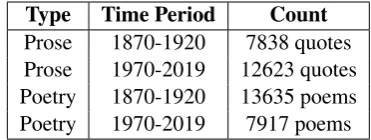
For poetry, PoetryFoundation1 and Po-emHunter2 websites were used. Finding the year of publishing of individual poems was difficult, so lists of popular poets of that time period were manually chosen from the websites mentioned, and their works were collated in the form of pdf files. These pdf files were converted into datasets. For prose, 30 top liked quotes (or lesser if 30 weren’t available) from 500 most popular books of the time segment as listed by Goodreads3 were computationally collected. The top liked quotes are often quite ’poetic’ in their content. The meta structure of our datasets is described in table1.
2.2 Features
Each line of a poem, and each sentence of a quote was considered as the smallest unit on which the
1
https://www.poetryfoundation.org/ 2
https://www.poemhunter.com/ 3https://www.goodreads.com/
Type Time Period Count
[image:3.595.322.508.62.132.2]Prose 1870-1920 7838 quotes Prose 1970-2019 12623 quotes Poetry 1870-1920 13635 poems Poetry 1970-2019 7917 poems
Table 1: Datasets
following features were calculated:
2.2.1 Grammar
While prose is always grammatical, poetry tends to break away from the limitations of grammar. With regard to the celebrated poet Emily Dick-inson, Miller (1987) writes that the former of-ten wrote in an ungrammatical manner. The term ‘poetic license’ (Britannica, 2007) is a testament to the fact that poets often break the rules of grammar. For instance, Kaur (2017) and Cum-mings (1994) have written without capitalization or punctuation, thus violating grammar.
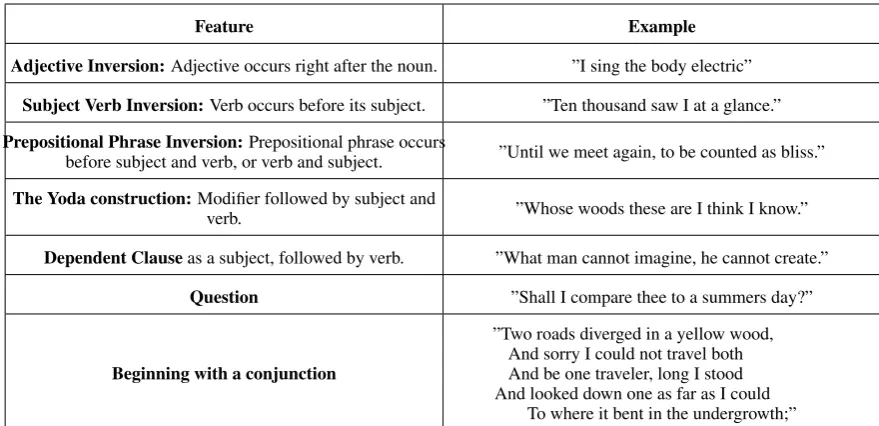
While the lack of capitalization and punctuation are not universal among poems, by manual eval-uation, it was noticed that the styles of the sen-tences used in poetry greatly differed from those in prose because of the use of inversion. Inversion is defined as, “the syntactic reversal of the normal order of the words and phrases in a sentence, as, in English, the placing of an adjective after the noun it modifies (“the form divine”), a verb be-fore its subject (“Came the dawn”), or a noun pre-ceding its preposition “worlds between”)” ( Britan-nica,2016).
As an example, Wordsworth in his poem, “I Wandered Lonely As A Crowd” (Wordsworth) uses the verb-subject inversion when he writes “Ten thousand saw I at a glance” instead of “I saw ten thousand at a glance”.
We use four different kind of inversions that we observed in poetry based on the discussion of styling sentences in Waddell (1993) supplemented by the insights in Literary Devices website ( De-vices,2015).
Waddell (1993) also describes the use of depen-dent clauses as a pattern of styling sentences and we noted that dependent clause as a subject oc-curred quite often in poems. The use of rhetori-cal questions in literature (Devices,2017) is quite prevalent, and they occurred more in our poetry datasets. The list of features related to grammar with examples are listed in table2.
In order to implement all of the above features, Stanford CoreNLP (Manning et al., 2014) tools of tokenization, parts of speech tags, dependency parse trees, OpenIE triples were used. Simple heuristics were used to decide which kind of in-versions exist in a given sentence using POS tags and OpenIE triple occurrences in the sentence. For instance, if the subject given by OpenIE triple of a line is a noun or pronoun, and it is preceded by a verb, the line would be marked as having subject-verb inversion. The OpenIE tool trained on prose, doesn’t always fetch results for lines in poetry and in these cases, we use POS tags as they are ac-curate for poetry as well. The various inversion counts were normalized by the number of lines in poetry datasets and the number of sentences in prose datasets, so as to remove dependency on the the length of the poem or quote.
2.2.2 Meter
Poets use inversion in order to fit their material into a meter (Britannica, 2016), which is noth-ing but the arrangement of stressed(s) and un-stressed(w) syllables in a certain manner (Boulton,
2014). In order to implement meter, we used Stan-ford Literary Lab’s Poesy (Heuser et al., 2018), which is a python module for poetic processing. The module gives information of a base meter among four types of base meters:
1. Iambic [ws]
2. Trochaic [sw]
3. Anapestic [wws]
4. Dactylic [sww]
It also gives information regarding the number of repetitions of meter in a given line, thus leading to information on whether the poem is a pentame-ter, hexameter etc.
2.2.3 Rhyme
Inversion is also used often to fit into a rhyme scheme along with meter. Using the Poesy
(Heuser et al.,2018) module, we also extract the rhyme scheme of poems. It was only used for comparison between the two poetry datasets. It has not been applied on the prose datasets as the values were null.
2.3 Classification
The feature vectors consisted of 9 features dis-cussed in the previous sections. Seven of them are various inversion types, followed by the base me-ter and number of feet. The extra feature, ‘rhyme type’ was only used for classification between the two poetry datasets.
The feature data was trained through a random forest classifier (Breiman,2001) and KNN classi-fier with a 70/30 split for the training and testing data. The optimal value of the number of trees for random forest classifier was found to be 100. The value of k is taken be 3 for the KNN classifier. To deal with class imbalance, we adjust weights inversely proportional to class frequencies in the data.
Four experiments of different classifications be-tween poetry and prose were conducted.
3 Results
Random Forest classifier performed better than KNN classifier in all of the below experiments:
3.1 Prose vs Poetry of Each Period
Classification of prose and poetry of each period was done to see if classification accuracy between poetry and prose has reduced for the time seg-ment 1970-2019 as compared to that of 1870-1920. This would indicate that poetry and prose are more similar in 1970-2019 than they were in 1870-1920. Various combinations of features were used with both the classifiers.
The reduction in the classification accuracy of poetry and prose of 1970-2019 as shown in table4
as compared to 1870-1920 as shown in table3, in-dicates convergence in poetry and prose in the pe-riod 1970-2019.
3.2 Poetry: 1870-1920 vs 1970-2019
Classification of poetry of 1870-1920 and poetry of 1970-2019 was conducted with rhyme as an ad-ditional feature.
Feature Example
Adjective Inversion:Adjective occurs right after the noun. ”I sing the body electric”
Subject Verb Inversion:Verb occurs before its subject. ”Ten thousand saw I at a glance.”
Prepositional Phrase Inversion:Prepositional phrase occurs
before subject and verb, or verb and subject. ”Until we meet again, to be counted as bliss.”
The Yoda construction:Modifier followed by subject and
verb. ”Whose woods these are I think I know.”
Dependent Clauseas a subject, followed by verb. ”What man cannot imagine, he cannot create.”
Question ”Shall I compare thee to a summers day?”
Beginning with a conjunction
”Two roads diverged in a yellow wood, And sorry I could not travel both And be one traveler, long I stood And looked down one as far as I could
[image:5.595.77.517.61.274.2]To where it bent in the undergrowth;”
Table 2: Grammatical Features
Classifier Feature Accuracy F1 Score ROC AUC Score
Random Forest All 98.4 98.4 98.02
Random Forest Meter 93.7 93.7 93.8 Random Forest Inversion 91.8 91.8 91.3
kNN All 97.4 97.4 97.02
kNN Meter 93.6 93.6 93.8
kNN Inversion 91.8 91.8 91.2
Table 3: Poetry vs Prose classification results for 1870-1920
Classifier Feature Accuracy F1 Score ROC AUC Score
Random Forest All 91.5 91.3 89.7
Random Forest Meter 83.4 82.8 80.06 Random Forest Inversion 85.1 84.5 82.06
kNN All 90.0 89.8 88.2
kNN Meter 80.6 79.2 75
kNN Inversion 84.1 83.6 81.07
Table 4: Poetry vs Prose classification results for 1970-2019
Classifier Accuracy F1 Score ROC AUC Score
Random Forest 77.0 76.3 73.11
kNN 72.6 72.5 70
Table 5: Poetry 1870-1920 vs Poetry 1970-2019 classification
Classifier Accuracy F1 Score ROC AUC Score
Random Forest 59.2 50.7 50
kNN 51.4 52.09 51.1
Classifier Accuracy F1 Score ROC AUC Score
Random Forest 94.7 94.7 94.7
[image:6.595.159.439.62.107.2]kNN 94.04 94.0 94.01
Table 7: Poetry vs Prose classification overall
3.3 Prose: 1870-1920 vs 1970-2019
Classification of prose of 1870-1920 and prose of 1970-2019 was conducted.
The results as shown in table 6 indicate that nothing much has changed in prose as per these features over the two periods because the evalua-tion scores are close to a random guess (59%).
3.4 Poetry and Prose Both Periods Combined
[image:6.595.313.513.164.318.2]This classification was done with combined datasets of poetry against combined datasets of prose. As per the results shown in table7, given an input, this classifier would differentiate between it being a poem or prose with 94.7% accuracy. This is an important result as we do not consider line breaks.
Figure 1: Poetry (18701920) vs Poetry (19702019) -Inversion Count
4 Analysis
4.1 Inversion
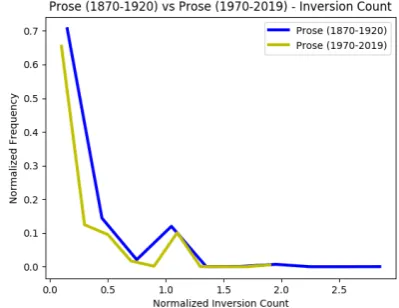
Figures 1 and2 are plotted between the normal-ized inversion count(so as to remove any depen-dency on the length of the poem/prose), and the normalized frequency of the datasets(so as to re-move dependency on the number of data points).
Figure 2: Prose (18701920) vs Prose (19702019) -Inversion Count
Figure1indicates a significant fall in the inver-sion count in the second time period. And figure 2
shows that the inversion counts of the two periods of prose are more or less the same.
4.2 Meter Base Type
The figures3and4represent the historical change in meter over the two periods for both prose and poetry. The y axis represents the percentage of dataset, which is a normalized indicator and does not skew the graph towards the period with higher data points.
[image:6.595.78.277.426.584.2] [image:6.595.313.518.573.726.2]Figure 4: Prose (18701920) vs Prose (19702019) -Meter Type
Figure 3 clearly shows the dominance of the iambic base meter in poetry datasets, and its fall from 1870-1920 to 1970-2019. It also shows that in 1970-2019, the number of poems with no dis-tinguishable meter has risen considerably with no significant change in anapestic or dactylic base meters.
Figure4proves that there is no significant dif-ference in the base meter of prose over the two chosen periods, with none value as the most dom-inant.
4.3 Popular Meters
Figure5and Figure6were drawn so as to show the change in meter. Meter plotted is a combination of the base meter and its feet in the poem. The top 7 meters were chosen for the plots.
Figure5shows the significant fall of the all the popular meters in the second time period as com-pared to the first. The increase in the none values also suggests that the second time period consists of poetry with no recognizable meter.
Figure 5: Poetry (1870-1920) vs Poetry (1970-2019)
[image:7.595.315.514.103.257.2]Figure6, on the other hand, shows the lack of recognizable meter in prose which is expected.
Figure 6: Prose (1870-1920) vs Prose (1970-2019)
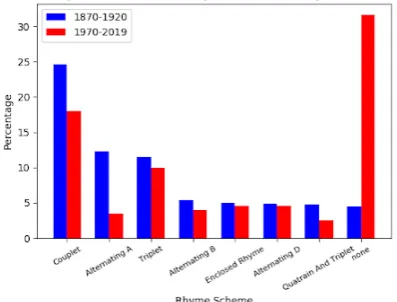
Figure 7: Poetry (18701920) vs Poetry (19702019) -Rhyme Scheme
4.4 Rhyme
The rhyme feature used in figure 7, shows that a large percentage of 1970-2019 poetry has no rhyme scheme, while also showing that the preva-lence of the other rhyme schemes has also come down.
5 Conclusion
[image:7.595.315.514.306.457.2] [image:7.595.79.282.586.740.2]defi-nition of poetry is thus established considering the changes in poetry as an artform.
Apart from justifying the historical changes in poetry and prose, this paper also achieves high ac-curacy in the classification of poem and prose us-ing no semantic features. This is an important in-dicator that semantic content of poetry and prose can be very alike and that they can still be differen-tiated using stylistic features without considering the obvious visual difference of line breaks.
The future work of this paper is to use these fea-tures in constructing a personalized poetry assis-tant that learns the stylistic preferences of the user in inversions and meter, based on user input of cre-ative text. This personalized nature of the assistant would adapt to the user’s wishes in becoming a ‘modern’ or a ‘classic’ poet.
References
Elizabeth Ann Beaulieu. 2003. The Toni Morrison
En-cyclopedia. Greenwood Publishing Group.
Walter Benjamin and JA Underwood. 1998. The work of art in the age of mechanical reproduction. na.
Marjorie Boulton. 2014.The Anatomy of Poetry (Rout-ledge Revivals). Routledge.
Leo Breiman. 2001. Random forests. Machine learn-ing, 45(1):5–32.
The Editors of Encyclopaedia Britannica. 2007.Poetic license.
The Editors of Encyclopaedia Britannica. 2016. Inver-sion.
Quanze Chen, Chenyang Lei, Wei Xu, Ellie Pavlick, and Chris Callison-Burch. 2014. Poetry of the crowd: A human computation algorithm to convert prose into rhyming verse. InSecond AAAI
Confer-ence on Human Computation and Crowdsourcing.
Edward Estlin Cummings and George James Firmage. 1994. ee cummings: Complete Poems, 1904-1962. Liveright Publishing Corporation.
Literary Devices. 2015. Inversion Examples and Defi-nition.
Literary Devices. 2017.Rhetorical question.
Sarjoun Doumit, Nagendra Marupaka, and Ali A Mi-nai. 2013. Thinking in prose and poetry: A seman-tic neural model. In The 2013 International Joint
Conference on Neural Networks (IJCNN), pages 1–
8. IEEE.
Terry Eagleton. 2007. How to read a poem. John Wi-ley & Sons.
Marjan Ghazvininejad, Xing Shi, Yejin Choi, and Kevin Knight. 2016. Generating topical poetry. In
Proceedings of the 2016 Conference on Empirical
Methods in Natural Language Processing, pages
1183–1191.
Dana Gioia. 2003. Disappearing ink: Poetry at the end of print culture. The Hudson Review, 56(1):21–49.
Leon Golden. 1968. Aristotle’s Poetics: a translation and commentary for students of literature. Prentice-Hall.
Ryan Heuser, Mark Algee-Hewitt, Maria Kraxen-berger, J.D. Porter, Jonny Sensenbaugh, and Justin Tackett. 2018.Poesy.
Noraini Jamal, Masnizah Mohd, and Shahrul Azman Noah. 2012. Poetry classification using support vector machines. Journal of Computer Science, 8(9):1441.
Immanuel Kant, Immanuel Kant, and Sir James Creed MEREDITH. 1952. The Critique of Judgement. Translated with Analytical Indexes by James Creed Meredith. Oxford.
Justine T Kao and Dan Jurafsky. 2015. A computa-tional analysis of poetic style. LiLT (Linguistic Is-sues in Language Technology), 12.
Rupi Kaur. 2017. The sun and her flowers. Simon and Schuster.
Christopher Manning, Mihai Surdeanu, John Bauer, Jenny Finkel, Steven Bethard, and David McClosky. 2014. The stanford corenlp natural language pro-cessing toolkit. In Proceedings of 52nd annual meeting of the association for computational lin-guistics: system demonstrations, pages 55–60.
Cristanne Miller. 1987. Emily Dickinson: A Poet’s
Grammar. Harvard University Press.
Ranzivelle Marianne Roxas and Giovanni Tapang. 2010. Prose and poetry classification and bound-ary detection using word adjacency network anal-ysis. International Journal of Modern Physics C, 21(04):503–512.
Percy Bysshe Shelley. 2009. A defence of poetry by percy bysshe shelley.
Catherine Soanes. 2012.Can you start a sentence with a conjunction?
Chris Tanasescu, Bryan Paget, and Diana Inkpen. 2016. Automatic classification of poetry by meter and rhyme. In The Twenty-Ninth International Flairs Conference.
Marie L Waddell. 1993. The art of styling sentences:
20 patterns for success. Barron’s Educational
Se-ries.