Munich Personal RePEc Archive
Estimating Efficiency Effects in a Panel
Data Stochastic Frontier Model
Paul, Satya and Shankar, Sriram
4 June 2018
Online at
https://mpra.ub.uni-muenchen.de/89236/
Estimating Efficiency Effects in a Panel Data Stochastic Frontier Model
Satya Paul+ and Sriram Shankar*
28 September 2018
Abstract
This paper proposes a stochastic frontier model which includes time-invariant unobserved
heterogeneity along with the efficiency effects. The efficiency effects are specified by a
standard normal cumulative distribution function of exogenous variables which ensures the
efficiency scores to lie in a unit interval. The model parameters are consistently estimated by
non-linear least squares after removing the individual effects by the usual within
transformation. The efficiency scores are directly calculated once the model is estimated. An
empirical illustration based on widely used panel data on Indian farmers is presented.
JEL Classification: C51, D24, Q12
Keywords: Fixed effects; Stochastic frontier; Technical efficiency; Standard normal cumulative distribution function; Non-linear least squares.
Acknowledgement: We are grateful to Hung-Jen Wang for providing us the farm level data that we have used for empirical exercise in this paper.
+ Centre for Economics and Governance, Amrita University, India, and 14 Grafton St., Eastlakes,
Sydney 2018, Email: [email protected].
* Corresponding author: Centre for Social Research and Methods, Australian National University, Email: [email protected].
1. Introduction
There is a vast literature on the measurement of technical (in) efficiency based on stochastic
frontier models ever since the pioneering studies of Aigner et al. (1977) and Meeusen van den
Broeck (1977). In most of the models, inefficiency is captured by a half normal or truncated
normal distribution, and a transformation proposed by Jondrow et al.(1982) (popularly known
as JLMS estimator) is utilised to derive the technical inefficiency scores. A number of
subsequent stochastic frontier studies have focussed on explaining inefficiency. For this
purpose, some studies notably by Kalirajan (1981) and Pitt and Lee (1981) have followed a
two-step procedure. In the first step, the production frontier is estimated, and the technical
inefficiency scores are obtained for each firm. In the second step, these technical inefficiency
scores are regressed against a set of variables which are hypothesized to influence firm’s
inefficiency. Given the drawbacks associated with the two-step method1, some recent studies
estimate the inefficiency scores and exogenous effects in one single step. Amongst these
studies, the most popular are those of Kumbhakar et al. (1991), Huang and Liu (1994) and
Battese and Coelli (1995). In order to examine the exogenous influence on inefficiency, these
authors parameterize the mean of pre-truncated distribution. These models are further
complemented by Caudill and Ford (1993), Caudill et al. (1995) and Hadri (1999) who account
for potential heteroscedasticity by parameterizing the variance of pre-truncated distribution.
Wang (2002) proposes a more general model that combines these two strands of one-step
models.
Availability of Panel data has led to further improvements in the stochastic frontier modelling,
allowing for time-invariant unobserved heterogeneity. Some of the earlier panel data stochastic
1See, for example, Battese and Coelli (1995), Simar and Wilson (2007) and Wang (2002).
frontier studies treated unobserved heterogeneity as a measure of inefficiency (eg. Schmidt and
Sickles, 1984; Kumbhakar, 1990; Battese and Coelli, 1992). This approach does not allow for
individual effects (in the traditional sense) to exist alongside inefficiency effects.
Greene (2005) proposes a “true fixed-effect” model, which is essentially a standard fixed-effect
panel data model augmented by an additional one-sided error term, whose mean is a function
of inefficiency effects. In this model, the heterogeneity is represented by dummy variables and
the problem of incidental (nuisance) parameters is encountered. Greene’s Monte Carlo
simulations reveal that this problem does not affect the frontier coefficients, but it leads to
inconsistent variance estimates. A similar result is reported in Wang and Ho (2010). The error
variances are important in the stochastic frontier context because they affect the extraction of
inefficiency scores from estimated composite residuals (Jondrow et al., 1982).
Chen et al. (2014) and Belotti and Ilardi (2017) adopted different estimation approaches to
estimate Greene’s model. The estimators proposed in these studies provide consistent estimates
of the frontier parameter vector
β
and composite error varianceσ
2even for small N (numberof firms) and T (time observations for each firm). However, these and couple of other studies
which explicitly account for ‘persistent’ (time-invariant) and ‘transient’ (time varying)
inefficiencies, (eg. Colombi et al., 2014) utilise JLMS transformation (Jondrow et al., 1982) to
derive the inefficiency scores. As shown in Schmidt and Sickles (1984), the JLMS estimator is
not consistent in that the conditional mean or mode of the random variable representing
inefficiency component (u) given the composite error (v-u) term, that is, u v−unever
approaches u even when the number of cross-sectional units tends to infinity. However, if the
panel data are used, this limitation can be overcome under certain other assumptions, some of
which may be less realistic (Parmeter and Kumbhakar, 2014)2.
Parmeter and Kumbhakar (2014) discuss a distribution free inefficiency effects model which
was first proposed in Simar et al. (1994) and later explained in Wang and Schmidt (2002) and
Alvarez et al. (2006). Parmeter et al. (2017) non-parametrically estimate distribution free
inefficiency effects using a partly linear model initially proposed by Robinson (1988). This
model is similar to the one proposed by Deprins and Simar (1989a, 1989b) and extended in
Deprins (1989). Paul and Shankar (2018) propose a distribution free efficiency effect model to
estimate technical efficiency scores3. The efficiency effects are specified by a standard normal
cumulative distribution function of exogenous variables which ensures the efficiency scores to
lie in a unit interval. Their model eschews one-sided error term present in almost4 all the
existing inefficiency effects models.
However, none of the existing distribution free models including more recent ones by Parmeter
et al. (2017) and Paul and Shankar (2018) account for unobserved heterogeneity. The present
paper extends Paul and Shankar’s (2018) model to account for unobserved heterogeneity within
the framework of a panel data stochastic frontier. While this technique can be applied to
2 Battese and Coelli (1988) have proposed an alternative estimator( (exp{ } |E −u v u− )). Kumbhakar and Lovell
(2000, pp.77-79) discuss this and the JLMS estimator in details and also refer to related findings of Horrace and Schmidt (1996).
3 In the efficiency literature, the term ‘distribution free’ is mentioned in Parmeter and Kumbhakar (2014) to refer
to the fact that inefficiency estimation need not utilize the truncated normal distribution. Parmeter and Kumbhakar (2014) utilize a scaling function and Paul and Shankar (2018) use a cumulative distribution function to derive efficiency scores. The relevant details are provided in Section 2 of this paper.
4 Even though the model as proposed in Parmeter and Kumbhakar (2014) requires no distributional assumptions
for the inefficiency term, it does invoke the scaling property in which the inefficiency term is initially assumed to have a basic distribution such as half or truncated normal distribution. Further, Parmeter et al. (2017) make no distributional assumptions concerning the inefficiency term but the estimation is performed in a non-parametric framework
stochastic frontiers of any type, production, cost or any other, the analytical framework and
empirical application presented in this paper are specific to a production frontier. The
parameters of the production function and efficiency effect specification are estimated by
non-linear least squares (NLS) after removing the individual effects by the usual within
transformation. Unlike existing parametric stochastic frontier models, the JLMS
transformation is not required to compute the efficiency scores. These scores are directly
calculated once the model is estimated.
The paper is organised as follows. Section 2 provides a review of existing panel data based
stochastic frontier models of inefficiency. In Section 3, we propose a stochastic frontier model
to estimate efficiency effects, accounting for time-invariant unobserved heterogeneity. An
empirical illustration based on panel data on Indian farmers is presented in Section 4. Section
5 provides conclusions.
2. A Review of Literature on Efficiency Measurement Based on Panel Data Stochastic Frontier Models
The literature on efficiency measurement based on panel data stochastic frontier is quite rich
and comprehensive. However, our review of literature presented below is brief and selective.
It covers topics such as unobserved heterogeneity, true fixed effects, persistent and time
varying inefficiencies, and distribution free (in) efficiency effects.
(i) Modelling Unobservable Firm Effects as a Measure of Inefficiency
The role of unobservable individual effects in the panel data estimation of stochastic frontier
models has been recognised for long. In some of the early panel data stochastic frontier studies,
individual effects are interpreted as inefficiency. For example, Schmidt and Sickles (1984)
consider the following stochastic production frontier specification.
it i it it
y =α +x β ε+ , i =1, … , N; t = 1, . . . , T. (1)
where yit is log of output and xit is a vector whose values are functions of input quantities and
time, i and t are cross section and time subscripts respectively, αi is time-invariant unobserved
firm-specific (individual) effect, and εit is a random noise term. Equation (1) is consistently
estimated by ‘within group’ ordinary least squares. After the model parameters are estimated,
individual effects are recovered and then adjusted to conform to an inefficiency interpretation
as
* = − =max
i i where i
α α α α α (2)
That is, inefficiency is measured as the difference between a particular firm’s fixed effects and
the firm that has the highest estimate of the fixed effects in the sample.By interpreting the firm
specific term as ‘inefficiency’ any unmeasured time invariant cross firm heterogeneity is
assumed away. The inefficiency estimates so obtained are time-invariant. Obviously, this
approach does not allow for individual effects (in the traditional sense) to exist alongside
inefficiency effects.
The time-invariant inefficiency assumption has been relaxed in a number of subsequent studies,
including Kumbhakar (1990) and Battese and Coelli (1992). These studies specify inefficiency
(uit) as a product of two components. One of the components is a function of time and the other
is an individual specific effect so that uit =G t( )×ui. For example, in Battese and Coelli (1992)
(
)
( ) exp
G t = −η t T− 5 and
(
, 2)
i
u N+ µ σ 6. In these models, however, the time varying
5η is an unknown scale parameter of the exponential function.
6
(
2)
,
N+ µ σ refers to truncated normal distribution.
pattern of inefficiency is the same for all individuals, so the problem of inseparable inefficiency
and individual heterogeneity remains.
(ii) True Fixed Effects Models
Greene (2005) has strongly argued that inefficiency effect and the time- invariant firm-specific
effect are different and should be accounted for separately in the estimation. If the firm-specific
heterogeneity is not adequately controlled for, then the estimated inefficiency may be picking
up firm-specific heterogeneity in addition to or even instead of inefficiency. Thus, the inability
of a model to estimate individual effects in addition to the inefficiency effect poses a problem
for empirical research. Greene (2005) proposed the following ‘True Fixed Effects’ (TFE)
model which account for unobserved firm specific heterogeneity along with time varying
inefficiency.
it i it it it i it it
y =α +x β +v −u =α +x β ε+ (3)
Assuming that the inefficiency term uit is half normally distributed, that is,
(
)
2
0,
it
u N+
σ
,the log likelihood function for the fixed effects stochastic frontier model is expressed as
1 1
2
log log
N T
it i it it i it i t
y x y x
L λ α β φ α β
σ σ σ
= =
− − − −
= Φ −
∑∑
(4)where φ
( )
. and Φ( )
. are the probability and cumulative density functions of a standard normaldistribution respectively, σ = σu2+σv2 is the standard deviation of the composite error term
it vit uit
ε = − and u
v
σ λ
σ
= is the ratio of inefficiency standard deviation to noise standard
deviation. Maximization of the unconditional log likelihood function in (4) is done by ‘brute
force’ even in the presence of possibly thousands of nuisance (incidental) parameters by using
Newton’s method. Based on Monte Carlo simulation, Greene shows that
β
estimates are notbiased but the residual estimates are biased possibly due to incidental parameters problem7.
Wang and Ho (2010) eliminate incidental parameters by either first differencing or within
transformation. Their model is specified as:
it i it it y =α +x β ε+ ,
it vit uit ε = − ,
vit N
( )
0,σ
v2 , (5)*
it it i
u =h ×u , hit = f z( itδ), ui* N
(
µ σ
, u2)
+
.
it
u is the technical inefficiency and zit is a vector of variables explaining the inefficiency. The
model exhibits the ''scaling property'' in the sense that, conditional onzit, the one-sided error
term equals a scaling function hit multiplied by a one-sided error distributed independently of
it
z . With this property, the shape of the underlying distribution of inefficiency is the same for
all individuals, but the scale of the distribution is stretched or shrunk by observation-specific
factorszit. The time-invariant specification of
*
i
u allows the inefficiency uit to be correlated over time for a given individual. On first differencing, the above equations result in the
following:
7 The incidental parameters problem is first defined in Neyman and Scott (1948) and surveyed in Lancaster
(2000).
( )
(
)
*
* 2
, , 0, ,
, ,
i i i
i i i
i
i it i
i u
y x
v u
v MVN
u h u
u N
β ε ε
µ σ
+
∆ = ∆ + ∆
∆ = ∆ − ∆
∆ Σ
∆ = ∆ ×
(6)
where∆ = ∆wi
(
wi2,∆wi3,...,∆wiT)
′, w∈{
y x, , , ,ε u v}
. The first-difference introduces correlations of ∆vitwithin the ith panel, and the(
T − ×1) (
T−1)
variance-covariance matrix ofthe multivariate normal distribution (MVN) of ∆viis given by
2
2 1 0 0
1 2 1 0
0
1
0 0 1 2
v
σ
−
− −
Σ =
−
−
(7)
Marginal likelihood function is then derived and estimation is performed by numerically
maximising the marginal log-likelihood function of the model (see Wang and Ho, 2010, p. 288
for details). Monte Carlo simulations carried out in their paper indicate that while the incidental
parameters problem does not affect the estimation of slope coefficients, it does introduce bias
in the estimated model residuals. Since the inefficiency estimation is based on residuals,
incident parameter problem should be of concern to empirical researchers, particularly when T
is not large.8
8Wang and Ho (2010) also estimated their model after within transformation and the results of Monte Carlo
simulations do not alter the conclusions.
Chen et al. (2014) suggest an alternative to the TFE treatment of Wang and Ho (2010).
Specifically, they propose a consistent marginal maximum likelihood estimator (MMLE) for
the TFE model exploiting a within-group data transformation and the properties of the closed
skew normal (CSN) class of distributions (Gonzalez-Farias et al., 2004). They also conduct a
simulation exercise and do not encounter any bias in the estimation of variance that Greene
(2005) and Wang and Ho (2010) have found in their studies.
Belotti and Ilardi (2018) propose two alternative consistent estimators which extend the Chen
et al. (2014) results in different directions. The first estimator is a marginal maximum simulated
likelihood estimator (MMSLE) that can be used to estimate both homoscedastic and
heteroskedastic normal-half normal and normal-exponential models. This estimator allows
only the time-invariant inefficiency effects. The second is a U-estimator based on all pairwise
quasi-likelihood contributions constructed exploiting the analytical expression available for the
marginal likelihood function when T = 2. This strategy allows them to provide a
computationally feasible approach to estimate normal-half normal, normal-exponential and
normal-truncated normal models in which inefficiencies can be heteroskedastic and may follow
a first-order autoregressive process. This estimator allows the modelling of inefficiency
variance9 as a function of exogenous effects. Finally, the finite sample properties of the
proposed estimators are investigated by conducting Monte Carlo simulations. The results show
good finite sample properties, especially in small samples.
9 Existing effects models parameterize the mean of the pre-truncated distribution as a way to study the
exogenous influence on inefficiency.
In another related research, Wikstrom (2015) suggests a class of consistent method of moment
estimators that goes beyond the normal half-normal TFE model proposed by Greene (2005).
This is demonstrated by deriving a consistent normal-gamma TFE estimator.
(iii) Models with Persistent and Time Varying Inefficiencies
In some panel data-based models, technical inefficiency is viewed as consisting of two
components, namely, persistent (long run) inefficiency and time varying (short run)
inefficiency. The persistent inefficiency is time-invariant and could arise due to the presence
of rigidity within a firm’s organisation and production process. Unless there is a change in
something that affects management practices at the firm (for example, new government
regulations or a change in ownership), it is unlikely that persistent inefficiency will change.
The time varying inefficiency could be due to non-organisational factors that can be reduced/
removed in the short run even in the presence of organisational rigidities10. The models
proposed by Kumbhakar (1991), Kumbhakar and Heshmati (1995) and Kumbhakar and
Hjalmarsson (1993, 1995) treat firm effects as persistent inefficiency and include another
component to capture time varying technical inefficiency and thus do not account for the
heterogeneity effects. The task of estimating these two inefficiencies while also allowing for
firm-effects heterogeneity is undertaken in Tsionas and Kumbhakar (2012) and Colombi et al.
(2014). The model proposed by these authors can be written as (see Kumbhakar et al., 2012):
10Colombi et al. (2014) have clarified the difference between persistent and time-varying inefficiencies by giving
an example of a hospital which has more capacity (beds) than the optimal required level, but downsizing may be a long-run process due to social pressure. This implies that the hospital has a long-run inefficiency since this gap cannot be completely recovered in the short-run. But this hospital may increase its efficiency in the short-run by reallocating the work force across different activities. Thus, some of the physicians' and nurses' daily working hours might be changed to include other hospital activities such as acute discharges. This is a short-run improvement in efficiency. Hence, the hospital continues to suffer from long run inefficiency due to excess capacity, but the time varying activities have improved part of its short-run inefficiency.
(
)
(
)
(
)
(
)
2
2
2
2 0,
0,
0,
0,
it i it it it i
i w
it v
it u
i h
y w x v u h
w N
v N
u N
h N
α β
σ
σ
σ
σ
+
+
+
= + + + − −
(8)
In this model wi, uit, hi represent respectively firm-specific unobserved heterogeneity,
transient inefficiency and persistent inefficiency. Fillipini and Greene (2016) develop a
practical full information maximum simulated likelihood estimator for this model in order to
reduce the extreme complexity of the log likelihood function in Colombi et al. (2014).
(iv) Distribution Free Models of (In)efficiency Measurement
Parmeter and Kumbhakar (2014) discuss a model possessing the scaling property which can be
estimated without making any distributional assumption. Their model can be written as
yit =xitβ +vit−g z
( )
itγ uit (9)where
( )
zitit
g z
γ
=e γ is the scaling function and uitthe basic distribution such as half-normal ortruncated normal. The conditional mean of y, given x and z, is
(
,)
= − zitit it it it
E y x z x β e γµ (10)
where µ=E u
( )
it . The equation (9) can be re-written as(
)
= − zit + − zit − = − zit +
it it it it it it
y x β e γµ v e γ u µ x β e γµ ε (11)
where = − zit
(
−)
it vit e uit γ
ε µ is independent but not identically distributed. This model can be
estimated with nonlinear least squares by minimizing
(
)
21 1
= =
− +
∑∑
itN T
z it it i t
y x β e γµ .
Parmeter et al. (2017) estimate the following partly linear regression model initially proposed
by Robinson (1988), which does not invoke the scaling property.
( )
(
( )
)
( )
= + − = − + − − = − +
it it it it it it it it it it it it
y x β v u x β g z γ v u g z γ x β g z γ ε (12)
where εit =vit−
(
uit −g z( )
itγ)
and E u( )
it =g z( )
itγ >0. To estimateβ
, the following equation is required.yit −E y z
(
it it)
=(
xit −E x z(
it it)
)
β ε+ it (13) Since, E y z(
it it)
and E x z(
it it)
are unknown, to obtain consistent estimate of βfor the partly linear model of Robinson (1988) the conditional means are replaced with their nonparametricestimates.
As pointed out in Parmeter and Kumbhakar (2014), the above two models, (11) and (12), suffer
from certain limitations. First, to avoid identification issues, z cannot contain a constant term
in models (11) and (12). Second, in model (11), since
ε
depends onz
throughe
zγ , x and zcannot contain common elements. However, Parmeter et al. (2017) show that x−E x z
( )
in(13) is uncorrelated with
ε
and hence the correlation betweenz
and xis not an issue. Finally,it is possible to obtain negative estimates ofg z
( )
in model (12) which is inconsistent with thenotion thatg z
( )
represents average inefficiency.Paul and Shankar (2018) propose a distribution free model wherein the efficiency effects are
specified by a standard normal cumulative distribution function of exogenous variables. This
ensures the efficiency scores to lie in a unit interval. Their model eschews one-sided error term
present in almost all the existing inefficiency effects models. The model contains only a
statistical noise term (v), and its estimation is done in a straightforward manner using the
non-linear least squares. Once the parameters are estimated, the efficiency scores are calculated
directly.
However, all the existing distribution free models including more recent ones by Parmeter et
al. (2017) and Paul and Shankar (2018) do not account for unobserved heterogeneity. In the
next section, we extend Paul and Shankar’s (2018) stochastic frontier model to account for
unobserved heterogeneity.
3. The Model
3.1 Model Specification
We propose the following TFE stochastic production frontier efficiency effects model which
accounts for time-invariant unobserved heterogeneity.
[
]
1
exp( ln ( ) ) 1,..., ; 1,...,
= + + + = =
it i it it it it i
Y α x β v H z γ u i N t T
µ (14)
where µ1ln
[
H z( itγ)]
uitis the scaled one-sided error term, Yit is the quantity of output, xit is avector whose values are functions of input quantities and time, andβis the corresponding
coefficient vector
(
K1×1)
. αi is firm-specific unobserved effect, and vit represents the random noise. (H zitγ) represents technical efficiency and is required to lie between 0 and 1, that is,0≤H z( itγ) 1≤ . Any cumulative distribution function (cdf) will satisfy this property. We
assume the efficiency term to take a probit functional form, that is,H z( itγ)= Φ(zitγ), where Φ
is a standard normal cdf, zit is a vector containing a constant 1 and exogenous variables
11
assumed to influence efficiency and γ is the corresponding
(
K2×1)
coefficient vector12.Equation (14) is written assuming that the panel data are unbalanced. However, in the case of
balanced data, Ti is to be replaced by T for all i.
Taking logarithm on both sides of (14), we have
[
]
1
ln( ) ln ( ) ) 1,..., ; 1,...,
it it i it it it it i
y Y α x β z γ u v i N t T
µ
= = + + Φ + = = (15)
This can be re-written as
[
]
ln ( )
it i it it it
y =α +x β+ Φ zγ +ε (16) where εit =vit+µ1ln
[
Φ(zitγ)]
(
uit−µ)
is independent but not identically distributed and( )
it E uµ = .
3.2 Within Transformation
The within transformation will eliminate unobserved firm-specific effects (αi). Thus, on
subtracting time averages of the concerned variables, we have
11 A potential limitation of our specification as well most other distribution free inefficiency effects models
including the recent one by Parmeter et al. (2017) is that the firms with the same z have the same efficiency.
However, in most practical applications if sufficient number of variables are included into the (in) efficiency effects model then it is less likely that any two firms in the same time period or the same firm across different
time periods will have the same z vector.
12 We could have chosen any other function which is not a cumulative distribution function as long as this function
is constrained to lie between 0 and 1. For example, we could have chosen ( ) 1
1
it
it
H z
z
γ
γ
=
+ and restrictedzitγ ≥0
. Another example of a function which is also not a distribution function but whose range lies is the unit interval,
is a Gompertz function of the form ( ) ezit
it
G zγ =e− γ(see Simar et al., 1994)). Instead, we chose probit function
because it is quite popular in econometric literature and we do not have to impose any constraints on the parameter
vector γ so that 0< Φ(zitγ) 1< .
(
)
(
)
(
)
1 1 1 1
1
1
1
1
1 1 1 1
ln ( ) ln ( )
( ) ln ( ) ( ) ln ( )
i i i i
i i
i i
T T T T
it ip it ip it ip it ip
p p p p
i i i i
it
it i it i it i
T T ip p it it it T T ip p
y y x x z z
T T T T
or
z
y y x x
z
z y x
z
β γ γ ε ε
γ
β ε ε
γ γ β γ = = = = = =
− = − + Φ − Φ + −
Φ
− = − + + − Φ Φ = + Φ
∑
∑
∑
∑
∏
∏
εit i 1,..., ;N t 1,...,Ti
+ = = (17) where 1 1 Ti
i ip
p i
w w
T =
=
∑
andw
i= −
w
itw w
i,
∈
{
y x
, ,
ε
}
.Equation (17) can be estimated by minimizing the following sum of squared errors with respect
to parameter vectorθ :
( )
2 1 1 1 1 ( ) ln ( ) i i i T N itNT it it
T T i t ip p z
Q y x
z
γ
θ
β
γ
= = = Φ
= − −
Φ
∑∑
∏
(18)
where θ =
(
β γ′ ′,)
′ is(
K×1)
parameter vector. Equation (17) can be estimated using the nonlinear least squares (NLS).Equation (17) can be re-written as
(
, ,)
1,..., ; 1,...,= + = + = =
it it it it it it i
y g x z θ ε g ε i N t T (19)
where
(
)
11
( )
, , ln
( )
i i
it it it it
T T
ip p
z
g x z x
z γ
θ β
γ
=
Φ
= +
Φ
∏
.
Stacking all the time series observations of a firm together equation (19) can be compactly
written in matrix notion as
= +
y
g
ε
(20)where
(
11, 12, , 11, , 1, 2, , , , 1, 2, ,)
'=
y y yT y i yi yiTi yN yN yNTN
y
1 1
11 11 12 12 1 1 1 1 2 2
1 1 2 2
{ ( , , ), ( , , ), , ( , , ), , ( , , ), ( , , ), , ( , , ),
, ( , , ), ( , , ), , ( , , )}'
i i
N N
T T i i i i iT iT
N N N N NT NT
g x z g x z g x z g x z g x z g x z
g x z g x z g x z
θ θ θ θ θ θ
θ θ θ
=
g
(
11, 12, , 11, , 1, 2, , , , 1, 2, ,)
'=
ε ε εT ε εi i εiTi ε εN N εNTN
ε
Each of these three vectors have a dimension of
(
L×1)
, where1
N
i i
L T
= =
∑
.Thus equation (18) can be written as
( )
(
(
)
)
2(
) (
)
1 1
, ,
i
T N
L it it it
i t
Q θ y g x z θ
= =
′ ′
=
∑∑
− =ε ε = y g y g− − (21)Given this setup, Theorems 1 and 2 state the assumptions required for the proposed nonlinear
least squares estimator to be consistent.
Theorem 1:
Consider the following conditions.
(i) The parameter space Θ is an open subset of K
R ,
(ii) QL
( )
θ is a measurable function of data for all θ∈Θ and QL( )
θ is continuous in θ ∈Θ.(iii) The objective function QL
( )
θ converges in probability to a non-stochastic function( )
0
Q θ , and Q0
( )
θ attains a global maximum atθ0.If these conditions hold, then the estimator ˆ arg max ( )
NLS θ QL
θ = ∈Θ θ is consistent forθ0, that is,
0
ˆ p
NLS
θ →θ . Here, uniform convergence in probability of QL
( )
θ to Q0( )
θ =plimQL( )
θ in condition(iii) implies thatSup
( )
0( )
0p L
Q Q
θ∈Θ θ − θ → .
Proof: See Theorem 4.1.1 and related proof in Amemiya (1985).
In case of local maximum, the first derivative of QL
( )
θ need to exist, but one needs to thenfocus on the behaviour of QL
( )
θ and its derivative in the neighbourhood of θ0.Theorem2:
Consider the following conditions.
(i) The parameter space Θ is an open subset of K
R .
(ii) QL
( )
θ is a measurable function of data for all θ∈Θ, and( )
LQ θ
θ ∂
∂ exists and is
continuous in an open neighbourhood of θ0.
(iii) The objective function QL
( )
θ converges uniformly in probability to Q0( )
θ in openneighbourhood ofθ0, and Q0
( )
θ attains a local maximum atθ0.If these conditions hold, then one of the solutions to QL
( )
θθ ∂
=
∂ 0is consistent forθ0.
Proof: See Theorem 4.1.2 and related proof in Amemiya (1985).
Condition (i) in Theorem 1 allows a global maximum to be on the boundary of the parameter
space, whereas in Theorem 2 a local maximum has to be in the interior of the parameter space.
Condition (ii) in Theorem 2 also means continuity of QL
( )
θ in an open neighbourhood ofθ0,where a neighbourhood N
( )
θ0 of θ0is open if and only if there exists a ball with centre θ0entirely contained inN
( )
θ0 . Condition (iii) is important in both the Theorems as the maximum,global or local, of QL
( )
θ must occur atθ θ= 0. In Theorem 1, (iii) provides the identificationcondition that θ is unique. For local maximum, if there is only one local maximum then
analysis is straight forward as ˆθ is uniquely defined by ( )
ˆ
NLS
L
Q
θ
θ θ
∂ =
∂ 0. When there is more than
one local maximum then Theorem 2 implies that one of the local maximum is consistent. In
such cases it is best to consider the global maximum and apply Theorem 1. For a discussion on
this, see Newey and McFadden (1994, p.2117).
The following Theorem establishes the asymptotic distribution for the proposed nonlinear least
squares estimator.
Theorem3:
Consider the following specifications.
(i) The model is given by yit =g x z
(
it, ,it θ)
+εit =git+εit(ii) In the DGP, E
(
εit x zit, it)
=0 andE(
εε′x zit, it)
= Σ, whereΣ =ij σij.(iii) The mean function g
( )
⋅ satisfies g x z(
, ,θ( )1)
=g x z(
, ,θ( )2)
if and only if θ( )1 =θ( )2(iv) The matrix
0 0
1 A plim
L θ θ θ
′ ∂ ∂ =
′ ∂ ∂
g g
(22)
exists and is finite non-singular for any sequence θsuch that 0
p
θ →θ .
(v)
[
]
0 1 2
0 1 1
1
plim , B
i
T
N d
it it i j
g
L N
L θ ε θ
−
= =
∂ →
∂
∑∑
0 , where0 0
1 B = plim
L θ θ θ
′ ∂ Σ ∂
′ ∂ ∂
g g
. (23)
Then, the NLS estimatorθˆNLS, defined to be root of the first order conditions
( )
1
L
L Q− θ θ
∂ ∂ =0is
consistent for θ0and
(
)
1 2 1 1
0 0 0 0
ˆ d , A B A
NLS
L− θ −θ → N0 − − . (24)
Proof: See Appendix A
Specifications (i) to (iii) are needed to establish consistency ofθˆNLS, that is, ˆ 0
p NLS
θ →θ and they
also imply that the regression function is correctly specified and regressors are uncorrelated
with the errors and that θ0is identified. Since probit is a strictly increasing function of its
parameters, (iii) is satisfied in Theorem 3. The probability limits in (22) and (23) are with
respect to the DGP of x and z; they become regular limits if x and z are non-stochastic. Since,
1
N i i
L T
=
=
∑
, consistency of the NLS estimator is obtained by N → ∞ or Ti→ ∞ ∀i.Given Theorem 3, the resulting asymptotic distribution of the NLS estimator can be expressed
as
(
)
1(
)
1ˆ a ,
NLS N D D D D D D
θ θ ′ − ′ ′ −
Σ
(25)
where the derivative matrix
0
D
θ
θ
∂ =
′ ∂
g
and
1
1 1
1
L
L
K K
g g
g g
θ θ
θ
θ θ
∂ ∂
∂ ∂
′ ∂
=
∂
∂ ∂
∂ ∂
g
. We assume that the law
of large numbers applies, so that the plim operator in the definitions of A and 0 B are replaced 0
by limE, and then the limit can be dropped.
3.3 Structure of the Covariance Matrix
Theorem 4 below specifies the error covariance matrix in (19).
Theorem 4:
Consider the following assumptions.
(i) E v
( )
it2 =σ
v2(ii) E v v
(
it is)
=0if t≠s(iii) E v v
( )
it jt =0if i≠ j(iv) E u
( )
it =µ(v) E u u
(
it js)
=E u( )
it E u( )
js =µ
2 ∀ ≠i jand/ort≠s(vi) E
(
uit−E u( )
it 2)
=σ
u2(vii) E v u
( )
it js =E v E u( )
it( )
js = ∀0 i j t, , andsIf these assumptions hold, then,
( )
1 0 0 0
0 0 0
0 0 0 0
0 0 0
i
N
E
Σ
′ = Σ = Σ
Σ
εε
has a dimension of
1 1
N N
i i
i i i
T T
= =
×
∑ ∑
. Σi has a dimension of(
Ti×Ti)
and is specified asΣ = Σ + Σ + Σi Ai Bi Ci (26) where
2
1 1 1
1 1 1
1 1
i
i i i
i
i i i
Ai v
i
i i
T
T T T
T
T T T
T T T σ − − − − − −
Σ =
− − , ( )
{
}
(
( ) ( ))
(
( )(
)
)
( ) ( )(
)
{
( )}
(
( )(
)
)
22 2 2 2
1 1 2 1
2
2 2 2 2
2
2 1 2 2
2
2 1 1
ln ( ) 1 ln ( ) ln ( ) ln ( ) ln ( )
1 2 1
ln ( ) ln ( ) ln ( ) 1 ln ( ) ln ( )
1
ln (
i
i
Bi
i i i i iT
i i i
i i i i iT
u
i i i
i i
z z z z z
T T T
z z z z z
T T T
z T
γ γ γ γ γ
γ γ γ γ γ
σ µ Σ =
Φ − − Φ + Φ − Φ + Φ
− Φ + Φ Φ − − Φ + Φ
− Φ
(
)
( )(
2 2)
(
(
)
2 ( ) 2)
{
(
)
}
21 2
1 2
) ln ( ) ln ( ) ln ( ) ln ( ) 1
i i i
T i iT i iT
i i
z z z z
T T
γ γ γ γ γ
+ Φ − Φ + Φ Φ −
(
)
{
}
2 2 2 2 1ln ( )
i
T u
Ci ik i i
k i
z T
σ γ ιι
µ =
′
Σ =
∑
Φ , where ιi is a(
Ti×1)
vector of 1’s.Proof: See Appendix B
3.4. Recovering the Individual Fixed Effects
Even though the individual effects αi'sare not estimated in the model, their values can be
retrieved as follows:
(
(
)
)
1
1 ˆ
ˆ ln ( ˆ) 1,...,
i
T
i it it it
t i
y x z i N
T
α β γ
=
=
∑
− − Φ = (27)The estimates of individual fixed effects thus obtained would be consistent if Ti→ ∞. The hat
symbol on the right-hand side of the above equation refers to values estimated with nonlinear
least squares.
3.5 Estimating ˆ2
v σ
Since 2
v
σ is unknown, in order to obtains its estimates we have to assume a distribution for the
term uitin (15). We assume it to be Gamma distributed, that is, uit Γ
(
µδ δ,)
. We then have( )
itE u µδ µ
δ
= = (28)
( )
(
( )
2)
22 u V uit E uit E uit
µδ µ σ
δ δ
= = − = = and (29)
( )
(
3)
3 2
2 2
it it
E u E u µδ µ
δ δ
− = =
(30)
These properties in (16) imply that
( )
it 0E ε = (31)
( )
(
)
( )
(
)
(
)
2 2
2 2 2
2 2
2 2
1 1
ln ( ) ln ( )
1
ln ( )
= + Φ = + Φ
= + Φ
it v it it v it
v it
E z V u z
z
µ
ε σ γ σ γ
µ µ δ
σ γ
µδ
(32)
( )
(
)
(
( )
)
(
)
( )
(
)
3 3 3
3
3 3 2
3 2
1 1 2
ln ( ) ln ( )
2
ln ( )
= Φ − = Φ = Φ
it it it it it
it
E z E u E u z
z
µ
ε γ γ
µ µ δ
γ µδ
(33)
A consistent estimate of 2
v
σ can now be obtained13 from the residuals in (15) by means of
13 Since
( )
( )
(
)
3
3 3
2 2
ln ( )
it E it eit zit eit
ε ε γ
µδ
= + = Φ +
,
( )
2 2µδ is the coefficient estimate of this regression. Here
it
e is the random error term.
(
)
(
)
( )
3 3 1 1 2 6 1 1ˆ ln ( ˆ)
2 ˆ
ln ( ) i i T N it it i t T N it i t z z ε γ µδ γ = = = = Φ = ⇒ Φ
∑∑
∑∑
(
)
(
)
6 1 1 3 1 1 ˆ2 ln ( )
ˆ ln ( ˆ)
i i T N it i t T N it it i t z z γ µδ ε γ = = = = Φ = Φ
∑∑
∑∑
(34)and
(
)
2 2 2 1 1ln ( )
1 ˆ ˆ i T N it v it i t z L K γ σ ε µδ = =
Φ
= −
−
∑∑
(35)Hence, by substituting ˆ2
v
σ from the above equation in (26) the feasible variance-covariance14
matrix is given15 by
1
ˆ 0 0 0
0 0 0
ˆ
0 0 0 0
ˆ
0 0 0
i
N
Σ
Σ = Σ
Σ
(36) where
i Ai Bi Ci
Σ = Σ + Σ + Σ (37)
14 From (28) and (29) we get
2
2 1
u
σ
µ =µδ and this is used in the variance-covariance matrix below.
15 Since
(
)
2
2 2 1
ln ( )
it v zit eit
ε σ γ
µδ
= + Φ +
, ˆ2
v
σ is obtained by regressing
(
)
2 2 1
ln ( )
it zit
ε γ
µδ
− Φ
on a constant.
Here eitis the random error term.
2
1 1 1
1 1 1
1 1
i
i i i
i
Ai v i i i
i
i i
T
T T T
T
T T T
T
T T
σ
− − −
− − −
Σ =
− −
,
( )
(
)
{
}
(
)
(
)
(
)
(
)
(
)
(
)
{
(
)
}
(
)
(
)
2 2 2 2
2
1 1 2 1
2 2 2 2
2 1 2 2
2 1 1
ln ( ) 1 ln ( ) ln ( ) ln ( ) ln ( )
1 2 1
ln ( ) ln ( ) ln ( ) 1 ln ( ) ln ( )
1
i
i
Bi
i i i i iT
i i i
i i i i iT
i i i
z z z z z
T T T
z z z z z
T T T
γ γ γ γ γ
γ γ γ γ γ
µδ Σ =
Φ − − Φ + Φ − Φ + Φ
− Φ + Φ Φ − − Φ + Φ
(
)
(
)
(
)
(
)
{
(
)
}
2
2 2 2 2 2
1 2
1 1 2
ln ( ) ln ( ) ln ( ) ln ( ) ln ( ) 1
i i i
iT i iT i iT
i i i
z z z z z
T γ γ T γ γ γ T
− Φ + Φ − Φ + Φ Φ −
( )
{
(
)
}
2 2
1 1
ln ( )
i
T
Ci ik i i
k i
z T
γ ιι µδ =
′
Σ =
∑
Φ , where ιi is a(
Ti×1)
vector of 1’s.3.6 Technical Efficiency
It may be noted that
(
)
(
)
1
ln ( it ) it ln ( it )
E zγ u z γ
µ
Φ = Φ
(38)
Once the coefficient vector γ is estimated, the mean technical efficiency can be readily
estimated as
=exp ln
(
[
Φ( ˆ)]
)
= Φ( ˆ)it it it
TE z γ z γ (39)
4. An Empirical Illustration
Annual data from 1975–1976 to 1984–1985 on farmers from the village of Aurepalle in State
of Andhra Pradesh in India16 are used for empirical illustration. The data are unbalanced for 34
farmers with 271observations over the period of 10 years17. This data set was made available
to us by Hung-Jen Wang to whom we are thankful. In the past, this dataset has been used in
several inefficiency studies including Battese and Coelli (1995), Coelli and Battese (1996) and
Wang (2002). In line with these studies, the Cobb-Douglas functional form is chosen for our
stochastic production function. For the production function, yit: ln(Yit) where Y is the total value
of output (in Rupees, in 1975-76 values) from the crops which are grown; xit: {ln(Landit),
ln(Laborit), ln(Bullockit), PILandit, ln[Max(Costit, 1 −Dit)], Yearit} where Land is the total area
of irrigated and unirrigated land operated, Labor is the total hours of family and hired labor,
Bullock is the hours of bullock labor and PILand is the proportion of operated land that is
irrigated. Cost is the value of other inputs, including fertilizer, manure, pesticides, machinery,
etc. and D is a variable which has a value of one if Cost is positive, and a value of zero if
otherwise. Year is the year of the observation, numbered from 1 to 10, which accounts for the
Hicksian neutral technological change. For the efficiency effect specification, zit: {Ageit,
Schoolingit, Landit,, Landit2}, where Age is the age of the primary decision-maker in the farming
operation and Schooling is the years of formal schooling of the primary decision maker. We
expect the efficiency level of the farms to increase with the level of education of the decision
maker. However, it is difficult to predict a priori the sign on the effect of age of primary
decision maker on efficiency. If the younger people have better knowledge of farming
techniques and management then the farms with younger decision makers are likely to be more
16 These farm-level data on the agricultural operations of farmers were collected by the International Crops
Research Institute for the Semi-Arid Tropics (ICRISAT).
17 This data set contains all the 10 year observations for 16 of the farmers, and 2 minimal observations for 2 of
the farmers.
technically efficient, other things remaining the same. On the other hand, if the experience
gained over the years matters for farming, then the farms managed by older persons might be
technically more efficient. Thus, the effect of age of primary decision maker on technical
efficiency is an empirical issue. Land and Land2are used to capture non-linear relationship
between efficiency and farm size. There is a very old and vast literature debating the negative
relationship between farm size and productivity where the latter is defined as output per land
area cultivated (Sen, 1966; Carter, 1984; Eswaran and Kotwal, 1986; Bhalla and Roy, 1988;
Benjamin, 1995; Barrett, 1996; Heltberg, 1998). However, the effect of land size on farm
efficiency is investigated only recently. Whether small farms have technical efficiency
advantage and remain competitive in the light of ongoing transformation of agricultural
markets and supply chain, is an empirical question. Using the Mexican panel data on farming,
Kagin et al. (2016) find an inverse efficiency relationship with farm size within the stochastic
frontier framework of Battese and Coelli (1995). Using the Brazilian farming data, Helfand
and Levine (2004) reveal a non-linear relationship between farm size and efficiency, with
efficiency first falling and then rising with size. Similarly, for the Swedish dairy farms,
Hansson (2008) also reports a U-shaped relationship between efficiency and farm size. The
insertion of Land and Land squared terms in the efficiency model allows us to test whether the
U-shaped farm size-efficiency relationship also holds for Indian farmers.
The summary statistics of sample data are presented in Table 1. The land area cultivated varies
from 0.20 to 20.97 hectares. The percentage of land area under irrigation varies from 0 to 100%.
The age of farmers varies from 26 to 90 years and the level of education of farmers varies from
illiteracy to 10 years of schooling.
[insert Table 1 here]
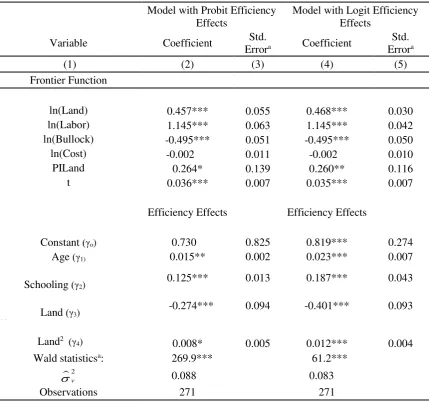
The non-linear least squares (NLS) parameter estimates of the proposed model (equation 17)
are obtained using Matlab software package. These estimates along with their standard errors
are presented in cols. 2 and 3 of Table 2. The coefficients of inputs in the production function
represent their output elasticities. The output elasticities with respect to Land and Labor are
positive and statistically significant. In terms of the magnitude of elasticity, labor turns out to
be most important factor of production. The output elasticity of Bullock, which is negative and
statistical significant, is not to our expectations. This result was also observed in Battese and
Coelli (1992, 1995), Coelli and Battese (1996) and Battese et al. (1989). A plausible
explanation for this result, as provided in Battese and Coelli (1995), is that farmers may use
bullocks more in years of poor production (associated with low rainfall) for the purpose of
weed control, levy bank maintenance etc., which are difficult to conduct in years of higher
rainfall and higher output. Hence, the bullock-labor variable may be acting as an inverse proxy
for rainfall. The elasticity of Cost (of other inputs) is negative but statistically insignificant.
The elasticity of PILand is positive and significant at the10 percent level, implying that higher
the proportion of irrigated farming, the larger is the output, other things remaining the same.
The coefficient on Year is positive and significant, implying that there is significant
technological progress.
[insert Table 2 here]
In the technical efficiency effects specification, the coefficient of Schooling of the decision
maker is positive and statistically significant, implying that the efficiency of a farm improves
with the level of education of the primary decision maker. The coefficient of Age of the
decision maker is also positive and significant, implying that, cetris paribus, farms managed
by older farmers are more efficient than those managed by younger farmers. This is expected
because in the traditional farming, the practical experience gained by farmers over the years is
likely to improve their farming efficiency. While the coefficient of Land is negative (-0.247)
and statistically significant at the 1 percent level, the coefficient of Land Squared is positive
(0.008) and statistically significant at the 10 percent level. This implies that the efficiency
relationship with farm size is U-shaped with efficiency first declining with farm size and then
increasing with size. This finding is similar to the results reported in Helfand and Levine (2004)
for the Brazilian farms. These results suggest that since small farms have efficiency advantage,
it could be that a heterogeneous farm structure, in which small farms coexist with large ones,
is consistent with promoting agricultural growth. While the small farms’ technical efficiency
advantage has ramifications for their potential role in combating poverty and enhancing food
security, the medium sized farmers should aim for farm sizes which are in the larger farm size
segments to take advantage of higher productive efficiency.
The null hypothesis that there are no efficiency effects (i.e., all the coefficients of efficiency
effects model are zero) is rejected at the 1% significance level by the Wald statistics. The
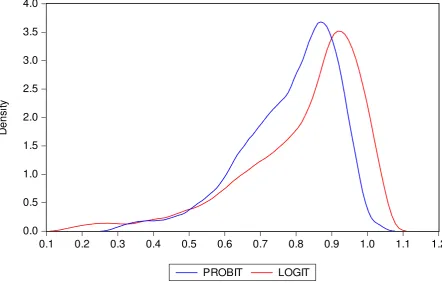
technical efficiency levels range from 0.344 to 0.989 with an average level of 0.783 (Table 3,
col. 2). The estimated probability density function (pdf) of technical efficiency which is skewed
to the left, is leptokurtic as revealed by the Kurtosis statistics (Figure 1).
[insert Table 3 here]
[insert Figure 1 here]
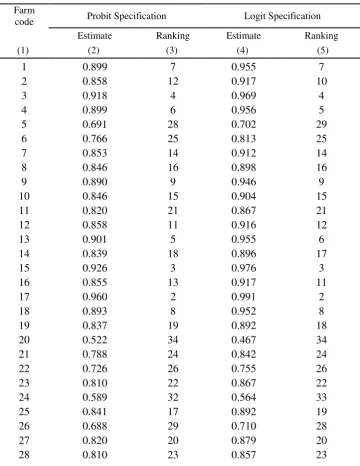
The technical efficiency scores of farms (averaged over the sample period) along with their
rankings are presented in cols. 2 and 3 of Table 4. It is also worth noting that the average
efficiency level of farmers shows a mild increase over time, from an average of 0.777 in the
first half of the period to 0.789 in the second half (Table 5).
[insert Table 4 here]
[insert Table 5 here]
The model with efficiency effects specified by a logistic cumulative distribution function (logit
model) is also estimated to see the sensitivity of results. The input elasticities of the production
function with logit efficiency effects specification presented in col 4 of Table 2 are quite similar
to those with the probit specification, in terms of magnitude and signs. The estimated
coefficients of Age and Schooling of the decision maker in the logit specification of efficiency
effects have the same signs as observed in the case the probit specification. The efficiency
relationship with farm size is also observed to be U-shaped. The average efficiency level of
farms based on the logit specification is 0.818which is slightly higher than that observed in the
case of the probit specification (0.783) (Table 3). The efficiency ranking of farms by the logit
model is almost the same (with some minor differences) as that by the probit model (Table 4).
Like the probit model, the logit specification also shows a mild increase in average efficiency
from first half period to the second half (Table 5). It is also worth noting that the correlations
between the probit and logit efficiency estimates and their rankings are quite high, 0.998 and
0.997 respectively.
5. Concluding Remarks
This paper proposed a stochastic frontier panel data model which accommodates time-invariant
unobserved heterogeneity along with efficiency effects. The efficiency effects are specified by
a standard normal cumulative distribution function of exogenous variables which ensures the
efficiency scores to lie in a unit interval. The model is within-transformed and then estimated
with non-linear least squares. The estimated parameters thus obtained are consistent. The JLMS
transformation is not required to compute efficiency scores. In our case, the efficiency scores
are calculated directly once parameters of the model are obtained.
The empirical exercise conducted with widely used panel data on Indian farmers reveals that
both the education and age of the primary decision-maker enhance the efficiency of farms. The
relationship between efficiency and farm size is found to be U-shaped. This suggests that since
small farms have efficiency advantage, it could be that a heterogeneous farm structure, in which
small farms co-exist with large ones, is consistent with promoting agricultural growth