Quantum Teleportation with an Accelerated
Partner in Open System
Maohuai Xiang, Jiliang Jing*
Department of Physics, and Key Laboratory of Low Dimensional Quantum Structures and Quantum Control of Ministry of Education, Hunan Normal University, Changsha, China
Email: *[email protected]
Received September 23,2012; revised November 5, 2012; accepted November 14,2012
ABSTRACT
We investigate the teleportation between two relatively accelerating partners undergoing the phase flip, bit flip and bit-phase flip channels. We find that: 1) the fidelity decreases by increasing the acceleration of accelerated observer; 2) the dynamic evolution of the fidelity is different for various channels if the acceleration is fixed; and 3) the fidelity is always symmetric about 2 1
2
where is a parameter of the transmission state.
Keywords: Quantum Teleportation; Non-Inertial Frames; Open System
1. Introduction
In recent years, quantum mechanics and quantum infor- nmation science have developed rapidly. As one of the significant characteristics of quantum mechanics [1], the quantum entanglement has been attracted much attention [2] and its momentous application is quantum teleporta- tion proposed by Bennett et al. [3]. This application in- volves many attractive theoretical features and shows a bran-new way unlike classical teleportation [4-8]. How- ever, the early study was confined to the inertial frame. About ten years ago, P. M. Alsing et al. considered the teleportation with an uniformly accelerated partner [9,10], which firstly extended the quantum information to the non-inertial frames. Since then, many authors focus on this interdiscipline [11-16]. Moreover, some of them studied the teleportation in some kinds of black hole spacetimes and discussed how the Hawking effect affects the entanglement and teleportation [17-21]. It is not doubtful that these studies will makes the theories more complete, not only for quantum information theory, but also for relativistic quantum mechanics and quantum field in curved spacetime.
It is well known that the interaction between quantum system and surrounding environment is inevitably in our real world, and then the dynamic evolution of the quan- tum system is non-unitary (although the whole system including the quantum system and surrounding environ- ment evolves in an unitary fashion), so it becomes more complex. Generally, this interaction can be viewed as the
interchange of information between quantum system and surrounding environment. It plays a fundamental role in the description of the quantum-to-classical transition [22,23] and has been successfully applied in some im- portant places such as the cavity QED [24] and ion trap experiments [25]. So studying teleportation between two relatively accelerated partners in open system is an inter- esting topic, which not only makes the theory of the quantum teleportation more complete, but also is helpful for us to understand how the surrounding environment affects the quantum teleportation. In this paper, we will discuss teleportation for fermionic resources with one of the EPR partners accelerated undergoing the environ- ment, such as the bit flip, the phase flip, and the phase-bit flip channels.
The outline of this paper is as follows. In Section 2 we analyse the entangled state shared by two relatively ac- celerated partners. In Section 3 we introduce the dy- namics of the system interacting with the environment. In Section 4 we investigate how the environment effects the fidelity of the teleportation when teleportation undergoes environment. And we summarize and discuss conclu-sions in the last section.
2. Entangled State between Alice and Rob
We assume that an unknown state is teleported from Al- ice who stays rest to Rob who moves with uniform ac- celeration, and all our work is confined to Dirac field. As shown in Refs. [26-29], the corresponding Unruh spinor basis states can be described by a superposition of Unruhmonochromatic modes
0U 0 U, 1U 1
U, (1) with
0 cos 0 | 0 sin 1 1
1 1 0 ,
II
U I I
U I II
r r
,
II
(2)
where the subscripts I and II represent Rindler regions I and II,
speed of light in vacuum.
Considering Alice and Rob initially share the maxi- mally entangled Bell state
1
0 0 1 1 ,
2 A R A R
(3)
then Alice stays stationary, while Rob moves with an uniform acceleration. To describe the state shared by them, we must rewrite the initial state (3). Using Equa- tion (2), the state can also be represented as
1 2 2πcosr e c a1 , a is Rob’s acceleration,
is the frequency of the Dirac particle, and is the c
2
2
1
cos 000 000 cos sin 000 011 2
cos 000 110 cos sin 011 000 sin 011 011
sin 011 110 cos 110 000 sin 110 011 sin 110 110 .
AR r r r
r r r r
r r r r
(4)
As we all known, the regions I and II of Rindler space- time are causally disconnected, and our accelerated ob- server must remain in either region I or II. Thus, for Rob who stays in region I we must trace over the modes in region II where he can’t access. After taking the trace, Equation (4) in terms of matrix turns to be
2 2
cos 0 0 cos
0 sin 0 0
1
.
2 0 0 0 0
cos 0 0 1
I
AR
r r
r
r
(5)
3. Environment
We discuss the local channel, in which each subsystem interacts with its own environment and has no commu- nication with others. Then the total evolution of state s
can be expressed as [30]
1 1
( ) N ,
s M M SM M
N (6)
where Mi
are the Kraus operators, N is the number of
the subsystems interacted with the environment. In clas- sical computation, the bit flip is the only error that will occur. However, there are the bit flip, the phase flip and the phase-bit flip in quantum computation be- cause of the possibility of the superposition. And the Kraus operators for the three channels are given by [30]
01
0 1 2 1, 1 2
i
i
M p M p , (7) where i = x gives us the bit flip, i = z the phase flip, and i = y the phase-bit flip.
4. Teleportation in an Open System
Our teleportation model can be described as follow: Al- ice and Rob share an entangled state at the beginning,
then Alice stays stationary, while Rob accelerates uni- formly. Meanwhile, the whole system undergoes the same environment, but each subsystem only interacts with its own environment. And a client wants to send a qubit state from Alice to Rob.
From above discussion we know that we can described the evolved state of two particles undergoing local envi- ronment as [31]
† † ,,
A R R A
AR i j AR i j
i j
(8)where are the Kraus operators that de- scribe the noise channels interacted with A and R. Now, we will discuss the phase flip, bit flip and bit-phase flip channels, respectively.
k
,i k A R
4.1. Phase Flip Channel
The phase flip channel is a quantum noise process with loss of quantum information but without loss of energy [31-33]. For this channel, the Kraus operators are given by [30-33]
0 ( ) 1
0
1
diag 1 2, 1 2 1 ,
diag( 2, 2) 1 ,
1 diag 1 2, 1 2
1 diag 2, 2 ,
A
A A
A
A A R
R
A R
R
A R R
p p
p p
p p
p p
,
R
R
where pA R
0 pA R 1
is parameterized time in thechannel A R
p p. For simplicity, we consider the special situation that the decoherence rate is the same in both channels, i.e. A R p.
2 22
2
cos 0 0 1 cos
1 0 sin 0 0 .
2 0 0 0 0
( 1) cos 0 0 1
I evo AR
r p
r
p r
r
(9)
If we assume that the client wants to send the state
0
teleportation is: firstly Alice performs CNOT and Ha- damard gate operation on the first two qubits, i.e.,
; then she measures the two qubits in Z-basis. The total state, after her measurement, will collapse to
†
†1 1 1 in 1 1 1
H CNOT CNOT H
ij I
ij ij with the probability of
14
I
ij AR
p Tr ij ij
1
to Rob, considering the three subsys- tems as a whole system, then the total initial state comes
to evo
in AR
. And the process of the quantum where ij I
are given by
2 2 2
0
2 2
2 2
2 2 1
2 2
2 2
cos 1 1 cos
1
= ,
4 1 1 cos sin
cos 1 1 cos
1
= ,
4 1 1 cos sin
i i
I i
i i
I i
r p
p r r
r p
p r r
2 r
r (10)
finally Alice sends the results of the measurement (i and j) to Rob by a classical information channel. According to these information, Rob performs the corresponding
quantum gate
X Zj i
1Zi jij i j ij
X on the qubit in his possession, and gets
i j
†,i.e.,I Z X I Z X
2 2 2 2
0 00 1
2
2 2
sin 1 cos
1
, .
4 1 cos cos
i i
I I I
r p
p r r
r
(11)
Then, the fidelities
ij
ij I
F Tr can be cal- culated analytically as
2
2 2 4 2 4 2 2 2
0
2
2 2 4 2 4 2 2 2
1
2 1 cos cos si
2 1 cos cos sin
i
i
n , .
F p r r r
F p r r
r (12)
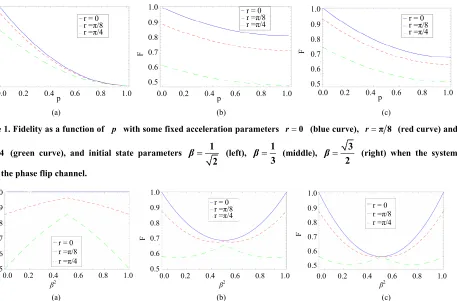
From Equation (12), it is clear that the fidelities of the teleportation depend on the channel parameter p, accel- eration parameter r and state parameter . In addition, the suitable value of the fidelity should be the minimum of the Fi0 and Fi1 since in reality Alice will not know the result of the measurement as the quantum state. Hereafter we take the minimum fidelity and plot them in
[image:3.595.63.286.88.147.2]Figures 1 and 2.
Figure 1 shows that the fidelity decreases monoto-
nously as p increases, i.e., the transmission capacity con- sistently weakened for this channel. Especially, when
2 1 2
and p1, the fidelity 1 2
F , which means that the fidelity will converge if the time of the interact- tion between the system and environment is long enough, and the information would never completely disappear. However, when 1
3
and 3
2
, the fidelities don’t gather even the environment interacts for infinite
time.
Figure 2 shows that the fidelity of the teleportation has a symmetric point 2 1 2. It is interest to note that
the fidelity is independent on p when 2 0 or
2 1
, which means that as the transmitted state is a single bit the environment has no effect on the teleporta- tion.
4.2. Bit Flip Channel
For the bit flip channel, the Kraus operators are
0 diag 1 2, 1 2 1
A
R
p p
1 2 1
A A
x R
p
0 1 diag 1 2, 1 2
R
A p p
and 1 1 1 2
R R
A p x
1.0
0.9
0.8
0.7
0.6
0.5
F
0.0 0.2 0.4 0.6 0.8 1.0 r = 0
r =π/8 r =π/4
r = 0 r =π/8
r =π/4 r = 0r =π/8
r =π/4
p
1.0
0.9
0.8
0.7
0.6
0.5
F
1.0
0.9
0.8
0.7
0.6
0.5
F
0.0 0.2 0.4 0.6 0.8 1.0 p 0.0 0.2 0.4 0.6 0.8 1.0p
[image:4.595.81.538.84.385.2](a) (b) (c)
Figure 1. Fidelity as a function of p with some fixed acceleration parameters r0 (blue curve), rπ8 (red curve) and
π 4
r (green curve), and initial state parameters 1
2
β (left), 1
3
β (middle), 3
2
β (right) when the system under the phase flip channel.
1.0
0.9
0.8
0.7
0.6
0.5
F
0.0 0.2 0.4 0.6 0.8 1.0 r = 0
r =π/8 r =π/4
r = 0 r =π/8 r =π/4
r = 0 r =π/8 r =π/4 1.0
0.9 0.8
0.7 0.6
0.5
F
1.0
0.9
0.8
0.7
0.6
0.5
F
0.0 0.2 0.4 0.6 0.8 1.0 0.0 0.2 0.4 0.6 0.8 1.0
β2 β2 β2
[image:4.595.59.536.88.202.2](a) (b) (c)
Figure 2. Fidelity as a function of β2 with some fixed acceleration parameters r0 (blue curve), rπ 8 (red curve)
and rπ4 (green curve) when p=0 (left), =1 2
p (middle) and (right) as the system under the phase flip chan- nel.
=1 p
1
2
3
4 1
0 0 2 2
2
1
0 2 cos
1 2 ,
1 4
0 2 cos 0
2
1
2 2 cos 0 0
2 I
evo AR
B p
B p p r
p p r B
p p r B
cos 0
p r
2r
2r
(13)
with
1 2 1 2 3 cos
B p p p p
2 2 1 1 cos 2
B p p p r
3 3 1 cos 2
B p p p r
and B4 4
p3
p
p1
pcos .Analogous analysis as the subsection A, Rob obtains the state ij
I
2 2
0 1 3
2 2
4 2
4 cos
1 ,
4 4 cos
i I
B B r
r B B
(14) or
2 2
1 4 2
2 2
1 3
4 cos
1 .
4 4 cos
i I
B B r
r B B
(15)
Then the fidelities Fij are
2 2 4 4
0 2 3 4 1
2 2 4 4
1 2 3 4 1
1
8 ,
4
1 8 .
4
i
i
F B B B B
F B B B B
(16)
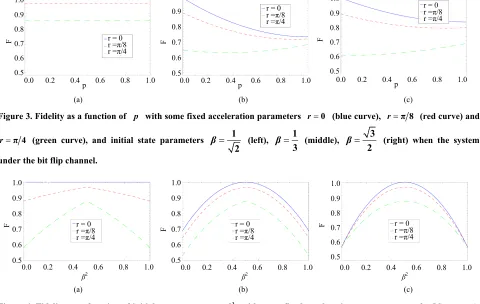
We plot the fidelity in Figures 3 and 4. From Figure 3, we know that when
2 1
2
1.0 1.0
0.9
0.8
0.7 0.6
0.5 0.9
0.8
0.7
0.6
0.5
F
0.0 0.2 0.4 0.6 0.8 1.0 1.0
0.9
0.8
0.7 0.6
0.5
r = 0 r =π/8 r =π/4 r = 0
r =π/8 r =π/4 r = 0
r =π/8 r =π/4
F
F
0.0 0.2 0.4 0.6 0.8 1.0 0.0 0.2 0.4 0.6 0.8 1.0
p p p
[image:5.595.66.529.89.198.2](a) (b) (c)
Figure 3. Fidelity as a function of p with some fixed acceleration parameters r0 (blue curve), rπ8 (red curve) an d
π 4
r (green curve), and initial state parameters 1
2
β (left), 1
3
β (middle), 3
2
β (r when the system
he bit flip channel.
ight) under t
1.0
0.9
0.8
0.7
0.6
0.5
F
0.0 0.2 0.4 0.6 0.8 1.0 r = 0
r =π/8 r =π/4
r = 0 r =π/8 r =π/4
r = 0 r =π/8 r =π/4 1.0
0.9
0.8
0.7
0.6 0.5
F
1.0
0.9
0.8
0.7
0.6
0.5
F
0.0 0.2 0.4 0.6 0.8 1.0 0.0 0.2 0.4 0.6 0.8 1.0
β2 β2 β2
(a) (b) (c)
Figure 4. Fidelity as a function of initial state parameter β2 with some fixed acceleration parameters r0 (blue curve),
π 8
r (red curve) and rπ 4 (green curve), and the en ronment parameters vi p=0 (left), =1 2
p (mi e) and p=1 hen the system und it flip channel.
arameter p. However, when
ddl
(right) w er the b
p 1 and 3
2
3 ,
fo onoto with th
the fidelity r r0 decreases m nously e increase of , while for p r0, it decreases monoto- nously until
5 2 s 2r
1 3
and
3co 14 1 cos 2 p
r
for
2 cos 2 1 cos 2
r p
r
for 3 2
, then increases mono ously. In general, it flip c
ton
for b hannel, the turning point for r0 is given by
2 2
2 2
2 2
2 2
4 1 3cos 2 4 cos 2 1
, for < , 2 2 2 1 1 cos 2
4 3 cos 2 4 cos 2 1
, for > . 2 2 2 1 1 cos 2
r r
r p
r r
r
(17)
The rebound process of the fidelity results from the teraction between Unruh radiation and the quantum e
in
d coherence. It is interesting to note that when
2 1 1, 1 3,
4 2 2 4
the fidelity, provided is chosen appropriately, will increases consistently by increasing , which means
that the environment effect will improve the ability of the transmission for this special case.
In Figure 4, it is obvious that the fidelity is also sym- metric around the point
r
p
2 1
2
, and the fidelity for
2 1 2
[image:5.595.59.539.94.398.2]
0 or 1
the difference of the fidelities of dif- ferent r cases will becomes smaller and smaller with the increase of p. Especially, when p1 they con- verge to F1.2
4.3. Bit-Phase Flip Channel
For this channel, the Kraus operators are
0 diag 1 2, 1 2
A 1
R
p p
1 2 1
A A
y R
p
0 1 diag 1 2, 1 2
R
A p p
1 1 2
R R
A p y
and [30-33]. Using Equations (5) and (8), the evolved state is given by
1 2 3 4 0 2 2 10 2 cos 0
1 2 .
1
4 0 2 cos 0
2
1
2 2 cos 2 0 0
2 I
evo AR
B p r
B p p r
p p r B
p p r B
(18)
After analogous analysis done in the Section 4.3, the final state
1
0 2 2 pcos
ij I
Rob obtained is
2 2 24 2
, 4 4 1 cos
I
p r B B
(19) 2 2 2 1 3
0 1 B B 4 p1 cosr
or i
2 2 2 4 2 12 2 2
1 3
4 1 cos
1
. 4 4 1 cos
i I
B B p r
p r B B
(20)
The fidelities Fij are
1 2 1= 8 1
i p B B
2 2 2 4 4
0 2 3 4 1
2 2 2 4 4
3 4 1
1 8 1 4 . 4 i
F p B B B B
F B B
, (21)
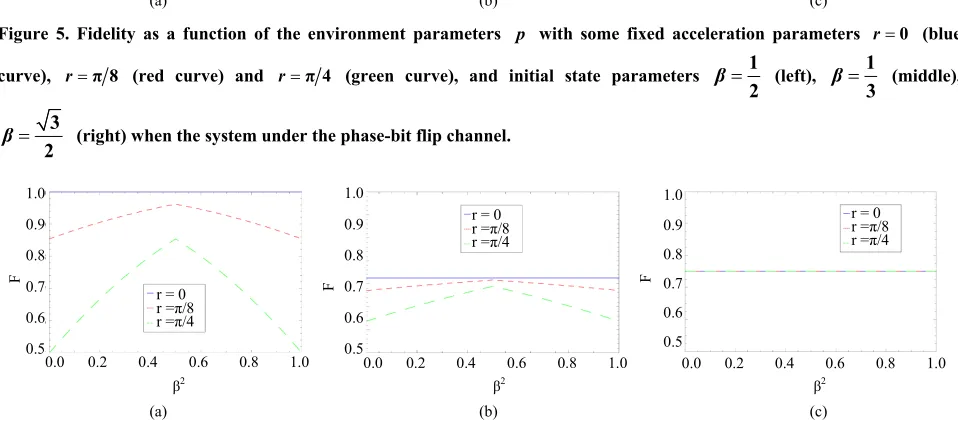
We plot the fidelity of the teleportation in Figures 5
and 6. We can see from Figure 5 that different fidelities corresponding to different acceleration parameters r will finally converge to the point with the value of
1 2
F . For 2 1
2
, the fidelity is monotonously decrease as
ment. an
p increases. That is to say, the transmitting capacity becomes weaken when the system interacts with the en- viron However, provided r0, the fidelity de- creases at the beginning, then increases monotonously,
d the turning points are
35 128cos 161cos 2 2 49 64cos 49cos 2
r r
p
r r
f or
1 3
a n d
2 3cosr cos 2r
p for 3
2
rning point 0 1 6cos rcos 2r , respectively. In
general, for bit-phase flip the tu for r is
2 2 2 2 2
2 2
2
sec 1
, for < , 2 2 cos r r 2 2
4 4 1 1
2 2 2 2 2
2 2
2 2 2
16 1 cos 2 1 4 1 4 3 cos 2
16 1 cos 2 1 4 3 4 1 cos 2 sec 1
, for > . 2
4 4 1 1 2 cos
r r
p
r r r
r (22)
[image:6.595.57.292.350.510.2]It is worthy to point that the turning point could close to but never reach it with any acceleration.
Figure 6 also shows that the fidelity is symmetric
ar
0
p
ound the axis 2 1
2
. And we are interested to note
that th
i.e
environment is long enough, both the initial state and Rob’s acceleration doesn’t affect the fidelity any more, it is always
e fidelity, when p 1, is invariant for any β and r, ., when the time of interaction between subsystem and
1 2
F .
5. Summary
1.0
0.9
0.8
0.7
0.6
0.5
F
r = 0 r =π/8 r =π/4
r = 0 r =π/8 r =π/4
r = 0 r =π/8 r =π/4 1.0
0.8
0.7
0.6
0.5 0.9 1.0
0.9
0.8
0.7
0.6
0.5
F F
0.0 0.2 0.4 0.6 0.8 1.0 p 0.0 0.2 0.4 0.6 0.8 1.0 p p
0.0 0.2 0.4 0.6 0.8 1.0
[image:7.595.66.535.86.198.2](a) (b) (c)
Figure 5. Fidelity as a function of the environment parameters p with some fixed acceleration parameters r0 (blue
curve), rπ 8 (left), 1
3 (mi
(green curve), and initial state parameters 1
2
β
(red curve) and rπ 4 β ddle),
3
2
β (right) when the system under the phase-bit flip channel.
1.0
0.8 0.9
0.7
0.6
0.5
F
0.0 0.2 0.4 0.6 0.8 1.0 r = 0
r =π/8 r =π/4
r = 0 r =π/8 r =π/4
r = 0 r =π/8 r =π/4 1.0
1.0
0.9
0.8
0.7
0.6
0.5
0.9
0.8
0.7
0.6
0.5
F
F
0.0 0.2 0.4 0.6 0.8 1.0 0.0 0.2 0.4 0.6 0.8 1.0
β2 β2 β2
[image:7.595.58.537.194.406.2](a) (b) (c)
Figure 6. Fidelity as a function of initial state parameter β2 with some fixed acceleration parameters r0 (blue curve),
π 8
r (green curve), and the environment parameters p=0 (left), =1
2
p (middl
(red curve) and rπ 4 e) and
(right) when the sys
bit-phase flip channels is studied. It was shown that the fidelity ion de
it-
=1 p tem under the phase-bit flip channel.
erated partners undergoing the phase flip, bit flip, and of the teleportat pends on the acceleration parameter r, environment parameter p and transm
d state parameter
te . By fixing p and , the fidel-
F e
ity is consistently decreases with the increase of the ac- celeration. However, by fixing r, the dynamic evolution of the fidelity has different properties, which are listed as follows: 1) or the phase flip channel, th fidelity is mo- notonously reduced as p increases. When 2 1
2
, the
fidelity will converge to 1
2
F after a long time of the interaction between the system and the environment; 2) For the bit flip channel, when 21, the fid f the teleportation is not affec the environment at all.
2 elity o
ted by But when 2 1
2
, the fidelity will emerge a turning point at the p axis. Before nt the fidelity de- creases monotonously and after increases
the poi
that the fidelity
d be n
hosen riate can
increase monotonously with the increase of when monotonously. However, the fidelity decreases all the time if Rob is not accelerated. It shoul oted out that, provided r is c approp ly, the fidelity
p
2 1 1, 1 3,
4 2 2 4
; And 3) for the phase-bit channel,
ities co
all the fidel nverge to one point F1 for any
2
acceleration and any transmission state parameter if the time of the interaction between the system and the environment is long enough. The fidelity is also mo- notonously decreasing when 2 1
2
or the acceleration is zero in this channel.
In addition to that,
ronment the fidelity is always symmetric about
undergoing any of the three envi-
2 1
2
as it is a function of the transmission state parameter . And it, as 2 0 or 2 1, is constant for the p se
flip channel, while it is constant with
ha 2 1
for the bit
flip channel, which indicates that there are the different characters between these environments.
nts
Th75065 10935013; the National Basic Research of China
0003; PCSIRT,
n of C ogram of t
NCES
6. Acknowledgeme
is work was supported by the National Natural Sci-ence Foundation of China under Grant No. 111 ,
under Grant No. 2010CB833004; the SRFDP under Grant No. 2011430611 No. IRT0964; the Hunan Provincial Natural Science Foundatio hina under Grant No 11JJ7001; and Construct Pr he Na-tional Key Discipline.
REFERE
[1] A. Einstein, B. Podolsky and N. Rosen, “Can Quantum- Mechanical Description of Physical Reality Be Consider- ed Complete?” Physical Review, Vol. 47, No. 10, 1935, p. 777. doi:10.1103/PhysRev.47.777
[2] R. Horodecki, P. Horodecki, M. Horodecki and K. Horodecki, “Quantum Entanglement,” Reviews of Mod-ern Physics, Vol. 81, No. 2, 2009, p. 865.
doi:10.1103/RevModPhys.81.865 [3] C. H. Bennett, G. B
and W. K. Wootters, “Tel
rassard, C. Crpeau, R. Jozsa, A. Peres eporting an Unknown Quantum State via Dual Classical and Einstein-Podolsky-Channels,” Physical Review Letters, Vol. 70, No. 13,Rosen 1993, p. 1895. doi:10.1103/PhysRevLett.70.1895
[4] Y. Yeo and W. K. Chua, “Teleportation and Dense Cod-ing with Genuine Multipartite Entanglement,” Physical Review Letters, Vol. 96, No. 6, 2006, Article ID: 060502. doi:10.1103/PhysRevLett.96.060502
[5] G. Gordon and G. Rigolin, “Generalized Teleportation Protocol,” Physical Review A, Vol. 73, No. 4, 2006, Arti-cle ID: 042309. doi:10.1103/PhysRevA.73.042309
ol. 68 [6] L. Mista and R. Filip, “Optimal Partial Deterministic
Quantum Teleportation of Qubits,” Physical Review A, Vol. 71, No. 4, 2005, Article ID: 022319.
[7] M. Fujii, “Continuous-Variable Quantum Teleportation with a Conventional Laser,” Physical Review A, V , No. 5, 2003, Article ID: 050302.
doi:10.1103/PhysRevA.68.050302
[8] D. Bouwmeester, J. Pan, K. Mattle, M. Eibl, H. Wein-furter and A. Zeilinger, “Experimental Quantum Telepor-tation,” Nature, Vol. 390, No. 6660, 1997, pp. 575-579. doi:10.1038/37539
[9] P. M. Alsing, “Teleportation in a Non-Inertial Frame,” Journal of Optics B: Quantum and Semiclassical Optics, Vol. 6, No. 8, 2004, p. S834.
doi:10.1088/1464-4266/6/8/033
[10] P. M. Alsing and G. J. Milburn, “Teleportation with a Uniformly Accelerated Partner,” Physical Review Letters, Vol. 91, No. 18, 2003, Article ID: 180404.
doi:10.1103/PhysRevLett.91.180404
Detectors: From the Casimir? Polder
88/1464-4266/6/8/011
[11] M. R. Hwang, D. Park and E. Jung, “Tripartite Entangle-ment in a Noninertial Frame,” Physical Review A, Vol. 83,
No. 1, 2001, Article ID: 012111.
[12] B. L. Hu, A. Roura and S. Shresta, “Vacuum Fluctuations and Moving Atoms/
to the Unruh? Davies? DeWitt? Fulling Effect,” Journal of Optics B: Quantum and Semiclassical Optics, Vol. 6, No. 8, 2004, p. S698. doi:10.10
Entan-2 [13] Q. Pan and J. Jing, “Degradation of Nonmaximal
glement of Scalar and Dirac Fields in Noninertial Frames,” Physical Review A, Vol. 77, No. 2, 2008, Article ID: 024302. doi:10.1103/PhysRevA.77.02430
z, “The Entangling
ssical Correlation and [14] M. Montero and E. Martin-Martine
Side of the Unruh-Hawking Effect,” Journal of High En-ergy Physics, Vol. 2011, No. 7, 2011, p. 6.
[15] J. Wang, J. Deng and J. Jing, “Cla
Quantum Discord Sharing of Dirac Fields in Noninertial Frames,” Physical Review A, Vol. 81, No. 5, 2010, Article ID: 052120. doi:10.1103/PhysRevA.81.052120
[16] J. Wang and J. Jing, “Multipartite Entanglement of Fer-mionic Systems in Noninertial Frames,” Physical Review A, Vol. 83, No. 2, 2011, Article ID: 022314.
doi:10.1103/PhysRevA.83.022314
[17] X. H. Ge and Y. G. Shen, “Teleportation in the Back-ground of Schwarzschild Space? Time,” Physics Letters B, Vol. 606, No.1-2, 2005, p. 184.
doi:10.1016/j.physletb.2004.11.067
[18] X. H. Ge and S. P. Kim, Class. “Quantum Entanglement and Teleportation in Higher Dimensional Black Hole Spacetimes,” Classical and Quantum Gravity, Vol. 25, No. 7, 2008, Article ID: 075011.
doi:10.1088/0264-9381/25/7/075011
[19] X. H. Ge and Y. G. Shen, “Quantum Teleportation with Sonic Black Holes,” Physics Letters B, Vol. 623, No. 1-2, 2005, p. 141. doi:10.1016/j.physletb.2005.07.036
iation, Entanglement, [20] Q. Pan and J. Jing, “Hawking Rad
and Teleportation in the Background of an Asymptoti-cally Flat Static Black Hole,” Physical Review D, Vol. 78, No. 6, 2008, Article ID: 065015.
doi:10.1103/PhysRevD.78.065015
[21] B. N. Esfahani, M. Shamirzai and M. Soltani, “Reduction of Entanglement Degradation in Einstein-Gauss-Bonnet gravity,” Physical Review D, Vol. 84, No. 2, 2011, Article ID: 025024.
[22] D. Giulini, E. Joos, C. Kiefer, J. Kupsch, I. O. Stamatescu
. Haroche, “Observing Meter in a Quantum and H. D. Zeh, “Decoherence and the Appearence of a Classical World in Quantum Teory,” Springer, Berlin, 1996, pp. 44-107.
[23] M. A. Schlosshauer, “Decoherence and the Quantum-to- Classical Transition,” Springer, Berlin, 2007.
[24] M. Brune, E. Hagley, J. Dreyer, X. Maitre, A. Maali, C. Wunderlich, J. M. Raimond and S
the Progressive Decoherence of the
Measurement,” Physical Review Letters, Vol. 77, No. 24, 1996, p. 4887. doi:10.1103/PhysRevLett.77.4887
desso and I. Fuentes, “Optimal Quan-[26] M. Aspachs, G. A
tum Estimation of the Unruh-Hawking Effect,” Physical Review Letters, Vol. 105, No. 15, 2010, Article ID: 151301. doi:10.1103/PhysRevLett.105.151301
[27] E. Martin-Martinez, L. J. Garay and J. Leon, “Unveiling Quantum Entanglement Degradation near a Schwarzschild Black Hole,” Physical Review D, Vol. 82, No. 6, 2010, Article ID: 064006.
[28] E. Martin-Martinez, L. J. Garay and J. Leon, “Quantum Entanglement Produced in the Formation of a Black Hole,” Physical Review D, Vol. 82, No.6, 2010, Article ID: 064028. doi:10.1103/PhysRevD.82.064028
[29] J. Wang and J. Jing, “System-Environment Dynamics of X-Type States in Noninertial Frames,” Annals of Physics, Vol. 327, No. 2, 2012, p. 283.
doi:10.1016/j.aop.2011.10.002
[30] A. Salles, F. de Melo, M. P. Almeida, M. Hor-Meyl
Entangle-22
l, S. P. Walborn, P. H. Souto Ribeiro and L. Davidovich,
“Ex-perimental Investigation of the Dynamics of
ment: Sudden Death, Complementarity, and Continuous Monitoring of the Environment,” Physical Review A, Vol. 78, No. 2, 2008, Article ID: 022322.
doi:10.1103/PhysRevA.78.0223
[31] J. Maziero, L. C. Celeri, R. M. Serra and V. Vedral, “Classical and Quantum Correlations under Decoher-ence,” Physical Review A, Vol. 80, No. 4, 2009, Article ID: 044102. doi:10.1103/PhysRevA.80.044102
[32] M. A. Nielsen and I. L. Chuang, “Quantum Computation and Quantum Information,” Cambridg
Cambridge, 2000, pp. 425-427.
e University Press,
[33] J. Maziero, T. Werlang, F. Fanchini, L. C. Celeri and R. M. Serra, “System-Reservoir Dynamics of Quantum and Classical Correlations,” Physical Review A, Vol. 81, No. 2, 2010, Article ID: 022116.