Proceedings of the 56th Annual Meeting of the Association for Computational Linguistics (Long Papers), pages 2631–2641 2631
A Structured Variational Autoencoder
for Contextual Morphological Inflection
Lawrence Wolf-Sonkin∗ Jason Naradowsky∗ Sebastian J. Mielke∗ Ryan Cotterell∗ Department of Computer Science, Johns Hopkins University
{lawrencews,narad,sjmielke,ryan.cotterell}@jhu.edu
Abstract
Statistical morphological inflectors are typi-cally trained on fully supervised, type-level data. One remaining open research ques-tion is the following: How can we effec-tively exploit raw, token-level data to im-prove their performance? To this end, we introduce a novel generative latent-variable model for the semi-supervised learning of inflection generation. To enable posterior inference over the latent variables, we de-rive an efficient variational inference pro-cedure based on the wake-sleep algorithm. We experiment on 23 languages, using the Universal Dependencies corpora in a sulated low-resource setting, and find im-provements of over 10% absolute accuracy in some cases.
1 Introduction
The majority of the world’s languages overtly en-codes syntactic information on the word form it-self, a phenomenon termed inflectional morphology (Dryer et al.,2005). In English, for example, the verbal lexeme with lemmatalkhas the four forms: talk,talks,talkedandtalking. Other languages, such as Archi (Kibrik,1998), distinguish more than a thousand verbal forms. Despite the cornucopia of unique variants a single lexeme may mutate into, native speakers can flawlessly predict the correct variant that the lexeme’s syntactic context dictates. Thus, in computational linguistics, a natural ques-tion is the following: Can we estimate a probability model that can do the same?
The topic of inflection generation has been the focus of a flurry of individual attention of late and, moreover, has been the subject of two shared tasks
∗All authors contributed equally.
m1 m2 m3 m4
`1 `2 `3 `4
f1 f2 f3 f4
POS/morph. POS/morph.
tag LM
tag LM
lemma
lemma
generator generator
morphological
morphological inflector
inflector
POS=PRN
CASE=GEN POS
=N
NUM=PL POS
=ADV POS=V TNS=PAST
I wug gently weep
[image:1.595.308.523.243.368.2]my wugs gently wept
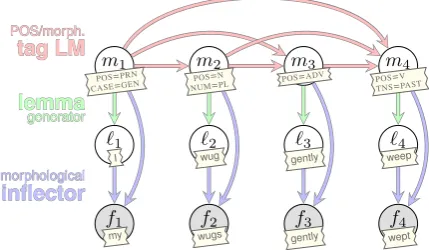
Figure 1: A length-4example of our generative model
fac-torized as in Eq. (1) and overlayed with example values of the random variables in the sequence. We highlight that all the conditionals in the Bayesian network are recurrent neural networks, e.g., we note thatmidepends onm<ibecause we
employ a recurrent neural network to model the morphological tag sequence.
(Cotterell et al.,2016,2017). Most work, however, has focused on the fully supervised case—a source lemma and the morpho-syntactic properties are fed into a model, which is asked to produce the desired inflection. In contrast, our work focuses on the semi-supervised case, where we wish to make use of unannotated raw text, i.e., a sequence of inflected tokens.
Concretely, we develop a generative directed graphical model of inflected forms in context.
A contextual inflection model works as follows: Rather than just generating the proper inflection for a single given word formout of context(for
exam-plewalkingas the gerund ofwalk), our generative
model is actually a fully-fledged language model. In other words, it generatessequencesof inflected
SG PL SG PL
NOM Wort Wörter Herr Herren
GEN Wortes Wörter Herrn Herren
ACC Wort Wörter Herrn Herren
[image:2.595.84.278.63.142.2]DAT Worte Wörtern Herrn Herren
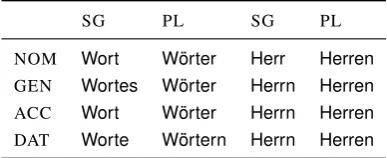
Table 1: As an exhibit of morphological inflection, full paradigms (two numbers and four cases, 8 slots total) for the German nounsWort(“word”) andHerr(“gentleman”), with
abbreviated and tabularized UniMorph annotation.
raw-text corpora (which is useful when we have less annotated data), we marginalize out the unob-served lemmata and morpho-syntactic annotation from unlabeled data. In terms of Fig.1, this refers to marginalizing out m1, . . . , m4 and `1, . . . , `4.
As this marginalization is intractable, we derive a variational inference procedure that allows for efficient approximate inference. Specifically, we modify the wake-sleep procedure ofHinton et al. (1995). It is the inclusion of raw text in this fashion that makes our modeltoken level, a novelty in the
camp of inflection generation, as much recent work in inflection generation (Dreyer et al.,2008;Durrett and DeNero,2013;Nicolai et al.,2015;Ahlberg et al.,2015;Faruqui et al.,2016), trains a model on
type-levellexicons.
We offer empirical validation of our model’s utility with experiments on 23 languages from the Universal Dependencies corpus in a simulated low-resource setting.1Our semi-supervised scheme
im-proves inflection generation by over 10% absolute accuracy in some cases.
2 Background: Morphological Inflection
2.1 Inflectional Morphology
To properly discuss models of inflectional morphol-ogy, we require a formalization. We adopt the framework of word-based morphology (Aronoff, 1976;Spencer, 1991). Note in the present paper, we omit derivational morphology.
We define an inflected lexicon as a set of 4-tuples consisting of a part-of-speech tag, a lexeme, an inflectional slot, and a surface form. Alexeme is a discrete object that indexes the word’s core meaning and part of speech. In place of such an abstract lexeme, lexicographers will often use a lemma, denoted by`, which is a designated2
sur-1We make our code and data available at: https://
github.com/lwolfsonkin/morph-svae.
2A specific slot of the paradigm is chosen, depending on
face form of the lexeme (such as the infinitive). For the remainder of this paper, we will use the lemma as a proxy for the lexeme, wherever convenient, although we note that lemmata may be ambiguous: bankis the lemma for at least two distinct nouns and two distinct verbs. For inflection, this ambigu-ity will rarely3play a role—for instance, all senses
ofbankinflect in the same fashion.
A part-of-speech (POS) tag, denoted t, is a
coarse syntactic category such as VERB. Each
POS tag allows some set of lexemes, and also al-lows some set of inflectionalslots, denoted asσ,
such as
TNS=PAST,PERSON=3
. Each allowed
htag, lexeme, slotitriple is realized—in only one
way—as an inflectedsurface form, a string over a fixed phonological or orthographic alphabetΣ. (In this work, we take Σ to be an orthographic alphabet.) Additionally, we will define the term morphological tag, denoted bym, which we take
to be the POS-slot pairm=ht, σi. We will further
defineT as the set of all POS tags andMas the
set of all morphological tags.
A paradigm π(t, `) is the mapping from tag
t’s slots to the surface forms that “fill” those slots
for lexeme/lemma`. For example, in the English
paradigmπ(VERB,talk), the past-tense slot is said to be filled bytalked, meaning that the lexicon con-tains the tuplehVERB,talk,PAST,talkedi.
A cheat sheet for the notation is provided in Tab.2.
We will specifically work with the UniMorph annotation scheme (Sylak-Glassman,2016). Here, each slot specifies a morpho-syntactic bundle of inflectional features such as tense, mood, person, number, and gender. For example, the German surface formWörternis listed in the lexicon with tag NOUN, lemmaWort, and a slot specifying the feature bundle
NUM=PL,CASE=DAT
. The full paradigmsπ(NOUN,Wort)andπ(NOUN,Herr)are found in Tab.1.
2.2 Morphological Inflection
Now, we formulate the task of context-free mor-phological inflectionusing the notation developed in §2. Given a set ofN form-tag-lemma triples {hfi, mi, `ii}Ni=1, the goal of morphological
inflec-tion is to map the pairhmi, `iito the formfi. As the part-of-speech tag – all these terms are defined next.
3One example of a paradigm where the lexeme, rather than the lemma, may influence inflection ishang.If one chooses the lexeme that licenses animate objects, the proper past tense ishanged, whereas it is hungfor the lexeme that licenses
object symbol example
form f talking
lemma ` talk
POS t VERB
slot σ TNS=GERUND
morph. tag m POS=V,TNS=GERUND
Table 2: Notational cheat sheet for the paper.
the definition above indicates, the task is tradition-ally performed at thetype level. In this work,
how-ever, we focus on a generalization of the task to thetoken level—we seek to map a bisequence of
lemma-tag pairs to the sequence of inflected forms in context. Formally, we will denote the lemma-morphological tag bisequence ash`,miand the
form sequence asf. Foreshadowing, the primary motivation for this generalization is to enable the use of raw-text in a semi-supervised setting.
3 Generating Sequences of Inflections
The primary contribution of this paper is a novel generative model over sequences of inflected words in their sentential context. Following the nota-tion laid out in §2.2, we seek to jointly learn a distribution over sequences of formsf, lemmata `, and morphological tags m. The generative procedure is as follows: First, we sample a se-quence of tagsm, each morphological tag com-ing from a language model over morphological tags:mi ∼pθ(· |m<i). Next, we sample the se-quence of lemmata`given the previously sampled sequence of tags m— these are sampled condi-tioned only on the corresponding morphological tag: `i ∼ pθ(· | mi). Finally, we sample the se-quence of inflected wordsf, where, again, each word is chosen conditionally independent of other elements of the sequence: fi ∼ pθ(· | `i, mi).4 This yields the factorized joint distribution:
pθ(f,`,m) = (1)
|f| Y
i=1
pθ(fi |`i, mi) | {z }
morphological inflector
3
· pθ(`i |mi) | {z }
lemma generator
2
!
·pθ(m)
| {z }
m-tag LM
1
We depict the corresponding directed graphical model in Fig.1.
4Note that we denote all three distributions asp
θto sim-plify notation and emphasize the joint modeling aspect; con-text will always resolve the ambiguity in this paper. We will discuss their parameterization in §4.
Relation to Other Models in NLP. As the graphical model drawn in Fig.1shows, our model is quite similar to a Hidden Markov Model (HMM) (Rabiner,1989). There are two primary differences. First, we remark that an HMM directly emits a form fi conditioned on the tag mi. Our model, in contrast, emits a lemma`i conditioned on the morphological tag mi and, then, conditioned on both the lemma`iand the tagmi, we emit the in-flected formfi. In this sense, our model resembles the hierarchical HMM ofFine et al.(1998) with the difference that we do not have interdependence between the lemmata`i. The second difference is that our model is non-Markovian: we sample the ith morphological tagmi from a distribution that depends onallprevious tags, using an LSTM
language model (§4.1). This yields richer interac-tions among the tags, which may be necessary for modeling long-distance agreement phenomena.
Why a Generative Model? What is our interest in a generative model of inflected forms? Eq. (1) is a syntax-only language model in that it only allows for interdependencies between the morpho-syntactic tags in pθ(m). However, given a tag
sequencem, the individual lemmata and forms are conditionally independent. This prevents the model
from learning notions such as semantic frames and topicality. So what is this model good for? Our chief interest is the ability totrain a morphological inflector on unlabeled data, which is a boon in a
low-resource setting. As the model is generative, we may consider the latent-variable model:
pθ(f) =
X
h`,mi
pθ(f,`,m), (2)
where we marginalize out the latent lemmata and morphological tags from raw text. The sum in Eq. (2) is unabashedly intractable—given a se-quencef, it involves consideration of an exponen-tial (in|f|) number of tag sequences and aninfinite
number of lemmata sequences. Thus, we will fall back on an approximation scheme (see §5).
4 Recurrent Neural Parameterization
4.1 LSTM Language Models
Before proceeding, we review the modeling of sequences with LSTM language models. Given some alphabet∆, the distribution over sequences x∈∆∗can be defined as follows:
p(x) = |x| Y
j=1
p(xj |x<j), (3)
wherex<j =x1, . . . , xj−1. The prediction at time
stepjof a single elementxj is then parametrized by a neural network:
p(xj |x<j) =softmax(W·hj+b), (4)
whereW∈R|∆|×dandb∈R|∆|are learned pa-rameters (for some number of hidden unitsd) and
the hidden state hj ∈ Rd is defined through the recurrence given byHochreiter and Schmidhuber (1997) from the previous hidden state and an em-bedding of the previous character (assuming some learned embedding functione: ∆→Rcfor some number of dimensionsc):
hj = LSTM hj−1,e(xj−1)
(5)
4.2 Our Conditional Distributions
We discuss each of the factors in Eq. (1) in turn.
1 Morphological Tag Language Model:pθ(m). We definepθ(m)as an LSTM language model, as
defined in §4.1, where we take∆ = M, i.e., the
elements of the sequence that are to be predicted are tags like
POS=V,TNS=GERUND
. Note that the embedding functionedoes not treat them as atomic units, but breaks them up into individual attribute-value pairs that are embedded individually and then summed to yield the final vector representation. To be precise, each tag is first encoded by a multi-hot vector, where each component corresponds to a attribute-value pair in the slot, and then this multi-hot vector is multiplied with an embedding matrix.
2 Lemma Generator: pθ(`i | mi). The next distribution in our model is a lemma generator which we define to be a conditional LSTM
lan-guage model over characters (we take∆ = Σ), i.e., eachxi is a single (orthographic) character. The language model is conditioned onti(the part-of-speech information contained in the morphological tag mi = hti, σii), which we embed into a low-dimensional space and feed to the LSTM by con-catenating its embedding with that of the current
character. Thusly, we obtain the new recurrence relation for the hidden state:
hj = LSTM
hj−1,
h
e [`i]j−1
;e0 ti
i
, (6)
where[`i]j denotes thejth character of the gener-ated lemma`i ande0 : T →Rc
0
for somec0 is a
learned embedding function for POS tags. Note that we embed only the POS tag, rather than the entire morphological tag, as we assume the lemma depends on the part of speech exclusively.
3 Morphological Inflector: pθ(fi | `i, mi). The final conditional in our model is a morpho-logical inflector, which we parameterize as a neural recurrent sequence-to-sequence model (Sutskever et al.,2014) with Luong dot-style attention (Luong et al., 2015). Our particular model uses a single encoder-decoder architecture (Kann and Schütze, 2016) for all tag pairs within a language and we refer to reader to that paper for further details. Con-cretely, the encoder runs over a string consisting of the desired slot and all characters of the lemma that is to be inflected (e.g. <w> V PST t a l k </w>), one LSTM running left-to-right, the other
right-to-left. Concatenating the hidden states of both RNNs at each time step results in hidden states h(jenc). The decoder, again, takes the form of an LSTM language model (we take ∆ = Σ), pro-ducing the inflected form character by character, but at each time step not only the previous hidden state and the previously generated token are consid-ered, but attention (a convex combination) over all encoder hidden statesh(enc)j , with the distribution given by another neural network; seeLuong et al. (2015).
5 Semi-Supervised Wake-Sleep
We train the model with the wake-sleep procedure, which requires us to perform posterior inference over the latent variables. However, the exact com-putation in the model is intractable—it involves a sum over all possible lemmatizations and tag-gings of the sentence, as shown in Eq. (2). Thus, we fall back on a variational approximation ( Jor-dan et al.,1999). We train aninference network
qφ(`,m | f) that approximates the true
poste-rior over the latent variablespθ(`,m | f).5 The
variational family we choose in this work will be
5Inference networks are also known asstochastic inverses
(Stuhlmüller et al.,2013) orrecognition models(Dayan et al.,
detailed in §5.5. We fit the distributionqφusing
a semi-supervised extension of the wake-sleep al-gorithm (Hinton et al.,1995;Dayan et al.,1995; Bornschein and Bengio,2014). We derive the al-gorithm in the following subsections and provide pseudo-code in Alg.1.
Note that the wake-sleep algorithm shows struc-tural similarities to the expectation-maximization (EM) algorithm (Dempster et al.,1977), and, pre-saging the exposition, we note that the wake-sleep procedure is a type of variational EM (Beal,2003). The key difference is that the E-step minimizes an inclusive KL divergence, rather than the exclusive one typically found in variational EM.
5.1 Data Requirements of Wake-Sleep We emphasize again that we will train our model in a semi-supervised fashion. Thus, we will assume a set of labeled sentences,Dlabeled, represented as
a set of triples hf,`,mi, and a set of unlabeled
sentences,Dunlabeled, represented as a set of surface
form sequencesf.
5.2 The Sleep Phase
Wake-sleep first dictates that we find an approxi-mate posterior distributionqφthat minimizes the
KL divergences for all form sequences:
DKL
pθ(·,·,·)
| {z }
full joint:Eq.(1)
|| qφ(·,· | ·)
| {z }
variational approximation
(7)
with respect to the parameters φ, which control the variational approximationqφ. Becauseqφ is
trained to be a variational approximation forany
input f, it is called an inference network. In other words, it will return an approximate pos-terior over the latent variables for any observed sequence. Importantly, note that computation of Eq. (7) is still hard—it requires us to normalize the distributionpθ, which, in turn, involves a sum
over all lemmatizations and taggings. However, it does lend itself to an efficient Monte Carlo ap-proximation. As our model is fully generative and directed, we may easily take samples from the com-plete joint. Specifically, we will takeK samples hf˜,˜`,m˜i ∼pθ(·,·,·)by forward sampling and
de-fine them asDesleep. We remark that we use a tilde
to indicate that a form, lemmata or tag is sampled, rather than human annotated. UsingK samples,
we obtain the objective
Sunsup=1/K· X
hf˜,˜`,m˜i∈Desleep
logqφ(˜`,m˜ |f˜), (8)
which we could maximize by fitting the modelqφ
through backpropagation (Rumelhart et al.,1986), as one would during maximum likelihood estima-tion.
5.3 The Wake Phase
Now, given our approximate posteriorqφ(`,m |
f), we are in a position to re-estimate the param-eters of the generative modelpθ(f,`,m). Given
a set of unannotated sentencesDunlabeled, we again
first consider the objective
Wunsup=1/M·
X
hf,˜`,m˜i∈Dewake
logpθ(f,˜`,m)˜ (9)
where Dewake is a set of triples hf,˜`,m˜i with
f ∈ Dunlabeled andh˜`,m˜i ∼ qφ(·,· | f),
maxi-mizing with respect to the parametersθ(we may stochastically backprop through the expectation simply by backpropagating through this sum). Note that Eq. (9) is a Monte Carlo approximation of the inclusive divergence of the data distribution of
Dunlabeledtimesqφwithpθ.
5.4 Adding Supervision to Wake-Sleep So far we presented a purely unsupervised training method that makes no assumptions about the la-tent lemmata and morphological tags. In our case, however, we have a very clear idea what the latent variables should look like. For instance, we are quite certain that the lemma oftalkingis talkand that it is in fact aGERUND. And, indeed, we have
access to annotated examplesDlabeledin the form of
an annotated corpus. In the presence of these data, we optimize the supervised sleep phase objective,
Ssup=1/N·
X
hf,`,mi∈Dlabeled
logqφ(`,m|f). (10)
which is a Monte Carlo approximation of
DKL(Dlabeled || qφ). Thus, when fitting our
varia-tional approximationqφ, we will optimize a joint
objectiveS = Ssup+γsleep· Sunsup, where Ssup,
to repeat, uses actual annotated lemmata and mor-phological tags; we balance the two parts of the objective with a scaling parameterγsleep. Note that
on the first sleep phase iteration, we setγsleep= 0
since taking samples from an untrainedpθ(·,·,·)
when we have available labeled data is of little util-ity. We will discuss the provenance of our data in §7.2.
Algorithm 1semi-supervised wake-sleep
1: inputDlabeled .labeled training data
2: inputDunlabeled .unlabeled training data
3: fori= 1toIdo
4: Desleep← ∅
5: ifi >1then
6: fork= 1toKdo 7: hf˜,˜`,m˜i ∼pθ(·,·,·)
8: Desleep←Desleep∪ {hf˜,˜`,m˜i}
9: maximizelogqφonDlabeled ∪ Desleep
.this corresponds to Eq.(10)+ Eq.(8) 10: Dewake ← ∅
11: forf ∈ Dunlabeleddo
12: h˜`,m˜i ∼qφ(·,· |f)
13: Dewake←Dewake∪ {hf,˜`,m˜i}
14: maximizelogpθonDlabeled ∪ Dewake
.this corresponds to Eq.(11)+ Eq.(9)
variables found inDlabeled; this leads to the
follow-ing supervised objective
Wsup=1/N·
X
hf,`,mi∈Dlabeled
logpθ(f,`,m), (11)
which is a Monte Carlo approximation of
DKL(Dlabeled || pθ). As in the sleep phase, we
will maximizeW =Wsup+γwake· Wunsup, where
γwake is, again, a scaling parameter.
5.5 Our Variational Family
How do we choose the variational familyqφ? In
terms of NLP nomenclature,qφrepresents a joint
morphological tagger and lemmatizer. The open-source toolLEMMING(Müller et al.,2015)
repre-sents such an object. LEMMINGis a higher-order
linear-chain conditional random field (CRF; Laf-ferty et al.,2001), that is an extension of the mor-phological tagger ofMüller et al.(2013). Interest-ingly,LEMMINGis a linear model that makes use
of simple charactern-gram feature templates. On
both the tasks of morphological tagging and lemma-tization, neural models have supplanted linear mod-els in terms of performance in the high-resource case (Heigold et al.,2017). However, we are inter-ested in producing an accurate approximation to the posterior in the presence of minimal annotated examples and potentially noisy samples produced during the sleep phase, where linear models still outperform non-linear approaches (Cotterell and Heigold,2017). We note that our variational ap-proximation is compatible with any family.
5.6 Interpretation as an Autoencoder
We may also view our model as an autoencoder, followingKingma and Welling (2013), who saw that a variational approximation to any generative model naturally has this interpretation. The crucial difference between Kingma and Welling (2013) and this work is that our model is a structured variational autoencoder in the sense that the space of our latent code is structured: the inference net-work encodes a sentence into a pair of lemmata and morphological tagsh`,mi. This bisequence
is then decoded back into the sequence of formsf through a morphological inflector. The reason the model is called an autoencoder is that we arrive at an auto-encoding-like objective if we combine the
pθandqφas so:
p(f|fˆ) =X h`,mi
pθ(f|`,m)·qφ(`,m|fˆ) (12)
wherefˆ is a copy of the original sentencef. Note that this choice of latent space sadly pre-cludes us from making use of thereparametrization trickthat makes inference in VAEs particularly
ef-ficient. In fact, our whole inference procedure is quite different as we do not perform gradient de-scent on bothqφ andpθ jointly but alternatingly
optimize both (using wake-sleep). We nevertheless call our model a VAE to uphold the distinction be-tween the VAE as a model (essentially a specific Helmholtz machine (Dayan et al.,1995), justified by variational inference) and the end-to-end infer-ence procedure that is commonly used.
Another way of viewing this model is that it tries to force the words in the corpus through a syntactic bottleneck. Spiritually, our work is close to the conditional random field autoencoder ofAmmar et al.(2014).
We remark that many other structured NLP tasks can be “autoencoded” in this way and, thus, trained by a similar wake-sleep procedure. For instance, any two tasks that effectively function as inverses, e.g., translation and backtranslation, or language generation and parsing, can be treated with a simi-lar variational autoencoder. While this work only focuses on the creation of an improved morpho-logical inflectorpθ(f|`,m), one could imagine
a situation where the encoder was also a task of interest. That is, the goal would be to improve both the decoder (the generation model)andthe encoder
6 Related Work
Closest to our work isZhou and Neubig (2017), who describe an unstructured variational autoen-coder. However, the exact use case of our re-spective models is distinct. Our method models the syntactic dynamics with an LSTM language model over morphological tags. Thus, in the semi-supervised setting, we require token-level anno-tation. Additionally, our latent variables are in-terpretable as they correspond to well-understood linguistic quantities. In contrast,Zhou and Neubig (2017) infer latent lemmata as real vectors. To the best of our knowledge, we are only the second at-tempt, afterZhou and Neubig(2017), to attempt to perform semi-supervised learning for a neural inflection generator. Other non-neural attempts at semi-supervised learning of morphological inflec-tors includeHulden et al.(2014). Models in this vein are non-neural and often focus on exploiting corpus statistics, e.g., token frequency, rather than explicitly modeling the forms in context. All of these approaches are designed to learn from a type-level lexicon, rendering direct comparison difficult.
7 Experiments
While we estimate all the parameters in the gen-erative model, the purpose of this work is to im-prove the performance of morphological inflectors through semi-supervised learning with the incorpo-ration of unlabeled data.
7.1 Low-Resource Inflection Generation
The development of our method was primarily aimed at the low-resource scenario, where we ob-serve a limited number of annotated data points. Why low-resource? When we have access to a preponderance of data, morphological inflection is close to being a solved problem, as evinced in SIGMORPHON’s 2016 shared task. However, the CoNLL-SIGMORPHON 2017 shared task showed there is much progress to be made in the low-resource case. Semi-supervision is a clear avenue.
7.2 Data
As our model requirestoken-levelmorphological
annotation, we perform our experiments on the Universal Dependencies (UD) dataset (Nivre et al., 2017). As this stands in contrast to most work on morphological inflection (which has used the
UniMorph (Sylak-Glassman et al.,2015)6datasets),
we use a converted version of UD data, in which the UD morphological tags have been deterministically converted into UniMorph tags.
For each of the treebanks in the UD dataset, we divide the training portion into three chunks consist-ing of the first 500, 1000 and 5000 tokens, respec-tively. Theselabeledchunks will constitute three
unique setsDlabeled. The remaining sentences in
the training portion will be used asunlabeleddata
Dunlabeledfor each language, i.e., we will discard
those labels. The development and test portions will be left untouched.
Languages. We explore a typologically diverse set of languages of various stocks: Indo-European, Afro-Asiatic, Turkic and Finno-Ugric, as well as the language isolate Basque. We have organized our experimental languages in Tab.3 by genetic grouping, highlighting sub-families where possi-ble. The Indo-European languages mostly exhibit fusional morphologies of varying degrees of com-plexity. The Basque, Turkic, and Finno-Ugric lan-guages are agglutinative. Both of the Afro-Asiatic languages, Arabic and Hebrew, are Semitic and have templatic morphology with fusional affixes.
7.3 Evaluation
The end product of our procedure is a morphologi-cal inflector, whose performance is to be improved through the incorporation of unlabeled data. Thus, we evaluate using the standard metric accuracy. We will evaluate at thetype level, as is traditional in the
morphological inflection literature, even though the UD treebanks on which we evaluate aretoken-level
resources. Concretely, we compile an incomplete type-level morphological lexicon from the token-level resource. To create this resource, we gather all unique form-lemma-tag tripleshf, `, mipresent
in the UD test data.7
7.4 Baselines
As mentioned before, most work on morphological inflection has considered the task of estimating sta-tistical inflectors from type-level lexicons. Here, in
6The two annotation schemes are similar. For a discussion, we refer the reader to http: //universaldependencies.org/v2/features. html; sadly there are differences that render all numbers reported in this work incomparable with previous work, see §7.4.
FST NN SVAE 0%
20% 40% 60% 80% 100%
(a) 500 training tokens
FST NN SVAE 0%
20% 40% 60% 80% 100%
(b) 1000 training tokens
FST NN SVAE 0%
20% 40% 60% 80% 100%
[image:8.595.82.523.67.231.2](c) 5000 training tokens
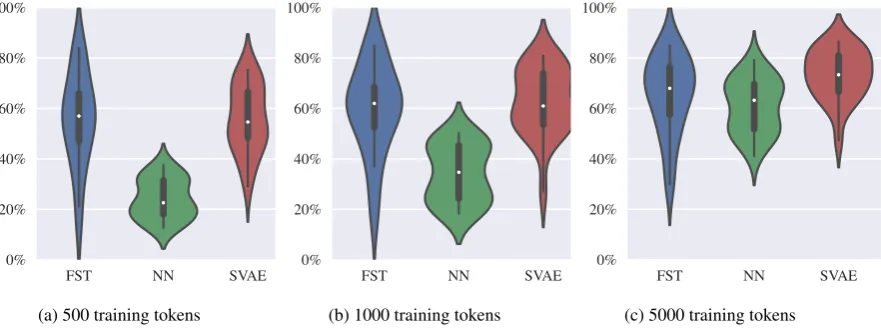
Figure 2: Violin plots showing the distribution over accuracies. The structured variational autoencoder (SVAE) always outperforms the neural network (NN), but only outperformed the FST-based approach when trained on 5000 annotated tokens. Thus, while semi-supervised training helps neural models reduce their sample complexity, roughly5000annotated tokens are
still required to boost their performance above more symbolic baselines.
contrast, we require token-level annotation to esti-mate our model. For this reason, there is neither a competing approach whose numbers we can make a fair comparison to nor is there an open-source system we could easily run in the token-level set-ting. This is why we treat our token-level data as a list of “types”8and then use two simple type-based
baselines.
First, we consider the probabilistic finite-state transducer used as the baseline for the CoNLL-SIGMORPHON 2017 shared task.9 We consider
this a relatively strong baseline, as we seek to gener-alize from a minimal amount of data. As described byCotterell et al.(2017), the baseline performed quite competitively in the task’s low-resource set-ting. Note that the finite-state machine is created by heuristically extracting prefixes and suffixes from the word forms, based on an unsupervised align-ment step. The second baseline is our neural in-flectorp(f | `, m) given in §4 withoutthe
semi-supervision; this model is state-of-the-art on the high-resource version of the task.
We will refer to our baselines as follows: FST is the probabilistic transducer, NN is the neu-ral sequence-to-sequence model without
semi-supervision, andSVAEis the structured variational autoencoder, which is equivalent toNNbut also trained using wake-sleep and unlabeled data.
8Typical type-based inflection lexicons are likely not i.i.d. samples from natural utterances, but we have no other choice if we want to make use of only our token-level data and not additional resources like frequency and regularity of forms.
9https://sites.google.com/view/
conll-sigmorphon2017/
7.5 Results
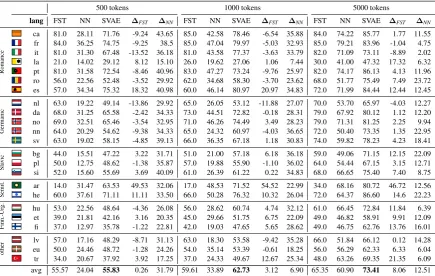
We ran the three models on 23 languages with the hyperparameters and experimental details de-scribed in App.A. We present our results in Fig.2 and in Tab.3. We also provide sample output of the generative model created using the dream step in App.B. The high-level take-away is that on almost all languages we are able to exploit the unlabeled data to improve the sequence-to-sequence model using unlabeled data, i.e., SVAE outperforms the NN model onalllanguages acrossalltraining
sce-narios. However, in many cases, the FST model is a better choice—the FST can sometimes generalize better from a handful of supervised examples than the neural network, even with semi-supervision (SVAE). We highlight three finer-grained observa-tions below.
500 tokens 1000 tokens 5000 tokens
lang FST NN SVAE ∆FST ∆NN FST NN SVAE ∆FST ∆NN FST NN SVAE ∆FST ∆NN
ca 81.0 28.11 71.76 -9.24 43.65 85.0 42.58 78.46 -6.54 35.88 84.0 74.22 85.77 1.77 11.55 fr 84.0 36.25 74.75 -9.25 38.5 85.0 47.04 79.97 -5.03 32.93 85.0 79.21 83.96 -1.04 4.75 it 81.0 31.30 67.48 -13.52 36.18 81.0 43.58 77.37 -3.63 33.79 82.0 71.09 73.11 -8.89 2.02 la 21.0 14.02 29.12 8.12 15.10 26.0 19.62 27.06 1.06 7.44 30.0 41.00 47.32 17.32 6.32 Romance pt 81.0 31.58 72.54 -8.46 40.96 83.0 47.27 73.24 -9.76 25.97 82.0 74.17 86.13 4.13 11.96 ro 56.0 22.56 52.48 -3.52 29.92 62.0 34.68 58.30 -3.70 23.62 68.0 51.77 75.49 7.49 23.72 es 57.0 34.34 75.32 18.32 40.98 60.0 46.14 80.97 20.97 34.83 72.0 71.99 84.44 12.44 12.45 nl 63.0 19.22 49.14 -13.86 29.92 65.0 26.05 53.12 -11.88 27.07 70.0 53.70 65.97 -4.03 12.27 da 68.0 31.25 65.58 -2.42 34.33 73.0 44.51 72.82 -0.18 28.31 79.0 67.92 80.12 1.12 12.20 no 69.0 32.51 65.46 -3.54 32.95 71.0 46.26 74.49 3.49 28.23 79.0 71.31 81.25 2.25 9.94 Germanic nn 64.0 20.29 54.62 -9.38 34.33 65.0 24.32 60.97 -4.03 36.65 72.0 50.40 73.35 1.35 22.95 sv 63.0 19.02 58.15 -4.85 39.13 66.0 36.35 67.18 1.18 30.83 74.0 59.82 78.23 4.23 18.41 bg 44.0 15.51 47.22 3.22 31.71 51.0 21.00 57.18 6.18 36.18 59.0 49.06 71.15 12.15 22.09 pl 50.0 12.75 48.62 -1.38 35.87 57.0 19.88 55.90 -1.10 36.02 64.0 54.44 67.15 3.15 12.71
Sla
vic
si 52.0 15.60 55.69 3.69 40.09 61.0 26.39 61.22 0.22 34.83 68.0 66.65 75.40 7.40 8.75 ar 14.0 31.47 63.53 49.53 32.06 17.0 48.53 71.52 54.52 22.99 34.0 68.16 80.72 46.72 12.56 Semit. he 60.0 37.61 71.11 11.11 33.50 66.0 50.28 76.32 10.32 26.04 72.0 64.37 86.60 14.6 22.23 hu 53.0 22.56 48.64 -4.36 26.08 56.0 28.62 60.74 4.74 32.12 61.0 66.45 72.84 11.84 6.39 et 39.0 21.81 42.16 3.16 20.35 45.0 29.66 51.75 6.75 22.09 49.0 46.82 58.91 9.91 12.09
Finn.-Ur
g.
fi 37.0 12.97 35.78 -1.22 22.81 42.0 19.03 47.65 5.65 28.62 49.0 46.75 62.76 13.76 16.01 lv 57.0 17.16 48.29 -8.71 31.13 63.0 18.30 53.58 -9.42 35.28 66.0 51.84 66.12 0.12 14.28 eu 50.0 24.46 48.72 -1.28 24.26 54.0 35.14 53.39 -0.61 18.25 56.0 56.29 62.33 6.33 6.04
other
[image:9.595.81.517.62.338.2]tr 34.0 20.67 37.92 3.92 17.25 37.0 24.33 49.67 12.67 25.34 48.0 63.26 69.35 21.35 6.09 avg 55.57 24.04 55.83 0.26 31.79 59.61 33.89 62.73 3.12 6.90 65.35 60.90 73.41 8.06 12.51
Table 3: Type-level morphological inflection accuracy across different models, training scenarios, and languages
Observation 2: Agglutinative Languages. The next trend we remark upon is that languages of an agglutinating nature tend to benefit more from the semi-supervised learning. Why should this be? Since in our experimental set-up, every lan-guage sees thesame number of tokens, it is
natu-rally harder to generalize on languages that have more distinct morphological variants. Also, by the nature of agglutinative languages, relevant mor-phemes could be arbitrarily far from the edges of the string, making the (NN and) SVAE’s ability to learn more generic rules even more valuable.
Observation 3: Non-concatenative Morphology. One interesting advantage that the neural models have over the FSTs is the ability to learn non-concatenative phenomena. The FST model is based on prefix and suffix rewrite rules and, naturally, struggles when the correctly reinflected form is more than the concatenation of these parts. Thus we see that for the two semitic language, the SVAE is the best method across all resource settings.
8 Conclusion
We have presented a novel generative model for morphological inflection generation in context. The model allows us to exploit unlabeled data in the training of morphological inflectors. As the model’s rich parameterization prevents tractable
in-ference, we craft a variational inference procedure, based on the wake-sleep algorithm, to marginal-ize out the latent variables. Experimentally, we provide empirical validation on 23 languages. We find that, especially in the lower-resource condi-tions, our model improves by large margins over the baselines.
References
Malin Ahlberg, Markus Forsberg, and Mans Hulden. 2015. Paradigm classification in supervised learning of morphology. InHuman Language Technologies: The 2015 Annual Conference of the North American Chapter of the ACL, pages 1024–1029, Denver, CO. Association for Computational Linguistics.
Waleed Ammar, Chris Dyer, and Noah A. Smith. 2014. Conditional random field autoencoders for unsuper-vised structured prediction. InAdvances in Neural Information Processing Systems, pages 3311–3319.
Mark Aronoff. 1976. Word Formation in Generative Grammar. Number 1 in Linguistic Inquiry Mono-graphs. MIT Press, Cambridge, MA.
Matthew James Beal. 2003.Variational Algorithms for Approximate Bayesian Inference. University Col-lege London.
Jörg Bornschein and Yoshua Bengio. 2014. Reweighted wake-sleep.CoRR, abs/1406.2751.
Ryan Cotterell and Georg Heigold. 2017. Cross-lingual character-level neural morphological tag-ging. In Proceedings of the 2017 Conference on Empirical Methods in Natural Language Processing, pages 748–759, Copenhagen, Denmark. Association for Computational Linguistics.
Ryan Cotterell, Christo Kirov, John Sylak-Glassman, Géraldine Walther, Ekaterina Vylomova, Patrick Xia, Manaal Faruqui, Sandra Kübler, David Yarowsky, Jason Eisner, and Mans Hulden. 2017. The CoNLL-SIGMORPHON 2017 shared task: Uni-versal morphological reinflection in 52 languages. InProceedings of the CoNLL-SIGMORPHON 2017 Shared Task: Universal Morphological Reinflection, Vancouver, Canada. Association for Computational Linguistics.
Ryan Cotterell, Christo Kirov, John Sylak-Glassman, David Yarowsky, Jason Eisner, and Mans Hulden. 2016. The SIGMORPHON 2016 shared task— morphological reinflection. In Proceedings of the 14th SIGMORPHON Workshop on Computational Research in Phonetics, Phonology, and Morphol-ogy, pages 10–22, Berlin, Germany. Association for Computational Linguistics.
Peter Dayan, Geoffrey E. Hinton, Radford M. Neal, and Richard S. Zemel. 1995. The Helmholtz ma-chine. Neural Computation, 7(5):889–904.
A. P. Dempster, N. M. Laird, and D. B. Rubin. 1977. Maximum likelihood from incomplete data via the em algorithm. Journal of the Royal Statistical Soci-ety. Series B (Methodological), 39(1):1–38.
Markus Dreyer, Jason Smith, and Jason Eisner. 2008. Latent-variable modeling of string transductions with finite-state methods. In Proceedings of the 2008 Conference on Empirical Methods in Natural Language Processing (EMNLP), pages 1080–1089, Honolulu, Hawaii. Association for Computational Linguistics.
Matthew S. Dryer, David Gil, Bernard Comrie, Hagen Jung, Claudia Schmidt, et al. 2005. The world atlas of language structures.
Greg Durrett and John DeNero. 2013. Supervised learning of complete morphological paradigms. In Proceedings of the 2013 Conference of the North American Chapter of the Association for Computa-tional Linguistics: Human Language Technologies, pages 1185–1195, Atlanta, Georgia. Association for Computational Linguistics.
Manaal Faruqui, Yulia Tsvetkov, Graham Neubig, and Chris Dyer. 2016. Morphological inflection genera-tion using character sequence to sequence learning. InProceedings of the 2016 Conference of the North American Chapter of the Association for Computa-tional Linguistics: Human Language Technologies,
pages 634–643, San Diego, California. Association for Computational Linguistics.
Shai Fine, Yoram Singer, and Naftali Tishby. 1998. The hierarchical hidden Markov model: Analysis and applications. Machine Learning, 32(1):41–62.
Georg Heigold, Guenter Neumann, and Josef van Gen-abith. 2017. An extensive empirical evaluation of character-based morphological tagging for 14 lan-guages. InProceedings of the 15th Conference of the European Chapter of the Association for Compu-tational Linguistics: Volume 1, Long Papers, pages 505–513, Valencia, Spain. Association for Computa-tional Linguistics.
Geoffrey E. Hinton, Peter Dayan, Brendan J. Frey, and Radford M. Neal. 1995. The "wake-sleep" algo-rithm for unsupervised neural networks. Science, 268(5214):1158–1161.
Sepp Hochreiter and Jürgen Schmidhuber. 1997. Long short-term memory. Neural Computation, 9(8):1735–1780.
Mans Hulden, Markus Forsberg, and Malin Ahlberg. 2014. Semi-supervised learning of morphological paradigms and lexicons. InProceedings of the 14th Conference of the European Chapter of the Asso-ciation for Computational Linguistics, pages 569– 578, Gothenburg, Sweden. Association for Compu-tational Linguistics.
Michael I. Jordan, Zoubin Ghahramani, Tommi S. Jaakkola, and Lawrence K. Saul. 1999. An intro-duction to variational methods for graphical models. Machine Learning, 37(2):183–233.
Katharina Kann and Hinrich Schütze. 2016. Single-model encoder-decoder with explicit morphological representation for reinflection. InProceedings of the 54th Annual Meeting of the Association for Compu-tational Linguistics (ACL), pages 555–560, Berlin, Germany. Association for Computational Linguis-tics.
Aleksandr E. Kibrik. 1998. Archi. In Andrew Spencer and Arnold M. Zwicky, editors, The Handbook of Morphology, pages 455–476.
Diederik P. Kingma and Max Welling. 2013. Auto-encoding variational Bayes. arXiv preprint arXiv:1312.6114.
John D. Lafferty, Andrew McCallum, and Fernando C. N. Pereira. 2001. Conditional random fields: Probabilistic models for segmenting and labeling se-quence data. In Proceedings of the Eighteenth In-ternational Conference on Machine Learning, pages 282–289.
2015 Conference on Empirical Methods in Natu-ral Language Processing, pages 1412–1421, Lis-bon, Portugal. Association for Computational Lin-guistics.
Thomas Müller, Ryan Cotterell, Alexander Fraser, and Hinrich Schütze. 2015. Joint lemmatization and morphological tagging with Lemming. In Proceed-ings of the 2015 Conference on Empirical Meth-ods in Natural Language Processing, pages 2268– 2274, Lisbon, Portugal. Association for Computa-tional Linguistics.
Thomas Müller, Helmut Schmid, and Hinrich Schütze. 2013. Efficient higher-order CRFs for morphologi-cal tagging. InProceedings of the 2013 Conference on Empirical Methods in Natural Language Process-ing, pages 322–332, Seattle, Washington, USA. As-sociation for Computational Linguistics.
Garrett Nicolai, Colin Cherry, and Grzegorz Kondrak. 2015. Inflection generation as discriminative string transduction. In Proceedings of the 2015 Confer-ence of the North American Chapter of the Associ-ation for ComputAssoci-ational Linguistics: Human Lan-guage Technologies, pages 922–931, Denver, Col-orado. Association for Computational Linguistics.
Joakim Nivre, Željko Agi´c, Lars Ahrenberg, Maria Je-sus Aranzabe, Masayuki Asahara, Aitziber Atutxa, Miguel Ballesteros, John Bauer, Kepa Bengoetxea, Riyaz Ahmad Bhat, Eckhard Bick, Cristina Bosco, Gosse Bouma, Sam Bowman, Marie Can-dito, Gül¸sen Cebiro˘glu Eryi˘git, Giuseppe G. A. Celano, Fabricio Chalub, Jinho Choi, Ça˘grı Çöl-tekin, Miriam Connor, Elizabeth Davidson, Marie-Catherine de Marneffe, Valeria de Paiva, Arantza Diaz de Ilarraza, and Dobrovoljc. 2017. Universal dependencies 2.0. LINDAT/CLARIN digital library at the Institute of Formal and Applied Linguistics ( ’UFAL), Faculty of Mathematics and Physics, Charles University.
Lawrence R. Rabiner. 1989. A tutorial on hidden Markov models and selected applications in speech recognition. Proceedings of the IEEE, 77(2):257– 286.
David E. Rumelhart, Geoffrey E. Hinton, and Ronald J. Williams. 1986. Learning internal representations by error propagation. Technical report, California Univ San Diego La Jolla Inst for Cognitive Science. Andrew Spencer. 1991. Morphological Theory: An Introduction to Word Structure in Generative Gram-mar. Wiley-Blackwell.
Andreas Stuhlmüller, Jacob Taylor, and Noah Good-man. 2013. Learning stochastic inverses. In Ad-vances in Neural Information Processing Systems, pages 3048–3056.
Martin Sundermeyer, Ralf Schlüter, and Hermann Ney. 2012. LSTM neural networks for language model-ing. InThirteenth Annual Conference of the Interna-tional Speech Communication Association.
Ilya Sutskever, Oriol Vinyals, and Quoc V. Le. 2014. Sequence to sequence learning with neural networks. In Advances in Neural Information Processing Sys-tems 27: Annual Conference on Neural Informa-tion Processing Systems 2014, December 8-13 2014, Montreal, Quebec, Canada, pages 3104–3112.
John Sylak-Glassman. 2016. The composition and use of the universal morphological feature schema (Uni-morph schema). Technical report, Johns Hopkins University.
John Sylak-Glassman, Christo Kirov, David Yarowsky, and Roger Que. 2015. A language-independent fea-ture schema for inflectional morphology. In Pro-ceedings of the 53rd Annual Meeting of the Associ-ation for ComputAssoci-ational Linguistics and the 7th In-ternational Joint Conference on Natural Language Processing (ACL), pages 674–680, Beijing, China. Association for Computational Linguistics.
Matthew D. Zeiler. 2012. Adadelta: An adaptive learn-ing rate method.arXiv preprint:1212.5701.