1499
Generating Informative Responses with Controlled Sentence Function
Pei Ke1, Jian Guan2, Minlie Huang1∗, Xiaoyan Zhu1
1Conversational AI group, AI Lab., Dept. of Computer Science, Tsinghua University 1Beijing National Research Center for Information Science and Technology, China
2Dept. of Physics, Tsinghua University, Beijing 100084, China
[email protected], [email protected] [email protected], [email protected]
Abstract
Sentence function is a significant factor to achieve the purpose of the speaker, which, however, has not been touched in large-scale conversation generation so far. In this paper, we present a model to gener-ate informative responses with controlled sentence function. Our model utilizes a continuous latent variable to capture vari-ous word patterns that realize the expected sentence function, and introduces a type controller to deal with the compatibility of controlling sentence function and gen-erating informative content. Conditioned on the latent variable, the type controller determines the type (i.e.,function-related, topic, and ordinary word) of a word to be generated at each decoding position. Experiments show that our model outper-forms state-of-the-art baselines, and it has the ability to generate responses with both controlled sentence function and informa-tive content.
1 Introduction
Sentence functionis an important linguistic feature and a typical taxonomy in terms of the purpose of the speaker (Rozakis,2003). There are four major function types in the language including interrog-ative, declarinterrog-ative, imperative, andexclamatory, as described in (Rozakis,2003). Each sentence func-tion possesses its own structure, and transforma-tion between sentence functransforma-tions needs a series of changes in word order, syntactic patterns and other aspects (Akmajian,1984;Yule,2010).
Since sentence function is regarding the purpose of the speaker, it can be a significant factor indi-cating the conversational purpose during
interac-∗
*Corresponding author: Minlie Huang.
Post I’m really hungry now. Interrogative What didyou haveat breakfast?
Response Imperative Let’shave dinnertogether!
[image:1.595.308.526.223.266.2]Declarative Me,too. Butyou atetoo much at lunch.
Figure 1: Responses with three sentence func-tions. Function-related words are in red, topic words in blue, and others are ordinary words.
tions, but surprisingly, this problem is rather un-touched in dialogue systems. As shown in Fig-ure 1, responses with different functions can be used to achieve different conversational purposes: Interrogative responses can be used to acquire further information from the user;imperative re-sponses are used to make requests, directions, in-structions or invitations to elicit further interac-tions; anddeclarativeresponses commonly make statements to state or explain something.1 Inter-rogative and imperative responses can be used to avoid stalemates (Li et al.,2016b), which can be viewed as important proactive behaviors in con-versation (Yu et al., 2016). Thus, conversational systems equipped with the ability to control the sentence function can adjust its strategy for dif-ferent purposes within difdif-ferent contexts, behave more proactively, and may lead the dialogue to go further.
Generating responses with controlled sentence functions differs significantly from other tasks on controllable text generation (Hu et al.,2017;Ficler and Goldberg, 2017;Asghar et al., 2017; Ghosh et al.,2017; Zhou and Wang, 2017;Dong et al.,
2017;Murakami et al.,2017). These studies, in-volving the control of sentiment polarity, emotion, or tense, fall intolocalcontrol, more or less, be-cause the controllable variable can be locally
re-1Note that we did not include the
flected by decoding local variable-related words, e.g., terrible for negative sentiment (Hu et al.,
2017; Ghosh et al., 2017), glad for happy emo-tion (Zhou et al., 2018; Zhou and Wang, 2017), and was for past tense (Hu et al., 2017). By contrast, sentence function is a global attribute of text, and controlling sentence function is more challenging in that it requires to adjust theglobal structure of the entire text, including changing word order and word patterns.
Controlling sentence function in conversational systems faces another challenge: in order to gen-erate informative and meaningful responses, it has to deal with the compatibility of the sentence func-tion and the content. Similar to most existing neu-ral conversation models (Li et al., 2016a; Mou et al.,2016;Xing et al.,2017), we are also strug-gling with universal and meaningless responses for different sentence functions, e.g., “Is that right?” for interrogative responses, “Please!” for imperative responses and “Me, too.” for declar-ative responses. The lack of meaningful topics in responses will definitely degrade the utility of the sentence function so that the desired conversa-tional purpose can not be achieved. Thus, the task needs to generate responses with both informative content and controllable sentence functions.
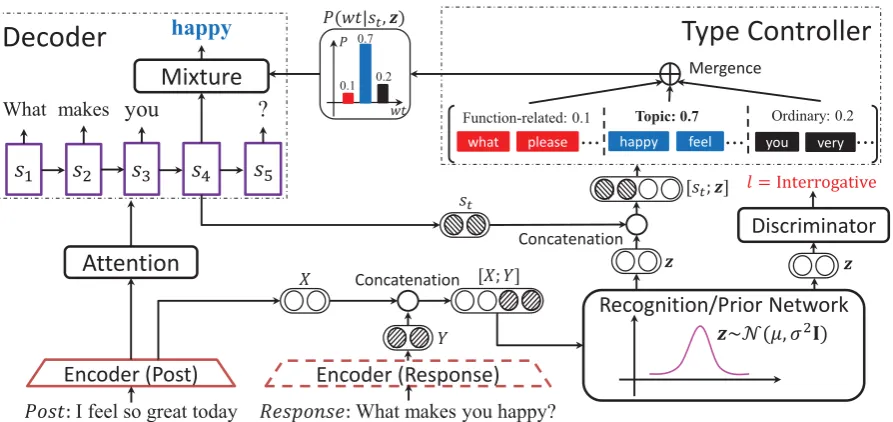
In this paper, we propose a conversation gen-eration model to deal with the global control of sentence function and the compatibility of control-ling sentence function and generating informative content. We devise an encoder-decoder structure equipped with a latent variable in conditional vari-ational autoencoder (CVAE) (Sohn et al., 2015), which can not only project different sentence func-tions into different regions in a latent space, but also capture various word patterns within each sentence function. The latent variable, supervised by a discriminator with the expected function la-bel, is also used to realize the global control of sen-tence function. To address the compatibility issue, we use a type controller which lexicalizes the sen-tence function and the content explicitly. The type controller estimates a distribution over three word types, i.e.,function-related,topic, andordinary words. During decoding, the word type distribu-tion will be used to modulate the generadistribu-tion distri-bution in the decoder. The type sequence of a re-sponse can be viewed as an abstract representation of sentence function. By this means, the model has an explicit and strong control on the function and
the content. Our contributions are as follows:
• We investigate how to control sentence func-tions to achieve different conversational pur-poses in open-domain dialogue systems. We analyze the difference between this task and other controllable generation tasks.
• We devise a structure equipped with a la-tent variable and a type controller to achieve the global control of sentence function and deal with the compatibility of controllable sentence function and informative content in generation. Experiments show the effective-ness of the model.
2 Related Work
Recently, language generation in conversational systems has been widely studied with sequence-to-sequence (seq2seq) learning (Sutskever et al.,
2014; Bahdanau et al., 2015; Vinyals and Le,
2015; Shang et al., 2015; Serban et al., 2016,
2017). A variety of methods has been proposed to address the important issue of content quality, including enhancing diversity (Li et al., 2016a;
Zhou et al.,2017) and informativeness (Mou et al.,
2016; Xing et al., 2017) of the generated re-sponses.
In addition to the content quality, controllabil-ity is a critical problem in text generation. Vari-ous methods have been used to generate texts with controllable variables such as sentiment polarity, emotion, or tense (Hu et al., 2017;Ghosh et al.,
2017;Zhou and Wang,2017;Zhou et al.,2018) . There are mainly two solutions to deal with con-trollable text generation. First, the variables to be controlled are embedded into vectors which are then fed into the models to reflect the character-istics of the variables (Ghosh et al., 2017; Zhou et al.,2018). Second, latent variables are used to capture the information of controllable attributes as in the variational autoencoders (VAE) (Zhou and Wang,2017). (Hu et al.,2017) combined the two techniques by disentangling a latent variable into a categorical code and a random part to better control the attributes of the generated text.
: I feel so great today
Attention
: What makes you happy? What makes you
happy
?
Recognition/Prior Network ~ ( , )
Discriminator = Interrogative
Mixture
what please ⋯ happy feel ⋯ you very ⋯
Decoder
Type Controller
Encoder (Post) Encoder (Response)
Function-related: 0.1 Topic: 0.7 Ordinary: 0.2
Concatenation [ ; ]
( | , )
[ ; ]
Concatenation
Mergence 0.1
0.7
[image:3.595.79.526.61.272.2]0.2
Figure 2: Model overview. During training, the latent variablezis sampled from the recognition network which is supervised by the function label in the discriminator. In the type controller, the latent variable and the decoder’s state are used to estimate a type distribution which modulates the final generation distribution. During test,zis sampled from the prior network whose input is only the post. The response encoder in the dotted box appears only in training.
plan the words globally to realize the function type to be controlled. (2) The compatibility of control-lable variables and content quality is less studied in the literature. The most similar work in (Zhao et al., 2017) proposed to control the dialogue act of a response, which is also a global attribute. However, the model controls dialog act by directly feeding a latent variable into the decoder, instead, our model has a stronger control on the genera-tion process via a type controller in which words of different types are concretely modeled.
3 Model
3.1 Task Definition and Model Overview
Our problem is formulated as follows: given a post
X = x1x2· · ·xn and a sentence function
cate-gory l, our task is to generate a response Y =
y1y2· · ·ymthat is not only coherent with the
spec-ified function category l but also informative in content. We denotec as the concatenation of all the input information, i.e. c = [X;l]. Essentially, the goal is to estimate the conditional probability:
P(Y,z|c) =P(z|c)·P(Y|z,c) (1)
The latent variable z is used to capture the sen-tence function of a response. P(z|c), parameter-ized as the prior network in our model, indicates the sampling process of z, i.e., drawing z from
P(z|c). AndP(Y|z,c) = Qmt=1P(yt|y<t,z,c)
is applied to model the generation of the response
Y conditioned on the latent variablez and the in-putc, which is implemented by a decoder in our model.
3.2 Encoder-Decoder Framework
The encoder-decoder framework has been widely used in language generation (Sutskever et al.,
2014;Vinyals and Le,2015). The encoder trans-forms the post sequence X = x1x2· · ·xn into
hidden representationsH = h1h2· · ·hn, as
fol-lows:
ht=GRU(e(xt),ht−1) (2)
where GRU is gated recurrent unit (Cho et al.,
2014), and e(xt) denotes the embedding of the
wordxt.
The decoder first updates the hidden statesS =
s1s2· · ·sm, and then generates the target
se-quenceY =y1y2· · ·ymas follows:
st=GRU(st−1,e(yt−1),cvt−1) (3)
yt∼P(yt|y<t,st) =sof tmax(W st) (4)
where thisGRUdoes not share parameters with the encoder’s network. The context vectorcvt−1
is a dynamic weighted sum of the encoder’s hid-den states, i.e., cvt−1 = Pni=1αit−1hi, andαti−1
scores the relevance between the decoder’s state
st−1 and the encoder’s statehi (Bahdanau et al., 2015).
3.3 Recognition/Prior Network
On top of the encoder-decoder structure, our model introduces the recognition network and the prior network of CVAE framework, and utilizes the two networks to draw latent variable samples during training and test respectively. The latent variable can project different sentence functions into different regions in a latent space, and also capture various word patterns within a sentence function.
In the training process, our model needs to sam-ple the latent variable from the posterior distribu-tion P(z|Y,c), which is intractable. Thus, the recognition network qφ(z|Y,c) is introduced to
approximate the true posterior distribution so that we can samplez from this deterministic parame-terized model. We assume thatz follows a mul-tivariate Gaussian distribution whose covariance matrix is diagonal, i.e.,qφ(z|Y,c) ∼ N(µ, σ2I).
Under this assumption, the recognition network can be parameterized by a deep neural network such as a multi-layer perceptron (MLP):
[µ, σ2] =MLPposterior(Y,c) (5)
During test, we use the prior networkpθ(z|c)∼
N(µ0, σ02I) instead to draw latent variable sam-ples, which can be implemented in a similar way:
[µ0, σ02] =MLPprior(c) (6)
To bridge the gap between the recognition and the prior networks, we add the KL divergence term that should be minimized to the loss function:
L1 =KL(qφ(z|Y,c)||pθ(z|c)) (7)
3.4 Discriminator
The discriminator supervises z to encode function-related information in a response with supervision signals. It takeszas input instead of the generated response Y to avoid the vanishing gradient of z, and predicts the function category conditioned onz:
P(l|z) =sof tmax(WD·MLPdis(z)) (8)
This formulation can enforcezto capture the fea-tures of sentence function and enhance the influ-ence ofzin word generation. The loss function of the discriminator is given by:
L2 =−Eqφ(z|Y,c)[logP(l|z)] (9)
3.5 Type Controller
The type controller is designed to deal with the compatibility issue of controlling sentence func-tion and generating informative content. As afore-mentioned, we classify the words in a response into three types: function-related, topic, and or-dinarywords. The type controller estimates a dis-tribution over the word types at each decoding po-sition, and the type distribution will be used in the mixture model of the decoder for final word gener-ation. During the decoding process, the decoder’s statestand the latent variablezare taken as input
to estimate the type distribution as follows:
P(wt|st,z) =sof tmax(W0·MLPtype(st,z))
3.6 Decoder
Compared with the traditional decoder described in Section 3.2, our decoder updates the hidden statestwith both the input informationcand the
latent variablez, and generates the response in a mixtureform which is combined with the type dis-tribution obtained from the type controller:
st=GRU(st−1,e(yt−1),cvt−1,c,z) (11)
P(yt|y<t,c,z) =P(yt|yt−1,st,c,z)
=
3
X
i=1
P(wt=i|st,z)P(yt|yt−1,st,c,z, wt=i)
(12)
where wt = 1,2,3 stand for function-related words, topic words, and ordinary words, respec-tively. The probability for choosing different word types at timet,P(wt=i|st,z), is obtained from
the type controller, as shown in Equation (10). The probabilities of choosing words in different types are introduced as follows:
Function-related Word: Function-related words represent the typical words for each sentence func-tion, e.g., what for interrogative responses, and please for imperative responses. To select the function-related words at each position, we simul-taneously consider the decoder’s statest, the latent
variablezand the function categoryl.
P(yt|yt−1,st,c,z, wt= 1) =
sof tmax(W1·[st,z,e(l)]) (13)
where e(l) is the embedding vector of the func-tion label. Under the control ofz, our model can learn to decode function-related words at proper positions automatically.
Topic Word: Topic words are crucial for generat-ing an informative response. The probability for selecting a topic word at each decoding position depends on the current hidden statest:
P(yt|yt−1,st,c,z, wt= 2) =sof tmax(W2st)
(14) This probability is over the topic words we predict conditioned on a post. Section 3.8 will describe the details.
Ordinary Word: Ordinary words play a func-tional role in making a natural and grammatical sentence. The probability of generating ordinary words is estimated as below:
P(yt|yt−1,st,c,z, wt= 3) =sof tmax(W3st)(15)
The generation loss of the decoder is given as below:
L3 =−Eqφ(z|Y,c)[logP(Y|z,c)]
=−Eqφ(z|Y,c)[ X
t
logP(yt|y<t,z,c)] (16)
3.7 Loss Function
The overall lossL is a linear combination of the KL termL1, the classification loss of the
discrim-inatorL2, and the generation loss of the decoder L3:
L=αL1+L2+L3 (17)
We let α gradually increase from 0 to 1. This technique of KL cost annealing can address the optimization challenges of vanishing latent vari-ables in the RNN encoder-decoder (Bowman et al.,
2016).
3.8 Topic Word Prediction
Topic words play a key role in generating an infor-mative response. We resort to pointwise mutual information (PMI) (Church and Hanks,1990) for predicting a list of topic words that are relevant to a post. Letxandyindicate a word in a postXand its responseY respectively, and PMI is computed as follows:
P M I(x, y) = log P(x, y)
P(x)P(y) (18)
Then, the relevance score of a topic word to a given postx1x2· · ·xncan be approximated as
fol-lows, similar to (Mou et al.,2016):
REL(x1, ..., xn, y)≈ n X
i=1
P M I(xi, y) (19)
During training, the words in a response with high
RELscores to the post are treated as topic words. During test, we useRELto select the top ranked words as topic words for a post.
4 Experiment
4.1 Data Preparation
We collected a Chinese dialogue dataset from Weibo 2. We crawled about 10 million post-responses pairs. Since our model needs the sen-tence function label for each pair, we built a clas-sifier to predict the sentence function automati-cally to construct large-scale labeled data. Thus,
we sampled about 2,000 pairs from the original dataset and annotated the data manually with four categories, i.e.,interrogative, imperative, declara-tiveandother. This small dataset was partitioned into the training, validation, and test sets with the ratio of 6:1:1. Three classifiers, including LSTM (Hochreiter and Schmidhuber, 1997), Bi-LSTM (Graves et al., 2005) and a self-attentive model (Lin et al.,2017), were attempted on this dataset. The results in Table1show that the self-attentive classifier outperforms other models and achieves the best accuracy of 0.78 on the test set.
[image:6.595.129.234.233.277.2]Model Accuracy LSTM 0.60 Bi-LSTM 0.75 Self-Attentive 0.78
Table 1: Accuracy of sentence function classifica-tion on the 2,000 post-response pairs.
We then applied the self-attentive classifier to annotate the large dataset and obtained a dialogue dataset with noisy sentence function labels3. To balance the distribution of sentence functions, we randomly sampled about 0.6 million pairs for each sentence function to construct the final dataset. The statistics of this dataset are shown in Table2. The dataset4is available athttp://coai.cs. tsinghua.edu.cn/hml/dataset.
Training
#Post 1,963,382
#Response
Interrogative 618,340 Declarative 672,346 Imperative 672,696
Validation
#Post 24,034
#Response
[image:6.595.80.284.451.555.2]Interrogative 7,045 Declarative 9,685 Imperative 7,304 Test #Post 6,000
Table 2: Corpus statistics.
4.2 Experiment Settings
Our model was implemented with TensorFlow5. We applied bidirectional GRU with 256 cells to the encoder and GRU with 512 cells to the de-coder. The dimensions of word embedding and function category embedding were both set to 100. We also set the dimension of latent vari-ables to 128. The vocabulary size was set to
3
Though the labels are noisy, the data are sufficient to train a generation model in practice.
4
Note that we strictly obeyed the policies of Weibo and anonymized potential private information in dialogues. This dataset is strictly limited for academic use.
5https://github.com/tensorflow/tensorflow
40,000. Stochastic gradient descent (Qian,1999) was used to optimize our model, with a learning rate of 0.1, a decay rate of 0.9995, and a momen-tum of 0.9. The batch size was set to 128. Our codes are available athttps://github.com/ kepei1106/SentenceFunction.
We chose several state-of-the-art baselines, which were implemented with the settings pro-vided in the original papers:
Conditional Seq2Seq (c-seq2seq): A Seq2Seq variant which takes the category (i.e., function type) embedding as additional input at each de-coding position (Ficler and Goldberg,2017). Mechanism-aware (MA): This model assumes that there are multiple latent responding mecha-nisms (Zhou et al.,2017). The number of respond-ing mechanisms is set to 3, equal to the number of function types.
Knowledge-guided CVAE (KgCVAE): A modi-fied CVAE which aims to control the dialog act of a generated response (Zhao et al.,2017).
4.3 Automatic Evaluation
Metrics: We adopted Perplexity (PPL) (Vinyals and Le, 2015), Distinct-1 (Dist-1), Distinct-2 (Dist-2) (Li et al., 2016a), and Accuracy (ACC) to evaluate the models at the content and function level. Perplexity can measure the grammatical-ity of generated responses. Distinct-1/distinct-2 is the proportion of distinct unigrams/bigrams in all the generated tokens, respectively. Accuracy mea-sures how accurately the sentence function can be controlled. Specifically, we compared the prespec-ified function (as input to the model) with the func-tion of a generated response, which is predicted by the self-attentive classifier (see Section4.1).
Model PPL Dist-1 Dist-2 ACC c-seq2seq 57.14 949/.007 5177/.041 0.973 MA 46.08 745/.005 2952/.027 0.481 KgCVAE 56.81 1531/.009 10683/.070 0.985 Our Model 55.85 1833/.008 15586/.075 0.992
Table 3: Automatic evaluation with perplexity (PPL), distinct-1 (Dist-1), distinct-2 (Dist-2), and accuracy (ACC). The integers in the Dist-* cells denote the total number of distinctn-grams.
Model Interrogative Declarative Imperative Gram. Appr. Info. Gram. Appr. Info. Gram. Appr. Info. Ours vs. c-seq2seq 0.534 0.536 0.896* 0.630* 0.573* 0.764* 0.685* 0.504 0.893* Ours vs. MA 0.802* 0.602* 0.675* 0.751* 0.592* 0.617* 0.929* 0.568* 0.577* Ours vs. KgCVAE 0.510 0.626* 0.770* 0.546* 0.515* 0.744* 0.780* 0.521* 0.837*
Table 4: Manual evaluation results for different functions. The scores indicate the percentages that our model wins the baselines after removing tie pairs. The scores of our model marked with * are significantly better than the competitors (Sign Test,p-value<0.05).
As for distinct-1 and distinct-2, our model gen-erates remarkably more distinct unigrams and bi-grams than the baselines, indicating that our model can generate more diverse and informative re-sponses compared to the baselines.
In terms of sentence function accuracy, our model outperforms all the baselines and achieves the best accuracy of 0.992, which indicates that our model can control the sentence function more precisely. MA has a very low score because there is no direct way to control sentence function, in-stead, it learns automatically from the data.
4.4 Manual Evaluation
To evaluate the generation quality and how well the models can control sentence function, we con-ducted pair-wise comparison. 200 posts were ran-domly sampled from the test set and each model was required to generate responses with three function types to each post. For each pair of re-sponses (one by our model and the other by a base-line, along with the post), annotators were hired to give a preference (win, lose, or tie). The total annotation amounts to 200×3×3×3=5,400 since we have three baselines, three function types, and three metrics. We resorted to a crowdsourcing ser-vice for annotation, and each pair-wise compari-son was judged by 5 curators.
Metrics: We designed three metrics to evaluate the models from the perspectives of sentence func-tion and content: grammaticality (whether a re-sponse is grammatical and coherent with the sen-tence function we prespecified), appropriateness (whether a response is a logical and appropriate reply to its post), andinformativeness(whether a response provides meaningful information via the topic words relevant to the post). Note that the three metrics were separately evaluated.
Results: The scores in Table4represent the per-centages that our model wins a baseline after re-moving tie pairs. A value larger than 0.5 indi-cates that our model outperforms its competitor. Our model outperforms the baselines significantly
in most cases (Sign Test, with p-value < 0.05). Among the three function types, our model per-forms significantly better than the baselines when generating declarative and imperative responses. As for interrogative responses, our model is bet-ter but the difference is not significant in some set-tings. This is because interrogative patterns are more apparent and easier to learn, thereby all the models can capture some of the patterns to gen-erate grammatical and appropriate responses, re-sulting in more ties. By contrast, declarative and imperative responses have less apparent patterns whereas our model is better at capturing the global patterns through modeling the word types explic-itly.
We can also see that our model obtains particu-larly high scores in informativeness. This demon-strates that our model is better to generate more informative responses, and is able to control sen-tence functions at the same time.
The annotation statistics are shown in Table
5. The percentage of annotations that at least 4 judges assign the same label (at least 4/5 agree-ment) is larger than 50%, and the percentage for at least 3/5 agreement is about 90%, indicating that annotators reached a moderate agreement.
At least 3/5 At least 4/5 Grammaticality 91.7% 60.1% Appropriateness 88.6% 52.5% Informativeness 95.9% 71.2%
Table 5: Annotation statistics. At least n/5means there are no less thannjudges assigning the same label to a record during annotation.
4.5 Words and Patterns in Function Control
Function Frequent Words Frequent Patterns Response Examples
Chinese English Chinese English Chinese English
Interrogative ?
ᱟ ੇ 䈤 ӰѸ
? be particle
mean what
ᱟ䈤 ੇ˛ Does mean ? ᱟ䈤ᡁᐵੇ˛ Do you mean I’m handsome?
ᱟ൘ ੇ˛ Is ? ᱟ൘ཨᡁੇ˛ Are you praising me?
൘ଚ ˛ Where does ? ൘ଚк⨝˛ Where do you work?
ᜣ ӰѸ ˛ What does want to ? ᜣ㾱ӰѸ㊫රⲴ˛ What type do you want to choose?
Imperative !
㾱 ਟԕ
ᶕ 䈧
! will can come please
䛓ቡ Do , then. 䛓ቡྭྭޫ⵰ Take care of yourself, then.
㾱ᢺ 㔉 Let give to . ᡁ㾱ᢺⲴᡯᆀ㔉 Let me give your house to you.
Declarative ᱟ
ҏ 㿹ᗇ ਟᱟ ⋑
be also/too
think but no
ҏᱟ ˈਟᱟ also , but ᡁҏᱟ䘉ѸᜣⲴˈਟᱟᡁ㾱 ањӪˈ
I also think so, but I will find a person. Ha-ha.
ҏᱟˈ 䜭 , too, and has . ᡁҏᱟˈᡁⲴ㊹э䜭㻛ᡁ䴷㋮ Ҷ
[image:8.595.73.529.63.206.2]Me, too, and my fans have been shocked by me.
Figure 3: Frequent function-related words and frequent patterns containing at least 3 function-related words. The letters denote the variables which replace ordinary and topic words in the generated re-sponses. The underlined words in responses are those occurring in patterns.
ordinary and topic words of a generated response with variables and treated each response as a se-quence of function-related words and variables. We then used the Apriori algorithm (Agrawal and Srikant, 1994) to mine frequent patterns in these sequences. We retained frequent patterns that con-sist of at most 5 words and appear in at least 2% of the generated responses.
Figure3presents the most frequent words (the second and third columns) and patterns (the fourth and fifth columns) for each function type. Note that the word patterns can be viewed as an abstract representation of sentence function. We observed that:
First, function-related words are distributed at multiple positions of a sentence, indicating that realizing a sentence function needs a global con-trol by not only predicting the word types but also planning the words of different types properly.
Second, the frequent words clearly reveal the difference between function types. For in-stance, interrogatives like 什么(what), ?(?) and
吗(particle) are commonly seen in interrogative responses, words like 请(please), 来(come), and 要(will) occur frequently in imperative responses. Further, word patterns in different function types differ significantly (see the fourth/fifth columns), indicating that the model is able to learn function-specific word patterns.
Third, interrogative and imperative responses have explicit patterns, while declarative responses are more implicit and divergent in pattern. Inter-rogative responses fall into Yes-No, Wh-, How-, and other questions. Imperative responses gener-ally start with the base form of verbs or imperative
words including请(please). Our model succeeds in capturing two typical forms in declarative re-sponses: adversative and progressive structures.
4.6 Case Study
Post: ྲ᷌ᴹаཙᡁケ❦䐏㔍ӔˈՊᘾѸṧ˛
What would you do if I suddenly broke up with you someday?
Target Function: Interrogative
c-seq2seq: ᱟ䈱˛
Who are you?
MA: ᡁՊᖫḕޣҾ⌅ᖻޣਨ⌅᧚ᯭⲴ㔃䇪ੇ˛
Should I investigate the conclusion of judicial measure related to the law?
KgCVAE: ᱟнᱟᜣᡁҶ
Did you miss me?
Our Model: 䈤䈤ⲴᱟᱟᡁⲴ䭉ੇੇ˛
Doyou meanthat it’s my fault?
Target Function: Imperative
c-seq2seq: ᡁՊྭྭⲴʽ
I’ll be fine!
MA: 㔍Ӕส֜ˈ㔍Ӕส֜
Break up with guys. Break up with guys.
KgCVAE: ᡁՊ䇹Ⲵʽ
I will tell you!
Our Model: ᡁՊՊᢺⲴ⽬⢙㔉㔉Ⲵˈ᭮᭮ᗳ
Rest assuredthat I would giveyourgifttoyou.
Target Function: Declarative
c-seq2seq: ᡁҏᱟ䘉Ѹ䇔ѪⲴˈᡁ㿹ᗇᡁᱟњྭᆙᆀ
I think so, too. I feel that I’m a good man.
MA: ᡁҏн⸕䚃ᘾѸ࣎ˈնᱟᡁᙅᙅ
Idon’t know what to do, but I’m in fear.
KgCVAE: ᡁҏ㿹ᗇᡁᱟњྭ⭧ӪDŽ
I think I’m a good man, too.
Our Model: ᡁ㿹㿹ᗇᡁՊՊᖸ۫ˈᡁՊՊ㻛ᡁྸ傲Ⲵ
Iwould thinkthat I was stupid and I would be
blamedby my mother.
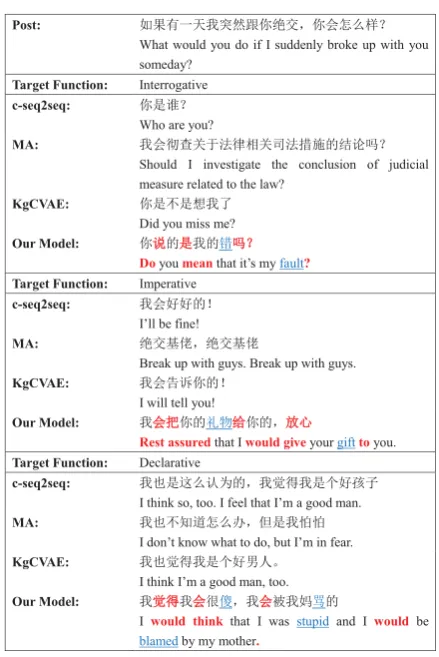
[image:8.595.306.526.356.685.2] [image:8.595.307.525.365.685.2]We presented an example in Figure 4 to show that our model can generate responses of differ-ent function types better compared to baselines. We can see that each function type can be real-ized by a natural composition of function-related words (in red) and topic words (in blue). More-over, function-related words are different and are placed at different positions across function types, indicating that the model learns function-specific word patterns. These examples also show that the compatibility issue of controlling sentence func-tion and generating informative content is well addressed by planning function-related and topic words properly.
Post ྲ᷌ᴹаཙᡁケ❦䐏㔍ӔˈՊᘾѸṧ˛
What would you do if I suddenly broke up with you someday?
Interrogative Response #1
䈤䈤ⲴᱟᱟᡁⲴ䭉ੇੇ˛
Doyou meanthat it’s my fault?
Interrogative Response #2
ՊՊнՊ䈤䈍˛˛
Canyou speaknormally?
Interrogative Response #3
ᜣᡁᘾᘾṧ˛ᡁ㾱㾱н㾱㔍Ӕ˛˛
[image:9.595.70.294.264.347.2]What doyou think I should do? ShallIbreak up withyou?
Figure 5: Different patterns of interrogative re-sponses generated by our model.
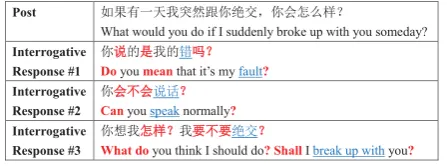
Furthermore, we verified the ability of our model to capture fine-grained patterns within a sentence function. We took interrogative re-sponses as example and obtained rere-sponses by drawing latent variable samples repeatedly. Figure
5shows interrogative responses with different pat-terns generated by our model given the same post. The model generates several Yes-No questions led by words such as 吗(do), 会(can) and 要(shall), and a Wh-question led by 怎样(what). This ex-ample shows that the latent variable can capture the fine-grained patterns and improve the diversity of responses within a function.
5 Conclusion
We present a model to generate responses with both controllable sentence function and informa-tive content. To deal with the global control of sentence function, we utilize a latent variable to capture the various patterns for different sentence functions. To address the compatibility issue, we devise a type controller to handle function-related and topic words explicitly. The model is thus able to control sentence function and generate infor-mative content simultaneously. Extensive exper-iments show that our model performs better than several state-of-the-art baselines.
As for future work, we will investigate how to apply the technique to multi-turn conversational systems, provided that the most proper sentence function can be predicted under a given conversa-tion context.
Acknowledgments
This work was partly supported by the Na-tional Science Foundation of China under grant No.61272227/61332007 and the National Basic Research Program (973 Program) under grant No. 2013CB329403.
References
Rakesh Agrawal and Ramakrishnan Srikant. 1994. Fast algorithms for mining association rules. In Pro-ceedings of the 20th VLDB Conference, pages 487– 499.
Adrian Akmajian. 1984. Sentence types and the form-function fit. Natural Language Linguistic Theory, 2(1):1–23.
Nabiha Asghar, Pascal Poupart, Jesse Hoey, Xin Jiang, and Lili Mou. 2017. Affective neural response gen-eration. arXiv preprint arXiv:1709.03968.
Dzmitry Bahdanau, Kyunghyun Cho, and Yoshua Ben-gio. 2015. Neural machine translation by jointly learning to align and translate. In Proceedings of International Conference on Learning Representa-tions.
Samuel R. Bowman, Luke Vilnis, Oriol Vinyals, An-drew M. Dai, Rafal Jozefowicz, and Samy Ben-gio. 2016. Generating sentences from a continuous space. InProceedings of the 20th SIGNLL Confer-ence on Computational Natural Language Learning, pages 10–21.
Kyunghyun Cho, Bart Van Merrienboer, Dzmitry Bah-danau, and Yoshua Bengio. 2014. On the proper-ties of neural machine translation: Encoder-decoder approaches. InProceedings of Eighth Workshop on Syntax, Semantics and Structure in Statistical Trans-lation, pages 103–111.
Kenneth Ward Church and Patrick Hanks. 1990. Word association norms, mutual information, and lexicog-raphy.Computational linguistics, pages 22–29.
Li Dong, Shaohan Huang, Furu Wei, Mirella Lapata, Ming Zhou, and Ke Xu. 2017. Learning to gen-erate product reviews from attributes. In Proceed-ings of the 15th Conference of the European Chap-ter of the Association for Computational Linguistics, pages 623–632.
Sayan Ghosh, Mathieu Chollet, Eugene Laksana, Louis-Philippe Morency, and Stefan Scherer. 2017. Affect-lm: A neural language model for customiz-able affective text generation. InProceedings of the 55th Annual Meeting of the Association for Compu-tational Linguistics, pages 634–642.
Alex Graves, Santiago Fern´andez, and J¨urgen Schmid-huber. 2005. Bidirectional lstm networks for im-proved phoneme classification and recognition. In
International Conference on Artificial Neural Net-works, pages 799–804.
Sepp Hochreiter and J¨urgen Schmidhuber. 1997. Long short-term memory. Neural Computation, 9(8):1735–1780.
Zhiting Hu, Zichao Yang, Xiaodan Liang, Ruslan Salakhutdinov, and Eric P. Xing. 2017. Toward con-trolled generation of text. In International Confer-ence on Machine Learning.
Jiwei Li, Michel Galley, Chris Brockett, Jianfeng Gao, and Bill Dolan. 2016a. A diversity-promoting ob-jective function for neural conversation models. In
Conference of the North American Chapter of the Association for Computational Linguistics: Human Language Technologies, pages 110–119.
Xiang Li, Lili Mou, Rui Yan, and Ming Zhang. 2016b. Stalematebreaker: A proactive content-introducing approach to automatic human-computer conversa-tion. InProceedings of International Joint Confer-ence on Artificial IntelligConfer-ence, pages 2845–2851.
Zhouhan Lin, Minwei Feng, Cicero Nogueira dos San-tos, Mo Yu, Bing Xiang, Bowen Zhou, and Yoshua Bengio. 2017. A structured self-attentive sentence embedding. In Proceedings of International Con-ference on Learning Representations.
Lili Mou, Yiping Song, Rui Yan, Ge Li, Lu Zhang, and Zhi Jin. 2016. Sequence to backward and for-ward sequences: A content-introducing approach to generative short-text conversation. InProceedings of 26th International Conference on Computational Linguistics, pages 3349–3358.
Soichiro Murakami, Akihiko Watanabe, Akira
Miyazawa, Keiichi Goshima, Toshihiko Yanase, Hi-roya Takamura, and Yusuke Miyao. 2017. Learning to generate market comments from stock prices. In Proceedings of the 55th Annual Meeting of the Association for Computational Linguistics, pages 1374–1384.
Ning Qian. 1999. On the momentum term in gradi-ent descgradi-ent learning algorithms. Neural Networks, 12(1):145–151.
Laurie E. Rozakis. 2003. The complete idiot’s guide to grammar and style. Alpha.
Iulian V. Serban, Alessandro Sordoni, Yoshua Bengio, Aaron Courville, and Joelle Pineau. 2016. Building
end-to-end dialogue systems using generative hier-archical neural network models. InProceedings of AAAI conference on Artificial Intelligence.
Iulian Vlad. Serban, Alessandro Sordoni, Ryan Lowe, Laurent Charlin, Joelle Pineau, Aaron Courville, and Yoshua Bengio. 2017. A hierarchical latent variable encoder-decoder model for generating dialogues. In
Proceedings of AAAI conference on Artificial Intel-ligence.
Lifeng Shang, Zhengdong Lu, and Hang Li. 2015. Neural responding machine for short-text conversa-tion. In Proceedings of the 53rd Annual Meeting of the Association for Computational Linguistics, pages 1577–1586.
Kihyuk Sohn, Honglak Lee, and Xinchen Yan. 2015. Learning structured output representation using deep conditional generative models. In Advances in Neural Information Processing Systems, pages 3483–3491.
Ilya Sutskever, Oriol Vinyals, and Quoc V Le. 2014. Sequence to sequence learning with neural net-works. InAdvances in neural information process-ing systems, pages 3104–3112.
Oriol Vinyals and Quoc Le. 2015. A neural conversa-tional model. In International Conference on Ma-chine Learning Deep Learning Workshop.
Chen Xing, Wei Wu, Yu Wu, Jie Liu, Yalou Huang, Ming Zhou, and Wei-Ying Ma. 2017. Topic aware neural response generation. InProceedings of AAAI conference on Artificial Intelligence.
Zhou Yu, Ziyu Xu, Alan W Black, and Alex I. Rud-nicky. 2016. Strategy and policy learning for non-task-oriented conversational systems. In Proceed-ings of 17th Annual SIGdial Meeting on Discourse and Dialogue.
George Yule. 2010. The study of language. Cambridge university press.
Tiancheng Zhao, Ran Zhao, and Maxine Eskenazi. 2017. Learning discourse-level diversity for neural dialog models using conditional variational autoen-coders. InProceedings of the 55th Annual Meeting of the Association for Computational Linguistics.
Ganbin Zhou, Ping Luo, Rongyu Cao, Fen Lin, Bo Chen, and Qing He. 2017. Mechanism-aware neural machine for dialogue response generation. In
Proceedings of AAAI conference on Artificial Intel-ligence.
Hao Zhou, Minlie Huang, Tianyang Zhang, Xiaoyan Zhu, and Bing Liu. 2018. Emotional chatting ma-chine: Emotional conversation generation with in-ternal and exin-ternal memory. InProceedings of AAAI conference on Artificial Intelligence.