621
Give Me More Feedback: Annotating Argument Persuasiveness and
Related Attributes in Student Essays
Winston Carlile Nishant Gurrapadi Zixuan Ke Vincent Ng Human Language Technology Research Institute
University of Texas at Dallas Richardson, TX 75083-0688
{winston,zixuan,vince}@hlt.utdallas.edu,[email protected]
Abstract
While argument persuasiveness is one of the most important dimensions of argu-mentative essay quality, it is relatively lit-tle studied in automated essay scoring re-search. Progress on scoring argument persuasiveness is hindered in part by the scarcity of annotated corpora. We present the first corpus of essays that are simul-taneously annotated with argument com-ponents, argument persuasiveness scores, and attributes of argument components that impact an argument’s persuasiveness. This corpus could trigger the development of novel computational models concerning argument persuasiveness that provide use-ful feedback to students on why their ar-guments are (un)persuasive in addition to howpersuasive they are.
1 Introduction
The vast majority of existing work on au-tomated essay scoring has focused on holis-tic scoring, which summarizes the quality of an essay with a single score and thus pro-vides very limited feedback to the writer (see
Shermis and Burstein (2013) for the state of the art). While recent attempts address this prob-lem by scoring a particular dimension of essay quality such as coherence (Miltsakaki and Kukich,
2004), technical errors, relevance to prompt (Higgins et al., 2004; Persing and Ng, 2014), or-ganization (Persing et al., 2010), and thesis clar-ity (Persing and Ng, 2013), argument persuasive-ness is largely ignored in existing automated essay scoring research despite being one of the most im-portant dimensions of essay quality.
Nevertheless, scoring the persuasiveness of ar-guments in student essays is by no means easy.
The difficulty stems in part from the scarcity of persuasiveness-annotated corpora of student es-says. While persuasiveness-annotated corpora ex-ist for other domains such as online debates (e.g., Habernal and Gurevych (2016a; 2016b)), to our knowledge only one corpus of persuasiveness-annotated student essays has been made publicly available so far (Persing and Ng,2015).
Though a valuable resource, Persing and Ng’s (2015) (P&N) corpus has several weaknesses that limit its impact on automated essay scoring research. First, P&N assign onlyone persuasive-ness score to each essay that indicates the persua-siveness of the argument an essay makes for its thesis. However, multiple arguments are typically made in a persuasive essay. Specifically, the ar-guments of an essay are typically structured as an argument tree, where the major claim, which is situated at the root of the tree, is supported by one or more claims (the children of the root node), each of which is in turn supported by one or more premises. Hence, each node and its children con-stitute an argument. In P&N’s dataset, only the persuasiveness of the overall argument (i.e., the ar-gument represented at the root and its children) of each essay is scored. Hence, any system trained on their dataset cannot provide any feedback to students on the persuasiveness of any arguments other than the overall argument. Second, P&N’s corpus does not contain annotations that explain why the overall argument is not persuasive if its score is low. This is undesirable from a feedback perspective, as a student will not understand why her argument is not persuasive if its score is low.
ar-gument in each essay (rather than simply the per-suasiveness of the overall argument), but we also identify a set of attributes that can explain an ar-gument’s persuasiveness and annotate each argu-ment with the values of these attributes. These an-notations enable the development of systems that can provide useful feedback to students, as the at-tribute values predicted by these systems can help a student understand why her essay receives a par-ticular persuasiveness score. To our knowledge, this is the first corpus of essays that are simultane-ously annotated with argument components, per-suasiveness scores, and related attributes.1
2 Related Work
While argument mining research has traditionally focused on determining the argumentative struc-ture of a text document (i.e., identifying its ma-jor claim, claims, and premises, as well as the re-lationships between these argument components) (Stab and Gurevych, 2014b, 2017a; Eger et al.,
2017), researchers have recently begun to study new argument mining tasks, as described below.
Persuasiveness-related tasks. Most related to our study is work involving argument persua-siveness. For instance, Habernal and Gurevych
(2016b) and Wei et al. (2016) study the persua-siveness ranking task, where the goal is to rank two internet debate arguments written for the same topic w.r.t. their persuasiveness. As noted by Habernal and Gurevych, ranking arguments is a relatively easier task than scoring an argument’s persuasiveness: in ranking, a system simply deter-mines whether one argument is more persuasive than the other, but nothow much morepersuasive one argument is than the other; in scoring, how-ever, a system has to determine how persuasive an argument is on an absolute scale. Note that ranking is not an acceptable evaluation setting for studying argument persuasiveness in the essay do-main, as feedback for an essay has to be provided independentlyof other essays.
In contrast, there are studies that focus on fac-tors affecting argument persuasiveness in internet debates. For instance, Lukin et al. (2017) exam-ine how audience variables (e.g., personalities) in-teract with argument style (e.g., factual vs. emo-tional arguments) to affect argument
persuasive-1Our annotated corpus and annotation man-ual are publicly available at the website http://www.hlt.utdallas.edu/∼zixuan/EssayScoring.
ness. Persing and Ng (2017) identify factors that negativelyimpact persuasiveness, so their factors, unlike ours, cannot explain what makes an argu-ment persuasive.
Other argument mining tasks. Some of the at-tributes that we annotate our corpus with have been studied. For instance,Hidey et al.(2017) ex-amine the different semantic types of claims and premises, whereas Higgins and Walker(2012) in-vestigate persuasion strategies (i.e., ethos, pathos, logos). Unlike ours, these studies use data from online debate forums and social/environment re-ports. Perhaps more importantly, they study these attributes independently of persuasiveness.
Several argument mining tasks have recently been proposed. For instance, Stab and Gurevych
(2017b) examine the task of whether an argument is sufficiently supported. Al Khatib et al. (2016) identify and annotate a news editorial corpus with fine-grained argumentative discourse units for the purpose of analyzing the argumentation strategies used to persuade readers.Wachsmuth et al.(2017) focus on identifying and annotating 15 logical, rhetorical, and dialectical dimensions that would be useful for automatically accessing the quality of an argument. Most recently, the Argument Rea-soning Comprehension task organized as part of SemEval 2018 has focused on selecting the cor-rect warrant that explains reasoning of an argu-ment that consists of a claim and a reason.2
3 Corpus
The corpus we chose to annotate is composed of 102 essays randomly chosen from the Argument Annotated Essays corpus (Stab and Gurevych,
2014a). This collection of essays was taken from essayforum3, a site offering feedback to students wishing to improve their ability to write persuasive essays for tests. Each essay is written in response to a topic such as “should high school make music lessons compulsory?” and has already been an-notated by Stab and Gurevych with an argument tree. Hence, rather than annotate everything from scratch, we annotate the persuasiveness score of each argument in the already-annotated argument trees in this essay collection as well as the at-tributes that potentially impact persuasiveness.
Each argument tree is composed of three types of tree nodes that correspond to argument
compo-2
Essays: 102 Sentences: 1462 Tokens: 24518 Major Claims: 185 Claims: 567 Premises: 707 Support Relations: 3615 Attack Relations: 219
Table 1: Corpus statistics.
nents. The three annotated argument component types include: MajorClaim, which expresses the author’s stance with respect to the essay’s topic;
Claims, which are controversial statements that should not be accepted by readers without addi-tional support; and Premises, which are reasons authors give to persuade readers about the truth of another argument component statement. The two relation types include: Support, which indi-cates that one argument component supports an-other, andAttack, which indicates that one argu-ment component attacks another.
Each argument tree has three to four levels. The root is a major claim. Each node in the second level is a claim that supports or attacks its par-ent (i.e., the major claim). Each node is the third level is a premise that supports or attacks its par-ent (i.e., a claim). There is an optional fourth level consisting of nodes that correspond to premises. Each of these premises either supports or attacks its (premise) parent. Stab and Gurevych(2014a) report high inter-annotator agreement on these an-notations: for the annotations of major claims, claims, and premises, the Krippendorff’sαvalues (Krippendorff, 1980) are 0.77, 0.70, and 0.76 re-spectively, and for the annotations of support and attack relations, theαvalues are both 0.81.
Note thatStab and Gurevych(2014a) determine premises and claims by their position in the argu-ment tree and not by their semantic meaning. Due to the difficulty of treating an opinion as a non-negotiable unit of evidence, we convert all sub-jective premises into claims to demonstrate that they are subjective and require backing. At the end of this process, several essays contain argu-ment trees that violate the scheme used by Stab and Gurevych, due to some premises supported by opinion premises, now converted to claims. Although the ideal argument should not violate the canonical structure, students attempting to im-prove their persuasive writing skills may not un-derstand this, and mistakenly support evidence with their own opinions.
Statistics of this corpus are shown in Table 1. Its extensive use in argument mining research in re-cent years together with its reliably annotated
ar-gument trees makes it an ideal corpus to use for our annotation task.
4 Annotation
4.1 Definition
Since persuasiveness is defined on an argument, in order to annotate persuasiveness we need to define precisely what an argument is. Following
van Eemeren et al.(2014), we define an argument as consisting of a conclusion that may or may not be supported/attacked by a set of evidences. Given an argument tree, a non-leaf node can be inter-preted as a “conclusion” that is supported or at-tacked by its children, which can therefore be in-terpreted as “evidences” for the conclusion. In contrast, a leaf node can be interpreted as an un-supported conclusion. Hence, for the purposes of our work, an argument is composed of a node in an argument tree and all of its children, if any.
4.2 Annotation Scheme
Recall that the goal of our annotation is to score each argument w.r.t. its persuasiveness (see Ta-ble 2 for the rubric for scoring persuasiveness) and annotate each of its components with a set of pre-defined attributes that could impact the argument’s persuasiveness. Table 3 presents a summary of the attributes we annotate. The rest of this subsection describes these attributes.
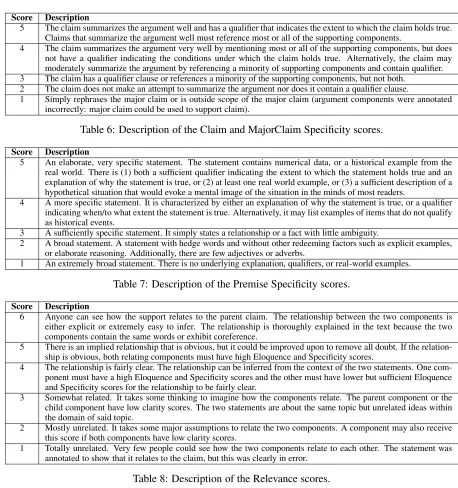
Each component type (MajorClaim, Claim, Premise) has a distinct set of attributes. All com-ponent types have three attributes in common: Eloquence, Specificity, and Evidence. Eloquence is how well the author uses language to convey ideas, similar to clarity and fluency. Specificity refers to the narrowness of a statement’s scope. Statements that are specific are more believable because they indicate an author’s confidence and depth of knowledge about a subject matter. Ar-gument assertions (major claims and claims) need not be believable on their own since that is the job of the supporting evidence. The Evidence score describes how well the supporting components support the parent component. The rubrics for scoring Eloquence, Evidence, Claim/MajorClaim Specificity, and Premise Specificity are shown in Tables 4, 5, 6, and 7 respectively.
Score Description
6 A very strong, clear argument. It would persuade most readers and is devoid of errors that might detract from its strength or make it difficult to understand.
5 A strong, pretty clear argument. It would persuade most readers, but may contain some minor errors that detract from its strength or understandability.
4 A decent, fairly clear argument. It could persuade some readers, but contains errors that detract from its strength or understandability.
3 A poor, understandable argument. It might persuade readers who are already inclined to agree with it, but contains severe errors that detract from its strength or understandability.
2 It is unclear what the author is trying to argue or the argument is poor and just so riddled with errors as to be completely unpersuasive.
[image:4.595.70.530.379.638.2]1 The author does not appear to make any argument (e.g. he may just describe some incident without explaining why it is important). It could not persuade any readers because there is nothing to be persuaded of. It may or may not contain detectable errors, but errors are moot since there is not an argument for them to interfere with.
Table 2: Description of the Persuasiveness scores.
Attribute Possible Values Applicability Description
Specificity 1–5 MC,C,P How detailed and specific the statement is Eloquence 1–5 MC,C,P How well the idea is presented
Evidence 1–6 MC,C,P How well the supporting statements support their parent Logos/Pathos/Ethos yes,no MC,C Whether the argument uses the respective persuasive strategy Relevance 1–6 C,P The relevance of the statement to the parent statement ClaimType value,fact,policy C The category of what is being claimed
PremiseType see Section 4.2 P The type of Premise, e.g. statistics, definition, real example, etc.
Strength 1–6 P How well a single statement contributes to persuasiveness
Table 3: Summary of the attributes together with their possible values, the argument component type(s) each attribute is applicable to (MC: MajorClaim,C: Claim,P: Premise), and a brief description.
Score Description
5 Demonstrates mastery of English. There are no grammatical errors that distract from the meaning of the sentence. Exhibits a well thought out, flowing sentence structure that is easy to read and conveys the idea exceptionally well. 4 Demonstrates fluency in English. If there are any grammatical or syntactical errors, their affect on the meaning is
negligible. Word choice suggests a broad vocabulary.
3 Demonstrates competence in English. There might be a few errors that are noticeable but forgivable, such as an incorrect verb tense or unnecessary pluralization. Demonstrates a typical vocabulary and a simple sentence structure.
2 Demonstrates poor understanding of sentence composition and/or poor vocabulary. The choice of words or gram-matical errors force the reader to reread the sentence before moving on.
1 Demonstrates minimal eloquence. The sentence contains errors so severe that the sentence must be carefully analyzed to deduce its meaning.
Table 4: Description of the Eloquence scores.
Score Description
6 A very strong, very persuasive argument body. There are many supporting components that have high Relevance scores. There may be a few attacking child components, but these components must be used for either concession or refuting counterarguments as opposed to making the argument indecisive or contradictory.
5 A strong, persuasive argument body. There are sufficient supporting components with respectable scores. 4 A decent, fairly persuasive argument body.
3 A poor, possibly persuasive argument body. 2 A totally unpersuasive argument body.
1 There is no argument body for the given component.
Table 5: Description of the Evidence scores.
three attributes are not inherent to the text identi-fying the major claim but instead summarize the child components in the argument tree.
Claim The claim argument component pos-sesses all of the attributes of a major claim in ad-dition to a Relevancescore and a ClaimType. In
Score Description
5 The claim summarizes the argument well and has a qualifier that indicates the extent to which the claim holds true. Claims that summarize the argument well must reference most or all of the supporting components.
4 The claim summarizes the argument very well by mentioning most or all of the supporting components, but does not have a qualifier indicating the conditions under which the claim holds true. Alternatively, the claim may moderately summarize the argument by referencing a minority of supporting components and contain qualifier. 3 The claim has a qualifier clause or references a minority of the supporting components, but not both.
2 The claim does not make an attempt to summarize the argument nor does it contain a qualifier clause.
[image:5.595.67.525.50.538.2]1 Simply rephrases the major claim or is outside scope of the major claim (argument components were annotated incorrectly: major claim could be used to support claim).
Table 6: Description of the Claim and MajorClaim Specificity scores.
Score Description
5 An elaborate, very specific statement. The statement contains numerical data, or a historical example from the real world. There is (1) both a sufficient qualifier indicating the extent to which the statement holds true and an explanation of why the statement is true, or (2) at least one real world example, or (3) a sufficient description of a hypothetical situation that would evoke a mental image of the situation in the minds of most readers.
4 A more specific statement. It is characterized by either an explanation of why the statement is true, or a qualifier indicating when/to what extent the statement is true. Alternatively, it may list examples of items that do not qualify as historical events.
3 A sufficiently specific statement. It simply states a relationship or a fact with little ambiguity.
2 A broad statement. A statement with hedge words and without other redeeming factors such as explicit examples, or elaborate reasoning. Additionally, there are few adjectives or adverbs.
1 An extremely broad statement. There is no underlying explanation, qualifiers, or real-world examples.
Table 7: Description of the Premise Specificity scores.
Score Description
6 Anyone can see how the support relates to the parent claim. The relationship between the two components is either explicit or extremely easy to infer. The relationship is thoroughly explained in the text because the two components contain the same words or exhibit coreference.
5 There is an implied relationship that is obvious, but it could be improved upon to remove all doubt. If the relation-ship is obvious, both relating components must have high Eloquence and Specificity scores.
4 The relationship is fairly clear. The relationship can be inferred from the context of the two statements. One com-ponent must have a high Eloquence and Specificity scores and the other must have lower but sufficient Eloquence and Specificity scores for the relationship to be fairly clear.
3 Somewhat related. It takes some thinking to imagine how the components relate. The parent component or the child component have low clarity scores. The two statements are about the same topic but unrelated ideas within the domain of said topic.
2 Mostly unrelated. It takes some major assumptions to relate the two components. A component may also receive this score if both components have low clarity scores.
1 Totally unrelated. Very few people could see how the two components relate to each other. The statement was annotated to show that it relates to the claim, but this was clearly in error.
Table 8: Description of the Relevance scores.
is true or false), orpolicy(claiming that some ac-tion should or should not be taken).
Premise The attributes exclusive to premises are PremiseType and Strength. To understand Strength, recall that only premises can per-suade readers, but also that an argument can be composed of a premise and a set of sup-porting/attacking premises. In an argument of this kind, Strength refers to how well the parent premise contributes to the persuasive-ness independently of the contributions from its children. The scoring rubric for Strength is shown in Table 9. PremiseType takes on a discrete value from one of the following: real example, invented instance, analogy,
Score Description
6 A very strong premise. Not much can be improved in order to contribute better to the argument. 5 A strong premise. It contributes to the persuasiveness of the argument very well on its own.
4 A decent premise. It is a fairly strong point but lacking in one or more areas possibly affecting its perception by the audience.
3 A fairly weak premise. It is not a strong point and might only resonate with a minority of readers. 2 A totally weak statement. May only help to persuade a small number of readers.
[image:6.595.341.493.182.309.2]1 The statement does not contribute at all.
Table 9: Description of the Strength scores.
Attribute Value MC C P
Specificity 1 0 80 64
2 73 259 134
3 72 155 238
4 32 59 173
5 8 14 98
Logos Yes 181 304
No 4 263
Pathos Yes 67 59
No 118 508
Ethos Yes 16 9
No 169 558
Relevance 1 1 5
2 33 45
3 58 59
4 132 145
5 97 147
6 246 306
Evidence 1 3 246 614
2 62 115 28
3 57 85 12
4 33 80 26
5 16 35 15
6 14 6 12
Eloquence 1 3 23 24
2 19 106 97
3 116 320 383
4 42 102 154
5 5 16 49
ClaimType fact 368
value 145
policy 54
PremiseType real example 93 invented instance 53
analogy 2
testimony 4
statistics 15
definition 3
common know. 493
warrant 44
Persuasiveness 1 3 82 8
2 62 278 112
3 60 84 145
4 28 74 249
5 17 39 123
6 15 10 70
Table 10: Class/Score distributions by component type.
4.3 Annotation Procedure
Our 102 essays were annotated by two native speakers of English. We first familiarized them with the rubrics and definitions and then trained
Attribute MC C P
Persuasiveness .739 .701 .552 Eloquence .590 .580 .557 Specificity .560 .530 .690 Evidence .755 .878 .928 Relevance .678 .555
Strength .549
Logos 1 .842 Pathos .654 .637 Ethos 1 1 ClaimType .589 PremiseType .553
Table 11: Krippendorff’sαagreement on each at-tribute by component type.
them on five essays (not included in our corpus). After that, they were both asked to annotate a randomly selected set of 30 essays and discuss the resulting annotations to resolve any discrep-ancies. Finally, the remaining essays were parti-tioned into two sets, and each annotator received one set to annotate. The resulting distributions of scores/classes for persuasiveness and the attributes are shown in Table 10.
4.4 Inter-Annotator Agreement
We use Krippendorff’s α to measure inter-annotator agreement. Results are shown in Ta-ble 11. As we can see, all attributes exhibit an agreement above 0.5, showing a correlation much more significant than random chance. Persuasive-ness has an agreement of 0.688, which suggests that it can be agreed upon in a reasonably gen-eral sense. The MajorClaim components have the highest Persuasiveness agreement, and it declines as the type changes to Claim and then to Premise. This would indicate that persuasiveness is easier to articulate in a wholistic sense, but difficult to explain as the number of details involved in the explanation increases.
[image:6.595.71.293.190.652.2]easily recognized it. This is largely due to the in-disputability of recognizing a reference to an ac-cepted authority on a given subject. Very few au-thors utilize this approach, so when they do it is extremely apparent. Contrary to Persuasiveness, Evidence agreement exhibits an upward trend as the component scope narrows. Even with this pat-tern, the Evidence agreement is always higher than Persuasiveness agreement, which suggests that it is not the only determiner of persuasiveness.
In spite of a rubric defining how to score Elo-quence, it remains one of the attributes with the lowest agreement. This indicates that it is diffi-cult to agree on exact eloquence levels beyond ba-sic English fluency. Additionally, Specificity pro-duced unexpectedly low agreement in claims and major claims. Precisely quantifying how well a claim summarizes its argument turned out to be a complicated and subjective task. Relevance agree-ment for premises is one of the lowest, partly be-cause there are multiple scores for high relevance, and no examples were given in the rubric.
All attributes but those with the highest agree-ment are plagued by inherent subjectivity, regard-less of how specific the rubric is written. There are often multiple interpretations of a given sen-tence, sometimes due to the complexity of natural language, and sometimes due to the poor writing of the author. Naturally, this makes it difficult to identify certain attributes such as Pathos, Claim-Type, and PremiseType.
Although great care was taken to make each at-tribute as independent of the others as possible, they are all related to each other to a minuscule degree (e.g., Eloquence and Specificity). While annotators generally agree on what makes a per-suasive argument, the act of assigning blame to the persuasiveness (or lack thereof) is tainted by this overlapping of attributes.
4.5 Analysis of Annotations
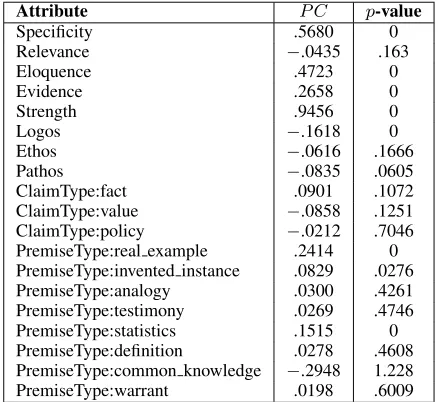
To understand whether the attributes we annotated are indeed useful for predicting persuasiveness, we compute the Pearson’s Correlation Coefficient (PC) between persuasiveness and each of the at-tributes along with the corresponding p-values. Results are shown in Table 12. Among the cor-relations that are statistically significant at thep < .05 level, we see, as expected, that
Persuasive-ness is positively correlated with Specificity, Ev-idence, Eloquence, and Strength. Neither is it
sur-Attribute P C p-value
Specificity .5680 0
Relevance −.0435 .163
Eloquence .4723 0
Evidence .2658 0
Strength .9456 0
Logos −.1618 0
Ethos −.0616 .1666
Pathos −.0835 .0605
ClaimType:fact .0901 .1072 ClaimType:value −.0858 .1251
ClaimType:policy −.0212 .7046
PremiseType:real example .2414 0 PremiseType:invented instance .0829 .0276 PremiseType:analogy .0300 .4261 PremiseType:testimony .0269 .4746 PremiseType:statistics .1515 0 PremiseType:definition .0278 .4608 PremiseType:common knowledge −.2948 1.228
[image:7.595.307.526.62.263.2]PremiseType:warrant .0198 .6009
Table 12: Correlation of each attribute with Per-suasiveness and the correspondingp-value.
MC C P Avg
P C .9688 .9400 .9494 .9495
M E .0710 .1486 .0954 .1061
Table 13: Persuasiveness scoring using gold at-tributes.
prising that support provided by a premise in the form of statistics and examples is positively cor-related with Persuasiveness. While Logos and in-vented instance also have significant correlations with Persuasiveness, the correlation is very weak.
Next, we conduct an oracle experiment in an attempt to understand how well these attributes, when used together, can explain the persuasive-ness of an argument. Specifically, we train three linear SVM regressors (using the SVMlight soft-ware (Joachims, 1999) with default learning pa-rameters except for C (the regularization param-eter), which is tuned on development data using grid search) to score an argument’s persuasiveness using the gold attributes as features. The three regressors are trained on arguments having Ma-jorClaims, Claims, and Premises as parents. For instance, to train the regressor involving Major-Claims, each instance corresponds to an argument represented by all and only those attributes in-volved in the major claim and all of its children.4
Five-fold cross-validation results, which are
4
[image:7.595.334.498.310.341.2]Prompt: Government budget focus, young children or university?
Education plays a significant role in a country’s long-lasting prosperity. It is no wonder that governments throughout the world lay special emphasis on education development. As for the two integral components within the system, elementary and advanced education, there’s no doubt that a government is supposed to offer sufficient financial support for both. Concerning that elementary education is the fundamental requirement to be a qualified citizen in today’s society, gov-ernment should guarantee that all people have equal and convenient access to it. So a lack of well-established primary education goes hand in hand with a high rate of illiteracy, and this interplay compromises a country’s future development. In other words, if countries, especially developing ones, are determined to take off, one of the key points governments should set on agenda is to educate more qualified future citizens through elementary education.
[image:8.595.75.522.198.346.2]. . .
Table 14: An example essay. Owing to space limitations, only its first two paragraphs are shown.
P E S Ev R St Lo Pa Et cType pType
M1 government is supposed to offer sufficient financial support for both
3 4 2 3 T F F
C1 if countries, especially developing ones, are deter-mined to take off, one of the key points governments should set on agenda is to educate more qualified fu-ture citizens through elementary education
4 5 4 4 6 T F F policy
P1 elementary education is the fundamental require-ment to be a qualified citizen in today’s society
4 5 3 1 6 4 A
C2 government should guarantee that all people have equal and convenient access to it
2 3 1 1 6 F F F policy
P2 a lack of well-established primary education goes hand in hand with a high rate of illiteracy, and this in-terplay compromises a country’s future development
4 5 3 1 6 4 C
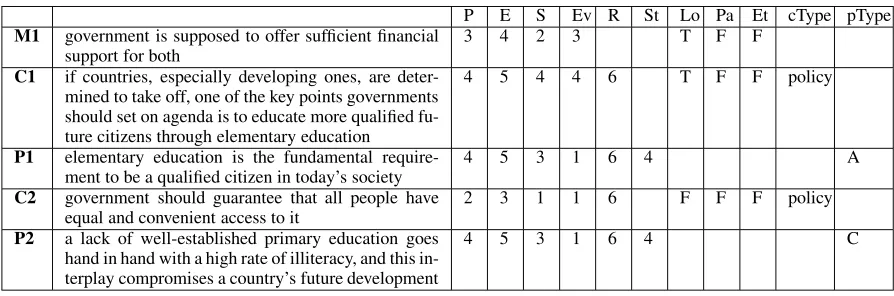
Table 15: The argument components in the example in Table 14 and the scores of their associated at-tributes: Persuasiveness,Eloquence,Specificity,Evidence,Relevance,Strength,Logos,Pathos,Ethos,
claimType, andpremiseType.
shown in Table 13, are expressed in terms of two evaluation metrics, P C and M E (the mean ab-solute distance between a system’s prediction and the gold score). SinceP C is acorrelation metric, higher correlation implies better performance. In contrast, M E is an errormetric, so lower scores imply better performance. As we can see, the largeP Cvalues and the relatively lowM Evalues provide suggestive evidence that these attributes, when used in combination, can largely explain the persuasiveness of an argument.
What these results imply in practice is that mod-els that are trained on these attributes for per-suasiveness scoring could provide useful feed-back to students on why their arguments are (un)persuasive. For instance, one can build a pipeline system for persuasiveness scoring as fol-lows. Given an argument, this system first pre-dicts its attributes and then scores its persuasive-ness using the predicted attribute values computed in the first step. Since the persuasiveness score of an argument is computed using its predicted at-tributes, these attributes can explain the persua-siveness score. Hence, a student can figure out which aspect of persuasiveness needs improve-ments by examining the values of the predicted
at-tributes.
4.6 Example
To better understand our annotation scheme, we use the essay in Table 14 to illustrate how we ob-tain the attribute values in Table 15. In this es-say, Claim C1, which supports MajorClaim M1, is supported by three children, Premises P1 and
P2as well as ClaimC2.
we can assign a score of 3. Its PremiseType is common knowledgebecause it is reasonable to as-sume most people would agree that poor primary education causes illiteracy, and also that illiter-acy inhibits a country’s development. Its Rele-vance score is 6: its relationship with its parent is clear because the two components exhibit coref-erence. Specifically, P2 contains a reference to primary/elementary education and shows how this affects a country’s inability to transition from de-veloping to developed. Its Strength is 4: though eloquent and relevant, P2 is lacking substance in order to be considered for a score of 5 or 6. The PremiseType iscommon knowledge, which is mediocre compared to statistics and real example. In order for a premise that is not grounded in the real world to be strong, it must be very specific.
P2 only scored a 3 in Specificity, so we assign a Strength score of 4. Finally, the argument headed by P2, which does not have any children, has a Persuasiveness score of 4, which is obtained by summarizing the inherent strength of the premise and the supporting evidence. Although there is no supporting evidence for this premise, this does not adversely affect persuasiveness due to the stan-dalone nature of premises. In this case the persua-siveness is derived totally from the strength.
Next, the annotator would score C2 and P1, but for demonstration purposes we will examine the scoring of C1. C1’s Eloquence score is 5 be-cause it shows fluency, broad vocabulary, and at-tention to how well the sentence structure reads. Its ClaimType ispolicybecause it specifically says that the government should put something on their agenda. Its Specificity score is 4: while it contains information relevant to all the child premises (i.e., creating qualified citizens, whose role it is to pro-vide the education, and the effect of education on a country’s development), it does not contain a qual-ifier stating the extent to which the assertion holds true. Its Evidence score is 4:C1has two premises with decent persuasiveness scores and one claim with a poor persuasiveness score, and there are no attacking premises, so intuitively, we may say that this is a midpoint between many low qual-ity premises and few high qualqual-ity premises. We mark Logos as true, Pathos as false, and Ethos as false: rather than use an emotional appeal or an ap-peal to authority of any sort, the author attempts to use logical reasoning in order to prove their point. Its Persuasiveness score is 4: this score is mainly
determined by the strength of the supporting evi-dence, given that the assertion is precise and clear as determined by the specificity and eloquence. Its Relevance score is 6, as anyone can see how en-dorsement of elementary education in C1 relates to the endorsement of elementary and university education in its parent (i.e.,M1).
After all of the claims have been annotated in the bottom-up method, the annotator moves on to the major claim,M1. M1’s Eloquence score is 4: while it shows fluency and a large vocabulary, it is terse and does not convey the idea exceptionally well. Its persuasion strategies are obtained by sim-ply taking the logical disjunction of those used in its child claims. Since every claim in this essay re-lied on logos and did not employ pathos nor ethos,
M1is marked with Logos as true, Pathos as false, and Ethos as false. Its Evidence score is 3: in this essay there are two other supporting claims not in the excerpt, with persuasiveness scores of only 3 and 2, soM1’s evidence has one decently persua-sive claim, one claim that is poor but understand-able, and one claim that is so poor as to be com-pletely unpersuasive (in this case it has no support-ing premises). Its Specificity score is 2 because it does not have a quantifier nor does it attempt to summarize the main points of the evidence. Fi-nally, its Persuasiveness score is 3: all supporting claims rely on logos, so there is no added persua-siveness from a variety of persuasion strategies, and since the eloquence and specificity are ade-quate, they do not detract from the Evidence score.
5 Conclusion
We presented the first corpus of 102 persuasive student essays that are simultaneously annotated with argument trees, persuasiveness scores, and at-tributes of argument components that impact these scores. We believe that this corpus will push the frontiers of research in content-based essay grad-ing by triggergrad-ing the development of novel compu-tational models concerning argument persuasive-ness that could provide useful feedback to students on why their arguments are (un)persuasive in ad-dition to how persuasive they are.
Acknowledgments
References
Khalid Al Khatib, Henning Wachsmuth, Johannes Kiesel, Matthias Hagen, and Benno Stein. 2016. A news editorial corpus for mining argumentation strategies. In Proceedings of COLING 2016, the 26th International Conference on Computational Linguistics: Technical Papers, pages 3433–3443.
Frans H. van Eemeren, Bart Garssen, Erik C. W. Krabbe, Francisca A. Snoeck Henkemans, Bart Ver-heij, and Jean H. M. Wagemans. 2014. InHandbook of Argumentation Theory. Springer, Dordrecht.
Steffen Eger, Johannes Daxenberger, and Iryna Gurevych. 2017. Neural end-to-end learning for computational argumentation mining. In Proceed-ings of the 55th Annual Meeting of the Association for Computational Linguistics (Volume 1: Long Pa-pers), pages 11–22.
Ivan Habernal and Iryna Gurevych. 2016a. What makes a convincing argument? Empirical analysis and detecting attributes of convincingness in Web argumentation. In Proceedings of the 2016 Con-ference on Empirical Methods in Natural Language Processing, pages 1214–1223.
Ivan Habernal and Iryna Gurevych. 2016b. Which ar-gument is more convincing? Analyzing and predict-ing convincpredict-ingness of Web arguments uspredict-ing bidi-rectional LSTM. In Proceedings of the 54th An-nual Meeting of the Association for Computational Linguistics (Volume 1: Long Papers), pages 1589– 1599.
Christopher Hidey, Elena Musi, Alyssa Hwang, Smaranda Muresan, and Kathy McKeown. 2017. Analyzing the semantic types of claims and premises in an online persuasive forum. In Proceed-ings of the 4th Workshop on Argument Mining, pages 11–21.
Colin Higgins and Robyn Walker. 2012. Ethos, logos, pathos: Strategies of persuasion in so-cial/environmental reports. Accounting Forum, 36:194-208.
Derrick Higgins, Jill Burstein, Daniel Marcu, and Claudia Gentile. 2004. Evaluating multiple aspects of coherence in student essays. In Human Lan-guage Technologies: The 2004 Annual Conference of the North American Chapter of the Association for Computational Linguistics, pages 185–192.
T. Joachims. 1999. Making large-scale SVM learn-ing practical. In B. Sch¨olkopf, C. Burges, and A. Smola, editors, Advances in Kernel Methods -Support Vector Learning, chapter 11, pages 169– 184. MIT Press, Cambridge, MA.
Klaus Krippendorff. 1980.Content Analysis: An Intro-duction to Its Methodology. Sage commtext series. Sage, Thousand Oaks, CA.
Stephanie Lukin, Pranav Anand, Marilyn Walker, and Steve Whittaker. 2017. Argument strength is in the eye of the beholder: Audience effects in persuasion. InProceedings of the 15th Conference of the Euro-pean Chapter of the Association for Computational Linguistics: Volume 1, Long Papers, pages 742–753.
Eleni Miltsakaki and Karen Kukich. 2004. Evaluation of text coherence for electronic essay scoring sys-tems. Natural Language Engineering, 10(1):25–55.
Isaac Persing, Alan Davis, and Vincent Ng. 2010. Modeling organization in student essays. In Pro-ceedings of the 2010 Conference on Empirical Meth-ods in Natural Language Processing, pages 229– 239.
Isaac Persing and Vincent Ng. 2013. Modeling the-sis clarity in student essays. InProceedings of the 51st Annual Meeting of the Association for Compu-tational Linguistics (Volume 1: Long Papers), pages 260–269.
Isaac Persing and Vincent Ng. 2014. Modeling prompt adherence in student essays. InProceedings of the 52nd Annual Meeting of the Association for Compu-tational Linguistics (Volume 1: Long Papers), pages 1534–1543.
Isaac Persing and Vincent Ng. 2015. Modeling ar-gument strength in student essays. InProceedings of the 53rd Annual Meeting of the Association for Computational Linguistics and the 7th International Joint Conference on Natural Language Processing (Volume 1: Long Papers), pages 543–552.
Isaac Persing and Vincent Ng. 2017. Why can’t you convince me? Modeling weaknesses in unpersua-sive arguments. In Proceedings of the 26th Inter-national Joint Conference on Artificial Intelligence, pages 4082–4088.
Mark D. Shermis and Jill Burstein. 2013.Handbook of Automated Essay Evaluation: Current Applications and New Directions. Routledge Chapman & Hall.
Christian Stab and Iryna Gurevych. 2014a. Annotat-ing argument components and relations in persua-sive essays. InProceedings of the 25th International Conference on Computational Linguistics: Techni-cal Papers, pages 1501–1510.
Christian Stab and Iryna Gurevych. 2014b. Identify-ing argumentative discourse structures in persuasive essays. InProceedings of the 2014 Conference on Empirical Methods in Natural Language Process-ing, pages 46–56.
Christian Stab and Iryna Gurevych. 2017a. Parsing ar-gumentation structures in persuasive essays. Com-putational Linguistics, 43(3):619–659.
Computational Linguistics: Volume 1, Long Papers, pages 980–990.
Henning Wachsmuth, Nona Naderi, Yufang Hou, Yonatan Bilu, Vinodkumar Prabhakaran, Tim Al-berdingk Thijm, Graeme Hirst, and Benno Stein. 2017. Computational argumentation quality assess-ment in natural language. InProceedings of the 15th Conference of the European Chapter of the Associa-tion for ComputaAssocia-tional Linguistics: Volume 1, Long Papers, pages 176–187.