Bayesian Factorized Cointegration Analysis
Kai Cui1, Wenshan Cui2
1Department of Statistical Science, Duke University, Durham, USA
2School of Science and Information, Qingdao Agricultural University, Qingdao, China Email: [email protected], [email protected]
Received October 25,2012; revised November 30, 2012; accepted December 8, 2012
ABSTRACT
The concept of cointegration is widely used in applied non-stationary time series analysis to describe the co-movement of data measured over time. In this paper, we proposed a Bayesian model for cointegration test and analysis, based on the dynamic latent factor framework. Efficient computational algorithms are also developed based on Markov Chain Monte Carlo (MCMC). Performance and efficiency of the the model and approaches are assessed by simulated and real data analysis.
Keywords: Cointegration; Bayesian; Dynamic Factor; Non-Stationary; Root Structure; MCMC
1. Introduction
Many macroeconomic and financial time series are non- stationary [1], characterized by the existence of stochas- tic trends or unit roots. Thus, modeling multivariate non- stationary time series via linear regression, while has been widely used on stationary time series analysis, has been shown to be a dangerous approach that could pro- duce spurious regression [1]. Alternatively, if linear com- binations of non-stationary or unit-root variables are sta- tionary, then cointegration is said to occur, which is often observed in practice. Since the development of the con- cept of cointegration [2], there has been a rich literature on testing cointegration and inference using such models. However, most of the work adopted a classical econo- metric perspective based on the linear cointegrated error correction models. In this study, the Bayesian factorized cointegration analysis proposed here as a different per- spective shed new lights on many key properties of coin- tegration models.
To establish the notion and illustrate the basic ideas underlying classical cointegration analysis, let
yt tT1be a realization of Q dimensional Vector Autoregressive (VAR) process of lag order p:
1
p
i
t i t i t
y y
0, i yt i t
where t Q . denotes the autoregression
intercept. This model can be written in the Vector Error Correction Model (VECM) form as:
N
1 1
1
p
t t
i
y y
where the matrix of rank r can be written as
and Q r
, where are both full rank
matrices, with 0 r Q denoting the number of coin- tegration relationships. Note that as a special case, when
is zeros matrix with , then all time series are non-stationary with unit roots, but no cointegration relationship exists.
0
r
is called the cointegration vector with yt being stationary.
In this paper, we propose the framework of Bayesian factorized cointegration analysis as a straightforward and computationally efficient approach for cointegration test and modeling. Although the dynamic latent factor model has been proposed for time series analysis for decades, the idea of incorporation of dynamic structures that can accommodate possible non-stationarity flexibly enough via the Bayesian modeling framework and computational strategies, which we proposed as an alternative Bayesian cointegration test, is novel. The model and approaches are described in in Section 2, followed by Bayesian com- putation and posterior analysis via Markov Chain Monte Carlo (MCMC) methods in Section 3. Section 4 applies the model to simulated data sets to gauge the perfor- mance of the models. In Section 5 the model is applied to detecting and analyzing cointegration between real non- stationary time series, with conclusions and future dire- ctions in Section 6.
2. Model Specification
2.1. Basic Dynamic Latent Factor Models
Let t t1 be a realization of Q dimensional non- stationary time series, we propose a Bayesian dynamic latent factor model to jointly model the multivariate non- stationary time series and detecting cointegration among the component time series via common dy-
Ty
q q Q
1, ,
t t qt
namic latent factors. Specifically, let denote the vector of q dynamic latent factors, the model is of the form:
2
, , 1
0,diag
, 0,
i
i it it
t t t t
p
it i k i t p
k y N N
2 2
1, , ,
i Q (1)
where is a lower triangular factor loading matrix. Each factor it is modeled as following a AR p
i
i 1, ,Q
1 Q F F
1
1pi
1 A
process that can be either stationary or non-stationary.
2.2. Model in the Matrix State-Space Form
Let ,, , 1, , , 1 ,
i
it i t i t i t p
1, ,
t t Qt
, F , where
,0,0,
i
F is a vector, and
Q A A , , i i p A I
1 , 1 ,
1 0
i i
i i p i p
, where
i
.
A is the transition matrix giving
with i N 0,Wi
2 1 = 0 i i i p
2 2 1 1 1, 0,diag , , , 0,diag , ,
t t t t Q
t t Q
y F N
A N W W
, where W . Then
model (1) can be written in the matrix state-space form:
(2)
The matrix state-space form model (2) is primarily used in deriving efficient computational strategies for sampling latent factors as shown in the following section. As stated previously, although this dynamic latent factor model has been applied for time series analysis for de- cades, our idea of the incorporation of dynamic structures that can accommodate possible non-stationarity flexibly enough via the Bayesian modeling framework and com- putational strategies, which we proposed as an alternative Bayesian cointegration test, is novel and shown in the following sections.
2.3. Modeling Dynamic Latent Factors
The key idea of modeling multivariate nonstationary time series via independent latent factors requires flexible modeling of the dynamic factors. It is critical that the model is flexible in terms of two aspects. The values of
AR p
coefficients of the dynamic structure of latent factors need to be able to flexibly model stationary and non-stationary (unit-root) processes. And secondly, the autoregressive order p should also be flexibly modeled.
A
To achieve these, we followed the R p process decomposition proposed by [4], with spike-and-slab priors placed on the root structures. Induced priors on the
AR p th i i p
,
0, 2
i
i B it it it N
coefficients can be deduced. We further used half-cauchy prior for the innovation variances, as recom- menced by [5] for hierarchical modeling.
In details: given that the time-varying latent factor is modeled via an autoregressive process with (maxi- mum) lag order , we have that:
, 1 i
i i t
A
it
,
1 1pi k
i k ik
(3)
where B is the backshift operator,
,1, , , i
i i i p
is the characteristic polynomial of the model,
pi1
th
i
is a vector of the autore- gression coefficients of the dynamic latent factor, and it is white noise.
iAssume that the characteristic polynomial
R Ci
2
p R C
i
has
i non-zeros real roots and pairs of non-zero con-
jugate complex roots (with i i i)1, then the
autoregressive process can be characterized in term so either the autoregressive coefficients or the cha- p
racteristic roots. Let j jexp
1, , i
denote the pairs of complex roots and
j j denote the real roots, then we
place a class of hierarchical models on the root structures as introduced by [6], which indirectly induce models on the i
r i
i
C
2C1, , p
j C
r j
s that either fall into the stationary or unit-root process space. Specifically, the models we used are:
1) For the complex roots jexp
j
1, , i
,we model the modulus
r i j C
j
r and period j 2πj as
follows:
0 0 1 1
0 1
π π π Beta
Unif 2, 2
π ,π,π Dir 1,1,1
j j j b
j
b
r I r I r
T 0 ; ,1 j r
· (4)where I0
· and I1 are Dirac delta functions at 0and 1 respectively. 0 1 b are weights with Diri-
chlet prior distributions, and is the number of time points.
π ,π,π
T
π0 0
2) For the real roots, similarly we have
1 1 1 1
π π
π Unif ; 1,1
j j rj I rj
p
u j
r I r I
r (5)
Clearly, first of all, in modeling complex and real roots, by giving a probability of having root at 0, the un- certainly of lag orders i is incorporated in the model and thus can be simultaneously inferred from the number of non-zero real and complex roots. The framework al- lows specifying a very high-ordered autoregressive mo- del without running into over-fitting problems, and thus can flexibly model the dynamic structure of latent factors. Secondly, stationarity is also simultaneously assessed, with the existence of at least one unit roots indicating the non-stationarity of a dynamic latent factor, which pro- vides a useful link between the posterior distribution of root structures and testing cointegration.
2.4. Bayesian Cointegration Test via Latent Factors
We focus on the case where the all Q component time series of t are known to be non-stationary a priori. In model (1), if we partition
y
t
as a vector of q non- stationary
NSt
and
q q
S
tstationary
latent factors, then model (1) can also be written as:1 2
S t NS
t t
y t T
(6)
Proposition 1. Given model (6) and that ytt1 is a non-stationary time series, the followings are equivalent: 1 Q t y li
1) is cointegrated with rank r. 2) r nearly independent
3) rank
r Q<
1
Therefore, testing the existence of cointegration can be achieved by testing whether the rank of 1 is smaller
than Q. Note that the cointegration vector .
may not be unique, if there exist r such linearly independent
, i 1, ,r
i , then yt is said to be cointegrated with
cointegration rank r. It is worth mentioning that with two nonstationary time series, is unique if it exists and can be easily derived based on 1. And we call the ratio
between the two time series as cointegration ratio in the following studies.
3. Bayesian Computation and Posterior
Analysis
We use Markov Chain Monte Carlo (MCMC) sampler for the Bayesian inference of unknown quantities in the model. The sampler is computationally efficient and mixes rapidly due to the conditionally multivariate nor- mal matrix state-space representation of the model as shown by (2). In details:
Let denote all model parameters in (1), so that
2 2
, 0 1 1 1 0
, , ; , ; π ,π,π ; π ,π,π ,π where 1, , ; 1, , ; 1, , .
j
i i k b u
i
i Q k p j q
(7)
Also, recall that 0 1,0, ,q,0
,0 ,0, , 1, , , i 1
i i i i p
pi 1
defined in (2),
with being a vector
of initial values for the dynamic latent factor. Pos- terior inference is based on a standard Gibbs sampler that iteratively simulate from posterior full conditional dis- tributions
th
i
0, . .s t yt
is a sta-
tionary process. (existence of cointegration)
1: 0 1: 0 1: 1:
0 1: 1:
, , , , ,
and , ,
T T T T
T T f f f y y y . Specifically,
1) To sample from 1:T 0, , y1:T
.To obtain samples of latent factors
1:T from thefull conditional distribution, we applied a efficient sam- pler based on the Forward-Filtering-Backward-Sampling algorithm. Basically, forward filtering follows (2) and is performed in terms of t
. For backward sampling, t
is first sampled, giving samples of T p 1 :T . Then
1:T p
are sequentially sampled backwardly based on the backward sampling distributions derived from model (1). The detailed filtering and sampling algorithm is shown in Appendix I.
2) To sample from f 0, 1:T,y1:T
.Given latent factors 1:T and the initial values 0,
root structures j are sampled following [6], from which
11
p
1
p
j t t j t j
j j
B
j1, , q
where B is the backshift operator.
Given the half-cauchy priors for the innovation variances, posterior distributions of i do
not have closed form, and thus are sampled using Ada- ptive-Rejection Sampler (ARS). Other model parameters generally have conjugate priors and have closed-form posteriors.
2
3) To sample from f
0 ,1:T,y1:T
.We take advantage of the reversibility of AR p
process to sample initial values 0. So,
2
,t N 0, i
, , , ,
1
, where
i
p
i t i k i t k i t i k
,i1, p
ith i t,(8)
Therefore, for the initial values
,0 ,0 ,
i i
,i, i 1 of the latent factor,
are sequentially sampled backwardly from t0 to .
i 1
t p
t
y
,
t t
1t
4. Simulation Examples
4.1. Study 1: Simulation from Factor Model
We first look at the case of detecting cointegration be- tween two time series, where the time series are generated from two latent dynamic latent factors
1 2t , where
follows random walk and 2t
follows a stationary AR
2
1
2
2, 2 2
, 0, ,
, 0, ,
,
t t t
t t
y N
N
80
T 1 0
0.2 1.5
process, as shown in (9).
2
1 2
1 1, 1 1 1
2 2, 1
2 2
where
, ,
0.5 0.24
0, .
t t t
t t
t t t
t t
t
y y y
N
(9)
In the simulation study, we generated the times series
of 0, and used , ,
1
1, 2
0.3
1 2
and
. Clearly, in this case, the two time series cointegrate, with the cointegration ratio between 1t and 2t being 5, meaning that zt = y1t +
5y2t is a stationary time series. To test the model we
proposed for cointegration analysis, we modeled the si- mulated time series using a two-factor dynamic factor model as shown in (1), specifying the maximum number of pairs of complex roots to be 2, and that of real roots to be 4 for both dynamic latent factors. Thus, the maximum autoregressive order for both latent factors are 8. For
efficient MCMC sampling, priors are placed on para- meters of the Parameter-eXpanded (PX) model as des- cribed by [7] and [8]. 30,000 posterior samples are drawn for model parameters, latent initial values and latent fac- tors via MCMC after a 5000 iteration burn-in.
y
Posterior inference of the existence of cointegration in this case is to test whether the rank of the factor loading matrix of non-stationary factors is smaller than 2. There- fore, we first looked at the posterior samples of the cha- racteristic roots of both 1t and 2t and the factor
loading matrix. Two results can be obtained immediately from this. First of all, based on 30,000 posterior samples, the marginal probability of 1t having unit roots is
and the joint probability of at least one of the latent factors having unit roots is , which are consistent with the known facts that both 1t and 2t
are non-stationary. Secondly, the probability that the rank of the factor loading matrix of non-stationary factors is smaller than the number of non-stationary component time series is 99.99 , indicating that the two time series are cointegrated at the confidence level.
99.39%
99.39%
y y
%
99.99%
We also specifically focused on obtaining the con- ditional posterior distribution of the cointegration ratio
[image:4.595.315.534.587.710.2]
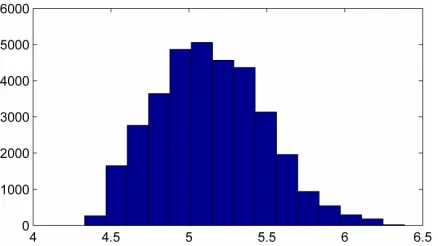
R given the two cointegrate, which is an important quantity in cointegration analysis. This, in this case, can be derived from the posterior samples of roots and the factor loading matrix , as shown in Algorithm 1. A histogram of the posterior samples of is shown inFigure 1. has a posterior mean of 5.14, posterior mode of 5.03, and HPD interval of [4.47,5.79], which is consistent with the true values 5.
R R
95%
i
1) For the MCMC sampler at the ith iteration, check if η
1t has unit
roots and η2t does not have unit roots.
2) If 1 satisfies, let denote the sample of the factor loading matrix of the ith iteration, and a sample of R can be obtained by:
y
11
21 i
i
R i
kl
, where denotes the element of at row k and column l.
i
Algorithm 1. To derive posterior samples of the cointegra- tion ratio (R) from Λ.
Furthermore, we looked at the inference of the latent factors structures. As shown in Table 1, the autore- gression coefficients are all correctly inferred with poste- rior mean closed to and posterior C.I. covering the true values. Posterior distributions of autoregressive lag or- ders of both latent factors are also derived based on the non-zero posterior roots and the histograms are shown in
Figure 2, which show good inference that the lag order of 1t spikes at 1 and that of 2t peaks at 2.
Overall, the framework provides very good inference of the latent structures and unknown quantities. Cointe- gration relationship is also found correctly between the two non-stationary time series with good recovery of the cointegration ratio.
4.2. Study 2: Simulation from VECM Model
Out of model studies are shown here. We applied our model and algorithm to simulations generated from the Vector Error Correction Model (VECM). As stated ear- lier, the VECM representation has been commonly used for modeling and testing cointegration among I(1) non- stationary time series in both classical and Bayesian models.
Taking advantage of the VECM model, an example of second-order nonstationary vector autoregressive model where cointegration exists is first considered here:
1
0
0.2 0.1 0.8 0.5 0.2 0.4
100 0
where = and
0 100
t t
y y
y
2
0.7 0.6
0
t t
y
95%
(10)
[image:5.595.80.287.416.470.2]This process gives the following VECM(2) represen-
Table 1. Posterior summary of selected autoregression co- efficients of latent factors, as compared to true values.
βs Mean Std C.I. True
1,1
0.9991 0.0179 [0.9533,1.0310] 1
1,2
0.0014 0.0216 [−0.0405,0.0641] 0
2,1
0.4543 0.0292 [0.3962,0.5164] 0.5
2,2
0.2826 0.0320 [0.2242,0.3468] 0.24
(a) (b)
Figure 2. Histogram of posterior samples of autoregressive lag orders of latent factors η1t and η2t.
tation, indicating that the two time series are co-inte- grated, and the cointegration vector is
1, 2
(with cointegration ratio being –2).
1 10.4 0.8 0.7
1, 2
0.1 0.4 0.6
t t t t
y y y
800
T
(11)
Our goal is to test whether our proposed framework can correctly detect the cointegration relationship be- tween the time series and provide inference of other un- known quantities. We simulated the time series up to
, with 8 time points of 1t randomly missing.
Two-factor model is fitted to the data, and set the maxi- mum number of complex pairs and real roots to be 5 and 10 respectively, making the maximum autoregressive lag order being 20. Missing data are interpolated during MCMC. Similarly, PX-model are used for prior spe- cification and posterior sampling, and 15,000 posterior samples of missing values, model parameters, root struc- tures and latent factors are obtained via MCMC after a 5000 burn-in. First of all, the posterior marginal pro- bability of having unit roots for the two latent factors are
and 0.17 , and the posterior joint probability of at least one of them have unit roots is , indi- cating that we cannot reject that both of the time series are nonstationary. Secondly, the existence of cointegra- tion is tested. The posterior probability that the rank of the factor loading matrix of non-stationary factors is smal- ler than the number of unit-root processes is , indicating that cointegration exists at the confi- dence level.
y
83.24% %
83.27%
99.83% 99%
Given that the test shows that the two time series cointegrate, we specifically analyze the cointegration ratio
R95%
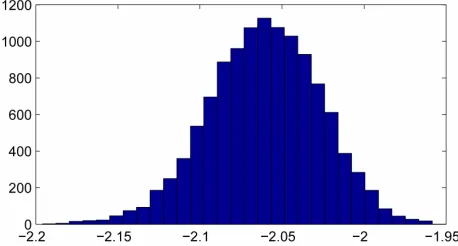
between the two time series. Posterior distri- bution of the cointegration ratio are derived from poste- rior samples and plotted in Figure 3, with posterior mean at −2.060 and C.I.
2.130, 1.997
, This is very much consistent with the true value −2 (obtained from model (11)). [image:5.595.308.537.587.710.2]To confirm that the right posterior distribution of the cointegration ratio is found, we specifically focused on
the posterior mean , and let t 1t 2t. t
2.060 z
R y Ry
z is shown in Figure 4 to illustrate the mean-reverting property, the stationarity of which is further confirmed by Augmented Dickey-Fuller (ADF) test [9], which re- jects the null hypothesis that zt has unit roots with all
p-values < 0.01 for lag orders up to 10.
On the other hand, in a parallel study using the VECM model, two time series that are not co-integrated can be simulated from the following VAR model
1 2
0.7 0.6
0
t t
y
0
0.2 0.7 0.8 0.4 0.4 0.4
100 0
where and
0 100
t t
y y
y
1
.7 .6 yt
(12)
where the corresponding VECM representation is 0.8 0
0.4 0
t
y t
800
T
y
2t
y
(13)
[image:6.595.311.536.520.678.2]We also tested whether our model and algorithms can correctly detect the non-existence of the cointegration relationship between the time series, among inference of other unknown quantities. In this study, we simulated the two-dimensional time series up to , fit the data with two-factor model, and set the maximum number of complex pairs to be 10 and that of real roots to be 15 for both latent factors, suggesting that the maximum auto- regressive lag order is 35. Based on 15,000 MCMC pos- terior samples of root structures and factor loading ma- trix after a 5000 burn-in, the posterior probability that the rank of the factor loading matrix of non-stationary fac- tors is smaller than the number of unit-root processes is 4.44%, indicating that there is no existence of cointe- gration between the two time series at the 95% confi- dence level. Secondly, the posterior marginal proba- bilities of having unit roots for the two latent factors are 83.94% and 95.56%, and the posterior joint probability of at least one of them having unit roots is 99.36%, which means that we cannot reject that 1t is nonsta- tionary, and is non-stationary at 99% confident
Figure 4. Plot of to illustrate mean-reverting and sta- tionarity.
level.
Therefore, our simulation studies clearly show the efficacy of the model proposed to both capture the true (non)stationary strutures of the multivariate time series and identify the cointegration relationship correctly.
5. Real Data Analysis
5.1. GDX-GLD Pair vs PEP-KO Pair
Gold ETF GLD versus gold-miner ETF GDX have been reported as good candidates for real-world cointegrated pairs [10], because GLD reflects the spot price of gold, and GDX is a basket of gold-mining stocks. The coin- tegration relationship has been tested in empirical studies via frequentist cointegration test (e.g. Covariate-Aug- mented Dickey-Fuller (CADF) test), using the coefficient of the ordinary least squares regression as the cointe- gration ratio [11]. However, as mentioned earlier, most classical cointegration tests suffer from many problems, including multiple testing issues, how to choose lag order and whether deterministic terms (e.g. the intercept) should be included.
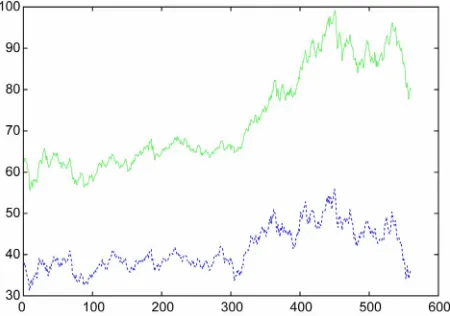
We applied our Bayesian cointegration analysis via dynamic factor models to the GDX and GLD daily closed price from Jun. 1, 2006 to Aug. 19, 2008 (T = 560). The original data (shown in Figure 5) is log- transformed, normalized and fitted with a two-factor dy- namic factor model as (1), with priors placed on the corresponding PX-model. 15,000 posterior samples are obtained for each unknown quantity via MCMC and analyzed, after a 5000 burn-in.
[image:6.595.61.284.579.692.2]Posterior samples show that the probability that the rank of the factor loading matrix of nonstationary factors is smaller than the number of unit-root process is 99.99%, indicating that based on this dataset the GDX and GLD
Figure 5. Original daily closed prices of GDX ETF (shown with the dotted line) and GLD ETF (shown with the solid line) from Jun. 1, 2006 to Aug. 19, 2008 are plotted. The ori- ginal data is log-transformed and “normalized” before modeling.
t z
1 2
t t t
cointegrate at the 99% confidence level. The marginal probability of the first latent factor having unit roots is 98.69%, and the joint probability of at least one factor having unit roots is 98.70%, showing that both time series are unit-root processes. Given that GDX and GLD cointegrate, the posterior samples of cointegration ratio is calculated ( t t t is stationary).
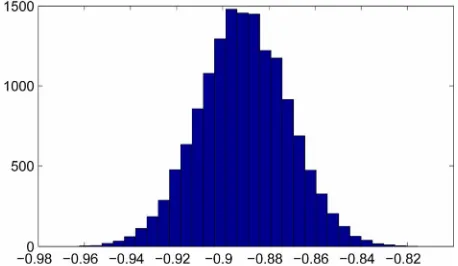
[image:7.595.58.287.378.511.2]R has the posterior mean of −0.8909 and 95% C.I. [−0.9290,−0.8524]. The histogram of R is shown in
Figure 6.
R R GLD0.8909
R
LD
R
GDX
z
To confirm that the right posterior distribution of R is found, we take the posterior mean , let
t GDXt t, and t
z G z is plotted in Figure 7 to illustrate the stationarity and mean-reversion. The sta- tionarity of zt is further confirmed by testing the null
hypothesis H0 that the process zt has unit roots, using the Augmented Dickey-Fuller (ADF) test [9], and the p-values are shown in Table 2.
Another candidate cointegrated pair could the stock price of PepsiCo Inc. (PEP) and Coca-Cola Co. (KO), because they operate in the same market and thus may be exposed to similar macro-economic and industry condi- tions. [11] specifically looked at this pair and showed
[image:7.595.59.284.560.702.2]Figure 6. Histogram of posterior samples of cointegration ratio (R) between log-transformed GDX and GLD daily close price.
Figure 7. Plot of zt to illustrate stationarity. zt= GDX + R ×
GLD, where GDX and GLD are normalized log-trans- formed data, and R is the cointegration ratio.
Table 2. p-Values of the ADF test for H0 with respect to
different lag orders. H0:zt has unit roots.
Lag Orders: 1 2 3 4 5
p-values (×10−2): 0.55 0.65 1.2 0.96 1.5
that they are indeed correlated 0.4849 , but are not cointegrated, using the classical Augmented Dickey- Fuller (ADF) test. We also looked at the daily closed price of PEP and KO from Dec. 3, 1998 to Jan. 11, 2002
T 780
. The log transformed data are fitted with the two-factor model, setting C = 5 and R = 10 (maximum autoregressive lag order of latent factors is thus 20). 15,000 posterior samples are obtained after a 5000 burn- in, which shows that the probability that PEP and KO cointegrate is 1.6% and thus reject the existence of co- integration based on this dataset, which is also consistent to the finding of [11].6. Conclusion
In this study, we showed the Bayesian factorized coin- tegration analysis for detecting cointegration among non- stationary time series. A strong message of this study is that, while testing cointegration of the original multi- variate non-stationary time series via classical tests may have limitations both conceptually and computationally, studying the properties of independent latent factors in a Bayesian dynamic factor model framework serves as a powerful tool. As the majority of studies in the literature have used the traditional linear cointegrated error correc- tion model, the models and methods we have described show accurate inference and efficient computation, and thus is a promising area for future research. One exten- sion worth noting is to consider the more general case where the number of dynamic latent factors are un- known, in which the fundamental modeling and testing approaches discussed in this study are also applicable while some model selection criteria or penalization need to be further imposed to also incorporate the uncertainly of number of factors.
REFERENCES
[1] C. W. J. Granger and P. Newbold, “Spurious Regressions in Econometrics,” Journal of Econometrics, Vol. 2, No. 2, 1974, pp. 111-120.
[2] R. F. Engle and C. W. J. Granger, “Co-Integration and Error Correction: Representation, Estimation, and Test-ing,” Econometrica, Vol. 55, No. 2, 1987, pp. 251-276. [3] S. Johansen, “Estimation and Hypothesis Testing of
Coin-tegration Vectors in Gaussian Vector Autoregressive Models,” Econometrica, Vol. 59, No. 6, 1991, pp. 1551- 1580.
84, No. 2, 1997, pp. 489-494.
[5] A. Gelman, “Prior Distributions for Variance Parameters in Hierarchical Models,” Bayesian Analysis, Vol. 24, No. 1, 2006, pp. 1-19.
[6] G. Huerta and M. West. “Priors and Component Struc- tures in Autoregressive Time Series Models,” Journal of the Royal Statistical Society Series B, Vol. 61, No. 4, 1999, pp. 881-899.
[7] J. Ghosh and D. B. Dunson, “Default Prior Distributions and Efficient Posterior Computation in Bayesian Factor Analysis,” Journal of Computational and Graphical Sta- tistics, Vol. 18, No. 2, 2009, pp. 306-320.
[8] K. Cui and D. B. Dunson, “Generalized Dynamic Factor
Models for Mixed-Measurement Time Series,” Journal of Computational and Graphical Statistics, 2012.
[9] D. A. Dickey and W. A. Fuller, “Distribution of the Esti- mators for Autoregressive Time Series with a Unit Root,”
Journal of the American Statistical Association, Vol. 74, No. 366, 1979, pp. 427-431.
[10] K. Triantafyllopoulos and G. Montana, “Dynamic Model- ing of Mean-Reverting Spreads for Statistical Arbitrage,”
Computational Management Science, Vol. 8, No. 1-2, 2011, pp. 23-49.