Aspect Extraction with Automated Prior Knowledge Learning
Zhiyuan Chen Arjun Mukherjee Bing Liu Department of Computer Science
University of Illinois at Chicago Chicago, IL 60607, USA
{czyuanacm,arjun4787}@gmail.com,[email protected]
Abstract
Aspect extraction is an important task in sentiment analysis. Topic modeling is a popular method for the task. However, unsupervised topic models often generate incoherent aspects. To address the is-sue, several knowledge-based models have been proposed to incorporate prior knowl-edge provided by the user to guide mod-eling. In this paper, we take a major step forward and show that in the big data era, without any user input, it is possi-ble to learn prior knowledge automatically from a large amount of review data avail-able on the Web. Such knowledge can then be used by a topic model to discover more coherent aspects. There are two key challenges: (1) learning quality knowl-edge from reviews of diverse domains, and (2) making the model fault-tolerant to handle possibly wrong knowledge. A novel approach is proposed to solve these problems. Experimental results using re-views from 36 domains show that the pro-posed approach achieves significant im-provements over state-of-the-art baselines. 1 Introduction
Aspect extraction aims to extract target entities and their aspects (or attributes) that people have expressed opinions upon (Hu and Liu, 2004, Liu, 2012). For example, in “The voice is not clear,” the aspect term is “voice.” Aspect extraction has two subtasks: aspect term extraction and aspect term resolution. Aspect term resolution groups tracted synonymous aspect terms together. For ex-ample, “voice” and “sound” should be grouped to-gether as they refer to the same aspect of phones.
Recently, topic models have been extensively applied to aspect extraction because they can per-form both subtasks at the same time while other
existing methods all need two separate steps (see Section 2). Traditional topic models such as LDA (Blei et al., 2003) and pLSA (Hofmann, 1999) are unsupervised methods for extracting la-tent topics in text documents. Topics are aspects in our task. Each aspect (or topic) is a distribution over (aspect) terms. However, researchers have shown that fully unsupervised models often pro-duce incoherent topics because the objective func-tions of topic models do not always correlate well with human judgments (Chang et al., 2009).
To tackle the problem, several semi-supervised topic models, also called knowledge-based topic models, have been proposed. DF-LDA (Andrze-jewski et al., 2009) can incorporate two forms of prior knowledge from the user: must-links and cannot-links. A must-link implies that two terms (or words) should belong to the same topic whereas a cannot-link indicates that two terms should not be in the same topic. In a similar but more generic vein, must-sets andcannot-setsare used in MC-LDA (Chen et al., 2013b). Other re-lated works include (Andrzejewski et al., 2011, Chen et al., 2013a, Chen et al., 2013c, Mukher-jee and Liu, 2012, Hu et al., 2011, Jagarlamudi et al., 2012, Lu et al., 2011, Petterson et al., 2010). They all allow prior knowledge to be specified by the user to guide the modeling process.
In this paper, we take a major step further. We mine the prior knowledge directly from a large amount of relevant data without any user inter-vention, and thus make this approach fully au-tomatic. We hypothesize that it is possible to learn quality prior knowledge from the big data (of reviews) available on the Web. The intuition is that although every domain is different, there is a decent amount of aspect overlapping across domains. For example, every product domain has the aspect/topic of “price,” most electronic products share the aspect “battery” and some also share “screen.” Thus, the shared aspect
edge mined from a set of domains can poten-tially help improve aspect extraction in each of these domains, as well as in new domains. Our proposed method aims to achieve this objective. There are two major challenges: (1) learning qual-ity knowledge from a large number of domains, and (2) making the extraction model fault-tolerant, i.e., capable of handling possibly incorrect learned knowledge. We briefly introduce the proposed method below, which consists of two steps.
Learning quality knowledge: Clearly, learned knowledge from only a single domain can be er-roneous. However, if the learned knowledge is shared by multiple domains, the knowledge is more likely to be of high quality. We thus propose to first use LDA to learn topics/aspects from each individual domain and then discover the shared as-pects (or topics) and aspect terms among a sub-set of domains. These shared aspects and aspect terms are more likely to be of good quality. They can serve as the prior knowledge to guide a model to extract aspects. A piece of knowledge is a set of semantically coherent (aspect) terms which are likely to belong to the same topic or aspect, i.e., similar to a must-link, but mined automatically.
Extraction guided by learned knowledge: For reliable aspect extraction using the learned prior knowledge, we must account for possible errors in the knowledge. In particular, a piece of au-tomatically learned knowledge may be wrong or domain specific (i.e., the words in the knowledge are semantically coherent in some domains but not in others). To leverage such knowledge, the system must detect those inappropriate pieces of knowledge. We propose a method to solve this problem, which also results in a new topic model, called AKL (Automated Knowledge LDA), whose inference can exploit the automatically learned prior knowledge and handle the issues of incorrect knowledge to produce superior aspects.
In summary, this paper makes the following contributions:
1. It proposes to exploit the big data to learn prior knowledge and leverage the knowledge in topic models to extract more coherent aspects. The process is fully automatic. To the best of our knowledge, none of the existing models for as-pect extraction is able to achieve this.
2. It proposes an effective method to learn qual-ity knowledge from raw topics produced using review corpora from many different domains.
3. It proposes a new inference mechanism for topic modeling, which can handle incorrect knowledge in aspect extraction.
2 Related Work
Aspect extraction has been studied by many re-searchers in sentiment analysis (Liu, 2012, Pang and Lee, 2008), e.g., using supervised sequence labeling or classification (Choi and Cardie, 2010, Jakob and Gurevych, 2010, Kobayashi et al., 2007, Li et al., 2010, Yang and Cardie, 2013) and us-ing word frequency and syntactic patterns (Hu and Liu, 2004, Ku et al., 2006, Liu et al., 2013, Popescu and Etzioni, 2005, Qiu et al., 2011, So-masundaran and Wiebe, 2009, Wu et al., 2009, Xu et al., 2013, Yu et al., 2011, Zhao et al., 2012, Zhou et al., 2013, Zhuang et al., 2006). However, these works only perform extraction but not as-pect term grouping or resolution. Separate asas-pect term grouping has been done in (Carenini et al., 2005, Guo et al., 2009, Zhai et al., 2011). They assume that aspect terms have been extracted be-forehand.
To extract and group aspects simultaneously, topic models have been applied by researchers (Branavan et al., 2008, Brody and Elhadad, 2010, Chen et al., 2013b, Fang and Huang, 2012, He et al., 2011, Jo and Oh, 2011, Kim et al., 2013, Lazaridou et al., 2013, Li et al., 2011, Lin and He, 2009, Lu et al., 2009, Lu et al., 2012, Lu and Zhai, 2008, Mei et al., 2007, Moghaddam and Es-ter, 2013, Mukherjee and Liu, 2012, Sauper and Barzilay, 2013, Titov and McDonald, 2008, Wang et al., 2010, Zhao et al., 2010). Our proposed AKL model belongs to the class of knowledge-based topic models. Besides the knowledge-based topic models discussed in Section 1, document labels are incorporated as implicit knowledge in (Blei and McAuliffe, 2007, Ramage et al., 2009). Ge-ographical region knowledge has also been con-sidered in topic models (Eisenstein et al., 2010). All of these models assume that the prior knowl-edge is correct. GK-LDA (Chen et al., 2013a) is the only knowledge-based topic model that deals with wrong lexical knowledge to some extent. As we will see in Section 6, AKL outperformed GK-LDA significantly due to AKL’s more effective er-ror handling mechanism. Furthermore, GK-LDA does not learn any prior knowledge.
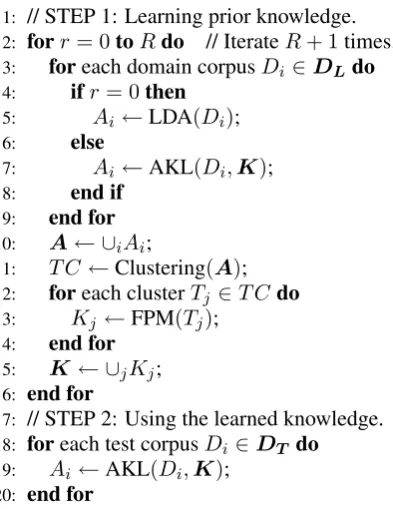
Input: CorporaDLfor knowledge learning
Test corporaDT
1: // STEP 1: Learning prior knowledge. 2: forr = 0toRdo // IterateR+ 1times. 3: foreach domain corpusDi ∈DLdo 4: ifr= 0then
5: Ai ←LDA(Di);
6: else
7: Ai ←AKL(Di,K);
8: end if
9: end for 10: A← ∪iAi;
11: T C←Clustering(A); 12: foreach clusterTj ∈T Cdo 13: Kj ←FPM(Tj);
14: end for 15: K ← ∪jKj;
16: end for
17: // STEP 2: Using the learned knowledge.
18: foreach test corpusDi∈DT do 19: Ai ←AKL(Di,K);
[image:3.595.77.274.89.344.2]20: end for
Figure 1: The proposed overall algorithm. transfer learning (He et al., 2011, Pan and Yang, 2010, Xue et al., 2008). However, transfer learn-ing in these papers is for traditional classification rather than topic/aspect extraction. In (Kang et al., 2012), labeled documents from source domains are transferred to the target domain to produce topic models with better fitting. However, we do not use any labeled data. In (Yang et al., 2011), a user provided parameter indicating the technical-ity degree of a domain was used to model the lan-guage gap between topics. In contrast, our method is fully automatic without human intervention.
3 Overall Algorithm
This section introduces the proposed overall algo-rithm. It consists of two main steps:learning qual-ity knowledge and using the learned knowledge. Figure 1 gives the algorithm.
Step 1 (learning quality knowledge, Lines 1-16): The input is the review corpora DL from
multiple domains, from which the knowledge is automatically learned. Lines 3 and 5 run LDA on each review domain corpus Di ∈ DL to
gener-ate a set of aspects/topics Ai (lines 2, 4, and 6-9 will be discussed below). Line 10 unions the topics from all domains to give A. Lines 11-14 cluster the topics inAinto some coherent groups (or clusters) and then discover knowledgeKjfrom each group of topics using frequent pattern mining
(FPM) (Han et al., 2007). We will detail these in Section 4. Each piece of the learned knowledge is a set of terms which are likely to belong to the same aspect.
Iterative improvement: The above process can actually run iteratively because the learned knowl-edgeKcan help the topic model learn better top-ics in each domain Di ∈ DL, which results in
better knowledgeKin the next iteration. This it-erative process is reflected in lines 2, 4, 6-9 and 16. We will examine the performance of the process at different iterations in Section 6.2. From the sec-ond iteration, we can use the knowledge learned from the previous iteration (lines 6-8). The learned knowledge is leveraged by the new model AKL, which is discussed below in Step 2.
Step 2(using the learned knowledge, Lines 17-20): The proposed model AKL is employed to use the learned knowledgeK to help topic modeling in test domains DT, which can be DL or other
unseen domains. The key challenge of this step is how to use the learned prior knowledgeK effec-tively in AKL and deal with possible errors inK. We will elaborate them in Section 5.
Scalability: the proposed algorithm is naturally scalable as both LDA and AKL run on each do-main independently. Thus, for all dodo-mains, the algorithm can run in parallel. Only the resulting topics need to be brought together for knowledge learning (Step 1). These resulting topics used in learning are much smaller than the domain corpus as only a list of top terms from each topic are uti-lized due to their high reliability.
4 Learning Quality Knowledge
This section details Step 1 in the overall algorithm, which has three sub-steps: running LDA (or AKL) on each domain corpus, clustering the resulting topics, and mining frequent patterns from the top-ics in each cluster. Since running LDA is simple, we will not discuss it further. The proposed AKL model will be discussed in Section 5. Below we focus on the other two sub-steps.
4.1 Topic Clustering
by topics across several domains. Thus, it is nat-ural to exploit a frequency-based approach to dis-cover frequent set of terms as quality knowledge. However, we need to deal with two issues. 1. Generic aspects, such as price with aspect
terms likecost andpricy, are shared by many (even all) product domains. But specific as-pects such as screen, occur only in domains with products having them. It means that dif-ferent aspects may have distinct frequencies. Thus, using a single frequency threshold in the frequency-based approach is not sufficient to extract both generic and specific aspects be-cause the generic aspects will result in numer-ous spurinumer-ous aspects (Han et al., 2007).
2. A term may have multiple senses in different domains. For example,lightcan mean “of little weight” or “something that makes things visi-ble”. A good knowledge base should have the capacity of handling this ambiguity.
To deal with these two issues, we propose to discover knowledge in two stages: topic clustering and frequent pattern mining (FPM).
The purpose of clustering is to group raw topics from a topic model (LDA or AKL) into clusters. Each cluster contains semantically related topics likely to indicate the same real-world aspect. We then mine knowledge from each cluster using an FPM technique. Note that the multiple senses of a term can be distinguished by the semantic mean-ings represented by the topics in different clusters. For clustering, we tried k-means and k -medoids (Kaufman and Rousseeuw, 1990), and found that k-medoids performs slightly better. One possible reason is thatk-means is more sen-sitive to outliers. In our topic clustering, each data point is a topic represented by its top terms (with their probabilities normalized). The distance be-tween two data points is measured by symmetrised KL-Divergence.
4.2 Frequent Pattern Mining
Given topics within each cluster, this step finds sets of terms that appear together in multiple top-ics, i.e., shared terms among similar topics across multiple domains. Terms in such a set are likely to belong to the same aspect. To find such sets of terms within each cluster, we usefrequent pattern mining (FPM) (Han et al., 2007), which is suited for the task. The probability of each term is ig-nored in FPM.
FPM is stated as follows: Given a set of trans-actionsT, where each transactionti ∈ Tis a set of items from a global item setI, i.e., ti ∈ I. In our context, ti is the topic vector comprising the top terms of a topic (no probability attached). T
is the collection of all topics within a cluster and
I is the set of all terms inT. The goal of FPM is to find all patterns that satisfy some user-specified frequency threshold (also called minimum support count), which is the minimum number of times that a pattern should appear in T. Such patterns are called frequent patterns. In our context, a pat-tern is a set of terms which have appeared multiple times in the topics within a cluster. Such patterns compose our knowledge base as shown below.
4.3 Knowledge Representation
As the knowledge is extracted from each cluster individually, we represent our knowledge base as a set of clusters, where each cluster consists of a set of frequent 2-patterns mined using FPM, e.g.,
Cluster 1: {battery, life}, {battery, hour},
{battery, long},{charge, long}
Cluster 2: {service, support}, {support, cus-tomer},{service, customer}
Using two terms in a set is sufficient to cover the semantic relationship of the terms belonging to the same aspect. Longer patterns tend to contain more errors since some terms in a set may not belong to the same aspect as others. Such partial errors hurt performance in the downstream model.
5 AKL: Using the Learned Knowledge We now present the proposed topic model AKL, which is able to use the automatically learned knowledge to improve aspect extraction.
5.1 Plate Notation
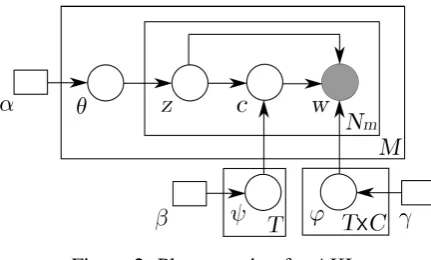
Differing from most topic models based on topic-term distribution, AKL incorporates a latent clus-ter variable c to connect topics and terms. The plate notation of AKL is shown in Figure 2. The inputs of the model are M documents, T top-ics and C clusters. Each document m has Nm terms. We model distribution P(cluster|topic)
as ψ and distribution P(term|topic, cluster) as
ϕ with Dirichlet priors β and γ respectively.
P(topic|document) is modeled by θ with a
Dirichlet priorα. The terms in each document are assumed to be generated by first sampling a topic
α θ
z
c
w
Nm
M
ψ T φ TXC
[image:5.595.72.288.60.190.2]β γ
Figure 2: Plate notation for AKL.
a term w given topic z and clusterc. This plate notation of AKL and its associated generative pro-cess are similar to those of MC-LDA (Chen et al., 2013b). However, there are three key differences. 1. Our knowledge is automatically mined which
may have errors (or noises), while the prior knowledge for MC-LDA is manually provided and assumed to be correct. As we will see in Section 6, using our knowledge, MC-LDA does not generate as coherent aspects as AKL. 2. Our knowledge is represented as clusters. Each
cluster contains a set of frequent 2-patterns with semantically correlated terms. They are different from must-sets used in MC-LDA. 3. Most importantly, due to the use of the new
form of knowledge, AKL’s inference mecha-nism (Gibbs sampler) is entirely different from that of MC-LDA (Section 5.2), which results in superior performances (Section 6). Note that the inference mechanism and the prior knowl-edge cannot be reflected in the plate notation for AKL in Figure 2.
In short, our modeling contributions are (1) the capability of handling more expressive knowledge in the form of clusters, (2) a novel Gibbs sampler to deal with inappropriate knowledge.
5.2 The Gibbs Sampler
As the automatically learned prior knowledge may contain errors for a domain, AKL has to learn the usefulness of each piece of knowledge dy-namically during inference. Instead of assigning weights to each piece of knowledge as a fixed prior in (Chen et al., 2013a), we propose a new Gibbs sampler, which can dynamically balance the use of prior knowledge and the information in the cor-pus during the Gibbs sampling iterations.
We adopt a Blocked Gibbs sampler (Rosen-Zvi et al., 2010) as it improves convergence and re-duces autocorrelation when the variables (topicz
and clustercin AKL) are highly related. For each
term wi in each document, we jointly sample a topicziand clusterci(containingwi) based on the conditional distribution in Gibbs sampler (will be detailed in Equation 4). To compute this distribu-tion, instead of considering how wellzi matches with wi only (as in LDA), we also consider two other factors:
1. The extentcicorroborateswigiven the corpus. By “corroborate”, we mean whether those fre-quent 2-patterns in ci containing wi are also supported by the actual information in the do-main corpus to some extent (see the measure in Equation 1 below). Ifci corroborateswi well,
ci is likely to be useful, and thus should also provide guidance in determiningzi. Otherwise,
cimay not be a suitable piece of knowledge for
wi in the domain.
2. Agreement between ci and zi. By agreement we mean the degree that the terms (union of all frequent 2-patterns of ci) in cluster ci are re-flected in topiczi. Unlike the first factor, this is a global factor as it concerns all the terms in a knowledge cluster.
For the first factor, we measure how well ci corroborates wi given the corpus based on co-document frequency ratio. As shown in (Mimno et al., 2011), co-document frequency is a good in-dicator of term correlation in a domain. Follow-ing (Mimno et al., 2011), we define a symmetric co-document frequency ratio as follows:
Co-Doc(w, w0) =(D(w) +D(w, wD(w0) + 10))×1
2 + 1
(1)
where(w, w0)refers to each frequent 2-pattern in
the knowledge clusterci. D(w, w0)is the number of documents that contain both termswandw0and
D(w) is the number of documents containing w. A smoothing count of1is added to avoid the ratio being0.
For the second factor, if cluster ci and topiczi agree, the intuition is that the terms inci(union of all frequent2-patterns ofci) should appear as top terms under zi (i.e., ranked top according to the term probability under zi). We define the agree-ment using symmetrised KL-Divergence between the two distributions (DISTc and DISTz) cor-responding to ci andzi respectively. As there is no prior preference on the terms of ci, we use the uniform distribution over all terms in ci for
with their probabilities (re-normalized) to repre-sent the topic. Note that a smoothing probability (i.e., a very small value) is also given to every term for calculating KL-Divergence. GivenDISTcand
DISTz, the agreement is computed with:
Agreement(c, z) = KL(DIST1
c, DISTz) (2)
The rationale of Equation 2 is that the lesser di-vergence betweenDISTcandDISTzimplies the more agreement betweenciandzi.
We further employ the Generalized Plya urn (GPU) model (Mahmoud, 2008) which was shown to be effective in leveraging semantically related words (Chen et al., 2013a, Chen et al., 2013b, Mimno et al., 2011). The GPU model here ba-sically states that assigning topiczi and clusterci to termwi will not only increase the probability of connecting zi and ci with wi, but also make it more likely to associate zi andci with termw0 where w0 shares a 2-pattern with w
i in ci. The amount of probability increase is determined by matrixAc,w0,wdefined as:
Ac,w0,w =
1, ifw=w0
σ, if(w, w0)∈c, w6=w0
0, otherwise
(3)
where value1controls the probability increase of
wby seeingwitself, andσcontrols the probability increase ofw0 by seeingw. Please refer to (Chen
et al., 2013b) for more details.
Putting together Equations 1, 2 and 3 into a blocked Gibbs Sampler, we can define the follow-ing samplfollow-ing distribution in Gibbs sampler so that it provides helpful guidance in determining the usefulness of the prior knowledge and in selecting the semantically coherent topic.
P(zi=t, ci=c|z−i,c−i,w, α, β, γ,A)
∝ X
(w,w0)∈c
Co-Doc(w, w0)×Agreement(c, t)
×PTn−im,t+α
t0=1(n−im,t0+α)
×
PV
w0=1PVv0=1Ac,v0,w0×n−it,c,v0+β
PC
c0=1(PVw0=1PVv0=1Ac0,v0,w0×n−it,c0,v0+β)
×
PV
w0=1Ac,w0,wi×n−it,c,w0+γ
PV
v0=1(PVw0=1Ac,w0,v0×n−it,c,w0+γ)
(4)
wheren−idenotes the count excluding the current assignment ofziandci, i.e.,z−iandc−i.nm,t de-notes the number of times that topictwas assigned to terms in document m. nt,c denotes the times
that clustercoccurs under topict. nt,c,v refers to the number of times that termvappears in cluster
cunder topict.α,βandγare predefined Dirichlet hyperparameters.
Note that although the above Gibbs sampler is able to distinguish useful knowledge from wrong knowledge, it is possible that there is no cluster corroborates for a particular term. For every term
w, apart from its knowledge clusters, we also add a singleton cluster forw, i.e., a cluster with one pattern{w, w}only. When no knowledge cluster is applicable, this singleton cluster is used. As a singleton cluster does not contain any knowledge information but only the word itself, Equations 1 and 2 cannot be computed. For the values of sin-gleton clusters for these two equations, we assign them as the averages of those values of all non-singleton knowledge clusters.
6 Experiments
This section evaluates and compares the pro-posed AKL model with three baseline models LDA, MC-LDA, and GK-LDA. LDA (Blei et al., 2003) is the most popular unsupervised topic model. MC-LDA (Chen et al., 2013b) is a re-cent knowledge-based model for aspect extrac-tion. GK-LDA (Chen et al., 2013a) handles wrong knowledge by setting prior weights using the ratio of word probabilities. Our automatically extracted knowledge is provided to these models. Note that cannot-set of MC-LDA is not used in AKL.
6.1 Experimental Settings
Dataset. We created a large dataset containing reviews from 36 product domains or types from Amazon.com. The product domain names are listed in Table 1. Each domain contains1,000 re-views. This gives us36domain corpora. We have made the dataset publically available at the web-site of the first author.
Pre-processing. We followed (Chen et al., 2013b) to employ standard pre-processing like lemmatiza-tion and stopword removal. To have a fair compar-ison, we also treat each sentence as a document as in (Chen et al., 2013a, Chen et al., 2013b).
Amplifier DVD Player Kindle MP3 Player Scanner Video Player Blu-Ray Player GPS Laptop Network Adapter Speaker Video Recorder
Camera Hard Drive Media Player Printer Subwoofer Watch CD Player Headphone Microphone Projector Tablet Webcam Cell Phone Home Theater System Monitor Radar Detector Telephone Wireless Router
[image:7.595.103.499.62.125.2]Computer Keyboard Mouse Remote Control TV Xbox
Table 1: List of 36 domain names. and set toα = 1,β = 0.1,T = 15, andσ = 0.2.
Furthermore, for each cluster,γis set proportional to the number of terms in it. The other param-eters for MC-LDA and GK-LDA were set as in their original papers. For parameters of AKL, we used the top 15 terms for each topic in the clus-tering phrase. The number of clusters is set to the number of domains. We will test the sensitiv-ity of these clustering parameters in Section 6.4. The minimum support count for frequent pattern mining was set empirically tomin(5,0.4×#T), where#Tis the number of transactions (i.e., the number of topics from all domains) in a cluster.
Test Settings: We use two test settings as below: 1. (Sections 6.2, 6.3 and 6.4) Test on the same
cor-pora as those used in learning the prior knowl-edge. This is meaningful as the learning phrase is automatic and unsupervised (Figure 1). We call thisself-learning-and-improvement. 2. (Section 6.5) Test on new/unseen domain
cor-pora after knowledge learning.
6.2 Topic Coherence
This sub-section evaluates the topics/aspects gen-erated by each model based on Topic Coher-ence (Mimno et al., 2011) in test setting 1. Tra-ditionally, topic models have been evaluated us-ing perplexity. However, perplexity on the held-out test set does not reflect the semantic coher-ence of topics and may be contrary to human judg-ments (Chang et al., 2009). Instead, the met-ric Topic Coherence has been shown in (Mimno
-1510 -1490 -1470 -1450 -1430
0 1 2 3 4 5 6
T
op
ic Co
he
re
nc
e
AKL GK-LDA
[image:7.595.72.289.602.722.2]MC-LDA LDA
Figure 3: Average Topic Coherence of each model at different learning iterations (Iteration 0 is equiv-alent to LDA).
et al., 2011) to correlate well with human judg-ments. Recently, it has become a standard prac-tice to use Topic Coherence for evaluation of topic models (Arora et al., 2013). A higher Topic Coher-ence value indicates a better topic interpretability, i.e., semantically more coherent topics.
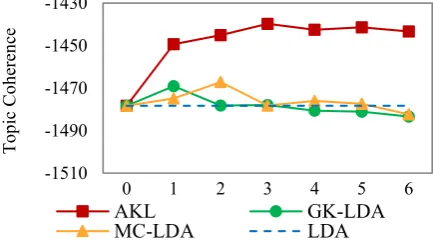
Figure 3 shows the average Topic Coherence of each model using knowledge learned at different learning iterations (Figure 1). For MC-LDA or GK-LDA, this is done by replacing AKL in lines 7 and 19 of Figure 1 with MC-LDA or GK-LDA. Each value is the average over all 36 domains. From Figure 3, we can observe the followings: 1. AKL performs the best with the highest Topic
Coherence values at all iterations. It is actu-ally the best in all 36 domains. These show that AKL finds more interpretable topics than the baselines. Its values stabilize after iteration 3. 2. Both GK-LDA and MC-LDA perform slightly
better than LDA in iterations 1 and 2. MC-LDA does not handle wrong knowledge. This shows that the mined knowledge is of good quality. Although GK-LDA uses large word probability differences under a topic to detect wrong lexical knowledge, it is not as effective as AKL. The reason is that as the lexical knowl-edge is from general dictionaries rather than mined from relevant domain data, the words in a wrong piece of knowledge usually have a very large probability difference under a topic. However, our knowledge is mined from top words in related topics including topics from the current domain. The words in a piece of in-correct (or in-correct) knowledge often have sim-ilar probabilities under a topic. The proposed dynamic knowledge adjusting mechanism in AKL is superior.
Paired t-test shows that AKL outperforms all baselines significantly(p <0.0001).
6.3 User Evaluation
0.6 0.7 0.8 0.9 1.0
Camera Computer Headphone GPS
P
rec
is
io
n
@
5
AKL GK-LDA MC-LDA LDA
0.6 0.7 0.8 0.9 1.0
Camera Computer Headphone GPS
P
rec
is
io
n
@
1
0
[image:8.595.100.503.67.167.2]AKL GK-LDA MC-LDA LDA
Figure 4: AverageP recision@5(Left) andP recision@10(Right) of coherent topics from four models in each domain. (Headphonehas a lot of overlapping topics in other domains whileGPShas little.)
terms coherently represent a real-world product aspect; otherwise incoherent. For a coherent topic, each top term is annotated as correct if it reflects the aspect represented by the topic; otherwise in-correct. We labeled the topics of each model at learning iteration 1 where the same pieces of knowledge (extracted from LDA topics at learn-ing iteration 0) are provided to each model. After learning iteration 1, the gap between AKL and the baseline models tends to widen. To be consistent, the results later in Sections 6.4 and 6.5 also show each model at learning iteration 1. We also notice that after a few learning iterations, the topics from AKL model tend to have some resemblance across domains. We found that AKL with 2learning it-erations achieved the best topics. Note that LDA cannot use any prior knowledge.
We manually labeled results from four domains, i.e., Camera, Computer, Headphone, and GPS. We chose Headphone as it has a lot of overlapping of topics with other domains because many elec-tronic products use headphone. GPS was cho-sen because it does not have much topic overlap-ping with other domains as its aspects are mostly about Navigation and Maps. Domains Camera and Computer lay in between. We want to see how domain overlapping influences the performance of AKL. Cohen’s Kappa scores for annotator agree-ment are0.918(for topics) and0.872(for terms).
To measure the results, we compute
P recision@n (or p@n) based on the
anno-tations, which was also used in (Chen et al., 2013b, Mukherjee and Liu, 2012).
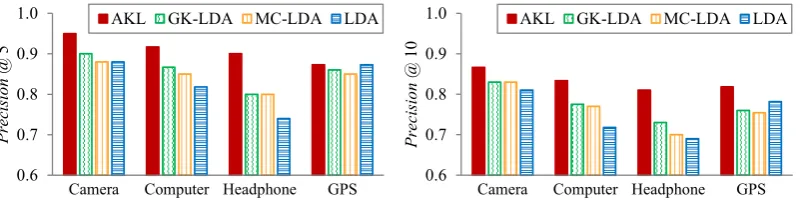
Figure 4 shows the precision@n results for
n = 5and10. We can see that AKL makes im-provements in all 4 domains. The improvement varies in domains with the most increase in Head-phone and the least in GPS as HeadHead-phone overlaps more with other domains than GPS. Note that if a domain shares aspects with many other domains,
its model should benefit more; otherwise, it is rea-sonable to expect lesser improvements. For the baselines, GK-LDA and MC-LDA perform simi-larly to LDA with minor variations, all of which are inferior to AKL. AKL’s improvements over other models are statistically significant based on pairedt-test(p <0.002).
In terms of the number ofcoherenttopics, AKL discovers one more coherent topic than LDA in Computer and one more coherent topic than GK-LDA and MC-GK-LDA in Headphone. For the other domains, the numbers of coherent topics are the same for all models.
Table 2 shows an example aspect (battery) and its top 10 terms produced by AKL and LDA for each domain to give a flavor of the kind of im-provements made by AKL. The results for GK-LDA and MC-GK-LDA are about the same as GK-LDA (see also Figure 4). Table 2 focuses on the as-pects generated by AKL and LDA. From Table 2, we can see that AKL discovers more correct and meaningful aspect terms at the top. Note that those terms marked in red and italicized are er-rors. Apart from Table 2, many aspects are dra-matically improved by AKL, including some com-monly shared aspects such as Price, Screen, and Customer Service.
6.4 Sensitivity to Clustering Parameters
This sub-section investigates the sensitivity of the clustering parameters of AKL (again in test setting
1). The top sub-figure in Figure 5 shows the aver-age Topic Coherence values versus the topkterms per topic used in topic clustering (Section 4.1). The number of clusters is set to the number of domains (see below). We can observe that using
k = 15top terms gives the highest value. This is intuitive as too few (or too many) top terms may generate insufficient (or noisy) knowledge.
Camera Computer Headphone GPS
AKL LDA AKL LDA AKL LDA AKL LDA
battery battery battery battery hour long battery trip
life card hour cable long battery hour battery hour memory life speaker battery hour long hour long life long dvi life comfortable model mile
charge usb speaker sound charge easy life long
extra hour sound hour amp uncomfortable charge life minute minute charge connection uncomfortable headset trip destination
charger sd dvi life comfortable life purchase phone
short extra tv hdmus period money older charge
[image:9.595.115.486.62.178.2]aa device hdmus tv output hard compass mode
Table 2: Example aspectBatteryfrom AKL and LDA in each domain. Errors are italicized in red.
-1510 -1490 -1470 -1450 -1430
5 10 15 20 25 30
T
op
ic
Co
he
re
nc
e
#Top Terms for Clustering
-1510 -1490 -1470 -1450 -1430
20 30 40 50 60 70
T
op
ic
Co
he
re
nc
e
[image:9.595.73.292.218.389.2]#Clusters
Figure 5: Average topic coherence of AKL versus #top k terms (Top) and #clusters (Bottom).
-1490 -1480 -1470 -1460 -1450
AKL GK-LDA MC-LDA LDA
T
op
ic
C
oh
er
en
ce
Figure 6: Average topic coherence of each model tested on new/unseen domain.
of clusters. We fix the number of top terms per topic to15as it yields the best result (see the top sub-figure in Figure 5). We can see that the per-formance is not very sensitive to the number of clusters. The model performs similarly for 30 to
50 clusters, with lower Topic Coherence for less than30or more than50clusters. The significance test indicates that using 30, 40, and 50 clusters, AKL achieved significant improvements over all baseline models (p < 0.0001). With more do-mains, we should expect a larger number of clus-ters. However, it is difficult to obtain the optimal number of clusters. Thus, we empirically set the
number of clusters to the number of domains in our experiments. Note that the number of clus-ters(C)is expected to be larger than the number of topics in one domain(T) becauseC is for all domains whileT is for one particular domain.
6.5 Test on New Domains
We now evaluate AKL in test setting2, i.e., the au-tomatically extracted knowledgeK (Figure 1) is applied in new/unseen domains other than those in domainsDLused in knowledge learning. The aim
is to see howK can help modeling in an unseen domain. In this set of experiments, each domain is tested by using the learned knowledge from the rest35domains. Figure 6 shows the average Topic Coherence of each model. The values are also av-eraged over the36tested domains. We can see that AKL achieves the highest Topic Coherence value while LDA has the lowest. The improvements of AKL over all baseline models are significant with
p <0.0001. 7 Conclusions
This paper proposed an advanced aspect extraction framework which can learn knowledge automati-cally from a large number of review corpora and exploit the learned knowledge in extracting more coherent aspects. It first proposed a technique to learn knowledge automatically by clustering and FPM. Then a new topic model with an advanced inference mechanism was proposed to exploit the learned knowledge in a fault-tolerant manner. Ex-perimental results using review corpora from 36 domains showed that the proposed method outper-forms state-of-the-art methods significantly. Acknowledgments
[image:9.595.74.291.446.539.2]References
David Andrzejewski, Xiaojin Zhu, and Mark Craven. 2009. Incorporating domain knowledge into topic modeling via Dirichlet Forest priors. InProceedings of ICML, pages 25–32.
David Andrzejewski, Xiaojin Zhu, Mark Craven, and Benjamin Recht. 2011. A framework for incorpo-rating general domain knowledge into latent Dirich-let allocation using first-order logic. InProceedings of IJCAI, pages 1171–1177.
Sanjeev Arora, Rong Ge, Yonatan Halpern, David Mimno, Ankur Moitra, David Sontag, Yichen Wu, and Michael Zhu. 2013. A Practical Algorithm for Topic Modeling with Provable Guarantees. In Pro-ceedings of ICML, pages 280–288.
David M. Blei and Jon D McAuliffe. 2007. Supervised Topic Models. InProceedings of NIPS, pages 121– 128.
David M. Blei, Andrew Y. Ng, and Michael I. Jordan. 2003. Latent Dirichlet Allocation. Journal of Ma-chine Learning Research, 3:993–1022.
S R K Branavan, Harr Chen, Jacob Eisenstein, and Regina Barzilay. 2008. Learning Document-Level Semantic Properties from Free-Text Annotations. In
Proceedings of ACL, pages 263–271.
Samuel Brody and Noemie Elhadad. 2010. An unsu-pervised aspect-sentiment model for online reviews. InProceedings of NAACL, pages 804–812.
Giuseppe Carenini, Raymond T Ng, and Ed Zwart. 2005. Extracting knowledge from evaluative text. InProceedings of K-CAP, pages 11–18.
Jonathan Chang, Jordan Boyd-Graber, Wang Chong, Sean Gerrish, and David Blei, M. 2009. Reading Tea Leaves: How Humans Interpret Topic Models. InProceedings of NIPS, pages 288–296.
Zhiyuan Chen, Arjun Mukherjee, Bing Liu, Meichun Hsu, Malu Castellanos, and Riddhiman Ghosh. 2013a. Discovering Coherent Topics Using General Knowledge. InProceedings of CIKM, pages 209– 218.
Zhiyuan Chen, Arjun Mukherjee, Bing Liu, Meichun Hsu, Malu Castellanos, and Riddhiman Ghosh. 2013b. Exploiting Domain Knowledge in Aspect Extraction. InProceedings of EMNLP, pages 1655– 1667.
Zhiyuan Chen, Arjun Mukherjee, Bing Liu, Meichun Hsu, Malu Castellanos, and Riddhiman Ghosh. 2013c. Leveraging Multi-Domain Prior Knowledge in Topic Models. In Proceedings of IJCAI, pages 2071–2077.
Yejin Choi and Claire Cardie. 2010. Hierarchical Se-quential Learning for Extracting Opinions and their Attributes. InProceedings of ACL, pages 269–274.
Jacob Eisenstein, Brendan O’Connor, Noah A Smith, and Eric P Xing. 2010. A Latent Variable Model for Geographic Lexical Variation. InProceedings of EMNLP, pages 1277–1287.
Lei Fang and Minlie Huang. 2012. Fine Granular As-pect Analysis using Latent Structural Models. In
Proceedings of ACL, pages 333–337.
Honglei Guo, Huijia Zhu, Zhili Guo, Xiaoxun Zhang, and Zhong Su. 2009. Product feature categoriza-tion with multilevel latent semantic associacategoriza-tion. In
Proceedings of CIKM, pages 1087–1096.
Jiawei Han, Hong Cheng, Dong Xin, and Xifeng Yan. 2007. Frequent pattern mining: current status and future directions. Data Mining and Knowledge Dis-covery, 15(1):55–86.
Yulan He, Chenghua Lin, and Harith Alani. 2011. Au-tomatically Extracting Polarity-Bearing Topics for Cross-Domain Sentiment Classification. In Pro-ceedings of ACL, pages 123–131.
Thomas Hofmann. 1999. Probabilistic Latent Seman-tic Analysis. InProceedings of UAI, pages 289–296. Minqing Hu and Bing Liu. 2004. Mining and Summa-rizing Customer Reviews. InProceedings of KDD, pages 168–177.
Yuening Hu, Jordan Boyd-Graber, and Brianna Sati-noff. 2011. Interactive Topic Modeling. In Pro-ceedings of ACL, pages 248–257.
Jagadeesh Jagarlamudi, Hal Daum´e III, and Raghaven-dra Udupa. 2012. Incorporating Lexical Priors into Topic Models. InProceedings of EACL, pages 204– 213.
Niklas Jakob and Iryna Gurevych. 2010. Extracting Opinion Targets in a Single- and Cross-Domain Set-ting with Conditional Random Fields. In Proceed-ings of EMNLP, pages 1035–1045.
Yohan Jo and Alice H. Oh. 2011. Aspect and senti-ment unification model for online review analysis. InProceedings of WSDM, pages 815–824.
Jeon-hyung Kang, Jun Ma, and Yan Liu. 2012. Trans-fer Topic Modeling with Ease and Scalability. In
Proceedings of SDM, pages 564–575.
L Kaufman and P J Rousseeuw. 1990. Finding groups in data: an introduction to cluster analysis. John Wiley and Sons.
Suin Kim, Jianwen Zhang, Zheng Chen, Alice Oh, and Shixia Liu. 2013. A Hierarchical Aspect-Sentiment Model for Online Reviews. InProceedings of AAAI, pages 526–533.
Lun-Wei Ku, Yu-Ting Liang, and Hsin-Hsi Chen. 2006. Opinion Extraction, Summarization and Tracking in News and Blog Corpora. In Proceed-ings of AAAI-CAAW, pages 100–107.
Angeliki Lazaridou, Ivan Titov, and Caroline Sporleder. 2013. A Bayesian Model for Joint Unsupervised Induction of Sentiment, Aspect and Discourse Representations. InProceedings of ACL, pages 1630–1639.
Fangtao Li, Chao Han, Minlie Huang, Xiaoyan Zhu, Yingju Xia, Shu Zhang, and Hao Yu. 2010. Structure-Aware Review Mining and Summariza-tion. InProceedings of COLING, pages 653–661. Peng Li, Yinglin Wang, Wei Gao, and Jing Jiang. 2011.
Generating Aspect-oriented Multi-Document Sum-marization with Event-aspect model. In Proceed-ings of EMNLP, pages 1137–1146.
Chenghua Lin and Yulan He. 2009. Joint senti-ment/topic model for sentiment analysis. In Pro-ceedings of CIKM, pages 375–384.
Kang Liu, Liheng Xu, and Jun Zhao. 2013. Syntactic Patterns versus Word Alignment: Extracting Opin-ion Targets from Online Reviews. InProceedings of ACL, pages 1754–1763.
Bing Liu. 2012.Sentiment Analysis and Opinion Min-ing. Morgan & Claypool Publishers.
Yue Lu and Chengxiang Zhai. 2008. Opinion inte-gration through semi-supervised topic modeling. In
Proceedings of WWW, pages 121–130.
Yue Lu, ChengXiang Zhai, and Neel Sundaresan. 2009. Rated aspect summarization of short com-ments. InProceedings of WWW, pages 131–140. Bin Lu, Myle Ott, Claire Cardie, and Benjamin K Tsou.
2011. Multi-aspect Sentiment Analysis with Topic Models. InProceedings of ICDM Workshops, pages 81–88.
Yue Lu, Hongning Wang, ChengXiang Zhai, and Dan Roth. 2012. Unsupervised discovery of opposing opinion networks from forum discussions. In Pro-ceedings of CIKM, pages 1642–1646.
Hosam Mahmoud. 2008. Polya Urn Models. Chap-man & Hall/CRC Texts in Statistical Science. Qiaozhu Mei, Xu Ling, Matthew Wondra, Hang Su,
and ChengXiang Zhai. 2007. Topic sentiment mix-ture: modeling facets and opinions in weblogs. In
Proceedings of WWW, pages 171–180.
David Mimno, Hanna M. Wallach, Edmund Talley, Miriam Leenders, and Andrew McCallum. 2011. Optimizing semantic coherence in topic models. In
Proceedings of EMNLP, pages 262–272.
Samaneh Moghaddam and Martin Ester. 2013. The FLDA Model for Aspect-based Opinion Mining: Addressing the Cold Start Problem. InProceedings of WWW, pages 909–918.
Arjun Mukherjee and Bing Liu. 2012. Aspect Extrac-tion through Semi-Supervised Modeling. In Pro-ceedings of ACL, pages 339–348.
Sinno Jialin Pan and Qiang Yang. 2010. A Survey on Transfer Learning. IEEE Trans. Knowl. Data Eng., 22(10):1345–1359.
Bo Pang and Lillian Lee. 2008. Opinion mining and sentiment analysis. Foundations and Trends in In-formation Retrieval, 2(1-2):1–135.
James Petterson, Alex Smola, Tib´erio Caetano, Wray Buntine, and Shravan Narayanamurthy. 2010. Word Features for Latent Dirichlet Allocation. In Pro-ceedings of NIPS, pages 1921–1929.
AM Popescu and Oren Etzioni. 2005. Extracting prod-uct features and opinions from reviews. In Proceed-ings of HLT, pages 339–346.
Guang Qiu, Bing Liu, Jiajun Bu, and Chun Chen. 2011. Opinion Word Expansion and Target Extrac-tion through Double PropagaExtrac-tion. Computational Linguistics, 37(1):9–27.
Daniel Ramage, David Hall, Ramesh Nallapati, and Christopher D. Manning. 2009. Labeled LDA: a su-pervised topic model for credit attribution in multi-labeled corpora. InProceedings of EMNLP, pages 248–256.
Michal Rosen-Zvi, Chaitanya Chemudugunta, Thomas Griffiths, Padhraic Smyth, and Mark Steyvers. 2010. Learning author-topic models from text cor-pora. ACM Transactions on Information Systems, 28(1):1–38.
Christina Sauper and Regina Barzilay. 2013. Auto-matic Aggregation by Joint Modeling of Aspects and Values.J. Artif. Intell. Res. (JAIR), 46:89–127. Swapna Somasundaran and J Wiebe. 2009.
Recog-nizing stances in online debates. InProceedings of ACL, pages 226–234.
Ivan Titov and Ryan McDonald. 2008. A joint model of text and aspect ratings for sentiment summariza-tion. InProceedings of ACL, pages 308–316. Hongning Wang, Yue Lu, and Chengxiang Zhai. 2010.
Latent aspect rating analysis on review text data: a rating regression approach. InProceedings of KDD, pages 783–792.
Yuanbin Wu, Qi Zhang, Xuanjing Huang, and Lide Wu. 2009. Phrase dependency parsing for opinion min-ing. InProceedings of EMNLP, pages 1533–1541. Liheng Xu, Kang Liu, Siwei Lai, Yubo Chen, and Jun
Zhao. 2013. Mining Opinion Words and Opinion Targets in a Two-Stage Framework. InProceedings of ACL, pages 1764–1773.
Bishan Yang and Claire Cardie. 2013. Joint Inference for Fine-grained Opinion Extraction. In Proceed-ings of ACL, pages 1640–1649.
Shuang Hong Yang, Steven P. Crain, and Hongyuan Zha. 2011. Bridging the language gap: Topic adap-tation for documents with different technicality. In
Proceedings of AISTATS, pages 823–831.
Jianxing Yu, Zheng-Jun Zha, Meng Wang, and Tat-Seng Chua. 2011. Aspect Ranking: Identifying Important Product Aspects from Online Consumer Reviews. InProceedings of ACL, pages 1496–1505. Zhongwu Zhai, Bing Liu, Hua Xu, and Peifa Jia. 2011. Constrained LDA for grouping product features in opinion mining. InProceedings of PAKDD, pages 448–459.
Wayne Xin Zhao, Jing Jiang, Hongfei Yan, and Xiaom-ing Li. 2010. Jointly ModelXiaom-ing Aspects and Opin-ions with a MaxEnt-LDA Hybrid. InProceedings of EMNLP, pages 56–65.
Yanyan Zhao, Bing Qin, and Ting Liu. 2012. Col-location polarity disambiguation using web-based pseudo contexts. In Proceedings of EMNLP-CoNLL, pages 160–170.
Xinjie Zhou, Xiaojun Wan, and Jianguo Xiao. 2013. Collective Opinion Target Extraction in Chinese Mi-croblogs. InProceedings of EMNLP, pages 1840– 1850.