Munich Personal RePEc Archive
A multilevel latent Markov model for the
evaluation of nursing homes’ performance
Montanari, Giorgio E. and Doretti, Marco and Bartolucci,
Francesco
Department of Political Science, University of Perugia, Department
of Political Science, University of Perugia, Department of
Economics, University of Perugia
8 August 2017
A multilevel latent Markov model for the
evaluation of nursing homes’ performance
Giorgio E. Montanari
∗1, Marco Doretti
1, and Francesco Bartolucci
21
Department of Political Science, University of Perugia
2Department of Economics, University of Perugia
August 8, 2017
Abstract
The periodic evaluation of health care services is a primary concern for many in-stitutions. In this work, we focus on nursing home services with the aim to produce a ranking of a set of nursing homes based on their capability to improve - or at least to keep unchanged - the health status of the patients they host. As the overall health status is not directly observable, latent variable models represent a suitable approach. Moreover, given the longitudinal and multilevel structure of the available data, we rely on a multilevel latent Markov model where patients and nursing homes are the first and the second level units, respectively. The model includes individual covariates to account for the patient case-mix and the impact of nursing home membership is modeled through a pair of correlated random effects affecting the initial distribution and the transition probabilities between different levels of health status. Through the prediction of these random effects we obtain a ranking of the nursing homes. Fur-thermore, the proposed model is designed to address non-ignorable dropout, which typically occurs in these contexts because some elderly patients die before completing the survey. We apply our model to the Long Term Care Facilities dataset, a longi-tudinal dataset gathered from Regione Umbria (Italy). Our results are robust to the sensitivity parameter involved (the number of latent states) and show that differences in nursing homes’ performances are statistically significant.
Keywords: clustered data, health status evaluation, non-ingorable dropout, random effects
1
Introduction
Due to population aging, the demand of health care services from elderly people is
con-stantly increasing in many occidental countries (White, 2007; Gray, 2009). As a
conse-quence, the proper evaluation of the offered services has become a key matter of
govern-ments, at national and regional level. Among these services, nursing home care is one of
the most relevant (Makai et al., 2014).
In this work, we develop a statistical model to compare the performance of different
nursing homes operating in the same context. As an illustration we apply such a model to
the health care system of Umbria, a region of central Italy, where a specific public protocol
namedLong Term Care Facilities (LTCF) has been implemented for many years. As part of
the LTCF program, a questionnaire is periodically administered to elderly patients hosted
in regional nursing homes (NHs) in order to monitor their overall health status. Thus, a
longitudinal dataset is available for many purposes. Specifically, our aim is to use such a
database for developing methods of evaluation of the ability of a nursing home to preserve
its patients in good health conditions.
For longitudinal multivariate data, latent Markov (LM) models represent an interesting
approach when the response variables are categorical and are assumed to measure some
underlying characteristic (Bartolucci et al., 2013). This class of models was first introduced
by Wiggins (1973) and has become quite popular for this kind of data. In its classical
formulation, an LM model assumes that the response variables (typically resulting from
the administration of a questionnaire) are affected by an unobserved process evolving over
time according to a first-order discrete-time Markov chain with a finite number of states.
This unobserved process represents the latent trait of interest, which in our application
viewed as the counterpart of the latent class model (Goodman, 1974) for longitudinal data
in which each latent class (or latent state) corresponds to a different level of the health
status. Many extensions of the basic LM model have been proposed in the literature to
account for additional information, represented by individual covariates, or specific data
structures; see for example Vermunt et al. (1999). In this paper, we develop a multilevel
latent Markov (MLM) model with covariates to deal with the hierarchical structure of the
LTCF data (i.e., patients hosted in different nursing homes). The nursing home effect on
the health status of their patients is represented by a pair of random effects assumed to
affect the distribution of the initial latent state and the transition probabilities between
latent states across time. As a matter of fact, our final goal is to rank the nursing homes
based on their performance in improving or maintaining their patients’ conditions as good
as possible.
Though the multilevel extension of the latent class model has been widely discussed
and applied in the literature; see, among the others, Vermunt (2003), Henry and Muth´en
(2010), Montanari et al. (2010), and Gnaldi et al. (2016), its longitudinal counterpart,
namely the MLM model, is not as much widespread. To the best of our knowledge, just
a few authors have adopted it as a modeling strategy in their applications. For instance,
Bartolucci et al. (2011) focus on educational data, while Koukounari et al. (2013) consider
the MLM model for the analysis of longitudinal datasets in the medical context. In these
papers, the multilevel structure is accounted for by means of cluster-specific time-fixed
random effects. Bartolucci and Lupparelli (2016) extend this approach using cluster random
effects with a time-varying structure, specifically, a Markov chain. In any case, a discrete
distribution over a finite number of support points is specified for the random effects.
On the contrary, in this work we adopt a continuous distribution. This strategy permits
(i.e., nursing homes) in a more explicit way with respect to models that, being based on
discrete random effects, provide a clustering of such units. There are also advantages in
terms of stability of the parameter estimates, being the proposed model more parsimonious
than the counterpart based on discrete random effects. Continuous random effects have
been already introduced in this field within the so-called class of mixed hidden Markov
models (Altman, 2007; Maruotti, 2011; Maruotti and Rocci, 2012). However, often these
random effects are intended as means to capture unobserved heterogeneity between units
rather than accounting for multilevel data structures.
Bartolucci et al. (2009) propose a similar framework with the aim of evaluating nursing
home performances. They also use an LM model with covariates to assess the effect of
nursing homes on the probability of transition between latent states through fixed effects
introduced by a suitable set of dummy explanatory variables. However, the estimation
of these NH effects is rather unreliable - when not unfeasible - if as in our case some
NHs contain just a few units. Furthermore, the model proposed here also accounts for
dropout due to the death of patients, which is a common problems arising in this type of
applications. Ignoring the missing data mechanism may lead to biased estimates. Overall,
up to our knowledge, the application of an MLM model to the present context (multivariate
longitudinal data with missing values) is innovative.
The outline of the paper is as follows. In Section 2 we present in detail the LTCF data
considered in our analysis. The proposed MLM model is illustrated in Section 3, while
model results are reported in Section 4. Main conclusions are given in Section 5 together
2
The LTCF dataset
The data motivating the proposed approach come from the Suite interRAI questionnaire,
an internationally validated and widely adopted tool (Hirdes et al., 2008; Kim et al., 2015).
Our sample refers to the years 2012 and 2013 and contains 1,292 individuals grouped in
47 different NHs. The questionnaire is planned to be administered approximately every
six months so that, ideally, four measurement occasions - one for each semester of the two
years - should be present for each patient. However, only 3,924 instead of 5,168 (4×1,292) observations are available. This is due to either intermittent missingness, when a patient
does not respond at a given measurement occasion but responds at a following occasion,
or dropout, due to patients leaving the study before scheduled because of death or other
causes. Intermittent missingness involves a modest, though not negligible, proportion of
observations (204, approximately 5%). Dropout has a more severe impact as it concerns
439 individuals (34% of the sample). About the reasons for dropout, death occurs in 377
cases (86%); other reasons are discharge or transfer to other structures such as hospitals.
A description of how such missingness mechanisms are taken into account is provided in
Section 3.2.
We have to note that, although observations of each patient are expected to be collected
every six months, the time intervals between observations show a variability related to the
evolution of patients’ health conditions. Observations are sometimes anticipated in the
presence of some change in these conditions, or delayed in the opposite case.
The entire Suite interRAI questionnaire is divided in several sections referring to
dif-ferent spheres of the health status, which in general is a multidimensional phenomenon.
However, in this paper we focus on a single section of the questionnaire. This section is an
the difficulty patients experience in taking common actions. Specifically, the ADL section
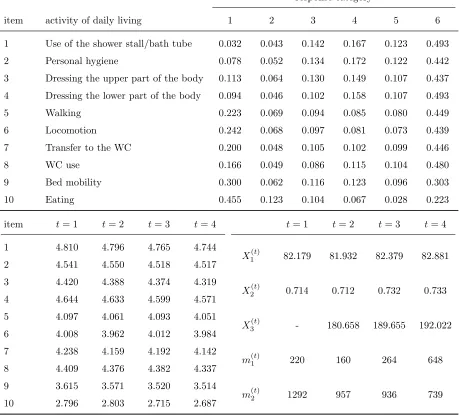
includes ten items, which are described in Table 1. Focussing only on the ADL implies
that the latent trait we consider represents just patients’ physical condition in a strict
sense. This approach might be perceived as limiting, because other important aspects of
the health status (cognitive conditions, humoral status, etc.) are not included in the
anal-ysis. However, it permits to represent the latent trait as a unidimensional variable having
a meaningful interpretation.
The response variables are measured on an ordinal scale with 6 categories (1-6), from no
difficulty at all to complete dependence on other people. In the upper part of Table 1, for
each ADL item we report the frequency distribution of the response categories referred to
all the 3,924 observations. In the bottom-left-hand side we report the item average response
(i.e., the mean of the category labels weighted with their frequencies) for each time occasion
t = 1, . . . ,4. Note that, although one expects an increase in the ADL difficulties over time, this is not the case because of dropout. In the bottom-right-hand side of Table 1, we also
report for each time the average patients’ age (X1(t)), the proportion of females (X2(t)), the average time interval in days between the current and the previous observation (X3(t)), the number of patients with t observations (m(1t)), and the number of patients surveyed at the
t-th occasion (m(2t)).
3
The multilevel latent Markov model
In this section, we present the MLM model. Here, we introduce the main notation, while the
model specification, including how the missing data mechanism is formulated, is illustrated
in Sections 3.1 and 3.2. Finally, Section 3.3 describes the maximum likelihood estimation
response category
item activity of daily living 1 2 3 4 5 6
1 Use of the shower stall/bath tube 0.032 0.043 0.142 0.167 0.123 0.493 2 Personal hygiene 0.078 0.052 0.134 0.172 0.122 0.442 3 Dressing the upper part of the body 0.113 0.064 0.130 0.149 0.107 0.437 4 Dressing the lower part of the body 0.094 0.046 0.102 0.158 0.107 0.493 5 Walking 0.223 0.069 0.094 0.085 0.080 0.449 6 Locomotion 0.242 0.068 0.097 0.081 0.073 0.439 7 Transfer to the WC 0.200 0.048 0.105 0.102 0.099 0.446
8 WC use 0.166 0.049 0.086 0.115 0.104 0.480
9 Bed mobility 0.300 0.062 0.116 0.123 0.096 0.303 10 Eating 0.455 0.123 0.104 0.067 0.028 0.223 item t= 1 t= 2 t= 3 t= 4 t= 1 t= 2 t= 3 t= 4 1 4.810 4.796 4.765 4.744
X1(t) 82.179 81.932 82.379 82.881 2 4.541 4.550 4.518 4.517
3 4.420 4.388 4.374 4.319
X2(t) 0.714 0.712 0.732 0.733 4 4.644 4.633 4.599 4.571
5 4.097 4.061 4.093 4.051
X3(t) - 180.658 189.655 192.022 6 4.008 3.962 4.012 3.984
7 4.238 4.159 4.192 4.142
m(t)1 220 160 264 648 8 4.409 4.376 4.382 4.337
9 3.615 3.571 3.520 3.514
[image:8.612.77.536.89.506.2]m(t)2 1292 957 936 739 10 2.796 2.803 2.715 2.687
As typical in a multilevel analysis, we have n sample units divided into H different clusters. Therefore, every unit is characterized by a double index hi, with h = 1, . . . , H
and i = 1, . . . , nh, where nh is the dimension of the h-th cluster so that n = PHh=1nh.
Furthermore, we denote by Yhi(t) the response vector of unit i in cluster h at occasion t. This vector consists of J univariate categorical responses, that is Yhi(t) = (Yhi(t1), . . . , YhiJ(t)). Each univariate response Yhij(t) might have a generic number of categories cj, j = 1, . . . , J.
Moreover, every unit hi can have a specific number of measurement occasions Thi ≤ T,
where T denotes the maximum number of occasions observed in the sample for a unit. The vectorsYhi(t) can be collected across time in the vector Yhi= (Y
(1)
hi , . . . ,Y
(Thi)
hi ). In
turn, we let Yh = (Yh1, . . . ,Yhnh) be the vector of all observations of cluster h. Individual
covariates are denoted by Xhi(t), and similarly to the response variables we set Xhi =
(Xhi(1), . . . ,X(Thi)
hi ) and Xh = (Xh1, . . . ,Xhnh). Every individual-specific Markovian latent
process is denoted by Vhi = (V
(1)
hi , . . . , V
(Thi)
hi ), where, at each time occasion t, V
(t)
hi is
a categorical variable with k levels. Again, individual latent processes within the same cluster can be collected in the vector Vh = (Vh1, . . . ,Vhnh). Finally, we denote the vector
of cluster-specific random effects, which are time invariant, with Uh = (Wh, Zh).
3.1
Model formulation
In the MLM model, the latent processes of two different clusters - say Vh and Vh′ - are
considered independent. As a consequence, the vectors Y1, . . . ,YH collecting the responses
at cluster level are marginally independent. However, for units in the same cluster h, the independence is conditional on the cluster random effect Uh. Moreover, the Markovian
structure governing the latent individual processes Vhi is assumed to hold conditionally
on the cluster random effect Uh and on individual covariates Xhi. This means that the
process. Specifically, we define the conditional initial probabilities as
πhi(1)(v) = P(Vhi(1) =v|Xhi(1) =x(1)hi, Wh =wh), v = 1, . . . , k,
and the conditional transition probabilities as
πhi(t)(v|v¯) = P(Vhi(t) =v|V(t−1)
hi = ¯v,X
(t)
hi =x
(t)
hi, Zh =zh), v,v¯= 1, . . . , k, t = 2, . . . , Thi,
where Wh and Zh are the two components of Uh already defined above. Notice that we
are implicitly assuming that Zh is independent of Vhi(1) given (Xhi(1), Wh) and that Wh is
independent of Vhi(t) given (V(t−1)
hi ,X
(t)
hi, Zh) for t = 2, . . . , Thi. Also, Uh is assumed to be
marginally independent of Xh. Such conditional initial and transition probabilities are
collected into individual-specific vectors
πhi(1) =πhi(1)(1), . . . , π(1)hi(k)
and matrices
Π(hit) =
π(hit)(1|1) . . . πhi(t)(k|1) ... . .. ...
πhi(t)(1|k) . . . π(hit)(k|k)
, t= 2, . . . , Thi.
Their dependence on cluster membership and individual covariates is modeled by the
re-gression equations
logπ
(1)
hi (v+ 1) +· · ·+π
(1)
hi (k)
πhi(1)(1) +· · ·+πhi(1)(v) =ξv +x
(1)
hiβ+whσw, v = 1, . . . , k−1 (1)
and
log π
(t)
hi(v + 1|v¯) +· · ·+π
(t)
hi(k|v¯)
πhi(t)(1|¯v) +· · ·+πhi(t)(v|¯v) =ψv¯+ωv+x
(t)
hiγ+zhσz, v = 1, . . . , k−1, ¯v = 1, . . . , k,
for t= 2, . . . , Thi.
In Equations (1) and (2), a global logit parametrization is assumed; see Bartolucci et al.
(2009) for more details about this parametrization applied in a similar context. Under this
parametrization, the covariate effects, represented by the column vectors β and γ, are
constant across the logit equations, while the sequences of thresholds ξ1 ≥ · · · ≥ξk−1 and ω1 ≥ · · · ≥ωk−1 must be non-increasing to ensure that the cumulative sums of probabilities
along the ordered categories of the latent variables are non-decreasing. On the contrary,
no order restrictions are posed on the sequence ψ1, . . . , ψk. However, ψ1 = 0 is set for
identification purposes.
A standard bivariate normal distribution with correlation coefficient ρ is assumed for the cluster effect random vector Uh. The overall variability of the clustering process is
governed by the parameters σw and σz in (1) and (2). These parameters are obviously
constrained to be non-negative in the estimation phase (see Section 3.3). The higher (and
the more statistically significant) their deviations from zero, the higher the relevance of
clustering in the data (and therefore the necessity to account for it).
Individual covariates and cluster effects are assumed not to enter in the measurement
model, that is, in the model for the outcomes given the latent process. In the present
context, this assumption allows to interpret the latent statesv = 1, . . . , k as different levels of seriousness of patients’ conditions. As a matter of fact, each outcome Yhij(t) is assumed to be independent of any other variable in the model conditionally on Vhi(t). Under this setting, the relevant parameters are the conditional response probabilities
φjyjv =P(Y
(t)
hij =yj|V
(t)
hi =v),
with j = 1, . . . , J, yj = 1, . . . , cj, and v = 1, . . . , k. Notice that these probabilities are not
the conditional response probabilities can be stored in the matrix
Φj =
φj11 . . . φjcj1
... ... ...
φj1k . . . φjcjk
, j = 1, . . . , J.
However, the number of unconstrained conditional response probabilities is rather high
even in relatively small settings.
In order to make the model more parsimonious, several different parametrizations can
be imposed. Also in this case, we adopt a global logit parametrization of type
log φj,m+1,v+· · ·+φjcjv
φj1v +· · ·+φjmv
=τjm+δv, (3)
for j = 1, . . . , J, m = 1, . . . , cj −1, and v = 1, . . . , k. As in (1) and (2), in Equation (3)
the sequences of thresholds τj1 ≥ · · · ≥ τj,cj−1 must be non-increasing for j = 1, . . . , J.
Moreover, δ1 is set to 0 to ensure model identifiability and δ1 ≤ · · · ≤ δk is imposed
in order to obtain a positive association between the responses and the latent variable.
In this way, we can tackle the label switching problem, that is typical of discrete latent
variable models (see, e.g., Stephens, 2000). Notice that this parametrization provides a
clear interpretation of the latent states and is appropriate as the latent variables Vhi(t) have an ordinal nature.
3.2
Missing data modelling
As already shown in Section 2, in the LTCF dataset we consider there is a relatively large
proportion of missing data. Therefore, a careful evaluation of the missingness mechanism
is needed. On one hand, intermittent missingness and dropout due to reasons other than
the other hand, dropout due to death is very often associated to a worsening in patients’
health conditions. Therefore, the former can be treated as ignorable (Little and Rubin,
2002), while the latter clearly cannot, and an explicit model needs to be set for it.
Dropout due to death is modeled by expanding the available set of observations.
Specif-ically, for each response j, we add an extra response category cj + 1 in a way such that
data trajectories for patients dead after thet-th occasion (t < T) are completed by setting
Yhij(u) =cj + 1 for u=t+ 1, . . . , T. A similar approach was undertaken also by Montanari
and Pandolfi (2016). In our application, the total number of observations raises from 3,924
to 4,746 after this expansion. We also define an extra latent state k+ 1 corresponding to death, which may be seen as an extreme health condition. Some of the extra probabilities
generated by this adjustment are suitably constrained. Specifically, we have:
• πhi(1)(k+ 1) = 0 for all h and i: no one can be in the extra death state at the first occasion;
• πhi(t)(v|k+ 1) = 0 andπhi(t)(k+ 1|k+ 1) = 1 for allhand i, andt= 2, . . . , T: no one can revert to other latent states after being in the extra death state (also called absorbing
state);
• φj,cj+1,v = 0, v = 1, . . . , J, and φj,cj+1,k+1 = 1 for all j: only the extra response
category can be observed if one is in the extra latent state.
Thus, initial probability vectors and transition matrices take the form
π(1)hi =πhi(1)(1), . . . , π(1)hi(k),0
, Π(hit)=
πhi(t)(1|1) . . . πhi(t)(k|1) πhi(t)(k+ 1|1) ... . .. ... ...
π(hit)(1|k) . . . πhi(t)(k|k) πhi(t)(k+ 1|k)
0 0 0 1
while each conditional response matrix becomes
Φj =
φj11 . . . φjcj1 0
... ... ... 0
φj1k . . . φjcjk 0
0 0 0 1
.
Clearly, πhi(t)(k+ 1|1), . . . , π(hit)(k+ 1|k) are the only unconstrained additional probabilities our dropout correction entails to estimate. These are the probabilities of transition to the
death state, given the patient is in a generic latent statev at the previous occasion, forv = 1, . . . , k. According to the adopted parametrization, this corresponds to the estimation of the single additional thresholdωk, withωk ≤ωk−1: the probabilities which are constrained
to zero or one are obtained by introducing new thresholds taking values equal to −∞
or +∞, respectively. Finally, the model extension we propose to deal with missing data involves only one free parameters to estimate: the additional threshold ωk.
3.3
Maximum likelihood estimation
Denoting by p1 =|β| and p2 =|γ| the number of individual covariates affecting the initial
and transition probabilities, the total number of free model parameters is
p= 4k+p1+p2+
J
X
j=1
(cj −1).
Specifically, we have:
• k−1 +p1 parameters for the initial probabilities;
• PJ
j=1(cj −1) +k−1 parameters for the conditional response probabilities;
• 3 parameters for the cluster random effect.
Putting all these parameters in a single vector θ, the model log-likelihood is expressed by
ℓ(θ) =
H
X
h=1
logP(Yh =yh|Xh =xh). (4)
Computing the above log-likelihood obviously requires the computation of the
cluster-specific probabilities P(Yh =yh|Xh =xh). The model assumptions imply that
P(Yh =yh|Xh =xh) =
Z
R2
"nh Y
i=1
P(Yhi =yhi|Xhi =xhi,Uh =uh)
#
φ(uh;0,Σ)duh, (5)
where φ(uh;0,Σ) denotes the density function at uh of a bivariate normal distribution
with null mean and variance-covariance matrix
Σ= 1 ρ ρ 1 ,
with ρ being the correlation between the two componentsWh and Zh ofUh. For every hi,
P(Yhi=yhi|Xhi=xhi,Uh =uh) may be computed by the Baum-Welch forward recursion (Baum et al., 1970; Welch, 2003). To compute the integral in (5), we rely on a bivariate
quadrature approximation (Press et al., 1989) based on the following steps. First, by a
Gauss-Hermite method we define Q quadrature points ν∗
q and the corresponding weights
λ∗
q (q = 1, . . . , Q) for the standard bivariate normal distribution (with ρ = 0). Then, to
account for the correlation ρ we let
νq=Lνq∗, λq =λ∗q, q = 1, . . . , Q,
where Lis the Choleski decomposition of Σ. Finally, we use the approximation
P(Yh =yh|Xh =xh)≈ Q X q=1 "n h Y i=1
P(Yhi=yhi|Xhi=xhi,Uh =νq)
#
In our application, we consider 11 quadrature points for each dimension, so that a grid of
Q = 112 = 121 points is obtained overall. This approximation is reasonable and higher
values would result in prohibitive computational times.
Parameter estimates ˆθ are obtained from direct maximization of the log-likelihood. For
this aim we rely on a BFGS algorithm (Fletcher, 1987), which is available in the statistical
software R. In order to run this algorithm, the approximate log-likelihood gradient must
be calculated; see Supplementary material Section 1 for details on how to compute this
gradient. The BFGS algorithm also returns the Hessian matrix containing the numerical
second derivatives ofℓ(θ) at the maximum likelihood estimate ˆθ. Therefore, the estimated variance-covariance matrix is readily available to compute standard errors for the parameter
estimates.
In the end it is worth clarifying some aspects about the implementation of the maximum
likelihood estimation. First of all, the whole maximization algorithm is run using suitable
transformations of the random effect parameters σw, σz, and ρ. Specifically, logarithmic
transformations for σw and σz are introduced to ensure these parameters are positive (see
Section 3.1). Moreover, a Fisher transformation F(ρ) = 1/2 log[(1 +ρ)/(1−ρ)] is used for
ρ so that its final estimate is ensured to lie between -1 and 1 (Fisher, 1915). The variance-covariance matrix of these parameters on the original scale, namely prior to transformations,
can be easily approximated by using the Delta method (Oehlert, 1992). Moreover, as any
iterative algorithm, the BFGS needs to start from an initial guess for the parameter vector
θ. In this regard we recall that for complex latent variable models, as that object of the
present paper, multimodality of the likelihood function may arise and this leads to a lack
of uniqueness of the maximum likelihood solution. A typical solution consists in trying
different initializations for the estimation algorithm. In our application, we mainly follow
LM model with cluster-level fixed effects (Bartolucci et al., 2009), which is performed by an
Expectation Maximization algorithm (Dempster et al., 1977), and lettingσw =σz = 1 and
ρ= 0 as starting values. In fact, given the complexity of the model, trying many different starting values may be prohibitive in terms of computing time for large values of k. In any case, we tried different starting values which were randomly generated and we found
that the initial solution based on the preliminary fitting of the fixed-effects LM model is
typically better than other solutions.
4
Results
In this section, we summarize the results from the fitting of the MLM model on the LTCF
data. We recall that in this dataset n = 1,292 patients are divided in H = 47 NHs. Moreover, there are J = 10 categorical outcomes with the same number of categories, that is, cj = c = 6 for j = 1, . . . , J. Finally, because of intermittent missing data and
dropout we have a varying number of measurement occasions Thi≤T = 4 for each patient.
Age, age squared, gender, and time interval between occasions are considered as individual
covariates (see Section 2). Clearly, the last covariate covariate is included only in the model
for transition probabilities (see Equation (2)) and not in the model for initial probabilities.
In this way we account for the variability of the time length between consecutive time
occasions for the same individual. Typically, one is interested in six-month ahead transition
probabilities, as six months is the interval between measurements originally designed in the
LTCF study, though deviations from this target are observed.
In the reminder of this section, we first provide an outline of the procedure we adopted
for model selection (Section 4.1). Then, results for the selected models are reported
4.1
Model selection
As typical in the latent variable framework, model selection is essentially concerned with
the choice of the number of latent statesk. This decision requires a preliminary exploration of a range of different values of k. In this application, we fit models with k from 2 to 7. We avoid higher values ofk as it is known that models with many latent states often result in some of the generated subgroups having a reduced dimension and collecting sample
units with a behavior very far different from the majority of the sample. Typically, these
spurious subgroups do not represent real segments of the population under investigation,
and their existence is due to overfitting only. Moreover, fork > 7 the threshold constraints of Section 3.1 are unlikely to be met without additional model structure.
One way to account for model complexity is to rely on classical information criteria
based on the log-likelihood penalization. Specifically, here for every model we compute the
Bayesian Information Criterion (BIC, Schwarz, 1978), defined as
BIC =−2ℓ( ˆθ) +plogn,
where n is the number of sample units and p is the overall number of free parameters. In principle, models with a lowerBIC should be preferred. However, this index is often prone to favor models with too many latent states; see Bacci et al. (2014) for a detailed comparison
of different selection criteria in a similar context. Therefore, it is a good practice to also
consider alternative criteria. For instance, one could assess how sharp the posterior (i.e.,
given the data) classification of units into the latent states is. Formally, letting
˜
vhi(t) = max
v=1,...,kP(V
(t)
k 2 3 4 5 6 7
BIC 92,486.98 81,888.21 77,430.13 76,010.54 75,393.62 74,924.52
[image:19.612.108.505.70.144.2]G 0.9896 0.9796 0.9729 0.9578 0.9476 0.9524
Table 2: Values of BIC and G for models with k∈2, . . . ,7
for the MLM a measure of the sharpness of a k-state model’s classification is given by
G=
H
P
h=1
nh
P
i=1
Thi
P
t=1
˜
v(hit)− 1
k
N1− 1k
,
with N being the total number of observations. TheG index varies between 0 and 1, with 0 corresponding to random classification (i.e., units classified with constant probability
1/k for every state) and 1 corresponding to the sharpest classification (that is, one latent state has probability 1). Notice that to compute G we here focus only on the original 3,924 observations instead of the 4,746 records obtained after the data expansion due to
accounting fro dropout. Indeed, for the additional observations the latent process is in the
extra latent state k+ 1 with probability 1 by construction.
Table 2 reports the BIC and the G index for the considered models. As expected, the
BIC tends to support models with a higher number of states, while all values ofGare close to 1, denoting a good classification capability for all values of k. According to Table 2, one might think the model withk = 7 represents a good compromise. Nevertheless, results from this model show that the second latent state contains only the 2% of patients and has
the same conditional response probabilities of state 3. The only relevant difference is in
the average transition probability which is 0.863 for state 2 and zero for state 3. Overall,
this is likely to be a case of overfitting as described above. As a consequence, we prefer to
describe the results obtain from the former, while the results under latter, which are not
substantially different, are reported in the Supplementary material, Section 2.
4.2
Estimation results for
k
= 5
The five latent states may be characterized in terms of conditional response probabilities.
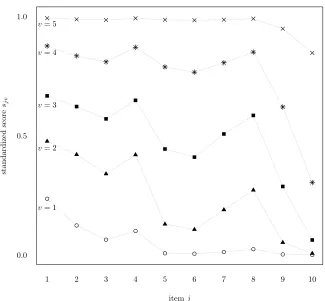
A summary picture can be provided by the normalized item scores
sjv =
1
cj −1 cj
X
yj=1
(yj −1) ˆφjyjv v = 1, . . . , k, j = 1, . . . , J.
These scores vary in the 0-1 interval and measure the difficulty a patient in latent state
v experiences in taking the action associated to item j. A value near to zero indicates that most of the conditional probability is attributed to the first category, corresponding
to no difficulty at all in the activity of daily living the item refers to. On the contrary,
a value near to one means that the probability is mostly allocated in the last category,
corresponding to totally unable to do the activity.
The normalized item scores for each latent state are plotted in Figure 1; see Table 1
for a summary description of each item. Patients in the first latent state experience some
difficulties and require some assistance related to the first four items: use of the shower
stall or bath tube, personal hygiene, and dressing the upper, and lower part of the body.
The need for assistance increases for individuals in the second latent state with respect
to the activities related to those items and some initial difficulties arise in transferring to
and using the WC, walking, and moving around. For patients in latent state 3, the needed
assistance become intensive for all activities apart from mobility in bed and eating. Latent
state 4 includes those requiring the assistance of two or more persons (apart from eating,
for which the assistance is limited). Finally, individuals in latent state 5 are totally unable
itemj
st
an
d
ar
d
iz
ed
sc
or
e
sj
v
v= 1
v= 2
v= 3
v= 4
v= 5
1 2 3 4 5 6 7 8 9 10
[image:21.612.135.460.179.480.2]0.0 0.5 1.0
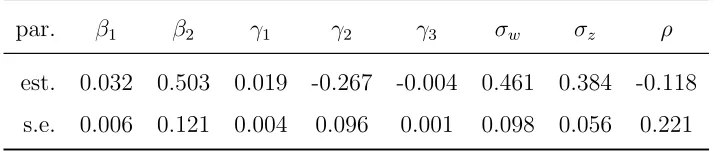
Turning the attention to the latent process, Table 3 contains estimates and standard
errors for the main parameters of the model with five latent states, once the covariate age
squared - that is not significant - has been removed. The coefficients ˆβ1 and ˆγ1 represent
the effect of patients’ age (in years) on their initial and transition probabilities respectively.
Given the assumed parametrization, it is not surprising to observe positive values,
meaning that older patients have initial and transition probabilities more concentrated on
the higher states, that is on the states associated to worse health conditions. It is also
interesting to examine the gender effect, expressed by ˆβ2 and ˆγ2. As gender is coded here
as a binary variable equal to 1 for females and 0 for males, from Table 3 we evince that
females are in a worse physical condition at the first occasion ( ˆβ2 > 0), whereas males
migrate towards critical health states with higher probability at the following occasions
(ˆγ2 < 0). Finally, the negative estimate ˆγ3 denotes that patients for which measurement
occasions are more distant have a lower tendency to move to worse states. This result
may be explained by nursing homes’ tendency to anticipate measurements when there is a
worsening in the health conditions of their patients (see Section 2). All these parameters
are significantly different from zero at 5% significance level. A significant effect of age on
initial probabilities, consistent with the one reported here, is found also by Bartolucci et al.
(2009), which focus on the period 2003-2005. However, their findings exclude a significant
par. β1 β2 γ1 γ2 γ3 σw σz ρ
est. 0.032 0.503 0.019 -0.267 -0.004 0.461 0.384 -0.118
[image:22.612.127.484.473.549.2]s.e. 0.006 0.121 0.004 0.096 0.001 0.098 0.056 0.221
effect of gender on initial and transition probabilities as well as an effect of age on transition
probabilities.
The two random effect coefficients are ˆσw = 0.461 and ˆσz = 0.384, whereas the estimated
correlation is ˆρ = −0.118. Standard errors for these estimates are reported in Table 3, but statistical t-tests are performed on the parameter transformation scales mentioned in Section 3.3 to deal with parameters varying on the real line. Specifically, we have
log(ˆσw) = −0.774 (s.e. 0.212), log(ˆσz) = −0.957 (s.e. 0.146), and F(ˆρ) = −0.119 (s.e.
0.225). From these results we conclude that σw and σz are significantly greater than 0.25
(p-values 0.0019 and 0.0017 on the logarithmic scale), while ρ is not significantly different from zero (p-value 0.5972 on the Fisher transformation scale). The absence of correlation between the random effects permits to interpretZhas an NH performance measure. On the
contrary, a - say - positive correlation would imply that nursing homes with a more relevant
effect on transition towards critical health states are also more likely to host unhealthier
patients at the first occasion. In this case, a comparison between NHs based on the Zh
variables would not account for the different complexities nursing homes have to face at a
first stage.
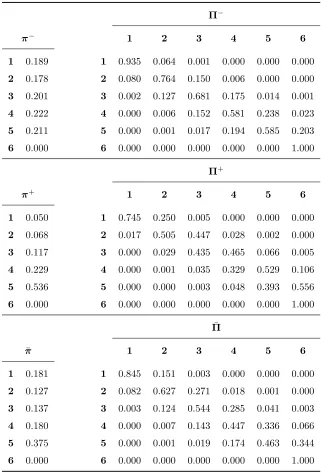
To understand the impact of these NH effects in terms of initial and transition
probabil-ities, in Table 4 we report the initial probability vectors and the 180-day ahead transition
matrices for the nursing homes with the higher and lower effects. Notice that these four
ar-rays are associated to four different NHs, that is, the nursing home with the higher (lower)
effect on initial probabilities is not the one with the higher (lower) effect on transition
prob-abilities. Lower effect initial and transition probabilities are denoted by π− andΠ−, while
higher effect ones by π+ and Π+. Each array is computed via the standard population method (Kitagawa, 1964), meaning that it is averaged across the same set of patients (and,
Π−
π− 1 2 3 4 5 6
1 0.189 1 0.935 0.064 0.001 0.000 0.000 0.000 2 0.178 2 0.080 0.764 0.150 0.006 0.000 0.000 3 0.201 3 0.002 0.127 0.681 0.175 0.014 0.001 4 0.222 4 0.000 0.006 0.152 0.581 0.238 0.023 5 0.211 5 0.000 0.001 0.017 0.194 0.585 0.203 6 0.000 6 0.000 0.000 0.000 0.000 0.000 1.000
Π+
π+ 1 2 3 4 5 6
1 0.050 1 0.745 0.250 0.005 0.000 0.000 0.000 2 0.068 2 0.017 0.505 0.447 0.028 0.002 0.000 3 0.117 3 0.000 0.029 0.435 0.465 0.066 0.005 4 0.229 4 0.000 0.001 0.035 0.329 0.529 0.106 5 0.536 5 0.000 0.000 0.003 0.048 0.393 0.556 6 0.000 6 0.000 0.000 0.000 0.000 0.000 1.000
¯
Π
¯
π 1 2 3 4 5 6
[image:24.612.144.465.77.550.2]1 0.181 1 0.845 0.151 0.003 0.000 0.000 0.000 2 0.127 2 0.082 0.627 0.271 0.018 0.001 0.000 3 0.137 3 0.003 0.124 0.544 0.285 0.041 0.003 4 0.180 4 0.000 0.007 0.143 0.447 0.336 0.066 5 0.375 5 0.000 0.001 0.019 0.174 0.463 0.344 6 0.000 6 0.000 0.000 0.000 0.000 0.000 1.000
rule out the case-mix, which in this context is the effect of the different NH compositions
with regard to patients’ age and gender. The standard population is taken here to be the
available sample of patients, irrespective of the NH they belong to. Finally, the overall
averaged initial and transition probabilities, pooling together all NHs, denoted by ¯π and ¯
Π, are also reported in Table 4. We recall that latent state 6 corresponds to the additional
state associated to death, and many probabilities involving it are constrained to zero or
one as illustrated in Section 3.2.
Looking at the overall transition probabilities, it is worth to notice that the persistence
in the same state after a 180-day time period decreases for higher latent states. Beside
that, the probability of worsening is greater than the probability of improving the health
condition. The probability of death increases with the latent state and reaches 34.4% in
latent state 5.
As regards the NH effects on the transition probabilities, the largest effect yields the
lowest persistence probabilities and the greatest probabilities of death, especially in latent
state 5, compared to the least effect. In this respect we can produce a ranking of the NHs
with respect to their ability in avoiding the worsening of patients’ health conditions. To
this purpose, we can use the scaled posterior expectation
˜
Zh = ˆσzE(Zh|Xh =xh,Yh =yh), h= 1, . . . , H.
Given the model assumptions, this quantity can be obtained from the approximation
E(Uh|Xh =xh,Yh =yh)≈ Q
X
q=1
νqαhq
where
αhq =
P(Yh =yh|Xh =xh,Uh =νq)λq
PQ
q=1P(Yh =yh|Xh =xh,Uh =νq)λq
Nursing Homes
95%
O
v
er
lap
In
te
rv
al
s
[image:26.612.133.463.165.431.2]0 1
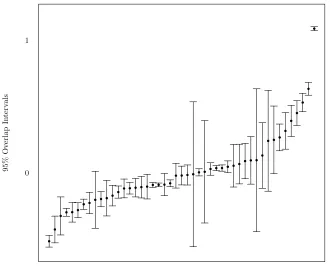
Figure 2: Posterior random effects for transition probabilities: caterpillar plot of 95%
Figure 2 depicts the caterpillar plot for the values of ˜Zh. The vertical bars are the
95% overlap intervals for pairwise comparisons: the effects on transition probabilities of
two nursing homes are significantly different at the 5% level if their intervals do not
over-lap (Goldstein and Healy, 1995). More than 60% of the pairwise comparisons are
signif-icantly different, denoting the importance of accounting for clustering in this application.
We recall that lower values of ˜Zh correspond to better NH performances. Notice that the
worst-performing NH, whose effect is pictured in the upper right-hand corner of Figure 2,
is the one with the higher number of patients (96). Obviously, the smaller the number of
units in the cluster, the larger the overlap interval.
5
Conclusions
In this work, we built a multilevel latent Markov model to evaluate the performance of a
group of nursing homes (NHs). We constructed a NH ranking based on the capability each
NH shows in improving or maintaining its patients in the best physical health conditions.
Health status was modeled like a categorical ordinal variable. As proxies of such a variable,
which is not directly observable, ten items measuring the so-called Activities of Daily Living
(ADL) were used. We applied our model to a longitudinal dataset collected in the Umbria
region (Italy) within the Long Term Care Facilities program, a public health protocol in
which patients in nursing homes are administered a questionnaire collecting information
also on the ADL. Results show that many pairwise differences between NH performances
are statistically significant.
NH effects were modeled by means of a continuous bivariate random effect, so that
the performance-based ranking can be obtained. Specifically, a normal distribution has
distribution may considerably affect the results, specific reasons to discard the normality
assumption do not appear to exist here. NH effects could in principle be estimated as fixed
effects by introducing binary variables in the regression equations (Bartolucci et al., 2009).
Within this framework, estimates are typically obtained via an Expectation Maximization
(EM) algorithm. This approach has the advantage of avoiding an untestable assumption
(that is, the specification of distributional form for random effects), but it is problematic
in the presence of small clusters, for which the estimation process might be unstable or
even unfeasible. For example, to obtain the EM estimates we used as starting point for the
multilevel model (see Section 3.3), we had to aggregate nursing homes with less than ten
patients.
Finally, it is worth to mention that alternative estimation methods were also proposed
within this framework. These include three-step estimation (Bartolucci et al., 2015) and
Bayesian estimation (Raffa and Dubin, 2015). Extending them to a multilevel context
would widen the range of possible estimation methods for this kind of data. Furthermore,
we argue that traditional tools to handle non-ignorable missingness - like joint models - are
still not widespread in the class of latent Markov models. In our view, these represent two
interesting lines of work future research in this area might be concerned with.
References
Altman, R. M. (2007). Mixed hidden Markov models: an extension of the hidden Markov
model to the longitudinal data setting. Journal of the American Statistical
Associa-tion 102(477), 201–210.
selection in the latent Markov model for longitudinal data. Advances in Data Analysis
and Classification 8(2), 125–145.
Bartolucci, F., A. Farcomeni, and F. Pennoni (2013). Latent Markov Models for
Longitu-dinal Data. Statistics in the Social and Behavioural Sciences. Chapman & Hall/CRC.
Bartolucci, F. and M. Lupparelli (2016). Pairwise likelihood inference for nested hidden
Markov chain models for multilevel longitudinal data.Journal of the American Statistical
Association 111(513), 216–228.
Bartolucci, F., M. Lupparelli, and G. E. Montanari (2009). Latent Markov model for
longitudinal binary data: an application to the performance evaluation of nursing homes.
The Annals of Applied Statistics 3(2), 611–636.
Bartolucci, F., G. E. Montanari, and S. Pandolfi (2015). Three-step estimation of latent
Markov models with covariates. Computational Statistics & Data Analysis 83, 287–301.
Bartolucci, F., F. Pennoni, and G. Vittadini (2011). Assessment of school performance
through a multilevel latent Markov Rasch model. Journal of Educational and Behavioral
Statistics 36(4), 491–522.
Baum, L. E., T. Petrie, G. Soules, and N. Weiss (1970). A maximization technique occurring
in the statistical analysis of probabilistic functions of Markov chains. The Annals of
Mathematical Statistics 41, 164–171.
Dempster, A. P., N. M. Laird, and D. B. Rubin (1977). Maximum likelihood from
incom-plete data via the EM algorithm.Journal of the Royal Statistical Society, Series B 39(1),
Fisher, R. A. (1915). Frequency distribution of the values of the correlation coefficient in
samples from an indefinitely large population. Biometrika 10(4), 507–521.
Fletcher, R. (1987). Practical methods of optimization (2nd ed.). New York: John Wiley
& Sons.
Gnaldi, M., S. Bacci, and F. Bartolucci (2016). A multilevel finite mixture item response
model to cluster examinees and schools. Advances in Data Analysis and
Classifica-tion 10(1), 53–70.
Goldstein, H. and M. J. R. Healy (1995). The graphical presentation of a collection of
means. Journal of the Royal Statistical Society, Series A 158(1), 175–177.
Goodman, L. A. (1974). Exploratory latent structure analysis using both identifiable and
unidentifiable models. Biometrika 61(2), 215–231.
Gray, A. (2009). Population aging and health care expenditure. China Labor
Eco-nomics 1(10), 105–114.
Henry, K. and B. Muth´en (2010). Multilevel latent class analysis: An application of
adoles-cent smoking typologies with individual and contextual predictors. Structural Equation
Modeling 17(2), 193–215.
Hirdes, J. P., G. Ljunggren, J. N. Morris, D. H. Frijters, H. Finne Soveri, L. Gray, M.
Bj¨ork-gren, and R. Gilgen (2008). Reliability of the interRAI suite of assessment instruments:
a 12-country study of an integrated health information system. BMC Health Services
Research 8(1), 277.
of the interRAI Long Term Care Facilities (LTCF) and interRAI Home Care (HC).
Geriatrics & Gerontology International 15(2), 220–228.
Kitagawa, E. M. (1964). Standardized comparisons in population research.
Demogra-phy 1(1), 296–315.
Koukounari, A., I. Moustaki, N. C. Grassly, I. M. Blake, M.-G. Bas´a˜nez, M. Gambhir, D. C.
Mabey, R. L. Bailey, M. J. Burton, and A. W. Solomon (2013). Using a nonparametric
multilevel latent Markov model to evaluate diagnostics for trachoma. American Journal
of Epidemiology 177(9), 913–922.
Little, R. J. and D. B. Rubin (2002). Statistical Analysis with Missing Data (2nd ed.).
Wiley.
Makai, P., W. B. Brouwer, M. A. Koopmanschap, E. A. Stolk, and A. P. Nieboer (2014).
Quality of life instruments for economic evaluations in health and social care for older
people: a systematic review. Social Science & Medicine 102, 83–93.
Maruotti, A. (2011). Mixed hidden Markov models for longitudinal data: an overview.
International Statistical Review 79(3), 427–454.
Maruotti, A. and R. Rocci (2012). A mixed nonhomogeneous hidden Markov model for
categorical data, with application to alcohol consumption. Statistics in Medicine 31(9),
871–886.
Montanari, G. E. and S. Pandolfi (2016). Evaluation of health care services through a
latent Markov model with covariates. InSIS 2016 - 48th
Scientific Meeting of the Italian
Montanari, G. E., M. G. Ranalli, and P. Eusebi (2010). Multilevel latent class models for
evaluation of long-term care facilities. InData Analysis and Classification, pp. 249–256.
Springer.
Oehlert, G. W. (1992). A note on the delta method. The American Statistician 46(1),
27–29.
Press, W. H., B. P. Flannery, S. A. Teukolsky, and W. T. Vetterling (1989). Numerical
recipes, Volume 3. Cambridge University Press, Cambridge.
Raffa, J. D. and J. A. Dubin (2015). Multivariate longitudinal data analysis with mixed
effects hidden Markov models. Biometrics 71(3), 821–831.
Schwarz, G. (1978). Estimating the dimension of a model. The Annals of Statistics 6(2),
461–464.
Stephens, M. (2000). Dealing with label switching in mixture models. Journal of the Royal
Statistical Society, Series B 62(4), 795–809.
Vermunt, J. (2003). Multilevel latent class models. Sociological Methodology 33(1), 213–
239.
Vermunt, J. K., R. Langeheine, and U. Bockenholt (1999). Discrete-time discrete-state
latent Markov models with time-constant and time-varying covariates. Journal of
Edu-cational and Behavioral Statistics 24(2), 179–207.
Welch, L. R. (2003). Hidden Markov models and the Baum-Welch algorithm. IEEE
White, C. (2007). Health care spending growth: how different is the United States from
the rest of the OECD? Health Affairs 26(1), 154–161.
Wiggins, L. M. (1973). Panel analysis: Latent probability models for attitude and behavior
A multilevel latent Markov model for the
evaluation of nursing homes’ performance:
1
Log-likelihood gradient
The approximate gradient of the log-likelihood function is given by
∂ℓ(θ)
∂θ ≈
H
X
h=1
1
P(Yh =yh|Xh =xh) Q X q=1 " exp nh X i=1
ℓhiq(θ)
nh
X
i=1
∂ℓhiq(θ) ∂θ
λq
#
, (1)
where ℓhiq(θ) = logP(Yhi =yhi|Xhi=xhi,Uh =νq). Given the complete log-likelihood
ℓ∗
hiq(θ) = logP(Yhi=yhi,Vhi=vhi|Xhi =xhi,Uh =νq)
and its posterior expectation E∗
hiq(θ) = E(ℓ∗hiq(θ)|Yhi = yhi), a theoretical result (Oakes,
1999) stating that
∂ℓhiq(θ)
∂θ =
∂E∗ hiq(θ) ∂θ is exploited to compute each derivative present in (1).
2
Results for the model with
k
= 6
In this section, we report the results for the model with k = 6. As stated in the paper,
these are not substantially different from those obtained in the model withk = 5, denoting
the stability of the conclusions drawn. Table 1 reports estimates and standard errors for
the same parameters we consider in the model with five latent states. A comparison with
paper’s Table 3 shows that both estimates and standard errors are very similar in the two
models. Parameters’ significance and interpretation remain unchanged.
Figure 1 reports the normalized item scores. Again, the overall trend is very close
to that of the model with k = 5 (paper’s Figure 1). Specifically, once more we observe
that for every latent statev the biggest difficulties concern items 1 and 4 (washing/taking a
β1 β2 γ1 γ2 γ3 σw σz ρ
est. 0.032 0.482 0.020 -0.262 -0.004 0.469 0.372 -0.131
s.e. 0.006 0.121 0.004 0.095 0.001 0.102 0.056 0.220
Table 1: Main parameter estimates and standard errors for the model with k = 6
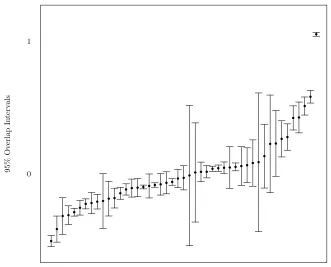
and eating (items 9 and 10). Figure 2 depicts the caterpillar plot of the scaled posterior
expectations ˜Zh. The resulting ranking is almost identical to the previous one, with a
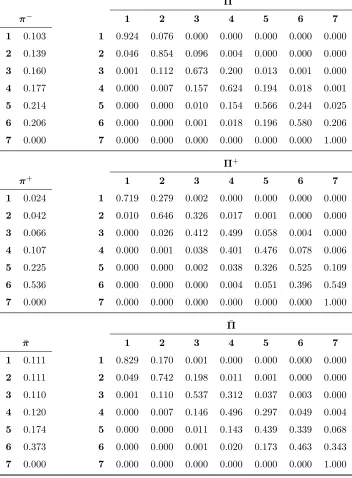
Spearman correlation coefficient of 0.995. Finally, Table 2 is the analogous for k = 6 of
paper’s Table 4. Once again, results are very similar overall.
References
Oakes, D. (1999). Direct calculation of the information matrix via the em. J. R. Stat. Soc.
itemj
st
an
d
ar
d
iz
ed
sc
or
e
sj
v
v= 1
v= 2
v= 3
v= 4
v= 5
v= 6
1 2 3 4 5 6 7 8 9 10
[image:37.612.135.460.180.480.2]0.0 0.5 1.0
Nursing Homes
95%
O
v
er
lap
In
te
rv
al
s
[image:38.612.131.462.164.431.2]0 1
Figure 2: Posterior random effects for transition probabilities: caterpillar plot of 95%
Π−
π− 1 2 3 4 5 6 7
1 0.103 1 0.924 0.076 0.000 0.000 0.000 0.000 0.000
2 0.139 2 0.046 0.854 0.096 0.004 0.000 0.000 0.000
3 0.160 3 0.001 0.112 0.673 0.200 0.013 0.001 0.000
4 0.177 4 0.000 0.007 0.157 0.624 0.194 0.018 0.001
5 0.214 5 0.000 0.000 0.010 0.154 0.566 0.244 0.025
6 0.206 6 0.000 0.000 0.001 0.018 0.196 0.580 0.206
7 0.000 7 0.000 0.000 0.000 0.000 0.000 0.000 1.000
Π+
π+ 1 2 3 4 5 6 7
1 0.024 1 0.719 0.279 0.002 0.000 0.000 0.000 0.000
2 0.042 2 0.010 0.646 0.326 0.017 0.001 0.000 0.000
3 0.066 3 0.000 0.026 0.412 0.499 0.058 0.004 0.000
4 0.107 4 0.000 0.001 0.038 0.401 0.476 0.078 0.006
5 0.225 5 0.000 0.000 0.002 0.038 0.326 0.525 0.109
6 0.536 6 0.000 0.000 0.000 0.004 0.051 0.396 0.549
7 0.000 7 0.000 0.000 0.000 0.000 0.000 0.000 1.000
¯
Π
¯
π 1 2 3 4 5 6 7
1 0.111 1 0.829 0.170 0.001 0.000 0.000 0.000 0.000
2 0.111 2 0.049 0.742 0.198 0.011 0.001 0.000 0.000
3 0.110 3 0.001 0.110 0.537 0.312 0.037 0.003 0.000
4 0.120 4 0.000 0.007 0.146 0.496 0.297 0.049 0.004
5 0.174 5 0.000 0.000 0.011 0.143 0.439 0.339 0.068
6 0.373 6 0.000 0.000 0.001 0.020 0.173 0.463 0.343
[image:39.612.129.481.80.558.2]7 0.000 7 0.000 0.000 0.000 0.000 0.000 0.000 1.000
Table 2: Minimum effect, maximum effect and average initial and transition probabilities