Spectral Semi-Supervised Discourse Relation Classification
Robert Fisher
Carnegie Mellon University 5000 Forbes Ave Pittsburgh, PA 15213
Reid Simmons
Carnegie Mellon University 5000 Forbes Ave Pittsburgh, PA 15213
Abstract
Discourse parsing is the process of dis-covering the latent relational structure of a long form piece of text and remains a significant open challenge. One of the most difficult tasks in discourse parsing is the classification of implicit discourse re-lations. Most state-of-the-art systems do not leverage the great volume of unlabeled text available on the web–they rely instead on human annotated training data. By in-corporating a mixture of labeled and unla-beled data, we are able to improve relation classification accuracy, reduce the need for annotated data, while still retaining the ca-pacity to use labeled data to ensure that specific desired relations are learned. We achieve this using a latent variable model that is trained in a reduced dimensionality subspace using spectral methods. Our
ap-proach achieves anF1 score of 0.485 on
the implicit relation labeling task for the Penn Discourse Treebank.
1 Introduction
Discourse parsing is a fundamental task in natural language processing that entails the discovery of the latent relational structure in a multi-sentence piece of text. Unlike semantic and syntactic ing, which are used for single sentence pars-ing, discourse parsing is used to discover inter-sentential relations in longer pieces of text. With-out discourse, parsing methods can only be used to understand documents as sequences of unrelated sentences.
Unfortunately, manual annotation of discourse structure in text is costly and time consuming. Multiple annotators are required for each relation to estimate inter-annotator agreement. The Penn Discourse Treebank (PDTB) (Prasad et al., 2008).
is one of the largest annotated discourse parsing datasets, with 16,224 implicit relations. However, this pales in comparison to unlabeled datasets that can include millions of sentences of text. By aug-menting a labeled dataset with unlabeled data, we can use a bootstrapping framework to improve predictive accuracy, and reduce the need for la-beled data–which could make it much easier to port discourse parsing algorithms to new domains. On the other hand, a fully unsupervised parser may not be desirable because in many applications spe-cific discourse relations must be identified, which would be difficult to achieve without the use of la-beled examples.
There has recently been growing interest in a breed of algorithms based on spectral decomposi-tion, which are well suited to training with unla-beled data. Spectral algorithms utilize matrix fac-torization algorithms such as Singular Value De-composition (SVD) and rank factorization to
dis-coverlow-rank decompositionsof matrices or
ten-sors of empirical moments. In many models, these decompositions allow us to identify the subspace spanned by a group of parameter vectors or the actual parameter vectors themselves. For tasks where they can be applied, spectral methods pro-vide statistically consistent results that avoid lo-cal maxima. Also, spectral algorithms tend to be much faster—sometimes orders of magnitude faster—than competing approaches, which makes them ideal for tackling large datasets. These meth-ods can be viewed as inferring something about the latent structure of a domain—for example, in a hidden Markov model, the number of latent states and the sparsity pattern of the transition matrix are forms of latent structure, and spectral methods can recover both in the limit.
This paper presents a semi-supervised spectral model for a sequential relation labeling task for discourse parsing. Besides the theoretically desir-able properties mentioned above, we also
strate the practical advantages of the model with an empirical evaluation on the Penn Discourse Treebank (PDTB) (Prasad et al., 2008) dataset,
which yields anF1 score of 0.485. This accuracy
shows a 7-9 percentage point improvement over approaches that do not utilize unlabeled training data.
2 Related Work
There has been quite a bit of work concerning fully supervised relation classification with the PDTB (Lin et al., 2014; Feng and Hirst, 2012; Webber et al., 2012). Semi-supervised relation classification is much less common however. One recent example of an attempt to leverage unla-beled data appears in (Hernault et al., 2011), which showed that moderate classification accu-racy can be achieved with very small labeled datasets. However, this approach is not compet-itive with fully supervised classifiers when more training data is available. Recently there has also been some work to use Conditional Random Fields (CRFs) to represent the global properties of a parse sequence (Joty et al., 2013; Feng and Hirst, 2014), though this work has focused on the RST-DT corpus, rather than the PRST-DTB.
In addition to requiring a fully supervised train-ing set, most existtrain-ing discourse parsers use non-spectral optimization that is often slow and inex-act. However, there has been some work in other parsing tasks to employ spectral methods in both supervised and semi-supervised settings (Parikh et al., 2014; Cohen et al., 2014). Spectral methods have also been applied very successfully in many non-linguistic domains (Hsu et al., 2012; Boots and Gordon, 2010; Fisher et al., 2014).
3 Problem Definition and Dataset
This section defines the discourse parsing prob-lem and discusses the characteristics of the PDTB. The PDTB consists of annotated articles from the Wall Street Journal and is used in our empiri-cal evaluations. This is combined with the New York Times Annotated Corpus (Sandhaus, 2008), which includes 1.8 million New York Times arti-cles printed between 1987 and 2007.
Discourse parsing can be reduced to three sepa-rate tasks. First, the text must be decomposed into
elementary discourse units(EDUs), which may or may not coincide with sentence boundaries. The EDUs are often independent clauses that may be
connected with conjunctions. After the text has been partitioned into EDUs, the discourse struc-ture must be identified. This requires us to iden-tify all pairs of EDUs that will be connected with
somediscourse relation. These relational links
in-duce the skeletal structure of the discourse parse tree. Finally, each connection identified in the pre-vious step must be labeled using a known set of relations. Examples of these discourse relations include concession, causal, and instantiation rela-tions. In the PDTB, only adjacent discourse units are connected with a discourse relation, so with this dataset we are considering parse sequences rather than parse trees.
In this work, we focus on the relation labeling task, as fairly simple methods perform quite well at the other two tasks (Webber et al., 2012). We use the ground truth parse structures provided by the PDTB dataset, so as to isolate the error intro-duced by relation labeling in our results, but in practice a greedy structure learning algorithm can
be used if the parse structures are not knowna
pri-ori.
Some of the relations in the dataset are induced by specific connective words in the text. For exam-ple, a contrast relation may be explicitly revealed
by the conjunction but. Simple classifiers using
only the text of the discourse connective with POS tags can find explicit relations with high accu-racy (Lin et al., 2014). The following sentence shows an example of a more difficult implicit re-lation. In this sentence, two EDUs are connected with an explanatory relation, shown in bold, al-though the connective word does not occur in the text.
“But a few funds have taken other defen-sive steps. Some have raised their cash
positions to record levels.[BECAUSE]
High cash positions help buffer a fund when the market falls.”
We focus on the more difficult implicit relations that are not induced by coordinating connectives in the text. The implicit relations have been shown to require more sophisticated feature sets includ-ing syntactic and linclud-inguistic information (Lin et al., 2009). The PDTB dataset includes 16,053 exam-ples of implicit relations.
This hasn't been Kellogg Co.'s year
The oat-bran craze has cost the world's largest cereal maker market share, and!
the company's president quit suddenly. edu2
r12!
(Contingency.Cause.Reason)
h
12 [image:3.595.83.282.66.206.2]edu1
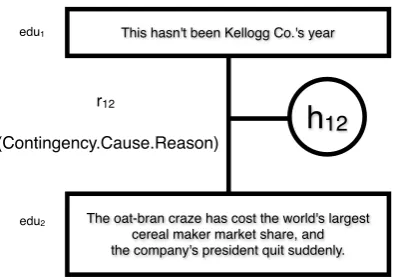
Figure 1: An example of the latent variable dis-course parsing model taken from the Penn Dis-course Treebank Dataset. The relation here is an example of a cause attribution relation.
to level 2, as the level 3 (sub-type) relations are too specific and show only 80% inter-annotator agreement. There are 16 level 2 relations in the PDTB, but the 5 least common relations only ap-pear a handful of times in the dataset and are omit-ted from our tests, yielding 11 possible classes.
4 Approach
We incorporate unlabeled data into our spectral discourse parsing model using a bootstrapping framework. The model is trained over several iter-ations, and the most useful unlabeled sequences are added as labeled training data after each it-eration. Our method also utilizes Markovian la-tent states to compactly capture global informa-tion about a parse sequence, with one latent vari-able for each relation in the discourse parsing se-quence. Most discourse parsing frameworks will label relations independently of the rest of the ac-companying parse sequence, but this model allows for information about the global structure of the discourse parse to be used when labeling a rela-tion. A graphical representation of one link in the parsing model is shown in Figure 1.
Specifically, each potential relationrij between
elementary discourse unitsei andej is
accompa-nied by a corresponding latent variable ashij.
Ac-cording to the model assumptions, the following equality holds:
P(rij =r|r1,2, r2,3...rn+1,n) =P(rij =r|hij) To maintain notational consistency with other latent variable models, we will denote these
re-lation variables as x1...xn, keeping in mind that
there is one possible relation for each adjacent pair of elementary discourse units.
For the Penn Discourse Treebank Dataset, the discourse parses behave like sequence of random variables representing the relations, which allows us to use an HMM-like latent variable model based on the framework presented in (Hsu et al., 2012). If the discourse parses were instead trees, such as those seen in Rhetorical Structure Theory (RST) datasets, we can modify the standard model to in-clude separate parameters for left and right chil-dren, as demonstrated in (Dhillon et al., 2012).
4.1 Spectral Learning
This section briefly describes the process of learn-ing a spectral HMM. Much more detail about the process is available in (Hsu et al., 2012). Learn-ing in this model will occur in a subspace of
di-mensionalitym, but system dynamics will be the
same if m is not less than the rank of the
obser-vation matrix. If our original feature space has
dimensionalityn, we define a transformation
ma-trix U ∈ Rn×m, which can be computed using
Singular Value Decomposition. Given the matrix
U, coupled with the empirical unigram (P1),
bi-gram (P2,1), and trigram matrices (P3,x,1), we are
able to estimate the subspace initial state
distribu-tion (ˆπU) and observable operator (AˆU) using the
following equalities (wherein the Moore-Penrose
pseudo-inverse of matrixXis denoted byX+):
ˆ
πU =UTP1
ˆ
AU =UTP3,x,1(UTP2,1)+∀x
For our original feature space, we use the rich linguistic discourse parsing features defined in (Feng and Hirst, 2014), which includes syn-tactic and linguistic features taken from depen-dency parsing, POS tagging, and semantic simi-larity measures. We augment this feature space with a vector space representation of semantics. A term-document co-occurrence matrix is computed using all of Wikipedia and Latent Dirichlet Anal-ysis was performed using this matrix. The top 200 concepts from the vector space representation for each pair of EDUs in the dataset are included in the feature space, with a concept regularization pa-rameter of 0.01.
4.2 Semi-Supervised Training
ex-tract EDU segments using the method described in (Feng and Hirst, 2014). The model is then trained using the labeled dataset, and the unlabeled re-lations are predicted using the Viterbi algorithm. The most informative sequences in the unlabeled training set are added to the labeled training set as labeled examples. To measure how informative a
sequence of relations is, we use density-weighted
certainty sampling (DCS). Specifically for a
se-quence of relationsr1...rntaken from a document,
d, we use the following formula:
DCS(d) = n1Xn i=1
ˆ
p(ri)
H(ri)
In this equation,H(ri)represented the entropy of
the distribution of label predictions for the
rela-tion ri generated by the current spectral model,
which is a measure of the model’s uncertainty for the label of the given relation. Density is
de-notedpˆ(ri), and this quantity measures the extent
to which the text corresponding to this relation is representative of the labeled corpus. To com-pute this measure, we create a Kernel Density Es-timate (KDE) over a 100 dimensional LDA vector space representation of all EDU’s in the labeled corpus. We then compute the density of the KDE
for the text associated with relationri, which gives
uspˆ(ri). All sequences of relations in the
unla-beled dataset are ranked according to their aver-age density-weighted certainty score, and all
se-quences scoring above a parameter ψ are added
to the training set. The model is then retrained, the unlabeled data re-scored, and the process is
repeated for several iterations. In iteration i, the
labeled data in the training set is weighted wl
i,
and the unlabeled data is weighted wu
i, with the
unlabeled data receiving higher weight in subse-quent iterations. The KDE kernel bandwidth and
the parametersψ,wl
i,wiu, and the number of
hid-den states are chosen in experiments using 10-fold cross validation on the labeled training set, cou-pled with a subset of the unlabeled data.
5 Results
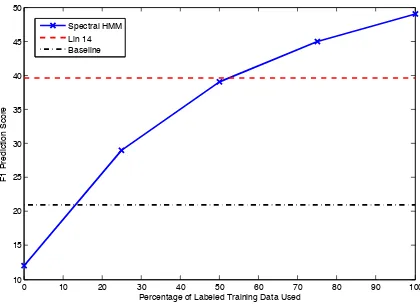
Figure 2 shows the F1 scores of the model using
various sizes of labeled training sets. In all cases, the entirety of the unlabeled data is made avail-able, and 7 rounds of bootstrapping is conducted. Sections 2-22 of the PDTB are used for training, with section 23 being withheld for testing, as rec-ommended by the dataset guidelines (Prasad et al.,
0 10 20 30 40 50 60 70 80 90 100 10
15 20 25 30 35 40 45 50
Percentage of Labeled Training Data Used
F1 Prediction Score
[image:4.595.311.521.66.220.2]Spectral HMM Lin 14 Baseline
Figure 2: Empirical results for labeling of implicit relations.
2008). The results are compared against those re-ported in (Lin et al., 2014), as well as a simple baseline classifier that labels all relations with the
most common class, EntRel. Compared to the
semi-supervised method described in (Hernault et al., 2011), we show significant gains in accuracy at various sizes of dataset, although the unlabeled dataset used in our experiments is much larger.
When the spectral HMM is trained using only the labeled dataset, with no unlabeled data, it
pro-duces anF1score of41.1%, which is comparable
to the results reported in (Lin et al., 2014). By comparison, the semi-supervised classifier is able to obtain similar accuracy when using approxi-mately 50% of the labeled training data. When given access to the full labeled dataset, we see
an improvement in the F1 score of 7-9
percent-age points. Recent work has shown promising re-sults using CRFs for discourse parsing (Joty et al., 2013; Feng and Hirst, 2014), but the results re-ported in this work were taken from the RST-DT corpus and are not directly comparable. However, supervised CRFs and HMMs show similar accu-racy in other language tasks (Ponomareva et al., 2007; Awasthi et al., 2006).
6 Conclusions
sets are available, which would allow discourse analysis to be applied in many new and interest-ing domains.
Acknowledgements
We give thanks to Carolyn Penstein Ros´e and Geoff Gordon for their helpful discussions and suggestions. We also gratefully acknowledge the National Science Foundation for their support through EAGER grant number IIS1450543. This material is also based upon work supported by the Quality of Life Technology Center and the National Science Foundation under Cooperative Agreement EEC-0540865.
References
Pranjal Awasthi, Delip Rao, and Balaraman Ravindran. 2006. Part of speech tagging and chunking with
hmm and crf. Proceedings of NLP Association of
India (NLPAI) Machine Learning Contest 2006.
Byron Boots and Geoffrey J Gordon. 2010. Predictive
state temporal difference learning. arXiv preprint
arXiv:1011.0041.
Shay B Cohen, Karl Stratos, Michael Collins, Dean P Foster, and Lyle Ungar. 2014. Spectral learning of latent-variable pcfgs: Algorithms and sample
com-plexity. The Journal of Machine Learning Research,
15(1):2399–2449.
Paramveer S Dhillon, Jordan Rodu, Michael Collins, Dean P Foster, and Lyle H Ungar. 2012. Spectral
dependency parsing with latent variables. In
Pro-ceedings of the 2012 joint conference on empirical methods in natural language processing and compu-tational natural language learning, pages 205–213. Association for Computational Linguistics.
Vanessa Wei Feng and Graeme Hirst. 2012. Text-level discourse parsing with rich linguistic
fea-tures. In Proceedings of the 50th Annual Meeting
of the Association for Computational Linguistics: Long Papers-Volume 1, pages 60–68. Association for Computational Linguistics.
Vanessa Wei Feng and Graeme Hirst. 2014. A linear-time bottom-up discourse parser with constraints
and post-editing. In Proceedings of The 52nd
An-nual Meeting of the Association for Computational Linguistics (ACL 2014), Baltimore, USA, June.
Robert Fisher, Reid Simmons, Cheng-Shiu Chung, Rory Cooper, Garrett Grindle, Annmarie Kelleher, Hsinyi Liu, and Yu Kuang Wu. 2014. Spectral ma-chine learning for predicting power wheelchair
exer-cise compliance. InFoundations of Intelligent
Sys-tems, pages 174–183. Springer.
Hugo Hernault, Danushka Bollegala, and Mitsuru Ishizuka. 2011. Semi-supervised discourse relation
classification with structural learning. In
Compu-tational Linguistics and Intelligent Text Processing, pages 340–352. Springer.
Daniel Hsu, Sham M Kakade, and Tong Zhang. 2012. A spectral algorithm for learning hidden markov
models. Journal of Computer and System Sciences,
78(5):1460–1480.
Shafiq R Joty, Giuseppe Carenini, Raymond T Ng, and Yashar Mehdad. 2013. Combining intra-and multi-sentential rhetorical parsing for document-level
dis-course analysis. InACL (1), pages 486–496.
Ziheng Lin, Min-Yen Kan, and Hwee Tou Ng. 2009. Recognizing implicit discourse relations in the penn
discourse treebank. InProceedings of the 2009
Con-ference on Empirical Methods in Natural Language Processing: Volume 1-Volume 1, pages 343–351. Association for Computational Linguistics.
Ziheng Lin, Hwee Tou Ng, and Min-Yen Kan. 2014.
A pdtb-styled end-to-end discourse parser. Natural
Language Engineering, pages 1–34.
Ankur Parikh, Shay B Cohen, and Eric Xing. 2014. Spectral unsupervised parsing with additive tree
metrics. In Proceedings of the 52nd Annual
Meet-ing of the Association for Computational LMeet-inguis- Linguis-tics: Long Papers. Association for Computational Linguistics.
Natalia Ponomareva, Paolo Rosso, Ferr´an Pla, and An-tonio Molina. 2007. Conditional random fields vs. hidden markov models in a biomedical named
en-tity recognition task. In Proc. of Int. Conf. Recent
Advances in Natural Language Processing, RANLP, pages 479–483.
Rashmi Prasad, Nikhil Dinesh, Alan Lee, Eleni Milt-sakaki, Livio Robaldo, Aravind K Joshi, and Bon-nie L Webber. 2008. The penn discourse treebank
2.0. InLREC. Citeseer.
Evan Sandhaus. 2008. The new york times annotated
corpus ldc2008t19.Linguistic Data Consortium.
Bonnie Webber, Markus Egg, and Valia Kordoni. 2012. Discourse structure and language technology.