Bilingual Word Embeddings from Non-Parallel Document-Aligned Data
Applied to Bilingual Lexicon Induction
Ivan Vuli´c and Marie-Francine Moens
Department of Computer Science KU Leuven, Belgium
{ivan.vulic|marie-francine.moens}@cs.kuleuven.be
Abstract
We propose a simple yet effective approach to learning bilingual word embeddings (BWEs) from non-parallel document-aligned data (based on the omnipresent skip-gram model), and its application to bilingual lexicon induction (BLI). We demonstrate the utility of the induced BWEs in the BLI task by reporting on benchmarking BLI datasets for three language pairs: (1) We show that our BWE-based BLI models signifi-cantly outperform the MuPTM-based and context-counting models in this setting, and obtain the best reported BLI results for all three tested language pairs; (2) We also show that our BWE-based BLI models outperform other BLI models based on recently proposed BWEs that require parallel data for bilingual training. 1 Introduction
Dense real-valued vectors known as distributed representations of words or word embeddings (WEs) (Bengio et al., 2003; Collobert and We-ston, 2008; Mikolov et al., 2013a; Pennington et al., 2014) have been introduced recently as part of neural network architectures for statisti-cal language modeling. Recent studies (Levy and Goldberg, 2014; Levy et al., 2015) have show-cased a direct link and comparable performance to “more traditional” distributional models (Turney and Pantel, 2010), but the skip-gram model with negative sampling (SGNS) (Mikolov et al., 2013c) is still established as the state-of-the-art word rep-resentation model, due to its simplicity, fast train-ing, as well as its solid and robust performance across a wide variety of semantic tasks (Baroni et al., 2014; Levy et al., 2015).
A natural extension of interest from monolin-gual to multilinmonolin-gual word embeddings has
oc-curred recently (Klementiev et al., 2012; Zou et al., 2013; Mikolov et al., 2013b; Hermann and Blunsom, 2014a; Hermann and Blunsom, 2014b; Gouws et al., 2014; Chandar et al., 2014; Soyer et al., 2015; Luong et al., 2015). When operat-ing in multiloperat-ingual settoperat-ings, it is highly desirable to learn embeddings for words denoting similar con-cepts that are very close in theshared inter-lingual embedding space(e.g., the representations for the English word school and the Spanish word es-cuelashould be very similar). These shared inter-lingual embedding spaces may then be used in a myriad of multilingual natural language process-ing tasks, such as fundamental tasks of comput-ing cross-lcomput-ingual and multilcomput-ingual semantic word similarity and bilingual lexicon induction (BLI), etc. However, all these models critically require at least sentence-aligned parallel data and/or readily-available translation dictionaries to induce bilin-gual word embeddings(BWEs) that are consistent and closely aligned over languages in the same se-mantic space.
Contributions In this work, we alleviate the re-quirements: (1) We present the first model that is able to induce bilingual word embeddings from non-parallel data without any other readily avail-able translation resources such as pre-given bilin-gual lexicons; (2) We demonstrate the utility of BWEs induced by this simple yet effective model in the BLI task from comparable Wikipedia data on benchmarking datasets for three language pairs (Vuli´c and Moens, 2013b). Our BLI model based on our novel BWEs significantly outperforms a se-ries of strong baselines that reported previous best scores on these datasets in the same learning set-ting, as well as other BLI models based on re-cently proposed BWE induction models (Gouws et al., 2014; Chandar et al., 2014). The focus of the work is on learning lexicons from document-aligned comparable corpora (e.g., Wikipedia arti-cles aligned through inter-wiki links).
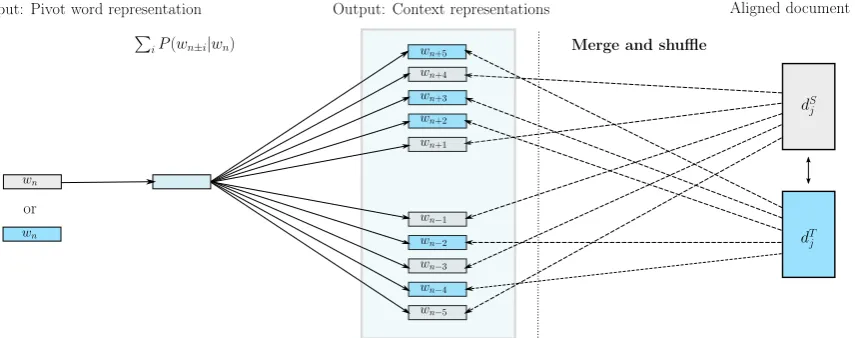
Figure 1: The architecture of our BWE Skip-Gram model for learning bilingual word embeddings from document-aligned comparable data. Source language words and documents are drawn as gray boxes, while target language words and documents are drawn as blue boxes. The right side of the figure (sepa-rated by a vertical dashed line) illustrates how a pseudo-bilingual document is constructed from a pair of two aligned documents; two documents are first merged, and then words in the pseudo-bilingual docu-ment are randomly shuffled to ensure that both source and target language words occur as context words.
2 Model Architecture
In the following architecture description, we as-sume that the reader is familiar with the main assumptions and training procedure of SGNS (Mikolov et al., 2013a; Mikolov et al., 2013c). We extend the SGNS model to work with bilingual document-aligned comparable data. An overview of our architecture for learning BWEs from such comparable data is given in fig. 1.
Let us assume that we possess a document-aligned comparable corpus which is defined as
C = {d1, d2, . . . , dN} = {(d1S, dT1),(dS2, dT2),
. . . ,(dS
N, dTD)}, where dj = (dSj, dTj) denotes a pair of aligned documents in the source language
LS and the target languageLT, respectively, and
N is the number of documents in the corpus.
VS andVT are vocabularies associated with lan-guagesLSandLT. The goal is to learn word em-beddings for all words in bothVSandVT that will be semantically coherent and closely aligned over languages in a shared cross-lingual word embed-ding space.
In the first step, we merge two documents dS j and dT
j from the aligned document pair dj into a single “pseudo-bilingual” document d0
j and re-move sentence boundaries. Following that, we randomly shuffle the newly constructed pseudo-bilingual document. The intuition behind this pre-training completely random shuffling step1 (see
1In this paper, we investigate only the random shuffling procedure and show that the model is fairly robust to different
fig. 1) is to assure that each word w, regardless of its actual language, obtains word collocates from both vocabularies. The idea of having bilin-gual contexts for each pivot word in each pseudo-bilingual document will steer the final model to-wards constructing a shared inter-lingual embed-ding space. Since the model depends on the align-ment at the docualign-ment level, in order to ensure the bilingual contexts instead of monolingual con-texts, it is intuitive to assume that larger window sizes will lead to better bilingual embeddings. We test this hypothesis and the effect of window size in sect. 4.
The final model called BWE Skip-Gram (BWESG) then relies on the monolingual vari-ant of skip-gram trained on the shuffled pseudo-bilingual documents.2The model learns word em-beddings for source and target language words that are aligned over the d embedding dimen-sions and may be represented in the same shared cross-lingual embedding space. The BWESG-based representation of wordw, regardless of its actual language, is then a d-dimensional vector:
~w = [f1, . . . , fk, . . . , fd], wherefk ∈ Rdenotes
the score for the k-th inter-lingual feature within thed-dimensional shared embedding space. Since all words share the embedding space, semantic similarity between words may be computed both outputs of the procedure if the window size is large enough. As one line of future work, we plan to investigate other, more systematic and deterministic shuffling algorithms.
monolingually and across languages. Given w, the most similar word cross-lingually should be its one-to-one translation, and we may use this intu-ition to induce one-to-one bilingual lexicons from comparable data.
In another interpretation, BWESG actually builds BWEs based on (pseudo-bilingual) docu-ment level co-occurrence. The window size pa-rameter then just controls the amount of random data dropout. With larger windows, the model becomes prohibitively computationally expensive, but in sect. 4 we show that the BLI performance flattens out for “reasonably large” windows.
3 Experimental Setup
Training DataWe use comparable Wikipedia data introduced in (Vuli´c and Moens, 2013a; Vuli´c and Moens, 2013b) available in three language pairs to induce bilingual word embeddings: (i) a collec-tion of 13, 696 Spanish-English Wikipedia article pairs (ES-EN), (ii) a collection of 18, 898 Italian-English Wikipedia article pairs (IT-EN), and (iii) a collection of 7, 612 Dutch-English Wikipedia arti-cle pairs (NL-EN). All corpora are theme-aligned comparable corpora, that is, the aligned docu-ment pairs discuss similar themes, but are in gen-eral not direct translations. Following prior work (Haghighi et al., 2008; Prochasson and Fung, 2011; Vuli´c and Moens, 2013b), we retain only nouns that occur at least 5 times in the corpus. Lemmatized word forms are recorded when avail-able, and original forms otherwise. TreeTag-ger (Schmid, 1994) is used for POS tagging and lemmatization. After the preprocessing vocabular-ies comprise between 7,000 and 13,000 noun types for each language in each language pair. Exactly the same training data and vocabularies are used to induce bilingual lexicons with all other BLI mod-els in comparison.
BWESG Training Setup We have trained the BWESG model with random shuffling on 10 ran-dom corpora shuffles for all three training cor-pora with the following parameters from the
word2vec package (Mikolov et al., 2013c): stochastic gradient descent with a default learning rate of 0.025, negative sampling with 25 samples, and a subsampling rate of value1e−4. All models are trained for 15 epochs. We have varied the num-ber of embedding dimensions:d= 100,200,300, and have also trained the model with d = 40 to be directly comparable to pre-trained
state-of-the-art BWEs from (Gouws et al., 2014; Chandar et al., 2014). Moreover, in order to test the effect of window size on final results, we have varied the maximum window sizecsfrom 4 to 60 in steps of 4.3 Since cosine is used for all similarity compu-tations in the BLI task, we call our new BLI model BWESG+cos.
Baseline BLI ModelsWe compare BWESG+cos to a series of state-of-the-art BLI models from document-aligned comparable data:
(1) BiLDA-BLI - A BLI model that relies on the induction of latent cross-lingual topics (Mimno et al., 2009) by the bilingual LDA model and repre-sents words as probability distributions over these topics (Vuli´c et al., 2011).
(2) Assoc-BLI - A BLI model that represents words as vectors of association norms (Roller and Schulte im Walde, 2013) over both vocabularies, where these norms are computed using a multilin-gual topic model (Vuli´c and Moens, 2013a). (3) PPMI+cos - A standard distributional model for BLI relying on positive pointwise mutual infor-mation and cosine similarity (Bullinaria and Levy, 2007). The seed lexicon is bootstrapped using the method from (Peirsman and Pad´o, 2011; Vuli´c and Moens, 2013b).
All parameters of the baseline BLI models (i.e., topic models and their settings, the number of dimensions K, feature pruning values, window size) are set to their optimal values according to suggestions in prior work (Steyvers and Griffiths, 2007; Vuli´c and Moens, 2013a; Vuli´c and Moens, 2013b; Kiela and Clark, 2014). Due to space con-straints, for (much) more details about the base-lines we point to the relevant literature (Peirsman and Pad´o, 2011; Tamura et al., 2012; Vuli´c and Moens, 2013a; Vuli´c and Moens, 2013b).
Test DataFor each language pair, we evaluate on standard 1,000 ground truth one-to-one translation pairs built for the three language pairs (ES/IT/NL-EN) (Vuli´c and Moens, 2013a; Vuli´c and Moens, 2013b). Translation direction is ES/IT/NL→EN.
Evaluation Metrics Since we can build a one-to-one bilingual lexicon by harvesting one-one-to-one translation pairs, the lexicon qualiy is best re-flected in the Acc1 score, that is, the number
of source language (ES/IT/NL) words wS i from ground truth translation pairs for which the top ranked word cross-lingually is the correct
trans-3We will make all our BWESG BWEs available at:
Spanish-English (ES-EN) Italian-English (IT-EN) Dutch-English (NL-EN) (1)reina (2)reina (3)reina (1)madre (2)madre (3)madre (1)schilder (2)schilder (3)schilder (Spanish) (English) (Combined) (Italian) (English) (Combined) (Dutch) (English) (Combined)
rey queen(+) queen(+) padre mother(+) mother(+) kunstschilder painter(+) painter(+)
trono heir rey moglie father padre schilderij painting kunstschilder
monarca throne trono sorella sister moglie kunstenaar portrait painting
heredero king heir figlia wife father olieverf artist schilderij
matrimonio royal throne figlio daughter sorella olieverfschilderijcanvas kunstenaar hijo reign monarca fratello son figlia schilderen impressionist portrait
reino succession heredero casa friend figlio frans cubism olieverf
reinado princess king amico childhood sister nederlands art olieverfschilderij regencia marriage matrimonio marito family fratello componist poet schilderen
[image:4.595.74.527.66.193.2]duque prince royal donna cousin wife beeldhouwer drawing artist
Table 1: Example lists of top 10 semantically similar words for all 3 language pairs obtained using BWESG+cos;d= 200, cs= 48; (col 1.) only source language words (ES/IT/NL) are listed while target language words are skipped (monolingual similarity); (2) only target language words (EN) are listed (cross-lingual similarity); (3) words from both languages are listed (multilingual similarity). EN words are given in italic. The correct one-to-one translation for each source word is marked by (+).
lation in the other language (EN) according to the ground truth over the total number of ground truth translation pairs (=1000) (Gaussier et al., 2004; Tamura et al., 2012; Vuli´c and Moens, 2013b). 4 Results and Discussion
Exp 0: Qualitative Analysis Tab. 1 displays top 10 semantically similar words monolingually, across-languages and combined/multilingually for one ES, IT and NL word. The BWESG+cos model is able to find semantically coherent lists of words for all three directions of similarity (i.e., mono-lingual, cross-mono-lingual, multilingual). In the com-bined (multilingual) ranked lists, words from both languages are represented as top similar words. This initial qualitative analysis already demon-strates the ability of BWESG to induce a shared cross-lingual embedding space using only docu-ment aligndocu-ments as bilingual signals.
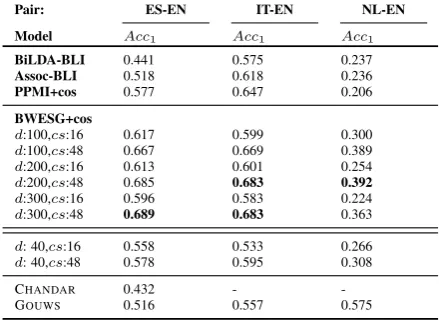
Exp I: BWESG+cos vs. Baseline ModelsIn the first experiment, we test whether our BWESG+cos BLI model produces better results than the base-line BLI models which obtain current state-of-the-art results for BLI from comparable data on these test sets. Tab. 2 summarizes the BLI results.
As the most striking finding, the results reveal superior performance of the BWESG-cos model for BLI which relies on our new framework for in-ducing bilingual word embeddings over other BLI models relying on previously used bilingual word representations. The relative increase in Acc1
scores over the best scoring baseline BLI mod-els from comparable data is 19.4% for the ES-EN pair, 6.1% for IT-EN (significant atp < 0.05 us-ing McNemar’s test) and 65.4% for NL-EN. For large enough values for cs (cs ≥ 20) (see also
Pair: ES-EN IT-EN NL-EN
Model Acc1 Acc1 Acc1
BiLDA-BLI 0.441 0.575 0.237 Assoc-BLI 0.518 0.618 0.236 PPMI+cos 0.577 0.647 0.206 BWESG+cos
d:100,cs:16 0.617 0.599 0.300
d:100,cs:48 0.667 0.669 0.389
d:200,cs:16 0.613 0.601 0.254
d:200,cs:48 0.685 0.683 0.392
d:300,cs:16 0.596 0.583 0.224
d:300,cs:48 0.689 0.683 0.363
d: 40,cs:16 0.558 0.533 0.266
d: 40,cs:48 0.578 0.595 0.308
CHANDAR 0.432 -
-GOUWS 0.516 0.557 0.575
Table 2: BLI performance for all tested BLI models for ES/IT/NL-EN, with all bilingual word representations except CHANDAR and GOUWS learned from comparable Wikipedia data. The scores for BWESG+cos are computed as post-hoc averages over 10 random shuffles.
fig. 2(a)-2(c)), almost all BWESG+cos models for all language pairs outperform the highest baseline results. We may also observe that the performance of BWESG+cos is fairly stable for all models with larger values for cs (cs ≥ 20). This finding re-veals that even a coarse tuning of these parameters might lead to optimal or near-optimal scores in the BLI task with BWESG+cos.
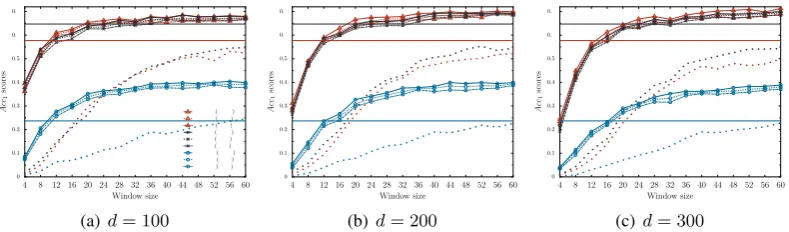
Exp II: Shuffling and Window Size Since our BWESG model relies on the pre-training random shuffling procedure, we also test whether the shuf-fling has significant or rather minor impact on the induction of BWEs and final BLI scores. There-fore, in fig. 2, we present maximum, minimum, and average Acc1 scores for all three language
[image:4.595.306.526.276.436.2]val-0 0.1 0.2 0.3 0.4 0.5 0.6 0.7
4 8 12 16 20 24 28 32 36 40 44 48 52 56 60
Acc 1 scores Window size ES-EN (MAX) ES-EN (AVG) ES-EN (MIN) IT-EN (MAX) IT-EN (AVG) IT-EN (MIN) NL-EN (MAX) NL-EN (AVG) NL-EN (MIN)
(a)d= 100
0 0.1 0.2 0.3 0.4 0.5 0.6 0.7
4 8 12 16 20 24 28 32 36 40 44 48 52 56 60
Acc
1
scores
Window size (b)d= 200
0 0.1 0.2 0.3 0.4 0.5 0.6 0.7
4 8 12 16 20 24 28 32 36 40 44 48 52 56 60
Acc
1
scores
[image:5.595.101.496.60.176.2]Window size (c)d= 300
Figure 2: Maximum (MAX), minimum (MIN) and average (AVG) Acc1 scores with BWESG+cos in
the BLI task over 10 different random corpora shuffles for all 3 language pairs, and varying values for parameterscsandd. Solid horizontal lines denote the highest baselineAcc1 scores for each language
pair. NOS (thicker dotted lines) refers to BWESG+cos without random shuffling. ues for cs. Results reveal that random shuffling
affects the overall BLI scores, but the variance of results is minimal and often highly insignificant. It is important to mark that even the minimumAcc1
scores over these 10 different random shuffles are typically higher than the previous state-of-the-art baseline scores for large enough values fordand
cs(compare the results in tab. 2 and fig. 2(a)-2(c)). A comparison with the BWESG model without shuffling (NOS on fig. 2) reveals that shuffling is useful even for largercs-s.
Exp III: BWESG+cos vs. BWE-Based BLIWe also compare our BWESG BLI model with two other models that are most similar to ours in spirit, as they also induce shared cross-lingual word em-bedding spaces (Chandar et al., 2014; Gouws et al., 2014), proven superior to or on a par with the BLI model from (Mikolov et al., 2013b). We use their pre-trained BWEs (obtained from the au-thors) and report the BLI scores in tab. 2. To make the comparison fair, we search for transla-tions over the same vocabulary as with all other models. The results clearly reveal that, although both other BWE models critically rely on paral-lel Europarl data for training, and Gouws et al. (2014) in addition train on entire monolingual Wikipedias in both languages, our simple BWE in-duction model trained on much smaller amounts of document-aligned non-parallel data produces sig-nificantly higher BLI scores for IT-EN and ES-EN with sufficiently large windows.
However, the results for NL-EN with all BLI models from comparable data from tab. 2 are sig-nificantly lower than with the GOUWSBWEs. We attribute it to using less (and clearly insufficient) document-aligned training data for NL-EN (i.e., training corpora for ES-EN and IT-EN are almost double or triple the size of training corpora for NL-EN, see sect. 3).
5 Conclusions and Future Work
We have proposed Bilingual Word Embeddings Skip-Gram (BWESG), a simple yet effective model that is able to learn bilingual word em-beddings solely on the basis of document-aligned comparable data. We have demonstrated its utility in the task of bilingual lexicon induction from such comparable data, where our new BWESG-based BLI model outperforms state-of-the-art models for BLI from document-aligned comparable data and related BWE induction models.
The low-cost BWEs may be used in other (se-mantic) tasks besides the ones discussed here, and it would be interesting to experiment with other types of context aggregation and selection beyond random shuffling, and other objective functions. Preliminary studies also demonstrate the utility of the BWEs in monolingual and cross-lingual infor-mation retrieval (Vuli´c and Moens, 2015).
Finally, we may use the knowledge of BWEs obtained by BWESG from document-aligned data to learn bilingual correspondences (e.g., word translation pairs or lists of semantically simi-lar words across languages) which may in turn be used for representation learning from large unaligned multilingual datasets as proposed in (Haghighi et al., 2008; Mikolov et al., 2013b; Vuli´c and Moens, 2013b). In the long run, this idea may lead to large-scale fully data-driven rep-resentation learning models from huge amounts of multilingual data without any “pre-requirement” for parallel data or manually built lexicons. Acknowledgments
References
Marco Baroni, Georgiana Dinu, and Germ´an
Kruszewski. 2014. Don’t count, predict! A
systematic comparison of context-counting vs.
context-predicting semantic vectors. InACL, pages
238–247.
Yoshua Bengio, R´ejean Ducharme, Pascal Vincent, and Christian Janvin. 2003. A neural probabilistic
lan-guage model. Journal of Machine Learning
Re-search, 3:1137–1155.
John A. Bullinaria and Joseph P. Levy. 2007. Ex-tracting semantic representations from word
co-occurrence statistics: A computational study.
Be-havior Research Methods, 39(3):510–526.
Sarath Chandar, Stanislas Lauly, Hugo Larochelle, Mitesh M. Khapra, Balaraman Ravindran, Vikas C. Raykar, and Amrita Saha. 2014. An autoencoder approach to learning bilingual word representations.
InNIPS, pages 1853–1861.
Ronan Collobert and Jason Weston. 2008. A unified architecture for natural language processing: Deep
neural networks with multitask learning. InICML,
pages 160–167.
´Eric Gaussier, Jean-Michel Renders, Irina Matveeva, Cyril Goutte, and Herv´e D´ejean. 2004. A geometric view on bilingual lexicon extraction from
compara-ble corpora. InACL, pages 526–533.
Stephan Gouws, Yoshua Bengio, and Greg Corrado. 2014. BilBOWA: Fast bilingual distributed
rep-resentations without word alignments. CoRR,
abs/1410.2455.
Aria Haghighi, Percy Liang, Taylor Berg-Kirkpatrick, and Dan Klein. 2008. Learning bilingual lexicons
from monolingual corpora. InACL, pages 771–779.
Karl Moritz Hermann and Phil Blunsom. 2014a. Mul-tilingual distributed representations without word
alignment. InICLR.
Karl Moritz Hermann and Phil Blunsom. 2014b. Mul-tilingual models for compositional distributed
se-mantics. InACL, pages 58–68.
Douwe Kiela and Stephen Clark. 2014. A systematic study of semantic vector space model parameters. In CVSC Workshop at EACL, pages 21–30.
Alexandre Klementiev, Ivan Titov, and Binod Bhat-tarai. 2012. Inducing crosslingual distributed
repre-sentations of words. InCOLING, pages 1459–1474.
Omer Levy and Yoav Goldberg. 2014. Neural word
embedding as implicit matrix factorization. InNIPS,
pages 2177–2185.
Omer Levy, Yoav Goldberg, and Ido Dagan. 2015. Im-proving distributional similarity with lessons learned
from word embeddings. Transactions of the ACL,
3:211–225.
Thang Luong, Hieu Pham, and Christopher D. Man-ning. 2015. Bilingual word representations with
monolingual quality in mind. InProceedings of the
1st Workshop on Vector Space Modeling for Natural Language Processing, pages 151–159.
Tomas Mikolov, Kai Chen, Gregory S. Corrado, and Jeffrey Dean. 2013a. Efficient estimation of word
representations in vector space. InICLR Workshop
Papers.
Tomas Mikolov, Quoc V. Le, and Ilya Sutskever. 2013b. Exploiting similarities among languages for
machine translation. CoRR, abs/1309.4168.
Tomas Mikolov, Ilya Sutskever, Kai Chen, Gregory S. Corrado, and Jeffrey Dean. 2013c. Distributed rep-resentations of words and phrases and their
compo-sitionality. InNIPS, pages 3111–3119.
David Mimno, Hanna Wallach, Jason Naradowsky, David A. Smith, and Andrew McCallum. 2009.
Polylingual topic models. InEMNLP, pages 880–
889.
Yves Peirsman and Sebastian Pad´o. 2011. Semantic
relations in bilingual lexicons. ACM Transactions
on Speech and Language Processing, 8(2):article 3.
Jeffrey Pennington, Richard Socher, and Christopher Manning. 2014. GloVe: Global vectors for word
representation. InEMNLP, pages 1532–1543.
Emmanuel Prochasson and Pascale Fung. 2011. Rare word translation extraction from aligned comparable
documents. InACL, pages 1327–1335.
Stephen Roller and Sabine Schulte im Walde. 2013. A multimodal LDA model integrating textual,
cogni-tive and visual modalities. InEMNLP, pages 1146–
1157.
Helmut Schmid. 1994. Probabilistic part-of-speech
tagging using decision trees. InProceedings of the
International Conference on New Methods in Lan-guage Processing.
Hubert Soyer, Pontus Stenetorp, and Akiko Aizawa. 2015. Leveraging monolingual data for crosslingual
compositional word representations. InICLR.
Mark Steyvers and Tom Griffiths. 2007. Probabilistic
topic models. Handbook of Latent Semantic
Analy-sis, 427(7):424–440.
Akihiro Tamura, Taro Watanabe, and Eiichiro Sumita. 2012. Bilingual lexicon extraction from comparable
corpora using label propagation. InEMNLP, pages
24–36.
Peter D. Turney and Patrick Pantel. 2010. From frequency to meaning: Vector space models of
se-mantics. Journal of Artifical Intelligence Research,
Ivan Vuli´c and Marie-Francine Moens. 2013a. Cross-lingual semantic similarity of words as the similarity
of their semantic word responses. InNAACL, pages
106–116.
Ivan Vuli´c and Marie-Francine Moens. 2013b. A study on bootstrapping bilingual vector spaces from
non-parallel data (and nothing else). InEMNLP, pages
1613–1624.
Ivan Vuli´c and Marie-Francine Moens. 2015. Mono-lingual and cross-Mono-lingual information retrieval
mod-els based on (bilingual) word embeddings. In
SI-GIR,to appear.
Ivan Vuli´c, Wim De Smet, and Marie-Francine Moens. 2011. Identifying word translations from
compara-ble corpora using latent topic models. InACL, pages
479–484.