http://dx.doi.org/10.4236/am.2013.41024 Published Online January 2013 (http://www.scirp.org/journal/am)
Methods for Lower Approximation Reduction in
Inconsistent Decision Table Based on Tolerance Relation
Xiaoyan Zhang, Weihua Xu
School of Mathematics and Statistics, Chongqing University of Technology, Chongqing, China Email: [email protected]
Received April 18, 2012; revised November 27, 2012; accepted December 3, 2012
ABSTRACT
It is well known that most of information systems are based on tolerance relation instead of the classical equivalence relation because of various factors in real-world. To acquire brief decision rules from the information systems, lower approximation reduction is needed. In this paper, the lower approximation reduction is proposed in inconsistent infor- mation systems based on tolerance relation. Moreover, the properties are discussed. Furthermore, judgment theorem and discernibility matrix are obtained, from which an approach to lower reductions can be provided in the complicated in-formation systems.
Keywords: Rough Set; Tolerance Relation; Lower Approximation Reduction; Discernibility Matrix
1. Introduction
The rough set theory, proposed by Pawlak in the early 1980s [1], is an extension of the classical set theory for modeling uncertainty or imprecision information. The re- search has recently roused great interest in the theoretical and application fronts, such as machine learning, pattern recognition, data analysis, and so on.
Attribute reduction is one of the hot research topics of rough set theory. Much study on this area had been re- ported and many useful results were obtained [2-8]. However, most work was based on consistent informa- tion systems, and the main methodology has been de- veloped under equivalence relations (indiscernibility re- lations). In practice, most of information systems are not only inconsistent, but also based on tolerance relations because of various factors. The tolerance of properties of attributes plays a crucial role in those systems. For this reason, J. Jarinen [9-13] proposed an extension rough sets theory, called the rough sets based on tolerances to take into account the tolerance relation properties of attri- butes. This innovation is mainly based on substitution of the indiscernibility relation by a tolerance relation. And many studies have been made in DRSA [14-18]. But useful results of attribute reductions are very poor in in-consistent information systems based on tolerance re- lations until now.
In this paper, the lower approximation reduction is proposed in inconsistent information systems based on tolerance relations. Moreover, some properties are dis- cussed. Furthermore, judgment theorem and discerni-
bility matrix are obtained, from which an approach to lower approximation reductions can be provided in in- consistent information systems based on tolerance re- lations.
2. Rough Sets and Information Systems
Based on Tolerance Relations
The following recalls necessary concepts and prelimina- ries required in the sequel of our work. Detailed des- cription of the theory can be found in [5,17].
An information system with decisions is an ordered quadrupleI
U A, D F G, ,
, where
1,x2,,xn
U x is a non-empty finite set of objects;
AD is a non-empty finite attributes set;
1, 2, , p
A a a a denotes the set of condition attri- butes;
1, 2, , q
D d d d denotes the set of decision attri- butes, andAD ;
k k,
F f UV k p , fk
x is the value of ak for xU , vk is the domain of ak, where akA;
k k,
G g U V kq , gk
x is the value ofk
d for xU, vk is the domain of dk, dkD. If a binary relation T on the universe U is reflexive and symmetric, it is called a tolerance relation on U. The set of all tolerance relations on U is denoted by Tol U
. A tolerance relation T can construct a covering of the uni-verse U, not a partition. For any tolerance relation
1, ,
,
0, ,
x y T
T x y
x y T
= ;
,
T x yU xTy xU ;
where means x and have the tolerance , or
,T x y 1 y
T x and haven’t the tolerance , and the is called the tolerance neighborhood or tolerance class of the object
y T
T x
x.
An information system is called an information system based on tolerance relations, in brief TIS, if all relations of condition attributes are tolerance relations.
In general, we call an information system based on tolerance relations with decision to be a decision table based tolerance relations, denoted by TD , that is
. Thus the following definition can be obtained.
T
, , ,TDT U AD F G
Definition 2.1. Let TDT
U A, D F G, ,
be a de- cision table based on tolerance relations, for any , denoteBA
T B
R and RTD
TDT
are tolerance relations of infor- mation system .
If we denote
T
,
T
i B j i j B
x x U x x R ;
i T
j
i, j
T
D D
x x U x x R ,
then the following properties of a tolerance relation are trivial.
Proposition 2.1. Let be a tolerance relation. The following hold.
T A
R
(1) is reflexive, symmetric, but not transitive, so it is not an equivalence relation.
T A
R
(2) IfBA, thenRTA RBT.
(3) IfBA, then xi TA
xi TB(4) J
xTA xU
constitutes a covering of U .For any subset X of U , and A of TDT define
T
T
A A
R X xU x X ;
T
T
A A
R X xU x X ,
T AR X and RTA
X are said to be the lower and up-per approximation of X with respect to a tolerance relation . And the approximations have also some properties which are similar to those of Pawlak app- roximation spaces.T A
R
Proposition 2.2. Let be an information systems based on tolerance relation and
, , ,TDT U AD F G
,
X YU, then its lower and upper approximations sa- tisfy the following properties.
(1)RTA
X X RTA
X .(2)
;
.
T T T
A A A
T T T
A A A
R X Y R X R Y
R X Y R X R Y
(3)
;
.
T T T
A A A
T T T
A A A
R X Y R X R Y
R X R Y R X Y
(4)
;
.
T T
A A
T T
A A
R X R X
R X R X
(5) RAT
; RTA
U U.(6) If X Y , then RTA
X RTA
Y and
T T
A RA Y
R X ;
where X is the complement of X.
Definition 2.2. For an information system based on tolerance relations with decisions
, , ,
TDT U AD F G , if D, then this infor-
mation system is consistent, otherwise, this system is in- consistent.
T A
R RT
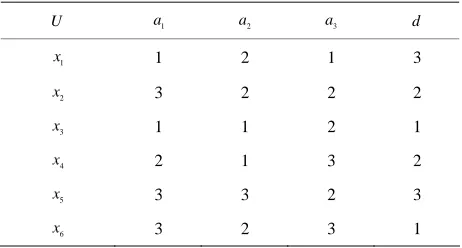
Example 2.1. Given an information system based on tolerance relations in Table 1.
Define the tolerance relation Tas following:
A
R
, , , 1,
T
A i j i i j i i
R x x f x a f x a a A
From the table, we have
1 1 3
2 2 4 5 6
3 1 3 4
4 2 3 4 6
5 2 5 6
6 2 4 5 6
, ;
, , , ;
, , ;
, , , ;
, , ;
, , , ;
T A T A T
A T A T A T A
x x x
x x x x x
x x x x
x x x x x
x x x x
x x x x x
and
1 5 1 2 4 5
2 4 1 2 3 4 5 6
3 6 2 3 4 6
, , , ;
, , , , , ;
, , , .
T T d d
T T d d T T d d
x x x x x x
x x x x x x x x
x x x x x x
Obviously, by the above, we have , so the system in Table 1 is inconsistent.
T A
R RT
D
For simple description, the following information sys-tem with decisions is based on tolerance relations, i.e. information systems based on tolerance relations.
3. Theories of Lower Approximation
Reduction in Inconsistent Information
Systems Based on Tolerance Relation
Let TDT
U A, D F G, ,
be an information system based on tolerance relations with decisions, and TB
Table 1. An information system based on tolerance rela- tions.
U a1 a2 a3 d 1
x 1 2 1 3
2
x 3 2 2 2
3
x 1 1 2 1
4
x 2 1 3 2
5
x 3 3 2 3
6
x 3 2 3 1
T D
R be tolerance relations derived from condition attri- butes set A and decision attributes set respectively. For , denote
D
BA
1 2
;
, , ,
T T
B i B i T
D r
U R x x U
U R D D D
;
1 , 2 , ,T T T
B B B
B
L R D R D R Dr
;where
T
, TB
B
x yU x y R . Furthermore, we said
B
L is the lower approximation function about attribu- tions sets B.
Definition 3.1. Let and
be two vectors with dimensions. If
T1, 2, , n
a a a
n
T1, 2, , n
b b b
1, ,
i i
a b i n , we said that is equal to , denoted by . If ai bi
i1,,n
, we said that is less than , denoted by
,n
a. Otherwise, If it exists i0, 1, 2i0
, such that i0 bi0, we said is not less than , denoted by .
Such as
1, 2, 3
1,1, 4
, and
1,1, 4
1, 2, 3
. From the above, we can have the following proposi- tions immediately.Proposition 3.1. Let be an information system based on tolerance relations with decisions. If , then
, , ,TDT U AD F G
A B
L L
BA .
Definition 3.2. Let TDT
U A, D F G, ,
be an In- consistent information system. If B A, for all, we say that is a lower approximation consistent set of . If is a lower approximation consistent set, and no proper subset of is lower approximation con- sistent set, then is called an lower approximation con- sistent reduction of .L L
B
TDT B
B TDT
B
Example 3.1. Consider the system in Table 1. For the system in Table 1, we denote
1 1 5
2 2 4
3 3 6
;
;
,
T T d d
T T d d T T d d
D x x
D x x
D x x
We can have
1A
R D
2
1, 2, 3, 4, 5, 6
A
R D x x x x x x
3 4A
R D x
When B
a a2, 3
, it can be easily checked that
A i B i , for all
R D R D i dT. So that
A B
D U R
L L , and B
a a2, 3
TDT
is a lower approximation consistent set of . Furthermore, we can examine that
a2 and
a3T
are not lower approximation con- sistent set of TD . That is to say is a lower approximation reduction of .
2, 3B a a
T
TD
Moreover, it can be easily calculated that B
a a1, 3
and B
a a1, 2
TD
are not lower approximation con- sistent sets of . Thus there exist only one lower approximation reduction of in the system of Ta-ble 1, which is
T
TDT
a a2, 3
In the following, detailed judgment theorems of lower approximation reduction are obtained.
.
4. Methods for Attribute Reduction in
Inconsistent Information Systems Based
on Tolerance Relations
This section provides approaches to lower approximation reduction in inconsistent information systems.
Definition 4.1. Let be an in- formation system, Denote
, , ,
TDT U AD F G
, ,
;L D
T T T
A A
i j i i j i i
D x x x R D x R D D U R
, 0 , ,
,
, ,
k
T
k a i j i j L L i j
i j L
a A R x x x x D
D x x
x x D
,
L i j
D x x is called lower approximation discernibility attribute set, and matrixes
, ,
L L i j i j
M D x x x x U is referred to lower appro-
ximation discernibility matrix of TDT respectively. Theorem 4.1. Let be an in-formation system, , then is a lower approxi- mation consistent set
, , ,
TDT U AD F G
BA B
if
T
i
,
T
A i A
xR D yR D , then exists bBsuch that
, 0b
R x y , for any
D
T i
D U R .
Proof. Assume that exists Di, for any bB, and
b
R x y, 1, if T
, T
A i A i
xR D yR D , then
T By x .
Since B is a lower approximation consistent set, there- fore, for any DiU RTD , we can have
T T
A i B i
R D R D . According to xRTA
Di , so we can obtain xRTA
Di and
T i B
x D. Moreover for
T B
T B iyR D . Hence we have , which is contradiction.
T A iyR D
Supposed that isn’t a lower approximation consistent set, then exists
B
D
T i
D U R , such that
T T
A i RB Di
R D , therefore exists 0
T A i
x R D and
0
T B i
x R D . So we can have
0T i A
x D and
0T i B
x D.
Moreover,
0 0T A
T B
x x , so there exists 0
0T B y x
and y0Di, i.e. 0
T A i
y R D . In addition, we can
have that exists such that , which is contradict with
bB
Rb
x y0, 0
0
0
x .
Therefore B is a lower approximation consistent set. Theorem 4.2. Let TDT
U A, D F G, ,
BA B
be an in- formation system. , then is a lower appro- ximation consistent set if and only if for any
x y, DL, we can have
x y, .
,L
Proof. For any
BD
x y DL
, there exists
D
T
R
i such that
D U T
, T
A i A i
xR D yR D , so ac-cording to Theorem 4.1, we can have that exists bB such that R
x y, 0, so .B
b bDL
x y,Therefore, if is a lower approximation consistent set then for any
x y, DL
,, we can have .
,L
BD x y
If for any x y DL
, , then
exists such that , so we have
,L
BD x y
,k L x y
k
a B
,y a D
0
k
a
R x , and xRTA
Di ,yRTA
Di .Therefore is a lower approximation consistent set according to Theorem 4.1.
B
Definition 4.2. Let be an information system,
, , ,TDT U AD F G
L
M is referred to lower approxi- mation discernibility matrix of TDT, denote
,
, )
L k k L i j i j
k k L i j i j L
F a a D x x x x U
a a D x x x x D
L
F is called discernibility formula of lower approxi- mation.
Theorem 4.3. Let TDT
U A, D F G, ,
be an in- formation system. The minimal disjunctive normal form of discernibility formula of lower approximation is1 1
k
q p
L s
k s
F a
Denote Bk
a ss 1, 2,,qk
, then
B kk 1, 2,,p
is just set of all distribution re- duc-tions of TDT.Proof. It follows directly from Theorem 4.1 and the definition of minimal disjunctive normal of the discer- nibility formula of lower approximation.
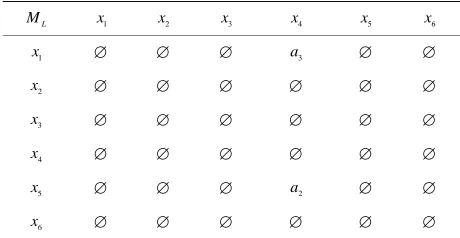
[image:4.595.307.537.101.220.2]Theorem 4.3 provides a practical approach to lower
Table 2. Lower approximation discernibility matrix ML.
L
M x1 x2 x3 x4 x5 x6 1
x a3 2
x
3
x
4
x
5
x a2 6
x
approximation reductions of information systems with decisions based on tolerance relation. The following we will consider the system in Table 1 using this approach.
Example 4.1. For the system in Table 1, the function of distribution and maximum distribution have been ob- tained in Example 3.1. In additional, we can have
1, 4 , 2, 4 , 3, 4 , 5, 4 , 6, 4
D x x x x x x x x x x ; The above table (Table 2) is the lower approximation discernibility matrix of system in Table 1.Consequently, we have
2 3
L
F a a
Therefore, we obtain that is all lower appro- ximation reduction of information system in Table 1, which accords with the result of Example 3.1.
a a2, 3
5. Conclusion
It is well known that most of information systems are not only inconsistent, but also based on tolerance relations because of various factors in practice. Therefore, it is important to study the lower approximation reduction in inconsistent information systems. In this paper, we are concerned with approaches to the problem. The lower approximation reduction is introduced in inconsistent information systems based on tolerance relations. The judgment theorem and discernibility matrix are obtained, from which we can provide the approach to attribute re-ductions in inconsistent information systems based on tolerance relations.
REFERENCES
[1] Z. Pawlak, “Rough Sets,” International Journal of Com- puter and Information Science, Vol. 11, No. 5, 1982, pp. 341-356. doi:10.1007/BF01001956
[2] M. Kryszkiewicz, “Comparative Studies of Alternative Type of Knowledge Reduction in Inconsistent Systems,” International Journal of Intelligent Systems, Vol. 16, No. 1, 2001, pp. 105-120.
[3] Y. Leuang, W. Z. Wu and W. X. Zhang, “Knowledge Acquisition in Incomplete Information Systems: A Rough Set Approach,” European Journal of Operational Re- search, Vol. 168, No. 1, 2006, pp. 164-180.
doi:10.1016/j.ejor.2004.03.032
[4] Z. Pawlak, “Rough Sets: Theoretical Aspects of Reason- ing about Data,” Kluwer Academic Publishers, Boston, 1991.
[5] W. X. Zhang, W. Z. Wu, J. Y. Liang and D. Y. Li, “The- ory and Method of Rough Sets,” Science Press, Beijing, 2001.
[6] W. Z. Wu, Y. Leuang and J. S. Mi, “On Characterizations of (I,T)-Fuzzy Rough Approximation Operators,” Fuzzy Sets and Systems, Vol. 154, No. 1, 2005, pp. 76-102. doi:10.1016/j.fss.2005.02.011
[7] W. Z. Wu, M. Zhang, H. Z. Li and J. S. Mi, “Knowledge Reduction in Random Information Systems via Demp- ster-Shafer Theory of Evidence,” Information Sciences, Vol. 174, No. 3-4, 2005, pp. 143-164.
doi:10.1016/j.ins.2004.09.002
[8] M. Zhang, L. D. Xu, W. X. Zhang and H. Z. Li, “A Rough Set Approach to Knowledge Reduction Based on Inclusion Degree and Evidence Reasoning Theory,” Ex- pert Systems, Vol. 20, No. 5, 2003, pp. 298-304.
[9] S. Greco, B. Matarazzo and R. Slowingski, “Rough Ap- proximation of a Preference Relation by Dominance Re- latioin ICS Research Report 16/96, Warsaw University of Technology, 1996,” European Journal of Operational Research, Vol. 117, 1999, pp. 63-83.
[10] S. Greco, B. Matarazzo and R. Slowingski, “A New Rough Set Approach to Multicriteria and Multiattribute Classifi- cation,” In: L. Polkowsik and A. Skowron, Eds., Rough Sets and Current Trends in Computing (RSCTC’98), Sprin- ger-Verlag, Berlin, 1998, pp. 60-67.
[11] S. Greco, B. Matarazzo and R. Slowingski, “A New
Rough Sets Approach to Evaluation of Bankruptcy Risk,” In: X. Zopounidis, Ed., Operational Tools in the Mana- gement of Financial Risks, Kluwer, Dordrecht, 1999, pp. 121-136.
[12] S. Greco, B. Matarazzo and R. Slowingski, “Rough Sets Theory for Multicriteria Decision Analysis,” European Journal of Operational Research, Vol. 129, No. 1, 2001, pp. 11-47. doi:10.1016/S0377-2217(00)00167-3
[13] S. Greco, B. Matarazzo and R. Slowingski, “Rough Sets Methodology for Sorting Problems in Presence of Multi- ple Attributes and Criteria,” European Journal of Opera- tional Research, Vol. 138, No. 2, 2002, pp. 247-259. doi:10.1016/S0377-2217(01)00244-2
[14] K. Dembczynski, R. Pindur and R. Susmaga, “Generation of Exhaustive Set of Rules within Dominance-Based Rough Set Approach,” Electronic Notes Theory Com- puter Science, Vol. 82, No. 4, 2003, p. 1.
[15] K. Dembczynski, R. Pindur and R. Susmaga, “Domi- nance-Based Rough Set Classifier without Induction of Decision Rules,” Electronic Notes Theory Computer Sci- ence, Vol. 82, No. 4, 2003, pp. 84-95
[16] Y. Sai, Y. Y. Yao and N. Zhong, “Data Analysis and Min- ing in Ordered Information Tables,” Proceedings of the 2001 IEEE International Conference on Data Mining, New York, 2001, pp. 497-504.
[17] M. W. Shao and W. X. Zhang, “Dominance Relation and Rules in an Incomplete Ordered Information System,” International Journal of Intelligent Systems, Vol. 20, No. 1, 2005, pp. 13-27.
[18] W. Z. Wu, Y. Leung and W. X. Zhang, “Connections between Rough Set Theory and Dempster-Shafer Theory of Evidence,” International Journal of General Systems, Vol. 31, No. 4, 2002, pp. 405-430.