RESEARCH ARTICLE
ALGORITHM OF SOLUTION OF THE PROBLEM OF BENDING TORSION OF THE ROD BASED
ON R-FUNCTION METHOD
*
Sh. A. Anarova
Ph.D., Senior Researcher, the Centre of Development of Software and Hardwarily-Program Complex
ARTICLE INFO ABSTRACT
An algorithm of solution of the problem of bending torsion of the rod based on R-function method is considered in the paper. The algorithm of integration of the systems of resolving equations on the basis of Rvachеv’s R-function method (RFM) and the method of progressive approximation is developed. Computing algorithm of elastic bodies of arbitrary section and software of stress-strain state study of elastic prismatic bodies of arbitrary section with a cavity is given. The examples of validity of design algorithm of elastic prismatic bodies and software functioning are also given in the paper.
Copyright©2016, Sh. A. Anarova. This is an open access article distributed under the Creative Commons Attribution License, which permits unrestricted use,
distribution, and reproduction in any medium, provided the original work is properly cited.
INTRODUCTION
Task Definition. The Vlasov-Djanelidze-Kabulov hypothesis (Report on the project, 2014) for bending torsion of the rod obtains the form:
u z u y
x z y
u
2 3
1 ( , ) , , ………...………(1)
The system of equations of bending torsion is obtained on the basis of Hamilton-Ostrogradsky variation principle (Yuldashev and Anarova, 2015)
v dv x z y y z G xE 2 0
2 2 2
4 4
2
……….……(2)
; 0 2 2 2 2 2 2 2 2
x E z y x G v ……….(3)Single out an integral along the section of the rod
x F F
dx x dF z y y z G x dF
E 2 0
2 2 2
4 4
2
…………..………(4)
*Corresponding author: Sh. A. Anarova,
Ph.D., Senior Researcher, the Centre of Development of Software and Hardwarily-Program Complex
ISSN: 0975-833X
International Journal of Current Research Vol. 8, Issue, 09, pp.37807-37819, September, 2016
INTERNATIONAL JOURNAL OF CURRENT RESEARCH
Article History:
Received 10thJune, 2016
Received in revised form 29thJuly, 2016
Accepted 18thAugust, 2016
Published online 20thSeptember, 2016
Key words:
Algorithm, RFM, Software.
Citation: Sh. A. Anarova 2016.“Algorithm of solution of the problem of bending torsion of the rod based on r-function method”,International Journal of Current Research, 8, (09), 37807-37819.
RESEARCH ARTICLE
ALGORITHM OF SOLUTION OF THE PROBLEM OF BENDING TORSION OF THE ROD BASED
ON R-FUNCTION METHOD
*
Sh. A. Anarova
Ph.D., Senior Researcher, the Centre of Development of Software and Hardwarily-Program Complex
ARTICLE INFO ABSTRACT
An algorithm of solution of the problem of bending torsion of the rod based on R-function method is considered in the paper. The algorithm of integration of the systems of resolving equations on the basis of Rvachеv’s R-function method (RFM) and the method of progressive approximation is developed. Computing algorithm of elastic bodies of arbitrary section and software of stress-strain state study of elastic prismatic bodies of arbitrary section with a cavity is given. The examples of validity of design algorithm of elastic prismatic bodies and software functioning are also given in the paper.
Copyright©2016, Sh. A. Anarova. This is an open access article distributed under the Creative Commons Attribution License, which permits unrestricted use,
distribution, and reproduction in any medium, provided the original work is properly cited.
INTRODUCTION
Task Definition. The Vlasov-Djanelidze-Kabulov hypothesis (Report on the project, 2014) for bending torsion of the rod obtains the form:
u z u y
x z y
u
2 3
1 ( , ) , , ………...………(1)
The system of equations of bending torsion is obtained on the basis of Hamilton-Ostrogradsky variation principle (Yuldashev and Anarova, 2015)
v dv x z y y z G xE 2 0
2 2 2
4 4
2
……….……(2)
; 0 2 2 2 2 2 2 2 2
x E z y x G v ……….(3)Single out an integral along the section of the rod
x F F
dx x dF z y y z G x dF
E 2 0
2 2 2
4 4
2
…………..………(4)
*Corresponding author: Sh. A. Anarova,
Ph.D., Senior Researcher, the Centre of Development of Software and Hardwarily-Program Complex
ISSN: 0975-833X
International Journal of Current Research Vol. 8, Issue, 09, pp.37807-37819, September, 2016
INTERNATIONAL JOURNAL OF CURRENT RESEARCH
Article History:
Received 10thJune, 2016
Received in revised form 29thJuly, 2016
Accepted 18thAugust, 2016
Published online 20thSeptember, 2016
Key words:
Algorithm, RFM, Software.
Citation: Sh. A. Anarova 2016.“Algorithm of solution of the problem of bending torsion of the rod based on r-function method”,International Journal of Current Research, 8, (09), 37807-37819.
RESEARCH ARTICLE
ALGORITHM OF SOLUTION OF THE PROBLEM OF BENDING TORSION OF THE ROD BASED
ON R-FUNCTION METHOD
*
Sh. A. Anarova
Ph.D., Senior Researcher, the Centre of Development of Software and Hardwarily-Program Complex
ARTICLE INFO ABSTRACT
An algorithm of solution of the problem of bending torsion of the rod based on R-function method is considered in the paper. The algorithm of integration of the systems of resolving equations on the basis of Rvachеv’s R-function method (RFM) and the method of progressive approximation is developed. Computing algorithm of elastic bodies of arbitrary section and software of stress-strain state study of elastic prismatic bodies of arbitrary section with a cavity is given. The examples of validity of design algorithm of elastic prismatic bodies and software functioning are also given in the paper.
Copyright©2016, Sh. A. Anarova. This is an open access article distributed under the Creative Commons Attribution License, which permits unrestricted use,
distribution, and reproduction in any medium, provided the original work is properly cited.
INTRODUCTION
Task Definition. The Vlasov-Djanelidze-Kabulov hypothesis (Report on the project, 2014) for bending torsion of the rod obtains the form:
u z u y
x z y
u
2 3
1 ( , ) , , ………...………(1)
The system of equations of bending torsion is obtained on the basis of Hamilton-Ostrogradsky variation principle (Yuldashev and Anarova, 2015)
v dv x z y y z G xE 2 0
2 2 2
4 4
2
……….……(2)
; 0 2 2 2 2 2 2 2 2
x E z y x G v ……….(3)Single out an integral along the section of the rod
x F F
dx x dF z y y z G x dF
E 2 0
2 2 2
4 4
2
…………..………(4)
*Corresponding author: Sh. A. Anarova,
Ph.D., Senior Researcher, the Centre of Development of Software and Hardwarily-Program Complex
ISSN: 0975-833X
International Journal of Current Research Vol. 8, Issue, 09, pp.37807-37819, September, 2016
INTERNATIONAL JOURNAL OF CURRENT RESEARCH
Article History:
Received 10thJune, 2016
Received in revised form 29thJuly, 2016
Accepted 18thAugust, 2016
Published online 20thSeptember, 2016
Key words:
Algorithm, RFM, Software.
;
0
2 2 2 2 2 2 2 2
E
dF
x
x
dF
z
y
G
F F x
………..(5)Here we would introduce the designations
.
;
;
;
;
3 2 3 5 0 2 2 2 0 2 3 2 2 2dF
y
z
M
dx
x
G
dx
x
dF
z
y
y
z
G
J
dF
E
I
F KP F кр F
…………..(6)where
-is a torsion angle;x
-relative angle of twisting;
(
y
,
z
)
-torsion function;)
1
(
2
E
G
;
1
)
2
1
(
E
;
-Poisson coefficient;E
-elasticity modulus.With introduced designations (6) the equations (4) and (5) would be rewritten as
;
0
2 2 4 4
x
I
x
I
кр
………(7)
Here consider the following boundary conditions:
.
0
;
0
;
;
0
,
0
,
0
2 2 3 3x
I
M
x
I
x
I
l
x
at
x
x
at
кр кр
………(8)0
2 23
………..………(9)
;
0
;
;
0
,
5 3 5 3z
y
b
y
at
y
z
a
z
at
………(10)To integrate the system of equations (7) - (10) we would reduce it to a convenient form
0
1
2
………(13)
;
0
;
;
0
,
z
y
b
y
at
y
z
a
z
at
……….(14)
where
;
;
.
3 2 1 1
2
I
M
I
I
r
кр H кр ………….(15)So, using the hypothesis (1), an entire set of the systems of equations is obtained for the problems of bending problems. Giving a
concrete geometry for the section as well as a torsional moment at z=
, one may solve the problems of bending torsion.Solution Algorithm.Development of the algorithm of integration of the system of resolving equations on the basis of Rvachеv R -function methods (RFM) and the method of progressive approximations.
To integrate the system of resolving equations (11) - (14) of the equilibrium of prismatic bodies of non-classical sectionRvachеv R-function methods (RFM) and the method of progressive approximations are used.
The main point of this algorithm is in the following:
1) Assuming that at zero approximation
1
0
, we solve the equations of torsion function (13) with boundary conditions (14);2) Using this solution (), we calculate the coefficients of the equations (11), (12), and then solve them and define the values of;
3) Further, using the solutions (11) and (12) we calculate the coefficients of the equations of bending torsion, and solve anew the equations (13) and (14);
4) Using this solution we calculate the coefficients of equations (11), (12) and then solve them.
This process goes on till
i1
z
,
y
i
z
,
y
is satisfied.For prismatic body of rectangular section the forms of torsion function at zero and the next approximations are, respectively, (3 - 5):
);
sin(
)
(
)
(
)
1
(
4
1 1
1 1
3 1
z
P
y
P
sh
b
P
ch
aP
zy
i in
i i i
i
c
……….(16)
(
)
sin(
1),
1
2 2
1
y
q
sh
P
y
P
z
q
zy
in
i
i i
i
………(17)where
;
P
aP
)
1
(
2
q
;
P
P
;
a
2
)
1
i
2
(
P
2i 2 2 i 1
1 i 1 i
1 1 2 i 1 2 i 2 i
1
.
)
b
P
(
ch
P
aP
)
P
2
(
)
1
(
2
q
i 2 3 i 2 2 i 1
1 2 i 2 i
i 2
All coefficients mentioned above are calculated on the basis of Gauss method (Kronrod, 1964; Krylov, 1967) at various numbers of nodes and weights. Considering the coefficients of equations (11) and (12) as the calculated ones, we would seek their solution in the form (Каbulov, 1966):
),
(
)
(
43 2
1
c
x
c
sh
rx
c
ch
rx
c
where
.
I
I
I
2
I
r
2 p d k
……….(19)Arbitrary constants с1, с2, с3, с4are determined from the conditions z0, and
z
.So, the solution for prismatic bodies of rectangular section is built. In case of difference of a given section of the body from classical forms, the construction of the systems of coordinate functions (torsion functions) leads to great complications. Therefore, V.L. Rvachеv’s R-function method (RFM) (Rvachev, 1967; Rvachev, 1974; Rvachev, 1980; Rvachev, 1987; Rvachev and Goncharyuk, 1973; Rvachev and Kurpa, 1988; Rvachev and Slesarenko, 1976) and Bubnov-Galerkin’s method are used.
Now consider the construction of coordinate progression using V.L. Rvachеv’s R-function method (RFM).
To do so in boundary conditions (14) we will conduct some transforms, that is, we would pass from Cartesian system of coordinates to curvilinear orthogonal system (n- normal,- tangent). In that case they would have the form
,
n
u
0
Г
………(20)where
,
0
y
z
z
y
г –is a boundary of a region;- normalized equation of the boundary of a region.
The structure of solution of boundary problems (13) and (14) has the form (Rvachev and Slesarenko, 1976)
,
D
1
0
………(21)where D1- is a differential operator:
;
1y
y
Ф
z
z
Ф
D
Ф- an undefined component of the structure of solution, which is commonly presented as (Rvachev, 1967)
)
(
)
(
00
y
Y
z
Z
C
ji
j
i ij n
i
; ……..…………(22)Here Сij- are unknown coefficients, needed to be determined; Zi(z),Yj(y)–an entire system of basic polynomials (power-mode,
trigonometric, Chebyshev’s and others).
а) computing algorithm of elastic bodies of rectangular section
Consider an elastic prismatic body of rectangular section, one of its sections
x
0
being fixed, and for another section
x
the values of torsion moment are given, and side surfaces are load-free. In this case arbitrary constants in (18) are determined from the conditions;
0
;
0
x
I
0
;
x
;
;
II
0
;
III
r
2
I
1H ,;
thr
rI
I
с
1 H 2
1
;
I
I
c
1 H 2
2
;
rI
I
c
1 H 2
3
thr
,
rI
I
c
1 H 2
4
……...……(23)where
I
1
I
2
I
d
I
k
.Substituting the values of
с
1,
c
2,
c
3,
c
4into (18), we get
rx
thr
shrx
thr
chrz
rI
M
кр
1
. ………...(24)In calculations, the following values were taken as geometrical and mechanical parameters:
;
2
.
0
,
5
.
0
,
1
,
1
cm
b
cm
cm
cm
a
1
cm
,
b
2
cm
,
4
cm
,
10
cm
;
E
2
10
6kg
/
сm
2;
0
.
3
.At these values the prismatic bodies of rectangular section were calculated analytically (Kurmanbaev, 1965; Kurmanbaev,
1971; Kurmanbaev, 1973), using R-function method to build the torsion function, and then applying the technology of the method of progressive approximations. Here the structure of solution is (21), and the forms of the boundary of a given body are determined by the following way
,
f
f
1
0 2
where
;
0
2
2 2
1
a
z
a
f
0;2
2 2
2
b y b f
0
- is the R-conjunction.This statement of the problem is solved when the surface load
I
2H
0
.
005
is applied on the surfacesz
a
andy
b
of a certain body
I
2H/
, the results are congruent, though the form of the solution is different:
r
rx
chr
r
chrx
chr
r
chrx
thr
shrx
thr
rx
rI
I
H2
1
2
1
. …...……(25)The solution taken in the form (18), does not satisfy the equilibrium condition:
zY
xyZ
x
d
M
кр,
………...(26)since at the sides
x
at boundary conditions there exists an additional term of the following sort:
I
d
I
k
I(
x
)
I
III(
x
)
. …………(27)Considering the previous problem on rectangular cavity of the following dimensions
a
1
a
/
10
;
b
1
b
/
10
, the surfaces of the cavity are load-free. Here (21) is taken as a structure of solution, and the forms of the boundary of a given body are determined by the following way.,
2 0 1
1
f
1
0f
2,where
,
f
f
3 0 4;
0
2
2 2
1
a
z
a
f
0;2
2 2
2
b y b
f
0
;
2
12 2 1
3
a
z
a
f
0,2 1
2 2 1
4
b y b
f
0- is the R - conjunction.In this problem for the torsion function in the region of the cavity the following boundary conditions are introduced:
;
1
a
z
(
z
y
)
0
;
y
b
1;
y
z
0
.
………..(28)
The same problem is considered, but with circular cavity of the following dimensions:
r
1
b
/
10
.Side surfaces of the cavity are load-free. In this problem for the torsion function in the region of the cavity the following boundary conditions are introduced:
;
y
zm
n
……….(29)m
,
.Here (21) is taken as a structure of solution, and the forms of the boundary of a given body are determined by the following way
,
2 0
1
1
f
1
0f
2 ,0
2
12 2 2 1
2
r
y
z
r
,where
;
0
2
2 2
1
a
z
a
f
0
;
2
2 2
2
b
y
b
f
0
- is the R-conjunction.The same problem is considered, but a prismatic body has an elliptical cavity of the following dimensions
a
1
a
/
5
;
b
1
b
/
10
. Internal face of the cavity is load-free and it has a boundary condition of the sort (29).In this statement the convergence of results was also studied depending on the length of a given body and the area of cross section.
Here (21) is taken as a structure of solution, and the forms of the boundary are determined in the form:
,
2 0
1
1
f
1
0f
2,1
0
,2 1
2 2 1
2
2
b
y
a
z
where
;
0
2
2 2
1
a
z
a
f
0
.
2
2 2
2
b
y
b
f
b) Computing algorithm of elastic bodies of arbitrary section.
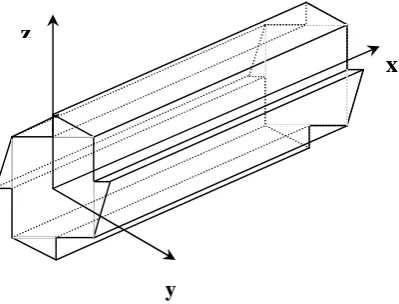
Consider a prismatic body of arbitrary section in Cartesian coordinates oxyz (Fig. 1), with one section
x
0
fixed
u
0
,
v
0
,
w
0
and with a torsional moment applied to the second section
P
zd
G
yd
P
G
I
2H1
zx1
yx;
2
.
0
,
5
.
0
,
9
.
0
,
9
.
0
сm
b
сm
сm
сm
a
a
2
a
/
10
cm
;
b
2
b
/
10
сm
;
1
сm
,
b
2
сm
,
4
сm
,
10
сm
;
;
/
10
2
6kg
сm
2 [image:7.595.54.254.117.269.2]E
0
.
3
. Side faces are load-free.Fig. 1. Prismatic body of arbitrary section Fig. 2. Configuration of cross section of prismatic body
To build the solution of this problem, as is well known, the combination of R-function methods and the method of progressive approximations is used. In relation to it the structures of solutions are taken in the form of (21), and the equations of the boundary region (sections) are determined by the following way:
);
5
0
)
4
0
)
3
0
)
2
0
1
((((
where
;
f
f
1 0 21
2
f
3
0f
4;
3
f
5
0f
6;
4
f
7
0f
8;
5
f
9
0f
10;
2 2
20
;
1
bc
a
y
bz
f
f
1
ad
2
ay
b
2z
2
0
;
f
3
z
;
f
4
b
y
0
;
f
5
y
0
;
;
0
6
а
z
f
f
7
z
0
;
f
8
y
b
0
;
f
9
y
0
;
f
10
z
a
0
;
c
a
a
2;
d
b
b
2.
The solution taken in the form (18), could not satisfy the condition
,
1
кр
F
z x
M
yX
zY
since the conformity between the tangential stresses and the shear is not attained. Therefore, when building the equations of equilibrium based on Lagrange variation principle in the right side of the condition there appear the additional terms of the sort:
I H 2
k d III H
2
I
I
I
I
I
.
The same problem is considered, but of the body with rectangular cavity of the following dimensions
a
1
a
/
10
;
b
1
b
/
10
and the boundary equation:),
)
)
)
)
(((((
1
0
2
0
3
0
4
0
5
0
6
Where
y
z
x
y
z b
-b
-a
b
a a
1
b
1
c = a + a
1
d = b + b
1
y
z
a
-b
b
-a
;
f
f
1 0 21
2
f
3
0f
4;
3
f
5
0f
6;
4
f
7
0f
8;
5
f9 0 f10; 0;2 2 2 0 2
) 2 2 (
6
b y b
a z a
2 2
20
;
1
bc
a
y
bz
f
f
1
ad
2
ay
b
2z
2
0
;
f3z;f
4
b
y
0
;
f
5
y
0
;
f
6
а
z
0
;
f
7
z
0
;
;
0
8
y
b
f
f
9
y
0
;
f
10
z
a
0
;
c
a
a
2;
d
b
b
2.
Inside the cavity the faces are load-free. In this problem in the cavity region there are made provisions for the additional boundary conditions for the torsion function in the form (28).
The same problem is considered but of circular cavity of the following dimension:
r
1
b
/
10
.Side faces of the cavity are load-free. In this problem in the cavity region there are made provisions for the additional boundary conditions for the torsion function in the form (29).
Here (21) is taken as a structure of solutions, and the forms of the boundary are determined by:
);
)
)
)
)
(((((
1
0
2
0
3
0
4
0
5
0
6
The expressions
1
5- are given in above problems, and0
2
)
(
1 2 1 2 2
6
r
r
y
z
.Consider the problem of the body with elliptical cavity of the following dimensions
a
1
a
/
5
;
b
1
b
/
10
. Internal face is load-free and has the following additional boundary conditions (29).Here (29) is taken as a structure of the solution, and the geometry of the region is described by:
);
)
)
)
)
(((((
1
0
2
0
3
0
4
0
5
0
6
where
1
5 are described in previous problems, and:. 0 1
2 1
2
2 1
2
6
b y
a z
A software for the study of stress-strain state of elastic prismatic bodies of arbitrary section with a cavity.
On the basis of developed computing algorithm, a complex of programs (CP) was built to solve the boundary problems for the systems of linear equations with partial derivatives, assigned to calculate stress-strain state of elastic prismatic bodies of arbitrary section with a cavity. Developed CP is aimed to calculate stress-strain state of elastic prismatic bodies of arbitrary section with a cavity. The CP was developed using the theoretical grounds of the Bubnov-Galerkin method, V.L. Rvachev R-function method (RFM) and the method of progressive approximations. The method of progressive approximations used here allows us to solve linear problems on each step of iteration.
The structure of the complex of programs consists in the following blocks (Nazirov et al., 1998):
1. Calculation of the values of basic polynomials (power-mode, trigonometric, Chebyshev’s and others) and their derivatives of nth order.
2. Calculation of the values of R-functions and their derivatives of required order. 3. Generation of the points and corresponding weights for numeric integration.
4. Calculation of the values of the systems of coordinate functions and their derivatives of nth order. 5. Forming the elements of resolving equations.
6. Forming the process of iteration.
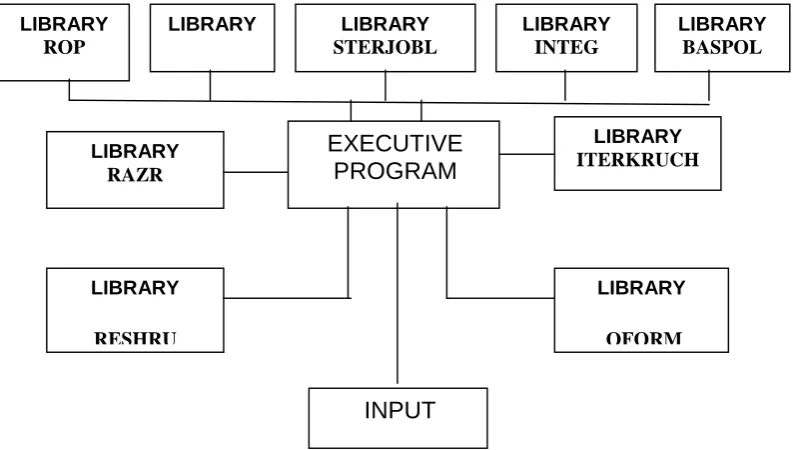
Structure of software (SW) is given in Figure 3. It is built of the basis of program complex (16-19), assigned for the solution of boundary problems of the Mechanics of deformable rigid bodies (MDRB); this expansion would provide for a possibility to calculate prismatic bodies of arbitrary section with a cavity.
Fig. 3. Software of the study of stress-strain state of the rods
Brief description of each library of software, including developed subprograms (procedures and functions) is given below. Several borrowed library are general, such as: ROP (a modulus realizing R-operation and structural formulae), COMM (library of types and constants), INTEG (a library to generate Gauss nodes and weights), BAZPOL (a library assigned to calculate the values of polynomials and their derivatives of the nth order), RESHRU (a library of solution of resolving equations, in this case, of the system of algebraic equations), OFORM (a library to represent calculations results). The library RAZR, STERJOBL are supplemented with corresponding modules, considering the specific nature of the problem: ITERKRUCH, is assigned to realize the algorithm, in (1). Then to calculate the sub-integral functions, and formation of the elements of resolving equations, the functions FBB and FFX were developed, (FBB-for the left side of the equation and FFX-for the right side). They are included into RAZR library. Developed procedures and functions (D1f, NEYMAN, FBB, FFX), and the library ITERKRUCH allow us to automatize the solution of a given problem. Now describe the procedures and functions used to solve the problems. Procedure heading D1f has the form of procedure D1f (np,so:integer;F,w:mat5; var c:mat5); where np-max is an order of differential, present in differential equation of boundary problem; so- is an order of differential operator present in structural solution; F(type:mat5)–is a massive containing the values of a function of the operator D1and the values of partial derivatives of required order, given in the following form
n n
y
F
y
F
y
z
F
z
F
y
F
z
F
F
;...,
,
,
;
,
;
22 2 2 2
; ………(30)
w- is a massive containing the values of equations of the boundary and geometry of the region and their derivatives; C- is a massive where the values of calculation results D1f and partial derivatives of required order are recorded. Results are presented in the form (30).
The type Mat5 is determined in the form mat5=array(1..dl) of real, where dl=(np+so+1)(np+so+1) div 2.
Procedure heading NEYMAN has the form
PROCEDURE Neyman (np, so: integer; i, j: integer; x, y: real; pc2: tpex; imjapolpro: imjpolpro; wi: mati5; var un: mat5),
where i, j-power of polynomial of relatively variable x and y; pc2- is informational massive of the type (tpex=array (1..6) of real;), containing the data on left side lower and right side upper boundaries along the ox-axis and oy-axis, that is, pc2(1)-Xmin;
pc2(2)-Xmax; pc2(3)-Ymin; pc2(4)-Ymax; Imjapolpro acquires the value of stepm2 or cheb2, or trigon2 depending on the use of power
polynomial or Chebyshev’s polynomial or trigonometrical one in a structure. Un- is a massive containing the values of the system of coordinate functions and partial derivatives up to required order at the point (x, y).
LIBRARY
ROP
LIBRARY
СОММ
LIBRARY
STERJOBL
LIBRARY
INTEG
LIBRARY
BASPOL
LIBRARY
RAZR
EXECUTIVE
PROGRAM
LIBRARY
ITERKRUCH
LIBRARY
RESHRU
LIBRARY
OFORM
An equation of geometry of the region is determined in the following form of the function:
function <name> (x, y: real): boolean, which determines the belonging of a given function inside the region or on the border or
beyond the region, where <name> is determined by the user; (x, y)- are the coordinates of a given point. If the point is in the region D
Г (D-is a region, Г-is its border), then the <name> acquires the value of “true”, otherwise-“false”.The heading of the function of value calculations of the equation of region geometry and their partial derivatives in the form (30) at a given point has the form
PROCEDURE <name> (pr, so: integer; x, y: real; pc2: tpex; var WI:mati5);
where WI- is a massive of the type mati5; it contains the values of equations of the borders of sub-regions and their derivatives of a required order at the point (x, y).
This procedure is included into the library STERJOBL.
The type mati5 is determined in the form (this type is included into the library COMM)
Mati5=array (1..kolobl) of mat5;
where kolobl- is a number of sub-regions of the type mat5, and the purpose of parameters np, so is described above. Arbitrary constants с1-с4in (18) are determined by the procedure CIPR, its heading having the form
PROCEDURE CIPR (r, l: integer; Inti: inttip; CI: typci); where
- is the length of the rod; Inti- is a massive of the type inttip(inttip=array(1..5) of real;сontaining the valuesof integrals Ip, Id, Ik, I, I2H.
СI (typCI=array(1..5) of extended;)–is a massive where the values of coefficients Сi(i=1, 5) are formed. The procedure VICHINT is assigned to calculate the values of double integrals; its heading having the form
PROCEDURE VICHINT (nch: char; clutoch: integer; DifObl: DIFOB
TIP; korfun: korftip; XG: mat4; var intMas: inttip);
where clutoch- is the number of Gauss nodes; DifOb, korfun is described above. XG- is a massive containing the solution of the system of algebraic equations. INTmas- is a massive containing the values of the integrals.
STR-is a procedure assigned to calculate the values of structural formulae and their derivatives of a required order at a given point. Procedure heading, which solves the system of algebraic equations by Gauss method, has the form
Procedure STR (x, y: real; nch: char; XG: MAT4; DIFOBL: DIFOBTIP;KORFUN: KORFTIP; var rez: mat5);
where x, y–are coordinates of calculated point; ch depending on complete symmetry or the symmetry along ox-axis and oy-axis and the dissymmetry of the region acquires the values of,: “с”, “x,” “y”, “v”, respectively; depending of symmetry of the problem or the symmetry of ох-axis or оу-axis, or dissymmetry of the massive XG (mat4=array (1..skm) of real;), skm- is a number of coordinate functions, which contain the solution of the system of algebraic equations.
difobtip=procedure (pr, so: integer; x, y: real; var ww: MATI5); KOrFtip=procedure (pr, SO: integer; i, j: integer; pc2: tpex; x, y: real; imjapolpro: imjpolpro; wi: mati5; var Un: mat5);
imjpolpro=procedure (so: integer; i, j: integer; pc2{,s}:tpex; x,y:real; var Un:mat5);
DIFOBL- is a name of a procedure (included into the library STERJOBL), assigned to calculate the values of an equation of region geometry and their derivatives of nth order. Its description is given above, KORFUN- is a name of structural formula. In this case it is Neymafist.
The functions1,2is assigned to form the values of
1(the massive omegchar), present in the formula (15). The heading of the function has the form function 12(R: real; CI: TYPSI);where the values of a variable R is calculated according the formula (19). The massive Cicontains the values of the coefficients in the formula (18).
The forming of the value of r2by the formula (15) has the form function rkv (CI: typci): real. The designation of CI is described above.
The check-up of the convergence of computing process is fulfilled by PROVERKА procedure, its heading having the form Procedure Proverka (Eps: real; oldfile, newfile: typfile;Log: boоlean);
where Eps-is a given level of accuracy; oldfile and newfile-are the files where the values of previous and current iterations are given;
Log-acquires the value “true” or boolean depending on numeric convergence.
The procedure ITERKRUCH is an executive program for the solution of the problems.
Initial value is determined by a variable OMEGCHER: =0, then the values of the massive are formed pc2(1): =-ag{Xmin}; pc2(2): =ag{Xmax};
pc2(3): =-bg{Ymin}; pc2(4): =bg{Ymax};
The variable OB of the type obtip (determined in the library COMM) obtains the name of the region (determined by a user), and DIFOB obtains the name of the procedure (present in the library STERJOBL), assigned to calculate the values of equation of region geometry and their derivatives of nth order.
Further when referring to the procedure OBLGAU (included into the library INTEG) Gauss nodes and weights are generated. Here the number of nodes is formed in clutoch, its value being determined in COMM. Then, there, in this library, the values of variables NP, SO, NK are formed and referred to the procedure (included into the library RAZR), where the elements of the matrix of resolving equations are formed. Obtained system of algebraic equations is solved by Gauss method and the values of unknown coefficients in the structure are determined. Substituting these values into the structure, we calculate the values of sought for
functions () and their derivatives at a given points. Then, the values of the integrals Ip, Id, Ik, I, I2H. are calculated. This is done by the procedure VICHINT (included into the library ITERKRUCH). These values of the integrals are contained in the massive IntMas (type его-array(1..5) of real). Then, forming the value of a variable r, we would refer to the procedure Qf, where the value of the massive Сi(i=1,2,3,4) is formed and the parameters, Zz, Zy, Zxand others are calculated. The convergence is checked up by the procedure PROVERKA. If a required level of accuracy is achieved, the process goes on. Otherwise, the value of variable OMEGCHER is formed anew as well as the processes described above.
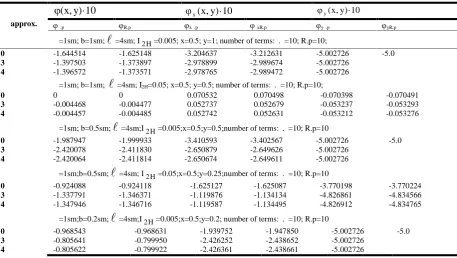
Validation of the algorithm of design of elastic prismatic bodies and the operation of software. As an example consider the torsion of the rods with rectangular section. Simultaneously compare the solutions of the problems by analytical way and by the R-function method. To demonstrate the applicability of the R-R-function method the Tables 1,2 show the results of stress R-function (
y z
,
,
) (16) and (17), coefficients of the equations (6) and the values of normal and tangential stresses, respectively. In Tables 1, 2 the index аpmeans that the solution is obtained analytically, and the index Rр–by using the R-function method. In all tablesthe 1stand the 2ndlines correspond to zero solution (16), and the next ones–to the approximations. From the Table 1 it is seen that in the 3rdand the 4thapproximations the torsion function coincides in two signs, and in derivatives by х and у –in four signs in significant figures. When the solutionis built analytically for rectangular section with results obtained by R-function method, there occurs the coincidence up to the 3rd sign of significant figures. With decreased section area of prismatic body the convergence becomes better and the coincidence closer (Table 1). So, when the section approaches the square form it is necessary to increase the number of terms in solutions.
[image:11.595.71.529.518.776.2]Table 2 shows the values of the components of stresses, hence a good convergence and close coincidence. The change in normal stress values Zz104/G and tangential stresses Zy104/G, Zx104/G are also shown in coordinates: x=0.5, y=1; x=0.5, y=0.5 respectively for rectangular section (а=1сm, b=1сm); x=0.5, y=0.5; x=0.5, y=0.25 for rectangular section (а=1сm, b=0.5сm); x=0.5, y=0.2; x=0.5, y=0.1 for narrow-width rectangular section (а=1сm, b=0.2сm) of a prismatic body.
Table 1. Results on torsional function and derivatives in various points
№ approx.
10 ) y , x
(
x(x,y)10 y(x,y)10
а.p R.p xа.p xR.p yа.p yR.p
а =1sm; b=1sm;
=4sm; I2H=0.005; x=0.5; y=1; number of terms:а.р=10; R.p=10;0 -1.644514 -1.625148 -3.204637 -3.212631 -5.002726 -5.0
3 -1.397503 -1.373897 -2.978899 -2.989674 -5.002726
4 -1.396572 -1.373571 -2.978765 -2.989472 -5.002726 а =1sm; b=1sm;
=4sm; I2H=0.05; x=0.5; y=0.5; number of terms:а.р=10; R.p=10;0 0 0 0.070532 0.070498 -0.070398 -0.070491
3 -0.004468 -0.004477 0.052737 0.052679 -0.053237 -0.053293
4 -0.004457 -0.004485 0.052742 0.052631 -0.053212 -0.053276 а =1sm; b=0.5sm;
=4sm;I2H=0.005;x=0.5;y=0.5;number of terms:а.р=10; R.p=100 -1.987947 -1.999933 -3.410593 -3.402567 -5.002726 -5.0
3 -2.420078 -2.411830 -2.650879 -2.649626 -5.002726
4 -2.420064 -2.411814 -2.650674 -2.649611 -5.002726 а =1sm;b=0.5sm;
=4sm; I2H=0.05;x=0.5;y=0.25;number of terms:а.р=10; R.p=100 -0.924088 -0.924118 -1.625127 -1.625087 -3.770198 -3.770224
3 -1.337791 -1.346371 -1.119876 -1.134134 -4.826861 -4.834566
4 -1.347946 -1.346716 -1.119587 -1.134495 -4.826912 -4.834765 а =1sm;b=0.2sm;
=4sm;I2H=0.005;x=0.5;y=0.2; number of terms:а.р=10; R.p=100 -0.968543 -0.968631 -1.939752 -1.947850 -5.002726 -5.0
3 -0.805641 -0.799950 -2.426252 -2.438652 -5.002726
а=1sm;b=0.2sm;
=4sm;I2H=0.005;x=0.5;y=0.1; number of terms:а.р=10; R.p=100 -0.477113 -0.476761 -0.998089 -0.998173 -4.807976 -4.815713
3 -0.372180 -0.371439 -1.286597 -1.295912 -3.809767 -3.813099
[image:12.595.53.540.62.396.2]4 -0.372161 -0.371411 -1.286484 -1.295845 -3.809743 -3.813067
Table 2. Results of the components of stress tensor in various points
№approx.
Xx(0,y,z) Xy(y,z,4) Xz(y,z,4)
Xxa.p XxR.p Xya.p XyR.p Xza.p XzR.p
a=1sm; b=1sm;
=4sm; I2H=0.005; x=0.5; y=1; Gauss nodes: 20; number of terms: а.р=10; R.p=10; 0 -9.345516 -9.345508 -0.000603 -0.000603 -2.508274 -2.507380 3 -10.585727 -10.596643 -0.000605 -0.000601 -2.517457 -2.514855 4 -10.588799 -10.599768 -0.000605 -0.000601 -2.517468 -2.515195x=0.5; y=0.5.
0 -0.000437 -0.000429 0.916595 0.910884 -0.911596 -0.910884 3 -0.000530 -0.000523 0.953871 0.953698 -0.954090 -0.953998 4 -0.000530 -0.000522 0.954407 0.954208 -0.954629 -0.954478
a=1sm; b=0.5sm;
=4sm; I2H=0.005; x=0.5;y=0.5; Gauss nodes: 20;number of terms: а.р=10; R.p=10; 0 -18.836561 -18.836651 -0.013764 -0.013756 -8.635030 -8.673674 3 -15.657442 -15.500477 -0.013712 -0.013733 -7.740475 -7.741313 4 -15.657129 -15.500388 -0.013709 -0.013723 -7.740337 -7.741267x=0.5; y=0.25.
0 -8.619827 -8.617734 1.469983 1.469455 -4.115811 -4.115811 3 -7.441723 -7.433828 1.619772 1.617878 -3.981812 -3.983909 4 -7.441355 -7.433813 1.619928 1.617872 -3.981537 -3.983087
a =1sm; b=0.2sm;
=4sm; I2H=0.005; x=0.5; y=0.2; Gauss nodes: 20;number of terms: а.р=10; R.p=10;0 -82.384095 -82.397427 -0.036584 -0.036674 -50.094224 -50.088471 3 -84.836229 -84.747514 -0.036472 -0.036475 -45.703020 -45.714755 4 -84.836773 -84.747694 -0.036472 -0.036480 -45.703035 -45.714587
x=0.2; y=0.1.
0 -40.688537 -40.555671 2.465214 2.461752 -25.577016 -25.582242 3 -41.545634 -41.511843 2.229569 2.235453 -22.742262 -22.776947 4 -41.545635 -41.511957 2.229223 2.235415 -22.742117 -22.776533
Conclusion
This study is devoted to the validation of a developed algorithm of calculation of elastic prismatic bodies with a cavity on the basis of R-function method and the method of progressive approximations; to the study of stress-strain state of elastic prismatic bodies of rectangular section and to its comparative analysis. Results of the studies are presented in the form of the tables. The statement of the problem is given in this paper, the algorithm of construction of the systems of resolving equations and its integration is developed, and the structure of software and the description of their modules are defined.
REFERENCES
2014 Report on the project «Improvement of the models, development and study of algorithmic methods of solution of the classes of multi-dimensional non-linear problems of the mathematical physics for the regions of complex configurations».
Kronrod А.С. nodes and weights of quadrature formulae.-Мoscow.: Nauka, 1964.-143p. Krylov V.N. Approximational calculations of the integrals.-Мoscow.:Nauka, 1967.-500p.
Kurmanbaev B. Algorithmization of the solution of threedimensional problems of the theory of elasticity in prismatic region. -Dissertation.-...Candidate of Phys. And Mathem. Sci.-Таshkent, 1971.
Kurmanbaev B. Numeric analysis of the solution of the problems of bending torsion of prismatic bodies //Problems of comput. and appl. mathem.– Таshkent, 1973.-Issue. 16.–P.70-82.
Kurmanbaev B. Numeric analysis of the theory of torsion of the rod // Problems of comput. Mathem. And Engin. // Таshkent: FAN, 1965.-Issue. 6.- P.23-44.
Nazirov Sh.A., Nuraliev F.M., Amanov O.T. Structure of program complex of solution of boundary problems for the systems of differential equations with partial derivatives //uzbek journal “problems of informatics and energetics”. –1998. -№6. –P.40-43. Nazirov Sh.А., Mukhammadiev А. Bending of elastic-plastic plates of complex form //reports of asRUZ. 1996. №6. –P. 85-94. Nazirov Sh.А., Pickorsky L.F. Complex of programs to calculate and optimize plate-like structures of complex configuration
//algorithms.-таshkent,1995.-ISSUE.80. -P. 41-54.
Nazirov Sh.А., Аnarova Sh.А. ПProgram complexof calculation of spatially-loaded rods //Abstract of the report in Republ. Sci. conference “Problems of algorithmic programming”.-Таshkent, 2000.-P.76-77.
Rvachev V.L. Geometrical applications of the algebra of logics.-Kiev: Tekhnika, 1967.- 212 p.
Rvachev V.L., Goncharyuk I.V. Torsion of the rods of complex profile.- Kharkov: Kharkov Polytechn. Institute, 1973. Rvachev V.L., Kurpa L.V. R-function in problems if the theory of plates.-Кiev: Naukova dumka, 1988.-118p.
Rvachev V.L., Slesarenko А.P. Algebra of logics and integral transforms in boundary problems.-Кiev: Naukova dumka, 1976. -287p.
Yuldashev T., Anarova Sh.A. Mathematical models of the rods with consideration of linear twisting and torsional function. Proc. Of Republican science-technical conference «Modern state and the perspectives of application of information technology in the management»Таshkent, 7–8 September 2015. P.266-272.
Каbulov V.К. Algorithmization in the theory of elasticity and deformational theory ofplasticity.− Таshkent: FAN, 1966. − 394 p.