THE DEVELOPMENT AND VALIDATION OF A THINKING MAPS
LEARNING MODULE FOR PHYSICAL SCIENCE THEME OF YEAR 5
*,1
Ruslan Mapeala
1
Institute of Teacher Education, Tawau Campus, Tawau Sabah, Malaysia
2
Faculty of Psychology and Education, Universiti Malaysia Sabah, Kota Kinabalu Sabah, Malaysia
ARTICLE INFO ABSTRACT
The main objective of this study is to explain about the development and Maps-aided Problem
(energy, light, electricity and heat) which is less mastered by the students. The development of this module was based on ADDIE instructional design model that is the basis of other instructional design models. ADDIE model consists of five phases, namely a
implementation and evaluation. Four experts were involved in this study; a Malaysia public university lecturer, a director of Malaysia Regional Centre for Education in Science and Mathematics, a primary school science pedagogy
Primary School Science's Excellent Teacher for the purpose of content validity and a linguist to perform face validity in terms of the use of language in the module.
evaluation show excellentmodule validity. The module prototype has been tested in a pilot study which involved 30 students from Year 5 at a primary school in Tawau, Sabah. The findings of this study show that the total value of the module reliability is high (Cr
describes that the developed module has high internal consistency and is suitable to be used in the process of teaching and learning of Year 5 Science for the topics in Physical Science theme. Therefore, this study suggests that
Physical Science theme of Science Year 5.
Copyright©2016, Ruslan Mapeala and Nyet Moi Siew.
unrestricted use, distribution, and reproduction in any medium, provided the original work is properly cited.
INTRODUCTION
Based on the TIMSS 2011 reports, as many as 38% of Malaysian students do not reach minimum level of proficiency in Science. Recently, the PISA 2012 study report found that the level of problem solving and scientific literacy of Malaysian students is very limited. This finding is supported by the study report of Kestrel Education Consultants in the United Kingdom and 21 Century Schools in the United States of America that find that the Higher Order Thinking Skills among teachers and students in Malaysia is very low (Curriculum Dev
Division, 2012:5). Fazliza and Abdul Majeed (2012) find that Science teachers are less clear about the concept of thinking and an appropriate method to improve these skills in students. The report of Schools Inspectorate and Quality Insurance, Malaysia Ministry of Educationon teacher competence in
*Corresponding author: Ruslan Mapeala,
Institute of Teacher Education, Tawau Campus, Tawau Sabah, Malaysia.
ISSN: 0975-833X
Article History:
Received 21st March, 2016
Received in revised form 07th April, 2016
Accepted 18th May, 2016
Published online 30th June,2016
Key words:
Development, Evaluation,
Problem-based learning module, Thinking Maps,
Science Year 5.
Citation: Ruslan Mapeala and Nyet Moi Siew, 2016.
physical science theme of year 5 science”, International Journal of Current Research
RESEARCH ARTICLE
THE DEVELOPMENT AND VALIDATION OF A THINKING MAPS-AIDED PROBLEM
LEARNING MODULE FOR PHYSICAL SCIENCE THEME OF YEAR 5
Ruslan Mapeala and
2Nyet Moi Siew
Institute of Teacher Education, Tawau Campus, Tawau Sabah, Malaysia
Faculty of Psychology and Education, Universiti Malaysia Sabah, Kota Kinabalu Sabah, Malaysia
ABSTRACT
The main objective of this study is to explain about the development and
aided Problem-Based Learning module for Year 5 Science subject of Physical Science Theme (energy, light, electricity and heat) which is less mastered by the students. The development of this module was based on ADDIE instructional design model that is the basis of other instructional design models. ADDIE model consists of five phases, namely a
implementation and evaluation. Four experts were involved in this study; a Malaysia public university lecturer, a director of Malaysia Regional Centre for Education in Science and Mathematics, a primary school science pedagogy lecturer at the Institute of Teacher Education, a Primary School Science's Excellent Teacher for the purpose of content validity and a linguist to perform face validity in terms of the use of language in the module.
tion show excellentmodule validity. The module prototype has been tested in a pilot study which involved 30 students from Year 5 at a primary school in Tawau, Sabah. The findings of this study show that the total value of the module reliability is high (Cr
describes that the developed module has high internal consistency and is suitable to be used in the process of teaching and learning of Year 5 Science for the topics in Physical Science theme. Therefore, this study suggests that the developed module can be used as a teaching aid for topics in Physical Science theme of Science Year 5.
Siew. This is an open access article distributed under the Creative Commons Att use, distribution, and reproduction in any medium, provided the original work is properly cited.
reports, as many as 38% of Malaysian students do not reach minimum level of proficiency in Science. Recently, the PISA 2012 study report found that the level of problem solving and scientific literacy of Malaysian supported by the study report of Kestrel Education Consultants in the United Kingdom and 21 Century Schools in the United States of America that find that the Higher Order Thinking Skills among teachers and Curriculum Development Fazliza and Abdul Majeed (2012) find that Science teachers are less clear about the concept of thinking and an appropriate method to improve these skills in students. The report of Schools Inspectorate and Quality Insurance,
on teacher competence in
Institute of Teacher Education, Tawau Campus, Tawau Sabah,
teaching and learning showed 52 percent
level of expectancy, 31 percent at satisfactory level, 5 percent at poor level and only 12 percent at excellent level (Inspectorate and Quality Assurance
teachers are at satisfactory score and below which shows that teachers are less challenging the critica
students (Inspectorate and Quality Assurance, 2013) Aliah et al. (2012) finds that the attitude, interest and motivation toward science learning in Malaysian students has declined over the period of their schooling.
the Malaysia Education Blueprint (2013
Education, MOE, 2013) that emphasizes on higher order thinking skills is timely. The objectives of the Primary School Science Curriculum are to instil and develop the students’ creativity through experience and investigation in order to master scientific knowledge, scientific skills and thinking skills as well as scientific attitudes and values (
Development Division, MOE,
i-THINK programme was introduced as a strategy to improve students' higher order thinking skills. Eight kinds of Thinking
International Journal of Current Research
Vol. 8, Issue, 06, pp.33780-33786, June, 2016
INTERNATIONAL
2016. “The development and validation of a thinking maps-aided problem
International Journal of Current Research, 8, (06), 33780-33786.
AIDED PROBLEM-BASED
LEARNING MODULE FOR PHYSICAL SCIENCE THEME OF YEAR 5 SCIENCE
Institute of Teacher Education, Tawau Campus, Tawau Sabah, Malaysia
Faculty of Psychology and Education, Universiti Malaysia Sabah, Kota Kinabalu Sabah, Malaysia
The main objective of this study is to explain about the development and validation of a Thinking Based Learning module for Year 5 Science subject of Physical Science Theme (energy, light, electricity and heat) which is less mastered by the students. The development of this module was based on ADDIE instructional design model that is the basis of other instructional design models. ADDIE model consists of five phases, namely analysis, design, development, implementation and evaluation. Four experts were involved in this study; a Malaysia public university lecturer, a director of Malaysia Regional Centre for Education in Science and lecturer at the Institute of Teacher Education, a Primary School Science's Excellent Teacher for the purpose of content validity and a linguist to perform face validity in terms of the use of language in the module. The findings of the expert panel tion show excellentmodule validity. The module prototype has been tested in a pilot study which involved 30 students from Year 5 at a primary school in Tawau, Sabah. The findings of this study show that the total value of the module reliability is high (Cronbach's Alpha = .96). This describes that the developed module has high internal consistency and is suitable to be used in the process of teaching and learning of Year 5 Science for the topics in Physical Science theme. the developed module can be used as a teaching aid for topics in
is an open access article distributed under the Creative Commons Attribution License, which permits
teaching and learning showed 52 percent of teachers is at the percent at satisfactory level, 5 percent at poor level and only 12 percent at excellent level Inspectorate and Quality Assurance, 2013). 30 percent of teachers are at satisfactory score and below which shows that teachers are less challenging the critical thinking skills of the Inspectorate and Quality Assurance, 2013). Fatin (2012) finds that the attitude, interest and motivation toward science learning in Malaysian students has r the period of their schooling. The launching of the Malaysia Education Blueprint (2013-2025) (Ministry of that emphasizes on higher order thinking skills is timely. The objectives of the Primary School Science Curriculum are to instil and develop the students’ ty through experience and investigation in order to master scientific knowledge, scientific skills and thinking skills as well as scientific attitudes and values (Curriculum Development Division, MOE, 2014). Through this plan, the
e was introduced as a strategy to improve students' higher order thinking skills. Eight kinds of Thinking
INTERNATIONAL JOURNAL OF CURRENT RESEARCH
Maps have been introduced to students at all levels of schooling since 2013.
According to Dochy et al. (2005), problem-based learning (PBL) method is suitable to be implemented in various institutions and levels of schooling. Through this PBL, students' ability to retain information is longer as compared to the traditional learning method (N. Drake and Long, 2009), in addition to improving problem-solving skills and teamwork (Ferreira and Trudel, 2012), students are also more active during their learning process (Akınoğlu and Tandoğan, 2007), thereby improving students' academic achievement (Inman, 2011) and mastery of concepts through thinking tools such as FILA table (Faaizah, 2008; Ruqayyah et al., 2013) and mind map (Yee et al., 2011). Therefore, the use of thinking tools is catalytic to students' critical thinking skills. Hyerle and Alper (2011) state that Thinking Map is an effective thinking tool in improving the thinking skills of students. This is because Thinking Map is based on the human cognitive process to understand the concept, analyse the problem and thus solve the problem. Thinking Map has been proven effective in the skills of classifying, observing and making conclusions (Salah and Mohamed, 2014), comparing and differentiating and also explaining (Wies, 2009). All these have a positive impact on students’ understanding, achievement and motivation (Fahmi, 2008). In addition, the use of Thinking Map is also proven to be able to alter the behaviour of the students to be more positive and diligent (Muhamad Sidek et al., 2012) albeit Thinking Map has only been practised for a short period of time (Muhamad Sidek, 2013).
Therefore, through the infusion of PBL method as a teaching element for thinking and Thinking Map as a teaching element of thinking into a single module, gives a positive impact in the context of teaching and learning Science in order to improve the critical thinking skills and motivation towards learning Science. According to Beyer (1997), combining both of these components, will not only make learning more explicit, but also make thinking-based learning more systematic, clear and focused. This situation also has an impact on students' mind to be more open (Marzano, 2007; Swartz et al., 1998). Thus, it is necessary to develop a learning module in order to attract the interest of the students, increase aspects of knowledge, understanding, abilities, needs and experiences which are the basics to an effective teaching especially if it involves a large number of students per classroom (Auditor and Naval, 2014). This is because the module can provide a learning environment and context to help students build and appreciate certain knowledge (Nik Azis, 2014), to reduce competition and threats on facing failure and increase interest and motivation (Shahrom and Yap, 1991, Sidek and Jamaludin, 2005), to be able to identify the uniqueness of pupils (Norlidah and Saedah, 2012), to improve achievement (Habibah and Wan Rafaei 1994) and to enhance the pupils' learning experience (Gagrin, 2003). Thus, the teaching module is an effective instrument to help realising the objectives of education. In conclusion, the use of modules can facilitate the teaching process, facilitate students' understanding as well as to attract students’ interest and increase their motivation to learn. However, the validity and reliability of a module developed needs to be determined before it being put to use. Some earlier studies regarding the
development and module evaluation had been organised, one of them is the research by Auditor and Naval (2014), Norlidah and Saedah (2012), Haspiah (2006) and also Gargarin (2003). With that, this study should also be conducted to know both of the two important aspects of learning module that were developed for Physical Science theme of Year 5 Science.
The Importance and Scope of the Study
This study provides guidelines for teachers to design and develop a module based on Thinking Maps-aided problem-based learning method. Providing input to the teacher in determining the criteria when designing and developing a module is important. Physical Science theme which consists of topics like Energy, Light, Electricity and Heat have been chosen because the topics in this theme are the ones that are less mastered by the students.
Methodology
The Study Design
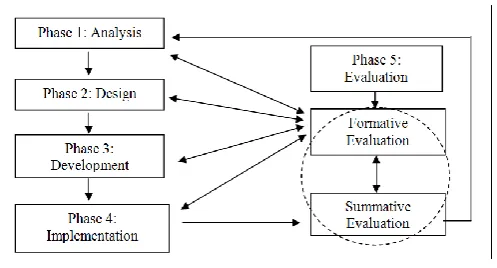
The development of this module is based on the five phases of the ADDIE instructional model which intertwined with each other. According to Nik Azis (2014), in the development of a learning module based on ADDIE instructional model, each phase is not necessarily in a sequential pattern, but each phase provides input to the other phases. The five phases include Phase 1: Analysis, Phase 2: Design, Phase 3: Development, Phase 4: Implementation Phase 5: Evaluation. Figure 1 shows the ADDIE instructional design model.
[image:2.595.308.557.422.556.2]Source: Nik Azis (2014: 382)
Figure 1. ADDIE instructional design model
The Subject of the Study
This study was conductedin an urban fully government-funded primary school in Tawau, Sabah, Malaysia. Five experts were appointed, namely (i) Associate Professor of a public university in Malaysia that specializes in the field of the development of problem-based learning modules, (ii) the Director of Regional Centre for Education in Science and Mathematics (RECSAM) who holds a doctorate in Science and Maths for primary school, (iii) a senior lecturer of Science Pedagogy for Primary School subject at the Institute of Teacher Education Malaysia, (iv) Excellent Teacher of Science for primary school who was experienced for 12 years, and (v) Master Teacher of Malay Language to help out with the language register in this module. 33781 Ruslan Mapeala and Nyet Moi Siew, The development and validation of a thinking maps-aided problem-based learning module for
This module’s pilot study involved 30 Year 5 students. Year 5 students were chosen because they are not having any public examination in Malaysia, therefore the pilot study would not interfere their process of teaching and learning. All students involved in this pilot study were those of the same class that had been assembled based on the achievement of the final exam when they were in Year 4. This shows that they have achieved the same or almost the same level. In addition, all of them had also been exposed to different kinds and Thinking Maps application via i-THINK programme introduced by the Ministry of Education Malaysia in early 2014.
Instrument
Data for module validity were obtained through Module Validity Evaluation Form (MVEF) instrument, which was designed by the researcher. MVEF was built based on the eight criteria of module evaluation by the experts as suggested by Russell (1974). The eight evaluation criteria are (i) Daily Lesson Plan, (ii) Learning Outcomes, (iii) Problem Scenario, (iv) Teaching and Learning, (v) Thinking Maps, (vi) Critical Thinking Skills, (vii) Motivation Towards Learning and (viii) Overall Module. The five appointed experts will give feedback on whether they "agree" or "disagree" and comment on each of the activity contained in this module, based on the eight evaluation criteria. Next, for reliability purpose of the module, the data were obtained by using the Module Reliability Questionnaire (MRQ) form, which was also built by the researcher. The researcher built this MRQ based on the criteria proposed by Sidek and Jamaludin (2005) and Russell (1974) in which each questionnaire that measure the reliability aspect of a module must be based on the measures taken for each activity contained in this module. This MRQ instrument is distributed to each student as soon as they have followed all of the activities in the module.
Development Procedure and Module validation
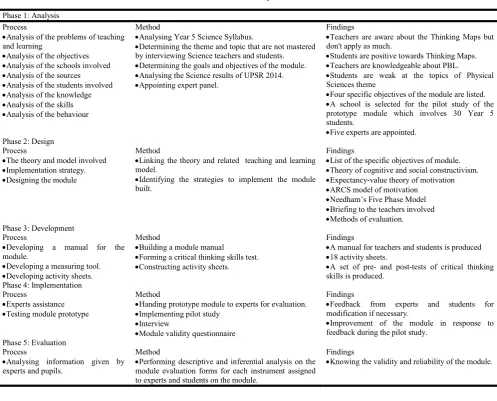
Module was written in Malay language because the teaching and learning process of Primary Science in Malaysia are carried out in Malay language. The development and validation of the module was carried out based on the phases of the ADDIE instructional model: Phase 1: Analysis, Phase 2: Design, Phase 3: Development, Phase 4: Implementation Phase 5: Evaluation. Each phase is different in terms of the process, method and findings as summarized in Table 1.
The front page of the module is designed by using mind graphical elements and cartoon elements. In addition, the front page of this module also displays three types of Thinking Maps in line with the three types of critical thinking skills which is the main focus of this module. One of the characteristics of PBL that emphasizes on group activities are shown through the characters of five children holding hands is also displayed at the bottom of the front page of this module.
Problem Scenario Presentation
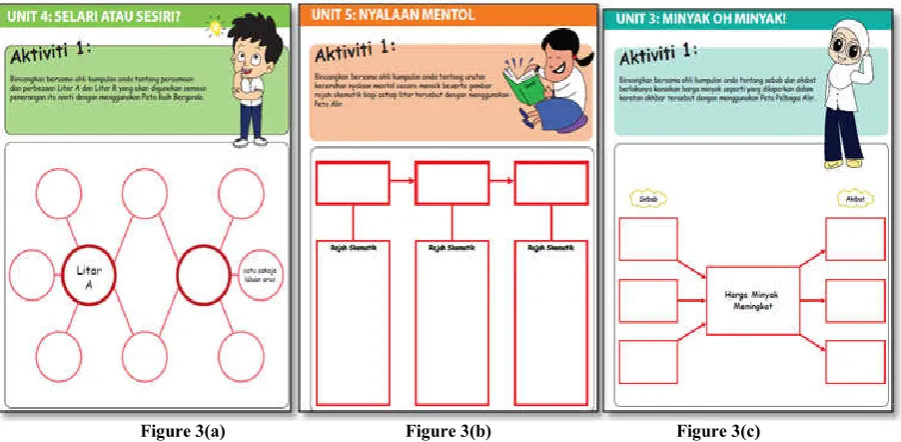
Figure 3 shows an example of problems presentation that was given to students to complete in a small group which usually consists of four to five people in accordance with the characteristics of PBL (Barret and Moore, 2011; Faaizah,
2008). The problems provided in this module function as a trigger (Barret and Moore, 2011; Savin-Baden and Major, 2004), are authentic and relevant to the daily lives of students (Hung, 2006) which is an important characteristic of PBL.
This module comes with Thinking Maps application placed at the bottom to be completed by the students. Only three of the eight kinds of Thinking Maps used in developing this module are parallel to the three types of micro critical thinking skills. Figure 3(a) shows the Double Bubble Maps application for critical thinking skills of ‘compare and contrast’, 3(b) Flow Map application for critical thinking skills of ‘create a sequence’, while 3(c) is the Multi Flow Maps application for critical thinking skills of ‘identify the cause and effect’. This module that has been developed is printed on A3 size poster paper. The purpose of this is to ensure that all team members have an equal opportunity to use the activity sheets during the discussions fairly. It is unlike the common activity sheets in the learning modules available in schools that are mostly in A4 size. These small activity sheets will limit the use of activity sheet modules to all group members simultaneously during the discussions conducted. To ensure that the students experience a more meaningful PBL process, thus the element of progression is applied in the development of this module.
This element of progression can be observed through problem presentation that is more general and the structure of Thinking Maps which is not as complete as the Thinking Maps structure on the activity sheet 1. This is to encourage students to think more deeply. Next, Figure 4 shows an example of an activity sheet 2 which is contained in the module with the progression element module developed.
This module provides more opportunities for students to create their own Thinking Maps as a result of the discussions. This is because it is a characteristic of Thinking Maps that it can be infinitely expanded and it is not static (Hyerle and Alper, 2011). Other than that, this allows them to easily visualise their ideas and findings to the entire class. This indirectly promotes social interaction among students. Furthermore, through social negotiation with group members, students have opportunities to compare and evaluate their understanding of subject matter with each other through what Barrett and Moore (2011) describe as dialogical knowing, this they claim being central to collaborative PBL practices. This module is also printed in colours to attract the attention and interest of students to use them during the learning session.
Data Analysis
The data obtained from MVEF for the module content validity was analysed using percentages. Meanwhile, the data obtained from MRQ for reliability analysis module used inferential analysis to determine the value of Alpha Cronbach.
33783 Ruslan Mapeala and Nyet Moi Siew, The development and validation of a thinking maps-aided problem-based learning module for physical science theme of year 5 science
Table 1. Module Development Process
Phase 1: Analysis
Process Method Findings
Analysis of the problems of teaching
and learning
Analysis of the objectives
Analysis of the schools involved
Analysis of the sources
Analysis of the students involved
Analysis of the knowledge
Analysis of the skills
Analysis of the behaviour
Analysing Year 5 Science Syllabus.
Determining the theme and topic that are not mastered
by interviewing Science teachers and students.
Determining the goals and objectives of the module.
Analysing the Science results of UPSR 2014.
Appointing expert panel.
Teachers are aware about the Thinking Maps but
don't apply as much.
Students are positive towards Thinking Maps.
Teachers are knowledgeable about PBL.
Students are weak at the topics of Physical
Sciences theme
Four specific objectives of the module are listed.
A school is selected for the pilot study of the
prototype module which involves 30 Year 5 students.
Five experts are appointed.
Phase 2: Design
Process Method Findings
The theory and model involved
Implementation strategy.
Designing the module
Linking the theory and related teaching and learning model.
Identifying the strategies to implement the module
built.
List of the specific objectives of module.
Theory of cognitive and social constructivism.
Expectancy-value theory of motivation
ARCS model of motivation
Needham’s Five Phase Model
Briefing to the teachers involved
Methods of evaluation.
Phase 3: Development
Process Method Findings
Developing a manual for the
module.
Developing a measuring tool.
Developing activity sheets.
Building a module manual
Forming a critical thinking skills test.
Constructing activity sheets.
A manual for teachers and students is produced
18 activity sheets.
A set of pre- and post-tests of critical thinking skills is produced.
Phase 4: Implementation
Process Method Findings
Experts assistance
Testing module prototype
Handing prototype module to experts for evaluation.
Implementing pilot study
Interview
Module validity questionnaire
Feedback from experts and students for
modification if necessary.
Improvement of the module in response to
feedback during the pilot study. Phase 5: Evaluation
Process Method Findings
Analysing information given by
experts and pupils.
Performing descriptive and inferential analysis on the
module evaluation forms for each instrument assigned to experts and students on the module.
Knowing the validity and reliability of the module.
[image:4.595.186.415.490.776.2]Front Page of the Module
Figure 3(a) Figure 3(b) Figure 3(c)
[image:5.595.79.530.55.276.2]Figure 3. Example of activity sheet 1 of the module
Figure 4. Example of activity sheet 2 of the module
Table 2. Module Validity
No Evaluation Criteria Agreement (%) percentage
Expert 1 Expert 2 Expert 3 Expert 4 Expert 5 (Language)
1 Daily Lesson Plan 100 100 100 100
Very
goo
d,
but
with
a
few im
p
ro
ve
m
ents
2 Learning Outcomes 100 100 100 100
3 Problem Scenario 100 100 100 100
4 Teaching and Learning 100 100 100 100
5 Thinking Maps 100 100 100 100
6 Critical Thinking Skills 100 100 100 100
7 Motivation 100 100 100 100
[image:5.595.98.506.319.508.2]8 Overall 100 100 100 100
Table 3. Module Internal Consistency
Unit and Topic Cronbach’s Alpha Number of Item
1: What Do The Experts Say? .74 4
2: Energy Transformation .72 5
3: Oil Oh Oil! .89 4
4: Parallel or Series? .77 4
5: Lighting of a Bulb .74 4
6: Electric Shock .72 4
7: Shadow Dialogue .86 4
8: Help Ramesh .70 4
9: Let’s measure heat .77 4
RESULTS AND DISCUSSION
Module Validity
Table 2 shows the percentage of approval of the expert panel that was appointed to the eight criteria of module evaluation. The findings confirmed that the language of the validity aspect of module contents that have been developed as well as the aspect of the language register validity used in this module is very suitable.
Module Reliability
Table 3 shows that the value of Cronbach's alpha module is high. In conclusion, all the module activity units obtain high reliability.
Conclusion
This module has received positive feedback from experts in terms of the validity of the module that was developed based on eight module evaluation criteria by using MVEF instruments namely the daily lesson plans, learning outcomes, problem scenario, teaching and learning, Thinking Maps, critical thinking skills, motivation and overall evaluation. Similarly, in the aspect of reliability, this module also received excellent feedback from students by using MRQ instrument of 5 point Likert scale which shows high internal consistency. Overall, the developed module is suitable to be used for the teaching of Year 5 Science topics of Physical Science theme to enhance critical thinking skills and motivation towards the learning of Science.
Recommendation
The main objective of this study was to develop and evaluate a module for Year 5 Science subject based on ADDIE instructional model. The results of data analysis show that this module can be applied for the teaching and learning of Year 5 Science for Physical Science theme that is less mastered by students. However, this study suggests that a module evaluation process in a long period of time involving the pre and post-tests can also be carried out to better understand the aspects of validity and reliability of the module developed.
REFERENCES
Akınoğlu, O. and Tandoğan, R. O. 2007. The Effects of Problem-based Active Learning in Science Education on Students’ Academic Achievement, Attitude and Concept Learning, Eurasia Journal of Mathematics, Science and
Technology Education, 3(1), 71-81.
Auditor, E. and Naval. D. J. 2014. Development and validation of tenth grade physics module based on selected least mastered competencies. International Journal of
Educational and Research, 2(12), 145-152.
Barrett, T. and Moore, S. 2011. New Approaches to Problem-Based Learning, Abingdon: Routledge.
Beyer, B. K. 1997. Improving Student Thinking: A
Comprehensive Approach. United States: Allyn & Bacon.
Curriculum Development Centre. 2012. Membudayakan Kemahiran Berfikir(cultivating thinking skills). Kuala Lumpur: Ministry of Education Malaysia.
Curriculum Development Centre. 2014. Dokumen Standard
Kurikulum dan Pentaksiran Sains Tahun Lima (Year five
science curriculum and assessment standard document).
Kuala Lumpur: Ministry of Education Malaysia.
Dochy, F., Segers, M., Bossche, P.V.D. and Struyven, K. 2005. Students’ Perceptions of a Problem-based Learning Environment,Learning Environments Research. 8, 41-66. Faaizah Shahbodin. 2008. Pakej Multimedia Sains (Nutrisi)
Menggunakan Pendekatan Pembelajaran Berasaskan Masalah Secara Hibrid (C2HADAM) (Multimedia package Sciences (Nutrition) Using Problem-Based Learning Approach through Hybrid (C2HADAM). Thesis Doctor of Philosophy. Universiti Kebangsaan Malaysia.
Fatin Aliah Phang, Mohd Salleh Abu., & Mohamad Bilal Ali. 2012. Faktor Penyumbang kepada Kemerosotan Penyertaan Pelajar dalam Aliran Sains. Satu Analisis Sorotan Tesis (Contributing factors to the decline in student participation in Science Stream. An Analysis Thesis Review) Seminar
Kebangsaan Majlis Dekan Pendidikan IPTA. 7-9 October
2012. Johor Baharu.
Fazliza Che Amat., and Abdul Majeed Ahmad, 2012. Pelaksanaan Sains KSSR Tahun Satu: Satu Tinjauan Awal (Implementation of Science KSSR Year One: A Preliminary Review) inhttp://www.fp.utm.my/ePusat Sumber/listseminar/medc2012/pdf/15.pdf. 20 Dicember 2014.
Gargarin, C. 2003. Module in Physics I: development and
evaluation. Eulogio” Amang Rodrigues Institute of Science
and Technology, Manila.
Habibah Elias and Wan Rafaei Abdul Rahman, 1994. Achievement motivation training module for university student. Journal Pendidikan, 89-97.
Haspiah Basiran. 2006. Pembangunan dan penilaian modul pengajaran dan pembelajaran menggunakan kalkulator grafik dalam pembelajaran persamaan kuadratik (Development and evaluation of teaching and learning modules use graphing calculators in the learning of quadratic equations). Master thesis, Universiti Teknologi Malaysia.
Hung, W. 2006. The 3C3R Model: A Conceptual Framework for Designing Problems in PBL.Interdisciplinary Journal of
Problem-Based Learning.
http://dx.doi.org/10.7771/1541-5015.1006.
Hyerle, D. and Alper, L. 2011. Students Successes With
Thinking Maps. 2nd ed. Thousand Oaks, Carlifornia: Sage.
Hyerle, D. 2009. Visual Tools for Transforming into
Knowledge. Thousand Oaks, Carlifornia: Sage.
Inman, T. F. 2011. The Effects of Problem-Based Learning in Maths and Science on High Potential Elementary School
Students. Thesis Doctor of Education. Western Kentucky
University.
Inspectorate and Quality Assurance, 2013. Laporan Profesionalisme, Kompetensi dan Mekanisme Pemantauan Kualiti Guru (Professionalism Report, Competence and Teacher Quality Monitoring Mechanism)in. http://repository.um.edu.my/.../BAB%2013%20LAPORAN 24 May 2014.
Laporan Eksekutif Pelan Pembangunan Pendidikan Malaysia (Malaysia Education Executive Blueprint Report).2013-2025. 2013. Kuala Lumpur: Ministry of EducationMalaysia. Martin, M. O., Mullis, I. V., Foy, P. and Stanco, G.M. 2012.
TIMSS 2011 International Result in Science. TIMSS and
PIRLS International Study Center: Boston College.
Marzano, R. J. 2007. The art and science of teaching:A
comprehensive framework for effective instruction.United
States of America: Association for Supervision and Curriculum Development (ASCD).
Ministry of Education 2013. Malaysia education blueprint 2013–2025. Ministry of Education Malaysia: Putrajaya. Nik Azis Nik Pa. 2002. Pengembangan nilai dalam pendidikan
Matematik dan Sains(Development of value in mathematics and science education). Kuala Lumpur: Universiti Malaya. Norlidah Alias and Saedah Siraj, 2012. Design and
development of Physics module based on leaning style and Appropriate Technology by employing Isman Instructional Design Model. The Turkish Online Journal of Educational
Technology, 11 (4), 84-93.
PISA 2012 Result in Focus. http://www.oecd.org/pisa/key findings/pisa-2012-results-overview.pdf. 26 April 2014. Rusell., J. D. 1974. Modular Instruction: A guide to design,
selection, utilization and evaluation of modular material.
New York: New York Publishing Company.
Salah A. Al-Naqa and Mohammed F. Abu-Owda, 2014. The Effect of Using Thinking Maps Strategy to Improve Science Processes in Science Course on Female Students of the Ninth Grade, Science Journal of Education, 2(2), 44-49.
Savin-Baden, M. and Major, C. H. 2004. Foundations of
Problem-based Learning. Berkshire, England: Open
University Press.
Shahrom Noordin and Yap Kueh Chin. 1991. Ke arah mengindividualkan pelajaran menerusi pengajaran bermodul(Towards individualizing teaching lessons through modular). Jurnal Pendidikan Guru, 7, 89-107. Sidek Mohd Noah and Jamaludin Ahmad, 2005. Pembinaan
modul: Bagaimana membina modul latihan dan modul akademik (Module Development: How to develop training
modules and academic module). Selangor: Universiti Putra
Malaysia.
Swartz, R. J., Fisher, S. and Parks, S. 1998. Infusion the Teaching of Critical and Creative Thinking into Secondary
Science: A Lesson Design Handbook. Pacific Grove, CA:
Critical Thinking Co.
Yee., T. K, Jailani Md Yunos, Widad Othman, Baharom Mohamad, Yee., M. H., and Mimi Mohaffyza Mohamad, 2011. Pembangunan dan penilaian kualiti modul pembelajaran kendiri kemahiran berfikir dan peta minda buzan (Development and evaluation of the quality of self-learning thinking modules and Buzan mind map). Seminar
Pasca Ijazah dalam Pendidikan. Universiti Tun Hussein
Onn Malaysia.