Numerical Solutions of a Class of Second Order Boundary
Value Problems on Using Bernoulli Polynomials
Md. Shafiqul Islam1*, Afroza Shirin2
1Department of Mathematics, Dhaka University, Dhaka, Bangladesh
2Department of Mathematics, Bangladesh University of Engineering and Technology, Dhaka, Bangladesh
E-mail:*[email protected]
Received January 24, 2011; revised June 3, 2011; accepted June 10, 2011
Abstract
The aim of this paper is to find the numerical solutions of the second order linear and nonlinear differential equations with Dirichlet, Neumann and Robin boundary conditions. We use the Bernoulli polynomials as linear combination to the approximate solutions of 2nd order boundary value problems. Here the Bernoulli polynomials over the interval [0, 1] are chosen as trial functions so that care has been taken to satisfy the cor-responding homogeneous form of the Dirichlet boundary conditions in the Galerkin weighted residual method. In addition to that the given differential equation over arbitrary finite domain [a, b] and the bound-ary conditions are converted into its equivalent form over the interval [0, 1]. All the formulas are verified by considering numerical examples. The approximate solutions are compared with the exact solutions, and also with the solutions of the existing methods. A reliable good accuracy is obtained in all cases.
Keywords: Galerkin Method, Linear and Nonlinear BVP, Bernoulli Polynomials
1. Introduction
There are many linear and nonlinear problems in science and engineering, namely second order differential equa-tions with various types of boundary condiequa-tions, are solved either analytically or numerically. In the literature of numerical analysis solving a two point second order boundary value problem (BVP) of differential equations, many authors have attempted to obtain higher accuracy rapidly by using a numerous methods. Among various numerical techniques, finite difference method has been widely used but it takes more computational costs to get high accuracy. In this method, a large number of pa-rameters are required and it can not be used to evaluate the value of the desired points between two grid points. For this, Galerkin weighted residual method is widely used to find the approximate results to any point in the domain of the problem.
Since piecewise polynomials can be differentiated and integrated easily, and can be approximated any function to any accuracy desired [1], spline functions have been studied extensively in [2-9]. Solving BVP only with
Dirichlet boundary conditions has been attempted in [4] while Bernstein polynomials [10,11] have been used to solve the two point BVP very recently by the authors
Bhatti and Bracken [1] rigorously by the Galerkin method. But it is limited only to second order BVP with
Dirichlet boundary conditions, and to first order nonlin-ear differential equation. On the other hand, Ramadan et al. [2] has studied linear BVP with Neumann boundary conditions using quadratic and cubic polynomial splines, and nonpolynomial splines. We have also found that the linear BVP with Robin (mixed) boundary conditions have been solved using finite difference method [12] and Sinc-Collocation method [13], respectively. Thus except [9], little attention has been given to solve the second order nonlinear BVP with Dirichlet and Neumann as well as Robin boundary conditions. Therefore, the pur-pose of this paper is to present the Galerkin weighted residual method to solve both linear and nonlinear sec-ond order BVP with all types of boundary csec-onditions as well.
MD. S. ISLAM ET AL. 1060
k
1 merically, though it is originated in [1].
However, in this paper, we first give an introduction of Bernoulli polynomials, and then we formulate the Galer- kin approximation method using Bernoulli polynomials. We derive the individual formulas for each BVP con- sisting of Dirichlet, Neumann and Robin boundary con- ditions, respectively. Numerical examples, for both linear and nonlinear boundary value problems, are considered to verify the effectiveness of the derived formulas, and are also compared with the exact solutions. All the com-putations are performed by MATHEMATICA.
2. Bernoulli Polynomials
The Bernoulli polynomials [14, p. 284] of degree can be defined over the interval [0, 1] implicitly by
n
0 n
n k n
k
n
Br x b x
k
(1a) where, bk are Bernoulli numbers given by0 1
b and
. (1b)1 0
d
k k
b
Br x x kAlso Equation (1) can be written explicitly as
0
0 0
0 0
1
1 1
1 1
1 ,
1
m n
k m
n k
m n k
m
n k
Br x
n
Br x x k
k n
n k m k n
1m
(2)
The first 11 Bernoulli polynomials are given bellow:
0 1
Br x
3 4 55
5 5 6 3 2
x x x Br x x
1
Br x x
2 4 5 66
5 3
2 2
x x
Br x x x
22
Br x x x
3 5 6 77
7 7 7 6 6 2 2
x x x x Br x x
2 33
3 2 2
x x Br x x
2 4 6 7 88
2 7 14 4 3 3 3
x x x
Br x x x
2 34 2
Br x x x x
3 5 7 89
3 21 9
2 6
10 5 2
x x x
Br x x x x9
2 4 6 8 910
3 5 7 15 5
2 2
x x
Br x x x x x10 Since Bernoulli polynomials have special properties at
0
x and x1: Brn
0 0, n1, and
Brn 1 0, n2 respectively, so that they can be used as a set of basis functions to satisfy the corresponding homogeneous form of the Dirichlet boundary conditions to derive the matrix formulation of second order BVP over the interval [0,1].
3. Formulation of Second Order BVP
We consider the general second order linear BVP [15]:
d d
,
d d
u
p x q x u r x
x x
a x b , (3a)
0u a 1u a' c,
1 0u b
1u b'
c2, (3b) where p x q x
, and r x
are specified continuous functions, and 0, 1, 0, 1, 1, 2 are specified numbers. Since our aim is to use the Bernoulli polyno-mials as trial functions which are derived over the inter-val [0,1], so the BVP (3) is to be converted to an equiva-lent problem on [0,1] by replacingc c
x by
b a
x a , and thus we have:
d d , 0 1
d d
u
p x q x u r x x
x x
(4a)
1
1
0u 0 u' 0 c1, 0u 1 u' 1
b a b a
c2
(4b)
where,
2 1
,
,
p x p b a x a
b a q x q b a x a
r x r b a x a
(4c)
Using Bernoulli polynomials, in Equation (2), we assume an approximate solution in a form, i
Br x
0
,
n i i
i
u x a Br x
n1, (5) Now the weighted residual equations corresponding to the differential Equation (4a) given by
1 0
d d
d 0
d d
1, 2,3, ,
j
u
p x q x u r x Br x x
x x
j n
,
(6)4
0 0 0 d d , d d0 0 and 1
n i i i n
i i i i
i i
Br u
a
x x
u a Br u a Br
n 1After minor simplification, from (6) we can obtain
1 0 0 0 1 0 1 1 2 1 0 1 1 d d d d d1 1 1
0 0 0
1 1 d 0 0
n j i i j i i j i j i j j j Br Brp x q x Br x Br x x x x
b a p Br Br
b a p Br Br a
c b a p Br r x Br x x
c b a p Br
(7)
or, equivalently in matrix form,
, 0
, 0,1, 2, ,
n
i j i j i
D a F j n
(8a)where,
1 , 0 0 1 0 1 d d d d d1 1 1
0 0 0
, 0,1, 2, ,
j i
i j i j
i j
i j
Br Br
D p x q x Br x Br x x x
b a p Br Br
b a p Br Br
i j n
x (8b)
1 2 1 0 1 1 1 1 d 0 0 , 0,1, 2, ,j
j j
j
c b a p Br F r x Br x x
c b a p Br
j n
(8c)Solving the system (8a), we find the values of the pa-rameters , and then substituting these parameters in (5), we get the approximate solution of the
0,1, 2, ,
i
a i n
BVP (4). If we replace x by x a
b a
in u x
, then we getthe desired approximate solution of the BVP (3). The absolute error, of this formulation is defined by
E
E u x u x .
Now we discuss the various types of BVP using
dif-ferent boundary conditions as follows:
Case 1: The matrix formulation with the Robin (mixed) boundary conditions, (i.e., 0 0 , 1 0, 0 0,
1 0
), are already defined in Equations (8).
Case 2: The matrix formulation of the differential equation (3a) with the Dirichlet boundary conditions (i.e.,
0 0
, 1 0, 0 0, 1 0),is given by ,
2
,
n
i j i j i
D a F
j2,3, , n (9a) where,
1 , 0 d d d , d d, 2,3, , .
j i
i j i j
Br Br
D p x q x Br x Br x
x x
i j n
x
(9b)
1 0 1 0 0 0 d d d d , d d 2,3, , j j j jF r x Br x x
Br
p x q x x Br x x x x j n
(9c)Case 3: The approximate solution of the differential equation (3a) consisting of Neumann boundary condi-tions (i.e., a00, a10, 0 0, 1 0,) can be ob-tained by putting a00 and 0 0, in the Equation (8) as
, 0
, 0,1, 2, ,
n
i j i j i
D a F j n
(10a)where
1 , 0 d d d , d d, 0,1, 2, ,
j i
i j i j
Br Br
D p x q x Br x Br x x x
i j n
x
(10b)
1 2 1 0 1 1 1 1 d 0 0 ,0,1, 2, ,
j j j j
c b a p Br F r x Br x x
c b a p Br
j n
(10c)
Similar formulation for nonlinear BVP using the Ber-noulli polynomials can be derived, which will be dis-cussed through numerical examples in the next section.
4. Numerical Examples
for-MD. S. ISLAM ET AL. 1062
mulations described in the previous sections. The con-vergence of each linear BVP is calculated by
1
n n
E u x u x ,
where denotes the approximate solution by the proposed method using n-th degree polynomial ap-proximation. The convergence of nonlinear BVP is as-sumed when the absolute error of two consecutive itera-tions is recorded below the convergence criterion
n
u x
such that
1
N N
u u
where N is the Newton’s iteration number and
varies from 108.
Example 1. First we consider the BVP with Robin
boundary conditions [15]:
2
2
d 2cos , π 2 π d
u u x x
x
(11a)
π 2 3
π 2 1,
π 4
π 4u u u u , (11b) and the exact solution is u x
cosx.The BVP (11) over [0,1] is equivalently to the BVP
2 2 2
1 d 2 cos π π , 0 1
2 2 d
π 2
u u x
x
x (12a)
2 0 3 0 1, 2 1 4 1 4
πu u πu u (12b)
Using the formula derived in equations (8) and using different number of Bernoulli polynomials, the approxi-mate solutions are summarized in Table 1. It is observed that the accuracy is found nearly the order 10 , 106 9
and on using 5, 7 and 9 Bernoulli polynomials, respectively.
11
10
Example 2. We consider the BVP with Dirichlet
boundary conditions [1]:
2
2 2
d e , 0 10 d
x
u u x x x
(13a)
0 0,
10 0u u (13b) The exact solution is:
2
10
1e 2
cot10 121cos e 10
1 2 e cos 2e sin
2 2e
x
x x c
x x x
x
The BVP (13) is equivalent to the BVP
2
2 10 2
1 d 100 e , 0 1 100 d
x
u u x x
x
(14a)
0
1u u 0, (14b) Using the formula derived in Equations (9), the ap-proximate solutions, shown in Table 2, are obtained using 8, 10 and 15 Bernoulli polynomials with accuracy up to 3, 4 and 6 significant digits, respectively. It is observed that using 21 Bernstein polynomials, the accuracy is found nearly the order of 105 in [1].
Example 3. In this case we consider the BVP with
Dirichlet boundary conditions [4]:
2
2 2
d 2 1
, 2 3 d
u u
x
x x x (15a)
2 0, 3u u
0 (15b) The exact solution is:
1 5 2 19 338
u x x x 6 x
The BVP (15) is equivalent to the BVP
2
2 2
d 2 1 ,
2
d 2
u u
x
x x 0 x 1 (16, a)
0 0, 1u u
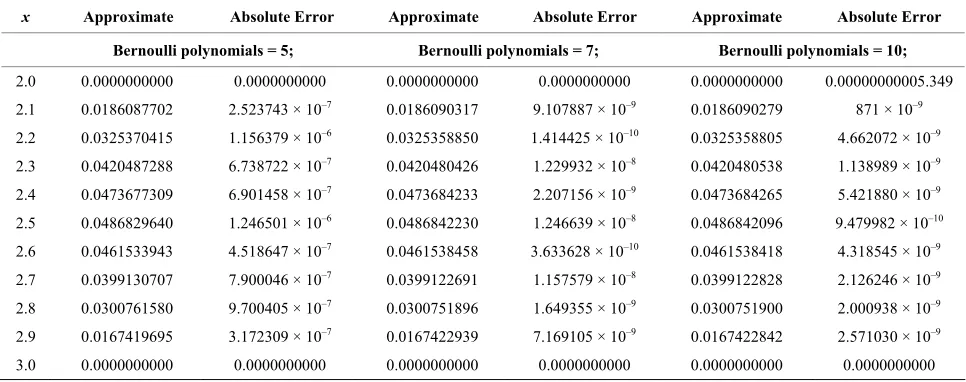
0 (16b) Using the formula derived in Equations (9), the ap-proximate solutions, shown in Table 3, are obtained on using 5, 7 and 10 Bernoulli polynomials, and the accuracy is observed nearly 7, 8 and 9 decimal places, respectively. On the contrary, the error is obtained nearly 1010 by Arshad [10] with h1 32,where h
b a N
, a andb are the endpoints of the domain and N is the number of subdivision of intervals [a,b].
Example 4. We consider the BVP with Neumann
boundary conditions [2]:
2
2
d
1, 0 1 d
u u
x x (17a)
0 1 cos1,
1 1 cos1 sin1 sin1u u (17b) whose exact solution is,
cos 1 cos1sin 1sin1
u x x x . Using the formula given in Equations (10), the ap-proximate solutions, shown in Table 4, are obtained on using 5, 7 and 10 Bernoulli polynomials with the re-markable accuracy nearly the order of 10 , 107 10 and
14
10 . On the other hand, Ramadan et al. [6] has found
Table 1. Approximate solutions and absolute differences for the example 1.
x Approximate Absolute Error Approximate Absolute Error Approximate Absolute Error
Bernoulli polynomials, 5 Bernoulli polynomials, 7 Bernoulli polynomials, 9
π/2 00.0000000000 0.0000000000 00.000000000 0.0000000000 0.0000000000 0.00000000000 11π/20 –0.1564317160 2.749065 × 10⁻⁶ –0.1564344475 1.755782 × 10⁻⁸ –0.1564344650 4.925213 × 10⁻¹¹
3π/5 –0.3090255130 8.518602 × 10⁻⁶ –0.3090169914 3.001562 × 10⁻⁹ –0.3090169944 5.283479 × 10⁻¹¹
13π/20 –0.4539971315 6.631794 × 10⁻⁶ –0.4539905271 2.730026 × 10⁻⁸ –0.4539904998 3.642830 × 10⁻¹¹
7π/10 –0.5877810347 4.217626 × 10⁻⁶ –0.587785252 7.19809 × 10⁻¹⁰ –0.5877852522 1.148404 × 10⁻¹⁰
3π/4 –0.7070961552 0.0000110000 –0.7071067522 2.896640 × 10⁻⁸ –0.7071067812 9.037660 × 10⁻¹²
4π/5 –0.8090116456 5.348787 × 10⁻⁶ –0.8090169912 3.186240 × 10⁻⁹ –0.8090169945 1.525206 × 10⁻¹⁰
17π/20 –0.8910126268 6.102617 × 10⁻⁶ –0.8910065523 2.810947 × 10⁻⁸ –0.8910065241 4.453860 × 10⁻¹¹
9π/10 –0.9510659385 9.422186 × 10⁻⁶ –0.9510565150 1.320862 × 10⁻⁹ –0.9510565162 1.337538 × 10⁻¹⁰
19π/20 –0.9876858881 2.452495 × 10⁻⁶ –0.9876883211 1.952363 × 10⁻⁸ –0.9876883408 1.614215 × 10⁻¹⁰
[image:5.595.57.540.312.503.2]π –1.0000000000 0.0000000000 –1.0000000000 0.0000000000 –1.0000000000 0.00000000000 Table 2. Approximate solutions and absolute differences for the example 2.
x Approximate Absolute Error Approximate Absolute Error Approximate Absolute Error
Bernoulli polynomials, 8 Bernoulli polynomials, 10 Bernoulli polynomials, 15
0. 0.0000000000 0.0000000000 0.0000000000 0.0000000000 0.0000000000 0.0000000000 1. 1.1136094978 0.0051685418 1.1187686211 9.418441 × 10⁻⁶ 1.1187829850 4.945487 × 10⁻⁶
2. 1.5330008942 0.0100998520 1.5229276754 2.663320 × 10⁻⁵ 1.5228972291 3.813112 × 10⁻⁶
3. 1.0001516651 0.0026819237 1.0028553869 2.179813 × 10⁻⁵ 1.0028378028 4.213962 × 10⁻⁶
4. –0.0413011761 0.0096199100 –0.0317862308 1.049646 × 10⁻⁴ –0.0316869594 5.693175 × 10⁻⁶
5. –0.7601267725 0.0047616938 –0.7647484696 1.399968 × 10⁻⁴ –0.7648818892 6.577111 × 10⁻⁶
6. –0.6303887189 0.0058561235 –0.6363262078 8.136546 × 10⁻⁵ –0.6362508546 6.012205 × 10⁻⁶
7. 0.1575008515 0.0046972725 0.1621779732 2.015082 × 10⁻⁵ 0.1622028015 4.677455 × 10⁻⁶
8. 0.8534716130 0.0008286515 0.8543763192 7.605468 × 10⁻⁵ 0.8542961563 4.108267 × 10⁻⁶
9. 0.7833934560 0.0017614110 0.7815841935 4.785153 × 10⁻⁵ 0.7816365818 4.536826 × 10⁻⁶
10. 0.0000000000 0.0000000000 0.0000000000 0.0000000000 0.0000000000 0.0000000000 Table 3. Approximate solutions and absolute differences for the example 3.
x Approximate Absolute Error Approximate Absolute Error Approximate Absolute Error
Bernoulli polynomials = 5; Bernoulli polynomials = 7; Bernoulli polynomials = 10;
2.0 0.0000000000 0.0000000000 0.0000000000 0.0000000000 0.0000000000 0.00000000005.349 2.1 0.0186087702 2.523743 × 10⁻⁷ 0.0186090317 9.107887 × 10⁻⁹ 0.0186090279 871 × 10–9
2.2 0.0325370415 1.156379 × 10⁻⁶ 0.0325358850 1.414425 × 10⁻¹⁰ 0.0325358805 4.662072 × 10⁻⁹
2.3 0.0420487288 6.738722 × 10⁻⁷ 0.0420480426 1.229932 × 10⁻⁸ 0.0420480538 1.138989 × 10⁻⁹
2.4 0.0473677309 6.901458 × 10⁻⁷ 0.0473684233 2.207156 × 10⁻⁹ 0.0473684265 5.421880 × 10⁻⁹
2.5 0.0486829640 1.246501 × 10⁻⁶ 0.0486842230 1.246639 × 10⁻⁸ 0.0486842096 9.479982 × 10⁻¹⁰
2.6 0.0461533943 4.518647 × 10⁻⁷ 0.0461538458 3.633628 × 10⁻¹⁰ 0.0461538418 4.318545 × 10⁻⁹
2.7 0.0399130707 7.900046 × 10⁻⁷ 0.0399122691 1.157579 × 10⁻⁸ 0.0399122828 2.126246 × 10⁻⁹
2.8 0.0300761580 9.700405 × 10⁻⁷ 0.0300751896 1.649355 × 10⁻⁹ 0.0300751900 2.000938 × 10⁻⁹
2.9 0.0167419695 3.172309 × 10⁻⁷ 0.0167422939 7.169105 × 10⁻⁹ 0.0167422842 2.571030 × 10⁻⁹
[image:5.595.56.539.531.722.2]MD. S. ISLAM ET AL. 1064
Table 4. Approximate solutions and absolute differences for the example 4.
x Approximate Absolute Error Approximate Absolute Error Approximate Absolute Error
Bernoulli polynomials = 5 Bernoulli polynomial = 7 Bernoulli polynomials = 10
0.0 0.0000000000 1.153937 × 10⁻¹⁰ 0.0000000000 0.0000000000 0.0000000000 0.0000000000
0.1 0.0495431439 2.654280 × 10⁻⁷ 0.0495434086 8.177960 × 10⁻¹⁰ 0.0495434094 1.932482 × 10⁻¹⁴
0.2 0.0886011150 9.870426 × 10⁻⁷ 0.0886001278 8.626597 × 10⁻¹¹ 0.0886001279 2.672862 × 10⁻¹⁴
0.3 0.1167806021 6.883117 × 10⁻⁷ 0.1167799150 1.222063 × 10⁻⁹ 0.1167799138 1.992850 × 10⁻¹⁴
0.4 0.1338006690 5.349698 × 10⁻⁷ 0.1338012039 9.031828 × 10⁻¹¹ 0.1338012040 1.013079 × 10⁻¹⁴
0.5 0.1394927538 1.173569 × 10⁻⁶ 0.1394939260 1.280755 × 10⁻⁹ 0.1394939273 2.942091 × 10⁻¹⁴
0.6 0.1338006690 5.349698 × 10⁻⁷ 0.1338012039 9.031831 × 10⁻¹¹ 0.1338012040 1.010303 × 10⁻¹⁴
0.7 0.1167806021 6.883117 × 10⁻⁷ 0.1167799150 1.222063 × 10⁻⁹ 0.1167799138 1.981748 × 10⁻¹⁴
0.8 0.0886011150 9.870426 × 10⁻⁷ 0.0886001278 8.626594 × 10⁻¹¹ 0.0886001279 2.670086 × 10⁻¹⁴
0.9 0.0495431439 2.654280 × 10⁻⁷ 0.0495434085 8.177957 × 10⁻¹⁰ 0.0495434094 1.942890 × 10⁻¹⁴
1.0 0.0000000000 0.0000000000 0.0000000000 0.0000000000 0.0000000000 0.0000000000
We now also implement the procedure described in section 3 to find the numerical solutions of two nonlinear second order boundary value problems.
Example 5. We consider a nonlinear BVP with
Dirichlet boundary conditions[16] 2
3 2
d 1 d 4 1
8 d 4
d
u u u x x
x
, 1 x 3 (18a)
1 17u and u
3 43 3 (18b) The exact solution of the problem is given by
2 16u x x x
To use Bernoulli polynomials, first we convert the BVP (18) to an equivalent BVP on
0,1 by replacingx by 2x1 such that
2
3 2
d 1 d
16 2 1 4 d
d
u u
u x
x
x , 0 x 1, (19a)
0 17u and u
1 433. (19b) Assume that the approximate solution of (19) using Bernoulli polynomials is given by
0
2
,
n i i
i
u x x a Br x
n2, (20)where 0
x 17 8 3 x is specified by the Dirichletboundary conditions at and , and for each
0
x x1 3, ,
i n
0
1i i
Br Br 0 2, .
The weighted residual equations of (19a) correspond-ing to the approximation (20), given by
1 2
3 2
0
d 1 d
16 2 1 ( )d 0 4 d
d
2,3, , .
k
u u
u x Br x
x x
k n
Exploiting integration by parts with minor simplifica-tions, we obtain
1
0 0
2 0
2 1
3 0 0
0 0
d d 1 d d
d d 4 d d
d
1 d
4 d
d d 1 d
16 2 1 d
d d 4 d 2,3, ,
n
i k i
k i k
i
n
j
j i k i
j
k
k k
Br Br Br
Br Br Br
x x x x
Br
a Br Br x a x
Br
x Br Br x
x x x
k n
(22) The above Equations (22) are equivalent to the matrix form
D C A G
(23) where the elements of the matrix A C D, , and G areand , , , , i i k i k
a c d gk, respectively, given by 1
0
, 0
0
d d 1 d d
d d
d d 4 d d
i k i
i k k i k
Br Br Br
Br Br Br x
x x x x
(24a) 1
,
2 0
d
1 d
4 d
n
j
i k j i k
j
Br c a Br Br
x
x (24b)
1
3 0 0
0 0
d d 1 d
16 2 1 d
d d 4 d
k
k k
Br
k
g x Br Br
x x x
x
(24c)
x
(21)
The initial values of these coefficients i are ob-tained by applying the Galerkin method to the BVP ne-glecting the nonlinear term in (19a). That is, to find ini-tial coefficients, we will solve the system
a
where the matrices are constructed from
1 ,
0 1
3 0
0
d d
d d and
d d
d d
16 2 1 d
d d
i k i k
k
k k
Br Br x x x
Br
g x Br
x x
x, (25b)
Once the initial values of the parameters i are ob-tained from Equation (25a), they are substituted into Equation (23) to obtain new estimates for the values of
i. This iteration process continues until the converged values of the unknowns are obtained. Substituting the final values of the coefficients in Equation (20), we ob-tain an approximate solution of the BVP (19), and if we replace
a
a
x by
x1 2
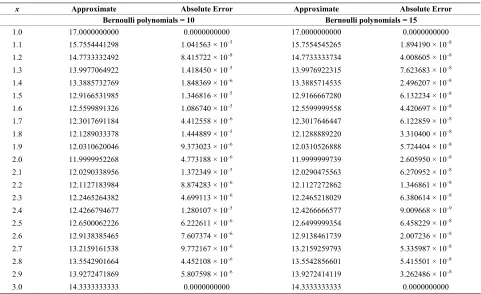
in this solution we will obtain the approximate solution of the given BVP (18).Using first 10 and 15 Bernoulli polynomials with 8 it-erations, the absolute differences between exact and the approximate solutions are sown in Table 5. It is ob-served that the accuracy is found of the order nearly
and on using 10 and 15 Bernoulli polynomi-als, respectively.
6
10 108
Example 6. Consider a nonlinear differential equation [9] with the Robin boundary conditions [17]:
2
3 2
d 1 1 ,
2 d
u x u
x 0 x 1. (26a)
0 0 1u u
The exact solution of the problem is given by
2 12
u x x x
.
In this case, solving the nonlinear BVP (26) by Modi-fied Galerkin method, the approximate solution is as-sumed by
0
,
n i i i
u x a Br x
n1, (27) Now following the procedures described as in exam-ple-5 and with minor simplifications, the Equation (22) leads us
1
2
0 0
0
0 2
1 3
0
d d 3 1 d d 2 3
1 2
1
d 2
1 1 0 0
1 1
1 0
2 2
0,1, 2, , .
n
i k
i k i
n
j i j k
j
n n
j l i j l k
j l
i k i k
k k k
Br Br
x Br Br x x
a x Br Br Br
a a Br Br Br Br x
Br Br Br Br a
x Br dx Br Br
k n
1
i
(28)
[image:7.595.58.539.428.722.2]2 and u
1 u 1 1. (26b)Table 5. Approximate solutions of example 5 using 8 iterations.
x Approximate Absolute Error Approximate Absolute Error
Bernoulli polynomials = 10 Bernoulli polynomials = 15
1.0 17.0000000000 0.0000000000 17.0000000000 0.0000000000
1.1 15.7554441298 1.041563 × 10⁻⁵ 15.7554545265 1.894190 × 10⁻⁸
1.2 14.7733332492 8.415722 × 10⁻⁸ 14.7733333734 4.008605 × 10⁻⁸
1.3 13.9977064922 1.418450 × 10⁻⁵ 13.9976922315 7.623683 × 10⁻⁸
1.4 13.3885732769 1.848369 × 10⁻⁶ 13.3885714535 2.496207 × 10⁻⁸
1.5 12.9166531985 1.346816 × 10⁻⁵ 12.9166667280 6.132234 × 10⁻⁸
1.6 12.5599891326 1.086740 × 10⁻⁵ 12.5599999558 4.420697 × 10⁻⁸
1.7 12.3017691184 4.412558 × 10⁻⁶ 12.3017646447 6.122859 × 10⁻⁸
1.8 12.1289033378 1.444889 × 10⁻⁵ 12.1288889220 3.310400 × 10⁻⁸
1.9 12.0310620046 9.373023 × 10⁻⁶ 12.0310526888 5.724404 × 10⁻⁸
2.0 11.9999952268 4.773188 × 10⁻⁶ 11.9999999739 2.605950 × 10⁻⁸
2.1 12.0290338956 1.372349 × 10⁻⁵ 12.0290475563 6.270952 × 10⁻⁸
2.2 12.1127183984 8.874283 × 10⁻⁶ 12.1127272862 1.346861 × 10⁻⁸
2.3 12.2465264382 4.699113 × 10⁻⁶ 12.2465218029 6.380614 × 10⁻⁸
2.4 12.4266794677 1.280107 × 10⁻⁵ 12.4266666577 9.009668 × 10⁻⁹
2.5 12.6500062226 6.222611 × 10⁻⁶ 12.6499999354 6.458229 × 10⁻⁸
2.6 12.9138385465 7.607374 × 10⁻⁶ 12.9138461739 2.007236 × 10⁻⁸
2.7 13.2159161538 9.772167 × 10⁻⁶ 13.2159259793 5.335987 × 10⁻⁸
2.8 13.5542901664 4.452108 × 10⁻⁶ 13.5542856601 5.415501 × 10⁻⁸
2.9 13.9272471869 5.807598 × 10⁻⁶ 13.9272414119 3.262486 × 10⁻⁸
MD. S. ISLAM ET AL. 1066
Table 6. Approximate solutions of examples using 8 iterations.
x Approximate Absolute Error Approximate Absolute Error
Bernoulli polynomials, 8 Bernoulli polynomials, 10
0.0 00.0000000000 0.0000000000 00.0000000000 0.0000000000
0.1 –0.0473680463 3.747086 × 10⁻⁷ –0.0473684172 3.803934 × 10⁻⁹
0.2 –0.0888891811 2.922364 × 10⁻⁷ –0.0888888959 6.992957 × 10⁻⁹
0.3 –0.1235296394 2.276838 × 10⁻⁷ –0.1235293980 1.372571 × 10⁻⁸
0.4 –0.1499995043 4.957444 × 10⁻⁷ –0.1500000116 1.157174 × 10⁻⁸
0.5 –0.1666665743 9.237249 × 10⁻⁸ –0.1666666693 2.681433 × 10⁻⁹
0.6 –0.1714291237 5.522990 × 10⁻⁷ –0.1714285563 1.508438 × 10⁻⁸
0.7 –0.1615383671 9.448797 × 10⁻⁸ –0.1615384751 1.360781 × 10⁻⁸
0.8 –0.1333328804 4.528913 × 10⁻⁷ –0.1333333287 4.621790 × 10⁻⁹
0.9 –0.0818186682 4.863450 × 10⁻⁷ –0.0818181840 2.134837 × 10⁻⁹
1.0 00.0000000000 0.0000000000 00.0000000000 0.0000000000
which can be written in a matrix form, similar to the sys-tem (23),
D C B A G
(29a) where the elements of A B C D, , ,k
and G are and
, , ,
, , ,
i i k i k i k
a b c d g , respectively, given by
1
2 ,
0
d d 3
d 1 d
d d 2
1 1 0 0
i k
i k i K
i k i k
Br Br
x Br Br x x x
Br Br Br Br
(29b)
1 ,
0 0
3
1 d
2
n
i k j i j k
j
c a x Br Br Br
x (29c)
1 ,
0 0 0
1 d
2
n n
i k j l i j l k
j l
b a a Br Br Br Br
x (29d)
1 3 0
1 1
1 d 0
2 2
k k k
g
x Br x Br Brk 1 (29e)To find the initial coefficients, on neglecting the nonlinear terms as we have done in example 5, we solve the reduced system
,
DA G (30a) where the elements of and , respectively, are now
,
D A G
1
2 ,
0
d d 3
d 1
d d 2
1 1 0 0
i k
i k i K
i k i k
Br Br
d
x Br Br x x x
Br Br Br Br
(30b)
1 3 0
1 1
1 0
2 2
k k k
g
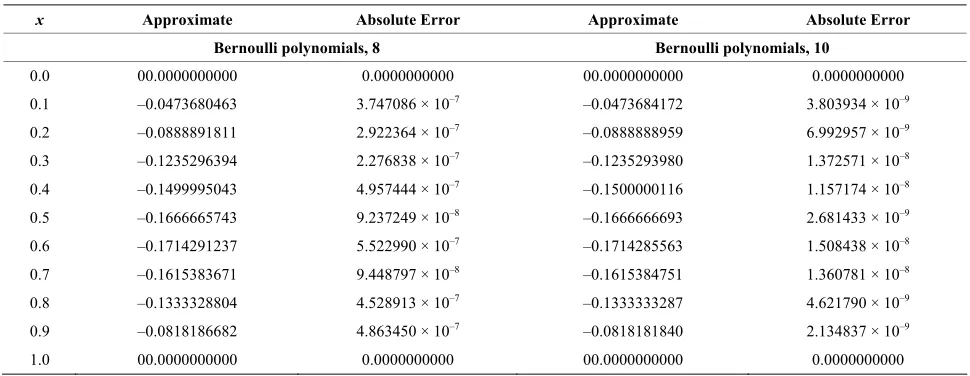
x Br dx Br Brk 1 (30c)The results are summarized in the Table 6 that ob-tained on using 8 and 10 Bernoulli polynomials with 8
iterations at various points of the domain of the problems. It is observed that the approximate results converge monotonically to the exact solutions.
5. Conclusions
We have discussed, in details, the formulation of one dimensional linear and nonlinear second order boundary value problems by Galerkin weighted residual method, using Bernoulli polynomials which have been used as the trial functions in the approximation. Some numerical examples are tested. All the mathematical formulations and numerical computations have been evaluated by
MATHEMATICA code. The computed solutions are com- pared with the exact solutions, and we have found a good agreement with the exact solution.
6. References
[1] M. I. Bhatti and P. Bracken, “Solutions of Differential Equations in a Bernstein Polynomial Basis,” Journal of
Computational and Applied Mathematics, Vol. 205, No. 1,
2007, pp. 272-280. doi:10.1016/j.cam.2006.05.002. [2] M. A. Ramadan, I. F. Lashien and W. K. Zahra,
“Poly-nomial and Nonpoly“Poly-nomial Spline Approaches to the Numerical Solution of Second Order Boundary Value Problem,” Applied Mathematics and Computation, Vol. 184, No. 2, 2007, pp. 476-484.
doi:10.1016/j.amc.2006.06.053.
[3] R.A. Usmani and M. Sakai, “A Connection between Quartic Spline and Numerov Solution of a Boundary Value Problem,” International Journal of Computer
Mathematics, Vol. 26, No. 3, 1989, pp. 263-273.
doi:10.1080/00207168908803700
[4] Arshad Khan, “Parametric Cubic Spline Solution of Two Point Boundary Value Problems,” Applied Mathematics
and Computation, Vol. 154, No. 1, 2004, pp. 175-182.
[5] E. A. Al-Said, “Cubic Spline Method for Solving Two Point Boundary Value Problems,” Korean Journal of
Computational and Applied Mathematics, Vol. 5, 1998,
pp. 759-770.
[6] E. A. Al-Said, “Quadratic Spline Solution of Two Point Boundary Value Problems,” Journal of Natural Geome-try, Vol. 12, 1997, pp. 125-134.
[7] D. J. Fyfe, “The Use of Cubic Splines in the Solution of Two Point Boundary Value Problems,” The Computer
Journal, Vol. 12, No. 2, 1969, pp. 188-192.
doi:10.1093/comjnl/12.2.188
[8] A. K. Khalifa and J. C. Eilbeck, “Collocation with Quad-ratic and Cubic Splines,” The IMA Journal of Numerical
Analysis, Vol. 2, No. 1, 1982, pp. 111-121.
doi:10.1093/imanum/2.1.111
[9] G. Mullenheim, “Solving Two-Point Boundary Value Problems with Spline Functions,” The IMA Journal of
Numerical Analysis, Vol. 12, No. 4, 1992, pp. 503-518.
doi:10.1093/imanum/12.4.503
[10] J. Reinkenhof, “Differentiation and Integration Using Bernstein’s Polynomials,” International Journal for
Nu-merical Methods in Engineering, Vol. 11, No. 10, 1977,
pp. 1627-1630. doi:10.1002/nme.1620111012
[11] E. Kreyszig, “Bernstein Polynomials and Numerical In-tegration,” International Journal for Numerical Methods
in Engineering, Vol. 14, No. 2, 1979, pp. 292-295.
doi:10.1002/nme.1620140213
[12] R. A. Usmani, “Bounds for the Solution of a Second Or-der Differential Equation with Mixed Boundary Condi-tions,” Journal of Engineering Mathematics, Vol. 9, No. 2, 1975, pp. 159-164. doi:10.1007/BF01535397
[13] B. Bialecki, “Sinc-Collocation Methods for Two Point Boundary Value Problems,” The IMA Journal of
Nu-merical Analysis, Vol. 11, No. 3, 1991, pp. 357-375.
doi:10.1093/imanum/11.3.357
[14] K. E. Atkinson, “An Introduction to Numerical Analy-sis,” 2nd Edition, John Wiley and Sons, New York, 1989, pp- 284.
[15] P. E. Lewis and J. P. Ward, “The Finite Element Method, Principles and Applications,” Addison-Wesley, Boston 1991.
[16] R. L. Burden and J. D. Faires, “Numerical Analysis,” Brooks/Cole Publishing Co., Pacific Grove, 1992. [17] M. K. Jain, “Numerical Solution of Differential