EFFECT OF AGING ON Y-Zr ON PHASE STABILITY AND SURFACE CHARACTERISTICS
*Dr. Gouri V Anehosur, Dr. Pragnya Medappa, Dr. Salian Bhavya Keshav and Dr. Lekha K
Department of Prosthodontics, SDM College of Dental Sciences and Hospital Dh
ARTICLE INFO ABSTRACT
Objective:
Yttrium stabilised zirconia ceramics after various low temperature aging using X analysis and Scanning Electron Microscopy respectively.
Materials and Methods:
manufacturers (n=15) Sample A AIDITE Sample B UPCERA
brand which were machined and sintered and glazed accordi mimic a final polished crown that is ready for cementation.
distilled water by heat treatment at temperatures of 100, 150 and 200°C for 10 hours each in order to induce phase transf
transformation using X
scanning electron microscopy (6380 LA, JEOL machine). Results:
temperature aging revealed only the tetragonal phase.
the specimens in as received condition appeared to be smooth with a few blebs here a aging was carried out, the surface irregularities became more pronounced.
Conclusion:
significant results on x
Copyright©2017, Gouri Anehosur et al. This is an open access article distributed
use, distribution, and reproduction in any medium, provided the original work is properly cited.
INTRODUCTION
Zirconia, emerging a supreme material with great value of strength and esthetics is being widely used in the field of dentistry. The array of applications of zirconia in dentistry include fabrication of posts, crowns, bridges, implants, implant abutments and esthetic orthodontic brackets
2007). Zirconia exists in three crystal phases at different temperatures namely cubic, monoclinic and tetragonal. Zirconia is in the monoclinic phase at room temperature and transforms into tetragonal phase above 1070°C. This tetragonal phase of zirconia is stable between a temperature of 1170°C and 2370°C. The cubic phase is stable only at very high temperatures (Kim et al., 2009). Clinically, the tetragonal phase of zirconia is important as it is hard, has good fra toughness and is corrosion resistant. In order to maintain this clinically significant tetragonal phase at room temperature, stabilisers such as yttria, magnesia, ceria etc are added.
*Corresponding author:Dr. Gouri V Anehosur,
Department of Prosthodontics, SDM College of Dental Sciences and Hospital Dharwad 580009, Karnataka, India.
ISSN: 0975-833X
Article History:
Received 24th May, 2017
Received in revised form
18th June, 2017
Accepted 23rd July, 2017
Published online 31st August, 2017
Citation: Dr. Gouri V. Anehosur, Dr. Pragnya Medappa, Dr. Salian Bhavya Keshav an
and surface characteristics – An in vitro study”, International Journal of Current Research
Key words:
Yttria- Stabilized Tetragonal Zirconia ceramic, Low temperature Aging, X ray Diffraction,
Scanning Electron Microscopy, Phase transformation, Surface Characteristics.
RESEARCH ARTICLE
Zr ON PHASE STABILITY AND SURFACE CHARACTERISTICS
AN IN VITRO STUDY
Dr. Gouri V Anehosur, Dr. Pragnya Medappa, Dr. Salian Bhavya Keshav and Dr. Lekha K
Prosthodontics, SDM College of Dental Sciences and Hospital Dharwad 580009, Karnataka,
ABSTRACT
Objective: The purpose of this study was to evaluate the phase stability and surface characteristics of Yttrium stabilised zirconia ceramics after various low temperature aging using X
analysis and Scanning Electron Microscopy respectively.
Materials and Methods: Our study included discs of Yttrium stabilized tetragon manufacturers (n=15) Sample A AIDITE (Qinhuangdao Technology Co., Sample B UPCERA (Shenzhen Upcera Dental Technology Co.,
brand which were machined and sintered and glazed according to manufacturer’s specifications to mimic a final polished crown that is ready for cementation. Specimens were artificially aged in distilled water by heat treatment at temperatures of 100, 150 and 200°C for 10 hours each in order to induce phase transformation. These specimens after aging were individually evaluated for the phase transformation using X- ray diffraction (JDX 8P, JEOL machine)and surface characteristics using scanning electron microscopy (6380 LA, JEOL machine).
Results: The results from x-ray diffraction analysis of both the specimens with and without low temperature aging revealed only the tetragonal phase. On scanning electron microscopy, the surface of the specimens in as received condition appeared to be smooth with a few blebs here a
aging was carried out, the surface irregularities became more pronounced.
Conclusion: The invitro tests conducted reveal that the two materials Aidite and Upcera did not show significant results on x-ray diffraction analysis and scanning electron microscopy.
is an open access article distributed under the Creative Commons Attribution License, which use, distribution, and reproduction in any medium, provided the original work is properly cited.
emerging a supreme material with great value of strength and esthetics is being widely used in the field of dentistry. The array of applications of zirconia in dentistry include fabrication of posts, crowns, bridges, implants, implant (Manicone et al., Zirconia exists in three crystal phases at different temperatures namely cubic, monoclinic and tetragonal. Zirconia is in the monoclinic phase at room temperature and 70°C. This tetragonal phase of zirconia is stable between a temperature of 1170°C and 2370°C. The cubic phase is stable only at very high Clinically, the tetragonal phase of zirconia is important as it is hard, has good fracture In order to maintain this clinically significant tetragonal phase at room temperature, stabilisers such as yttria, magnesia, ceria etc are added.
Dr. Gouri V Anehosur,
Prosthodontics, SDM College of Dental Sciences and
Occlusal and lateral forces along with added influence of saliva bring about a transformation from the tetragonal to monoclinic phase which would be undesirable
Interestingly, during clinical use this transformation is beneficial as this exhibits a volume expansion of 3 (Subbarao et al., 1974). This expansion inhibits the crack propagation that is initiated by various stresses. This transformation toughening phenomenon brings about high strength and fracture toughness of zirconia in vivo.
zirconia has excellent mechanical properties, various phenomenon that decrease the life time of zirconia have been reported. Kobayashi et al were the first to
degradation after aging process at 150
al., 1981). Since then, various studies have been carried out on low temperature aging phenomenon affecting the mechanical properties (Chevalier et al.,
performance of Yttrium stabilised tetragonal zirconia (Y in vitro, a process known as low temperature aging is carried out. Low temperature aging of zirconia is tetragonal to monoclinic transformation under simulated clinical conditions. This mimics the clinical conditions in the oral cavity and tests the performance of Y-TZP over a period of time. For example,
International Journal of Current Research
Vol. 9, Issue, 08, pp.56562-56567, August, 2017
Anehosur, Dr. Pragnya Medappa, Dr. Salian Bhavya Keshav and Dr. Lekha K, 2017. “Effect of aging on Y
International Journal of Current Research, 9, (08), 56562-56567.
Zr ON PHASE STABILITY AND SURFACE CHARACTERISTICS –
Dr. Gouri V Anehosur, Dr. Pragnya Medappa, Dr. Salian Bhavya Keshav and Dr. Lekha K
arwad 580009, Karnataka, India
The purpose of this study was to evaluate the phase stability and surface characteristics of Yttrium stabilised zirconia ceramics after various low temperature aging using X-ray diffraction
Our study included discs of Yttrium stabilized tetragonal zirconia from two (Qinhuangdao Technology Co., Ltd, Hebei, China) and (Shenzhen Upcera Dental Technology Co., Ltd, Guangdong, China), for each ng to manufacturer’s specifications to Specimens were artificially aged in distilled water by heat treatment at temperatures of 100, 150 and 200°C for 10 hours each in order to ormation. These specimens after aging were individually evaluated for the phase JEOL machine)and surface characteristics using
ray diffraction analysis of both the specimens with and without low On scanning electron microscopy, the surface of the specimens in as received condition appeared to be smooth with a few blebs here and there. As aging was carried out, the surface irregularities became more pronounced.
The invitro tests conducted reveal that the two materials Aidite and Upcera did not show ray diffraction analysis and scanning electron microscopy.
ribution License, which permits unrestricted
Occlusal and lateral forces along with added influence of saliva bring about a transformation from the tetragonal to monoclinic phase which would be undesirable normally. Interestingly, during clinical use this transformation is beneficial as this exhibits a volume expansion of 3-4% This expansion inhibits the crack propagation that is initiated by various stresses. This ughening phenomenon brings about high strength and fracture toughness of zirconia in vivo. Though zirconia has excellent mechanical properties, various phenomenon that decrease the life time of zirconia have been reported. Kobayashi et al were the first to observe the degradation after aging process at 150-400°C (Kobayashi et Since then, various studies have been carried out on low temperature aging phenomenon affecting the mechanical et al., 1999). To test the clinical formance of Yttrium stabilised tetragonal zirconia (Y-TZP) in vitro, a process known as low temperature aging is carried out. Low temperature aging of zirconia is tetragonal to monoclinic transformation under simulated clinical conditions. clinical conditions in the oral cavity and tests TZP over a period of time. For example,
INTERNATIONAL JOURNAL OF CURRENT RESEARCH
aging at 134°C for 1hour is theoretically similar to 3 vivo (Kim et al., 2009; Chevalier et al., 1999; Deville et al., 2005).
MATERIALS AND METHODS
Discs of Y-TZP from two manufacturers (n=15) Group A AIDITE(Qinhuangdao Technology Co. Ltd,
Group B UPCERA(Shenzhen Upcera Dental Technology Co. Ltd, Guangdong, China), for each brand were machined and sintered and glazed according to manufacturer’s specifications to mimic a final polished crown that is ready for cementation (Fig-1a and 1b). Control specimens (n=10) for each brand were evaluated in as-received condition.
Fig 1a. Y-TZP disc- Group A:-AIDITE
Fig. 1b. Y-TZP disc- Group B-UPCERA
Low temperature aging
Specimens were artificially aged in distilled water by heat treatment at temperatures of 100, 150 and 200°C for 10 hours each in order to induce phase transformation (Fig
they were individually evaluated for phase transformation using x-ray diffraction (XRD) and surface characteristics using scanning electron microscopy (SEM).
56563 Dr. Gouri V Anehosur et al. Effect of aging on Y
aging at 134°C for 1hour is theoretically similar to 3-4 years in 1999; Cales, 2000;
TZP from two manufacturers (n=15) Group Hebei, China) and Group B UPCERA(Shenzhen Upcera Dental Technology Co. Ltd, Guangdong, China), for each brand were machined and glazed according to manufacturer’s specifications to mimic a final polished crown that is ready for cementation 1a and 1b). Control specimens (n=10) for each brand
AIDITE
UPCERA
Specimens were artificially aged in distilled water by heat treatment at temperatures of 100, 150 and 200°C for 10 hours each in order to induce phase transformation (Fig-2). Further dividually evaluated for phase transformation ray diffraction (XRD) and surface characteristics using
X ray diffraction analysis
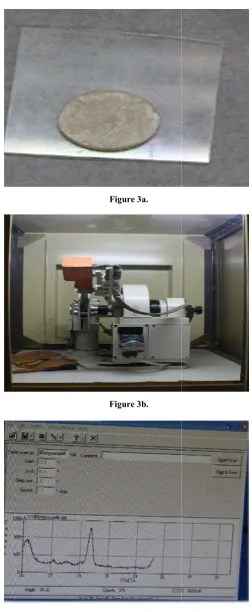
Diffraction pattern is characteristic for a particular element. This pattern can be compared with the library data to understand the composition of the material. In our study, XRD was carried out using a diffract meter
using Copper-potassium α radiation with a wavelength of λ= 1.54056Å, diffraction angle of 25 to 40°, step size of 0.02° and scan speed of 1° per minute was used (Fig
Peaks from the XRD output were compared with the library data, which is the x-ray diffraction standards file (17
zirconium oxide (Kim et al., 2009).
Figure
[image:2.595.58.270.461.664.2]Figure
Fig. 2a and Fig 2b. Low temperature aging
Scanning electron microscopy
Scanning electron microscopy (SEM) is a procedure wherein the surface characteristics of the said specimen is scanned by a beam of electrons are reflected to form an image. Gold sputtering was carried out using a
JEOL machine wherein the specimens were coated with a 15nm gold layer in order to make their surface conductive (Fig-4a, 4b and 4c). The surface grains were analysed and photographs were taken at magnifications of 5.0k and 15.0k using a 6380 LA, JEOL machine (Fig
Dr. Gouri V Anehosur et al. Effect of aging on Y-Zr on phase stability and surface characteristics
Diffraction pattern is characteristic for a particular element. e compared with the library data to understand the composition of the material. In our study, XRD diffract meter. JDX 8P,JEOL machine potassium α radiation with a wavelength of λ= , diffraction angle of 25 to 40°, step size of 0.02° and scan speed of 1° per minute was used (Fig-3a, 3b and 3c). Peaks from the XRD output were compared with the library ray diffraction standards file (17-0923) on
2009).
Figure 2a.
Figure 2b.
Low temperature aging
Scanning electron microscopy
Scanning electron microscopy (SEM) is a procedure wherein the surface characteristics of the said specimen is scanned by a beam of electrons are reflected to form an image. Gold sputtering was carried out using a JFC 1600 Autofine Coater, ein the specimens were coated with a 15nm gold layer in order to make their surface conductive 4a, 4b and 4c). The surface grains were analysed and photographs were taken at magnifications of 5.0k and 15.0k
6380 LA, JEOL machine (Fig-5).
RESULTS
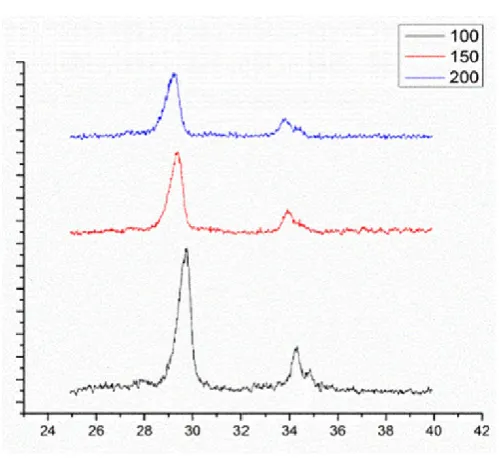
XRD: The XRD results of both the specimen
[image:3.595.33.286.151.765.2]revealed tetragonal phase. The highest phase of transformation was seen at a peak that ranged from 29.18° to 29.76° in Group A and 29.1° to 29.56° in Group B (Fig-6a and 6b). After aging only tetragonal phase was visible (Fig-7a and7b). No other significant changes were observed.
Figure 3a.
Figure 3b.
Figure 3c.
Fig. 3a, Fig-3b and Fig-3c. XRD using diffractometer JDX 8P, JEOL machine
results of both the specimen prior to aging revealed tetragonal phase. The highest phase of transformation was seen at a peak that ranged from 29.18° to 29.76° in Group 6a and 6b). After aging 7a and7b). No other
XRD using diffractometer JDX 8P,
Figure
Figure
[image:3.595.37.285.161.345.2]Figure
Fig. 4a, Fig. 4b. and Fig. 4c. Gold sputtering using Autofine Coater
Figure 4a.
Figure 4a.
Figure 4a.
Fig. 5. SEM JEOL machine
Fig. 6a. XRD of Group A before aging
Fig. 6b. XRD of Group B before aging
SEM
The surface of the specimen in as-received condition appeared to be smooth except for a few irregularities. With low temperature aging, the surface irregularities became more pronounced in Group B as compared to Group
These irregularities represented initiation of crack propagation.
56565 Dr. Gouri V Anehosur et al. Effect of aging on Y
SEM JEOL machine
XRD of Group A before aging
XRD of Group B before aging
received condition appeared for a few irregularities. With low temperature aging, the surface irregularities became more pronounced in Group B as compared to Group A (Fig-8). These irregularities represented initiation of crack propagation.
[image:4.595.36.289.265.463.2]Fig. 7a. XRD of Group A after aging
Fig. 7b. XRD of Group B after aging
Fig. 8. Images from SEM before and after aging at magnifications of 5k and 15k
Dr. Gouri V Anehosur et al. Effect of aging on Y-Zr on phase stability and surface characteristics
XRD of Group A after aging
XRD of Group B after aging
Images from SEM before and after aging at magnifications of 5k and 15k
[image:4.595.309.562.301.536.2] [image:4.595.37.290.490.686.2] [image:4.595.308.562.564.770.2]DISCUSSION
The phase transformation from tetragonal to monoclinic (up to 12%) is favourable in clinical situations as it does not allow crack to propagate. There is an increase in the flexural strength hence demonstrating an improved clinical performance of the material. When the percentage of monoclinic crystal increases beyond this i.e. 12-54%, there is a decrease in the flexural strength. In vitro phase transformation from tetragonal to monoclinic starts taking place from 100°C onwards. There is an increase in the monoclinic phase as the temperature increases. Therefore, to test the clinical performance of the material over a period of time, temperatures of 100°C, 150°C and 200°C were used. Also, the three temperatures used in the study correspond to the duration of the material in the oral cavity which signifies the longevity of the material. For instance, aging at 134°C for 1 hour is theoretically similar to 3-4 years in vivo. Hence aging at 100°C, 150°C and 200°C for 10 hours corresponds to approximately 8-10, 10-15 and 15-20 years in vivo respectively. XRD provides the percentage of particular phase of a material. According to a study conducted by Kim et al., 2009 XRD indicated that the flexural strength increased upto 12% of monoclinic concentration. Monoclinic concentration increased sharply from 12 to 75% as the temperature was increased to 125°C and above. The peak of the monoclinic phase transformation is seen at the 2 theta angle of roughly about 28° and second peak for tetragonal phase transformation is seen roughly at an angle of 30°. As opposed to this, our study showed only the tetragonal peak at the aforementioned temperatures during XRD. This implies that the monoclinic phase transformation is not very evident in the materials in Group A and Group B when aging is carried out at
a temperature above 100°C. In the study conducted by Kim et
al., 2009 SEM revealed an orange peel texture. It was found that, with an increase in temperature, there was an increase in the monoclinic phase giving it the orange peel appearance. As opposed to this, our study showed an increase in surface irregularities which became more pronounced as the temperature increased, thereby representing initiation of crack propagation. This implies that there has not been any volume expansion at the crack tip that inhibits crack propagation, suggesting the absence of monoclinic crystals in the two materials tested with aging.
Conclusion
The tetragonal to monoclinic transformation was caused by low temperature aging at temperatures of 100°C, 150°C and 200°C. After aging treatment up to 100°C, monoclinic phase started to appear, representing a clinically satisfactory performance of 8 -10 years. But the percentage of monoclinic crystals decreased with the higher temperatures i.e. 150°C and 200°C. This suggests that these two materials cannot be expected to perform clinically beyond 10 years.
Clinical implications of the study
The in vitro tests reveal that the two materials Aidite and Upcera did not show significant results on XRD and SEM which implies that the flexural strength of these two materials may be compromised after 10 years in vivo.
Scope of the study
The need to study flexural strength of the two materials
in vitro.
The need to study the percentage of monoclinic
crystals.
An in vivo simulation of lateral and vertical forces after low temperature aging.
Acknowledgement
We would like to thank Rajiv Gandhi University of Health Sciences (RGUHS) for funding this study with reference id RGU: Adv. Res: Proposal-D-40:2015-16.
REFERENCES
Aboushelib, M.N., De Jager, N, Kleverlaan, C.J., Feilzer, A.J. 2005. Microtensile bond strength of different components of core veneered all-ceramic restorations. Dent Mater., 21:984-91.
Ardlin, B.I. 2002. Transformation-toughened zirconia for dental inlays, crowns and bridges: chemical stability and effect of low-temperature aging on flexural strength and surface structure. Dent Mater., 18:590-5.
Cales, B. 2000. Zirconia as a sliding material: histologic, laboratory, and clinical data. Clin Orthop Relat Res., 379:94-112.
Cales, B., Stefani, Y., Lilley, E. 1994. Long-term in vivo and in vitro aging of a zirconia ceramic used in orthopaedy. J Biomed Mater Res., 28:619-24.
Cattani–Lorente, M. et al. 2011. Low temperature degradation of a Y-TZP dental ceramic. Acta Biomaterialia, 7:858-65. Chevalier, J., Cales, B., Drouin, J.M. 1999. Low-temperature
aging of Y-TZP ceramics. J Am Ceram Soc., 82:2150-204.
Chevalier, J., Deville, S., Mu ¨nch, E., Jullian, R., Lair, F. 2004. Critical effect of cubic phase on aging in 3mol% yttria-stabilized zirconia ceramics for hip replacement prosthesis. Biomaterials, 25:5539-45.
Deville, S., Chevalier, J., Fantozzi, G., Bartolome, J.F., Requena, J., Moya, J.S. 2003. Low-temperature ageing of zirconia-toughened alumina ceramics and its implication in biomedical implants. J Eur Ceram Soc., 23:2975-82. Deville, S., Gremillard, L., Chevalier, J., Fantozzi, G. 2005. A
critical comparison of methods for the determination of the aging sensitivity in biomedical grade yttria-stabilized zirconia. J Biomed Mater Res B Appl Biomater, 72:239-45. Emsley, J. 1991. The Elements (2nd ed.). Oxford University
Press, Oxford, UK.
Garvie, R.C., Nicholson, P.S. 1972. Phase analysis in zirconia systems. J Am Ceram Soc., 55:303-5.
Guazzato, M., Quach, L., Albakry, M., Swain, M.V. 2005. Influence of surface and heat treatments on the flexural strength of Y-TZP dental ceramic. J Dent., 33:9-18. Kim, H.T., Han, J.S., Yang, J.H., Lee, J.B., Kim, S.H. 2009.
The effect of low temperature aging on the mechanical property and phase stability of Y-TZP ceramics. J Adv Prosthodont, 1:113-7.
Kobayashi, K., Kuwajima, H., Masaki, T. 1981. Phase change and mechanical properties of ZrO2-Y2O3 solid electrolyte after ageing. Solid State Ionics, 3/4:489-93.
Kosmac, T., Oblak, C., Jevnikar, P., Funduk, N., Marion, L. 1999. The effect of surface grinding and sandblasting on flexural strength and reliability of Y-TZP zirconia ceramic. Dent Mater., 15:426-33.
Lawson, S. 1995. Environmental degradation of zirconia ceramics. J Eur Ceram Soc., 15:485-502.
transaction: corrosion and corrosive degradation of ceramics. Westerville: American Ceramics Society, 387-407.
Lube, T., Manner M, Danzer R. The miniaturization of the 4point bend test. Fatigue Fract. Engng Mater Struct 1997;20:160516.
Manicone, P.F., Lommetti, P.R., Raffaelli, L. 2007. An overview of zirconia ceramics:Basic properties and clinical implications. Journal of Dentistry Nov, 35(11):819-26. Oblak, C., Jevnikar, P., Kosmac, T., Funduk, N., Marion, L.
2004. Fracture resistance and reliability of new zirconia posts. J Prosthet Dent, 91:342-8.
Piconi, C., Maccauro, G. 1999. Zirconia as a ceramic biomaterial. Biomaterials, 20:1-25.
Pittayachawan, P., McDonald, A., Petrie, A., Knowles, J.C. 2007. The biaxial flexural strength and fatigue property of
Lava Y-TZP dental ceramic. Dent Mater, 23:1018-29.
Roebben, G., Basu, B., Vleugels, J., Van der Biest, O. 2003. Transformation induced damping behaviour of Y-TZP zirconia ceramics. J Eur Ceram Soc., 23:481-9.
Shimizu, K., Oka, M., Kumar, P., Kotoura, Y., Yamamuro, T., Makinouchi, K., Nakamura, T. 1993. Time-dependent changes in the mechanical properties of zirconia ceramic. J Biomed Mater Res., 27:729-34.
Suarez, M.J., Lozano, J.F., Paz Salido, M., Mart, nez, F. 2004. Three-year clinical evaluation of In-Ceram Zirconia posterior FPDs. Int J Prosthodont., 17:35-8.
Subbarao, E.C., Maiti, H.S., Srivastava, K.K. 1974. Martensitic transformation in zirconia. Phys Status Solidi Series A, 21:9-40.
Wen, M.Y., Mueller, H.J., Chai, J., Wozniak, W.T. 1999. Comparative mechanical property characterization of 3 all-ceramic core materials. Int J Prosthodont., 12:534-41. Yoshimura, M. 1988. Phase stability of zirconia. Am Ceram
Sot Bull, 67:1950-5.