Structural Inversion and Behavioural Changes as a
Function of Composition in Sr-La-Al-B-Si Based
Glasses
Prasanta Kumar Ojha
1,2*, Sangram K. Rath
1,2, Tapas K. Chongdar
1, Nitin M. Gokhale
1,
Ajit R. Kulkarni
21
Naval Materials Research Laboratory, Ambernath, Thane, Maharashtra, India; 2Indian Institute of Technology Bombay, Mumbai, India.
Email: [email protected]
Received April 29th, 2011; revised May 27th, 2011; accepted June 3rd, 2011.
ABSTRACT
A series of glass sealants for solid oxide fuel cell (SOFC) with compositions SrO (x wt%) La2O3 (15 wt%) Al2O3 (15
wt%) B2O3 (40-x wt%) SiO2 (30 wt%) [x = 10, 15, 20, 25 & 30] [SLABS] have been investigated by quantitative Fourier
Transform Infrared Spectroscopy (FTIR). Structural findings from FTIR reveal that with increasing substitution of B2O3
by SrO, even though the B2O3/SiO2 ratio decreases, however the Si-O-non-bridging bond content in the matrix is
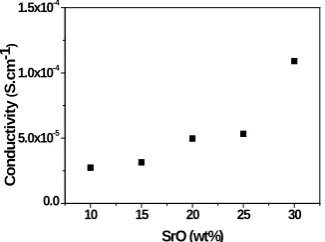
in-creasing and glass structure is getting more inverted. UV-Vis Diffused Reflectance Spectroscopy (UV-Vis-DRS) of the glass series shows that electrical band gap of glasses decreases in the series from 3.07 eV to 2.97 eV with increasing substitution from x = 10 to x = 30. Conductivities of the glass samples were measured by AC impedance spectroscopy and found to be increasing from 2.74 × 10⁻⁵ Scm-1 to 1.09 × 10⁻⁴ Scm-1 with increasing substitution from x = 10 to x = 30.
Keywords: Glass Ceramics, Mullite Ceramics Thin Tile, Composites, Bending Strength
1. Introduction
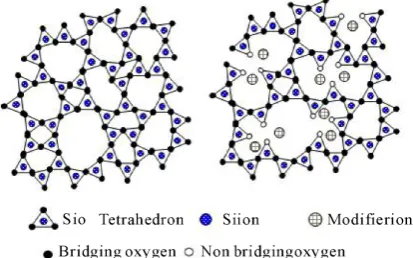
Oxide glasses are amorphous materials showing glass transition behavior and exhibit composition dependent properties. Basic studies of glasses reveal that the oxides used to synthesize glasses can be broadly divided into three groups. Network formers provide the basic network of glass, intermediate oxides which, though not able to form the network by themselves, participate with net-work formers in the basic structure, and modifier oxides “invert” the network structure by breaking the network bonds and generate non bridging oxygens. The term “in-vert” was introduced by Trapp and Stevels [1], because the traditional network forming oxides SiO2, B2O3, and
P2O5 form continuous molecular/ionic networks in
nor-mal conditions; however when the network modifying oxides are in majority on the molar basis, the glasses are inverted structurally compared to conventional glasses as shown in Figure 1. Composition of the glass and type of additives decide the nature of different structural units present in the glass which in turn decides the physical- chemical properties of glasses. For example, systematic
substitution of PbO by B2O3 in ternary lead borosilicate
[image:1.595.319.526.574.703.2]glasses [2] decreases the thermal expansion coefficient, and increases the glass transition temperature. This has been attributed to the formation of Si-O-B linkages and increase in concentration of Q4 structural units of silicon (where Qn represents silicon structural units having n-number of bridging oxygen atoms). Substitution of PbO by Bi2O3 in PbO-B2O3-SiO2 glasses results in the
increase of thermal expansion coefficient, deformation and flow temperature [3] due to structural modification. It has been reported [4-7] that addition of network mod-ifiers (alkali/alkaline earth metal oxides) to borosilicate glasses results in the initial conversion of BO3 to BO4
structural units. At higher concentration of modifiers, BO4 structural units in the glass are replaced by
BO3-structural units (planar BO3 structural units with one
non bridging oxygen atom). Hence the properties of glasses with different modifier concentrations are differ-ent. To understand the criticality of glass science it is pertinent to investigate the structure of glasses and cor-relate the structure with glass behavior. In this regard many researchers have tried to elucidate the structure of glasses using various spectroscopic techniques [8-21]. Extensive studies have been reported on the structural aspects of boroaluminosilicate glasses using techniques like FTIR, Raman and Magic Angle Spinning-Nuclear Magnetic Resonance (MAS-NMR) spectroscopy [11, 22-24]. These studies highlight the existence of various structural units like trigonally coordinated boron (BO3),
tetrahedrally coordinated boron (BO4), silicon atoms with
3 and 4 bridging oxygen atoms, Qn units with Si-O-B/ Si-O-Al linkages, etc. in the glass matrix. These structur-al units finstructur-ally govern the properties of the glasses.
In this work structure property correlation of a series of glasses with composition SrO (x wt%), La2O3 (15 wt
%), Al2O3 (15 wt%), B2O3 (40-x wt%) and SiO2 (30 wt
%) have been investigated. Glass compositions were se-lected for their application as sealant in solid oxide fuel cell (SOFC) with B2O3 and SiO2 as the network formers,
Al2O3 as the intermediate oxide and La2O3 and SrO as
the modifier oxides. In the glass composition, concentra-tion of SiO2, La2O3 and Al2O3 were kept constant and a
systematic substitution of B2O3 by SrO [x = 10, 15, 20,
25, 30] was introduced. This report includes the investi-gation of structural modification as a function of compo-sition by quantitative FTIR and UV-Vis Diffused Ref-lectance Spectroscopy (UV-Vis-DRS) and correlated with the electrical conductivity of glasses measured by AC Impedance spectroscopy.
2. Experimental
SiO2, AR grade from S. D. Fine-Chem. Ltd., India,
Al2O3, AR grade from CDH, India and La2O3, GR grade
from Loba Chemie, India were used as received for preparation of batches. Boric acid (H3BO3) (AR grade)
from SRL Pvt. Ltd., India was used as the source for B2O3 and SrCO3, extra pure grade from Loba Chemie,
India was used as the source for SrO. Batch formulations for compositions SrO (x wt%), La2O3 (15 wt%), Al2O3
(15 wt%), B2O3 (40-x wt%) and SiO2 (30 wt%) [x = 10,
15, 20, 25, 30] were calculated considering the gravime-tric factors for H3BO3 and SrCO3. Raw materials in
ap-propriate proportion for 50g batch size were mixed tho-roughly. Total mass was melted in a platinum crucible at 1450˚C for 1hr and quenched in a pre heated brass mould. Glass samples were characterized by differential thermal analysis (DTA) for their thermal behaviour. Subsequen- tly glasses were annealed at temperatures close their glass transition temperatures for removal of thermal stresses from the glass matrices.
To analyze the phases of the melt quenched sample X-ray diffractometry (XRD) was carried out using XPert MPD, PAnalytical. Diffraction studies were carried out in the range of 20˚ - 80˚ (2θ) with step size of 0.005˚ using CuKα radiation. Fourier Transform Infrared Spec-troscopy (FTIR) was carried out using 1600 Series FTIR of Perkin-Elmer via KBr pellet technique method. Quan-titative information about the structural groups in glasses was obtained from the deconvoluted FTIR spectra. In this report FTIR data are presented in absorbance mode for ease of deconvolution. The diffused reflectance spec-troscopy (DRS) of the glass samples were carried out in UV-Vis-NIR region using Perkin Elmer precisely, Lambda 35, UV/VIS Spectroscopy. In the DRS, absor-bance of the sample has been plotted against energy. The onset wavelength of the optical absorbance has been considered for band gap energy calculation using the standard equation, and is presented in the unit of electron Volt (eV). Electrical conductivity of samples were meas-ured from room temperature to 800˚C by Impedance Spectroscopy using AUTOLAB, ECO CHEMIE, Neth-erlands. Samples in the form of circular disc were in-serted between two platinum disks into an alumina hold-er and positioned (spring-loaded) inside a top loading furnace. Platinum leads attached to the platinum plates were connected to the impedance analyzer for collecting, storing and processing of data. Impedance spectra of the glasses at different temperatures were recorded in the frequency range 100 Hz to 1 MHz. From the impedance data resistance of the sample was used for calculating the conductivity, taking into account the sample dimensions.
3. Results and Discussion
Table 1. Batches with SrO-La2O3-Al2O3-B2O3-SiO2
compo-sitions for glass making and their corresponding nomen-clature.
Glass Code Glass Composition (wt%)
SrO La2O3 Al2O3 B2O3 SiO2
SLABS-3 10 15 15 30 30
SLABS-4 15 15 15 25 30
SLABS-5 20 15 15 20 30
SLABS-6 25 15 15 15 30
SLABS-7 30 15 15 10 30
pearing each case which is a clear indication of the amorphous/glassy nature of the sample. For structure elucidation all the glasses were characterized through FTIR spectroscopy. Figure 3 shows FTIR spectra for different glasses. Each spectrum shows four active infra-red spectral regions. First broad peak appeainfra-red in the range 400 - 600 cm-1 and is assigned to the bending vi-bration in SiO4 network. Peak in the range of 600 - 850
cm-1 is attributed to the bending vibration of borate seg-ments. 850 - 1200 cm-1 segment is attributed to stretching vibration of structural groups containing BO4 tetrahedral
and overlaps with SiO4 tetrahedral. These structural
groups consist of BO3 and BO4 units without
non-bridging oxygen (NBOs) ions. Peak in the region 1200 to 1500 cm-1 arises from B-O bond vibration of BO3 units [11,25-27]. This signifies two types of network
structures in the glass: one consisting of BO3 and BO4
units and the other consisting of SiO4 unit. FTIR spectra
were corrected using two- point baseline correction. The spectra were normalized to eliminate the concentration effect of the powder sample in KBr disc. To get quantita-tive information about structural groups, the spectra were deconvoluted in to Gaussian bands. Only the 400 - 1600 cm-1 range was considered for deconvolution and least square method was used to analyze the graphs. A repre-sentative plot is shown in Figure 4 which illustrates de-convolution of the FTIR spectrum of SLABS-4 glass. Data generated by deconvolution of FTIR spectra of samples include peak position, peak height, FWHM of the peak, and area under the peak. Peaks were assigned for characteristic bands and relative area under the peak was calculated with respect to the total area under all the peaks. FTIR spectra of all glass samples were deconvo-luted and the generated data were analysed for structural findings. Table 2 is a representative table enlisting de-convoluted data generated from FTIR spectra of SLABS-3 glass. As glasses are having complicated structures, several peaks obtained on deconvolution of FTIR spectra could not be assigned for characteristic vibrations as shown in the Table 2. The table includes relative area under peak which gives a quantitative idea of the corresponding structural group in the glass struc-ture. Although these glasses are having three network
formers BO3, BO4 and SiO4 units, however, glass
com-positions are changing with respect to wt% of B2O3 in the
glass matrix (B2O3 is decreasing from 30 wt% to 10 wt%
from SLABS-3 to SLABS-7) so it will not be technically proper to compare characteristic peaks due to BO3 and
BO4 in different glasses. Therefore the effect of
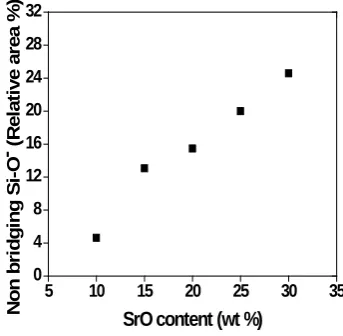
increas-ing SrO content as network modifier is compared in dif-ferent glasses relating to the changes in SiO4 network structure. From deconvolution data the relative area un-der Si-O– non bridging oxygen peak (~ 929 cm-1) [12] was calculated for different glass compositions. A graphical presentation of the non bridging oxygen (NBO) content in the glass with respect to SrO content is shown in Figure 5. The relative area which is a representation of the NBO content in the glass matrix was found to in-crease linearly with inin-crease in SrO content. This is due to SrO being a network modifier; it tends to invert the structure by breaking the network bonds in SiO4
tetrahe-dral. In the broken network, the Sr+2 ions occupy intersti-tial positions surrounded by non bridging oxygen ions. Lu et al. [28] reported, increase in glass network connec-tivity with decreasing B2O3/SiO2 in SLABS glass system.
However, in this case it was observed that even if the ratio decreases from 1 (SLABS-3) to 0.333 (SLABS-7), the connectivity decreases with formation of more non bridging oxygens as the SrO content increased. This may be due to network modifiers having more impact over the glass formers such as SiO2 and B2O3 [29].
Figure 2. XRD plot of SLABS-4.
Figure 3. FTIR plots of SLABS glasses (a. SLABS-3, b. SLABS-4, c. SLABS-5, d. SLABS-6, e. SLABS-7).
Figure 4. A typical deconvolution spectra of SLABS-4 glass a. experimental curve, b. simulated curve and the computed Gaussian bands.
(lower energy) with increasing SrO content. The shifts of the absorption band to longer wavelength correspond to the structural modification with generation of more NBOs which bound an excited electron less tightly than the bridging oxygen [30]. UV-Vis DRS result supports the findings in FTIR deconvolution study.
All the glasses have been characterized for their ther-mal behaviour and these glasses show glass transitions within temperature range of 554˚C to 659˚C and dila
5 10 15 20 25 30 35
0 4 8 12 16 20 24 28 32
N
o
n
b
ri
d
g
in
g
S
i-O
- (
R
el
at
ive ar
ea %
)
SrO content (wt %)
Figure 5. Non bridging Si-O– content in SLABS glasses as a
function of SrO content.
300 400 500 600 700 800
0.1 0.2 0.3 0.4 0.5 0.6 0.7 0.8 0.9 1.0 1.1
10 15 20 25 30 2.96
2.98 3.00 3.02 3.04 3.06 3.08
B
a
nd ga
p (
e
V
)
SrO content (wt%)
A
bsor
ban
ce
Wavelength (nm)
SLABS-3 SLABS-4 SLABS-5 SLABS-6 SLABS-7
Figure 6. UV-Vis Diffused Reflectance Spectroscopy (UV- Vis-DRS) of glasses with band gap versus composition shown inset.
[image:4.595.58.278.98.381.2] [image:4.595.314.521.303.456.2] [image:4.595.69.282.433.562.2]Table 2. Deconvolution data of the FTIR spectra of SLABS-3.
Peak Peak Type Peak Position
(cm–1) Height FWHH Area
Relative Area
(%) Band Assignment
1 Gaussian 431 0.02 42.89 0.78 0.76
2 Gaussian 453 0.03 45.56 1.24 1.20 Si-O-Si and O-Si-O bending vib
3 Gaussian 470 0.01 37.61 0.59 0.57
4 Gaussian 494 0.01 40.80 0.54 0.53
5 Gaussian 556 0.00 37.98 0.01 0.01
6 Gaussian 683 0.13 78.27 10.55 10.28 Stretching vib of B-O-B
7 Gaussian 803 0.00 36.85 0.03 0.03
8 Gaussian 903 0.07 66.05 4.76 4.64 Non bridging Si-O
9 Gaussian 968 0.09 68.05 6.76 6.58 BO4 stretching vib
10 Gaussian 1028 0.14 67.88 9.83 9.58
11 Gaussian 1090 0.15 69.19 10.98 10.70 Si-O-Si antisym stretching vib
12 Gaussian 1143 0.06 51.15 3.15 3.07
13 Gaussian 1276 0.08 81.89 6.63 6.46
14 Gaussian 1370 0.15 106.99 16.76 16.33
B-O bond vibration of borate group
15 Gaussian 1458 0.15 96.57 15.49 15.10
16 Gaussian 1542 0.13 90.62 12.16 11.85
17 Gaussian 1621 0.03 61.07 2.36 2.30
trix from 10 wt% to 30 wt%. In general, conductivity in oxide glass matrix depends on two factors, temperature and number of available charge carriers (i.e. oxide ions) [31]. In this case all the conductivities are reported at a constant temperature of 800˚C, thus the temperature ef-fect is constant for all the glasses. Again, the B2O3
con-tent in the glass matrices which may be contributing to the total conductivity of the glasses is changing. So in this case the changing conductivity of glasses is corre-lated with the structural changes of SiO4 units only.
In-creasing SrO content in the glass leads to increase in NBO content due to structural inversion and decreasing
10 15 20 25 30
0.0 5.0x10⁻⁵
1.0x10⁻⁴
1.5x10⁻⁴
C
o
n
d
u
c
ti
v
it
y
(
S
.c
m
-1)
SrO (wt%)
Figure 7. Conductivity of SLABS glasses versus SrO con-tent in the glass.
band edge. This makes more carriers available in the SrO content the conductivity of the glass increases.
4. Conclusions
Glasses with composition SrO (x wt%) La2O3 (15 wt%)
Al2O3 (15 wt%) B2O3 (40-x wt%) SiO2 (30 wt%) were
prepared for x = 10, 15, 20, 25 and 30. FTIR analysis show two types of network structures in the glass: one consisting of BO3 and BO4 units and the other consisting
of SiO4 unit. Deconvolution of FTIR plots highlights the
structural changes with composition. With increase in SrO content in the glass matrix, non bridging Si-O– con-tent increases even though the B2O3/SiO2 decreases. This
structural inversion is reflected in the properties of the glasses. The band edge of the glass samples measured by Uv-Vis DRS show a decreasing band gap with increasing SrO content. Conductivity of glass samples which is measured by impedance spectroscopy increases with increasing substitution of B2O3 by SrO.
REFERENCES
[1] H. J. L. Trapp and J. M. Stevels, “Physical Properties of Invert Glasses,” Glasstechn. Ber., 32K V. Internationaler Glaskongress, Miinchen, 1959, pp. VI/31-52.
[image:5.595.89.252.567.688.2](PbO)0.5 (SiO2)0.5 Glasses,” Journal of Physics:
Con-densed Matter, Vol. 14, No. 25, 2002, pp. 6553-6565.
[3] K. Kobayashi, “Thermogravimetric and MOS Capacitor Properties for PbO-Bi2O3-B2O3-SiO2 Glass System,”
Journal of Non-Crystalline Solids, Vol. 124, No. 2-3, 1990, pp. 229-232.
[4] G. E. Jellison and P. J. Bray, “A Structural Interpretation of B10 and B11 NMR Spectra in Sodium Borate Glasses,”
Journal of Non-Crystalline Solids, Vol. 29, No. 2, 1978,
pp. 187-206
[5] G. Bhasin, A. Bhatnagar, S. Bhowmick, C. Stehle, M. Affatigato, S. Feller, J. MacKenzie and S. Martin, “Short Range Order Structure in Sodium Borosilicate Glasses Obtained from Deconvolution of 29Si MAS NMR Spec-tra,” Physics and Chemistry of Glasses, Vol. 39, 1998, p. 269.
[6] B. G. Parkinson, D. Holland, M. E. Smith, A. P. Howes and C. R. Scales, “The Effect of Cs2O Additions on HLW
Waste form Glasses,” Journal of Non-Crystalline Solids, Vol. 351, No. 30-32, 2005, pp. 2425-2432.
[7] S. Feller, W. J. Dell and P. J. Bray, “B10 NMR Studies of Lithium Borate Glasses,” Journal of Non-Crystalline Solids, Vol. 51, No. 1, 1982, pp. 21-30.
[8] R. K. Brow, D. R. Tallant, S. T. Myers and C. C. Phifer, “The Short Range Structure of Zinc Phosphate glass,”
Journal of Non-Crystalline Solids, Vol. 191, No. 1-2,
1995, pp. 45-55
[9] P. P. Proulx, G. Cormier, J. A. Capobianco, B. Cham-pagnon and M. Bettinelli, “Raman and Low Frequency Raman Spectroscopy of Lead, Zinc and Barium Meta-phosphate Glasses Doped with Eu3+ Ions,” Journal of Physics: Condensed Matter, Vol. 6, No. 1, 1994, pp.
275-2
[10] S. Bale and S. Rahman, “Glass Structure and Transport Properties of Li2O Containing Zinc Bismuthate Glasses,”
Optics Materials, Vol. 31, No. 2, 2008, pp. 333-337.
[11] K. El-Egili, “Infrared Studies of Na2O-B2O3-SiO2 and
Al2O3-Na2O-B2O3-SiO2 Glasses,” Physica B, Vol. 325,
No. 1-4, 2003, pp. 340-348.
[12] V. Kumar, A. Arora, O. P. Pandey and K. Singh, “Studies on Thermal and Structural Properties of Glasses as Sea-lants for Solid Oxide Fuel Cells,” International Journal of Hydrogen Energy, Vol. 33, No. 1, 2008, pp. 434-438.
[13] F. Moreau, A. Durán and F. Muñoz, “Structure and Prop-erties of High Li2O-Containing Aluminophosphate
Glasses,” Journal of European Ceramic Society, Vol. 29, No. 10, 2009, pp. 1895-1902.
[14] J. Ramkumar, V. Sudarsan, S. Chandramouleeswaran, V. K. Shrikhande, G. P. Kothiyal, P. V. Ravindran, S. K.
Kulshreshtha and T. Mukherjee, “Structural Studies on Boroaluminosilicate Glasses,” Journal of Non-Crystalline Solids, Vol. 354, No. 15-16, 2008, pp. 1591-1597.
[15] M. S. Gaafar, H. A. Afifi and M. M. Mekawy, “Structural Studies of Some Phospho-Borate Glasses Using Ultra-sonic Pulse-Echo Technique, DSC and IR Spectroscopy,”
Physica B: Condensed Matter, Vol. 404, No. 12-13, 2009,
pp. 1668-167
[16] M. S. Gaafar, N. S. A. El-Aal, O. W. Gerges and G. El-Amir, “Elastic Properties and Structural Studies on Some Zinc-Borate Glasses Derived from Ultrasonic, FT-IR and X-Ray Techniques,” Journal of Alloys and Compounds, Vol. 475, No. 1-2, 2009, pp. 535-542.
[17] U. Hoppe, G. Walter, R. Kranold and D. Stachel, “Struc-tural Specifics of Phosphate Glasses Probed by Diffrac-tion Methods: A Review,” Journal of Non-Crystalline Solids, Vol. 263-264, No. 1-2, 2000, pp. 29-47.
[18] K. Suzuya, D. L. Price, C. K. Loong and S. W. Martin, “Structure of Vitreous P2O5 and Alkali Phosphate
Glasses,” Journal of Non-Crystalline Solids, Vol. 232- 234, 1998, pp. 650-657.
[19] A. Hayashi, M. Nakai, M. Tatsumisago, T. Minami, Y. Himei, Y. Miura and M. Katada, “Structural Investigation of SnO-B2O3 Glasses by Solid-State NMR and X-Ray
Photoelectron Spectroscopy,” Journal of Non-Crystalline Solids, Vol. 306, No. 3, 2002, pp. 227-237.
[20] N. P. Lower, J. L. McRae, H. A. Feller, A. R. Betzen, S. Kapoor, M. Affatigato and S. A. Feller, “Physical Proper-ties of Alkaline-Earth and Alkali Borate Glasses Prepared over an Extended Range of Compositions,” Journal of Non-Crystalline Solids, Vol. 293-295, 2001, pp. 669-675. [21] R and IR Spectroscopies,” Journal of Non-Crystalline
Solids, Vol. 232-234, 1998, pp. 113-118.
[22] E. I. Kamitsos, A. P. Patsis, M. A. Karakassides and G. D. Chryssikos, “Infrared Reflectance Spectra of Lithium Borate Glasses,” Journal of Non-Crystalline Solids, Vol. 126, No. 1-2, 1990, pp. 52-67.
[23] E. I. Kamitsos, M. A. Karakassides and G. D. Chryssikos, “A Vibrational Study of Lithium Borate Glasses with High Li2O Content,” Physics and Chemistry of Glasses,
Vol. 28, 1987, p. 203.
[24] E. I. Kamitsos, M. A. Karakassides and G. D. Chryssikos, “Vibrational-Spectra of Magnesium-Sodium-Borate Glasses. 2. Raman and Midinfrared Investigation of the Network Structure,” Journal of Physical Chemistry, Vol. 91, No. 5, 1987, pp. 1073-1079.
[25] K. Lu and M. K. Mahapatra, “Network Structure and Thermal Stability Study of High Temperature Seal Glass,” Journal of Applied Physics, Vol. 104, No. 7, 2008,
[26] P. Brix and L. Gaschler, “Sealing Glass for the Produc-tion of Glass-to-Metal Seals,” US Patent, US 5137849, 1992.
[27] H. A. A. Sidek, S. Rosmawati and Z. A. Talib, “Synthesis and Optical Properties of ZnO-TeO2 Glass System,”
American Journal of Applied Sciences, Vol. 6, No. 8,
2009, pp. 1489-1494