EFFECTS OF DIFFERENT TYPES OF COMMERCIAL FEED ON THE ZOOTECHNICAL PERFORMANCE
OF LARVAE OF THE "BRAZIL" STRAIN OF TILAPIA OF THE NILE
1
Ué Claver Zéa Bi,
1
Doctoral student at Félix Houphouët Boigny University, Biosciences UFR, Hydrobiology and Water
2
Senior Lecturer and Research Professor at
Hydrobiology and Water Ecotechnology Laboratory
3
Lecturer and Research Professor at Félix Houphouët Boigny University, Biosciences UFR,
Hydrobiology and Water Ecotechnology Laboratory
ARTICLEINFO ABSTRACT
The objective of this study is to evaluate the influence of different types of commercial feed on the zoo technical performance on Brazil strain larvae of Nile tilapia
1758) in
Skretting, Raanan and Real with 17%, 48%, 48%, 48% and 60% protein respectively. The average larvae 17.38 ± 1.92 mg were fed rations of 50% (1st week), 40% (2nd we
25% (4th week) of their total biomass for 28 days.The results showed that the best zootechnical performance was obtained with the Skretting feed, followed by the Raanan feed. The final average weights achieved were 1020.44 ± 24.66 m
369.29 mg respectively with Ivograin, Skretting, Raanan and Real. Larvae fed Ivograin feed had a high survival rate than those fed Skretting, Raanan and Real feeds. On the other hand, the nutrient quotient was significantly higher in larvae fed Ivograin and Real compared to other foods. The economic analysis showed that the cost of the feed distributed to larvae and the cost of the feed to produce the kilogram of fry were relatively higher with Skretting
and Real feed.
Copyright©2019, Ué Claver Zéa Bi et al. This is an open use, distribution, and reproduction in any medium, provided
INTRODUCTION
In many African countries, fish is the main source of inexpensive and nutritionally valuable protein and animal fat (Asté et al., 2012) In Côte d'Ivoire, national demand for fishery products is estimated at 300,000 tonnes(MIRAH, 2014). However, aquaculture production is insufficient. It increased from 1200 tonnes in 2000 to 866 tonnes in 2005, then to 1700 tonnes in 2010 and 3720 tonnes in 2013 (FAO, 2015).To meet these needs in fish products, the Ivorian State imports fish on a massive scale. According FAO (2011), these imports cause a considerable outflow of foreign currency in the order of 130.5 billion CFA francs. Thus, to reduce these imports, the Ivorian government has made the fisheries resources sector, particularly aquaculture, a new development pol
2012). To this end, the Ivorian authorities imported a strain of tilapia Nile Oreochromis niloticus from Brazil in 2014, in an effort to solve the problem of the size of the fish produced and increase fish production in Côte d'Ivoire.
ISSN: 0975-833X
Article History:
Received 26th February, 2019 Received in revised form 17th March, 2019 Accepted 13th April, 2019 Published online 30th May, 2019
Citation: Ué ClaverZéa Bi, Nahoua Issa Ouattara and Siaka Berté
the "Brazil" strain of tilapia of the Nile Oreochromis niloticus (Linnaeus, 1758)
Key Words:
Feed, Zootechnical Performance, Larvae, Brazil Strain,
Oreochromis niloticus.
*Corresponding author:
RESEARCH ARTICLE
EFFECTS OF DIFFERENT TYPES OF COMMERCIAL FEED ON THE ZOOTECHNICAL PERFORMANCE
OF LARVAE OF THE "BRAZIL" STRAIN OF TILAPIA OF THE NILE
OREOCHROMIS
(LINNAEUS, 1758).
Zéa Bi,
2Nahoua Issa Ouattara and
3Siaka Berté
Doctoral student at Félix Houphouët Boigny University, Biosciences UFR, Hydrobiology and Water
Ecotechnology Laboratory
Senior Lecturer and Research Professor at Félix Houphouët Boigny University, Biosciences UFR,
Hydrobiology and Water Ecotechnology Laboratory
Lecturer and Research Professor at Félix Houphouët Boigny University, Biosciences UFR,
Hydrobiology and Water Ecotechnology Laboratory
ABSTRACT
The objective of this study is to evaluate the influence of different types of commercial feed on the technical performance on Brazil strain larvae of Nile tilapia
1758) in breeding conditions in Côte d'Ivoire. The study focused on four commercial foods, Ivograin, Skretting, Raanan and Real with 17%, 48%, 48%, 48% and 60% protein respectively. The average larvae 17.38 ± 1.92 mg were fed rations of 50% (1st week), 40% (2nd we
25% (4th week) of their total biomass for 28 days.The results showed that the best zootechnical performance was obtained with the Skretting feed, followed by the Raanan feed. The final average weights achieved were 1020.44 ± 24.66 mg; 1615.55 ± 86.34 mg; 1478.44 ± 232.30 mg; 969.99 ± 369.29 mg respectively with Ivograin, Skretting, Raanan and Real. Larvae fed Ivograin feed had a high survival rate than those fed Skretting, Raanan and Real feeds. On the other hand, the nutrient nt was significantly higher in larvae fed Ivograin and Real compared to other foods. The economic analysis showed that the cost of the feed distributed to larvae and the cost of the feed to produce the kilogram of fry were relatively higher with Skretting
and Real feed.
open access article distributed under the Creative Commons Attribution provided the original work is properly cited.
In many African countries, fish is the main source of inexpensive and nutritionally valuable protein and animal fat ., 2012) In Côte d'Ivoire, national demand for fishery products is estimated at 300,000 tonnes(MIRAH, 2014). production is insufficient. It increased from 1200 tonnes in 2000 to 866 tonnes in 2005, then to 1700 (FAO, 2015).To meet these needs in fish products, the Ivorian State imports fish on a (2011), these imports cause a considerable outflow of foreign currency in the order of 130.5 billion CFA francs. Thus, to reduce these imports, the Ivorian government has made the fisheries resources sector, particularly aquaculture, a new development policy(Asté et al., 2012). To this end, the Ivorian authorities imported a strain of from Brazil in 2014, in an effort to solve the problem of the size of the fish produced and
According Lazard (2009), O. niloticus
appreciated flesh and rapid growth. Its reproduction and breeding are easy. He has a relatively plastic diet. However, one of the constraints for this species is the availability of fry due on the one hand to the lack of control of production techniques and on the other hand to the feeding based exclusively on high-quality protein
protein feeds by some fish farmers results in long production times and low larval growth of Cichlidae
addition, very little work has been done to report the zootechnical performance of O. niloticus
less than 2g (Bamba et al., 2007). Therefore, it seems appropriate to evaluate the zootechnical performance o fed quality protein-rich feeds over a period of 28 days for application in the production of fry in captivity. This study therefore aims to evaluate the effect of different types of commercial feed on the zootechnical performance of larvae of the Brazil strain of Nile tilapia
conditions in Côte d’Ivoire.
International Journal of Current Research Vol. 11, Issue, 05, pp.3917-3922, May, 2019
DOI: https://doi.org/10.24941/ijcr.35368.05.2019
Ué ClaverZéa Bi, Nahoua Issa Ouattara and Siaka Berté. 2019. “Effects of different types of commercial feed on the zootechnical performance of larvae of he Nile Oreochromis niloticus (Linnaeus, 1758)”, International Journal of Current Research, 11, (05
EFFECTS OF DIFFERENT TYPES OF COMMERCIAL FEED ON THE ZOOTECHNICAL PERFORMANCE
OREOCHROMIS NILOTICUS
Siaka Berté
Doctoral student at Félix Houphouët Boigny University, Biosciences UFR, Hydrobiology and Water
Félix Houphouët Boigny University, Biosciences UFR,
Lecturer and Research Professor at Félix Houphouët Boigny University, Biosciences UFR,
The objective of this study is to evaluate the influence of different types of commercial feed on the
technical performance on Brazil strain larvae of Nile tilapia Oreochromis niloticus (Linnaeus,
The study focused on four commercial foods, Ivograin, Skretting, Raanan and Real with 17%, 48%, 48%, 48% and 60% protein respectively. The average larvae 17.38 ± 1.92 mg were fed rations of 50% (1st week), 40% (2nd week), 30% (3rd week) and 25% (4th week) of their total biomass for 28 days.The results showed that the best zootechnical performance was obtained with the Skretting feed, followed by the Raanan feed. The final average g; 1615.55 ± 86.34 mg; 1478.44 ± 232.30 mg; 969.99 ± 369.29 mg respectively with Ivograin, Skretting, Raanan and Real. Larvae fed Ivograin feed had a high survival rate than those fed Skretting, Raanan and Real feeds. On the other hand, the nutrient nt was significantly higher in larvae fed Ivograin and Real compared to other foods. The economic analysis showed that the cost of the feed distributed to larvae and the cost of the feed to produce the kilogram of fry were relatively higher with Skretting feed compared to Raanan, Ivograin
Attribution License, which permits unrestricted
O. niloticus is a very hardy fish with
appreciated flesh and rapid growth. Its reproduction and breeding are easy. He has a relatively plastic diet. However, one of the constraints for this species is the availability of fry the one hand to the lack of control of production techniques and on the other hand to the feeding based quality protein-rich feeds. The use of low-protein feeds by some fish farmers results in long production
h of Cichlidae O. niloticus. In addition, very little work has been done to report the
O. niloticus specimens weighing
., 2007). Therefore, it seems appropriate to evaluate the zootechnical performance of larvae rich feeds over a period of 28 days for application in the production of fry in captivity. This study therefore aims to evaluate the effect of different types of commercial feed on the zootechnical performance of larvae of Brazil strain of Nile tilapia O. niloticus in farming OFCURRENTRESEARCH
MATERIALS AND METHODS
Larval production: The experiments were carried out in a
private fish farm (Aqualand), located about 40 kilometres from Abidjan in Côte d'Ivoire. Average larvae weights of 17.38 ± 1.92 mg were obtained from the Brazil brood stock of O.
niloticus with an average body weight of 215 ± 12.90 g for
females and 442.5 ± 132.25 g for males. The stocking density of the spawners was two females to one male (Chimatiro and Costa-Pierre, 1996). The larvae were collected three (3) weeks after loading the spawners in a 28 m² breeding happa installed in a 350 m² pond. To harvest the larvae, the surface of the breeding catch was narrowed to collect all the larvae produced. The larvae, once gathered at the surface of the water, were collected using two 1 mm mesh vacuum nets and poured into buckets containing water.
Experimental feeds and larval feeding: The test feeds used
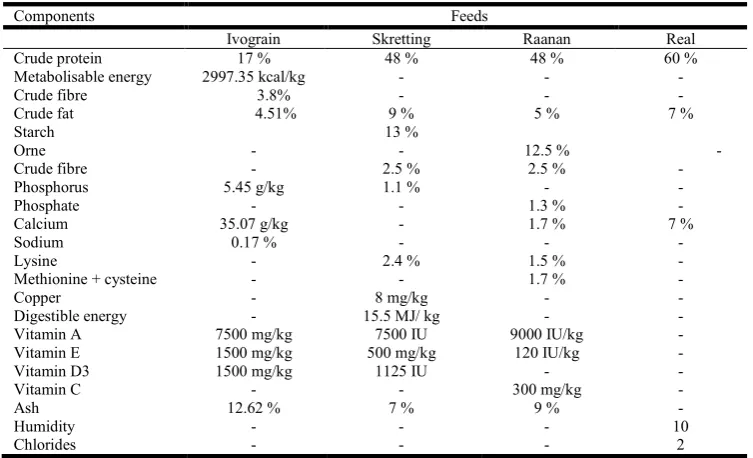
as a basis for this experiment were provided by four (4) industrial manufacturers. These are the test feeds Ivograin, Raanan, Real and Skretting with 17%, 48%, 60% and 48% protein respectively. The bromatological composition of these four experimental feeds is presented in Table 1. Larvae were fed rations of 50%, 40%, 30% and 25% of their total biomass respectively during the 1st, 2nd, 3rd and 4th week of feeding. Daily food rations were served manually in 6 meals at 8:00, 10:00, 12:00, 14:00, 15:00 and 16:00.
Experimental set-up and constitution of experimental lots:
The tests were conducted in a private fish farm (Aqualand) for 28 days in twelve (12) catchers with a surface area of 1 m² each and a mesh size of 1 mm. These happas were installed in a 350 m² pond. The pond is supplied with water by gravity from a water retention lake. It is equipped with a buried Polyvinyl Chloride pipe system, the opening of which is covered with a 1 mm mesh mosquito net. The larvae obtained were counted and distributed in breeding structures. Before the loading of the happas, the initial average weight of each individual was determined. This consisted of random sampling and weighing 3 samples of 200 larvae. Larval biomass (17g) was assessed by the product of the average weight and number of larvae of each happa. From this biomass, twelve batches of larvae in three batches per feed were formed to carry out the loading. For each batch, a stocking density of 1000 individuals/m² was used.
Water quality of the livestock and evaluation of
zootechnical parameters: Water quality (dissolved oxygen,
pH, transparency and temperature) was monitored twice a day between 6 am and 30' and 7 am and between 3 pm and 30' and 4 pm. This operation was performed before feeding and repeated 3 days a week (Ouattara et al., 2005). Weight growth control fisheries were conducted every seven (07) days on 25% of the high population. During these fisheries, all larvae of each happa were weighed together using a YP Series and YP 3002 electronic scale (accuracy 0.01 g; range 300 g) to determine the total biomass of each treatment. These control fisheries have made it possible to readjust the feed ration in proportion to the total biomass. At the end of the experiment, first all fish were counted to assess the survival rate. Then, 30 individuals randomly selected from each happa were measured for length (total and standard) using a 50 cm long ichthyometer and individual weight according (Tigoli et al., 2017). On the basis of these data, the various zootechnical performance parameters (survival rate, food conversion ratio, weight gain,
average daily gain, condition factor) on the one hand, and financial profitability on the other hand, were evaluated as follows:
Zootechnical parameters
Survival rate (SR) (%) =Number of ish harvested
Number of ish stocked x 100
Weight gain (WG) = Final weight (g) − Initial weight (g)
Average daily gain (ADG) =Weight gain (g)
Culturing day
Condition factor (CF) = Fish weight (g)
Standard lengthᶾ (mm) 100
Foodconverion ratio (FCR) = Total feed given (g)
Total weigth gained (g)
Production parameters and financial profitability of food Statistical analysis
Quantity of feed used (g) = Daily ration x Breeding time in days
Cost of feed used (fcfa)
= Amount of feed used x Cost per kg of feed
Net biomass (kg) = Final biomass − Initial biomass
Food cost of production per kg of fry =Cost of food used Net biomass
The zootechnical (survival rate, nutrient quotient, final weight, weight gain, daily weight gain, condition factor) and physico-chemical parameters were subjected to the analysis of variance using a criterion (ANOVA 1). This test was followed by the Tukey multiple comparison test for parameters with variability (p < 0.05) to identify specific differences between batches taken in pairs. As for the survival rate, it was subject to a contingency table. These analyses were performed using STATISTICA 7.1 software.
RESULTS
Physico-chemical characterization of water in Breeding
structure: The mean values of the abiotic variables (water
temperature, dissolved oxygen, pH, and transparency) are presented in Table 2. The average temperature recorded in the various happas ranges from 29.16°C (H2) to 29.38°C (H4). The
concentration of dissolved oxygen in happas is high (4.38 mg/l) in H2 and low (4.17 mg/l) in H4. The average value of
transparency was minimal (30.20 cm) in H1 and maximal
(30.39 cm) in H4. The average pH values obtained ranged from
7.16 (H2) to 7.38 (H4). However, statistical analysis of the
results shows that there is no significant difference (p > 0.05) between abiotic variables from one structure to another.
Evaluation of zootechnical parameters: The data on
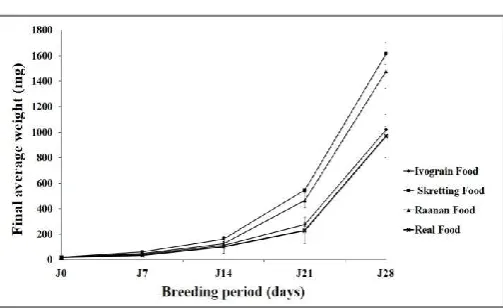
and 969.99 ± 369.29 mg respectively for Ivograin, Skretting, Raanan and Real foods. As for weight gain, the values recorded were 1003.44 ± 24.66 mg ; 1598.55 ± 86.34 mg ; 1461.44 ± 232.30 mg and 952.99 ± 369.29 mg Ivograin, Skretting, Raanan and Real respectively. Regarding daily weight gain, larvae fed Ivograin, Skretting, Raanan and Real obtained 35.83 ± 0.88 mg, 57.08 ± 3.08 mg, 52.19 ± 8.29 mg and 34.03 ± 13.19 mg respectively.
[image:3.595.105.482.94.323.2]In terms of nutrient quotient, the mean values observed in individuals were 0.60 ± 0.03 mg, 0.39 ± 0.05 mg, 0.38 ± 0.02 mg and 0.38 ± 0.02 mg respectively for Ivoigrain, Skretting, Raanan and Real foods. The survival rates recorded varied significantly (p < 0.05) from one food to another. The highest value (99.13 ± 0.23%) of this parameter was recorded in larvae bound to the Ivograin feed and the lowest value (90.53 ± 0.50%) in individuals fed the Real feed.
Table 1. Bromatological composition of foods experimental Ivograin, Skretting, Raanan and
Real used to feed Nile O. niloticus tilapia larvae
Components Feeds
Ivograin Skretting Raanan Real
Crude protein 17 % 48 % 48 % 60 %
Metabolisable energy 2997.35 kcal/kg - - -
Crude fibre 3.8% - - -
Crude fat 4.51% 9 % 5 % 7 %
Starch 13 %
Orne - - 12.5 % -
Crude fibre - 2.5 % 2.5 % -
Phosphorus 5.45 g/kg 1.1 % - -
Phosphate - - 1.3 % -
Calcium 35.07 g/kg - 1.7 % 7 %
Sodium 0.17 % - - -
Lysine - 2.4 % 1.5 % -
Methionine + cysteine - - 1.7 % -
Copper - 8 mg/kg - -
Digestible energy - 15.5 MJ/ kg - -
Vitamin A 7500 mg/kg 7500 IU 9000 IU/kg -
Vitamin E 1500 mg/kg 500 mg/kg 120 IU/kg -
Vitamin D3 1500 mg/kg 1125 IU - -
Vitamin C - - 300 mg/kg -
Ash 12.62 % 7 % 9 % -
Humidity - - - 10
[image:3.595.84.499.378.430.2]Chlorides - - - 2
Table 3. Environmental variables measured in happas H1, H2, H3 and H4 during the breeding of Nile O. niloticus tilapia larvae. The
values represent the means and standard deviations of triplicates. The values that are assigned the same alphabetical letter are not significantly different (p < 0.05) for each row of the table
Physico-chemical parameters H1 H2 H3 H4
Temperature (°C) 29.19 ± 0.02a 29.16 ± 0.03a 29.22 ± 0.11a 29.38 ± 0.46a
Dissolved oxygen (mg/l) 4.19 ± 0.02a 4.17 ± 0.03a 4.22 ± 0.12a 4.38 ± 0.46a
pH 7.19 ± 0.02a 7.16 ± 0.03a 7.22 ± 0.11a 7.38 ± 0.46a
Transparency (cm) 30.20 ± 0.02a 30.27 ± 0.19a 30.24 ± 0.13a 30.39 ± 0.45a
Values in the same row sharing the same superscript are not significantly different (p> 0.05). Data are represented as means ± standard error
Table 4. Zootechnical parameters of larvae of Nile tilapia O. niloticus subjected to different food treatments for 28 days
zootechnical parameters Ivograin Skretting Raanan Real
Initial average weight (mg) 17.38 ± 1.92a 17.38 ± 1.92a 17.38 ± 1.92a 17.38 ± 1.92a
Survival rate (%) 99.13 ± 0.23a 95.2 ± 0.72b 94.27 ± 1.41b 90,53 ± 0,50c
Food conversion rate 0.60 ± 0.03b 0,39 ± 0,05a 0.38 ± 0.02a 0,38 ± 0,02a
Final average weight (mg) 1020.44 ± 24.66a 1615.55 ± 86.34bc 1478.44 ± 232.30ac 969,99 ± 369,29a
Weight gain (mg) 1003.44 ± 24,66a 1598.55 ± 86.34bc 1461.44 ± 232.30ac 952,99 ± 369,29a
Average daily gain (mg/j) 35.83 ± 0.88a 57.08 ± 3.08bc 52.19 ± 8.29ac 34,03 ± 13,19a
Condition factor 1.73 ± 0.08ab 1.76 ± 0.01b 1.61 ± 0.04a 1,68 ± 0,02a
Values in the same row sharing the same superscript are not significantly different (p> 0.05). Data are represented as means ± standard error
Table 5. Economic parameters of larvae of Nile tilapia O. niloticus fed with different experimental feeds
Production and cost parameters Foods
Ivagrain Skretting Raanan Real
Initial biomass (kg) 0.00869 0.00869 0.00869 0.00869
Final biomass (kg) 0.506 0.769 0.696 0.439
Net biomass (kg) 0.497 0.760 0.687 0.430
Cost per kg of food (FCFA) 312 312 1420 630
Amount of feed distributed (g) 299.7 302.39 302.39 231.26
Cost of food distributied (FCFA) 93.5 703 703 145.6
[image:3.595.56.528.480.559.2] [image:3.595.66.520.619.707.2]Figure 1. Evolution of the average weight of larvae of the
Brazilian strain of tilapia of the Nile Oreochromis niloticus
subjected to different diets according to the days of breeding.
The values of the condition factor recorded in this study range from 1.61 to 1.76. The statistical analysis carried out shows that there is a significant difference (p ˂ 0.05) between these values.
Evaluation of production costs: Data on the costs per
kilogram of food, quantities of food used, costs of food distributed and food costs of production per kilogram of fry are recorded in Table 4. The costs per kilogram of food vary from 312 to 2325 CFA francs for the food used. The Skretting feed is the most expensive and the Ivograin feed the least expensive. Regarding the amount of feed distributed during the experiment, individuals in the H1, H2, H3 and H4 breeding
facilities consumed between 231.26 and 302.39 g of feed. The Skretting feed used in the H2 structure was the most distributed
compared to the Real feed used in the H4 structure. The feed
costs to produce the registered kg of fry range from 188 to 925 CFA francs for the feed used. The kilogram of fry produced with Skretting feed has a high cost price while the kilogram of fry produced with Ivograin feed has a low cost price. As for the costs of the feed distributed during the study, the costs obtained vary from 93.5 to 703 CFA francs for Ivograin, Skretting, Raanan and Real feeds. The Skretting feed is more expensive than the Real feed which is less expensive.
DISCUSSION
Survival rates obtained in larvae fed Ivograin, Skretting, Raanan and Real feed range from 90.53 to 99.13%. The average survival rate recorded in this study was 94.78%. This allows us to say that the food used has not negatively affected the survival of individuals. In addition, deaths generally occurred a few days after the control fisheries. These could therefore be related to the stress caused by the manipulations. According (FAO, 1990), a better survival rate in O. niloticus
breeding is above 90%. Thus, it can be stated that the survival rate observed in Niletilapia O. niloticus larvae in this study is excellent. This value is higher than those obtained by Tigoli et al. (2017) in fry of the Bouaké (90.83%) and Akosombo (91.16%) strain. This difference could be due to the breeding structures used. Indeed, the study on Bouaké and Akosombo fry was conducted in basins and the present study in ponds. Differences in growth performance between larvae can be attributed to the feed used. The Skretting feed gave better results than Ivograin and Real feeds. These used foods differ in their energy, fat and starch content (energy source). Therefore, the growth differences observed between larvae fed with Skretting and those fed with Ivograin and Real may be related
to the low fat levels in Ivograin (4.51%) and Real (7%) compared to Skretting which contains 9% fat. In addition, digestible energy is absent in Ivograin and Real foods, unlike Skretting, which contains 13% starch and 15.55 MJ/kg digestible energy. Indeed, according Du et al. (2005), an increase in lipid and energy contents in food can lead to an economy in protein utilization in fish and allow an increase in their growth performance. In addition, Person-Le Ruyet et Bergot (1999) indicate that larvae require high-fat foods for rapid growth. In addition, Sargent et al. (2002) reported that lipids are very important compounds in the formulation of diets for aquaculture operations, whether to meet energy or structural needs. In addition to the aspects discussed, another cause of this performance gap between Skretting and Ivograin and Real could be explained by the imbalance in the content of essential amino acids in the composition of these foods, particularly lysine. Indeed, according to Dabrowski et al. (2007), deficiency in one or more amino acids limits protein synthesis and affects fish growth. The best performance obtained with the Skretting feed can be related to the presence of lysine (2.4%) in this feed. On the other hand, Real and Ivograin foods do not contain this amino acid. The best growth performance observed with REAL despite the high protein content (60%) compared to Skretting with 48% protein would result from the higher degree of convertibility by fish of the ingredients incorporated in these two foods. In other words, the Skretting food would be more digestible and easily assimilated by fish. According Sklan et al. (2004), the digestibility of a food depends on the nature of the ingredients used. These same authors indicate that ingredients may appear to be excellent sources of nutrients, but of low nutritional value, due to the variability of their digestibility, absorption coefficients and the availability of nutrients such as amino acids and minerals. According Ouattara (2004), the ingredients contained in food have an influence on the zootechnical performance of fish. In addition, Shiau (1997) reported that food digestibility and convertibility increase with increasing fat content.
The growth difference observed between larvae fed with Skretting and those fed with Ivograin may be due to protein levels. The Skretting food, which contains 48% protein, is richer in protein than the Ivograin food, which contains 17% protein. According Tigoli et al. (2017), larval growth improves with increasing protein levels. Jauncey and Ross (1982) point out that the proportion of protein in the diet is of primary importance. The condition factor is a good indicator to characterize the physiological and nutritional state of fish. The recorded condition factor values range from 1.61 to 1.76 for individuals in breeding structures H1, H2, H3 and H4. The fish
in the H2 structure would be more overweight and in good
[image:4.595.37.289.47.201.2]Relatively to the cost of production related to food, the economic analysis of the results shows that Skretting food has a relatively higher cost compared to Ivograin, Raanan and Real food. However, the final average weight obtained in larvae compelled to feed the Skretting is higher than that of larvae that have consumed the other foods. The use of the Skretting food makes it possible to obtain good growth performance and increase the biomass produced, but above all to reduce the larval production time. The cost differences observed in this study can be explained, on the one hand, by the price and availability of the ingredients used in the composition of food and, on the other hand, by the means (financial, material and labour) deployed by each company for food production. With regard to water quality, analysis of the mean values of the recorded abiotic variables, compared to those obtained by Mélard (1999) (pH = 6 to 9, dissolved oxygen ≥ 3 mg/l and temperature ≥ 2 5 °C), showed that the water in the experimental pond has an acceptable quality for good fish productivity.
Conclusion
This study focused on the analysis of the zootechnical performance of larvae of the Brazil strain of Nile tilapia O.
niloticus fed with different types of commercial feed. This
work highlighted the importance of using high quality protein-rich feeds in the diet of O. niloticus in the larval breeding phase by happa implanted in a pond for application in the intensive production of fry in captivity. The analysis of the results of the zootechnical parameters at the end of the experiment revealed that individuals fed Skretting feed showed best growth performance, followed by the fish constrained Raanan feed, then of the fed specimens. with Ivograin and Real foods. In contrast to zootechnical parameters, the costs per kilogram of feed and feed costs to produce the kilogram of fry are relatively high with Skretting feed, followed by Raanan feed, then Real and Ivograin feed. However, these results allow us to indicate that the Skretting feed that has induced good growth performance is potentially better for the intensive production of best quality fry and the reduction of production time.
List of abbreviation
ADG: Average Daily Gain
ANOVA:Analysis of Variance
FAO: Food and Agriculture Organisation
CF: Condition Factor
CFA: French Colonies in Africa
FCR: Food Conversion Ratio
H: Hapa
IU: International Unit
MIRAH: Ministry of Animal and Fisheries Resources
SR: Survival Rate
WG: Weight Gain
REFERENCES
Atsé B.C., Koffi K.M., Konan K.J., N’dri K.M. 2012. Effets du taux de rationnement et de la fréquence de tri sur la croissance, la survie larvaire et le cannibalisme chez le silure Heterobranchus longifilis Valenciennes, 1840.
Journal of Applied Biosciences.59: 4358-4365.
Bamba Y., Ouattara A., Gourène G. 2007. Production d’alevins de tilapia (Oreochromis niloticus L., 1758)
nourris avec des sous-produits agricoles, sans adjonction de farine de poisson. Agronomie Africaine, 19 (2) : 211-221. Chimatiro S.K., Costa-Pierce B.A. 1996. Emploi des déchets
végétaux dans l’alimentation des juvéniles de Oreochromis
shiranus et Tilapia rendalli élevés en mono et polyculture.
In : Le Troisième Symposium International sur le Tilapia en Aquaculture. R. S. V. Pullin, J. Lazard, M. Legendre, J. B. Amon Kothias and D. Pauly (Eds.). ICLARM Conf. Proc, 202 - 212.
Dabrowski K., Arslan M., Terjesen B.F., Zhang Y.F. 2007.The effect of dietary indispensable amino acid imbalances on feed intake : is there a sensing of deficiency and neural signalling present in fish. Aquaculture; 268: 136-142. Du Z.Y., Liu Y.J., Tian L.X., Wang J.T., Wang Y., Liang G.Y.
2005. Effect of dietary lipid level on growth, feed utilisation and body composition by juvenile grass carp
(Ctenopharyngodon idella). Aquaculture et Nutrition, 11:
139 - 46.
FAO. 2015. Fisheries and aquaculture information and statistics service, Rome, Italie .http: //www. fao.org. FAO. 2011. Analyse prospective du développement de
l'aquaculture: la méthode Delphi. FAO, N° 521, Rome, 77. FAO. 1990. Aquaculture minutes. Inland Water Ressources
and Aquaculture Service (FIRI). In : Comparaison des performances de croissance et des caractéristiques électrophorétiques de trois souches d’Oreochromis
niloticus présentes en Côte d'Ivoire. Le troisième
symposium international sur le tilapia en aquaculture. ICLARM Conference Proceeding, 4l, Rome, 630.
Jauncey K., Ross B. 1982. A guide to tilapia feeds and feeding.
Institute of Aquaculture, University of Stirling, 111.
Lazard J.2009. La pisciculture des tilapias. Cahiers
Agricultures. 18 (2-3): 82-174.
Mamadou E., Cisse A., Ibouanga J. 1999.Evaluation du potentiel nutritionnel de deux aliments expérimentaux pour
Oreochromis niloticus. Institut des Savanes (IDESSA),
Bouaké, 1996, 15.
Mélard C. Bases biologiques de l’aquaculture. Notes de cours, Université de Liège, Belgique, 238.
MIRAH. 2014. Plan stratégique pour le développement de l’élevage, la pêche et de l’aquaculture en Côte d’Ivoire (PSDEPA 2014-2020). Tome 1 : Diagnostic-stratégie de développement orientations. Ministère des Ressources Animales et Halieutiques, Abidjan, 102.
Morissens P., Roche P., Aglinglo C. 1990. La pisciculture intensive en enclos dans les grandes lagunes du sud-est Bénin. In : Méthodes artisanales d'aquaculture du tilapia en Afrique. Lazard J., Morissens P., Parrel P., Aglinglo C., Ali 1. and Roche P. (Eds.), Centre Technique Forestier Tropical,47-66.
Ouattara N.I., N’Douba V., Teugels G.G., Philippart J.C. 2005. Effects of three agricultural by-products on cage culture growth performance of a landlocked population of
Sarotherodon melanotheron (Teleostei: Cichlidae) in
man-made Lake Ayamé, Côte d’Ivoire. African Journal of
Aquatic Science, 30 (2): 125-129.
Ouattara N.I. 2004.Etude du potentiel aquacole d’une population du tilapia estuarien Sarotherodon melanotheron
(Rüppell 1852) isolée dans le lac de barrage d’Ayamé (Côte d’Ivoire). Thèse de Doctorat, Université de Liège, 275.
Sargent J.R., Tocher D.R., Bell J.D. 2002.The lipids. In : Fish Nutrition. Halver J.E., Hardy R.W. (Eds.), Academiic
Press, New York, 181-257.
Shiau S.Y. 1997. Utilisation of carbohydrate in warmwater fish with particular reference to tilapia, Oreochromis niloticus
X O. aureus. Aquaculture, 151: 79 - 96.
Sklan D., Prag T., Lupatsch I. 2004. Apparent digestibility coefficients of feed ingredients and their prediction in diets
for tilapia, Oreochromis niloticus X Oreochromis aureus
(Teleostei, Tilapia). Aquaculture, 1: 3-8.
Tigoli K., Cissé M., Koné M., Ouattara M., Ouattara A., Gourene G. 2017. Effets de l’hormone : 17-a-methyltestosterone) sur les performances zootechniques des souches « Bouake » et « Akosombo » de Oreochromis
Niloticus (Linnaeus, 1758). Agronomie Africaine, 29 (1) :
21-31.