EXERGO-ECONOMIC OPTIMIZATION OF THE OPERATION OF A HEAT EXCHANGER SUBJECTED
Sandra Ludovic Huguette DJIMI
MANTSANGUISSA KIVOUTIKI
1
Université Marien NGOUABI, ENSP, LGPI, BP
2
Université Marien NGOUABI, ENSP, LMEI, BP
3
Université de Lorraine, LEMTA, UMR 7563, Vandœuvre
4
CNRS, LEMTA, UMR 7563, Vandœuvre
ARTICLE INFO ABSTRACT
The goal of this work is to study the sensitivity of the parameters over the optimal duration of operation of a concentric exchanger bi
heat exchanger subjected to a fouling by considering the
exergo economy offers additional possibilities of optimization compared to the conventional methods on the first principle of thermodynamics, because it allows to associate the irreversibilities to the economic aspects
economic and makes it possible to determine one optimal operation life before the stopping of the exchanger for maintains. These economic aspects take into account the capital co
purchase and the installation of the exchanger, the cost of maintenance related to the cleaning of the exchanger, and the economic losses caused by the malfunction of the heat exchanger. Different adimensional parameters were introduced i
sensitivity of the operation life operation life. These parameters are
which is related to the number of units of transfer of reference of the external wall of the tube, which defines the coefficient of surface convective exchange external in the clogged side a
the thermal resistance of the material,
convectif surface at the side fouling associated the asymptotic resistance of fouling of material, report/ratio of the internal ray, represent
geometry of the exchanger, exchange and
the parametric sensitivity.
Copyright © 2019, Sandra Ludovic Huguette DJIMI
permits unrestricted use, distribution, and reproduction in any medium, provided
INTRODUCTION
Among the problems encountered by the researcher and the engineer, the problems of optimization occupy at our time a place of choice. For this reason, Euler could say: "There is nothing in the world which is not carried out without the will to minimize or to maximize something" (
Optimization can be thus carried out on all the energy systems
*Corresponding author: Jean Mathurin NZIKOU
Université Marien NGOUABI, ENSP, LGPI, BP République du Congo.
ISSN: 0975-833X
Article History:
Received 24th August, 2019
Received in revised form 28th September, 2019
Accepted 25th October, 2019
Published online 26th November, 2019
Citation:Sandra Ludovic Huguette DJIMI, Louis OKOTAKA EBALE, Christian TATHY, M.G.M. MATSANGUISSA KIVOUTIKI, Abdelhamid KHEIRI and Jean Mathurin NZIKOU. 2019. “Exergo-economic optimization of the operation of a
Current Research, 11, (11), 8082-8088.
Key Words:
Optimization of the Heat Exchangers, Fouling, Exergy, Exergo-Economic Criterion, Study of Sensitivity.
RESEARCHARTICLE
ECONOMIC OPTIMIZATION OF THE OPERATION OF A HEAT EXCHANGER SUBJECTED
TO FOULING
Sandra Ludovic Huguette DJIMI
1, Louis OKOTAKA EBALE
2, Christian TATHY
TSANGUISSA KIVOUTIKI
1, Abdelhamid KHEIRI
3,4and *Jean Mathurin NZIKOU
Université Marien NGOUABI, ENSP, LGPI, BP-69, Brazzaville, République du Congo
Université Marien NGOUABI, ENSP, LMEI, BP-69, Brazzaville, République du
Université de Lorraine, LEMTA, UMR 7563, Vandœuvre-lès-Nancy, F-54500, France
CNRS, LEMTA, UMR 7563, Vandœuvre-lès-Nancy, F-54500, France
ABSTRACT
The goal of this work is to study the sensitivity of the parameters over the optimal duration of operation of a concentric exchanger bi-tube. To know: the dynamic optimization of the operation of a heat exchanger subjected to a fouling by considering the exergoeconomic criterion. Indeed, the exergo economy offers additional possibilities of optimization compared to the conventional methods on the first principle of thermodynamics, because it allows to associate the irreversibilities to the economic aspects. The model that we propose is a compromise between the aspects exergetic and economic and makes it possible to determine one optimal operation life before the stopping of the exchanger for maintains. These economic aspects take into account the capital co
purchase and the installation of the exchanger, the cost of maintenance related to the cleaning of the exchanger, and the economic losses caused by the malfunction of the heat exchanger. Different adimensional parameters were introduced into the model with an aim of evaluating the parametric sensitivity of the operation life . The results show a strong influence of the parameters over the operation life. These parameters are : which represents report/ratio calorific initial of fluids, which is related to the number of units of transfer of reference of the external wall of the tube, which defines the coefficient of surface convective exchange external in the clogged side a
the thermal resistance of the material, which represents the external coefficient of exchange convectif surface at the side fouling associated the asymptotic resistance of fouling of material, report/ratio of the internal ray, represents here on the external ray of the exchanger. It is related to the geometry of the exchanger, represents the report/ratio of the surface coefficients of convectifs exchange and represents the time-constant of the asymptotic kinetics with an aim thus of
the parametric sensitivity.
et al. This is an open access article distributed under the Creative Commons Attribution License, which permits unrestricted use, distribution, and reproduction in any medium, provided the original work is properly cited.
Among the problems encountered by the researcher and the optimization occupy at our time a place of choice. For this reason, Euler could say: "There is nothing in the world which is not carried out without the will to minimize or to maximize something" (Walter, 2015).
l the energy systems
Jean Mathurin NZIKOU
Université Marien NGOUABI, ENSP, LGPI, BP-69, Brazzaville,
in general and the heat exchangers in particular which are identified like one of the essential elements for any energy control in Industry. To this end, optimization can be studied in two manners (Feidt, 2009):In the case of an optimal dimensioning of the exchanger for a given operation: Static optimization;
During the operation of an exchanger, the conditions can vary with time; it will then act to optimize in time the performance of this exchanger: Dynamic optimization of the exchanger. However, the use of the heat exchangers
phenomenon of fouling which modifies the operating conditions considerably.
International Journal of Current Research Vol. 11, Issue, 11, pp.8082-8088, November, 2019
DOI: https://doi.org/10.24941/ijcr.37028.11.2019
Sandra Ludovic Huguette DJIMI, Louis OKOTAKA EBALE, Christian TATHY, M.G.M. MATSANGUISSA KIVOUTIKI, Abdelhamid KHEIRI
economic optimization of the operation of a heat exchanger subjected to fouling.”
ECONOMIC OPTIMIZATION OF THE OPERATION OF A HEAT EXCHANGER SUBJECTED
Christian TATHY
2, M.G.M.
and *Jean Mathurin NZIKOU
169, Brazzaville, République du Congo
69, Brazzaville, République du Congo
54500, France
54500, France
The goal of this work is to study the sensitivity of the parameters over the optimal duration of tube. To know: the dynamic optimization of the operation of a exergoeconomic criterion. Indeed, the exergo economy offers additional possibilities of optimization compared to the conventional methods on the first principle of thermodynamics, because it allows to associate the irreversibilities to the . The model that we propose is a compromise between the aspects exergetic and economic and makes it possible to determine one optimal operation life before the stopping of the exchanger for maintains. These economic aspects take into account the capital cost related on the purchase and the installation of the exchanger, the cost of maintenance related to the cleaning of the exchanger, and the economic losses caused by the malfunction of the heat exchanger. Different nto the model with an aim of evaluating the parametric . The results show a strong influence of the parameters over the which represents report/ratio calorific initial of fluids, which is related to the number of units of transfer of reference of the external wall of the tube, which defines the coefficient of surface convective exchange external in the clogged side associated which represents the external coefficient of exchange convectif surface at the side fouling associated the asymptotic resistance of fouling of material, the s here on the external ray of the exchanger. It is related to the represents the report/ratio of the surface coefficients of convectifs constant of the asymptotic kinetics with an aim thus of evaluating
This is an open access article distributed under the Creative Commons Attribution License, which
general and the heat exchangers in particular which are identified like one of the essential elements for any energy control in Industry. To this end, optimization can be studied in ):In the case of an optimal exchanger for a given operation: Static
During the operation of an exchanger, the conditions can vary with time; it will then act to optimize in time the performance of this exchanger: Dynamic optimization of the exchanger.
use of the heat exchangers is subject to a phenomenon of fouling which modifies the operating
INTERNATIONAL JOURNAL OF CURRENT RESEARCH
Sandra Ludovic Huguette DJIMI, Louis OKOTAKA EBALE, Christian TATHY, M.G.M. MATSANGUISSA KIVOUTIKI, Abdelhamid KHEIRI
Us must to stress that the consequences of fouling are the degradation of the thermal performances of the exchanger, which involves the increase in resistance to the transfer of the heat flow, of the pressure losses as well as operational costs related to the faulty operation of the equipment (Kazi, 2012). These extra costs are about million as Müller Steinhagen (Steinhagen, 1995) confirms it, which estimates the total of the cost of all the fouling exchangers in the United Kingdom east of about 2,5 million USD - is 14 million US dollars - with annual costs of cleaning of the fouled exchangers estimated between 40 and 50 miles USD. All this shows the importance to eliminate this deposit fouling while proceeding by a periodic cleaning from the walls of the exchanger. However, the choice of the criterion is a prerequisite for optimization, being given the diversity of the solutions and the absence of a commonly allowed basic criterion. Among all the criteria studied in the literature, the thermo-economic criterion can be regarded as an alternative validated in comparison with the others criteria (Xu Zhi-Ming, 2007)–(Di Somma et al., 2015)–(Ashouri et al., 2017) taking into account its capacity with being able to be applied in many practical cases as studied by Xu Zhi-Ming et
al., (Xu Zhi-Ming, 2007) (in the case of the turbines and boilers of the Chinese power stations).
However, an essential nuance can be underlined between the Energo-economy according to the first principle of thermodynamics and the Exergo-economy according to the second principle of thermodynamics (Feidt, 2009). Exergo-economic optimization in the exchangers was approached by several authors (Ghaebi et al, 2012) one can quote Draganov and Khalatov (Draganov and Khalatov, 2010). They studied the possibility of improving the thermics-hydraulics effectiveness of the heat-transferring surfaces by considering that the thermal coefficient of transfer and the process of friction are irreversible by nature, and showed that the exergy gives more information and makes it possible to especially improve the criterion of the thermics-hydraulics effectiveness if that is associated the economic aspects. Liaquat Ali Ali Khan and El-Ghalba (Ali Khan and El-Ghalba, 2008) were also interested in the exergo-economic criterion by optimizing the cost of the cycle of life of the heat exchangers with tube bank lasting the phase of design by using the evolutionary algorithms. M. Ghazi et al., (Ghazi et al., 2012) also undertook a study of modeling and thermo-economic optimization of the taken again heat of the heat exchangers by using a multimode algorithm. In spite of that, the phenomenon of fouling was not taken into account in these studies. The study addressed here relates to exergo-economic optimization by considering the fouling which handicaps the correct operation of the heat exchangers. The function to be optimized will present a model which will be used to determine the optimal duration of operation. This model will take into account the phenomena of fouling which is the origin of the irreversibilities, in particular the kinetics of the resistance of fouling, and the exergetic analysis of the exchanger in order to put forward the exergy destroyed during its operation and also an economic evaluation. With costs relating to the operation of the exchanger and maintenance. Since, the stop for cleaning must be done under optimal conditions which are a compromise to be found between the aspects exergetic and economic, capital costs and costs operational. Moreover, one study of sensitivity was approached in order to determine the influence of each parameter registered in the model ; ; ; ; ; ; on the optimal duration of operation .
MATERIALS AND METHODS
Material
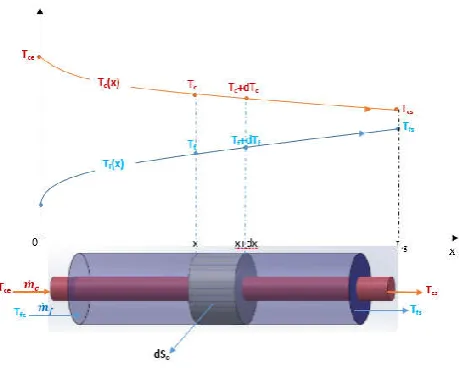
The choice of material as illustrated by figure 1, was made on a cylindrical concentric twin-tube exchanger SIEMENS. NFB/4779633 with a mode of circulation of the fluids in Co-current (Figure 2), and a mode of laminar flow. This is the simplest case to study before movingto a more complex application. Indeed, work of J. Padet quoted in (Padet, 2012) showed that it is possible to establish equivalence between the majority of the usual exchangers and an exchanger bitube of reference.
[image:2.595.313.559.221.336.2]Arrival of fluid in the outher tube
[image:2.595.317.547.387.571.2]Figure 1. Concentric exchanger twin-tube SIEMENS NFB/4779633
Figure 2. Diagram of temperature of the fluids in the exchanger
The geometrical and physical data of the tube interns are consigned in table 1.
Table 1. Geometrical and physical data of the internal tube
Geometric and physical data Values
Length of the inner tube 3
Inner tube radius 0.15
Inner tube diameter 0.30
Outer tube diameter 0.30277
Section d’origine du tube interne 0.7065
Inner tube thickness 2.77. 10
Thermal conductivity of the material 15 . .
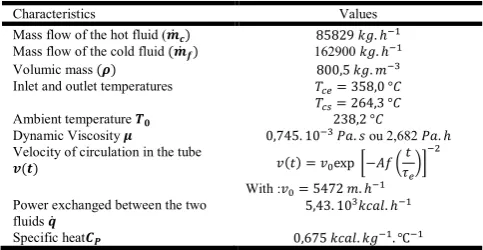
[image:2.595.313.554.648.732.2]Table 2. Thermo-hydraulic characteristics of the internal fluid
Characteristics Values
Mass flow of the hot fluid ( ̇ ) 85829 . ℎ
Mass flow of the cold fluid ( ̇ ) 162900 . ℎ
Volumic mass ( ) 800,5 .
Inlet and outlet temperatures = 358,0 °
= 264,3 °
Ambient temperature 238,2 °
Dynamic Viscosity 0,745. 10 . ou 2,682 . ℎ
Velocity of circulation in the tube
( ) ( ) = exp −
With : = 5472 . ℎ
Power exchanged between the two
fluids ̇
5,43. 10 . ℎ
Specific heat 0,675 . . ℃
Methods
Modeling: The methodology adopted for the modeling of the
function was carried out by considering the following parameters:
Fouling: Fouling is taken into account by the variation of the
resistance of fouling in the model of optimization. Then, if we consider that the evolution of the deposit is homogeneous and uniform with a thickness of fouling (t), we will have an additional surface thermal resistance which will come to be opposed to the heat transfer because of the clogging which is written:
( )=
( )
. . . × (1)
In the literature, we noted four models of kinetics of fouling, Rf
(t):
The asymptotic model of kinetics;
The model of kinetics square root;
The quadratic model of kinetics;
The linear model of kinetics.
The choice was made on the asymptotic model of kinetics in which resistance evolves/moves until a limiting value appears (Kearn and Seaton, 1959). This model is also representative of particulate fouling (Chamra end Webb, 1994). The expression of this fouling is as follows:
( )
=
∗× 1 −
−
(2)This evolution will be regarded as a reference, that is to say other resistances of fouling of the types refines, square and quadratic root, will be expressed by a simplification of the expression of the kinetics of fouling and will be presented in the following way:
( ) = ∗× (3)
Exergetic analysis: To make the exergetic analysis of a
system is to evaluate flows exergetic on the level of each subset of a system to deduce from them the local outputs exergetic. It is to point the most destroying subsets of exergie with an aim of adopting best engineering or to adopt the actions making it possible to improve the energy effectiveness of the system. The process of the thermal transfer and hydraulics being irreversible in kind, the exergy is more
instructive like criterion to evaluate the effectiveness of the heat exchangers (Draganov and Khalatov, 2010).
We recall that the expression of the exchanged exergy is:
Δ ̇ = ̇ + ̇ + ̇ (4)
̇ = ̇ ( )∆ − (5)
̇ ( ) = ̇ × ( )× ( ) ×
× ( ) (6)
= (7)
With:
̇ : Heat Exergy
̇ : Mechanical Exergy
̇ : Destroyed Exergy
One must note that these irreversibilities correspond to a destruction of exergy which is transformed into anergy (Benelmir et al., 2008). Being given that the fouling which is at the origin of the irreversibilities increases the pressure losses and decreases the exchanged thermal power, the destroyed exergy is the parameter most representative of this phenomenon. Then, the exergy exchanged during the transfer is not a representative parameter (Draganov and Khalatov, 2010). From where:
̇
=
̇+
̇ (8)The expression of the heat flow exchanging detailed in (Djimi et al, 2018) can be expressed such as:
̇ ( ) = ̇ × × ∆ × ( ) (9)
The expression of the effectiveness contains the various adimensional parameters introduced into the model (Djimi et
al, 2018):
( ) = × 1 − − ( )× ×
× ( ) (10)
If we note the operation life and the duration of stop for cleaning, the destroyed exergy will vary in the course of time as follows:
̇ ( ) = ̇ × ( ) + ̇ × ( )× ( ) ×
× ( ) − (11)
Economic study: The economic approach relates to the
= ℎ × (12)
CRF is the Capital Recovery Factor or the factor of return on investment. It is expressed by:
=( ( ) ) (13)
With n is the life of exchanger and i, is the financial discount rate. The costs related to maintenance (CM) include the costs of cleaning (CN) and stop (Ca) that is to say the cost of the economic losses related to an interruption of the production such that:
= + (14)
= × (15)
Where Cn is the unit cost of an operation of cleaning.
= × × (16)
A represents the financial cost of a stop (in euro/second), Nc
the number of cycles of annual operation and represents the duration of the stop.
RESULTS AND DISCUSSION
Exergo-economic approach: The function objective has to
minimize is that of the total cost binds to the operation of the heat exchanger, formulated as the sum of the costs related on the investment, the destroyed exergy, and the maintenance of the equipment (Mansilla- Pellen, 2006).
= + + ( ̇ × ̇ ) (17)
The approach of optimization was developed in the goal to minimize mainly the cost of the destroyed exergy on each sequence run/stop of a duration + . With a number of annual run/stop cycles 8000 hours industrial such as:
= × = , . (18)
This total cost thus expresses our function of optimization on the basis of exergo-economic criterion in the following way (19):
( ) = , . ̇ ∫ ( ) + ( ) + ( + ) +
( × ℎ ) (19)
The research of the minimum of this function will be carried out for a time of function optimal before stop for cleaning which we will note ∗. For this optimal duration, we pose:
∗= 0 (20)
It is the condition necessary to find our optimum. We then calculate the derivative of this function objective, then we will replace in the value of this root in the initial equation to find the value of the operation life of the exchanger before stop for cleaning while holding account the cycle run/stop evoked previously.
Parametric sensitivity study: The seven (07) adimensional
parameters which were introduced into the model of optimization, are necessary for the study of sensitivity, it are:
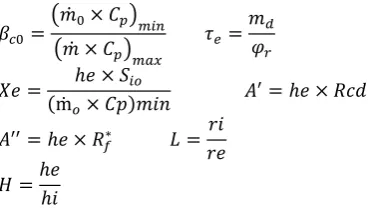
; ; ; ; ; ; .
= ̇ ×
̇ × =
= ℎ ×
(ṁ × ) = ℎ ×
= ℎ × ∗ =
=ℎ
ℎ
[image:4.595.307.492.123.228.2]Table 3 following presents all the parameters with their beaches of variation and their central values. Indeed, while one of the parameters varies, other fixed remainders.
Table 3. Values of the parameters of the study of sensitivity
Parameters Range of variation Central Values
Parameter 0 - 1 0.55
Le parameter 5000 − 660000 270000
Parameter 0.5 - 5 2
Parameter 1.846 10 − 1.841846 0.05
Parameter 0.0001 − 80 0.05
Parameter 0.01 - 6 1
Parameter 0.1 - 10 1
The results of the influence of the dimensionless parameters introduced in the model are represented by Figures 3 a, b, c, d, e, f and g thus show the parametric evolution over the optimal duration of operation. Parameter βco represents the initial heat
ratio, that of the fouling fluid (limiting fluid) over that of the non-fouling fluid. The evolution of this parameter (Figure 3a) shows an increase in the operating time of the exchanger as the value of βco increases. It can be seen that the high values of βco
correspond to the long operating times. This is obvious because the exergo-economic criterion also considers the hydrodynamic aspects that have a strong influence on the operating time. It is therefore easy to understand this influence, because increasing the parameter amounts to working with a larger section of passage, which in practice is associated with less fouling as confirmed by Schall (Schaal, 1998).
Figure 3a . Evolution of the root according to the parameter
The evolution of the parameters (Figure 3b) and Xe (Figure
[image:4.595.310.556.305.386.2] [image:4.595.327.537.574.736.2]The evolution of the parameter Xe means that the NTU being
related to the thermal efficiency is a factor representative of the exchanging power of the exchanger, because generally the value of the number of transfer unit makes the operation of the exchanger better when it is large. With regard to the parameter
[image:5.595.66.260.208.354.2]A' (Figure 3d), we can therefore translate this pattern by the fact that the nature of the material influences the optimal duration t1, because the nature of the material corresponds to a given thermal conductivity. Indeed, A' corresponds to the conduction resistance through the exchange walls since the surface exchange coefficient he is constant. This implies that high thermal conductivity induces low operating times.
[image:5.595.342.512.320.440.2]Figure 3b. Evolution of the root according to the parameter
[image:5.595.60.271.377.535.2]Figure 3c. Evolution of the root according to the parameter
Figure 3d. Evolution of the root according to the parameter ′
The evolution of the parameter ′ (Figure 3e) seems natural, it tends to decrease the duration of operation as it evolves. This is obvious, since ′is the product of the asymptotic fouling resistance by a system-specific exchange coefficient.
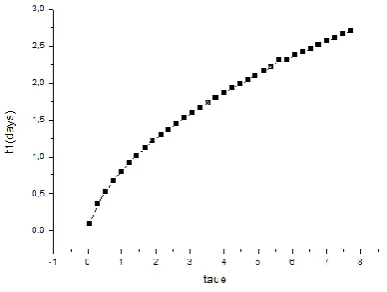
Thus, any increase in this parameter is directly related to an increase in the fouling resistance. In addition, it is obvious that any increase in the asymptotic fouling resistance is the consequence of a greater fouling, hence a shorter optimal operating time. In addition, the appearance of a fouling deposit on the exchange walls strongly affects the exergy destroy, and causes irreversibilities both in terms of heat transfer and mechanical friction. The parameter L represents the ratio of the internal and external radius. His study (Figure 3f) reveals that for low values of L, the evolution of the parameter gives low values of the root . It can be concluded that the larger L is, the lower the fouling, and the associated irreversibilities do not necessarily influence the operating time and the costs associated with fouling are lower. The parameter H represents the ratio of the surface convective exchange coefficients. His study (Figure 3g) reveals that its increase corresponds to the decrease of the root 1. It should be noted that, in practice, we
are looking for balanced transfers between the internal and external fluids, so we are looking at the central value of 1, wether at the transition between the linear influence (H> l) and the non-influence of this one coefficient (H<l) in this semi-logarithmic reference (Schaal, 1998).
0 10 20 30 40 50 60 70 80 90
0 5 10 15 20 25
t1(days)
A''
O r i g i n P r o 8 E v a l u a t i o n O r i g i n P r o 8 E v a l u a t i o n
O r i g i n P r o 8 E v a l u a t i o n O r i g i n P r o 8 E v a l u a t i o n
O r i g i n P r o 8 E v a l u a t i o n O r i g i n P r o 8 E v a l u a t i o n
O r i g i n P r o 8 E v a l u a t i o n O r i g i n P r o 8 E v a l u a t i o n
O r i g i n P r o 8 E v a l u a t i o n O r i g i n P r o 8 E v a l u a t i o n
O r i g i n P r o 8 E v a l u a t i o n O r i g i n P r o 8 E v a l u a t i o n
Figure 3e. Evolution of the root according to the parameter ′′
1 2 3 4 5 6
0,0 0,5 1,0 1,5 2,0 2,5 3,0
t1(days
)
L
O r i g i n P r o 8 E v a l u a t i o n O r i g i n P r o 8 E v a l u a t i o n
O r i g i n P r o 8 E v a l u a t i o n O r i g i n P r o 8 E v a l u a t i o n
O r i g i n P r o 8 E v a l u a t i o n O r i g i n P r o 8 E v a l u a t i o n
O r i g i n P r o 8 E v a l u a t i o n O r i g i n P r o 8 E v a l u a t i o n
O r i g i n P r o 8 E v a l u a t i o n O r i g i n P r o 8 E v a l u a t i o n
O r i g i n P r o 8 E v a l u a t i o n O r i g i n P r o 8 E v a l u a t i o n
Figure 3f. Evolution of the root according to the
parameterL
0 2 4 6 8 10
2,7 2,8 2,9 3,0 3,1 3,2
t1(da
ys)
H
O r i g i n P r o 8 E v a l u a t i o n O r i g i n P r o 8 E v a l u a t i o n
O r i g i n P r o 8 E v a l u a t i o n O r i g i n P r o 8 E v a l u a t i o n
O r i g i n P r o 8 E v a l u a t i o n O r i g i n P r o 8 E v a l u a t i o n
O r i g i n P r o 8 E v a l u a t i o n O r i g i n P r o 8 E v a l u a t i o n
O r i g i n P r o 8 E v a l u a t i o n O r i g i n P r o 8 E v a l u a t i o n
[image:5.595.335.520.474.593.2]O r i g i n P r o 8 E v a l u a t i o n O r i g i n P r o 8 E v a l u a t i o n
[image:5.595.57.278.564.726.2] [image:5.595.335.517.633.756.2]Conclusion
In this work, we conducted a study on the optimization of the operation of atwin-tube exchanger subjected to a fouling. All the cycles run/stop of the equipment during one year, on the basis of exergo-economic criterion of optimization were considered. The proposed model gives the advantage of taking into account the aspects thermal, hydrodynamic and economic related to the operation of the exchanger of heat. This model definite is a case of operation to flow constant in an exchanger with a flow co-current and laminar. Adimensional parameters in the model which were introduced made it possible to evaluate the influence of these on the duration of optimal operation of the heat exchanger. The sensitivity study made it possible to realize that the various parameters influence considerably the operation life of the exchanger, because a light modification of the parameter tends to make increase or decrease the value of the going operation life . A particular note on the increase in the parameter ′ which shows that the irreversibilities related to the destroyed exergy cause the operating time of the heat exchanger to only decrease while following an asymptote.
REFERENCES
Ali Khan L., El-Ghalba A., 2008,“Heat exchanger Exergetic lifecycle cost optimization using
Evolutionnary Algorithms”, WSEAS TRASACTIONS on Heat and Mass Tranfer, ISSN: 1790-5044, Vol 3; pp125-136.
Ashouri M., Ahmadi M.H., Pourkiaei S.M., Astaraei F.R., Ghasempour R., Ming T., Hemati J.H., 2017,
Exergy and Exergo-economic analysis and optimization of a solar double pressure organic Rankine cycle, Thermal Science and Engineering Progress, doi: https://doi.org/10.1016/j.tsep.2017.10.002.
Benelmir R., Lallemand A., Feidt M., 2008, “Analyse exergétique”, Techniques de l’ingénieur traité
Genie énergétique.
Di Somma M., Yan B., Bianco N., Graditi G., LuhP B., Mongibello L., Naso V., 2015, Operation
optimization of a distributed energy system considering energy costs and exergy efficiency, Energy Conversion and Management, Vol 103, pp 739-751.
Djimi S., Nzikou J.M., Kheiri A., 2018, Optimisation thermo-économique de l’encrassement d’un
échangeur thermique, Proceedings of Engineering and Technology, 5ème Conférence Internationale des Energies Renouvelables Sousse-Tunisia, vol 30, p 5-9.
Draganov B. Kh. and Khalatov A.A., 2010, “Exergoeconomic optimization of surface Heat exchangers”,
Thermal Engineering, ISSN 0040 -6015, Vol 57, N°10 pp 888- 891.
Feidt M., 2009 “Efficacité énergétique : Quels critères”, TERMOTEHNICA, pp 26-33.
Feidt M., “Thermodynamique et Optimisation énergétique des systèmes et procédés”, Génie énergétique :
Du dimensionnement des composants au pilotage des systèmes, Editions DUNOD Paris.
Ghaebi H., Saidi M.H., Ahmadi P., 2012, Exergoeconomic optimization of a trigeneration system for
heating, cooling and power production purpose based on TRR method and using evolutionary algorithm, Applied Thermal Engineering, Vol 36, pp 113-125.
Ghazi M., Ahmadi P., Sotoodeh A.F., Taherkhani A., 2012, Modeling and Thermo-economic
optimization of heat recovery heat exchangers using a multimodal genetic algorithm, Energy Conversion and Management, Vol 58, pp 149-156.
KaziS.N., 2012, “Fouling and Fouling mitigation on heat exchanger surfaces, Heat exchangers- Basics
design Applications”, Edition DrJovan Mitovic, ISBN: 978-953-51-0278-6, InTech.
Mansilla – Pellen, 2006, Contribution à l’optimisation technico-économique de systèmes énergétiques,
Thèse de Doctorat, Ecole Centrale des Arts et Manufactures, Ecole Centrale Paris, 222 p.
Padet J., 2012, Echangeurs thermiques : Méthodes globales de calcul avec problèmes résolus, Société
Française de thermique.
Schaal, L.R., 1998, Optimisation dynamique du comportement d’un échangeur de chaleur soumis au
Phénomène d’encrassement, Thèse en mécanique et énergétique, Université Henri Poincaré Nancy-1, 295 p.. SteinhagenM., 1995, “Heat exchangers fouling, Mitigation and
cleaning Technologies”, IchemE.
Walter E., 2015, Méthodes numériques d’optimisation : Un guide pour le consommateur, Fluctuant Nec
Mergunter Paris.
Xu Zhi-Ming, Zhang Zhong-Bin and Yang Shan-Rang, 2007, “Costs due to utility fouling in China”, Eci
Symposium Series, proceeding of 7th international on Heat
Exchanger Fouling and Cleaning Portugal, Volume RP5,
Article 16 pp 114-118.
NOMENCLATURE
A : coût de l’arrêt (€/s)
: Coût unitaire du nettoyage (€)
ℎ : Coût de l’échangeur (€)
̇ : Coût de l’exergie détruite (€/kWh)
Cp : Chaleur spécifique (J.kg-1.K-1) : Épaisseur du dépôt (m)
Dc : Diamètre interne du tube (m) Df : Diamètre externe du tube (m)
: Efficacité de l’échangeur thermique (-)
̇ : Exergie détruite (Kwh)
f : coefficient de friction (-)
∆ : Différence de température maximale (°C) Lg : Longueur du tube (m)
: Conductivité thermique du dépôt (W.m-2.K-1)
̇ : Débit massique (kg.s-1)
̇ : Débit massique du fluide chaud (kg.s-1)
̇ : Débit massique du fluide froid (kg.s-1) : Viscosité dynamique (Pa.s)
: Nombre de cycles dans l’année (-) NTU : Nombre d’unités de transfert (-)
̇ : Puissance thermique (W)
̇ : Puissance thermique maximale (W) : Densité (kg.m-3)
RAT : Résidu atmosphérique (-)
: Résistance de l’encrassement (m2.K. W-1) : Rayon interne (m)
Tce : Température du fluide chaud à l’entrée de l’échangeur (°C)
Tcs : Température du fluide chaud à la sortie de l’échangeur (°C)
Tf : Température du fluide froid (°C)
Tfe : Température du fluide froid à l’entrée de l’échangeur (°C)
Tfs : Température du fluide froid à la sortie de l’échangeur (°C) T0 : Température de l’environnement (°C)
Tmax : Température maximale (°C) : Durée de fonctionnement (s) : Durée de nettoyage(s)
v : Vitesse d’écoulement des fluides (m/s)