DOI 10.1007/s00294-016-0577-3
REVIEW
PCNA‑binding proteins in the archaea: novel functionality
beyond the conserved core
Stuart A. MacNeill1
Received: 4 February 2016 / Accepted: 6 February 2016
© The Author(s) 2016. This article is published with open access at Springerlink.com
Introduction
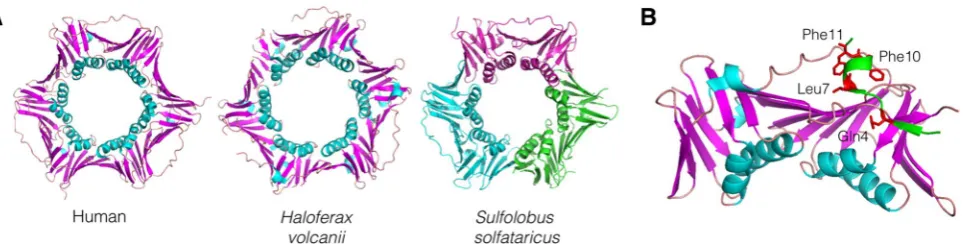
Sliding clamps play crucially important roles in DNA metabolism in all forms of cellular life by encircling dou-ble-stranded DNA (dsDNA) and offering a stable platform onto which other factors, typically enzymes with DNA-tar-geted activities such as DNA polymerases and nucleases, can be assembled in a spatially and temporally coordinated manner. In the archaea, the sliding clamp is PCNA (pro-liferating cell nuclear antigen), a trimeric protein complex found in either homo- or heterotrimeric forms in different archaeal lineages (Winter and Bunting 2012). Structures of PCNA trimers originating from a variety of archaeal organ-isms, including homotrimers from the thermophilic euryar-chaeal species Pyrococcus furiosus (Matsumiya et al. 2001) and Archaeoglobus fulgidus (Chapados et al. 2004) and the mesophilic haloarchaeon Haloferax volcanii (Morgunova et al. 2009; Winter et al. 2009) as well as the heterotrimer from the thermophilic crenarchaeon Sulfolobus solfataricus
(Williams et al. 2006), have been solved by crystallogra-phy, revealing a striking similarity to one another and also to eukaryotic PCNA (Fig. 1a).
Many of the proteins that interact with PCNA do so via a common conserved sequence motif known as a PIP (PCNA-interacting protein) motif that was first identified in the mammalian DNA replication inhibitor p21Cip1 (War-brick et al. 1995, 1997). The PIP motif is typically defined by the sequence QXXhXXaa, where ‘h’ represents amino acids with moderately hydrophobic side chains (leucine, isoleucine, methionine) and ‘a’ represents amino acids with aromatic hydrophobic side chains (phenylalanine, tyrosine) (Warbrick 1998). PIP motifs have been identified in a num-ber of key highly conserved DNA replication/repair factors including DNA polymerases B and D, replication factor C,
Abstract Sliding clamps play an essential role in coor-dinating protein activity in DNA metabolism in all three domains of life. In eukaryotes and archaea, the sliding clamp is PCNA (proliferating cell nuclear antigen). Across the diversity of the archaea PCNA interacts with a highly conserved set of proteins with key roles in DNA replica-tion and repair, including DNA polymerases B and D, rep-lication factor C, the Fen1 nuclease and RNAseH2, but this core set of factors is likely to represent a fraction of the PCNA interactome only. Here, I review three recently char-acterised non-core archaeal PCNA-binding proteins NusS, NreA/NreB and TIP, highlighting what is known of their interactions with PCNA and their functions in vivo and in vitro. Gaining a detailed understanding of the non-core PCNA interactome will provide significant insights into key aspects of chromosome biology in divergent archaeal lineages.
Keywords Sliding clamp · PCNA · Archaea · DNA replication · DNA repair · Chromosome biology · Interactome
Communicated by M. Kupiec.
Electronic supplementary material The online version of this article (doi:10.1007/s00294-016-0577-3) contains supplementary material, which is available to authorized users.
* Stuart A. MacNeill
[email protected]; [email protected] 1 Biomedical Sciences Research Complex, School of Biology,
the Fen1 nuclease and RNAseH2. Structural studies of co-crystallised archaeal PCNA–PIP peptide complexes have revealed details of the PCNA–PIP interaction in atomic detail (Matsumiya et al. 2002; Chapados et al. 2004). The residues immediately following the well-conserved glutamine (Q) adopt a 310 helix structure than inserts into a hydrophobic pocket formed at the surface of PCNA (Fig. 1b).
The DNA replication/repair factors mentioned above that bind PCNA are central to archaeal DNA replication and repair processes, are highly conserved across different archaeal lineages and can be considered to form the con-served core of the archaeal PCNA interactome. It is becom-ing increasbecom-ingly clear, however, that beyond this core group lies a much larger set of PCNA interactors, including pro-teins of unknown biochemical function, propro-teins with no homologues outwith the archaea and proteins with very restricted distribution within the archaea. In this review, I summarise recent analysis of three such factors: a dimeric nuclease displaying in vitro activity against a range of DNA substrates (NucS), a representative of a conserved family of archaeal proteins of no known biochemical activ-ity that has been implicated in DNA damage repair (NreA) and a small protein present in a single lineage only that has been proposed as a PCNA inhibitor (TIP).
NucS: a RecB family nuclease
The NucS protein was first identified using a combination of bioinformatic searching and peptide array screening for novel PCNA interactors (Meslet-Cladiere et al. 2007). NucS binds with high affinity to PCNA via a C-terminal PIP motif (Fig. 2), shares sequence similarity with the bac-terial RecB nuclease family and displays structure-specific nuclease activity on a variety of artificial substrates in vitro (Creze et al. 2012; Ren et al. 2009; Rezgui et al. 2014).
The structure of the 251 amino acid Pyrococcus abyssi
NucS protein (in isolation, rather than complexed to PCNA) has been solved by crystallography, revealing a dumbbell-like two-domain structure (Fig. 2c) (Ren et al. 2009). The PIP motif is not seen in the structure. The N- and C-termi-nal domains are separated from each other by a significant distance (almost 30 Å) and are joined by an unstructured linker region. The nuclease active site is located in the C-terminal domain, which is similar to (but much smaller than) the bacterial RecB nuclease domain. The N-terminal domain bares some similarity to the RNA-binding fold of the eukaryotic Sm proteins and the OB fold of ssDNA-binding proteins, suggesting a role in ssDNA ssDNA-binding that was confirmed by mutagenesis studies (Ren et al. 2009). In solution, NucS is a homodimer with the N-terminal domain of one subunit interacting with the C-terminal domain of the other (Fig. 2c). Intriguingly, SAXS (small angle X-ray scattering) analysis of the PCNA–NucS complex in solu-tion indicates that the homotrimeric P. abyssi PCNA binds a single NucS dimer only, suggesting that binding some-how alters the symmetrical structure of PCNA to disfavour binding of additional dimers (Creze et al. 2012).
Whilst the in vitro biochemical activity of the NucS pro-tein has been well defined, it is still not known what role the protein plays in vivo, although it has been reported that NucS is non-essential for growth and division in Hfx. volcanii (unpublished results cited in Creze et al. 2012). Two lines of evidence point to potential roles for NucS in chromosomal DNA replication and repair (Ren et al.
2009). Pull-down experiments using recombinant NucS and extracts from exponentially growing P. abyssi cells identified a small set co-purifying proteins that included— in addition to PCNA—the small and large subunits of the clamp loader complex RF-C, the helicase/nuclease Hef, two subunits of DNA topoisomerase VI and a putative ade-nine-specific DNA methyltransferase. Further clues to the
Fig. 1 PCNA structure and PIP binding. a Structures of homotri-meric PCNA from human cells and the mesophilic halophilic eur-yarchaeon Hfx. volcanii, alongside the heterotrimeric PCNA from the thermophilic crenarchaeon S. solfataricus. PDB codes: 4D2G (human), 3HI8 (Hfx. volcanii) and 2IX2 (S. solfataricus). b Details of
[image:2.595.61.543.55.181.2]function of NucS come from the location of the nucS gene on the chromosome. In P. abyssi, nucS is located close to the chromosomal replication origin, whilst in T. kodakaren-sis the nucS ORF overlaps that encoding the RadA recom-binase (Ren et al. 2009). Taken together, these results hint at an important role for NucS in genome stability without identifying what that role might be. Further work on NucS will be required to address this.
The Nre proteins: NreA and NreB
The ~400 amino acid Nre proteins (Giroux and MacNeill
2016) are unique to archaea, with no bacterial, eukaryotic or viral Nre homologues apparent in current databases. Almost all sequenced archaeal genomes encode at least one Nre protein (designated NreA) with a C-terminal PIP
motif (Fig. 2) but some species also encode a second pro-tein (NreB) with a less clear-cut PIP. Evidence for a direct NreA–PCNA interact comes from a yeast two-hybrid screen that identified the C-terminal domain of A. fulgidus
NreA as a PCNA interactor (Motz et al. 2002). In addition to possessing a C-terminal PIP motif, many Nre proteins possess an N-terminal Cys4 metal-binding domain that is likely either to comprise a zinc finger or an [Fe–S] clus-ter (see Fig. 2a). The function of this domain is not known but it is not universally conserved and thus cannot be abso-lutely essential for Nre protein function (Giroux and Mac-Neill 2016).
In a number of archaeal genomes, the gene encoding the NreB protein is found adjacent to (and sometimes over-lapping with) a gene encoding a protein with significant similarity to bacterial SplB enzymes, suggesting a close functional link (Giroux and MacNeill 2016). SplB (spore
Fig. 2 a Schematic representa-tion of the P. abyssi NucS, A. fulgidus NreA and NreB and T. kodakarensis TIP proteins high-lighting conserved domains. b
Known (NucS, NreA) or pos-sible (NreB, TIP) PIP motifs in the four proteins with conserved residues boxed (see Supple-mentary information, Figure S1, for full TIP alignment). c
[image:3.595.199.546.57.482.2]photoproduct lyase or SP lyase) is responsible for the repair of a unique type of DNA damage (the intrastrand thymine dimer 5-thyminyl-5,6-dihydrothymine) found exclusively in UV-irradiated bacterial spores. To date, however, there is no evidence for the SP formation in archaea, thus the sub-strate of the archaeal SplB-like enzymes remains unknown. To investigate the cellular function of NreA, we used the genetically tractable halophilic euryarchaeon Hfx. volcanii
as a model system (Giroux and MacNeill 2016). Hfx. vol-canii encodes a single NreA protein with a C-terminal PIP motif but in common with NreA proteins from other halo-archaea, lacks an N-terminal C4 metal-binding domain. Deletion of the nraA gene shows that the NreA protein is not essential for Hfx. volcanii cell viability: ∆nreA cells are
indistinguishable from wild type under normal growth con-ditions and are not supersensitive to the effects of UV irra-diation or the alkylating agent methyl methanesulphonate (MMS). They are, however, supersensitive to DNA damage induced by mitomycin C (MMC). MMC reacts with gua-nine residues to induce three types of DNA lesion: MMC-dG-monoadducts, intrastrand dG-MMC-dG biadducts and interstrand dG-MMC-dG crosslinks. That ∆nreA cells are
sensitive this type of damage suggests a role for the NreA protein in repair of one or more of these lesions.
To analyse this further, we used pulsed-field gel electro-phoresis (PFGE) to monitor the structure of Hfx. volcanii
chromosomes following transient MMC treatment (Giroux and MacNeill 2016). Restriction endonuclease-digested
Hfx. volcanii chromosomes can be readily resolved by PFGE. Following MMC treatment, the discrete banding is lost and instead, a smear of lower molecular weight DNA is seen. In wild-type cells this is relatively short-lived, with repair of the chromosomes being close to complete 8 h post-exposure. This is not the case in ∆nreA cells, however,
where little or no repair is seen up to 10 h post-exposure. These results point to a clear role for NreA in repair of MMC damage but do not address the question of whether interaction with PCNA is necessary for this. To address this issue, we used a reverse genetic strategy to create strains in which the NreA protein was expressed in a truncated form lacking the C-terminal PIP motif and tested these for MMC sensitivity and ability to repair chromosomal damage. In both cases, loss of the PIP motif phenocopied complete loss of NreA function, indicating that PCNA binding is essential for NreA’s role in DNA repair (Giroux and Mac-Neill 2016).
NreA is not the first DNA repair factor to be analysed genetically in Hfx. volcanii with previous studies highlight-ing the roles of the Mre11 and Rad50 proteins (homologues of eukaryotic MRN complex components), the Holliday junction resolvase Hjc, the helicase–nuclease Hef (men-tioned above) and UvrA, UvrB, UvrC and UvrD (homo-logues of bacterial proteins involved in nucleotide excision
repair, NER) (Lestini et al. 2010, 2013; Delmas et al. 2009,
2013). We tested whether strains carrying deletions of each of these genes were MMC sensitive and whether deletion of nreA in these genetic backgrounds exacerbated this. In the case of ∆mre11 ∆rad50, ∆hef, ∆hjc, ∆uvrA, ∆uvrB
and ∆uvrC strains, all six strains displayed increased
MMC sensitivity, indicating that each plays a role in repair of MMC-induced DNA damage. Subsequent deletion of
nreA in ∆mre11 ∆rad50, ∆hef and ∆hjc backgrounds led
to an increase in sensitivity, implying that NreA acts in dif-ferent repair pathways to these factors. However, enhanced sensitivity was not seen when nreA was deleted in ∆uvrA, ∆uvrB and ∆uvrC backgrounds, showing that NreA acts
together with the UvrABC system to repair MMC-induced DNA damage in Hfx. volcanii (Giroux and MacNeill 2016). Similar results were seen when the NreA PIP motif alone was deleted, underlining the key role of PCNA binding in this repair.
Taken together, these results point to Nre proteins poten-tially playing an important role in DNA damage repair in archaea. What remains to be done? Whilst NreA is clearly important for repair of MMC-induced DNA damage, it is entirely unclear how the protein performs this function and how it interacts with UvrABC. As noted above, every mem-ber of the conserved core group of archaeal PCNA-binding proteins is either an enzyme that acts catalytically on DNA or RNA (DNA polymerases B and D, Fen1, RNAseH2) or (in the case of the case of the large subunit of RFC) is part of a complex that binds directly to DNA to perform its cat-alytic function (PCNA loading). On balance of probability, it seems more likely that the Nre proteins will fall into the first group, i.e. that NreA will act directly on DNA, catalys-ing strand cleavage or some sort of covalent DNA modifi-cation, but analysis of the sequence of the Nre proteins fails to yield any clues as to what the precise function might be. Biochemical analysis of purified Nre proteins is clearly needed to address this. We attempted to take this route with NreA and NreB proteins from a diverse selection of archaeal species but did not succeed (Giroux and MacNeill
The TIP protein in the Thermococcales
A third non-core component of the archaeal PCNA interac-tome is the TIP protein, first identified on the basis of its abil-ity to co-purify with PCNA from extracts prepared from T. kodakarensis cells (Li et al. 2014). This organism encodes two distinct homotrimeric PCNA clamps (Kuba et al. 2012; Lad-ner et al. 2011; Pan et al. 2013)—one essential and one non-essential—and TIP binds to both, albeit with differing affini-ties. TIP is a small protein (only 64 amino acids) that contains a putative partial PH (pleckstrin homology)-like domain in its C-terminal half (Fig. 2a). Unlike the widely conserved Nre proteins and the reasonably well-conserved NucS, TIP homo-logues are found only in the Thermococcales, including vari-ous Thermococcus, Pyrococcus and Palaeococcus species (see Supplementary information, Figure S1). Genetic analysis of TIP function in T. kodakarensis has shown the protein to be non-essential for growth and division and cells lacking TIP to be no more sensitive than wild type to DNA damage induced by UV, MMS or MMC treatment (Li et al. 2014).
Whilst the in vivo function of TIP is unclear, in vitro TIP inhibits PCNA stimulation of PolB activity by inhibit-ing PCNA–PolB interactions and PCNA stimulation of Fen1, most likely by inhibiting PCNA–Fen1 interactions. How does TIP interact with PCNA? Two regions on the TIP protein have been implicated in PCNA binding by H/D exchange mass spectrometry (HDX-MS), corresponding to amino acids 2–8 and 35–38. TIP was originally reported not to contain a PIP motif and subsequent analysis of the protein was performed in that context (Li et al. 2014). I re-examined this conclusion by performing a multiple sequence alignment of TIP proteins from 26 Thermococcales in current databases (see Supplementary information, Figure S1). Strikingly, the resulting alignment appears to identify a PIP motif at the extreme N-terminus of the TIP proteins, separated from the conserved bulk of the protein (a putative PH-like domain) by a short poorly conserved and potentially unstructured linker (Figure S1). The location of this putative PIP (shown in Fig. 2b) corresponds to the location of the first of the PCNA-binding regions identified by HDX-MS. Whilst we have not undertaken any biochemical analysis of the TIP protein, I would like to propose TIP as a novel PIP motif-containing factor in the archaea and hope that future investigations will test this proposal. The presence of a PIP motif in TIP would provide a simple explanation for the in vitro inhibition of PCNA–PolB and PCNA–Fen1 interactions.
Concluding remarks
Whilst further analysis is clearly needed to pinpoint the precise molecular functions of the PCNA-interacting
proteins discussed in this review, the powerful combina-tion of genetics and biochemistry that can be applied in this arena has already begun to offer fascinating glimpses of the structural and functional diversity to be found beyond the conserved core of the archaeal PCNA interactome.
Acknowledgments Work on the NreA protein in the MacNeill lab was supported by the USAF Office of Scientific Research under award number FA9550-10-1-0421.
Open Access This article is distributed under the terms of the Creative Commons Attribution 4.0 International License ( http://crea-tivecommons.org/licenses/by/4.0/), which permits unrestricted use, distribution, and reproduction in any medium, provided you give appropriate credit to the original author(s) and the source, provide a link to the Creative Commons license, and indicate if changes were made.
References
Chapados BR, Hosfield DJ, Han S, Qiu J, Yelent B, Shen B, Tainer JA (2004) Structural basis for FEN-1 substrate specificity and PCNA-mediated activation in DNA replication and repair. Cell 116:39–50
Creze C, Ligabue A, Laurent S, Lestini R, Laptenok SP, Khun J, Vos MH, Czjzek M, Myllykallio H, Flament D (2012) Modulation of the Pyrococcus abyssi NucS endonuclease activity by rep-lication clamp at functional and structural levels. J Biol Chem 287:15648–15660
Delmas S, Shunburne L, Ngo HP, Allers T (2009) Mre11-Rad50 pro-motes rapid repair of DNA damage in the polyploid archaeon Haloferax volcanii by restraining homologous recombination. PLoS Genet 5:e1000552
Delmas S, Duggin IG, Allers T (2013) DNA damage induces nucle-oid compaction via the Mre11-Rad50 complex in the archaeon Haloferax volcanii. Mol Microbiol 87:168–179
Giroux X, MacNeill SA (2016) A novel archaeal DNA repair fac-tor that acts with the UvrABC system to repair mitomycin C-induced DNA damage in a PCNA-dependent manner. Mol Microbiol 99:1–14
Kuba Y, Ishino S, Yamagami T, Tokuhara M, Kanai T, Fujikane R, Daiyasu H, Atomi H, Ishino Y (2012) Comparative analyses of the two proliferating cell nuclear antigens from the hyperther-mophilic archaeon, Thermococcus kodakarensis. Genes Cells 17:923–937
Ladner JE, Pan M, Hurwitz J, Kelman Z (2011) Crystal structures of two active proliferating cell nuclear antigens (PCNAs) encoded by Thermococcus kodakaraensis. Proc Natl Acad Sci USA 108:2711–2716
Lestini R, Duan Z, Allers T (2010) The archaeal XPF/Mus81/ FANCM homolog Hef and the Holliday junction resolvase Hjc define alternative pathways that are essential for cell viability in Haloferax volcanii. DNA Repair (Amst) 9:994–1002
Lestini R, Laptenok SP, Kuhn J, Hink MA, Schanne-Klein MC, Liebl U, Myllykallio H (2013) Intracellular dynamics of archaeal FANCM homologue Hef in response to halted DNA replication. Nucleic Acids Res 41:10358–10370
Matsumiya S, Ishino Y, Morikawa K (2001) Crystal structure of an archaeal DNA sliding clamp: proliferating cell nuclear antigen from Pyrococcus furiosus. Protein Sci 10:17–23
Matsumiya S, Ishino S, Ishino Y, Morikawa K (2002) Physical inter-action between proliferating cell nuclear antigen and replication factor C from Pyrococcus furiosus. Genes Cells 7:911–922 Meslet-Cladiere L, Norais C, Kuhn J, Briffotaux J, Sloostra JW,
Fer-rari E, Hubscher U, Flament D, Myllykallio H (2007) A novel proteomic approach identifies new interaction partners for prolif-erating cell nuclear antigen. J Mol Biol 372:1137–1148 Morgunova E, Gray FC, MacNeill SA, Ladenstein R (2009)
Struc-tural insights into the adaptation of proliferating cell nuclear antigen (PCNA) from Haloferax volcanii to a high-salt environ-ment. Acta Crystallogr D Biol Crystallogr 65:1081–1088 Motz M, Kober I, Girardot C, Loeser E, Bauer U, Albers M, Moeckel
G, Minch E, Voss H, Kilger C, Koegl M (2002) Elucidation of an archaeal replication protein network to generate enhanced PCR enzymes. J Biol Chem 277:16179–16188
Pan M, Santangelo TJ, Cubonova L, Li Z, Metangmo H, Ladner J, Hurwitz J, Reeve JN, Kelman Z (2013) Thermococcus koda-karensis has two functional PCNA homologs but only one is required for viability. Extremophiles 17:453–461
Ren B, Kuhn J, Meslet-Cladiere L, Briffotaux J, Norais C, Lavigne R, Flament D, Ladenstein R, Myllykallio H (2009) Structure and function of a novel endonuclease acting on branched DNA sub-strates. EMBO J 28:2479–2489
Rezgui R, Lestini R, Kuhn J, Fave X, McLeod L, Myllykallio H, Alexandrou A, Bouzigues C (2014) Differential interaction kinetics of a bipolar structure-specific endonuclease with DNA flaps revealed by single-molecule imaging. PLoS One 9:e113493 Warbrick E (1998) PCNA binding through a conserved motif.
BioEs-says 20:195–199
Warbrick E, Lane DP, Glover DM, Cox LS (1995) A small pep-tide inhibitor of DNA replication defines the site of interaction between the cyclin-dependent kinase inhibitor p21Waf1 and pro-liferating cell nuclear antigen. Curr Biol 5:275–282
Warbrick E, Lane DP, Glover DM, Cox LS (1997) Homologous regions of Fen1 and p21Cip1 compete for binding to the same site on PCNA: a potential mechanism to co-ordinate DNA replica-tion and repair. Oncogene 14:2313–2321
Williams GJ, Johnson K, Rudolf J, McMahon SA, Carter L, Oke M, Liu H, Taylor GL, White MF, Naismith JH (2006) Structure of the heterotrimeric PCNA from Sulfolobus solfataricus. Acta Crystallogr Sect F Struct Biol Cryst Commun 62:944–948 Winter JA, Bunting KA (2012) Rings in the extreme: PCNA
interac-tions and adaptainterac-tions in the archaea. Archaea 2012:951010 Winter JA, Christofi P, Morroll S, Bunting KA (2009) The crystal