Pore Shape Modification of a Microporous Metal-Organic
Framework Using High Pressure: Accessing a New Phase
with Oversized Guest Molecules
Scott C. McKellar,
†Jorge Sotelo,
†Alex Greenaway,
‡John P. S. Mowat,
‡Odin Kvam,
†Carole A.
Morri-son,
†Paul A. Wright
‡and Stephen A. Moggach*
††EaStCHEM School of Chemistry and the Centre for Science at Extreme Conditions, University of Edinburgh, Kings
Build-ings, West Mains Road, Edinburgh, EH9 3JJ, UK
‡EaStCHEM School of Chemistry, University of St Andrews, Purdie Building, St Andrews, KY16 9ST, UK
ABSTRACT: Pressures up to 0.8 GPa have been used to squeeze a range of sterically ‘oversized’ C5-C8 alkane guest molecules into the cavities of a small-pore Sc-based metal-organic framework. Guest inclusion causes a pronounced reorientation of the aromatic rings of one third of the terephthalate linkers, which act as ‘torsion springs’, resulting in a fully reversible change in the local pore structure. The study demonstrates how pressure-induced guest uptake can be used to investigate framework flexibility relevant to ‘breathing’ behavior and to understand the uptake of guest molecules in MOFs relevant to hydrocarbon separation.
INTRODUCTION
One of the major drivers for the current intensive research into porous metal organic frameworks (MOFs) is the potential they offer for applications in gas separation.1 The wide variety of
chemical environments, pore sizes and shapes, and the flexible behaviour found in many MOFs may improve current separa-tion technologies, or enable previously unfeasible separasepara-tions.2
For example, a recent study has shown that the framework Fe2BDP3 (BDP = 1,4-benzenedipyrazolate) can separate
iso-mers of hexane according to their degree of branching3, which
has potential application in gasoline production, where the sep-aration of C6 isomers is a crucial step.3 Notably, the triangular
channel topology of Fe2BDP3, which imparts the selectivity, is
not observed in zeolites.
Understanding the controlling role of the MOF structure on the kinetics and selectivity of gas uptake is crucial for exploitation in such separation technologies.4 Molecular simulations are an
important part of this process as they offer insight into the gas adsorption sites and diffusivity through a framework.5,6
How-ever, it is becoming increasingly clear that it is not only the framework geometry that determines the uptake behaviour, but also the dynamics and structural response of a framework in the presence of adsorbates. In particular, ligands in MOFs have been observed to show rotation and tilting around an axis and the ability to hinge at the points of their connection to metal cations, all in response to uptake of adsorbates. This can lead to gate opening without change in the time-averaged structure, to subtle distortions and tilts of the framework structure and even to breathing behaviour with very large changes in the pore vol-umes, sometimes exceeding 100%.7,8 To predict adsorption
be-haviour for any given MOF, for example by molecular simula-tion, the nature and energetics of its structural response must first be measured and quantified.9,10,11-13
Structural changes of these types have been observed over a wide range of conditions in cases where significant guest up-takes occur, ranging from low temperatures and pressures14 to
room temperature and very high pressures.15,16 At very high
pressures, the PV energy term associated with the ingress of molecules from fluids into pores becomes comparable with typ-ical energies of adsorption. For example, for ZIF-8, (Zn(MeIM)2; MeIM = 2-methylimidazolate; ZIF = zeolitic
im-idazolate framework) a similar structural response has been ob-served for different adsorbates under very different conditions. The structure is observed by X-ray diffraction to undergo a tran-sition involving a rotation of the MeIm linkers which increases the porosity of the framework, allowing more guest molecules to enter the pores. This occurs at 0.02 bar in nitrogen gas at 77 K and also at 1,5 GPa in liquid methanol at 298 K. The latter was observed for a single crystal of ZIF-8 loaded into a diamond anvil cell (DAC) and surrounded with methanol as a pressure-transmitting liquid (to ensure pressure is applied hydrostatically to the sample)14 17-19 The high-pressure structure was used to
model the ambient-pressure structural changes responsible for the increased N2 uptake.14 Therefore, as well as directly giving
information on the structural response of the MOF to high ad-sorbate pressures – itself relevant to potential applications of MOFs in high pressure applications such as ultrahigh pressure chromatography, UPLC, or gas storage11-13 - such diamond
an-vil studies can shed light on the structural behaviour (adsorption site energies; flexibility) during adsorption at lower pressures. Like the imidazolate ZIF-8, the scandium 1,4-benzenedicarbox-ylate Sc2BDC3 is a highly stable 3D-connected small pore
MOF.20 The structure comprises isolated ScO
6 octahedra, all O
(methane, ethane, propane; ~4 Å).21 Crystallographic studies at
low temperature show that methane and ethane fit closely into the available channel space of the Sc2BDC3, though adsorption
sites for ethane are also observed in gaps in the channel walls between the aromatic rings. Preliminary packed column exper-iments indicated markedly shorter retention times over a packed column of Sc2BDC3 crystals for branched alkanes compared
with normal alkanes of similar boiling points, suggesting greater uptakes of straight chain alkanes than their branched iso-mers.22 To determine whether this resulted from size exclusion,
we investigated the adsorption behaviour of normal and branched alkanes up to saturated vapour pressures at room tem-perature and also at extreme pressures in a diamond anvil cell. The aim was to investigate whether guest uptake is limited to linear hydrocarbons, or if pressure could be used as a tool to overcome steric limitations. For this, we examined the adsorp-tive behaviour and associated structural response of Sc2BDC3
in the presence of a selection of hydrocarbons with varying chain lengths (from C5 to C8) and different degrees of
branch-ing.
EXPERIMENTAL
Synthesis. Single crystals of Sc2BDC3 were prepared
sol-vothermally according to the literature.20 Thermogravimetric
analysis confirmed the crystals contained no solvent in the pores prior to immersion and high-pressure diffraction experiments. Details of the synthesis and characterization are provided in the Supporting Information.
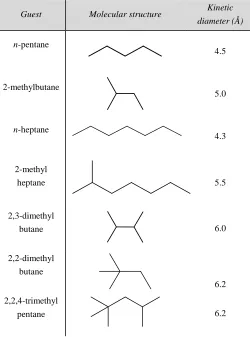
Gas adsorption isotherms.Gas isotherms for the different alkanes (2-methylbutane, n-pentane, n-hexane, 2,2-dimethyl-butane, 2,3-dimethyl2,2-dimethyl-butane, n-heptane, 2-methylheptane and 2,2,4-trimethylpentane (Table 1)) were measured volumetri-cally at 298 K for Sc2BDC3 using a custom-built vacuum line.
The Sc2BDC3 sample was degassed at 438 K under vacuum for
ca. 2 h prior to measurement of each isotherm. The alkane was degassed using a repeated freeze/thaw process using liquid N2.
The alkane uptake was determined as a function of increasing equilibrium pressure, up to pressures close to their saturated va-pour pressures. A full description of the apparatus and method is given in the Supporting Information (Figures S3-S11).
In-situ immersion single crystal X-ray diffraction ex-periments. Single-crystal X-ray diffraction experiments were performed on Sc2BDC3 crystals in a capillary, immersed in both
n-pentane and 2-methylbutane, using a method described previ-ously.23 A crystal was attached to the tip of a MiTeGen 100 μm
MicroloopTM using a small amount of AralditeTM epoxy resin.
The loop was mounted on a goniometer head and covered with a MicroRTTM polyester capillary. The capillary was stuck to the
goniometer head and sealed around the base using AralditeTM.
[image:2.612.60.297.48.558.2]When the epoxy resin was dry, the capillary was filled with the
Figure 2. Adsorption isotherms for Sc2BDC3 for linear as well as mono- and di-branched hydrocarbon species
[image:2.612.325.558.523.691.2]solvent in question (see Table 1) by injection through the top of
the capillary using a 0.6 mm diameter needle. The resultant hole was sealed with a drop of molten beeswax. Diffraction data were then collected at room temperature, and processed as de-tailed in the Supporting Information.
High-pressure single crystal X-Ray diffraction. High-pressure single-crystal diffraction data were obtained by plac-ing a splac-ingle-crystal of Sc2BDC3 - together with a ruby chip for
pressure calibration - in a Merril-Bassett Diamond Anvil Cell (DAC) with 600 µm culet diamonds and a tungsten gasket. For each pressure series the gasket chamber was filled with a differ-ent solvdiffer-ent as hydrostatic medium and the DAC closed care-fully. Diffraction data were then collected at room temperature and processed as detailed in the Supporting Information
Structure refinement. Structure solutions were performed using SUPERFLIP.24 In the cases where no satisfactory
solu-tion was obtained, the atomic coordinates of the previous pres-sure point were used as a starting model. The structures were refined against F2 in CRYSTALS25 where thermal similarity
and vibrational restraints were applied on all non-hydrogen at-oms (except for Sc) before refinement of anisotropic displace-ment parameters. Additional distance and angle restraints were also applied on the guest molecules and on the Group 2 BDC ring that is disordered as a consequence of the included guest. Hydrogen atoms attached to carbon atoms were placed geomet-rically and not refined. Analysis of the solvent accessible vol-ume and the residual electron density using SQUEEZE26 was
performed by applying the same resolution cut off of 1.1 Å to each data set following the procedure described by Graham et al.27. Further refinement details can be found in the Supporting
Information. All crystallographic data is available from the CCDC 1410949-1410961.
DFT single-point energy calculations. The structure of Sc2BDC3 determined experimentally under ambient conditions
(orthorhombic Fddd) was used as a starting model for the cal-culations. To save computational time the structure was trans-formed to its primitive cell. The energy of the primitive cell rel-ative to the geometry-optimized global minimum was then cal-culated as a function of the angle (θ) of rotation around the 1,4-phenylene axes of one Group 1 and one Group 2 linker (see Supporting Information, Figure S12). In both cases, calcula-tions were performed with and without the Tkatchenko-Scheffler dispersion correction. Energy values, calculated in 10° rotation increments, are provided in Table S1 in the sup-porting information.
RESULTS AND DISCUSSION
Immersion diffraction experiments and adsorption isotherms. The adsorption isotherms for alkanes on Sc2BDC3
obtained volumetrically at 298 K are shown in Figure 2. The straight chain alkanes n-pentane, n-hexane and n-heptane show strong uptake at low partial pressures (0.14 – 0.18 mmol g-1 at
40 mbar) indicating the molecules are taken up readily into the MOF. By contrast the geminal dimethylalkanes (2,2-dimethyl-butane and 2,2,4-trimethyl(2,2-dimethyl-butane) show very low uptakes (<0.02 mmol g-1 at 40 mbar). These low uptakes are not
unex-pected, considering the bulky t-butyl groups at the end of the molecules which must prevent these from penetrating into the pores of Sc2BDC3.
The mono-branched 2-methylbutane and the vicinal dimethyl 2,3-dimethylbutane uptakes are intermediate between n- and geminal dibranched alkanes. In particular the 2-methylbutane shows considerable uptake. By contrast, 2-methylheptane shows very low uptake, possibly in part due to its low saturated vapour pressure at 298 K.
In order to understand the uptake behaviour of Sc2BDC3 at low
[image:3.612.47.297.54.391.2]pressures and determine whether branched hydrocarbons can enter the pores under ambient conditions, we performed two im-mersion in situ single-crystal X-ray diffraction experiments,
Figure 3. Unit cell volume as a function of pressure for the different hy-drocarbons considered. Dotted lines refer to linear hyhy-drocarbons whilst solid lines denote branched molecules.
Guest Molecular structure Kinetic
diameter (Å)
n-pentane
4.5
2-methylbutane
5.0
n-heptane
4.3
2-methyl
heptane 5.5
2,3-dimethyl
butane 6.0
2,2-dimethyl butane
6.2
2,2,4-trimethyl
pentane 6.2
[image:3.612.323.557.530.687.2]where a single-crystal of Sc2BDC3 was immersed in a linear
al-kane (n-pentane) and a branched alal-kane (2-methylbutane) and diffraction data collected in situ.
Immersion in n-pentane induced subtle structural changes to the framework structure. Although the adsorbed linear hydrocar-bons could not be modelled crystallographically, a rotation of 14° of the Group 2 BDC linkers was observed. Together with a slight increase in the residual electronic density in the pores, these immersion experiments suggest that upon soaking, Sc2BDC3 easily adsorbs linear hydrocarbons. By contrast, no
crystallographic evidence for uptake of the branched and bulk-ier 2-methylbutane was obtained: when compared to the native Sc2BDC3 structure, neither structural changes in the framework
nor significant increases in the residual electron density in the pores were observed. These observations expose the limitations of the in situ immersion diffraction experiments. These meas-urements have an inherently low sensitivity due to the very low uptake of guest species into the pores at ambient pressure and temperature making these experiments extremely challenging for modelling guest species. In order to increase uptake, a series of high-pressure single-crystal X-ray diffraction experiments was performed to see whether very high pressures could be used to force larger amounts of sterically hindered and oversized guest molecules into the pores.
High-pressure inclusion experiments. Allalkanes listed in Table 1 were used as the pressure transmitting medium in high-pressures single crystal diffraction experiments on Sc2BDC3. In each case the pressure was increased from ca. 0.2
GPa until the samples became amorphous. While still crystal-line, Sc2BDC3 was observed to retain its orthorhombic Fddd
symmetry in all cases. The results of the variation of unit cell volume are given in Figure 3. The inclusion of molecules into MOFs is found not only to reduce the degree of unit cell con-traction upon compression, but also to stabilize the frameworks against collapse. We have recently shown that the compression of Sc2BDC3 in methanol has little physical effect on the
frame-work structure, but that the super-filling of methanol and guest-guest interactions throughout the channels stabilizes the MOF
at high pressures,24 while similar behaviour has also been seen
in other MOFs and zeolites.28
For the experiments using n-pentane, which is known to be readily adsorbed, there is strong resistance to compression and the structure remains crystalline until 0.8 GPa. By contrast, for 2,2,4-trimethylpentane, amorphization occurred immediately upon loading the cell at 0.2 GPa, and for the geminal 2,2-dime-thylbutane the structure contracts strongly under pressure and loses crystallinity above 0.2 GPa, consistent with these mole-cules being too large to access the pores and stabilize the struc-ture, even at elevated pressures. For all the other alkanes, the behaviour is intermediate, suggesting some pore filling occurs under pressure. For 2-methylbutane, when the pressure was in-creased beyond 0.4 GPa the crystals became amorphous and un-derwent a change from colourless to black. In our previous high-pressure study on Sc2BDC3, we also reported this change
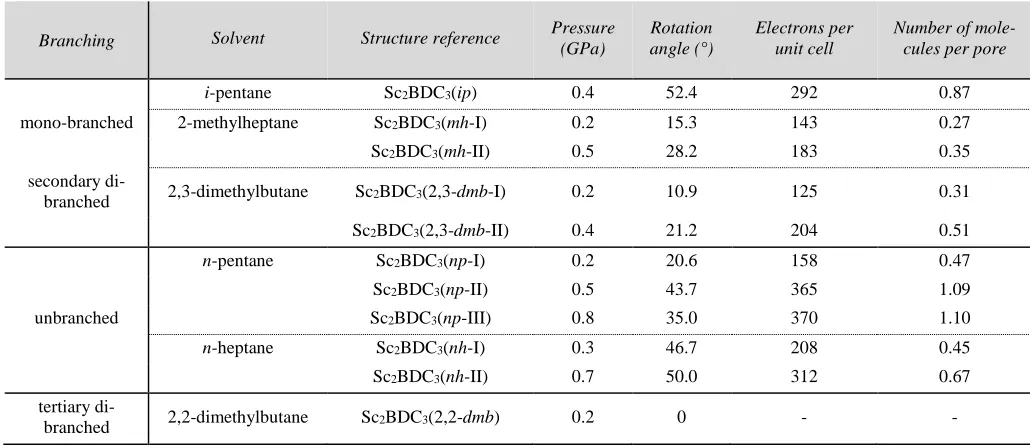
of optical properties upon amorphization. When the crystals were removed from the DAC after releasing the pressure, in all cases the samples became colourless and fully crystalline again. This is consistent with our previous study in methanol. High-pressure single crystal diffraction data allowed us not only to monitor how the framework responded to external pressure, but also to understand how the framework adapted to increasing guest content. When guest uptake had occurred, the extra-framework electron density could be modelled by disordered alkane adsorbates. Some details of the measured crystal struc-tures are given in Table 2, where the extra-framework electron density (modelled by using the SQUEEZE algorithm within PLATON) is given in terms of adsorbate molecules per pore. In line with the adsorption data, these results confirm that n-pen-tane is most readily taken up whilst 2,2-dimethylbun-pen-tane is not adsorbed at all. As well as locating extra framework electron density in the pores, these single crystal structures show that the Sc2BDC3 MOF can adapt to facilitate the uptake of alkanes
through a ligand rotation.
This modification is best explained in terms of the starting empty structure. Under ambient temperature and pressure con-ditions, Sc2BDC2 crystallises in the orthorhombic space group
Fddd, having two independent BDC linker molecules (Groups
Branching Solvent Structure reference Pressure
(GPa)
Rotation angle (°)
Electrons per unit cell
Number of mole-cules per pore
i-pentane Sc2BDC3(ip) 0.4 52.4 292 0.87
mono-branched 2-methylheptane Sc2BDC3(mh-I) 0.2 15.3 143 0.27
Sc2BDC3(mh-II) 0.5 28.2 183 0.35
secondary
di-branched 2,3-dimethylbutane Sc2BDC3(2,3-dmb-I) 0.2 10.9 125 0.31 Sc2BDC3(2,3-dmb-II) 0.4 21.2 204 0.51
n-pentane Sc2BDC3(np-I) 0.2 20.6 158 0.47
Sc2BDC3(np-II) 0.5 43.7 365 1.09
unbranched Sc2BDC3(np-III) 0.8 35.0 370 1.10
n-heptane Sc2BDC3(nh-I) 0.3 46.7 208 0.45
Sc2BDC3(nh-II) 0.7 50.0 312 0.67
tertiary
[image:4.612.58.573.43.267.2]di-branched 2,2-dimethylbutane Sc2BDC3(2,2-dmb) 0.2 0 - -
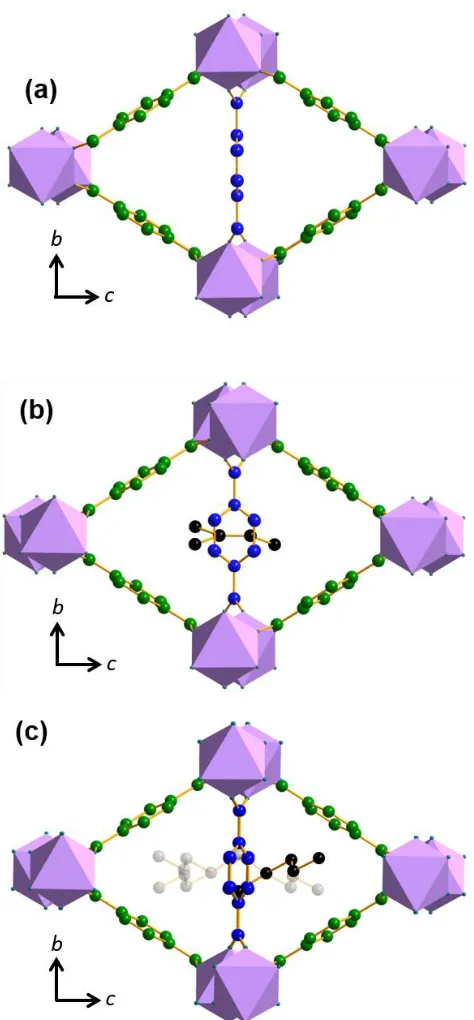
1 and 2) the phenyl rings of which are parallel to the a-axis (i.e. parallel to the principal framework channel direction). Upon uptake of either linear or di-branched hydrocarbons, the Group 2 BDC rings are rotated around [010] into two statically disor-dered (50:50 occupancy) positions (Figure 4a).
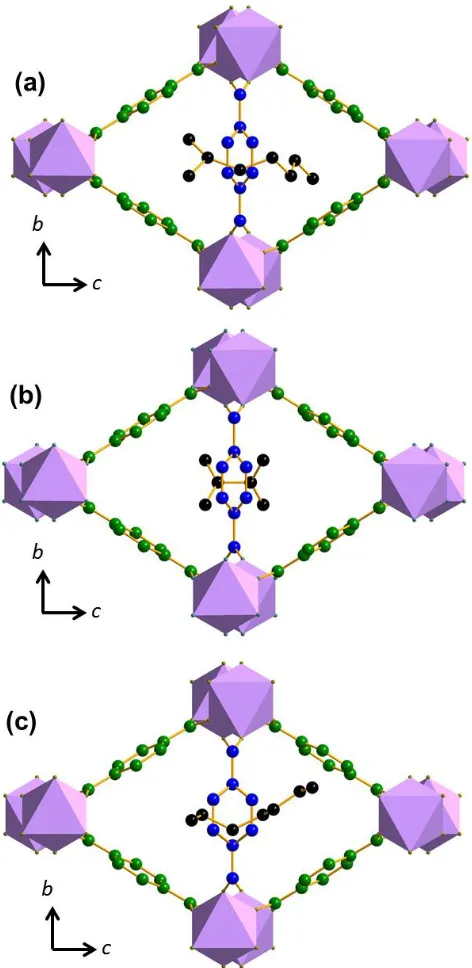
This effect is most significant in the case of 2-methylbutane in-clusion (henceforth referred to as Sc2BDC3(ip); Figure 1b and
4c), where the rings rotate by 52.4° (and -52.4° by symmetry) with respect to the (001) plane on which the Group 2 linkers lie in the empty Sc2BDC3 (Figure 4a). Fddd symmetry is
main-tained. The phase transition has a profound effect on the pore
size and shape. Sections of adjacent triangular channels – orig-inally partitioned by the Group 2 BDC ‘walls’ in the parent Sc2BDC3 structure amalgamate to give eight rhomboidal
cavi-ties per unit cell in the high-pressure Sc2BDC3(ip) phase (Figure
4b, 4c, and S13).
The intermolecular distance between adjacent Group 2 BDC linkers along the a-axis in empty Sc2BDC3 is ~4.5 Å (CH···HC;
normalized values), whereas in Sc2BDC3(ip) the distance
be-tween the two closest disordered BDC positions is ~6.3 Å. This significantly increases the depth of the pores, allowing the bulky 2-methylbutane molecules to sit in the isolated pores be-tween adjacent rotated rings along [100]. The pore volume29
in-dicates that the volume of each large pore in the high-pressure phase is ~240 Å3, compared with ~137 Å3 for each of the two
equivalent sections of triangular channel in the ambient pres-sure structure that merge, allowing the bulky 2-methylbutane molecules to be incorporated into the framework (Figure 1b and 4c).
A comparison can be made between these high-pressure guest-included Sc2BDC3 structures and the high pressure behaviour of
ZIF-8.19 In ZIF-8, a pressure-induced ring rotation was
ob-served when using methanol as a hydrostatic liquid at 1.5 GPa, causing the volume (and accessible pore volume) to increase with pressure. However, the overall accessible pore volume in the different high-pressure structures of Sc2BDC3 is actually
re-duced by around 10%. Instead, the radical change in local pore structure shows that the ring rotation can be attributed to the shape of the guest molecule, not the requirement of the system to increase the pore volume.
Amorphization of the crystal in 2-methylbutane occurs above 0.4 GPa, substantially lower in pressure than in methanol. As the 2-methylbutane-bearing structure at 0.4 GPa can no longer accommodate any more 2-methylbutane, it would appear that on increasing pressure further, direct compression and amor-phization occurs for Sc2BDC3(ip). Sc2BDC3(ip) does not
there-fore experience the stabilizing effect of channel ‘super-filling’ which occurs with methanol, which also occurs in other MOFs with one, two and three-dimensional channel connectiv-ity.15,23,30
Larger di-branched hydrocarbons can also penetrate into the pores of Sc2BDC3 at high pressures. Using 2,3-dimethylbutane
and 2-methylheptane as hydrostatic media, a similar transfor-mation is observed (see Figure 5a and b), though in each case the rotation is not as significant as in Sc2BDC3(ip): 21.2° for
2,3-dimethylbutane and 28.2° for 2-methylheptane. This can be explained by the amount of alkane that is being adsorbed into the framework. In the case of Sc2BDC3(ip) a whole
2-methyl-butane molecule is present in each pore at high pressure. On the other hand, at the highest pressure measured for both larger spe-cies (0.4 GPa for 2,3-dimethylbutane and 0.5 GPa for 2-methylheptane) the hydrocarbon uptake equates to less than half-occupancy for each guest molecule in the framework pores (see Table 2). For guests larger than 2-methylbutane a reduced uptake capacity results, which is coupled to a less substantial rotation angle of the Group 2 BDC ligands. This agrees well with trends observed in our gas adsorption experiments. High-pressure diffraction experiments on n-pentane and n-hep-tane show a similar structural transition to that observed with mono-branched secondary hydrocarbons. However the shape of the molecules and their location within the cavity results in dis-tinct differences in the structural behaviour of Sc2BDC3. These
[image:5.612.65.291.54.520.2]differences are particularly evident between 2-methylbutane and n-pentane.
The longer chain and increased flexibility of n-pentane, in com-parison to 2-methylbutane, causes the molecule to occupy addi-tional adsorption sites, extending across both the existing chan-nel space (along the [100] direction) and the deepened voids between the rotated BDC rings (as shown in Figure 1c). The longer, narrower shape of n-pentane results in three key differ-ences between the structural response of Sc2BDC3 to n-pentane
and 2-methylbutane uptake at high pressure. Firstly, the Group 2 BDC rings initially do not rotate to the same extent as in Sc2BDC3(ip). There is slight variation over the pressure regime
(from 20.8° in Sc2BDC3(np-I) to 35.0° in Sc2BDC3 (np-III)), but
the rotation of 54.6° in Sc2BDC3(ip) is far more extreme.
Sec-ondly, the framework channels do not become ‘closed’ in Sc2BDC3(np-I), as is the case in Sc2BDC3(ip). This is shown in
Figure S13 and is a direct result of the lesser degree of BDC rotation in Sc2BDC3(np-I). Finally, and related wholly to the
two previous points, the disordered sites of the n-pentane in-crease in occupancy as pressure is inin-creased on the Sc2BDC3
crystal. Essentially, more n-pentane is forced into the frame-work as the pressure is increased, with a subsequent increase in rotation angle of the BDC linker. In our previous pressure study using methanol, an increase in occupancy of two disordered methanol adsorption sites could also be followed as a function of pressure, however no change in framework geometry oc-curred.
Inclusion of n-heptane yields similar effects to those observed with n-pentane. However in this case, the rotation angle rec-orded for both n-heptane included structures, Sc2BDC3(hp-I)
and Sc2BDC3(hp-II) is more pronounced, measuring 46.7° and
50.0° respectively. This results from the longer chain length which extends not only along the channels but also between them. Comparing the uptake of n-heptane (0.65 molecules per pore) with that recorded for the monobranched 2-methylhep-tane (0.35 per pore) shows again the different behaviour of un-branched and un-branched hydrocarbons upon inclusion into Sc2BDC3.
Both in the case of n-pentane and n-heptane, crystallinity is maintained beyond 0.5 GPa, unlike in the case of branched hy-drocarbons. With n-pentane it was possible to keep increasing the pressure without significant loss in the diffraction quality up until 0.8 GPa. Amidst a gradual loss of resolution, it is not until 1.7 GPa that amorphization is complete, however, only unit cell dimensions could be obtained above 0.8 GPa. As mentioned previously, in both Sc2BDC3(np-II) and Sc2BDC3(np-III) the
occupancy of the included n-pentane molecules gradually in-creases to 100%, and coincides with the Group 2 BDC rotation angle increase, resulting in a single molecule of n-pentane per rhomboidal pore. Thus, the possibility to continue filling the framework results in a delay in the amorphization, showing a markedly different behaviour between the compression with branched and unbranched hydrocarbons.
Using 2,2-dimethylbutane or 2,2,4-trimethylpentane as hydro-static media, no evidence of guest uptake was detected in Sc2BDC3. Whilst for 2,2-dimethylbutane the only high-pressure
crystal structure collected at 0.2 GPa (Sc2BDC3 (2,2-dmb)),
re-vealed no obvious structural change. Additionally, the unit cell volume was substantially reduced; a clear indication of direct framework compression in tertiary branched hydrocarbons. This indicates that tertiary branched alkanes are too big to enter the framework pores, even at high pressures, and that the sec-ondary di-branched hydrocarbons represent the upper diameter limit for a guest species under pressure in Sc2BDC3. This in
principle could enable Sc2BDC3 to act as a molecular sieve
be-tween secondary and tertiary branched alkanes under pressure. The results show that the very high pressures in the DAC are required to achieve high adsorbate loadings of branched alkanes in Sc2BDC3. At these pressures, significant PV work is
avail-able to give rise to rotation of phenyl groups of the linker and to maintain them in a rotated, ‘high energy’, state, to allow hy-drocarbon uptake. At 0.1 GPa this is of the order of 10 kJ mol -1, for example, increasing linearly with pressure. To calculate
the energy associated with the rotation of Group 2 linker phenyl groups, we performed density functional theory single-point en-Figure 5. High-pressure crystal structures of Sc2BDC3 with the included
[image:6.612.63.299.62.546.2]ergy calculations of the potential energy of rotation in 10° rota-tion increments (Table S1 and Figure 6). For observed rotarota-tions in the 10 – 50° range, energies of 5 – 20 kJ mol-1 of linker are
observed, which could readily be offset by the work performed on the included hydrocarbons in the GPa regime would make a significant contribution.
It is also of interest to understand why it is the Group 2 linker phenyl groups, and not those of the Group 1 linker, that rotate, especially when the adsorption of CO2 is observed to cause a
minor tilt of the Group 1 rings while the Group 2 ring remains unperturbed. Comparison of the rotation energies (Figure 6) in-dicates that there is a higher energy required for significant ro-tation of the Group 1 linkers. Consideration of the steric limita-tions of different BDC groups indicates that concerted rotation of equivalent and adjacent Group 1 linkers (to a greater degree than the minor rotation already reported) could result in unfa-vourably close edge-to-edge contacts (< 1.25 Å) between aro-matic rings. The Group 2 BDC has more degrees of freedom to rotate since all adjacent BDC linkers are Group 1. The larger Tkatchenko-Scheffler dispersion correction term for Group 2, especially at higher rotation angles, also indicates that there may be additional van der Waals stabilization, which is not the case for the Group 1 linkers
CONCLUSIONS
In summary, we have demonstrated how sterically ‘oversized’ hydrocarbon molecules, can be squeezed into accessible cavi-ties of the small-pore MOF, Sc2BDC3, using high pressure.
Since C5-C8 hydrocarbons cannot penetrate or diffuse through
the framework in the same way as shorter unbranched hydro-carbons, inclusion results in a structural phase transition which alters the shape and size of the individual pores with relatively little change to the overall porosity. As a result of the ring rota-tion, guest molecules of an awkward shape are able to be admit-ted. Since this transition is fully reversible (no damage, frac-tures or polycrystallinity is imparted on the crystal), this result is akin to ‘breathing’ mechanisms in frameworks, exemplifying how high pressure X-ray diffraction can be used to probe the
structural flexibility of MOFs, and is a powerful tool for under-standing the structural effect of guest uptake. The framework responds differently to inclusion of linear, mono-branched, sec-ondary di-branched or tertiary branched hydrocarbons and so this material may have application in alkane separations. For instance, mono-branched hydrocarbons can penetrate the framework void space under relatively moderate pressures, while tertiary branched hydrocarbons cannot. Similarly, only linear molecules are readily adsorbed under ambient conditions. Such a potential application of Sc2BDC3 in the high-pressure
separation of alkane isomers would be facilitated by the com-plete reversibility of the adsorption/desorption process.
ASSOCIATED CONTENT
AUTHOR INFORMATION
Corresponding Author
Notes
The authors declare no competing financial interests
Author Contributions
The work was performed through contributions of all authors. All authors have given approval to the final version of the manuscript.
ACKNOWLEDGMENT
We thank the Royal Society of Edinburgh and the Scottish Government for a fellowship to Dr Stephen A. Moggach. We thank EPSRC (EP/J02077X/1) and Leverhulme Trust for a research project grant (RPG-209) for financial support. We also thank the UK Carr Parinello consortium for allocation of computing time on the EPSRC high per-formance computing resource ARCHER (managed by the Edinburgh Parallel Computing Centre, the EaSTCHEM Research Computing Fa-cility and the University of Edinburgh ECDF faFa-cility. The data which underpin this work are available at http://dx.doi.org/10.7488/ds/371. REFERENCES
![Figure 4. (a) Scheme of the ring rotation around [010] of Group 2 phenyl rings with respect to the (001) plane](https://thumb-us.123doks.com/thumbv2/123dok_us/8981946.393606/5.612.65.291.54.520/figure-scheme-rotation-group-phenyl-rings-respect-plane.webp)