ISSN Online: 2327-5227 ISSN Print: 2327-5219
DOI: 10.4236/jcc.2019.710001 Oct. 11, 2019 1 Journal of Computer and Communications
A Survey of Blind Forensics Techniques
for JPEG Image Tampering
Xueling Chu, Haiming Li
College of Computer Science and Technology, Shanghai University of Electric Power, Shanghai, China
Abstract
Blind forensics of JPEG image tampering as a kind of digital image blind fo-rensics technology is gradually becoming a new research hotspot in the field of image security. Firstly, the main achievements of domestic and foreign scholars in the blind forensic technology of JPEG image tampering were briefly described. Then, according to the different methods of tampering and detection, the current detection was divided into two types: double JPEG compression detection and block effect inconsistency detection. This paper summarized the existing methods of JPEG image blind forensics detection, and analyzed the two methods. Finally, the existing problems and future re-search trends were analyzed and prospected to provide further theoretical support for the research of JPEG image blind forensics technology.
Keywords
Image Forensics, Tamper Detection, JPEG Image Forensics, JPEG Block Effect
1. Introduction
As a very important and effective information carrier in people’s life, image de-scribes objective objects in a simple, direct and vivid way. As image processing technology becomes more advanced, tampering technology becomes more and more complex, and the tampered and forged images are more and more difficult to be detected by the human eye. If image tampering occurs in important occa-sions such as military politics and courts, it will inevitably have an immeasurable and harmful impact on national security and stability as well as people’s lives.
Active forensics and passive forensics are two main techniques of digital fo-rensics. Active forensics technology refers to the technology of embedding fra-gile watermark or signature into digital image in advance and extracting water-mark or signature for forensics. Digital image passive forensics technology, How to cite this paper: Chu, X.L. and Li,
H.M. (2019) A Survey of Blind Forensics Techniques for JPEG Image Tampering. Journal of Computer and Communications, 7, 1-13.
https://doi.org/10.4236/jcc.2019.710001
Received: August 19, 2019 Accepted: October 8, 2019 Published: October 11, 2019
Copyright © 2019 by author(s) and Scientific Research Publishing Inc. This work is licensed under the Creative Commons Attribution International License (CC BY 4.0).
DOI: 10.4236/jcc.2019.710001 2 Journal of Computer and Communications namely blind forensics technology, is a kind of technology that verifies the authen-ticity and source of images without relying on pre-signature or pre-embedding information extraction [1]. Compared with active forensics, passive forensics has higher application and research value, but it is more difficult to obtain evidence than active forensics. JPEG, as one of the popular image formats at present, is also the image compression standard. Its advantage is that it can still obtain bet-ter image quality with relatively high compression rate and relatively fast processing speed. Therefore, the blind forensics research on JPEG tampered im-ages has very important significance and application prospect. This paper briefly describes the main achievements in passive forensics of JPEG image tampering. Based on the different methods of tamper and detection, the current detection methods can be divided into dual JPEG compression detection method and JPEG block effect inconsistency detection method. The performance of repre-sentative methods of two kinds of detection methods is evaluated.
2. Double JPEG Detection
2.1. Double JPEG Image Compression Principle
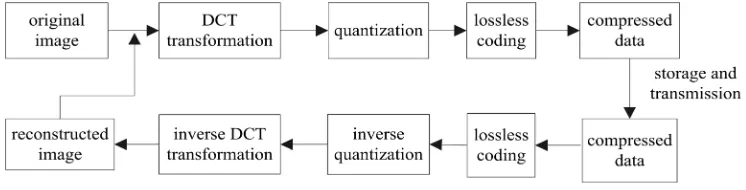
The double compression of JPEG image means that after the JPEG image is de-compressed, it is compressed with a new quantization table and stored again. When image software is used for image tampering, after the tampering is com-pleted, the JPEG image may be compressed again with a quality factor different from the original image compression factor, that is, the dual JPEG image com-pression. It should be noted that when the first compression quality factor QF1 is equal to the second compression quality factor QF2, the characteristics of the image do not change significantly, in this case, the image is not called through JPEG compression. The image double compression process is shown in Figure 1: decompression of the original JPEG image is performed first, namely decod-ing and inverse quantization, followed by inverse DCT transformation, and the decompression image is finally compressed for a second time.
2.2. Double-JPEG Image Blind Forensics Algorithm
[image:2.595.167.540.613.708.2]Researchers have developed many blind forensics algorithms for double-JPEG tampered images. The method of locating tampering areas by estimating the first compression quantization table of images [2] [3] [4] has been studied by many scholars. Farid uses different compression factors to re-compress the JPEG images
DOI: 10.4236/jcc.2019.710001 3 Journal of Computer and Communications to be detected. When the compression factor is equal to the compression factor of the tampered area, the statistical characteristics of the tampered area have lit-tle change in the degree of distortion, thus achieving the detection of the tam-pered area [5]. HE realized as a JPEG image tamper with the area of automatic detection and localization, this method can detect the different synthesis me-thods of image, without full decompression JPEG images can work, the speed, the experimental results show that the method of JPEG image compression effect is good, especially in the compression under the condition of high quality [6]. The estimated quantization step obtained by Fridrich et al. was extracted by es-timating DCT coefficient and quantization step compatibility [7]. However, this method can only detect the image tampered with BMP format saved image, JPEG dual compression format is invalid.
The detection algorithm proposed above has relatively large limitations: lite-rature [8] proposed an algorithm that can realize automatic detection of image tampering regions. The average probability density of histogram period is used to approximate the tampering region. Bayes theorem is used to calculate the posterior probability of a certain kind of image block. On the basis of literature
[8], Duan Xintao et al. used particle swarm optimization algorithm to set an
adaptive threshold to optimize the posterior probability density map, and classi-fied and judged the threshold. Detection and separation of tampered areas were realized through the posterior probability density map [9]. Experimental results show that this method can automatically detect and extract the tampered areas quickly and accurately, and the detection results are significantly improved when the first quality factor is greater than the second quality factor.
Literature [10] [11] traverse all possible compression factors of the detected image, and try to carry out the third compression, and then analyze the degree of image distortion, which can detect the size of the original compression factor of the image to be detected. Smartphones are exploding in the market for imaging devices, with megapixels threatening traditional digital cameras. While smart-phone images are widely distributed, images can be easily manipulated using a variety of photo editing tools. Therefore, smart phone image authentication and recognition after capture is an important content of digital forensics. Qingzhong Liu, et al. in order to improve the detection of pairs of JPEG compression, trans-plant JPEG steganographic analysis in the design of the adjacent joint density characteristics, and the joint density and DCT domain edge density characteris-tics of fusion, as a detector, learning classifier using edge density and adjacent joint density characteristics and identify the smartphone source and capture af-ter operation [12].
DOI: 10.4236/jcc.2019.710001 4 Journal of Computer and Communications Table 1. JPEG double compressed image feature classification and detection effect.
category feature recognition
effect different
quantizatio n matrix
block
alignment quantified DCT coefficients
the absolute difference values of the DC-AC coefficient and the AC-AC coefficient were calculated respectively [17]
general
difference in histogram of quantization
coefficient of DCT [15] [16] good difference in DCT coefficients before and after compression [9] good first significant
digit [7] [17] [18]
the first significant number of DCT
coefficient [14] general DCT coefficient low-frequency point first
significant digit [17] good first significant digit of DCT coefficient
based on Markov model [18] excellent block is
not aligned difference in adjacent coefficients [19] good percentage of JPEG coefficient [20] good quantization noise [42] excellent identical quantization
matrix disturbance threshold [21] general truncation error and rounding error [22] good convergence of block property [23] (only for jpeg-100) good
literature, which is recorded as “general”, “good” and “excellent”. In recent years, with the in-depth research of machine learning and deep learning, the method of deep learning is also applied in image forensics [24] [25] [26] [27] [28]. Literature [29] proposes a convolutional neural network detection algo-rithm based on double JPEG compression. Literature [30] and literature [31] re-spectively use naive Bayesian classifier and SVM classifier to detect and extract double JPEG compressed images. Table 2 and Table 3 are AUC values of three algorithms in literature [29] [30] and [31] respectively in two data sets. It can be concluded from the two table data that the algorithm in literature [29] is supe-rior to the other two algorithms, especially in the case of QF2. Although the al-gorithm achieves good results, the computational complexity is obviously higher than the other two algorithms.
3. JPEG Block Effect Inconsistency Detection
3.1. Generation of JEPG Image Block Effect
DOI: 10.4236/jcc.2019.710001 5 Journal of Computer and Communications Table 2. AUC values of literature [29], literature [30] and literature [31] in the large data set.
QF2
QF1 60 70 80 90
60
literature [29] 0.68 0.95 0.99 1.00 literature [30] 0.50 0.97 0.99 0.99 literature [31] 0.50 0.90 0.74 0.94
70
literature [29] 0.95 0.67 1.00 1.00 literature [30] 0.85 0.48 1.00 0.99 literature [31] 0.72 0.68 0.75 0.97
80
literature [29] 0.98 0.99 0.44 1.00 literature [30] 0.90 0.93 0.44 1.00 literature [31] 0.50 0.82 0.40 0.85
90
literature [29] 0.89 0.91 0.97 0.45 literature [30] 0.68 0.67 0.82 0.50 literature [31] 0.54 0.65 0.71 0.65
Table 3. AUC values of references [29] [30] and [31] in the small figure data set.
QF2
QF1 60 70 80 90
60
literature [29] 0.64 0.95 0.98 0.94 literature [30] 0.53 0.95 0.97 0.95 literature [31] 0.53 0.90 0.81 0.78
70
literature [29] 0.88 0.52 0.96 0.98 literature [30] 0.82 0.54 0.95 0.95 literature [31] 0.70 0.57 0.80 0.84
80
literature [29] 0.93 0.89 0.52 0.98 literature [30] 0.69 0.84 0.54 0.96 literature [31] 0.50 0.74 0.44 0.73
90
literature [29] 0.74 0.73 0.79 0.48 literature [30] 0.69 0.73 0.75 0.60 literature [31] 0.45 0.54 0.74 0.52
[image:5.595.205.540.365.605.2]infor-DOI: 10.4236/jcc.2019.710001 6 Journal of Computer and Communications mation during JPEG compression, and the quantization error will be introduced during the rounding operation, denoted as e (u, v), and the quantization step can be expressed as shown in formula (1): they are unavoidable.
( )
,( )
( )
,( ) ( )
( )
, , , , 0,1, ,7, ,
Q F u v F u v
F u v round e u v u v
Q u v Q u v
= = + =
(1)
The reverse quantization operation is carried out at the decoding end, as shown in formula (2), the DCT coefficient after the reverse quantization is ob-tained:
( )
, Q( ) ( )
, ,( ) ( ) ( )
, , , , , 0,1, ,7F u v =F u v Q u v× =F u v e u v Q u v u v+ × = (2)
Then DCT inverse transformation is carried out to obtain the decoded image, so that the distribution of decoding quantization error e (u, v) × Q (u, v) can be obtained in the whole decoded image. The decoding quantization error will be superimposed during the block processing of JPEG image, and then the decod-ing will break the correlation between each sub-block in the image, so the block-effect phenomenon is formed at the sub-block boundary.
3.2. Algorithm Based on JEPG Image Block Effect
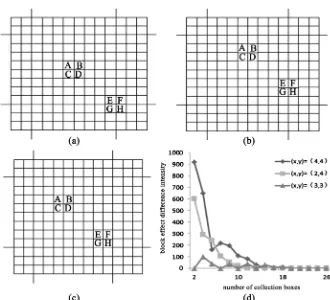
In recent years, domestic and foreign researchers have proposed many algo-rithms to eliminate the block effect [33]-[38], but these algoalgo-rithms in the block effect is used to eliminate the blurred image at the same time be tampering with the evidence, so the algorithm of image block effect to eliminate only able to increase the quality of compressed image, JPEG tampering with the harsh conditions of image blind forensics has not improved. Literature [39] first proposed a fast and effective method to detect JPEG block effect, that is, if there is no compression, the difference between adjacent pixels intersecting the block boundary should be similar to the difference between adjacent pixels within the block, but the difference between adjacent pixels intersecting the block boundary will be different after JPEG compression. Figure 2 shows the difference between the pixels within each 8 × 8 block with an intersecting block boundary with a compression quality factor of 85 in Lena image, as shown in formula (3):
( )
( )
, ,
Z x y A D B C
Z x y E H F G
′ = + − −
′′ = + − − (3)
where (x, y) represents the coordinates of A position in each block. By calculat-ing the histogram of Z x y′
(
,)
and Z x y′′(
,)
of 3 positions (4, 4), (2, 4) and (3, 3), the difference strength of block effect of H1 and H2 is shown in formula (4):( )x y,
( )
1( )
2( )
,[
0.255 2]
K n = H n H n− n∈ × (4)
DOI: 10.4236/jcc.2019.710001 7 Journal of Computer and Communications Figure 2. Example of block effect difference of JPEG image. (a) (x, y) = (4, 4); (b) (x, y) = (2, 4); (c) (x, y) = (3, 3); (d) Histogram comparison of (x, y) under different coordinates.
DOI: 10.4236/jcc.2019.710001 8 Journal of Computer and Communications of block effect, and then the low-frequency compensation is carried out. Only 15 DCT coefficients of the low-frequency are compensated here. Finally, the quan-tized noise model is modified to detect the double-compression block effect of block alignment or misalignment.
Many scholars have studied the mesh mismatch between the block-effect grid of the tampered region and the background region, and recognized the tampered region according to the extraction of block-effect grid. Tralic, D. et al. [43] pro-posed that the tamper region of JPEG forged image is detected and located ac-cording to the mismatch of image block-effect grid. This detection method can effectively process the image of smooth copy region boundary through the value of average neighboring pixels, and is realized by extracting and analyzing the grid block effect of block components introduced in the process of JPEG com-pression. Image compression for many times will produce block-effect mesh offset. Huang Wei [44] et al. introduced background information irrelevant to the original image in the process of image re-acquisition. Whether the original of image is offset is detected by using the average information loss of image to conduct block-effect mesh. Compared with the traditional method, this method has higher precision and shorter average detection time.
There must be mismatch inconsistency between block-effect grid of original JPEG image and block-effect grid of tampered image. Based on this assumption, blind forensics is effective in most cases, and detection will fail only if the pasted tampering area coincides with the surrounding original image block-effect grid, but the probability of this happening is only 1/64, that is, 1.56% [45].
4. Conclusions
4.1. Existing Problems
With the rapid development of image processing technology, image tampering has tended to be normalized. Although the blind forensics technology of JPEG image tampering has achieved some effects, it has not made many break-throughs in recent years and there is no perfect architecture, which is mainly re-flected in the following aspects:
1) The method is highly targeted. Most of the blind forensics of JPEG image tampering is for a specific tampering method, such as single compression, double compression, splicing, copy and paste, etc. Because without any prior knowledge when analyzing an image, it is difficult to detect the features of the image forgery to be detected, in order to meet the actual requirements, it is ne-cessary to develop a fusion algorithm that can detect complex image tampering.
2) The forensics algorithm based on the statistical characteristics of JPEG im-ages relies too much on the classifier and the selection of training samples, and most forensics algorithms need to rely on pre-training. For the poor perfor-mance of common blind detection, most forensics methods do not have a uni-fied measurement standard.
DOI: 10.4236/jcc.2019.710001 9 Journal of Computer and Communications proprietary databases or some open source databases, and the images may come from different digital devices. Due to the difference between training samples and test samples, these differences have a low coupling degree, which will lead to different detection results of the same algorithm in different image databases. Therefore, it is impossible to effectively compare the advantages and disadvan-tages of each algorithm, and there is no unified standard model for the judgment of experimental results. In order to analyze and compare all kinds of tampering images and detection technologies objectively, it is necessary to establish a com-mon image database and unify system evaluation norms and methods.
4.2. Research Prospect
Blind forensics of JPEG image tampering is a kind of passive forensics. Tamper-ing detection can be divided into two types: double JPEG compression detection and block effect inconsistency detection. So far, the solutions to the problems faced are not completely mature, and there is still a certain gap with the actual application. Based on the summary and analysis of the existing research work, future research prospects can be considered from the following aspects:
1) Most JPEG image dual compression methods are only effective when the second compression quality factor QF2 is higher than the first QF1. When QF1 > QF2, the detection effect of the algorithm is poor. In the case of large JPEG second compression quality factor, forensic algorithm detection is still ef-fective, which is the future research trend.
2) When the image is tampered with a lower compression quality factor, the original JPEG compression trace of the tampered area will be destroyed, and the tampering detection difficulty will increase. Therefore, when the tampered im-age is compressed and saved again with a lower quality factor than the original image, the blind forensics method of JPEG tampered image based on block effect measurement usually has poor or even invalid detection results. The faked JPEG image which is compressed again with a quality factor smaller than the original image can be further analyzed by combining other features, such as combining with the dual quantization of the JPEG image.
3) In recent years, with the rapid development of information and computer research, some fields related to digital image blind forensics research are also constantly innovating and making progress. At present, the rapidly developing statistical machine learning, deep learning, cloud computing, computer vision, big data and so on can provide valuable references for the research on the blind forensics of JPEG image tampering.
Conflicts of Interest
The authors declare no conflicts of interest regarding the publication of this paper.
References
Im-DOI: 10.4236/jcc.2019.710001 10 Journal of Computer and Communications
age Based on JPEG Double Quantization Effect. Proceedings of DPCS 2015, 35, 3198-3202. (In Chinese)
[2] Zheng, E.G. and Ping, X. J. (2010) Passives-Blind Forensics for a Class of JPEG Im-age Forgey. Journal of Electronics & Information Technology, 32, 394-399. (In Chinese)
[3] Lukas, J. and Fridrich, J. (2003) Estimation of Primary Quantization Matrix in Double Compressed JPEG Images. Proceedings of the 2003 Digital Forensic Re-search Workshop, Piscataway, 67-84.
[4] Lin, T., Chang, M. and Chen, Y. (2011) A Passive-Blind Forgery Detection Scheme Based on Content-Adaptive Quantization Table Estimation. IEEE Transactions on Circuits and Systems for Video Technology, 21, 421-434.
https://doi.org/10.1109/TCSVT.2011.2125370
[5] Farid, H. (2009) Exposing Digital Forgeries from JPEG Ghosts. IEEE Transactions on Information Forensics and Security, 4, 154-160.
https://doi.org/10.1109/TIFS.2008.2012215
[6] He, J., Lin, Z., Wang, L., et al. (2006) Detecting Doctored JPEG Images via DCT Coefficient Analysis. In: Leonardis, A., Bischof, H. and Pinz, A., Eds., Lecture Notes in Computer Science, Springer, Berlin, Heidelberg, 423-435.
https://doi.org/10.1007/11744078_33
[7] Fridrich, J., Goljan, M. and Du, R. (2001) Steganalysis Based on JPEG Compatibili-ty. ITCom 2001: International Symposium on the Convergence of IT and Commu-nications, International Society for Optics and Photonics, 275-280.
https://doi.org/10.1117/12.448213
[8] Lin, Z., He, J., Tang, X., et al. (2009) Fast, Automatic and Fine-Grained Tampered JPEG Image Detection via DCT Coefficient Analysis. Pattern Recognition, 42, 2492-2501.https://doi.org/10.1016/j.patcog.2009.03.019
[9] Duan, X.T., Peng, T., Li, F.F. and Wang, J. (2017) Blind Separation of Tampered Images Based on JPEG Double Compression Properties. Journal of University of Ji-nan (Science and Technology), 31, 87-96. (In Chinese)
[10] Shih, F.Y. and Shi, Y.Q. (2012) Passive Detection of Copy-Paste Forgery between JPEG Images. Journal of Central South University, 19, 2839-2851.
https://doi.org/10.1007/s11771-012-1350-5
[11] Zhou, X.J., Li, F. and Xiong, B. (2012) Blind Detection of Synthetic Image Based on JPEG Quantization Distortion. Application Research of Computers, 29, 2346-2349. (In Chinese)
[12] Liu, Q., Cooper, P.A., Chen, L., et al. (2013) Detection of JPEG Double Compres-sion and Identification of Smartphone Image Source and Post-Capture Manipula-tion. Applied Intelligence, 39, 705-726.https://doi.org/10.1007/s10489-013-0430-z
[13] Wang, Z.F., Zhu, L., Zeng, C.Y., et al. (2018) Survey on Recompression Detection for Digital Images. ComputerScience, 9, 20-29. (In Chinese)
[14] Fu, D.D., Shi, Y.Q. and Su, W. (2007) A Generalized Benford’s Law for JPEG Coef-ficients and Its Applications in Image Forensics. Proceedings of SPIE, 6505, 58-61.
https://doi.org/10.1117/12.704723
[15] Wang, H.M. and Yang, X.Y. (2014) Detection Method for JPEG Image Based on the Difference of DCT Coefficient Histograms. Journal of Sichuan University ( Ad-vancedEngineering Science), 46, 41-46. (In Chinese)
Jour-DOI: 10.4236/jcc.2019.710001 11 Journal of Computer and Communications nal of Electronics & Information Technology, 31, 836-839. (In Chinese)
[17] Li, B., Shi, Y.Q. and Huang, J. (2008) Detecting Doubly Compressed JPEG Images by Using Mode Based First Digit Features. 2008 IEEE 10th Workshop on Multime-dia Signal Processing, Cairns, Australia,8-10 October 2008, 730-735.
[18] Dong, L.S., Kong, X.W., et al. (2011) Double Compression Detection Based on Markov Model of the First Digits of DCT Coefficients. 2011 Sixth International Conference on Image and Graphics,Hefei,12-15 August 2011, 234-237.
https://doi.org/10.1109/ICIG.2011.100
[19] Chen, C., Shi, Y.Q. and Su, W. (2008) A Machine Learning Based Scheme for Double JPEG Compression Detection. 2008 19th International Conference on Pat-tern Recognition, Tampa, FL, 8-11 December 2008, 1-4.
https://doi.org/10.1109/ICPR.2008.4761645
[20] Bianchi, T. and Piva, A. (2012) Detection of Nonaligned Double JPEG Compression Based on Integer Periodicity Maps. IEEE Transactions on Information Forensics and Security, 7, 842-848.https://doi.org/10.1109/TIFS.2011.2170836
[21] Huang, F., Huang, J. and Shi, Y.Q. (2010) Detecting Double JPEG Compression with the Same Quantization Matrix. IEEE Transactions on Information Forensics and Security, 5, 848-856.https://doi.org/10.1109/TIFS.2010.2072921
[22] Yang, J., Xie, J., Zhu, G., Kwong, S. and Shi, Y.-Q. (2014) An Effective Method for Detecting Double JPEG Compression with the Same Quantization Matrix. IEEE Transactions on Information Forensics and Security, 9, 1933-1942.
https://doi.org/10.1109/TIFS.2014.2359368
[23] Lai, S.Y. and Bohme, R. (2013) Block Convergence in Repeated Transform Coding: JPEG-100 Forensics, Carbon Dating, and Tamper Detection. 2013 IEEE Interna-tional Conference on Acoustics, Speech and Signal Processing, Vancouver, 26-31 May 2013, 3028-3032. https://doi.org/10.1109/ICASSP.2013.6638214
[24] Belhassen, B. and Matthew, C.S. (2017) On the Robustness of Constrained Convo-lutional Neural Networks to JPEG Post-Compression for Image Resampling Detec-tion. 2017 IEEE International Conference on Acoustics, Speech and Signal Processing,New Orleans, LA, 5-9 March 2017, 2152-2156.
[25] Rao, Y. and Ni, J.Q. (2016) A Deep Learning Approach to Detection of Splicing and Copy-Move Forgeries in Images. 2016 IEEE International Workshop on Informa-tion Forensics and Security, Abu Dhabi, 4-7 December 2016, 2157-4774.
https://doi.org/10.1109/WIFS.2016.7823911
[26] Zhou, P., Han, X.T., Morariu, V.I. and Davis,L.S. (2018) Learning Rich Features for Image Manipulation Detection. 2018 IEEE Conference on Computer Vision and Pattern Recognition,Salt Lake City, UT,18-23 June 2018, 1053-1061.
https://doi.org/10.1109/CVPR.2018.00116
[27] Geethu, V. and Arun, K.M.N. (2016) Detection of Double JPEG Compression on Color Image using Neural Network Classifier. International Journal for Innovative Research in Science & Technology, 3, 175-181.
[28] Amerini, I., Uricchio, T., Ballan, L. and Caldelli, R. (2017) Localization of JPEG Double Compression through Multi-Domain Convolutional Neural Networks. 2017
IEEE Conference on Computer Vision and Pattern Recognition Workshops, Ho-nolulu, HI,21-26 July 2017, 2160-7516. https://doi.org/10.1109/CVPRW.2017.233
[29] Wang, Q. and Zhangk R. (2016) Double JPEG Compression Forensics Based on a Convolutional Neural Network. EURASIP Journal on Information Security, 2016,
DOI: 10.4236/jcc.2019.710001 12 Journal of Computer and Communications
[30] Bianchi, T. and Piva, A. (2012) Image Forgery Localization via Block-Grained Analysis of JPEG Artifacts. IEEE Transactions on Information Forensics and Secu-rity, 7, 1003-1017.https://doi.org/10.1109/TIFS.2012.2187516
[31] Amerini, I., Becarelli, R., Caldelli, R. and Del Mastio, A. (2014) Splicing Forgeries Localization through the Use of First Digit Features. 2014 IEEE International Workshop on Information Forensics and Security, Atlanta, GA, 3-5 December 2014, 143-148. https://doi.org/10.1109/WIFS.2014.7084318
[32] Zhao, J., Guo, J.C. and Zhang, Y. (2013) Survey: Blind Forensic of JPEG Forgeries Based on Blocking Artifacts. Journal of Image and Graphics, 18, 613-620. (In Chi-nese)
[33] Singh, J., Singh, S., Singh, D. and Uddin, M. (2011) A Signal Adaptive Filter for Blocking Effect Reduction of JPEG Compressed Images. International Journal of Electronics and Communications, 65, 827-839.
https://doi.org/10.1016/j.aeue.2011.01.012
[34] Jung, C., Jiao, L.C., Qi, H.T. and Sun, T. (2012) Image Deblocking via Sparse Re-presentation. Signal Processing: ImageCommunication, 27, 663-677.
https://doi.org/10.1016/j.image.2012.03.002
[35] Seok, B.Y., Kyuha, C. and Jong, B.R. (2011) Post Processing for Blocking Artifact Reduction. 2011 18th IEEE International Conference on Image Processing, Brussels, 11-14 September 2011, 1509-1512.
[36] Nath, V.K. and Hazarika, D. (2012) Blocking Artifacts Suppression in Wavelet Transform Domain Using Local Wiener Filtering. 2012 3rd National Conference on Emerging Trends and Applications in Computer Science, Shillong, India, 30-31 March 2012, 93-97.https://doi.org/10.1109/NCETACS.2012.6203306
[37] Suo, S.Y., He, X.H., Xiong, S.H., et al. (2018) Image Deblocking Algorithm Using Adaptive High-Dimensional Nonlocal Total Variational for Compressed Image.
Science Technology and Engineering, 10, 224-230. (In Chinese)
[38] Bhardwaj, D. and Pankajakahan, V. (2018) A JPEG Blocking Artifact Detector for Image Forensics. SignalProcessing: ImageCommunication, 68, 155-161.
https://doi.org/10.1016/j.image.2018.07.011
[39] Fan, Z.G. and Queiroz, R.L. (2003) Identification of Bitmap Compression History: JPEG Detection and Quantizer Estimation. IEEE Transactions on Image Processing, 12, 230-235.https://doi.org/10.1109/TIP.2002.807361
[40] Ye, S.M., Sun, Q.B. and Chang, E.C. (2007) Detecting Digital Image Forgeries by Measuring Inconsistencies of Blocking Artifact. 2007 IEEE International Confe-rence on Multimedia and Expo, Beijing, 2-5 July 2007, 12-15.
https://doi.org/10.1109/ICME.2007.4284574
[41] Wei, W.M. and Tang, Z.J. (2009) Blind Detection of Composite Images by Measur-ing Inconsistencies of JPEG BlockMeasur-ing Artifact. Journal of Image and Graphics, 14, 2387-2390. (In Chinese)
[42] Chen, Y. and Hsu, C. (2011) Detecting Recompression of JPEG Images via Peri-odicity Analysis of Compression Artifacts for Tampering Detection. IEEE Transac-tions on Information Forensics and Security, 6, 396-406.
https://doi.org/10.1109/TIFS.2011.2106121
[43] Tralic, D., Petrovic, J. and Grgic, S. (2012) JPEG Image Tampering Detection Using Blocking Artifacts. 2012 19th International Conference on Systems, Signals and Image Processing. Vienna,11-13 April 2012, 11-13.
DOI: 10.4236/jcc.2019.710001 13 Journal of Computer and Communications
Tamper Detection Method Based on Block Effect Grid Offset. Chinese Journal of Network and Information Security, 3, 24-30. (In Chinese)

![Table 2. AUC values of literature [29], literature [30] and literature [31] in the large data set](https://thumb-us.123doks.com/thumbv2/123dok_us/8932765.392482/5.595.205.540.365.605/table-auc-values-literature-literature-literature-large-data.webp)