Original Article
Association of single nucleotide polymorphisms of DNA
repair genes in NER pathway and susceptibility
to pancreatic cancer
Fuli Zhao1, Yuhong Shang2, Chen Zeng1, Dongdong Gao1, Ke Li3
1The First Department of Tumor Internal Medicine, Zhumadian Central Hospital, Zhumadian 463000, China; 2
De-partment of Tumor, The First Affiliated Hospital of Zhengzhou University, Zhengzhou 450052, China; 3Department
of Hepatobiliary Surgery, Henan Provincial People’s Hospital, Zhengzhou 450003, China
Received July 28, 2015; Accepted August 28, 2015; Epub September 1, 2015; Published September 15, 2015
Abstract: In our study, we conducted a case-control study to investigate the association of ERCC1, ERCC2, ERCC3, ERCC4, ERCC5, XPA, XPC and DDB2 gene polymorphisms in the risk of pancreatic cancer. Between May 2012
and May 2014, a total of 246 patients with who were newly diagnosed with histopathologically confirmed primary
pancreatic cancer and 246 controls were selected into our study. Genotyping of ERCC1 rs3212986 and rs11615, ERCC2 rs13181, ERCC3 rs4150441, ERCC4 rs6498486, ERCC5 rs873601, XPA rs2808668, XPC rs2228000, XPC rs2228001 and DDB2 rs2029298 were analyzed using polymerase chain reaction (PCR) coupled with restriction fragment length polymorphism (RFLP). By conditional logistic regression analysis, individuals carrying with TT geno-type of ERCC1 rs3212986 and GG genogeno-type of ERCC2 rs13181 were associated with increased risk of pancreatic cancer when compared with wide-type genotype, and the adjusted ORs (95% CI) were 2.40 (1.29-4.52) and 2.27 (1.26-4.15), respectively. We found that individuals carrying with GT+TT genotype of ERCC1 rs3212986 and TG+GG genotype of ERCC2 rs1318 gene polymorphisms were correlated with higher risk of pancreatic cancer in smokers when compared with non-smokers, and the adjusted ORs (95% CI) were 1.89 (1.05-3.40) and 1.88 (1.06-3.34), respectively. In conclusion, our study suggests that ERCC1 rs3212986 and ERCC2 rs1318 gene polymorphisms contribute to the development of pancreatic cancer, especially in smokers.
Keywords: DNA repair genes, polymorphism, pancreatic cancer
Introduction
Pancreatic cancer is one of the most fatal malignant tumors worldwide, and this cancer has the highest fatality rates and the fourth-highest mortality rate among both men and women [1, 2]. It is estimated that there are 65,727 new cases with pancreatic cancer and 63,662 deaths due to this cancer in China [3]. It is reported that the pancreatic cancer is grad-ually increasing, and less than 5% patients live 5 years after diagnosis although the advanced in detection and treatment for pancreatic can-cer [1]. It is well known that the development of pancreatic cancer is involved in complex and multifactorial process, and this cancer is caused by many environmental factors, such as alcohol drinking, tobacco smoking, overall weight, diabetes mellitus and family history of
pancreatic cancers in the first relatives [4, 5].
However, not all the individuals who expose to the risk factors would develop pancreatic can-cer, which suggests that genetic factors may contribute to the development of this cancer.
Efficient DNA repair plays an important role in
genes involved in the DNA damage incision [8, 9], ERCC2 and ERCC3 are two genes and responsible for the damage unwinding process [10, 11], and XPA, XPC and DDB2 are involved in the DNA damage recognition [12]. Until now, few studies have been conducted to investi-gate the role of genes in NER pathways in the development of pancreatic cancer risk. In our study, we conducted a case-control study to investigate the association of ERCC1, ERCC2, ERCC3, ERCC4, ERCC5, XPA, XPC and DDB2 gene polymorphisms in the risk of pancreatic cancer.
Materials and methods
Subjects
Between May 2012 and May 2014, a total of 265 patients with who were newly diagnosed
with histopathologically confirmed primary pan -creatic cancer were selected from Zhumadian Central Hospital. Patients who had primary tumors other than pancreatic cancer and tumors of an unknown origin were excluded from this study. Finally, 246 patients are accord-ing to the inclusion criteria and included into
least once a week for more than half a year pre-viously. All individuals voluntarily participated in the study and gave their informed consent. The project was approved by the Ethics Committee of Zhumadian Central Hospital.
DNA extraction and SNPs genotyping
5 ml peripheral blood sample was drawn from each patient with pancreatic cancer and con-trol subject, and the peripheral blood samples were kept in -20°C until use. DNA was extract-ed from peripheral blood samples collectextract-ed from patients and controls using the conven-tional phenol/chloroform extraction method. Genotyping of ERCC1 rs3212986 and rs11615, ERCC2 rs13181, ERCC3 rs4150441, ERCC4 rs6498486, ERCC5 rs873601, XPA rs280-8668, XPC rs2228000, XPC rs2228001 and DDB2 rs2029298 were analyzed using poly-merase chain reaction (PCR) coupled with restriction fragment length polymorphism (RFLP). The PCR fragments of the investigated polymorphisms were subsequently digested
[image:2.612.91.367.97.389.2]with their specific restriction enzyme. The reac -tion condi-tion for PCR was conducted at 95°C for 5 min for the initial denaturation, following Table 1. Demographic characteristics of patients with pancreatic
cancer and control subjects
Variables Patients % Controls % χ2-test P value
Age, years
≤55 102 41.46 104 42.28
>55 144 58.54 142 57.72 0.03 0.86 Gender
Male 168 68.29 168 68.29
Female 78 31.71 78 31.71 0.00 1.00 Tobacco smoking
Non-smokers 114 46.34 151 61.38
Smokers 132 53.66 95 38.62 11.20 0.001 Alcohol drinking
Non-drinkers 106 43.09 141 57.32
Drinkers 140 56.91 105 42.68 9,96 0.002 Body Mass Index (BMI)
≤24 136 55.28 168 68.29
>24 110 44.72 78 31.71 8.82 0.003 Type 2 diabetes
No 39 15.85 26 10.57
Yes 207 84.15 220 89.43 2.99 0.08
Family history of pancreatic cancer in the first relatives
No 232 94.31 246 100.00
Yes 14 5.69 0 0.00 14.41 <0.001
this study, and the participation rate is 92.83%.
The control group consisted of 246 subjects without malig-nant pathologies consulting at Orthopedics, Dermatology and Pneumology departments in the same hospital. The controls were matched with patients in terms of age and gender. Cases and controls were inter-viewed using a standardized questionnaire including socio-demographic characteristics, such as gender, age, tobacco smoking, alcohol drinking, body mass index and type 2 diabe-tes as well as family history of pancreatic cancer. Tobacco smokers were divided into smokers and non-smokers.
Smokers were defined as those
who had smoked a pack of cig-arettes once a week for more than half a year. Drinkers were
defined as those who had
30 cycles of denaturation at 95°C for 30 s, annealing at 62°C for 45 s, extension at 72°C
for 30 s and final extension at 72°C for 5 mins.
Digestion products were separated by electro-phoresis on ethidium bromide stained agarose
Statically analysis
Means of quantitative variables were compared between groups using Student t-test, while dis-tributions of categorical variables were com-Table 2. Association between DNA gene polymorphisms and risk of pancreatic cancer
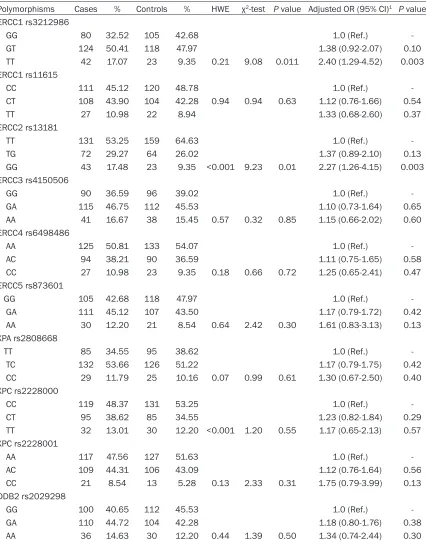
Polymorphisms Cases % Controls % HWE χ2-test P value Adjusted OR (95% CI)1 P value
ERCC1 rs3212986
GG 80 32.52 105 42.68 1.0 (Ref.) GT 124 50.41 118 47.97 1.38 (0.92-2.07) 0.10 TT 42 17.07 23 9.35 0.21 9.08 0.011 2.40 (1.29-4.52) 0.003 ERCC1 rs11615
CC 111 45.12 120 48.78 1.0 (Ref.) CT 108 43.90 104 42.28 0.94 0.94 0.63 1.12 (0.76-1.66) 0.54 TT 27 10.98 22 8.94 1.33 (0.68-2.60) 0.37 ERCC2 rs13181
TT 131 53.25 159 64.63 1.0 (Ref.) TG 72 29.27 64 26.02 1.37 (0.89-2.10) 0.13 GG 43 17.48 23 9.35 <0.001 9.23 0.01 2.27 (1.26-4.15) 0.003 ERCC3 rs4150506
GG 90 36.59 96 39.02 1.0 (Ref.) GA 115 46.75 112 45.53 1.10 (0.73-1.64) 0.65 AA 41 16.67 38 15.45 0.57 0.32 0.85 1.15 (0.66-2.02) 0.60 ERCC4 rs6498486
AA 125 50.81 133 54.07 1.0 (Ref.) AC 94 38.21 90 36.59 1.11 (0.75-1.65) 0.58 CC 27 10.98 23 9.35 0.18 0.66 0.72 1.25 (0.65-2.41) 0.47 ERCC5 rs873601
GG 105 42.68 118 47.97 1.0 (Ref.) GA 111 45.12 107 43.50 1.17 (0.79-1.72) 0.42 AA 30 12.20 21 8.54 0.64 2.42 0.30 1.61 (0.83-3.13) 0.13 XPA rs2808668
TT 85 34.55 95 38.62 1.0 (Ref.) TC 132 53.66 126 51.22 1.17 (0.79-1.75) 0.42 CC 29 11.79 25 10.16 0.07 0.99 0.61 1.30 (0.67-2.50) 0.40 XPC rs2228000
CC 119 48.37 131 53.25 1.0 (Ref.) CT 95 38.62 85 34.55 1.23 (0.82-1.84) 0.29 TT 32 13.01 30 12.20 <0.001 1.20 0.55 1.17 (0.65-2.13) 0.57 XPC rs2228001
AA 117 47.56 127 51.63 1.0 (Ref.) AC 109 44.31 106 43.09 1.12 (0.76-1.64) 0.56 CC 21 8.54 13 5.28 0.13 2.33 0.31 1.75 (0.79-3.99) 0.13 DDB2 rs2029298
GG 100 40.65 112 45.53 1.0 (Ref.) GA 110 44.72 104 42.28 1.18 (0.80-1.76) 0.38 AA 36 14.63 30 12.20 0.44 1.39 0.50 1.34 (0.74-2.44) 0.30
[image:3.612.96.522.81.622.2]Table 3. Interaction between ERCC1 rs3212986 and ERCC2 rs1318 gene polymorphisms and tobacco smoking and alcohol drinking in the risk of pancreatic cancer
ERCC1 rs3212986
OR (95% CI)1 P value
ERCC2 rs1318
OR (95% CI) P value
GG GT+TT TT TG+GG
Patients Controls Patients Controls Patients Controls Patients Controls Tobacco smoking
Non-smokers 41 63 73 88 1.27 (0.75-2.17) 0.34 68 99 46 52 1.29 (0.76-2.19) 0.32 Smokers 39 42 93 53 1.89 (1.05-3.40) 0.02 63 60 69 35 1.88 (1.06-3.34) 0.02 Alcohol drinking
Non-drinkers 35 60 71 81 1.50 (0.86-2.63) 0.13 56 91 50 50 1.63 (0.94-2.81) 0.06 Drinkers 45 45 95 60 1.58 (0.91-2.77) 0.09 75 68 65 37 1.59 (0.92-2.78) 0.08
librium (HWE) was examined using a χ2-test
with one degree of freedom. Multiple condition-al logistic regression models were established to estimate relative risks of tobacco and alco-hol consumption as well as risks related to each SNP after adjustment for gender, age, tobacco smoking, alcohol drinking, body mass index and type 2 diabetes as well as family his-tory of pancreatic cancer. Additional regression models were designed where subjects were
stratified on demographic characteristics and
genetic polymorphisms of the study variations.
Odds ratios (ORs) and their 95% confidence
intervals (CIs) were calculated. All tests were
two-sided with a significant level of P-value <0.05. Statistical analysis was conducted using the SPSS 21.0 package (SPSS Inc., Chicago, IL, USA).
Results
The demographic characteristics of patients with pancreatic cancer and control subjects were summarized in Table 1. The mean ages of patients with pancreatic cancer and control subjects were 57.3±7.9 and 56.8±8.1 years
old, respectively. By χ2-test, no significant dif
-ferences were found between patients with pancreatic cancer and control subjects in terms of age, gender and type 2 diabetes. When com-pared with control subjects, patients with pan-creatic cancer were more likely to be tobacco smokers and alcohol drinkers, and have higher BMI and family history of pancreatic cancer in
the first relatives.
The genotype distributions of ERCC1 rs321- 2986 and rs11615, ERCC3 rs4150506, ERCC4 rs6498486, ERCC5 rs873601, XPA rs2808- 668, XPC rs2228001 and DDB2 rs2029298
confirmed with the Hardy-Weinberg equilibrium
in the controls (P value >0.05), but ERCC2 rs13181 and XPC rs2228000 were not (P value <0.05) (Table 2). By χ2-test, there were signifi
-cant differences between patients with pancre-atic cancer and control subjects in terms of genotype distributions of ERCC1 rs3212986
(χ2=9.08, P value =0.011) and ERCC2 rs13181
(χ2=9.23, P value =0.01). By conditional logistic
regression analysis, individuals carrying with TT genotype of ERCC1 rs3212986 and GG geno-type of ERCC2 rs13181 were associated with increased risk of pancreatic cancer when com-pared with wide-type genotype, and the adjust-ed ORs (95% CI) were 2.40 (1.29-4.52) and
2.27 (1.26-4.15), respectively. However, we did
not find significant difference association of
ERCC1 rs11615, ERCC3 rs4150506, ERCC4 rs6498486, ERCC5 rs873601, XPA rs280- 8668, XPC rs2228000, XPC rs2228001 and DDB2 rs2029298 with the risk of pancreatic cancer.
We further analyzed the association between ERCC1 rs3212986 and ERCC2 rs1318 gene polymorphisms and risk of pancreatic cancer
stratified by tobacco smoking and alcohol drink -ing (Table 3). We found that individuals carrying with GT+TT genotype of ERCC1 rs3212986 and TG+GG genotype of ERCC2 rs1318 gene poly-morphisms were correlated with higher risk of pancreatic cancer in smokers when compared with non-smokers, and the adjusted ORs (95% CI) were 1.89 (1.05-3.40) and 1.88 (1.06-3.34), respectively.
Discussion
Polymorphisms have an effect on the regula-tion of gene expression, and they can contrib-ute to the differences between individuals in the susceptibility to a disease and its severity. The regulation of DNA repair plays an important role in the multistep process of carcinogenesis, and NER pathway is an important DNA repair process, and it has steps of damage recogni-tion, damage demarcation and unwinding, damage incision, and new strand ligation [13, 14]. Polymorphisms in DNA repair genes
result-ing in variation of DNA repair efficiency may
therefore be associated with risk of cancers. In the present study, we investigate the role of ERCC1, ERCC2, ERCC3, ERCC4, ERCC5, XPA, XPC and DDB2 gene polymorphisms of the NER pathway in the risk of pancreatic cancer, and we found that ERCC1 rs3212986 and ERCC2 rs1318 gene polymorphisms contribute to the development of pancreatic cancer.
The excision repair cross complementation group 1 (ERCC1) enzyme belongs to nucleotide excision repair (NER) system which has the abil-ity of repairing DNA adducts and other DNA helix-distorting lesions [15]. ERCC1 has interac-tion with XPA, XPF and/or RPA, guiding the 5’ cleavage activity in the NER pathway [16, 17].
Cells from ERCC1-deficient mice show a high
exchange, a response adopted by rodent cells to prevent the accumulation of DNA double strand breaks [18]. Therefore, functional SNPs
in ERCC1 could influence cellular DNA repair
capacity and thus may be important for the development of cancers. Previous studies have reported that the ERCC1 rs3212986 polymor-phism is associated with development of sev-eral kinds of cancer, such as colorectal cancer, lung cancer, breast cancer and glioma [19, 22]. A recent meta-analysis with 48 case-control studies reported that no association between ERCC1 rs3212986 and susceptibility to can-cers [23]. For the association between ERCC1 rs3212986 polymorphism and risk of pancre-atic cancer, only study reported that ERCC1
rs3212986 polymorphism could not influence
the development of pancreatic cancer [24]. However, we found that ERCC1 rs3212986 was associated with an increased risk of pancreatic cancer. The discrepancy of the different results may be caused by different in ethnicities, study design, source of patients, sample size, and by chance.
The ERCC2 protein, encoded by the gene locat-ed at chromosome 19q13.3, possesses both single strand DNA-dependent ATPase and 5’-3’ DNA helicase activities and participates in DNA unwinding during NER [25, 26]. Polymorphisms in the ERCC2 gene are thought to reduce the helicase activity, resulting in a lower DNA repair
capacity of NER pathway and influencing can -cer susceptibility [27, 28]. Previous studies have reported that ERCC2 rs1318 gene poly-morphism is associated with many kinds of cancers, such as esophageal cancer, hepato-cellular cancer, skin cancer and breast cancer [29-32]. Two studies reported the association between ERCC2 rs1318 gene polymorphism and pancreatic cancer [33, 34]. Jiao et al. reported that ERCC2 rs1318 gene
polymor-phism could be a genetic risk modifier for
smoking-related pancreatic cancer in a Chinese population [33]. Duell et al. also found that ERCC2 rs1318 gene polymorphism in combina-tion with cigarette smoking may increase the risk for pancreatic cancer [34]. In our study, we found that ERCC2 rs1318 gene polymorphism
influence the development of pancreatic can -cer, especially in smokers, which are in line with previous studies.
There were several limitations in our study. First, ERCC2 rs13181 and XPC rs2228000
were not in line with Hardy-Weinberg equilibri-um, which suggest that the controls may not present the general population. Second, cases and controls were selected from one hospital, selection bias may be considered in our study. Third, tobacco smoking and alcohol drinking were recalled by included subjects, and infor-mation bias may be existed. Fourth, the sample size of this study is relatively small, and small sample size may limit the statistical power to
find differences between groups.
In conclusion, our study suggests that ERCC1 rs3212986 and ERCC2 rs1318 gene polymor-phisms contribute to the development of pan-creatic cancer, especially in smokers. Further large sample studies are greatly warranted to
elucidate our finding.
Disclosure of conflict of interest None.
Address correspondence to: Dr. Yuhong Shang,
Department of Tumor, The First Affiliated Hospital
of Zhengzhou University, No. 1 of Jian She Dong Road, Zhengzhou 450052, China. Tel: +86-371-66295541; Fax: +86-371-+86-371-66295541; E-mail: [email protected]
References
[1] Vincent A, Herman J, Schulick R, Hruban RH, Goggins M. Pancreatic cancer. Lancet 2011; 378: 607-20.
[2] Hidalgo M. Pancreatic cancer. N Engl J Med 2010; 362: 1605-17.
[3] International Agency for Research on Cancer. GLOBOCAN 2012: Estimated Cancer Inci-dence, Mortality and Prevalence Worldwide in 2012.
[4] Pandol S, Gukovskaya A, Edderkaoui M, Daw-son D, Eibl G, Lugea A. Epidemiology, risk fac-tors, and the promotion of pancreatic cancer: role of the stellate cell. J Gastroenterol Hepatol 2012; 27 Suppl 2: 127-34.
[5] Krejs GJ. Pancreatic cancer: Epidemiology and risk factors. Dig Dis 2010; 28: 355-8.
[6] Goode EL, Ulrich CM, Potter JD. Polymorphisms in DNA repair genes and associations with can-cer risk. Cancan-cer Epidemiol Biomarkers Prev 2002; 11: 1513-30.
[7] Nouspikel T. DNA repair in mammalian cells: Nucleotide excision repair: variations on versa-tility. Cell Mol Life Sci 2009; 66: 994-1009. [8] Enzlin JH, Scharer OD. The active site of the
[9] Matsunaga T, Mu D, Park CH, Reardon JT, San-car A. Human DNA repair excision nuclease. Analysis of the roles of the subunits involved in dual incisions by using anti-XPG and anti-ER-CC1 antibodies. J Biol Chem 1995; 270: 20862-9.
[10] Coin F, Oksenych V, Egly JM. Distinct roles for the XPB/p52 and XPD/p44 subcomplexes of TFIIH in damaged DNA opening during nucleo-tide excision repair. Mol Cell 2007; 26: 245-56.
[11] Evans E, Moggs JG, Hwang JR, Egly JM, Wood RD. Mechanism of open complex and dual inci-sion formation by human nucleotide exciinci-sion repair factors. EMBO J 1997; 16: 6559-73. [12] Sugasawa K. Multiple DNA damage
recogni-tion factors involved in mammalian nucleotide excision repair. Biochemistry (Mosc) 2011; 76: 16-23.
[13] Kamileri I, Karakasilioti I, Garinis GA. Nucleo-tide excision repair: new tricks with old bricks. Trends Genet 2012; 28: 566-73.
[14] Ng JM, Vermeulen W, van der Horst GT, Bergink S, Sugasawa K, Vrieling H, Hoeijmakers JH. A novel regulation mechanism of DNA repair by damage-induced and RAD23-dependent stabi-lization of xeroderma pigmentosum group C protein. Genes Dev 2003; 17: 1630-45. [15] de Laat WL, Jaspers NG, Hoeijmakers JH.
Mo-lecular mechanism of nucleotide excision re-pair. Genes Dev 1999; 13: 768-85.
[16] Volker M, Mone MJ, Karmakar P, van Hoffen A, Schul W, Vermeulen W, Hoeijmakers JH, van Driel R, van Zeeland AA, Mullenders LH. Se-quential assembly of the nucleotide excision repair factors in vivo. Mol Cell 2001; 8: 213-24.
[17] Sijbers AM, de Laat WL, Ariza RR, Biggerstaff M, Wei YF, Moggs JG, Carter KC, Shell BK, Ev-ans E, de Jong MC, Rademakers S, de Rooij J, Jaspers NG, Hoeijmakers JH, Wood RD. Xero-derma pigmentosum group F caused by a
de-fect in a structure-specific DNA repair endonu -clease. Cell 1996; 86: 811-22.
[18] Melton DW, Ketchen AM, Nunez F, Bonatti-Ab-bondandolo S, AbBonatti-Ab-bondandolo A, Squires S,
Johnson RT. Cells from ERCC1-deficient mice
show increased genome instability and a re-duced frequency of S-phase-dependent illegiti-mate chromosome exchange but a normal fre-quency of homologous recombination. J Cell Sci 1998; 111 Pt 3: 395-404.
[19] Hou R, Liu Y, Feng Y, Sun L, Shu Z, Zhao J, Yang S. Association of single nucleotide polymor-phisms of ERCC1 and XPF with colorectal can-cer risk and interaction with tobacco use. Gene 2014; 548: 1-5.
[20] Zhu J, Hua RX, Jiang J, Zhao LQ, Sun X, Luan J, Lang Y, Sun Y, Shang K, Peng S, Ma J.
Associa-tion studies of ERCC1 polymorphisms with lung cancer susceptibility: a systematic review and meta-analysis. PLoS One 2014; 9: e97616. [21] Pei XH, Yang Z, Lv XQ, Li HX. Genetic variation
in ERCC1 and XPF genes and breast cancer risk. Genet Mol Res 2014; 13: 2259-67. [22] Zhang N, Lin LY, Zhu LL, Wu F, Wen H, Pan D,
Huang YC, Chen DQ. ERCC1 polymorphisms and risk of adult glioma in a Chinese popula-tion: a hospital-based case-control study. Can-cer Invest 2012; 30: 199-202.
[23] Zhang L, Wang J, Xu L, Zhou J, Guan X, Jiang F, Wu Y, Fan W. Nucleotide excision repair gene ERCC1 polymorphisms contribute to cancer susceptibility: a meta-analysis. Mutagenesis 2012; 27: 67-76.
[24] McWilliams RR, Bamlet WR, Cunningham JM, Goode EL, de Andrade M, Boardman LA, Pe-tersen GM. Polymorphisms in DNA repair genes, smoking, and pancreatic adenocarci-noma risk. Cancer Res 2008; 68: 4928-35. [25] Sung P, Bailly V, Weber C, Thompson LH,
Prakash L, Prakash S. Human xeroderma pig-mentosum group D gene encodes a DNA heli-case. Nature 1993; 365: 852-5.
[26] de Boer J, Hoeijmakers JH. Nucleotide excision repair and human syndromes. Carcinogenesis 2000; 21: 453-60.
[27] Zhang J, Gu SY, Zhang P, Jia Z, Chang JH. ERCC2 Lys751Gln polymorphism is associated with lung cancer among Caucasians. Eur J Cancer 2010; 46: 2479-84.
[28] Xue H, Lu Y, Lin B, Chen J, Tang F, Huang G. The effect of XPD/ERCC2 polymorphisms on gas-tric cancer risk among different ethnicities: a systematic review and meta-analysis. PLoS One 2012; 7: e43431.
[29] Guo XF, Wang J, Lei XF, Zeng YP, Dong WG. XPD Lys751Gln polymorphisms and the risk of esophageal cancer: an updated meta-analysis. Intern Med 2015; 54: 251-9.
[30] Peng Q, Li S, Lao X, Chen Z, Li R, Qin X. Asso-ciation between XPD Lys751Gln and As-p312Asn polymorphisms and hepatocellular carcinoma risk: A systematic review and meta-analysis. Medicine (Baltimore) 2014; 93: e330.
[31] Zhu HL, Bao JM, Lin PX, Li WX, Zou ZN, Huang YE, Chen Q, Shen H. XPD Lys751Gln and As-p312Asn polymorphisms and susceptibility to skin cancer: a meta-analysis of 17 case-con-trol studies. Asian Pac J Cancer Prev 2014; 15: 6619-25.
case-control study among Han Women in a Chinese less-developed area. Genet Test Mol Biomark-ers 2014; 18: 703-10.
[33] Jiao L, Hassan MM, Bondy ML, Abbruzzese JL, Evans DB, Li D. The XPD Asp312Asn and Lys-751Gln polymorphisms, corresponding haplo-type, and pancreatic cancer risk. Cancer Lett 2007; 245: 61-8.