Tackling the challenge
Promoting race equality in the NHS in England
© March 2009 Commission for Healthcare Audit and Inspection.
This document may be reproduced in whole or in part, in any format or medium for non-commercial purposes, provided that it is reproduced accurately and not used in a derogatory manner or misleading context. The source should be acknowledged by showing the document title and © Commission for Healthcare Audit and Inspection 2009.
ISBN 978-1-84562-219-0
Concordat gateway number: 180
The Healthcare Commission 2
Summary 3
Introduction 12
Background 13
Healthcare Commission audits of NHS equalities publications 20
The race equality review 27
Conclusions 38
Recommendations 39
References 42
Acknowledgements 44
The Healthcare Commission works to promote improvements in the quality of healthcare and public health in England and Wales.
In England, we assess and report on the performance of healthcare organisations in the NHS and independent sector, to ensure that they are providing a high standard of care. We also encourage them to continually improve their services and the way they work.
In Wales, the Healthcare Commission’s role is more limited. It relates mainly to national reviews that include Wales and to our yearly report on the state of healthcare.
The Healthcare Commission aims to:
• Safeguard patients and promote continuous improvement in healthcare services for patients, carers and the public.
• Promote the rights of everyone to have access to healthcare services and the opportunity to improve their health.
• Be independent, fair and open in our decision making, and consultative about our processes.
On 1 April 2009, the Care Quality Commission, the new independent regulator of health, mental health and adult social care, will take over the Healthcare Commission’s work in England. Healthcare Inspectorate Wales will become responsible for carrying out our activities relating to Wales.
This report summarises a range of work undertaken by the Healthcare Commission and looks at the extent to which the NHS in England is meeting the legal basic building blocks in promoting race equality.
The report:
• Highlights some of the legal obligations of the NHS in meeting its race equality duties.
• Summarises the available data on the ethnic make-up of the national population and NHS workforce, and examines some of the health needs of different ethnic groups, and some of the different experiences of health services.
• Reviews progress on the performance by NHS trusts in promoting race equality, through assessment of performance against parts of relevant core standards that address some of the key requirements of the race relations legislation.
• Sets out some recommendations for the Department of Health, commissioners and providers of services, and the Care Quality Commission.
The importance of this work is clear. There is considerable evidence pointing to the different experiences and outcomes of healthcare for different minority ethnic groups, some of which is referred to in this report. This evidence shows that, in some areas, people from minority ethnic groups are less likely to have a favourable experience of NHS services, and that in a number of important conditions, such as diabetes, coronary heart disease and mental health, people from some minority ethnic groups experience worse outcomes. Furthermore, the Healthcare Commission has found that compliance with the Department of Health’s core standard that focuses on challenging discrimination and promoting equality and respect for human rights
had the second lowest compliance rate in the latest annual health check, and fewer trusts are declaring compliance.
Responding to these concerns, we undertook three annual audits of the websites of NHS trusts from 2006 onwards. We also asked trusts, in the autumn of 2008, to provide evidence of how they met three of the publication duties under the race relations legislation. Although the general picture is improving (albeit from a low base), only 35% of trusts were found to have provided some information on all three of the publication duties on their websites (acknowledging that publication could be achieved in other ways). Compliance with the legal requirements of race equality legislation continues to be a problem, particularly when one considers that trusts (like other public bodies) should have been producing this information since 2002. This work prompted the Commission to undertake a more detailed review in a small number of trusts.
All this is happening when the population is becoming increasingly ethnically diverse and when understanding the needs of this diverse population has particular significance for the commissioning and delivery of healthcare services.
This review comes at a time when significant changes in equalities legislation are anticipated with a Single Equality Bill. It has been undertaken against the background of the merging of the three single equality commissions into the Equalities and Human Rights Commission, and the relatively recent introduction of the disability and gender equality duties. This review serves as a reminder that there is still a great deal of ongoing work by healthcare organisations in this area and much more work to be done. And while the report focuses on race equality, there are wider lessons in promoting equalities and human rights more generally.
The report is based on a combination of
methods, including literature reviews, audits of NHS trusts’ websites, a bespoke data collection exercise, a review of 39 trusts and examples of leading practice from a further 11 trusts. This work does not attempt to provide a holistic view of everything that is required to transform the capability of the health service in meeting the publication duties and promoting race equality. Rather, it focuses on the basic building blocks that need to be in place to allow further progress.
Nevertheless, the combination of these methods paints a good picture of how trusts are trying to meet their obligations and identifies areas where more could be done. The report reflects the challenges we must all tackle in promoting race equality.
In undertaking this range of work, it has been made clear to us that people using services and NHS trusts do not have a shared view of what ‘good’ looks like in promoting race equality. More support and leadership from the centre is necessary in achieving this.
Background
In the 2001 census, nearly 8% of the UK population were from a minority ethnic background. Estimates from the Office for National Statistics suggest that this figure had grown to over 11% by 2006 and may be as much as 15% in England today.
NHS organisations have a legal responsibility, both as a provider and commissioner of services and as an employer, to promote race equality, eliminate unlawful discrimination and promote good relations. In addition, reducing inequalities in health and personalising services to meet individual needs run right through the Government’s recent reforms of health and social care services.
Historically, information about the ethnic origin of patients in health data sets has been poor and unreliable or incomplete. Apart from the Hospital Episodes Statistics and the Mental Health Minimum Dataset, ethnic origin is not normally recorded. There is no data on ethnicity for 90% of all contacts that patients have with their GPs, for example.
One of the greatest challenges for understanding relationships between people from minority ethnic groups and the NHS is the absence or incompleteness of data. However, the situation is improving. Following the recommendations of the Equalities Review, the Office of Government Statistics undertook a review that informed the Department of Health’s Equality Monitoring group. Consequently, mandatory recording of ethnic origin will be introduced from April 2009 for outpatients, people attending A&E departments, and births. And GPs will begin recording ethnicity and first language for their patients, on a
graduated basis, from 2009. When these changes are in place, analysis of interactions
between people from minority ethnic groups and the NHS will become increasingly possible.
An additional challenge is the need to separate out socioeconomic factors such as low income, education and housing when looking at the experience of people from minority ethnic groups. Commentators suggest that, even when we adjust for these factors, people from minority ethnic groups experience worse health outcomes than the wider population (although for some conditions they fare better).
According to the King’s Fund, even controlling for all these variables, there are still differences in health outcomes between minority ethnic groups and the majority of the population: “It seems highly likely that other factors, perhaps including the experience of racial discrimination or cultural insensitivity in the provision of healthcare, are also associated”.
There are some marked differences in health outcomes between minority ethnic groups and the majority of the population. For example, Pakistani men and Indian women have higher rates of angina, and Pakistani men and women are more prone to heart attacks. Diabetes is more common in people from Black Caribbean and many Asian communities. There is a high infant death rate in Pakistani communities. Black Caribbean people are between three to five times more likely than the wider population to suffer from psychotic illnesses. However, death rates for lung cancer are lower for men and women in minority ethnic groups.
In terms of access to, and experience of, NHS services, people from minority ethnic groups give less positive responses than the wider population, particularly for primary care and hospital outpatient departments. Patients from minority ethnic groups were more likely to say that they were not as involved in decisions
about their care as they wanted to be, and that doctors and nurses talked in front of them as if they were not there. Privacy in emergency departments was an issue for Chinese people.
The Department of Health and the Healthcare Commission published a joint report on the experiences of patients from minority ethnic groups in May 2008. The report was based on data from the national surveys of patients, led by the Healthcare Commission. It found that:
• There was a range of variations between minority ethnic groups and their White British counterparts. Where differences did exist, most were negative, indicating that people from minority ethnic groups were less likely to report a positive experience. But many areas showed no difference and a few showed a positive one.
• The largest number of differences was seen in the primary care and surveys of outpatients. There were relatively few differences in the survey of users of community mental health services.
Within the NHS, staff from minority ethnic groups constitute around 16% of the total workforce, and 30% of nurses and doctors are from minority ethnic groups but fewer than 10% of senior managers and only 1% of chief executives are from a similar background. The Department of Health is now considering setting targets for increasing the number of minority ethnic members of NHS boards, to make the people directing health services more representative of patients and staff.
An article in the Health Service Journal makes interesting reading. A survey of every NHS trust and PCT was carried out and 231 organisations responded. It found that staff from minority ethnic groups make up around 16% of the workforce, but are involved in more than twice as many bullying and harassment cases and capability reviews than the wider workforce. In addition, nearly a third of grievances are taken out by staff from minority ethnic groups.
People from minority ethnic groups play a critical role in the delivery of NHS services, but there is evidence to suggest discrimination within the NHS, as well as disproportionate involvement in bullying, harassment and grievance cases. While people from a minority ethnic group constitute around 16% of the NHS workforce, 30% of nurses and doctors and only 1% of chief executives are from a similar background.
Statutory duties
The NHS, like other public bodies, has legal responsibilities under the Race Relations Legislation, both as an employer and a commissioner and provider of services. Trusts must have due regard to the need to:
• Eliminate unlawful racial discrimination.
• Promote equality of opportunity.
• Promote good relations between persons of different racial groups.
In addition to the general duty, trusts must also comply with specific race equality duties. Among these are three publication duties, which require trusts to publish:
1. A race equality scheme, setting out the trust’s arrangements to meet its obligations under the general and specific duties.
The trust’s initial scheme should have been published before 31 May 2002, with a review to be carried out within three years.
2. Employment monitoring by reference to ethnic group. The trusts should publish this on an annual basis.
3. The results of race equality impact
assessments, detailing consultations and monitoring for any adverse impact by policies and initiatives on the promotion of race equality.
The NHS is committed to reducing inequalities in health, meeting the needs of individuals and protecting human rights through the World Class Commissioning initiative and the NHS constitution. The Department of Health’s Operating Framework 2009/10, states that “where there is substantial or good evidence of health inequalities arising from discrimination or disadvantage, we will review the Vital Signs at a national level by socioeconomic group, ethnicity and other dimensions in order to consider any trends relating to equality or inequalities”.
We conducted audits of all NHS trusts’ websites in 2006, 2007 and 2008, and supplemented this with a more rigorous and special data collection exercise in September 2008. Although a web audit is not a definitive test to demonstrate that trusts are meeting their publication obligations, we consider that web publication is a reasonable test that race equality schemes are being made easily accessible.
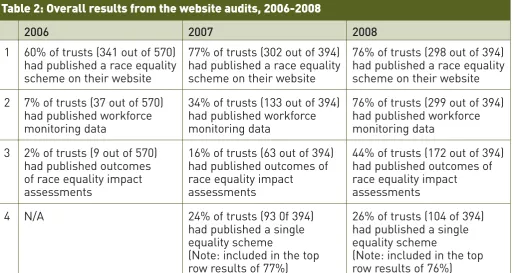
The results of these audits and data collection exercise show that progress has been made in meeting the three duties of publishing a race equality scheme, workforce statistics and equality impact assessments. In 2006, 60% of trusts had published a race equality scheme on their website, rising to 77% in 2007 and dropping back slightly to 76% of trusts in 2008.
In September 2008, 95% of trusts reported to the Commission that they had published a race equality scheme.
In 2006, 6.5% of trusts had published some workforce monitoring data, rising to 34% in 2007 and 76% in 2008.
In 2007, 9% of trusts published (on the internet) some information on all three publication duties, rising to 35% in 2008. But trusts are challenged by the obligation to publish all nine sets of workforce data, with only 18% recording ‘applicants for promotion’ in 2008 and 27% reporting ‘applicants for training’ in the same year.
It is clear that there is still some way to go before trusts meet all of the minimum requirements.
The race equality review
We undertook the race equality review in late 2007 and early 2008. We visited 39 trusts, which were selected where our data suggested a relative risk in performance in relation to parts of the five Department of Health core standards relating to race equality. The trusts selected were not representative of the NHS as a whole and the results cannot therefore be generalised to all trusts.
The race equality review builds on the review of literature, the three web audits and the special publication exercise that we carried out. It is also informed by the results of the 2007/08 annual health check. Standard C7e requires organisations to challenge discrimination, promote equality and respect human rights. This standard has the second lowest declared compliance rate in the annual health check, and fewer trusts are declaring compliance.
In 2005/06, the compliance rate for C7e was 91%, but this declined to 86% in 2006/07 and fell further to 83% in 2007/08. It is clearly an area which demands attention.
In these visits, we focused on the extent to which trusts could provide evidence on parts of five of the core standards:
• Challenging discrimination, promoting equality and respecting human rights.
• Supporting staff through programmes for organisational and personal development.
• Making information available to patients and the public on their services, providing patients with suitable and accessible information on the care and treatment they receive and, where appropriate, informing patients on what to expect during and after their care and treatment.
• Seeking the views of patients, their carers and others and taking these into account in designing, planning, delivering and improving healthcare services.
• Enabling all members of the population to access services equally, and offering choice in access to services and treatment equitably.
These review visits were supplemented with examples of leading practice provided by a further 11 trusts. These trusts were the first to volunteer to participate in the exercise from a wider group of trusts that had performed well in the earlier web audits.
The review presents a fairly mixed picture of performance across the 39 trusts. Trusts were more likely to be able to show evidence that they had:
• Published a race equality scheme, setting out how they would assess and consult on the likely impact of their proposed policies and monitor policies for any adverse impact.
• Provided information to patients and the public on their services.
• Provided accessible information to patients and the public on the care and treatment they would receive.
• Signed a local compact to develop ongoing relationships with patient and public groups in the community they served.
But they had difficulties with providing the evidence to demonstrate that they had:
• Monitored their workforce, particularly in terms of the numbers of people from minority ethnic communities who had applied for and received training, been promoted or “experienced detriment”.
• Consulted and sought the views of patients, carers and the local community in the ongoing planning of services.
• Identified those areas where patients could not access services provided by the trust.
As a result of the review, a number of trusts drew up action plans to address areas where shortcomings were identified.
Plenty of examples of leading practice were provided by the selected 11 trusts. Of particular note is the role of leadership in promoting race
equality and embedding equality in the trust’s activities and culture. For example, Newcastle PCT has put in place strong leadership and governance for achieving equality and diversity. There is an experienced equality and diversity lead, with champions in each service area. An equality and diversity group, which includes trust staff as well as members of the local community, reports to the quality and safety committee and the provider services board. All staff in the PCT are required to take personal responsibility for equality and diversity by incorporating them into their personal objectives. The PCT commissioned a local organisation to engage with local communities on its behalf and to represent their views to the PCT, which led to more focused engagement with the community.
Similarly, engagement with the people who use services has led to changes in King’s College Hospital Foundation Trust. An open day allowed patients from minority ethnic communities to feedback that the trust did not give sufficient focus to their dietary needs – the hospital menu has now been changed. The hospital also found that Afro-Caribbean men were not visiting their GPs and so not having their blood pressure tested. The trust set up stalls at local events where members of the public were invited to have their blood pressure checked and advised to see their GP if the reading was high.
Newham University Hospital Trust offers face-to-face interpreting services in 30 languages and 24-hour telephone interpreting in 150 languages. A community enhancement programme was established at the hospital in association with the local authority, with the aim of promoting greater health awareness and supporting local people in accessing health services.
Specially designed employment schemes were useful ways to introduce people from minority ethnic groups into the NHS workforce. For example, ‘Pathways to health’ is an Oldham PCT initiative that provides training to women from minority ethnic groups. It uses partner organisations such as Connexions to help these women gain confidence and skills to enter health and social care employment. The London Ambulance Service has a pre-employment scheme that provides support to people from minority ethnic communities prior to applying for a post in the service. South West London and St George’s Mental Health Trust specifically welcomes applications from people who have experienced mental health problems.
This section concludes that, while there are many examples of leading practice by NHS trusts, there are areas where the performance of some needs attention. These trusts will need help and support to fully meet the formal requirements of the race relations legislation, and additional impetus to embed the promotion of racial equality into their working practices.
Recommendations
Meeting the requirements of race relations legislation
• NHS trusts must take immediate action to address any shortfalls in meeting their legal duties under the race relations legislation. We expect the boards of all NHS trusts to review their performance in meeting their legal duties on all aspects of equality, as part of their declaration on the Department of Health’s core standards for the 2008/09 annual health check, and to take all necessary action if they are not fully compliant. We expect NHS trusts to provide the Care Quality Commission with clear assurance when they make their declaration for 2008/09 that they consider themselves to be compliant with those
statutory requirements. Boards should ensure their trusts are fully resourced to achieve this.
• Ensuring trusts meet their legal duties is clearly a core part of good governance. Strategic health authorities and Monitor should hold NHS trusts to account for their whole approach to race equality and ensure that they comply in full with all their legal obligations under the race relations legislation. Seven years on, it is completely unacceptable for trusts to only partially meet the publication requirements of the race relations legislation.
• Both the Next Stage Review and the NHS constitution recognise that NHS services should reflect the needs of their local communities and that patients and the public have a right to expect their local NHS to commission the services to meet their needs. Local trusts cannot deliver this promise if they do not have the evidence on their local populations or the mechanisms to achieve this. Trusts must, as part of their legal obligations, consult and engage with their local populations. They must also publicly demonstrate how this engagement has impacted on the development of policies. Conducting systematic, evidence-based equality impact assessments of all their policies and functions is one means to do this, but trusts will also need to introduce a variety of arrangements to reach out to their local communities.
• From April 2010, subject to legislation, the Government will require all providers of NHS care to publish ‘quality accounts’, which will report on the quality of care that they provide. The Department of Health’s guidance on quality accounts should require providers of NHS care to report on progress in promoting equality, diversity and human rights. NHS trusts already have legal requirements to publish annual reviews of their race, gender and disability schemes (or single equality schemes). The quality account should link to these publications, setting out how they have met their responsibilities under the equalities and human rights legislation (including
race equalities legislation). In their reviews, trusts must demonstrate how they have met their publication duties, and how they have consulted and engaged with their communities and published the results of these activities and the breakdown of their workforce statistics by minority ethnic group.
The reviews should also include the outcomes of these activities and the difference it has made for the local communities.
Patients
• The need to organise care around the individual was emphasised in the Next Steps Review, not only clinically, but also in terms of dignity and respect. NHS trusts, therefore, must tackle the issues identified in this race equality review and ensure that all patients, including those from minority ethnic groups, are treated with dignity and in privacy, and are involved in discussions around their care at all times.
NHS workforce
• Poor performance on recording workforce monitoring statistics by ethnicity has been tolerated for too long. Without comprehensive, accurate and up-to-date workforce monitoring statistics, trusts cannot ensure that their workforces are representative at all levels of the population they serve and that trusts are not discriminating against their own staff. This is a statutory requirement that NHS trusts are legally obliged to meet.
• NHS trusts must do more to ensure that people from minority ethnic groups are represented more equally in senior management positions. People from minority ethnic groups account for 16% of the NHS workforce and 30% of nurses and doctors, but fewer than 10% are in senior management roles and only 1% are chief executives. This is clearly unacceptable. We are aware of ongoing work in this area and recommend that the new NHS Leadership Council reviews what action is necessary, including the setting of specific objectives, to increase the representation of staff from minority ethnic groups in senior management.
• Although the evidence is unclear as to why, it is apparent that staff from minority ethnic groups are disproportionately involved in bullying and harassment cases, and are overrepresented in disciplinary and grievance procedures. NHS trusts must investigate the reasons for this disparity and take appropriate remedial action.
Leading practice
• NHS trusts must build on the examples of leading practice identified in this report. Meeting the responsibilities of race relations legislation is not just about ‘ticking boxes’, but embedding the positive promotion of equality into a trust’s culture. The Department of Health should ensure there is strong national and regional support to identify and embed good practice.
Department of Health
• The Department of Health should continue the work of the Health Equalities Monitoring Group and develop further the breadth and quality of NHS data on ethnicity. The Department should ensure that data on ethnicity is routinely collected and recorded at every point of contact with health services. This will provide the evidence to demonstrate that the NHS is delivering all of its services in a fair and equitable manner (or not). It should also look to the future, and consider and plan for the data requirements for disability and gender equalities and religion as legislation develops in the Equalities Bill.
• In order to drive improvement, the Department of Health needs to work with trusts and other relevant bodies to provide guidance on what ‘good’ looks like in relation to promoting equality, including race equality.
• The Department needs to give stronger leadership on promoting equality and diversity in the commissioning and provision of
healthcare, including providing stronger emphasis on actions to promote equalities, diversity and human rights in setting the priorities for the NHS in the Operating Framework.
Care Quality Commission
• We recommend that the board of the Care Quality Commission should review, within 12 months from the publication of this report, the extent to which the design of the registration system will ensure that all NHS trusts are fully compliant with their legal duties on equalities, diversity and human rights.
The need to promote race equality and eliminate discrimination has been recognised for many years. For public services to treat people well and effectively, they need to know who their users are and what the needs of individual users are likely to be.
The competencies needed to design healthcare services and deliver against the realities of a diverse society are complex, and to make sure that those services make sustained and sustainable progress is challenging. To meet this challenge, it is important for commissioners and providers of healthcare to identify gaps in information about services and shortcomings in the provision of services, and to overcome these with a robust programme of work that is closely managed at board level.
In this report, we set out the results of three annual audits of NHS websites carried out by the Healthcare Commission to assess whether NHS trusts were publishing some of the
information required by the race equality legislation (on their websites). Also, we include the results of a special publication exercise carried out in September 2008.
In addition, we report on the race equality review conducted with 39 NHS trusts in
December 2007 and January 2008. This review is supplemented by examples of leading practice produced by 11 other trusts. Overall, therefore, this report is based on a variety of data sets and a mixture of methods.
In the first section, we look at the size and composition of the minority ethnic population in the United Kingdom and analyse some background information on the health experiences of people from minority ethnic groups and their relationship with the NHS.
The second section sets out some of the statutory duties that govern NHS trusts (and other public bodies). Race relations legislation places a general duty on all NHS trusts to promote race equality and includes three specific publication requirements.1
We detail the results of the three audits of NHS trust’s websites we carried out to see how far trusts are meeting these three publication duties (by publishing on their websites). These audits are supplemented with the results of the additional bespoke data collection exercise.
In the third section, we examine the results of the review of 39 trusts. In addition, we give some examples of leading practice provided by another 11 trusts which had demonstrated that they had met all their publication duties in the Healthcare Commission’s audit of all trusts’ websites in 2007.2
The report concludes with recommendations for the Department of Health, providers and commissioners of healthcare services, and our successor body, the Care Quality Commission.
Why does ethnicity matter for health
services?
Following the murder of Stephen Lawrence in 1993, one of the main conclusions of the 1999 inquiry into his death was that public organisations were in danger of suffering from “institutional racism”, through a failure to provide an appropriate service to people because of their colour, culture or ethnic origin.3
The resulting legislative changes were designed to ensure that all public authorities deliver their services and manage their staff appropriately across all ethnic groups. To avoid the adverse impact that might arise from complacency or doing nothing, public bodies now have to provide evidence of activity to eliminate unlawful racial discrimination, promote racial equality and improve working relations between people from different ethnic groups.
NHS organisations have a legal responsibility, both as a provider and commissioner of services and as an employer, to promote race equality, eliminate unlawful discrimination and promote good relations. In addition, reducing health inequalities and personalising services to meet individual needs run right through the Government’s recent reforms of health and social care services.
The Department of Health states that a person’s ethnicity matters for two reasons. The first is the principle of ‘responsiveness’. The Government wants the NHS to be increasingly responsive to the needs of individual patients. The Department of Health’s own race equality scheme says that the NHS increasingly needs not only to take into account cultural and linguistic diversity but also to be able to cater for varying lifestyles and faiths.4
Also, the NHS core principles state that the NHS will shape its services around the needs and preferences of individual patients, their families and their carers. This means that the NHS must be responsive to the needs of different groups and individuals within society, and have respect for each person’s dignity. The principles also state that the NHS will respond to the different needs of different populations.
The second reason is that some people from minority ethnic groups experience poorer health outcomes than people from other groups, and thus need care that is better directed towards their needs. These health inequalities may be compounded by poorer access to services and poorer quality of services.5
In order to meet the needs of individual patients, the NHS must be able to identify those needs – to do this, a patient’s ethnicity must be taken into account.
In addition, PCTs and NHS trusts should be using the evidence on inequalities experienced by patients from minority ethnic groups to help them plan, commission and deliver their services. This will enable them to fulfil their legal and moral obligation to provide a safe and high quality service for all patients and ensure equal access to those services for all patients.
So there are compelling reasons why ethnicity is a critical issue for the provision of health services.
What is the size of the minority ethnic
population?
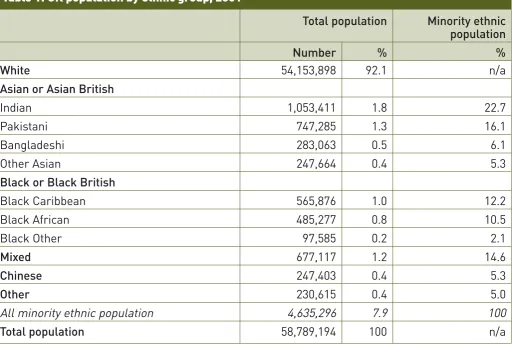
The most reliable figures on the ethnic distribution of people in the UK are taken from the 2001 census. Just over four and a half million people came from a BME group in 2001, which is 7.9% of the total population.
People from the Indian group were the largest minority group, followed by those from the Pakistani, Mixed, Black Caribbean, Black African and Bangladeshi groups.6
The statistics for England on its own are broadly comparable (as we would expect given the size of the population relative to the other countries), with a slightly higher proportion of people from the Asian/Asian British and Black/ Black British groups.6
The demographics of the UK have changed in the last seven years. To capture this, the Office for National Statistics produces estimated
resident population figures for ethnic groups. According to these, the size of the minority ethnic population grew to 11.3% of the overall UK population by mid-2006.7
According to these latest estimates, around 7.7 million people in England (15% of the population) belong to minority ethnic populations, defined as all ethnic groups other than White British (and therefore including people from the White Irish and Other White groups). In some areas – such as the London boroughs of Newham, Tower Hamlets and Ealing – people from minority ethnic groups comprise more than 50% of the local population. In 46 of the 354 local authorities
Background continued
White 54,153,898 92.1 n/a
Asian or Asian British
Indian 1,053,411 1.8 22.7
Pakistani 747,285 1.3 16.1
Bangladeshi 283,063 0.5 6.1
Other Asian 247,664 0.4 5.3
Black or Black British
Black Caribbean 565,876 1.0 12.2
Black African 485,277 0.8 10.5
Black Other 97,585 0.2 2.1
Mixed 677,117 1.2 14.6
Chinese 247,403 0.4 5.3
Other 230,615 0.4 5.0
All minority ethnic population 4,635,296 7.9 100
Total population 58,789,194 100 n/a
Source: Office for National Statistics
Total population Minority ethnic population
[image:16.595.43.556.195.541.2]Number % %
in England, more than 20% of the population are not from the White British group.8
Although forecasting population growth is associated with substantial uncertainty, if current migration patterns continue, the proportion of people coming from a minority ethnic group is likely to grow in future years, especially given the young demographics of many minority ethnic groups.
To help tackle health inequalities, the Government has identified a group of local authorities with the lowest life expectancy and the highest rates of death from cancer and circulatory diseases. This is known as the ‘spearhead group’. Forty-four per cent of the people from minority ethnic groups in England live in a local authority that is in the spearhead group.
It is also worth noting that broad classifications like ethnic group can hide much diversity in terms of culture and religion. For example, ‘Indian’ includes Hindus, Sikhs, Muslims and Christians, and ‘Black African’ covers a continent.
Challenges in analysing minority ethnic
group data and the NHS
One of the greatest challenges for understanding relationships between people from minority ethnic groups and the NHS is the absence or incompleteness of data. Without the right data, we can not know whether ethnic differences in access, quality, outcomes and choice are narrowing or getting bigger.
Historically, information about the ethnic origin of patients in health data sets has been poor and unreliable or incomplete. Apart from the Hospital Episodes Statistics and the Mental Health Minimum Dataset, ethnic origin is not normally recorded. There is no data on ethnicity
for the 90% of all contacts that patients have with their GPs, for example.
In the 2007/08 annual health check, analysis of data quality on the ethnic performance indicator reveals that 85% of acute and specialist trusts achieved the ethnic group performance indicator, but these types of trust also had the greatest spread of performance. The worst performing trust in this sector recorded only 48% of patients with valid ethnic coding. Eighty-seven per cent of PCTs achieved the indicator. Mental health trusts performed best, with 99% achieving the indicator, and with the worst performing mental health trusts in 2007/08 still managing to record 82% of its records with valid ethnic coding.9 (Note that this data is based on Hospital Episodes Statistics and Mental Health Minimum Datasets, and so does not include ambulance trusts.)
The Hospital Episodes Statistics (HES) comprise record-level patient data collected from every NHS hospital in England. Each year, approximately 13 million HES records for
inpatient and day case treatment are generated, containing details of individual patients such as age, sex, dates of admission and discharge, diagnoses, treatments and operations. However, HES data is incomplete for ethnic coding. There are also doubts about the ethnic classification used and suspicions that staff record the ethnicity of patients, rather than relying on the patients to self-assess.10
NHS specialist secondary mental health services have been required to submit the Mental Health Minimum Dataset (MHMDS), including ethnicity information, since April 2003. However, 16% of inpatients with mental health needs in the NHS are now treated in the independent sector, where there is no routine requirement to collect similar information.11
providers or how they move through the mental health care system.
Ethnicity is currently not recorded in birth or death certificates in England and Wales. Only the mother’s country of birth is recorded at the registration of a birth, and the deceased person’s country of birth during registration of the death.12
However, the situation is improving. Following the recommendations of the Equalities Review13
, the Office for National Statistics undertook a review that informed the Department of Health’s Equality Monitoring group. Consequently,
mandatory recording of ethnic origin will be introduced from April 2009 for outpatients, people attending A&E departments, and births. And GPs will begin recording ethnicity and first language for their patients, on a graduated basis, from 2009. When these changes are in place, analysis of interactions between people from minority ethnic groups and the NHS will become increasingly possible.
A more subtle challenge is to take account of factors such as age, low-income, occupation, education, housing tenure and location, and how these impact on the health of people from minority ethnic groups. People from these groups tend to be younger and more disadvantaged than the wider population. They also tend to live in poorer housing and be concentrated in inner cities.
It is, therefore, difficult to separate out the cause of why people have different experiences of healthcare. Simply stated, is it because of ethnicity, poverty or both? According to the King’s Fund, even controlling for all these variables, there are still differences in health outcomes between minority ethnic groups and the majority of the population: “It seems highly likely that other factors, perhaps including the
experience of racial discrimination or cultural insensitivity in the provision of healthcare, are also associated”.5
Different health outcomes
While there are some marked differences in health outcomes between the majority of the population and minority ethnic groups, the London Health Observatory10
points out that there are also large differences between minority ethnic groups, suggesting the explanation (and therefore the remedy) is complex.
A major study on the health of people from minority ethnic groups, carried out for the NHS Information Centre by the National Centre for Social Research and the Department of Epidemiology and Public Health at the Royal Free and University College Medical School, was published in 2005.14
The research found that:
• Pakistani women and Bangladeshi men were more likely than those in the general population to report a limiting, longstanding illness.
• Pakistani men and women were more likely to report acute sickness than the general population.
• Nearly a third of Pakistani men (31%) had angina, compared with 13% of men in the general population. Indian women were also higher at 15%, compared with 9% in the wider population.
• Pakistani men (19%) and women (7%) were more prone to heart attacks, compared with 10% of men and 5% of women in the general population.
• Diabetes is more common in people from Black Caribbean and many Asian communities. For example, around 10% of Black Caribbean men and 8% of women have diabetes, while
the figures for the general population are 4% for men and 3% for women. Indian, Pakistani and Bangladeshi men and women are also disproportionately affected. After adjusting for age, doctor-diagnosed diabetes was almost four times as prevalent in Bangladeshi men and almost three times as prevalent in Pakistani and Indian men, as men in the general population.
• In 2000, babies of mothers born in Pakistan had an infant death rate of 12.2 per 1,000 live births, which was higher than babies born to mothers from any other country and more than double the overall infant death rate of 5.5 per 1,000 live births.15
• Many studies, based largely on treatment rates, have reported that Black Caribbean people are between three and five times more likely to suffer from psychotic illness, including schizophrenia, than other people. Other studies report higher rates of compulsory psychiatric admission. Findings from the fourth annual census of the ethnicity of inpatients in mental health and learning disability services show that some people from minority ethnic groups are three or more times more likely than average to be admitted as inpatients in mental health services.16
• Black Caribbean and Irish men had the highest incidence of obesity. On the other hand, Bangladeshi men were almost five times, and Chinese men almost four times, less likely to be obese than men in the general population.
• After adjusting for age, Bangladeshi and Irish men were more, and Indian men less, likely to say they smoked than men in the general population.
• Rates of death from lung cancer are higher for men and women from Scotland and Ireland. However, they are low for both men and women in other groups (African, Caribbean
and south Asian). Generally, low rates of death from breast cancer are reported among women from minority ethnic groups.
Access to and experience of healthcare
services
The Department of Health and the Healthcare Commission published a joint report on the experiences of patients from minority ethnic groups in May 2008.17
The report was based on data from the national surveys of patients, led by the Healthcare Commission. It found that:
• There was a range of variations between minority ethnic groups and their White British counterparts. Where differences do exist, most are negative, indicating that people from minority ethnic groups are less likely to report a positive experience. But many areas show no difference and a few show a positive one.
• Patients from the Asian and Chinese/Other groups were less likely to give positive responses.
• Results for Black patients were mixed,
although slightly fewer gave positive responses compared with the patients from the White British group.
• Across many questions, patients from the White Irish group were more likely to give positive responses compared with people from the White British group.
• People from minority ethnic groups, particularly the Asian group, tended to be less positive about questions relating to ‘access and waiting’.
• Inpatients from minority ethnic groups generally gave similar or more positive experiences for questions on ‘safe, high quality, coordinated care’ than the White British baseline, but outpatients tended to be less positive.
• The largest number of differences was seen in the primary care and outpatient surveys. There were relatively few differences in the survey of users of community mental health services.
The Healthcare Commission published a report in 2006 that compared its surveys of patients across mental health services, PCTs, emergency departments and outpatient departments.18
For people who use mental health services:
• Patients who described themselves as being in poor mental health responded much more negatively to all questions (the most significant finding).
• Older people responded more favourably (which is in line with other satisfaction surveys).
• Patients from minority ethnic groups were more negative than White patients about their involvement in care decisions. Asian patients were more positive about their treatment, but less likely to have a copy of their care plan.
For people who use local health services commissioned or provided by PCTs:
• Again the most significant finding related to patients’ health. Patients who described themselves as being in poor health responded much more negatively to all questions.
• Ethnicity had a considerable impact. Asian patients responded more negatively than White patients in general, and patients from all minority ethnic groups were more likely to say they were not as involved in decisions about their care as they would have liked.
For people who attend emergency departments:
• Men responded more positively than women and older patients were also more favourably disposed.
• Patients in poor health and those with a disability were consistently more likely to report negative experiences.
• Patients from minority ethnic groups were much more likely to say that they were not as involved in decisions about their care as they would like to be, and doctors and nurses talked in front of them as if they were not there.
• Patients from the Chinese and Other groups were twice as likely as White patients to say that they were not given enough privacy when they were examined.
For outpatients:
• Patients in poor health or with a disability were consistently more likely to respond negatively, while older patients were consistently more positive.
• Patients from minority ethnic groups were significantly more likely than White patients to say that they were not as involved in decisions about their care as they wanted to be, and doctors and nurses talked in front of them as if they were not there.
The NHS workforce
With nearly 1.4 million people in its workforce, the NHS is one of the largest employers in the world. Around 16% of staff in the NHS are from a minority ethnic background. Thirty per cent of nurses and doctors are from minority ethnic communities, but fewer than 10% of senior managers and only 1% of chief executives are from such a background.19
The Department of Health is considering setting targets for increasing the number of minority ethnic members of NHS boards to make the people directing health services more representative of patients and staff.
In the Healthcare Commission’s national staff survey, around 3% of all staff said they had been discriminated against on the grounds of their ethnic background, which rose to 12% among employees from minority ethnic groups.20
Two articles in the Health Service Journal make interesting reading. A survey of every NHS trust and PCT was carried out and 231 organisations responded. It found that staff from minority ethnic groups make up around 16% of the workforce, but are involved in more than twice as many bullying and harassment cases (we do not know if they are the victims or accused) and capability reviews than the wider workforce. In addition, nearly a third of grievances are taken out by staff from minority ethnic groups.21
In a second survey of the South East Coast region of the NHS, staff from minority ethnic groups were found to be less likely to be appointed from a shortlist, and more likely to be disciplined, be involved in a grievance, be involved in a bullying or harassment dispute, and pursue a case through an employment tribunal, than staff from the wider population.22
Summary
Ethnicity within the NHS is of huge importance. As the number of people from minority ethnic groups increases and the country becomes more diverse, it takes on even more significance.
The availability of robust data on how people from minority ethnic groups interact with the NHS is
currently a challenge, although improvements are on the way. The ability to analyse the data is complicated by the fact that people from minority ethnic groups tend to be poorer and more disadvantaged. It is difficult to separate out these factors.
We should always be mindful that differences within groups can be as noticeable as those between groups. Nevertheless, it is clear that, in general, there are some marked differences in health outcomes between people from minority ethnic groups and those from the majority of the population, particularly around diabetes, cardiovascular disease, infant death and mental health. Death rates for cancer are lower for minority ethnic groups, though (except for men and women from Scotland and Ireland).
There are also differences in access to, and experience of, health services among and between people from minority ethnic groups. These people tended to be less positive than the rest of the population about access issues, waiting times and information. They were more likely to say that they had not been as involved in decisions about their care as they would have liked, and that doctors and nurses talked in front of them as if they were not there.
Equality of access to services, equity of provision and equality of outcomes are
paramount in a system of healthcare designed to put the needs of patients at its centre. As an employer, equality of opportunity is vital to the NHS’s drive to recruit and retain a workforce that can deliver modern healthcare to diverse communities. Furthermore, NHS organisations, as public authorities, are subject to a number of statutory duties to promote equality of
opportunity and eliminate racial discrimination.
Race relations legislation
Race relations legislation places a general duty on all NHS trusts to promote race equality. Trusts must have due regard to the need to:
• Eliminate unlawful racial discrimination.
• Promote equality of opportunity.
• Promote good relations between persons of different racial groups.
In addition to the general duty, trusts must also comply with specific race equality duties. Among these are three publication duties, which require trusts to publish:
1. A race equality scheme, setting out the trust’s arrangements to meet its obligations under the general and specific duties. The trust’s initial scheme should have been published before 31 May 2002, with a review to be carried out within three years.
2. Employment monitoring by reference to ethnic group. The trust should publish this on an annual basis.
3. The results of race equality impact
assessments, detailing consultations and monitoring for any adverse impact by policies and initiatives on the promotion of race equality.
Audits of NHS websites
In spring 2006, we carried out an audit of NHS trust’s websites to see whether they had published the information required by the specific duties.23We scanned each website for:
• A race equality scheme.
• Workforce monitoring statistics.
• The results of race equality impact assessments.
We made no judgement about the quality of these publications. The audit was intended to indicate whether or not trusts were publishing their specific requirements via their websites. There is no legal obligation to publish on websites; publication can be achieved in other ways. But we took the view that the fact that a scheme has been developed and published on a trust’s website is some indication that the Board is addressing inequalities and discrimination in providing a healthcare service and in its role as an employer.
We repeated this exercise in the spring of 20072 and 2008.
Some public bodies have chosen to introduce single equality schemes to cover a number of strands of equality, notably disability and gender. It is acceptable to take this approach as long as the race equality sections are distinct and specific and cover all parts of the statutory duties. A single equality scheme can therefore stand in place of a race equality scheme. Publication of single equality schemes was included in the audits for 2007 and 2008.
The overall findings of the three audits are set out in table 2.
Taking into account reconfigurations of trusts, the results of these three audits show a general improvement in the number of trusts putting information on their websites since 2006.
In order to supplement the three audits, we decided to carry out a special exercise with NHS trusts, to obtain the most recent published data and to provide more detail. Consequently, in September 2008, we wrote to the chief
executives of all 391 trusts in England requesting them to provide us with (through a web link or hard copy) an up-to-date, signed off and
published race equality or single equality scheme and up-to-date employment statistics which monitor staff by their ethnicity.
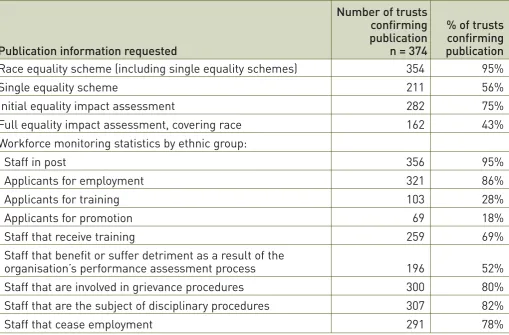
By September 2008, 95% of trusts were able to demonstrate that they had published a race equality scheme (for details of this and the other statistics, see table 3 below).
1 60% of trusts (341 out of 570) 77% of trusts (302 out of 394) 76% of trusts (298 out of 394) had published a race equality had published a race equality had published a race equality scheme on their website scheme on their website scheme on their website 2 7% of trusts (37 out of 570) 34% of trusts (133 out of 394) 76% of trusts (299 out of 394)
had published workforce had published workforce had published workforce
monitoring data monitoring data monitoring data
3 2% of trusts (9 out of 570) 16% of trusts (63 out of 394) 44% of trusts (172 out of 394) had published outcomes had published outcomes of had published outcomes of of race equality impact race equality impact race equality impact
assessments assessments assessments
4 N/A 24% of trusts (93 0f 394) 26% of trusts (104 of 394) had published a single had published a single equality scheme equality scheme
(Note: included in the top (Note: included in the top row results of 77%) row results of 76%)
[image:23.595.44.559.184.457.2]2006 2007 2008
Race equality schemes
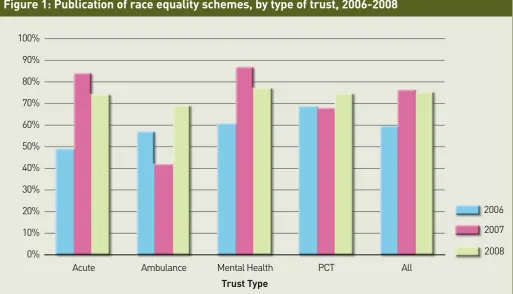
There was an improvement in the percentage of trusts that had published their race equality scheme on their websites between 2006 and 2007, but this fell back slightly in 2008. The reconfiguration of trusts makes detailed comparisons of performance across years more challenging.
Overall the percentage of trusts that published a race equality scheme in 2008 was similar to the previous year. The percentage of PCTs and ambulance trusts with a published race
equality scheme increased from 2007, while the percentage of acute trusts and mental health trusts decreased.
The King’s Fund found that 61% of PCTs had published an up-to-date race equality scheme on their website by 2006, which reflects our findings.24The authors of the report thought that there was no obvious relationship between the ethnic diversity of a population served by a PCT and the likelihood of them having published a race equality scheme. They pointed out that the publication of a scheme does not necessarily mean that the PCT is taking action to reduce inequalities and promote race equality. On the other hand, they found that some PCTs showed a great deal of activity aimed at improving the access to healthcare of people from minority ethnic groups, but had not published a race equality scheme.
Healthcare Commission audits of NHS equalities publications continued
Acute Ambulance Mental Health PCT All
Trust Type
2006 2007 2008 100%
[image:24.595.42.556.188.482.2]90% 80% 70% 60% 50% 40% 30% 20% 10% 0%
Workforce monitoring statistics
Trusts have a duty to monitor and publish workforce statistics by ethnic group. They must provide annual publications of staff in post and applicants for employment, training and promotion, from each ethnic group.
If trusts have a workforce of 150 or more full-time staff (and only one trust had fewer), they are also obliged to produce statistics on the numbers of staff from each group who:
• Receive training.
• Benefit or ‘suffer detriment’ as a result of its performance assessment procedures.
• Are involved in grievance procedures.
• Are subject to disciplinary procedures.
• Cease employment.
In 2006 and 2007, we reported on those trusts that had published at least one of these workforce statistics on their website and we collected comparative information in 2008.
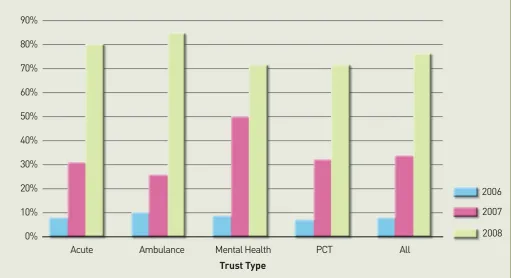
There was a wide variation in the workforce monitoring data collected and published by trusts on their websites. The statistics most commonly published were the composition of the workforce, with 75% of trusts publishing these. The next highest was recruitment and promotion, 33% of trusts, followed by leavers statistics, published by 27% of trusts. Four trusts published information on applications for training and none of the trusts published statistics on applications for promotion.
Acute Ambulance Mental Health PCT All
Trust Type
2006 2007 2008 90%
80%
70%
60%
50%
40%
30%
20%
10%
[image:25.595.44.556.206.484.2]0%
Equality impact assessments
Equality impact assessments (EIAs) are tools for ensuring that policies, functions and strategic plans do not build in barriers to equality of experiences and outcomes for patients and staff, and that opportunities to promote good relations between races are identified and acted upon.
EIA methodology should involve an initial or basic screening process. A full assessment should then be carried out in areas where the screening process identifies risks,
and an outcome report published. EIAs are one of the main routes for identifying organisational risk – they should be linked to the risk register and monitored there, as well as through the trust’s other governance processes.
There has been a steady increase in the percentage of trusts that have published the outcomes of EIAs on their websites, with nearly half of trusts publishing at least one in 2008. PCTs and acute trusts have improved most, while mental health trusts had the highest rate of publication in 2008.
Healthcare Commission audits of NHS equalities publications continued
Acute Ambulance Mental Health PCT All
Trust Type
2006 2007 2008 70%
60%
50%
40%
30%
20%
10%
[image:26.595.49.557.205.497.2]0%
Single equality schemes
There has been a slight increase, from 24% in 2007 to 26% in 2008, of trusts that published a single equality scheme on their websites – amounting to an additional 11 trusts.
Overall
In 2008, 35% of trusts were found to have published some information on all three
publication duties on their websites, compared with 9% in 2007. While this represents an improvement, there is still a considerable way to go.
The key areas for improvement are the publishing of workforce monitoring data and
outcomes of equality impact assessments.
We decided to carry out a special exercise with NHS trusts to obtain the most recent published data and to provide more detail. We wrote to the chief executives of all 391 trusts in England in September 2008 asking them to provide us with a published race equality or single equality scheme and up-to-date employment statistics which monitor staff by their ethnicity.
In all, 374 out of 391 trusts (down from 394 trusts because of further reconfigurations) responded by the requested date. (All the remaining trusts have now replied, except for one). A summary of the responses for the 374 trusts is set out in table 3 below.
Acute Ambulance Mental Health PCT All
Trust Type
2008 35%
30%
25%
20%
15%
10%
5%
[image:27.595.42.557.184.487.2]0%
Summary
It was not within our terms of reference to examine the quality of the publications posted on individual trust’s websites, or sent through in the extra data collection exercise. Our objective was to ascertain whether trusts were meeting the publication duties of the Race Relations legislation insofar as they were evidenced on their websites or communicated to us. Although we should be careful in comparing year on year, we can see that there has been an apparent improvement since 2006 – particularly in publishing race equality schemes, where 95% of trusts say they now do so.
It is also clear from the exercise we carried out in September 2008, that trusts had difficulty in responding to the workforce statistics, particularly around promotion and training. Trusts communicated to us that NHS procedures make the completion of these statistics challenging. For example, staff are required to formally apply for all new roles, whether at higher pay band or not. Trusts are able to monitor data on ‘applicants for posts’, but this includes staff applying for posts on a level transfer as well as promotion. Similarly, a number of trusts did not have centrally-managed statistics on ‘applicants for training’ as approval rested with the individual line manager rather than with formal HR systems.
Healthcare Commission audits of NHS equalities publications continued
Race equality scheme (including single equality schemes) 354 95%
Single equality scheme 211 56%
Initial equality impact assessment 282 75%
Full equality impact assessment, covering race 162 43%
Workforce monitoring statistics by ethnic group:
Staff in post 356 95%
Applicants for employment 321 86%
Applicants for training 103 28%
Applicants for promotion 69 18%
Staff that receive training 259 69%
Staff that benefit or suffer detriment as a result of the
organisation’s performance assessment process 196 52%
Staff that are involved in grievance procedures 300 80%
Staff that are the subject of disciplinary procedures 307 82%
Staff that cease employment 291 78%
Number of trusts
[image:28.595.45.555.204.539.2]confirming % of trusts publication confirming Publication information requested n = 374 publication
Our review had two main aims:
• To explore in depth how well trusts address some of the needs of patients and staff from minority ethnic groups, based on a targeted sample of trusts.
• To help the selected trusts to improve services, and to report any general lessons learned.
It builds on the review of literature, the three web audits and the special publication exercise discussed in the previous sections. It is also informed by the results of the 2007/08 annual health check. Standard C7e, which is in the ‘governance’ domain of Standards for Better Health, requires organisations to challenge discrimination, promote equality and respect human rights.25
This standard has the second lowest declared compliance rate in the annual health check, and fewer trusts are declaring compliance. In 2005/06, the compliance rate for C7e was 91%, but this declined to 86% in 2006/07 and fell further to 83% in 2007/08. It is clearly an area which demands attention.
Our overall approach, in the annual health check, is that it is for trust boards to assure themselves that their services meet the Government’s core standards. This is not just about having policies and saying they are in place. Trust boards must assure themselves that the services they provide meet those standards. Our review therefore asked trusts to provide the evidence and data that they used to assure their boards.
This section is in two parts. The first sets out the evidence from the visits to the 39 trusts chosen for the review. It analyses how these trusts provided evidence for each of the areas we assessed in the review. The second describes the examples of leading practice provided by an additional 11 trusts.
We are very grateful to all these trusts for their help and cooperation in this crucial area, as they have helped to identify leading practice and shone a light on areas where more work needs to be done.
Methods
As the main part of the race equality review, undertaken towards the end of 2007 and the beginning of 2008, we visited 39 trusts where our data suggested a relative risk in performance with regards to those parts of the five core standards relating to race equality. Of the trusts, 22 were PCTs, 11 were acute trusts, three were ambulance trusts and three were mental health trusts.
The trusts selected were not representative of the NHS as a whole and the results cannot therefore be generalised to all trusts. Instead, we paint a picture of how a relatively small group of trusts are managing their responsibilities in promoting race equality and we report general issues that may be relevant to other trusts.
Our visits included peer reviewers who were seeking evidence of activity in the five following areas:
• Challenging discrimination, promoting equality and respecting human rights.
• Supporting staff through organisational and personal development programmes.
• Making information available to patients and the public on their services, providing patients with suitable and accessible information on the care and treatment they receive and, where appropriate, informing patients on what to expect during and after their care and treatment.
• Seeking the views of patients, their carers and others and taking these into account in designing, planning, delivering and improving healthcare services.
• Enabling all members of the population to access services equally, and offering choice in access to services and treatment equitably.
We developed 16 more specific and detailed components for investigation within these five areas for all 39 trusts, plus an extra one for PCTs and mental health providers, and a further one for PCTs alone. In compiling individual reports on trusts’ performance, the assessment teams requested evidence on how far trusts were able to demonstrate assurance against these 16 to 18 additional components.
In a separate exercise, 11 trusts that had performed well in the web audit were asked to provide examples of leading practice in promoting race equality, eliminating discrimination and promoting good relations between races.
Challenging discrimination, promoting
equality and respecting human rights
Publishing statutory information
Healthcare organisations should be promoting equality, including publishing information specified by statute, in accordance with the general and specific duties of the race relations legislation and the Code of practice on the duty to promote race equality published by the Commission for Racial Equality.26
Twenty-eight of the 39 trusts we visited were able to provide evidence of assurance that they had an up-to-date race equality scheme. Four trusts could provide some evidence, but seven could not. These seven were evenly distributed
across the four healthcare sectors. Most trusts had consulted, revised and published their race equality schemes. Some trusts were moving to a single equality scheme covering race, gender, and disability. Where trusts were unable to demonstrate evidence, it was generally because the race equality scheme was out-of-date or there were no timescales attached to the action plans to monitor progress.
Workforce monitoring
Trusts are also obliged to monitor their workforce by ethnic group, in terms of the numbers of staff in post and the numbers of applicants for employment, training and promotion. If the trust employs over 150 or more full-time staff, it is also required to monitor, by ethnicity, the numbers of staff who:
• Receive training.
• Benefit or “suffer detriment” as a result of performance assessment procedures.
• Are involved in grievance or disciplinary procedures.
• Leave.
This duty requires trusts to monitor employment statistics by ethnic group and to publish the results annually. These statistics help to ensure that public bodies are not discriminating against their own staff. Monitoring, in itself, does not end discrimination but it provides the evidence for management action. The statistics also help to compare the trust’s workforce with the local population.
There are nine sets of workforce statistics that trusts are obliged to monitor and publish. Ten of the 39 trusts we visited as part of the review were able to demonstrate assurance about these statistics and 11 were able to provide