Developing complexity using networks
of synthetic replicators
Tamara Kosikova
This thesis is submitted in partial fulfilment for the degree of
Doctor of Philosophy
at the University of St Andrews
OF SYNTHETIC REPLICATORS
Tamara Kosikova
A Thesis Submitted for the Degree of PhD at the
University of St Andrews
2016
Full metadata for this item is available in St Andrews Research Repository
at:
http://research-repository.st-andrews.ac.uk/
Please use this identifier to cite or link to this item:
http://hdl.handle.net/10023/10835
I, Tamara Kosikova, hereby certify that this thesis, which is approximately 80000 words in length, has been written by me, that it is the record of work carried out by me and that it has not been submitted in any previous application for a higher degree.
I was admitted as a research student in September 2012 and as a candidate for the degree of Doc-tor of Philosophy in September 2013; the higher study for which this is a record was carried out in the University of St Andrews between 2012 and 2016.
Date . . . signature of candidate . . . .
2. Supervisor’s declaration:
I hereby certify that the candidate has fulfilled the conditions of the Resolution and Regulations appropri-ate for the degree of PhD in the University of St Andrews and that the candidappropri-ate is qualified to submit this thesis in application for that degree.
Date . . . signature of supervisor . . . .
3. Permission for electronic publication:
In submitting this thesis to the University of St Andrews I understand that I am giving permission for it to be made available for use in accordance with the regulations of the University Library for the time being in force, subject to any copyright vested in the work not being affected thereby. I also understand that the title and the abstract will be published, and that a copy of the work may be made and supplied to any bona fide library or research worker, that my thesis will be electronically accessible for personal or research use unless exempt by award of an embargo as requested below, and that the library has the right to migrate my thesis into new electronic forms as required to ensure continued access to the thesis. I have obtained any third-party copyright permissions that may be required in order to allow such access and migration, or have requested the appropriate embargo below.
The following is an agreed request by candidate and supervisor regarding the electronic publication of this thesis:
Access to all printed copies but an embargo on all electronic copies for a period of 1 year on the following ground: publication of this thesis would preclude future publications.
Declaration iii
Acknowledgements xi
Abbreviations xiii
Abstract xvii
1 Introduction 1
1.1 Preamble . . . 1
1.2 Origins of life . . . 5
1.3 Systems chemistry . . . 7
1.4 Replication: theory and practice . . . 9
1.4.1 Minimal model of self-replication . . . 9
1.4.2 Minimal model of reciprocal replication . . . 11
1.4.3 Replication efficiency . . . 12
1.4.4 Kinetic theory of self-replicating systems . . . 15
1.4.5 Synthetic replicating systems in practice . . . 17
1.4.5.1 Oligonucleotide-based replicators . . . 17
1.4.5.2 Peptide-based replicators . . . 22
1.4.5.3 Small molecule-based replicators . . . 33
1.5 Dynamic covalent chemistry . . . 42
1.5.1 Dynamic covalent libraries under thermodynamic control . . . 45
versible reaction processes . . . 60
1.6 Summary and outlook . . . 72
2 General design principles and objectives 75 2.1 Preamble . . . 75
2.2 The recognition event . . . 75
2.3 The chemical reaction . . . 78
2.4 Algorithm for network resolution . . . 81
2.5 Summary . . . 84
3 A kinetic study of an interconnected network based on two synthetic repli-cators 87 3.1 Preamble . . . 87
3.2 Aims and objectives . . . 87
3.2.1 Recognition and reaction processes in the system . . . 88
3.3 Syntheses of network components . . . 91
3.4 Kinetic analyses of replicators in isolation . . . 94
3.4.1 Recognition-disabled kinetic experiments . . . 94
3.4.2 Recognition-enabled kinetic experiments . . . 96
3.4.2.1 Uninstructed kinetics . . . 96
3.4.2.2 The autocatalytic cycles . . . 98
3.4.2.3 The crosscatalytic cycles . . . 99
3.4.2.4 Percentage enhancements in template instructed ex-periments . . . 100
3.4.2.5 Kinetic fitting: catalytic efficiency and template du-plex stability . . . 102
3.4.2.6 Kinetic simulations . . . 105
3.5 Competition kinetic experiments . . . 111
3.5.1 Stability of the replicator duplexes: an NMR study . . . 115
3.5.2 Kinetic simulations of a two-replicator reaction network . . . 119
3.6 Summary . . . 120
4 Probing the selectivity in a two-replicator network embedded within a dy-namic covalent library 123 4.1 Preamble . . . 123
4.2 Design of the DCL . . . 124
4.4.1 Control DCLs . . . 130
4.4.1.1 M1–M3library . . . 132
4.4.1.2 Template instructedM1–M3libraries . . . 134
4.4.1.3 M2–M3library . . . 136
4.4.1.4 Template instructedM2–M3libraries . . . 138
4.4.2 M1–M2library:T1–T2competition embedded within a DCL 139 4.4.2.1 Template instructedM1–M2competition libraries . 142 4.5 The limit on selectivity within a DCL . . . 144
4.5.1 Kinetic simulations . . . 145
4.6 Summary . . . 162
5 Coupling replication networks to reaction-diffusion processes 165 5.1 Preamble . . . 165
5.2 Spontaneous formation of self-organised patterns in a reaction-diffusion environment . . . 166
5.3 Replicating systems within reaction-diffusion environment . . . 171
5.3.1 Synthetic replicating systems in reaction-diffusion environment: objectives and previous work . . . 172
5.4 A two-replicator network within a reaction-diffusion environment . . 182
5.4.1 Synthesis of nitrone equipped with an optical tag . . . 182
5.4.2 Experimental set-up for the observation of reaction diffusion fronts . . . 183
5.4.3 Analysis of replicators under reaction-diffusion conditions . . 184
5.4.3.1 Uninstructed reaction-diffusion experiments . . . . 184
5.4.3.2 Template-instructed reaction-diffusion experiments 186 5.4.4 Competition within the reaction-diffusion environment . . . . 187
5.5 Towards improved analysis of replicating networks within reaction-diffusion environment . . . 191
5.5.1 Second generation of optical tags for use in reaction-diffusion experiments . . . 195
5.5.1.1 Syntheses of new optical tags . . . 196
5.5.1.2 NMR analysis and examination of optical properties 199 5.5.1.3 Diffusion analysis . . . 204
5.5.1.4 Analysis of propagating reaction-diffusion fronts in practice: proof-of-principle experiments . . . 207
6.1 Preamble . . . 225
6.2 Mechanically-interlocked architectures . . . 226
6.2.1 Chemical topology, nomenclature and synthetic approaches . 227 6.2.2 Rotaxanes: applications . . . 235
6.3 Integrating [2]rotaxane assembly with replication processes . . . 240
6.3.1 Structural requirements and kinetic models . . . 240
6.3.2 Previous work: Model 1 . . . 245
6.4 Model 2 . . . 249
6.4.1 Design and synthesis of rotaxane components . . . 249
6.4.1.1 Synthesis of the linear component . . . 251
6.4.1.2 Syntheses of macrocycles . . . 252
6.4.2 Pseudorotaxane binding studies . . . 253
6.4.3 Synthesis and characterisation of the thread and rotaxanes . . 258
6.4.4 Kinetic analyses . . . 262
6.4.4.1 Recognition-disabled kinetic experiments . . . 262
6.4.4.2 Kinetic analyses of thread . . . 263
6.4.4.3 Kinetic analyses of rotaxanes . . . 265
6.4.5 Kinetic fitting and simulations . . . 267
6.5 Model 3 . . . 271
6.6 Summary . . . 281
7 Future Work 285 7.1 Replicating systems under flow conditions . . . 286
7.2 Replicating systems under reaction-diffusion conditions: probing the diffusion parameter . . . 287
7.3 Reciprocally-replicating rotaxane network . . . 288
7.3.1 Multicyclic rotaxane–thread network . . . 290
8 Conclusions 291 9 Experimental procedures 299 9.1 General experimental procedures . . . 299
9.2 General NMR spectroscopy procedures . . . 300
9.2.1 1H NMR spectroscopy . . . 300
9.2.2 13C NMR spectroscopy . . . 300
9.2.3 19F{1H}NMR spectroscopy . . . 300
9.3.2 H NMR spectroscopy . . . 301
9.3.3 19F{1H}NMR spectroscopy . . . 302
9.3.4 Semi-automatic deconvolution . . . 303
9.3.5 Error estimation in NMR kinetic experiments onT1 and T2 replicators . . . 304
9.3.6 Kinetic fitting and simulations . . . 304
9.3.7 Heteroduplex NMR study . . . 305
9.4 Dynamic covalent libraries . . . 305
9.4.1 Preparation and analysis of DCLs . . . 305
9.4.2 Error estimation in DCL NMR experiments . . . 308
9.4.3 Preparation of the CD2Cl2saturated withpTSA . . . 308
9.4.4 Kinetic simulations . . . 309
9.5 Propagating reaction-diffusion fronts . . . 310
9.5.1 Determination of diffusion coefficients . . . 310
9.5.2 Single replicator reaction-diffusion fronts . . . 311
9.5.3 Competition reaction-diffusion fronts employingNE . . . 311
9.5.4 Control NMR experiments in DMSO-d6 . . . 312
9.6 Rotaxane study . . . 313
9.6.1 MALDI-TOF analysis of [2]rotaxanes . . . 313
9.6.2 Error estimation in kinetic experiments . . . 314
9.6.3 Rotaxane crystallographic data . . . 314
9.7 Crystallographic data forT1A,T1AFand macrocycle168 . . . 315
9.8 Compound characterisation . . . 317
References 365 Appendix 381 A1. Example semi-automatic deconvolution script . . . 383
A2. Example SimFit input files employed in kinetic fitting . . . 385
A3. Component concentrations for dynamic covalent libraries . . . 390
A4. SimFit input file for DCL simulation . . . 394
A5. Example SimFit files employed in rotaxane simulations . . . 399
The last four years have been a tremendous adventure—an adventure that was made significantly more enjoyable by the contributions of the people that helped me through it. First and foremost, I would like to thank my supervisor Professor Douglas Philp—for letting me loose in his lab, for his invaluable help with the challenges that occasionally accompany research in the field of systems chemistry, his incredible enthusiasm, and for what he might call “being picky”, but really, it means doing things the right way.
I had the privilege of sharing my PhD journey with an amazing group and lab mates. In the Philp group, Josh Richards and Leo Maugeri (congratulations Dr!) started their PhDs almost at the same time as I did, and together with David van Brussel, we had the unique chance to build on the great work produced by the previous members of the Philp lab, explore the wonders of self-replicating systems and get really good at synthesising all things insoluble. Thank you guys for all the discussions, the jokes, the company and the outings. During my PhD, I also had the opportunity to work with a number of great project students—thank you guys for the hard work and for making the lab such a lively, gently crazy place. I would like to thank Martin Peeks in particular, who worked on his project during my first year: the discussions were invaluable and I shall forever remain impressed by your skills with all things computer-related. Further, I want to thank the members of the Kay research group: Dr Euan Kay for his extremely helpful discussions and comments; Dr Flavio della Sala for his Italian ways and for his help and patience when I first joined the lab; Dr Stefan Borsley for baking us all those cakes (while not eating any!) and most importantly for his friendship both inside and outside of the lab. Nicolas Marro—thank you for being such a cheerful presence in the lab!
I am grateful to the DoH group, particularly Rudy, Tanya, Dr Ricardo and Rodrigo
for livening up the 4th floor corridor and for joining us on our Friday pub adventures.
Highlands (which was followed by many more). I would also like to thank Dr Stephen Thompson, for being an overall amazing and kind person and for introducing me to the loveliest Silvie in the world. Dr Neil Keddie, thank you for all the coffee chats, they were an often-needed break from the everyday craziness, and the expert discussions and assistance with all things chemistry.
The work done to produce this body of work has benefited tremendously from the help of the technical staff who work here at the School of Chemistry. I would like to thank Mrs Melanja Smith for brightening my visits to the NMR room and for her shared love of ceramics. Thank you and Dr Tom´aˇs L´ebl for your kind help with the numerous NMR experiments and for teaching me how to run them on my own. Mrs Caroline Horsburgh—thank you for the numerous mass spectrometry analyses; great thanks also go to Dr Matt Fuszard and Dr Sally Shirran for the MALDI-TOF analysis of my rotaxanes. I feel tremendous gratitude for the wonderful X-ray analysis performed by Dr David B. Cordes and Professor Alexandra M. Z. Slawin.
To my friends back home—Lucka, Dee, Mata, Matus and Amalka—thank you for all your love, our shared trips and the occasionally late-night chats. The number of won-derful people that I have met here in St Andrews is greater than I can mention—thank you all for making St Andrews the great place to be that it is. A special thank you goes to Lisa—you are an inspiration and who knows, maybe one day we will open that Caf´e.
To JoJo, the man I love?—thank you for sharing this journey with me.
LATEX—thank you for making the whole thesis writing processes significantly more
aq. aqueous
br broad
BZ Belousov-Zhabotinsky
C cytosine
CA Carbonic anhydrase
CI chemical ionisation
CSTR continuously-stirred tank reactor
d doublet
dd doublet of doublets
decomp. decomposition
DBU 1,8-Diazabicyclo[5.4.0]undec-7-ene
DCC dynamic covalent chemistry
DCL dynamic covalent library
DFT density functional theory
DKS dynamic kinetic stability
DNA deoxyribonucleic acid
DOSY diffusion-ordered spectroscopy
e autocatalytic efficiency
ee enantiomeric excess
EMkinetic kinetic effective molarity
EMthermo thermodynamic effective molarity
ESI electrospray ionisation
FMO frontier molecular orbitals
DGS free energy of connection
G guanine
GM glycol macrocycle
HRMS high resolution mass spectrometry
ILG informational leaving group
kbi bimolecular reaction rate constant
kuni unimolecular reaction rate constant
Ka association constant
Kd dissociation constant
LG leaving group
lit. literature
LUCA Last Universal Common Ancestor
LUMO lowest unoccupied molecular orbital
m multiplet
M maleimide
M.p. melting point
MALDI matrix-assisted laser desorption ionisation
Me methyl
MIA mechanically-interlocked architecture
MS mass spectrometry
NBS N-bromosuccinimide
NMR Nuclear magnetic resonance
p dissociation dependent autocatalytic reaction order
PhMe toluene
PM pyridine macrocycle
ppm parts per million
pTSA para-toluenesulfonic acid
quant. quantitative
R rotaxane
RR reciprocally-replicating
RM1 recife model 1
RMS residual fitting error
RNA ribonucleic acid
rOe rotating frame Overhauser effect
ROESY rotating frame nuclear Overhauser effect correlation spectroscopy
RR reciprocal replicator
RT room temperature
s singlet
sat. saturated
SR self-replicator / self-replicating reactivity
t triplet
TFA trifluoroacetic acid
THF tetrahydrofuran
TMS trimethylsilane
TS transition state
TSA transition state analogue
UV ultraviolet
WSBR well-stirred batch reactor
Molecular recognition plays an essential role in the self-assembly and self-organisation of biological and chemical systems alike—allowing individual components to form complex interconnected networks. Within these systems, the nature of the recognition and reactive processes determines their functional and structural properties, and even small changes in their identity or orientation can exert a dramatic effect on the observed properties. The rapidly developing field of systems chemistry aims to move away from the established paradigm in which molecules are studied in isolation, towards the study of networks of molecules that interact and react with each other. Taking inspiration from complex natural systems, where recognition processes never operate in isolation, systems chemistry aims to study chemical networks with the view to examining the system-level properties that arise from the interactions and reactions between the components within these systems.
CHAPTER 1
INTRODUCTION
1.1 Preamble
The world around us has come to rely on networks: social networks,1,2 citation
net-works,3,4transportation networks,5the world wide web,6and, in fact the human body
itself is a vast network comprised of a large number of smaller interconnected neural,
and gene signalling networks7,8—these are just few examples of the networks that we
experience in our everyday lives. These networks differ greatly, ranging in the num-ber of components, the links between them, and their strength, whether the networks
are physically tangible (e.g. transportation network) or more abstract (e.g. friendship
networks). One feature, however, is shared by all of these networks, and that is the dramatic influence they exert on our lives:
“August 2003: A massive power outage hit the Midwestern and North-eastern United States, caused by a cascading failure due to a shutdown at one generating plant in Ohio. The reported cause of the shutdown was that electrical lines, overloaded by high demand on a very hot day, sagged too far down and came into contact with overgrown trees, triggering an automatic shutdown of the lines, whose load had to be shifted to other parts of the electrical network, which themselves became overloaded and shut down. This pattern of overloading and subsequent shutdown spread rapidly, eventually resulting in about 50 million customers in the Eastern United
States and Canada losing electricity, some for more than three days.”9,10
Traditionally, the study of networks was the domain of mathematics, referred to
of networks has achieved significant importance, particularly in the field of social
sciences,13 with a focus on unravelling communication and relationships between
individuals as well as larger social units. The development of graph theory has allowed networks from the real-world to be represented in the form of graphs, where the graph vertices (or nodes) denote the components or individuals within a particular network,
and the edges represent the connections between them (Figure 1.1a). A network can
incorporate different types of nodes and edgesFigure 1.1billustrates an example of a
network with directed edges (i.e. a network where the interactions between nodes are
directional), such as in a network representing telephone calls. Alternatively, the edges can carry also different weights, which can be represented by the thickness of the edge line—a property of an edge that can vary greatly, for example, in friendship networks (Figure 1.1c).
Vertex (node)
Edge
(a) (b) (c)
Figure 1.1 A depiction of a simple(a)undirected,(b)directed and(c)undirected weighted network comprised of nine identical vertices (nodes) and ten connections (edges). Figure adapted from Ref. 12.
The representation of a network in the form a graph relays information about the structure of the network and its topology, which in turn provides information about its function and behaviour. For example, a graph representing a social network can be analysed in terms of the connectivity exhibited by various nodes, in particular the number (the degree of connectivity) and the strength of edges from a particular node, revealing the most essential nodes for the network to retain its function. However, extracting structural and functional information from the graphical representation of a network becomes significantly more difficult, if not impossible, as the number of components in a network increases beyond a certain critical threshold. Therefore, visual analysis that
can provide facile access to information about smaller networks (Figure 1.2c), becomes
less important for large networks (Figure 1.2aandFigure 1.2b).
Following the appearance7,13of two seminal papers, discussing the collective
dy-namics of the so-called ‘small-world’ networks, the research directed at investigations of complex networks has experienced a renewed surge across a large variety of
disci-plines. In this context, the term complex network is used12to represent networks that
This is a placeholder for the following image. The image cannot be displayed here due to copyright restrictions.
http://dx.doi.org/10.1137/S003614450342480
M. E. J. Newman, SIAM Rev. 2003, 45, 167–256. Fig 1.2
Figure 1.2 Three example networks varying significantly in the number of components (nodes) and interconnections (edges).(a)The structure of the internet network, where each node rep-resents a collection of computers.(b)A predator-prey network showing the interactions among the species inhabiting a single lake and(c)a social network of sexual contacts. Figure taken from Ref. 11.
but, instead, through the dynamic nature of the links themselves, which enable the networks to evolve over time. In complex networks, the degree of interconnectedness between the individual components can change over time, and an alteration in one network component can exert a dramatic influence on the rest of the network, resulting
in what has become known popularly as the Butterfly effect14 in chaos theory—a term
coined initially to denote systems that are highly sensitive to their initial conditions. The concept of feedback is crucial in complex systems, with the potential to amplify or dampen the effect of a particular change or stimulus.
Interestingly, research directed at complex networks has revealed13 that most of
the identified dynamic networks in the real world share certain identifying features. Namely, these complex networks, irrespective of their nature (biological, social, etc.),
are neither completely regular (Figure 1.3a) nor completely random (Figure 1.3c) in
terms of edge distribution, but lie instead somewhere in between these two extremes (Figure 1.3b). Watts and Strogatz coined13 the term ‘small-world’ networks15,16 to describe such systems, using the analogy to the small-world phenomenon, perhaps
better known as six-degrees of separation.17 Complex networks also contain highly
interconnected sections (known as clusters) and exhibit short average path length, where path length is understood as the shortest path between any two nodes. The example
of small-world network illustrated inFigure 1.3demonstrates this tendency of
‘small-world’ networks to exhibit reduced path length, generally caused by few random links between nodes—connections that are absent in regular networks. The short path length
emerged as a result of evolutionary pressure for fast information transfer (small path-length) and challenges associated with maintaining links over long-distances (only few random links are necessary to decrease path length significantly).
Increasing randomness (p)
p = 0 p = 1
Regular network
Small-world network
Random network
(c) (b)
(a)
Figure 1.3 Three example networks comprised of 20 nodes, illustrating a(a)completely regular,(b)
small-world and(c)random distribution of edges (interconnections). Probabilityprepresents the likelihood of an edge, associated with a particular node, of being randomly wired. Figure taken with permission from Ref. 13. Copyright 1998 Nature Publishing Group.
The structure of a network, its components and their interactions determine the function and behaviour of a network. Analysis of how structural features and connections affect complex networks, and the use of this knowledge in simulations, can facilitate predictions about the development of a complex network over time to be made. The topology of a network has been found to play a crucial role in determining whether
or not a network can expresses18 emergent properties, such as synchronisation and
robustness. An emergent phenomenon is one that is the result of a global expression
of system-level interactions,i.e. it does not stem from the properties of the individual
1.2 Origins of life
Life can likewise be considered as an emergent property that arises from the interactions of a large number of enzymes, proteins, oligonucleotides, membranes and many others components, that would not be considered alive in isolation otherwise. The examination
of the living complexity of life brings19,20 to mind the question—how did life originate?
What was the sequence of events that lead to the transition from a prebiotic world filled with simple molecules to a world abounding with living organisms? The origin of
life has been21the subject of scientific enquiry for centuries and the subject of man’s
enquiry for even longer.
Perhaps the earliest belief associated with the emergence of living organisms is that of spontaneous generation—a belief that life arises naturally from inanimate matter. After a prolonged debate, the matter of spontaneous emergence was finally settled by Pasteur around 1860s, using a series of simple and elegant experiments. Pasteur developed a swan-necked flask that possessed an S-shaped neck, which prevented any micro-organisms from reaching the sterile solution contained within. Once the neck was broken off, the bacteria gained access to the previously sterile broth, allowing the bacterial populations to multiply and, thus, demonstrating that life emerges only from other living matter. Whilst an essential step towards the understanding of living systems, the question of where and how life originated remained unanswered. At the beginning
of the 19th century, the vitalist view, advocating that living organisms possess a special
non-physical, but further unspecified quality that fundamentally distinguishes them from non-living entities—the vital force, was dominant. Only with the demonstration that an organic compound, namely urea, can be prepared in the laboratory “without
the need for an animal kidney”22 by W¨ohler, did the vitalist view begin to slowly lose
credibility. This first example of a synthesis of an organic product using purely inorganic starting material served as a bridge between the living and non-living world, whilst simultaneously heralding the beginning of a new era of chemical research and synthetic chemistry.
The understanding of living organisms was revolutionised by Darwin’s theory on the
Origin of Species,23 with three main processes at its core driving evolution: replication,
mutation and selectivity. Over time, further understanding into the specific nature of
living organisms was provided with the advent of molecular biology in the 20thcentury.
Replication, in the most general terms, involves the formation of an identical copy of an entity from a single original unit and is a complex phenomenon that is ubiquitous
in Nature. The capacity for replication in biological systems emerges24,25not simply
as a function of the large number of components present within a cell. Instead, it
to interact and react with each other, forming dynamic, self-organised, interconnected
networks. It is these complex networks, in particular, that give rise8 to the emergent
behaviour of life.
In 1953, Watson and Crick have, assisted by the work of Franklin and Wilkins,
uncovered27,28the double helical structure of deoxyribonucleic acid (DNA), revealing
the template-directed mechanism that enables the copying and transmission of the genetic material of an organism. This work highlighted the reliance of the replication mechanism on the specific molecular recognition between nucleotide sequences of the informational biopolymer. During replication, two helical DNA strands act as individual templates for the synthesis of one new DNA strand, producing sequences with nucleotide pattern that is complementary to each parent template strand. While the mechanism for replication is conceptually simple, the assistance of numerous components of the cellular machinery, such as enzymes, is required in order for replication to take place.
Ultimately, DNA, together with ribonucleic acid (RNA) and proteins lie29at the very
core of biology, encoding within their structure the instructions that enable living organisms to function and replicate persistently. However, in spite of the richness of detail now available for nearly every cellular process, the answer to the question “what
makes a cell alive?” remains unclear. As Albert Eschenmoser aptly noted30 “life as
we know it is a chemical life”. This means that it should be possible to explain the biological processes making life possible, in terms of the underlying chemistry.
The structural features and uniformity of the current genetic material suggest31 that
the modern living systems emerged32,33from a single Last Universal Common Ancestor
(LUCA), marking the transition from an inanimate world to a recognisably living
entity. However, our understanding and agreement as to what may constitute19,34–37 life
remains controversial. NASA has provided38 the most generally accepted definition
of life, where “a self-sustaining chemical system capable of undergoing Darwinian evolution” is considered to be living. We are unlikely to ever identify the concrete steps that facilitated the progressive spontaneous increase in complexity on Earth. The transformation to a living world, filled with a biodiversity of living organisms, required that the prebiotic soup of simple, chemical components developed into larger functional biopolymers. These functional materials must have been capable of catalytic activity and self-replication, and have possessed the capacity to couple with primitive metabolic
cycles and membrane-based compartments. In the 19th century, Darwin’s theory of
evolution transformed our understanding of how populations of species adapt and evolve over time through repeated cycles of replication, mutation and selection. The ability of molecules to self-replicate serves as a bridging element between chemistry and
theory can be extended to the physiochemical processes leading to LUCA. The prebiotic
chemistry literature abounds21,30,42,43with numerous models and theories that strive to
explain how such gradual transition could have taken place. These models generally fall into one of three main categories, differing in their approach to the experimental
study of life’s origins: RNA world hypothesis,44–47metabolism first hypothesis48–50
and the compartmentalistic approach.51–53These schools of thought tend to disagree on
the identity of the molecular species believed to have emerged first during the process of chemical evolution. All three frameworks, however, are united in their belief that autocatalysis has played a crucial role as the predecessor of modern self-replication in the sequence of events leading to the emergence of the modern biodiversity. Recently, integrative systems approaches, where individual monomers and larger oligomers and assemblies, primitive metabolic networks, catalytic species, metals and minerals all co-evolved simultaneously within the environment of the aqueous prebiotic soup are
beginning to replace54,55the more traditional, less holistic theories.
1.3 Systems chemistry
Undeniably, life and its origins are linked with the chemistry of complex systems. In general, however, the recognition of the role of complexity in both biology and
chemistry has been slow to develop,56,57 and lagging behind other science disciplines.
Recently, though, new systems-based approaches have emerged, first in the field of
biology,58–60and later also in chemistry.43,61–63These approaches are directed at trying
to understand chemical and biological complexity using a ‘bottom-up’ approach. In
particular, systems chemistry aims64–66to explore the connections between the
prop-erties of individual components (molecules) and the emergence of complex, dynamic, system-level behaviour as a result of the interactions of these components. In exploiting synthetic chemistry for the design and development of systems with complex and poten-tially life-like properties, systems chemistry strives to develop a better understanding of the principles governing assembly and function in complex systems, thereby shedding light on the origins of biological complexity.
A hypothetical and structurally-simple example of a chemical reaction network can be imagined in the form of reactants interconnected by a shared building block.
Figure 1.4ashows the topology of a three component network that can result in the
formation of two products:ABandAC, linked by a common building blockB. In the
scenario where the two reactions have the same rate constant (kAB=kBC) and all three
components are present at an identical concentration,ABandBCwill reach the same
one of these reactions is upregulated (increased), the product of this pathway will reach
a higher concentration. The example forkAB>kAC is illustrated inFigure 1.4b.
0 10 20 30 40 50 0 10 20 30 40 50 -100 -50 0 50 100 -100 -50 0 50 100 -100 -50 0 50 100 -100 -50 0 50 100 -100 -50 0 50 100 -100 -50 0 50 100
AB BC AB BC AB BC AD CD AB BC AD CD AC
A B C
A B
C D kAB kBC
kAB kBC kAD kCD kAC A B C D kAB kBC kAD kCD A kAB B kBC C
(a) (b) (c) (d)
C o n c e n tr a ti o n / m M % En h a n c e m e n t % En h a n c e m e n t % En h a n c e m e n t
Figure 1.4 Simulation outcome for a series of simple reaction networks composed of three to four components. Circles represent reaction building blocks, whilst coloured arrows denote the formation of product, governed by a specific reaction rate constant. Initial concentration of all components was 50 mMand each rate constant was set at 10 3 M 1s 1. Blue arrows represent a 10-fold increase in the rate constantkAB to 10 2 M 1s 1 in conditions(b) through(d). Product distribution was determined afterca.30 h.
Building on these two straightforward examples of simple reaction networks, the
system can be extended to incorporate an additional building block,D, affording a
network with four different products:AB,BC,CDandAD, each formed with a specific
rate constant (Figure 1.4c)—resulting in a network with a square topology. If the rate
constants are identical, the components will be equally distributed across the four
products (data not shown). An increase in one of the rate constants,kABfor example,
relative to the remaining rate constants, will result in an increased concentration ofAB
product. Interestingly, however, the increase in the rate constant for the formation ofAB
will also result in the concentration ofCDbeing higher than the concentration ofBC
andAD. TheCDproduct, whilst formed at a slower rate thanAB, will reach the same
concentration asABover time. The fast consumption of the reactantsAandBmeans
that the amount of these components available for reaction with componentsCandD
decreases relative to the condition where all four rate constants are identical. As a result
of this imbalance, the two components that are not consumed efficiently (Cand D)
remain available in the reaction mixture, where they can react together slowly over time. Hence, it is possible to observe behaviour that can be considered emergent with respect
to the upregulation of componentCD, afforded solely through the interactions in the
system. If this four-component network is extended by another edge, betweenAandC
capable of recognition-mediated interactions and reactions and feedback, for example,
networks involving molecules that are capable of catalysing their own formation,i.e.
self-replication.
Cellular systems normally possess much more intricate networks, where individual interactions are not easily decoupled. By examining the dynamic processes governing replication in synthetic systems, systems chemists are able to acquire a better under-standing of complex phenomena since the networks involved can introduce interactions between components in a designed and organised manner. Moreover, through the study of synthetic reaction networks capable of replication, it is possible to arrive at a set of minimal structural, recognition and reaction requirements necessary for a system to be capable of replication, delineating boundary conditions for the emergence of the enzymatic machinery available to modern cells.
Ultimately, the potential of systems chemistry to bridge the gap between the chem-ical and the biologchem-ical world is facilitated by advances in the tools available for the analysis of multi-component systems used to study complex phenomena, by combing results from experimental systems with computational simulations. In the last two
decades, significant progress has been made67–70in the design and experimental
demon-stration of minimalin vitroself-replicating systems, based on biological molecules and
organic molecule alternatives, both in isolation and within more complex interconnected networks.
1.4 Replication: theory and practice
1.4.1 Minimal model of self-replication
A system capable of self-replication is one that can transmit structural information through an autocatalytic process. What distinguishes self-replication from the larger subset of autocatalytic reactions is the specificity with which the product formed in the autocatalytic reaction acts as a specific catalyst for its own formation from the individual building blocks. For example, acid-catalysed ester hydrolysis results in the formation of a product that is in itself an acid—accelerating further the hydrolysis reaction. This reaction, however, is non-specific, and will be accelerated by any acid, not just the product itself. In a self-replicating system, the product itself acts as a specific catalyst for its own formation. Consequently, the rate of self-replicating reactions correlates directly with the amount of product template present within a particular reaction mixture.
Within the minimal model of self-replication71(Figure 1.5), product formation can
B, are equipped with complementary reactive (orange and green) and recognition sites
(yellow and blue). In Channel 1 (Figure 1.5, black), these two building blocks react
through a slow and uncatalysed template-independent pathway, affording templateTAB
orTAB?. Alternatively, the same molecules can react through two recognition-mediated
channels. The complementary recognition sites onAandBenable association of these
components in a binary complex [A·B]. Formation of the binary complex in Channel 2
(Figure 1.5, red) facilitates the reaction betweenAandBby preorganising their reactive
sites, resulting in the formation of a catalytically-inactive, closed templateTAB?.
A B
TAB TAB
Channel 1 Bimolecular Reaction
Channel 3 Template-Mediated Autocatalytic Cycle Channel 2
AB Complex
TAB [TAB•TAB] [A•B•TAB]
TAB*
[A•B]
TAB*
TAB
Figure 1.5 Cartoon representation of the minimal model of self-replication. ComponentsAandB
are equipped with a reactive (green/orange) and recognition site (yellow/blue). Formation of templateTABcan proceed through slow bimolecular reaction (Channel 1, black) and template-mediated self-replicating pathway (Channel 3, green). Channel 2 (red) describes the formation of a closed templateTAB?through a binary reactive complex [A·B] complex.
Ultimately, theAandBcomponents can reactviaa template-catalysed
recognition-mediated pathway, referred to as Channel 3 (Figure 1.5, green). In this pathway, the
templateTAB, formed through the bimolecular reaction initially, possesses
recognition-sites in an ‘open’ conformation that allow it to assemble with the unreacted components
A and B in a catalytically-active ternary complex [A·B·TAB]. Within this complex
the reactive sites present onA and B are preorganised for reaction, generating rate
enhancement in what is effectively a pseudounimolecular reaction. The outcome of the
template-mediated reaction is a template dimer [TAB·TAB], which supplies the reaction
mixture with two identical molecules of template, with the capacity to take part in further autocatalytic cycles.
Self-replicating systems often present with a sigmoidal reaction profile. The shape of the reaction profile results from the fact that the reaction rate within a self-replicating system in a closed reaction environment depends on two main factors: (i) the
con-centration of the free catalytically-active (open) template and (ii) the availability (i.e.
pro-file is present typically because the building blocks have to first react through the slow bimolecular reaction to produce the catalytically-active template before the reaction can operate efficiently. The concentration of the template within a reaction mixture will continue to increase slowly, until such a time when the concentration is sufficient for association of the template with the reactants in the ternary complex. The quantity of template required for the assembly into catalytically-active components is governed by
the dissociation constantKdfor the recognition-mediated processes in the corresponding
system (Kd= 1/Ka). Nevertheless, once the template concentration passes the threshold,
the predominant reaction pathway is the template-catalysed autocatalytic Channel 3—a phase in the reaction when the maximum reaction rate is observed in self-replicating systems. As a result of the direct dependence of the reaction rate on the concentration of free template, a decrease in the length of the lag period should be observed, proportional to the quantity of template added, if a self-replicating reaction is undertaken in the
presence of preformed template (added att= 0). In fact, kinetic experiments examining
formation of replicators in the presence of preformed instructional template are utilised to unambiguously establish the capacity of a system to template its own synthesis. The autocatalytic pathway will continue to operate efficiently until the reaction components are exhausted—a time point at which the reaction profile transitions into the plateau phase.
1.4.2 Minimal model of reciprocal replication
In addition to the well-established and also the most studied minimal model of self-replication described above, self-replication processes can also operate in a reciprocal
sense, i.e. by means of complementary recognition processes, instead of the
self-complementary template required for self-replication. The somewhat less-studied
mini-mal model of reciprocal replication (Figure 1.6) is comprised of four building blocks:
C,D,EandF. From these four components,Ccan react withDto form templateTCD,
whilst the reaction ofE andF producesTEF. These templates, formed through two
independent, uncatalysed bimolecular pathways (Channel 1 and 2) posses recognition sites that are mutually complementary, and, therefore, do not permit self-association.
As a result of the complementary nature of the recognition processes, templateTCD can
associateEandFin a ternary catalytically-active complex [E·F·TCD] (Channel 3), thus
accelerating the formation of templateTEF. Similarly,TEFcatalyses the formation of
TCD viathe formation of complex [C·D·TEF] (Channel 4). Dissociation of the resulting
heterodimer [TCD·TEF] releases one molecule of each reciprocal template back into the
Channel 3
Crosscatalytic Cycle TCD TEF
D
F E C
TCD
TEF
[C•D•TEF] [E•F•TCD]
[TCD•TEF]
Channel 4
Crosscatalytic Cycle TEF TCD
Bimolecular Reactions Channel 1
Channel 2
Figure 1.6 Cartoon representation of the minimal model of reciprocal-replication. Two templates,TCD andTEF, containing complementary recognition sites (yellow and dark blue) are formed first formed by the bimolecular reaction of componentCwithD(Channel 1, black) and
EwithF(Channel 2, black). Once formed, the complementary nature of the recognition sites allows them to take part in template-mediated reciprocal replicating pathways, where
TCDis formedviathe catalytically-active ternary complex [C·D·TEF] (Channel 4, blue) andTEFviathe analogous complex [E·F·TCD] (Channel 3, blue).
The formation of templates in a replication network operating in a reciprocal sense will be initially limited by the rates of the uncatalysed bimolecular reactions. Once the concentration of each reciprocal template is sufficient for the assembly of the reaction components in the catalytically-active ternary complexes, the template-directed pathways will begin to operate efficiently. The efficiency of the reciprocal system depends on the presence of free template molecules—replication trough the template-directed pathways can proceed only if the templates are not sequestered within template heterodimers.
1.4.3 Replication efficiency
The crucial role played by templates in both self- and reciprocal replication often makes these systems susceptible to product inhibition. In an ideal situation, the product du-plex would be less stable than the catalytically-active ternary comdu-plex, thereby driving the dissociation of the dimer into individual molecules of free template. Synthetically, however, designing systems where the template dimer is less stable than the ternary com-plex is extremely challenging, and instead the template generally remains sequestered partially within product complexes to a smaller or larger degree, unavailable as the monomeric species required for efficient replication.
Very recently, a new theoretical model of self-replication aimed at reducing template
inhibition has been reported72 by Herdewijn and co-workers. Taking inspiration from
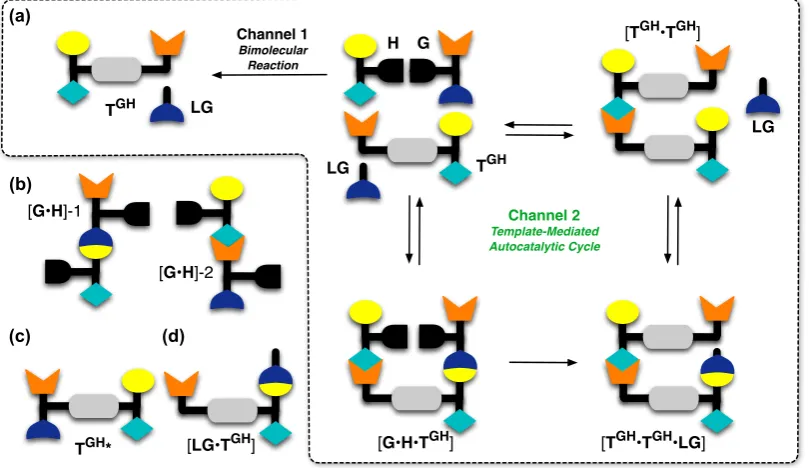
nucleotide-based systems,74the authors propose a theoretical model of self-replication (Figure 1.7a) that exploits an informational leaving group (ILG) in order to produce weakly bound template duplexes and overcome product inhibition in replicating systems.
In this ILG minimal model of self-replication, a template molecule TGH is formed
by the reaction of two precursors,GandH(Channel 1). Each precursor contains two
recognition sites and one reactive site. Interestingly, the increased number of recognition
sites means that the componentsGandHcan theoretically associate together to form
two binary complexes, [G·H]-1 and [G·H]-2 (Figure 1.7b) as well as longer chains.
Channel 1 Bimolecular Reaction
TGH*
TGH LG
[G•H•TGH]
Channel 2
Template-Mediated Autocatalytic Cycle
[TGH•TGH•LG] [TGH•TGH]
LG G
H
[G•H]-1
[G•H]-2
[LG•TGH] (a)
(b)
(c) (d)
TGH
LG
Figure 1.7 (a)Cartoon representation of a minimal model of self-replication exploiting an informational leaving group (ILG) strategy. PrecursorsGandHare each equipped with two recognition sites and a reactive site (black), react to form a molecule of templateTGH. The reaction results in a release of the leaving groupLG(Channel 1). The templateTGHcan catalyse the reaction between theGandHby preorganising their reactive sites in a catalytically-active ternary complex [G·H·TGH]. The ligation step (Channel 2) produces a ternary complex containing two template molecules and aLG, [TGH·TGH·LG]. Dissociation of theLGand the template returns two free catalytically-active molecules ofTGHinto solution.(b)The recognition sites on the precursorsGandHallow them to form two binary complexes [G·H]-1 and [G·H]-2.(c)Formation of templateTGH?in the ILG model is not possible.
(d)Association ofLGwith templateTGHin a complex [TGH·LG] can decrease catalytic efficiency. Figure adapted from Ref. 72.
The template forming reaction in this model is associated with a concomitant
dissociation of the leaving group,LG, producing a templateTGHthat is equipped with
three recognition sites, as opposed to templateTGH?, the formation of which would be
expected in the absence of the ILG (Figure 1.7c). Similarly to the minimal model of
self-replication, the produced templateTGHcan associate with the precursors,Gand
[image:32.595.104.509.246.480.2]reactive sites of these components, accelerating the formation of the ternary complex [TGH·TGH·LG] (Figure 1.7a, Channel 2). Because the formation of each template
molecule is associated with the release of the leaving groupLG, the resulting complex
involves a molecule of template taking part in two individual recognition-mediated
interactions with (i) another molecule of template and (ii) the leaving groupLG, making
the complex significantly less stable than the analogous template-dimer. Dissociation of
LGfrom the ternary complex [TGH·TGH·LG] produces a template dimer [TGH·TGH],
which is in equilibrium with the free-form of the catalytically-active templateTGH.
This novel theoretical ILG-based model of self-replication provides an interesting method for destabilising the product duplex, with the potential to improve replication efficiency, nevertheless, the problem of product inhibition, arising from the association
of the free templateTGH with the leaving groupLGin a complex [TGH·LG] is not
resolved completely (Figure 1.7d), and the viability of this theoretical model awaits
experimental testing.
In addition to exploring the use of an IGL, there are two reaction parameters can be varied fairly readily in order to improve the catalytic efficiency of a replicating system operating through one of the minimal models: concentration and temperature. By altering the concentration at which the reaction is performed, the proportion of free and bound template in solution can be manipulated. For example, changing the reaction concentration can be useful for controlling the relative contribution of the bimolecular and the recognition-mediated pathways towards the production of template. If, for example, the reaction concentration is halved, the bimolecular reaction will decrease by a factor of four, whereas the pseudounimolecular reaction will decrease only two-fold. Replicating systems generally contain a large number of various components present simultaneously in both bound and unbound state within the reaction mixture, and in order to deconvolute the overall effect of concentration on the reaction time course, it is often useful to employ kinetic simulations, utilising known kinetic and recognition
parameters (e.g. rate and association constants).
stabilities of all complexes relying on non-covalent interactions. The latter can perhaps lower the quantity of template required for its assembly with the reaction components in to catalytically-active complexes. Ultimately, though, each replicating system performs with the highest efficiency at a particular set of conditions.
1.4.4 Kinetic theory of self-replicating systems
Self-replication is a complex phenomenon, and as is often the case with complex be-haviour, understanding it often necessitates simplifications. In 1993, von Kiedrowski
reported71 seminal work describing empirically-determined and simplified kinetic
models for the kinetic behaviour of replicating systems. The simplest kinetic model (Figure 1.8) represents a purely autocatalytic system,i.e. a system where formation of template is possible only through a template-mediated pathway. Such self-replication
process is characterised by an autocatalytic reaction order:p. Experimental replicating
systems often fall between two extremes of reaction order,p= 0.5 andp= 1, values
which correspond to parabolic and exponential growth, respectively. In a replicating sys-tem withp= 0.5, the initial rate of reaction follows the square-root law of autocatalysis, which means that the addition of increasing quantities of template results in an increase in the rate of template formation that is equal to the square root of the concentration of template added.
A + B + p T (1 + p) T ka
a) b)
(a) (b)
Figure 1.8 Concentrationvstime (full line) and ratevstime (dashed line) profiles for a purely autocat-alytic reaction withpequal to(a)0.5 and(b)1. Data taken from Ref. 71.
The magnitude of the reaction order p also conveys information about the
rate-limiting step in the autocatalytic cycle. Forp= 0.5, the dissociation of product duplex
autocatalytic systems where the dissociation of product duplex is not the rate-limiting
step, the reaction orderpcan be closer to 1. In exponential growth systems, wherep=
1, doubling the amount of template added also doubles the rate of template synthesis.
The parabolic and exponential replicator growth curves portrayed inFigure 1.8aand
billustrate a purely autocatalytic system, and, therefore, these reaction profiles are not
applicable to majority of experimental replicating systems. Instead,Figure 1.9shows
the noticeably more varied behaviour obtained using a kinetic model that describes real
systems more accurately. In this case, the productTis formed fromAandBbothvia
a template-independent (bimolecular) pathway and a template-directed (autocatalytic)
pathway. Each pathway proceeds with a specific rate constant,ka(autocatalytic) andkb
(bimolecular). The ratio of these two rate constants is referred to as the autocatalytic
efficiencye (e=ka/kb). This parameter provides a measure of the contribution of each
pathway to the overall concentration of template produced in a replicating system. Examining the parabolic and exponential time course profiles, it is clear that the kinetic
behaviour varies significantly as a function ofe, and, in fact, the classical sigmoidal
reaction profile is expressed only in replicating systems witheabove a certain threshold
value. Therefore, in experimental systems that are thought to be self-replicating, but
do not express a sigmoidal reaction profile as a result of low catalytic efficiencye, the
ability of a system to template its own synthesis can be confirmed indirectly, through template-instructed experiments.
A + B + p T (1 + p) T
A + B T
ka
kb
a) b)
ε=ka kb
[image:35.595.101.488.494.723.2](a) (b)
The large variation in reaction profiles that can be exhibited by experimental replicat-ing systems demonstrates that ascertainreplicat-ing the rate-limitreplicat-ing step within each system as well as the catalytic efficiency, is generally not feasible by examining the reaction time
course only. Instead, it is necessary to utilise the concentrationvstime data available
from experimental kinetic analysis of a particular replicator and undertake full kinetic fitting, taking into account all of the reaction and recognition channels available to the system, in order to obtain these parameters. Only comprehensive kinetic fitting can determine the contribution of the various reaction pathways towards product formation.
1.4.5 Synthetic replicating systems in practice
The theoretical requirements for the establishment of self-replicating systems were complemented by reports of abiotic experimental systems, expressing the capacity to template their own synthesis. These synthetic replicating systems, ranging from simple replicators operating in isolation to a variety of increasingly complex interconnected systems, can facilitate our understanding of the molecular origins of life.
1.4.5.1 Oligonucleotide-based replicators
Following extensive work on template-directed synthesis75–78of oligonucleotides by
Orgel and co-workers, the von Kiedrowski laboratory reported79 in 1986 the first
example of non-enzymatic self-replication in a model chemical system based on a
oligonucleotide strand with a palindromic sequence (Scheme 1.1). In the replication
cycle, a trinucleotide CCG (protected at the 5’ end), activated using carbodiimide
EDCIin situ, was coupled to trinucleotideCGG(protected at the 3’ end), producing a
hexanucleotide templateCCGCGG. The complementarity of the template sequence,
now protected at both the 3’ and the 5’ end, to the building blocksCCG and CGG
enabled the association of the template with the trinucleotide precursorsvia
ON N
O NH2
H3CO
O P
O O
O ON
N O NH2 O P O O
O ON
O P O OH O N N NH NH2 O ON N O NH2 HO O P O O O ON O P O O O N N NH NH2 O ON O P O O O N N NH NH2 O Cl ON N O NH2
H3CO
O P
O O
O ON
N O NH2 O P O O
O ON
O P O O O N N NH NH2 O ON N O NH2 O P O O O ON O P O O O N N NH NH2 O ON O P O O O N N NH NH2 O Cl EDCI
N C N N
CGG3'
5'CCGCGG3' 5'CCG
Scheme 1.1 A self-replicating hexanucleotide with a palindromicCCGCGGsequence capable of catalysing its own formation by associating of template sequence with two smaller trin-ucleotidesCCGandCGGin a catalytically active ternary complex, as reported by von Kiedrowski in 1986. Scheme adapted from Ref. 79.
The autocatalytic reaction order was shown to be low (p= 0.48), suffering from
sig-nificant product inhibition. The ability of the hexanucleotide to replicate was improved
when the sequence was redesigned80 to contain an amine functional moiety on the
cytosine inCGGtrinucleotide instead of a hydroxyl group. While this phosphoamidate
linkage based replicator maintained its parabolic growth, the reaction profile exhibited a
sigmoidal reaction profile and good autocatalytic efficiency (e= 420). In further work,
Kiedrowski and co-workers have, in an attempt to overcome the product inhibition that limited the replication efficiency of the previous designs, successfully employed solid
support-immobilised DNA strands, in order to achieve81 exponential replication.
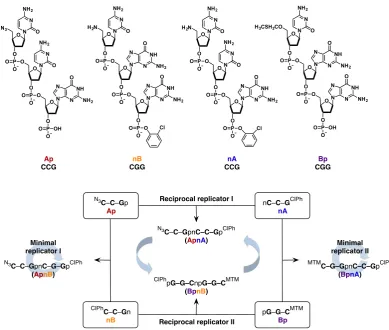
Building on the design of a single replicating system, the Kiedrowski
labora-tory has extended82,83 their oligonucleotide-based replicator into a multicyclic system
(Figure 1.10), capable of both autocatalysis and crosscatalysis. The new network was
composed of four DNA-based trinucleotides:Ap(CCG),nB(CGG),nA(CCG) and
phosphate group (denoted by p) at the 3’ end, while the 5’ prime end of these two components was protected in order to prevent any self-condensation reactions from
occurring. TrinucleotidesnBandnAincorporated a free nucleophilic amine (marked
asn) at the 5’ end. As forApandBp, their 3’ phosphate group was protected, in order
to prevent any unwanted ligation reactions.
ON N O NH2 N3 O P O O
O ON N O NH2 O P O O
O ON
O P O OH O N N NH NH2 O ON N O NH2 H2N
O P O O O ON O P O O O N N NH NH2 O ON O P O O O N N NH NH2 O Cl ON N O NH2 H2N
O P O O
O ON N O NH2 O P O O
O ON
O P O O O N N NH NH2 O ON N O NH2 H3CSH2CO
O P O O O ON O P O OH O N N NH NH2 O ON O P O O O N N NH NH2 O Cl Ap CCG nB CGG nA CCG Bp CGG
N3C–C–Gp Ap
nC–C–GClPh
nA
ClPh
C–C–Gn
nB
pG–G–CMTM
Bp
Reciprocal replicator I
Reciprocal replicator II Minimal
replicator I
Minimal replicator II N3C–C–GpnC–G–GpClPh
(ApnB)
MTM
C–G–GpnC–C–GpClPh
(BpnA)
N3C–C–GpnC–C–GpClPh
(ApnA)
ClPhpG–G–CnpG–G–CMTM
[image:38.595.106.496.183.513.2](BpnB)
Figure 1.10 Multicyclic replicating network composed of four trinucleotides:Ap(CCG),nB(CGG),
nA(CCG) andBp(CGG). The components can react to form two self-replicating tem-plates (ApnBandBpnA) and two reciprocally replicating templates (ApnAandBpnB). The lettersnandpcorrespond to the presence of a free amine group at the 5’ end and phosphate group at the 3’ end, respectively. Figure adapted from Ref. 84.
When reacted together, these four trinucleotide building blocks can form four
tem-plates. Condensation ofApandnBresults in the formation of a self-complementary
au-tocatalytic templateApnB(CCGCGG). Similarly, reaction ofnAwithBpyields a
self-replicating templateBpnAwith sequenceCGGCCG. The hexanucleotide templates,
produced by the reaction ofAp withnA(CCGCCG) and BpwithnB (GGCGGC)
result of these similarities, the four template products were nearly evenly distributed in the uninstructed experiment. Addition of preformed reciprocal template resulted in an increase in the concentration of the complementary strand. When the replicating network was instructed with template of either of the two self-replicating sequences, up-regulation (increase in the concentration) of both self-replicating pathways was observed. Interestingly, the second self-replicator was present at an increased concen-tration as well. The fact that instructing the system with one self-replicating template resulted in increased formation of the second self-replicators is a system-level property, stemming from the fast consumption of the components necessary for the reciprocal cycles to operate efficiently.
In 2002, Paul and Joyce reported85the first example of an RNA-based self-replicating
system, exploiting86 an R3C RNA ligase ribozyme. The study employed an adapted
version of an R3C ligase ribozyme, capable of catalysing the formation of a 3’,5’-phosphodiester bond between two individual RNA molecules. The RNA ribozyme
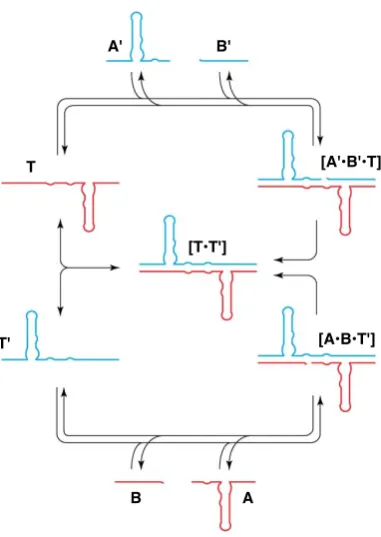
tem-plateTwas designed to be capable of ligating two RNA subunitsAandB(Figure 1.11)
viaa ternary complex, producing an exact copy of itself. The reaction was mediated by
a nucleophilic attack of the 3’-hydroxy group ofAon thea-phosphate of the 5’-pppG
of the subunitB, affording a template duplex [T·T], with a two-fold centre of symmetry.
A B
[A•B•T]
[T•T]
A B
(a)
T
(b)
2 T
Figure 1.11 (a)Self-replication of an RNA ribozyme follows the minimal replication-model of self-replication. TemplateTcan assemble withAandBinto a ternary complex, facilitating the formation of new template.(b)Structural details of the self-replicating ligase ribozyme, with two-fold symmetry in the middle. Figure taken from Ref. 85. Copyright 2002 National Academy of Sciences, USA.
When the formation of the RNA ribozyme was examined in the presence of pre-formed template, the system showed an increase in the initial rate of template formation,
with an autocatalytic orderp= 1. Kinetic fitting revealed that two processes contribute
to the formation of templateT: reaction of preformed complex [B·T] with componentA

![Figure 1.21A Diels-Alder reaction based replicator reported by Wang and Sutherland. Reactionbetween ene 4 and diene 5 produces template 6, capable of templating its own formationvia the ternary catalytic complex [4·5·6], mediated by hydrogen-bonding recogn](https://thumb-us.123doks.com/thumbv2/123dok_us/8677762.377854/54.595.206.402.386.486/replicator-sutherland-reactionbetween-produces-templating-formationvia-catalytic-hydrogen.webp)