3D Geometric Modelling of Discontinuous Fibre Composites Using a
Force Directed Algorithm
L.T. Harper*, C. C. Qian, R. Luchoo,N.A. Warrior
Division of Materials, Mechanics and Structures, Faculty of Engineering, University of Nottingham, NG7 2RD, United Kingdom
* Corresponding author ([email protected])
Abstract
A geometrical modelling scheme is presented to produce representative architectures for
discontinuous fibre composites, enabling downstream modelling of mechanical properties. The
model generates realistic random fibre architectures containing high filament count bundles
(>3k) and high (~50%) fibre volume fractions. Fibre bundles are modelled as thin shells using a
multi-dimension modelling strategy, in which fibre bundles are distributed and compacted to
simulate pressure being applied from a matched mould tool. FE simulations are performed to
benchmark the in-plane mechanical properties obtained from the numerical model against
experimental data, with a detailed study presented to evaluate the tensile properties at
various fibre volume fractions and specimen thicknesses. Tensile modulus predictions are in
close agreement (less than 5% error) with experimental data at volume fractions below 45%.
Ultimate tensile strength predictions are within 4.2% of the experimental data at volume
fractions between 40%-55%. This is a significant improvement over existing 2D modelling
approaches, as the current model offers increased levels of fidelity, capturing dominant failure
mechanisms and the influence of out-of-plane fibres.
1 Introduction
Discontinuous fibre composites (DFCs) offer great potential for high volume applications
(50,000ppa +) because of their short cycle times and low processing costs compared with
textile-based composites. Carbon fibre Sheet Moulding Compounds (SMCs) offer some of the
highest tensile properties for DFCs commercially available, with stiffness and ultimate strength
values reported to be up to 45GPa and 300MPa respectively [1-3]. The filaments in carbon
fibre SMCs are typically arranged randomly in bundle form (typically 24,000 filaments per
bundle), limiting the global fibre volume fractions to around 55%. The initial fibre charge
covers a large area of the mould tool (up to 90%), so material flow under pressure is minimal,
which ensures that the fibres remain in bundle form whilst facilitating long fibre lengths (up to
50mm). DFCs are versatile and their mechanical properties span a wide range [4-6], but it is
difficult to control the high levels of material variability compared with continuous fibre
composites. Due to this, a large number of test specimens is required to achieve suitable
confidence in experimental data [7, 8]. This is both time consuming and costly, particularly as
mechanical properties can also be influenced by size and scale [9-14] due to the random
heterogeneous nature of the material. This prevents the standard “building block approach”
[15] from being used, where coupon testing provides data for design, which is then validated
3 Finite Element Analysis (FEA) can be used to predict the mechanical properties of DFCs [16-18]
and to understand the source of variability, but accuracy is limited due to the quality of the
fibre architectures generated for the meso-scale Representative Volume Element (RVE) [19].
Existing numerical models for generating RVEs can be classified into three main groups [20];
soft, hard and sedimentation models and each has its limitations. Soft models allow
overlapping fibre bundles and are therefore unrealistic, as no restriction on fibre volume
fraction is imposed. Allowing bundle-bundle penetration also creates incorrect load transfer
paths at bundle cross-overs. Hard models prevent bundle-bundle penetration, but fibre
volume fractions are limited due to fibre jamming, which is commonly experienced when the
pockets of free space are too small to accept additional inclusions. Sedimentation algorithms
are hard systems with restrictions on the orientation distribution [21]. Although the restriction
on the ceiling volume fraction is reduced, sedimentation algorithms are computationally
expensive [20] and creating meshes for hard or sedimentation models can be problematic, due
to the small separation distances between bundles.
RVE size is linked to the fibre length and tow size [7] and can be several orders of magnitude
larger than the scale of the reinforcement. Computation time is therefore one of the primary
concerns associated with meso-scale FEA models for DFC materials. 2D models are the most
computationally inexpensive option, using 1D linear beam elements to represent fibre bundles
randomly distributed in 2D space [7, 22-26]. However, this approach overlooks fibre crimping
4 reducing accuracy. 2D models also tend to be over-stiff, as intersecting bundles are rigidly
bonded at the intersection point [25], which increases as the RVE thickness increases.
Three dimensional hard models have previously been developed [27, 28] using continuum
elements to represent the fibre bundles. Bundles were assumed to be straight with circular
cross section, limiting the maximum achievable volume fraction to ~13.5%. Further
developments [29] enabled fibre curvature and elliptical cross sections, increasing the volume
fraction of the cell to 35%. Pan et al. [29] used Halpin-Tsai predictions to benchmark the FEA
stiffness results, indicating relative errors of 5.8% and 12% for the tensile and shear moduli
respectively. Ignoring fibre curvature can artificially increase the predicted UTS values by up to
18% [30, 31].
A pre-processing scheme is presented in this paper to produce highly representative DFC
architectures. These architectures can be used to create finite element meshes for
determining mechanical properties at the mesoscale, providing an alternative to expensive
experimental testing for producing coupon data. The model aims to characterise random fibre
materials containing large filament count bundles (>3K) and high fibre volume fractions
(~50%). Fibre bundles are modelled as shells using a so-called mixed-dimensional modelling
strategy [32], which enables the bundles to be redistributed and compressed to simulate
pressure being applied from a matched mould tool. A force-directed algorithm is adopted to
simulate the through-thickness compliance of the fibre bundles, in order to achieve realistic
5 of bundle-bundle intersections and convergence times. FE simulations are performed to
predict the tensile properties for the fibre architectures produced by the numerical model,
which are validated against experimental data.
2 Geometric modelling scheme
The geometric modelling scheme consists of three parts: A deposition algorithm to determine
initial bundle locations and orientations; an intersection-elevation algorithm to detect and
avoid bundle-bundle intersections, and a spline interpolation algorithm to produce smooth
curved fibre bundles. This approach provides intimately packed fibre bundles and increases the
fibre volume fraction limits associated with existing models. A flowchart of the geometric
modelling scheme is presented in Figure 1, which is explained in more detail in the following
sections.
2.1 Deposition algorithm
The bundle deposition algorithm is based on the 2D algorithm developed in [25]. Rectangular
fibre bundles of user-specified length and tow size are generated, where bundle widths for
each tow size (K) have been derived experimentally [15] (see Table 1). Random numbers are
generated within specified bounds (the defined RVE) for the x, y and z coordinates of the
geometric centre of each fibre bundle. A fourth random number is generated for the in-plane
fibre orientation about the same centre. Each bundle is deposited sequentially within the RVE
6 boundary. This method ensures that edge effects are not introduced within the RVE, ensuring
the region of interest will exhibit representative material properties. A hard-walled boundary
approach has not been used as this can result in preferential fibre alignment along the cell
walls [35], as the experimental coupons used for validation have been cut from a larger plaque
rather than moulded net-shape. Fibre bundles are continuously deposited over the region of
interest until the target fibre volume fraction has been achieved.
2.2 Intersection-elevation algorithm
The intersection-elevation algorithm uses a force-directed approach to prevent bundle
intersections. It should be noted that this does not represent the true interaction mechanisms
between the fibre bundles, it merely aims to minimise/eliminate fibre-fibre intersections by
introducing fibre curvature and crimp. Fibre deformation mechanism such as tow
fragmentation and spreading, which commonly occur in compression moulding processes, are
not considered in this paper.
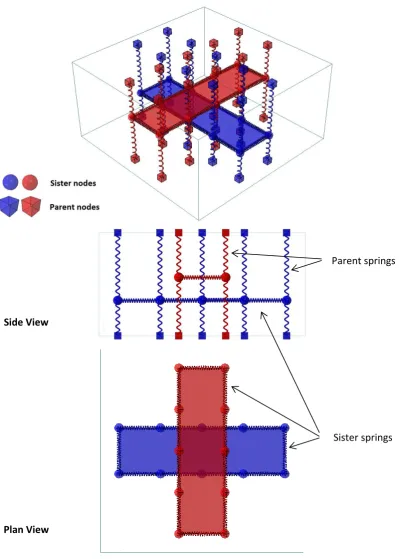
An initial nodal network [36] is created (shown in Figure 2) and an attraction-repulsion
mechanism is used to define the spatial distribution [20, 37], in order to separate neighbouring
fibre bundles. Each node is charged with charge Q, repelling any neighbouring nodes in close
7
FREPULSION = kREPULSIONQ2/r2 Equation 1
where kREPULSION is the Coulomb force constant, and r is the separation distance between two
nodes.
The distribution of nodes is controlled by connecting springs, causing attraction forces under
Hooke’s law. For springs with axial stiffness, kAX
where δL is the change in natural spring length. For springs with rotational (torsion) stiffness,
kRT
where Θ is the twisting angle of the spring in radians and π is the natural spring angle.
Two types of node exist; parent nodes and sister nodes. Sister nodes are distributed uniformly
around the perimeter of each bundle, shown as spheres in Figure 2. Neighbouring sister nodes
belonging to the same bundle are connected by sister springs with axial stiffness kSISTER-AX and
rotational stiffness kSISTER-RT. The axial stiffness provides a force to maintain the original bundle
dimensions, and the rotational stiffness controls the fibre curvature and crimp. This is
appropriate for DFCs that experience very little in-mould fibre flow, such as those created by
the directed fibre preforming process [38].
FATTRACTION = −kAXδL Equation 2
8 Each sister node is connected to a pair of parent nodes by parent springs (with axial stiffness
kPARENT-AX and rotational stiffness kPARENT-RT), in order to control the Z movement of each bundle.
Parent nodes are located on the top and bottom surfaces of the RVE and are shown as cubes in
Figure 2. The natural length of the parent springs has been chosen to be equal to the thickness
of an impregnated bundle to prevent unrealistic distances between neighbouring fibres and
cell surfaces. The thickness of the bundle is dependent on the filament count, as presented in
Table 1. Consequently, the RVE shown in Figure 2 is not in equilibrium.
As the number of bundles deposited within the RVE increases, the likelihood of a
bundle-bundle intersection increases. Intersections are handled by adjusting the nodal network
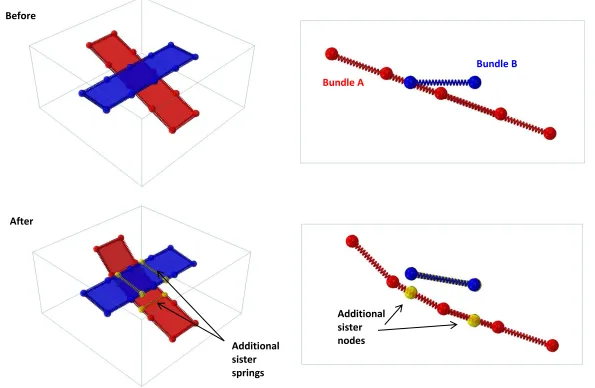
around the intersection point and two scenarios are considered in this work: edge-edge
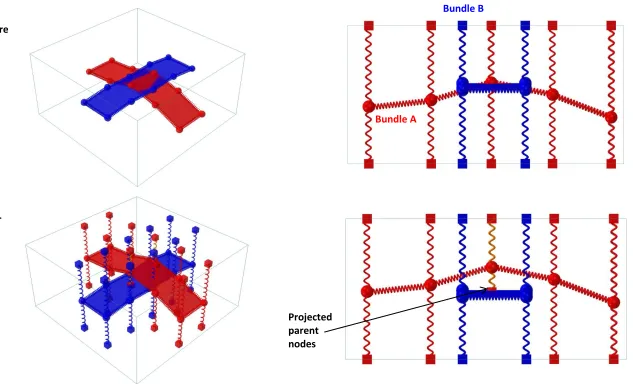
intersection (Figure 3) and edge-surface intersection (Figure 4). Edge-edge intersection can be
detected when the edge of Bundle A penetrates through the edge of Bundle B (Figure 3) and
can happen either at the beginning of fibre deposition process, when fibre bundles are initially
planar, or after the intersection-elevation algorithm has been evoked for neighbouring
bundles. Here an additional pair of sister nodes is created on each bundle, one at the
intersection location and the other on the opposite edge. Each pair of additional sister nodes is
connected to new sister springs with axial stiffness to prevent lateral spreading of the bundle.
Additional nodes on Bundle A and Bundle B are then moved apart under the repulsion force
9 Edge-surface intersection can be detected when the edge of fibre Bundle A penetrates through
the surface of fibre Bundle B without touching the edge of Bundle B (Figure 4). Edge-surface
intersections can only occur after the intersection-elevation algorithm has been evoked, when
fibre bundles are non-planar. Edge-surface intersections are eliminated by projecting some of
the parent nodes from Bundle A onto the surface of Bundle B, as shown in Figure 4.
Consequently, the upward forces in the parent springs above Bundle A exceed the downward
forces in the parent springs below Bundle A, resulting in Bundle A moving away from Bundle B.
During interaction-elevation operation, the net force exerted on each node is calculated using
Equations 1 to 3. The magnitude of the net force is multiplied by a dimensionless damping
factor c (0 < c < 1), in order to control the stability of the intersection-elevation process. A
sensitivity analysis has been performed to determine a value for c and results indicate that the
minimum acceptable value is 3x10⁻⁶.
2.3 Spline interpolation algorithm
Small adjustments to the sister nodes are performed to smooth fibre undulations and to
provide realistic crimp angles. This is achieved by interpolating a Catmull-Rom spline through
all sister nodes on the fibre boundary, where spline quality is controlled by the distance
between nodes. This type of polynomial spline provides a continuously varying tangent (no
discontinuities) along the tow path and is computationally inexpensive to define and
implement. Additional dummy sister nodes are added at each bundle end to provide the
10 cropped at the RVE boundary [39]. The implementation of the spline interpolation algorithm is
discussed in detail in [31]. It should be noted that spline interpolation can introduce further
edge-edge and edge-surface intersections, which increase in numbers as the curvature of the
edge increases. The resulting nodal network does not always violate the intersection-elevation
criteria and consequently these defects only become apparent after meshing. Small
intersections can therefore appear after spline interpolation, particularly for higher volume
fraction RVEs where fibre curvatures are generally greater. Intersections resulting from spline
interpolation do not prevent the part from being meshed or simulations being performed for
FE mechanical property prediction.
2.4 Stopping criteria
An iterative approach is adopted in this model to optimise fibre bundle distribution. The net
force (after damping) applied on each node is recalculated in each iteration and nodes are
displaced. The damping factor c is gradually increased from the minimum value (3x10⁻⁶) during
the iterative process and the increment is determined by a convergence check performed
every 100 iterations. The convergence check evaluates the total number of bundle-bundle
intersections (summation of edge-edge intersections and edge-surface intersections) and the
total strain energy of the spring system. If either the total number of bundle-bundle
intersections or the total energy has been reduced, no increment in c is applied. Alternatively,
c is increased by 20% if neither has reduced and the total number of intersections is non-zero,
11 A sensitivity study has been performed to determine the optimum spring and node-charge
constants. The quality of the chosen parameters is assessed by the percentage number of
bundle-bundle intersections once the system energy has converged, where the percentage is
calculated as the ratio of the number of intersecting points to the total number of nodes
within the fibre network. RVE architectures for a 50% Vf with 36mm long, 12K fibre bundles
have been adopted for the sensitivity analysis and the optimum spring and node-charge
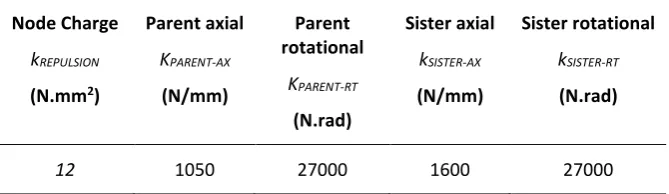
constants are listed in Table 2.
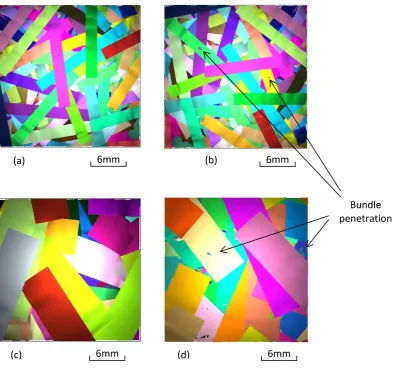
A variety of architectures with different bundle sizes have been generated using the variables
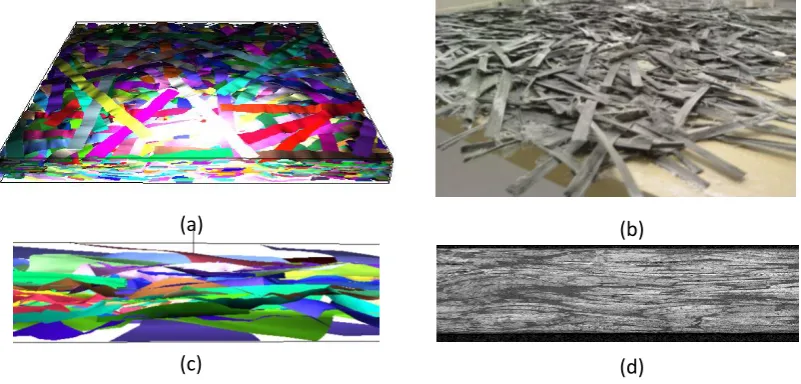
in Table 2 and are presented in Figure 5. Realistic RVE architectures are created, which are
physically similar to real fibre architectures (Figure 6) produced using a laboratory scale DFC
installation [40]. Bundles are evenly distributed through the thickness of the RVE, with
experimentally realistic fibre crimp. Results suggest that the model can reliably generate
intersection-free fibre architectures for small bundle sizes (3K) at fibre volume fractions of
~50%, and for large bundle sizes (12K) at fibre volume fractions of ~40%. For fibre content
higher than these limits, excessive fibre distortion and/or bundle to bundle penetration has
been seen to occur. Examples of bundle penetration are shown in Figure 5b and Figure 5d for
unrealistic fibre architectures of 60% fibre volume fraction. It should be noted however, that
the program will continue running with the presence of these bundle to bundle penetrations.
Figure 7 shows the CPU time and required number of iterations for convergence for a
12 (using an Intel Core i3 processor with 8GB of RAM). Convergence times were over 4 hours for a
typical realisation with a 60% Vf,38×38×3mm RVE. This value increases dramatically (over 24
hours) for larger RVEs (140×140×3mm). The required number of iterations for convergence is
shown to be directly proportional to the number of charged nodes in the RVE nodal network. A
quadratic relationship is observed between solution times and number of nodes.
3 FEA modelling for mechanical properties prediction
3.1 Mesh generation
Each fibre bundle is meshed independently with a custom Delaunay algorithm, to
accommodate the irregular polygon surfaces resulting from the cropping algorithm. Firstly, the
RVE cell boundary is offset internally by a distance that is equivalent to 10% of the seed size
used to mesh the fibre bundles. Mesh seeds falling between the two cell boundaries are
removed. Secondly, a minimum facet angle of 5° is specified. An additional seed is placed at
the element’s circumcentre if the facet angle is less than the threshold value [41] and the fibre
is re-meshed. Figure 8 shows an example of a meshed model. The seed size for the fibre
elements was approximately 10% of the measured bundle width and quadratic ABAQUS
STRI65 triangular shell elements were chosen to avoid potential hour-glassing effects.
The matrix material is modelled using a regular array of linear 8-noded brick elements
(ABAQUS type C3D8). Shell elements representing the fibre bundles are tied to the continuum
13 of the embedded shell element nodes (fibre) are determined by the translational
displacements of the host continuum element nodes (matrix). Using embedded elements
eliminates the need for a complex meshing algorithm to pair coincident nodes on the
fibres/resin interface. The benefit of this approach has been demonstrated in previous work
[25] using beam elements to represent fibre bundles and 2D continuum elements to represent
matrix. The local stress distribution was shown to be the same as using tie constraints to join
the two unstructured meshes at the fibre/resin interface. However, it should be noted that
using the embedded element technique may compromise the accuracy of the model in terms
of failure prediction, as the fibre-matrix interfacial properties cannot be considered, as
debonding is prohibited.
A simple RVE containing two fibre bundles, subjected to tensile loading conditions, has been
created (Figure 9) to demonstrate the suitability of the proposed embedded element approach
for the 3D architectures studied here. Two fibre bundles are orientated at 0˚ and 45˚ to the
loading direction and the principal stress (S11) and interfacial shear stress (S12) distributions
are plotted along the centreline and the fibre/matrix interface respectively for each fibre.
According to Figure 9, the principal stress in the 0˚ fibre is higher at the fibre mid-length and
lower at fibre ends, and follows the characteristic shape as predicted by shear-lag theory [42].
This is further supported by the interfacial shear stress curve for the same fibre, which changes
14 end. Similar curves are presented for the 45˚ fibre, but the stresses are lower due to the
off-axis fibre orientation.
The *EMBEDDED ELEMENT technique does not discount the volume of the matrix where fibre
elements are embedded, which artificially increases the effective fibre properties. Modified
shear (G*F) and axial (E*F) moduli derived from Equation 4 are therefore used to compensate
for this stiffening effect.
G*F = GF – GM , E*F = EF - EM Equation 4
where GF and GM are the original shear moduli of the fibre and matrix respectively, andEF and
EM are the corresponding Young’s moduli.
The seed size for the thickness of the matrix elements (z axis) was selected to be the same
magnitude as the bundle thickness to ensure an appropriate host volume was captured for
each embedded fibre element. The seed size for the fibre elements was approximately 12% of
the measured dry bundle width. Identical values were chosen for the x-y plane of the matrix to
maintain a 1:1 fibre to matrix ratio [25]. Following [8], a constant bundle Vf of 60% was used
for the present work. A summary of the seed values used is outlined in Table 1.
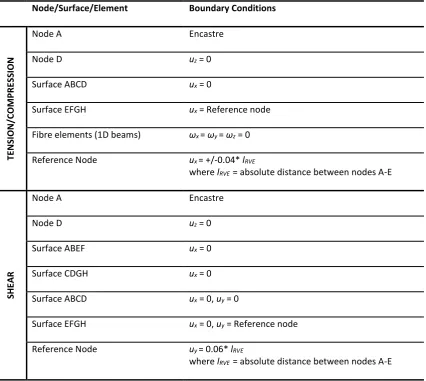
Boundary conditions outlined in Table 4 have been applied to facilitate different loading
conditions. Displacement controlled macroscopic loads are applied via the kinematically
coupled reference node, ensuring the loaded surface follows the exact prescribed motion of
15 a common approach amongst many authors [43-45]. Reference node reaction forces are
evaluated at each time step by dividing the force over the loaded surface area to obtain the
component stress. All rotational DOF (about the X, Y and Z axes) for the fibres are restricted
[46], since only translational DOF of the embedded (fibre) element are constrained within the
host (matrix) element (using *EMBEDDED ELEMENT). This prevents numerical singularities
from occurring due to “ball-joint” effects.
3.2 Constituent material properties
Experimental data from [2] is used to provide input parameters for the FEA modelling in this
paper. However, additional material properties are required due to the additional degrees of
freedom used in this mixed-dimensional model, such as fibre bundle shear and transverse
properties. Experimentally derived data for UD laminates has been collated from
manufacturers’ datasheets [47, 48] and experimental studies [2], as summarised in Table 3.
These parameters are implemented using a user-defined material model (UMAT) in
ABAQUS/Standard, based on a model previously developed by the authors in [2]. Failure
criteria have also been incorporated into the UMAT to simulate progressive damage and
enable ultimate strength predictions, using a continuum damage mechanics approach. If the
stress state in the element exceeds the corresponding failure criterion then appropriate
components within the stiffness matrix are degraded.
A simple Maximum Stress Criterion has been employed to identify fibre damage, where stress
16 components in the stiffness matrix are reduced to 1% of their original value if the failure
criterion is violated. An interactive failure model (von Mises Stress Criterion) has been
employed for the resin, which uses a single criterion to evaluate different modes of failure.
This enables the introduction of non-linear, progressive damage into the matrix phase. There
are three possible scenarios: undamaged, damaged (post elastic limit) and failed. The von
Mises stress from each load increment is compared with the failure criterion to check for
damage in tension, compression or shear. If no damage is present, the stiffness matrix is
calculated using the initial elastic constants. However, if the elastic limit of the matrix is
exceeded, the onset of damage occurs. Fracture or final failure is governed by a Maximum
Strain Criterion. Final failure occurs if the maximum strain is exceeded and the stiffness matrix
is reduced by the maximum degradation factor. For this case, the Young’s modulus is degraded
to 1% (dE = 0.01) of the initial value and the shear modulus to 20% (dG = 0.2) to account for
frictional effects at the fracture interface [49]. If the onset of damage is detected, but final
failure is not met, degradation factors are calculated to reduce the terms in the stiffness
matrix. This case occurs when the yield strength (defined in this case as the onset of
non-linearity on the stress/strain curve) has been exceeded, but the maximum ultimate strain
criterion has not. The stiffness degradation (D) is governed by a damage parameter d, and a
shape parameter n:
𝐷 = 1 −( 𝜎𝑀𝑖𝑠𝑒𝑠 𝜎𝑚𝑎𝑡𝑟𝑖𝑥− 1)
𝑛
17 where σMises denotes the von-Mises damage criterion and σmatrix denotes the current von-Mises
stress in the current time step. Previously performed regression analysis suggests that d is 10
and n is 1 for the current matrix system [2]. D is limited to a lower bound value of 1% for the
direct stiffness components (dE) and 20% for the shear components (dG) to account for
frictional effects at the fracture interface [49]:
𝑑𝐸 = max(𝐷, 0.01)
𝑑𝐺 = max(𝐷, 0.2)
Equation 6
The stiffness matrix at the relevant integration point is then recalculated for the isotropic
matrix material as follows:
1 11
0
0
0
1
0
1
G
d
E
d
E
d
E
d
E
d
S
C
G E E E E
Equation 718 4 Mechanical property determination
4.1 Damage initiation and progression
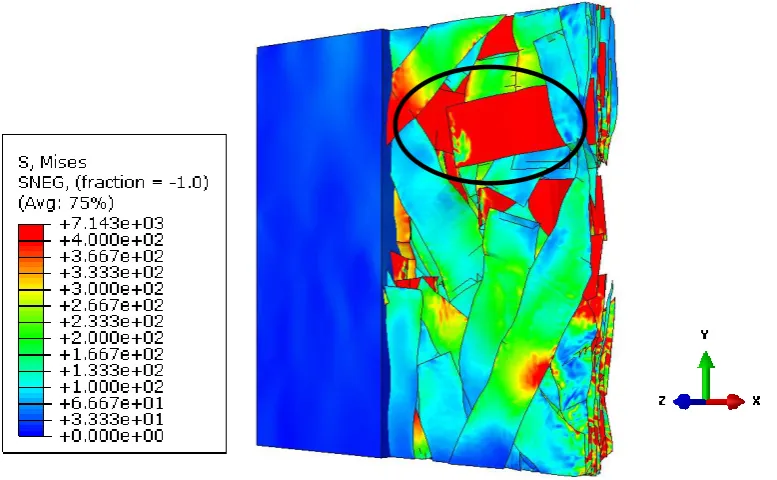
A von Mises stress contour plot is presented in Figure 10, for a 10% Vf RVE at a global applied
tensile strain of 0.8%. As expected, bundles aligned parallel to the loading axis (x direction)
exhibit the highest stress, since these fibres transfer a higher proportion of the tensile load.
The tensile stress is lower at the bundle ends compared with the mid-length, which is
consistent with shear lag theory [50] and the results presented in Figure 9.
Figure 11 presents damage parameter plots for an example tensile coupon of 12K, 36mm long
bundles at 10% Vf. The RVE dimensions were 38x38x3mm, which was subjected to a tensile
load in the x-direction. Each damage mode is recorded using a separate state variable (STATEV)
in ABAQUS/Standard, enabling the mode of failure to be investigated in more detail. Figure
11a shows the entire damage plot (0.8% applied strain) prior to final failure. It indicates that
large areas of matrix elements have become damaged (green regions) prior to final coupon
failure, which corresponds with audible cracking witnessed during experimental testing.
Failure is therefore progressive and is dominated by transverse bundle failure (see Figure 11b),
as previously reported in [51]. Additional bundles fail in shear as the applied strain develops, as
shown in Figure 11c. Transverse bundle failure is a common failure mode for DFCs under
tensile loading due to the significantly weaker transverse properties (70MPa) compared with
19 longitudinal bundle axis. This is an important failure mode captured by the current model,
which is overlooked when representing the bundles as 1D beam elements [7, 22-26].
Tensile stress/strain curves from the FEA simulations are compared against experimental
data[2] in Figure 12 for two fibre volume fractions. The curves closely match in terms of initial
stiffness, onset of non-linearity, ultimate strength and ultimate strain. Simulated strain to
failure values are within 15% of the experimental samples at volume fractions of 30% (~13%)
and 50% (~15%). This is considered to be a good level of agreement, considering the same
level of experimental error is reported for DFC materials in [52, 53]. These results demonstrate
the importance of characterising the non-linearity of the matrix material and support the
damage evolution described above.
Compressive and shear stress/strain curves from the FEA simulations are compared against
experimental data [54] in Figure 13. There is good agreement between the simulations and
experimental results in terms of the elastic stiffnesses. There is approximately a 2.5% error
between the experimental data and the simulation data for the compressive stiffness and 7%
for the shear stiffness. For the ultimate compressive strength, the predicted values are within
20% of the experimental results, where the largest contributing factor is the lack of fibre
buckling in the proposed implicit FE model, which is a common failure mode observed in the
experimental specimens. For the ultimate shear strength, the error between the numerical and
experimental values increases to ~40%, which is due to the simplified interfacial region,
20 4.2 Comparison with 2D approach
FEA tensile moduli and strengths predicted using the current 3D model are directly compared
in this section against experimental data [2] and the 2D model presented in [25]. Five repeat
simulations have been performed for each scenario and the results are presented in Figure 14.
RVEs featuring 36mm long, 12K fibres were generated for a range of volume fractions. All
three data sets in Figure 14 confirm that there is a linear relationship between the volume
fraction and the tensile modulus. It should also be noted that although tensile moduli are
presented for volume fractions of up to 60% in Figure 14, the practical upper limit for random
DFC is 50%-55% [2]. Higher volume fractions result in poor fibre impregnation, hence large
reduction in material properties, which is indicated by the experimental data point at 57% Vf in
Figure 14. According to Figure 14, tensile modulus predictions using the 2D and 3D models
yield similar results, with less than 5% error for all volume fractions considered. Both models
show good agreement with the experimental data at volume fractions between 40%-45%
(within 5% for the 3D shell model and within 3% for the 2D beam model), but errors increase
for both models (up to 30%) for volume fractions greater than 50%. A possible cause for this
increase in error is the oversight of tow fragmentation in the current model, which has been
reported to increase the tensile modulus by up to 13% compared to unfilamentised bundled
materials [55], as it improves the homogeneity.
UTS predictions are compared and benchmarked against experimental data in Figure 15. The
21 values predicted by the 2D model are closer to the experimental data at a volume fraction of
35%, but the 3D model provides closer agreement at higher volume fractions (up to 4.2% for
the 3D model and up to 18% for the 2D model over 40% Vf). At lower volume fractions (<30%),
UTS values predicted by the 2D model are generally lower than those predicted by the 3D
model, possibly because of the poor representation of the fibre areal coverage resulting from
using 1D beams to represent the ribbon-like fibre bundles. At higher volume fractions (>30%),
2D models tend to over-predict the UTS because some of the important failure mechanisms
such as transverse bundle failure and in-plane bundle shear cannot be captured using these
models. Additionally, the 3D model takes into account the effect of out-of-plane fibre
curvature, which significantly affects the load carrying capability of the fibres. This becomes
more significant as the fibre volume fraction increases and the fibres bend/distort to pack into
the available cavity volume.
It should be noted that in Figure 14 and Figure 15, the main sources of variability for the
experimental data can be attributed to variations in fibre architecture (local volume fraction
and fibre orientation), variations in constituent material properties and defects from
manufacturing (such as voids and dry-spots). Whereas, the numerical predictions currently
only account for variations in the fibre architecture, and the pre-processor always ensures the
target volume fraction is reached. Therefore, error bars for the predicted tensile modulus and
22 4.3 Effects of RVE thickness
A range of RVEs of varying thickness (1.5mm, 3mm, 4.5mm and 6mm) have been generated in
order to demonstrate the thickness size effect present in DFCs. All fibre architectures consisted
of 12K, 36mm long fibres. According to Figure 16, the tensile modulus follows a bi-linear
relationship with increasing RVE thickness. A critical thickness occurs at 3mm for the geometry
investigated, after which the modulus reaches a maximum. This bi-linear relationship was also
observed in [14], for DFC samples consisting of a different fibre architecture (6K, 57.5mm long
bundles at 30% Vf).
The predicted UTS for the 12K, 36mm DFC architecture appears to increase linearly from
1.5mm to 6mm, while the experimental UTS shows a bi-linear relationship. Comparisons
between the curves suggest that the UTS is more sensitive to size effects (increasing coupon
thickness) than the tensile modulus. Whilst the tensile modulus is a volume averaged material
property, the UTS is more susceptible to defects and irregularities in the heterogeneous fibre
architecture. As the RVE thickness decreases, it becomes increasingly difficult to achieve
homogeneous fibre coverage and local areal mass variations become more significant.
5 Conclusions
A numerical model has been developed to characterise a number of meso-scale, discontinuous
fibre architectures. Three numerical algorithms were integrated to produce a network of
23 simulated to produce realistic levels of fibre tortuosity observed in moulded samples. The
model has been demonstrated to produce RVEs with higher fibre volume fractions (~50%)
compared with conventional hard-core models presented in the literature.
A custom Delaunay meshing algorithm has been adopted to mesh the RVE fibre architecture
for FEA. The model has been adopted in this paper to predict the tensile, compressive and
in-plane shear properties of DFCs, using a UMAT subroutine to simulate progressive damage of
the constituent materials. For tensile samples, in-plane bundle shear and transverse tensile
bundle failure were the critical failure modes, which were in agreement with experimental
observations. Tensile modulus predictions were in close agreement with experimental data
(less than 5% error) at volume fractions between 40%-45%, but the error increased to ~30% at
volume fractions approaching 55%. Ultimate tensile strength predictions were within ~4.2% of
the experimental data at volume fractions between 40%-55%. Whilst the error in the tensile
modulus prediction increases marginally (from 3% to 5%) using the 3D model over the existing
2D beam model, the error in the UTS predictions is significantly reduced (from 18% to 4.2%).
This highlights the importance of capturing the dominant failure mechanisms and the influence
of out-of-plane fibres using the 3D model. Larger errors were reported for the ultimate
compressive strength (20%) and shear strength (40%) predictions, as some of the dominant
24 6 Acknowledgements
This work formed part of the Towards Affordable, Closed-Loop Recyclable Future Low Carbon
Vehicle Structures (TARF-LCV) project, funded by the UK Engineering and Physical Sciences
Research Council, EPSRC (reference EP/I038616/1). The authors would also like to thank
Bentley Motors Limited for their continued financial and technical support.
7 References
1. Feraboli, P., T. Cleveland, P. Stickler, and J. Halpin, Stochastic laminate analogy for
simulating the variability in modulus of discontinuous composite materials. Composites
Part A: Applied Science and Manufacturing, 2010. 41(4): p. 557-570.
2. Luchoo, R., L.T. Harper, M.D. Bond, N.A. Warrior, and A. Dodworth, Net-shape spray
deposition for compression moulding of discontinuous fibre composites for high performance applications Plastics, Rubber and Composites: Macromolecular
Engineering, 2009. 39(3-5): p. 216-231.
3. Aubry, J., HexMC — bridging the gap between prepreg and SMC. Reinforced Plastics, 2001. 45(6): p. 38-40.
4. Blumentrit, B.F., B.T. Vu, and S.L. Cooper, The mechanical properties of oriented
discontinuous fiber-reinforced thermoplastics. 1. Unidirectional fiber orientation.
Polymer Engineering and Science, 1974. 14: p. 633-640.
5. Feraboli, P., E. Peitso, F. Deleo, T. Cleveland, and P.B. Stickler, Characterization of
Prepreg-Based Discontinuous Carbon Fiber/Epoxy Systems. Composite Materials
Technology, 2008: p. 289-299.
6. Maalej, M., Tensile properties of short fiber composites with fiber strength distribution. Journal of Materials Science, 2001. 36: p. 2203-2212.
7. Harper, L.T., C. Qian, T.A. Turner, S. Li, and N.A. Warrior, Representative volume
elements for discontinuous carbon fibre composites – Part 2: Determining the critical size. Composites Science and Technology, 2012. 72(2): p. 204-210.
8. Harper, L.T., T.A. Turner, N.A. Warrior, and C.D. Rudd, Characterisation of random
carbon fibre composites from a directed fibre preforming process: Effect of fibre length.
Composites Part A: Applied Science and Manufacturing, 2006. 37(11): p. 1863-1878. 9. Wisnom, M.R., Size effects in the testing of fibre-composite materials. Composites
25 10. Sutherland, L.S., R.A. Shenoi, and S.M. Lewis, Size and scale effects in composites: I.
Literature review. Composites Science and Technology, 1999. 59(2): p. 209-220.
11. Gitman, I.M., H. Askes, and L.J. Sluys, Representative volume: Existence and size
determination. Engineering Fracture Mechanics, 2007. 74: p. 2518-2534.
12. Kanit, T., S. Forest, I. Galliet, V. Mounoury, and D. Jeulin, Determination of the size of the
representative volume element for random composites: statistical and numerical approach. International Journal of Solids and Structures, 2003. 40: p. 3647-3679.
13. Tuttle, M., T. Shifman, and B. Boursier, Simplifying certification of discontinuous
composite material forms for primary aircraft structures., in SAMPE Conference 2010:
Seattle.
14. Qian, C.C., L.T. Harper, T.A. Turner, and N.A. Warrior, Structural optimisation of random
discontinuous fibre composites: Part 1 – Methodology. Composites Part A: Applied
Science and Manufacturing, 2015. 68: p. 406-416.
15. Baker, A., S. Dutton, and K. Donald, Composite Materials for Aircraft Structures (2nd
Edition). 2004: American Institute of Aeronautics and Astronautics.
16. Pan, Y., Stiffness and progressive damage analysis on random chopped fiber composite
using FEM. 2010, The State University of New Jersey: New Brunswick.
17. Kari, S., Micromechanical Modelling and Numerical Homogenization of Fibre and Particle
Reinforced Composites, in Institute of Mechanics Department. 2005, Otto-von-Guericke
University Magdeburg: Magdeburg.
18. Faessel, M., C. Delisee, F. Bos, and P. Castera, 3D Modelling of random cellulosic fibrous
networks based on X-ray tomography and image analysis. Composites Science and
Technology, 2005. 65: p. 1931-1940.
19. Hill, R., Elastic properties of reinforced solids: some theoretical principles. Journal of the Mechanics and Physics of Solids, 1963. 11: p. 357.
20. Altendorf, H., 3D Morphological Analysis and Modeling of Random Fiber Networks, in
École doctorale nO432: Sciences des Métiers de l’Ingénieur. 2011, l’École Nationale
Supérieure des Mines de Paris: Paris.
21. Williams, S.R. and A.P. Philipse, Random packings of spheres and spherocylinders
simulated by mechanical contraction. Physical Review E, 2003. 67(5): p. 051301.
22. Elahi, M. and Y.J. Weitsman, On the mechanical response of chopped glass/urethane
resin composite: Data and model. 1999, Oak Ridge National Laboratory. p. 61.
23. Eason, T. and O. Ochoa, Modeling residual stresses and damage initiation in
discontinuous random fiber SRIM composites. Computer Aided Design in Composite
Material Technology, 1996. 5: p. 123-132.
24. Eason, T. and O. Ochoa, Material behaviour of Structural Reaction Injection Molded
composites under thermomechanical loading. Journal of Composite Materials, 2000.
34(5): p. 411-432.
25. Harper, L.T., C. Qian, T.A. Turner, S. Li, and N.A. Warrior, Representative volume
elements for discontinuous carbon fibre composites – Part 1: Boundary conditions.
26 26. Wu, X.-F. and Y.A. Dzenis, Elasticity of planar fiber networks. Journal of Applied Physics,
2005. 98.
27. Dirrenberger, J., S. Forest, and D. Jeulin, Towards gigantic RVE sizes for 3D stochastic
fibrous networks. International Journal of Solids and Structures, 2014. 51(2): p. 359-376.
28. Pan, Y., L. Iorga, and A.A. Pelegri, Analysis of 3D random chopped fiber reinforced
composites using FEM and random sequential adsorption. Computational Materials
Science, 2008. 43(3): p. 450-461.
29. Pan, Y., L. Iorga, and A.A. Pelegri, Numerical generation of a random chopped fiber
composite RVE and its elastic properties. Composites Science and Technology, 2008.
68(13): p. 2792-2798.
30. Velmurugan, R., G. Srinivasulu, and S. Jayasankar, Influence of fiber waviness on the
effective properties of discontinuous fiber reinforced composites. Computational
Materials Science, 2014. 91(0): p. 339-349.
31. Luchoo, R., L.T. Harper, N.A. Warrior, and A. Dodworth, Three-dimensional numerical
modelling of discontinuous fibre composite architectures. Plastics, Rubber and
Composites, 2011. 40(6/7): p. 356-362.
32. Cuilliere, J.C., S. Bournival, and V. Francois, A mesh-geometry-based solution to
mixed-dimensional coupling. Computer-Aided Design, 2010. 42: p. 509-522.
33. Liang, Y.-D. and B.A. Barsky, A New Concept and Method for Line Clipping. ACM Trans. Graph., 1984. 3(1): p. 1-22.
34. Liang, Y.-D., B.A. Barsky, and M. Slater, Some Improvements to a Parametric Line Clipping
Algorithm. 1992, EECS Department, University of California, Berkeley.
35. EVANS, K.E. and M.D. FERRAR, The packing of thick fibres. Journal of Physics D: Applied Physics, 1989. 22: p. 354-360.
36. Sherburn, M., Geometric and Mechanical Modelling of Textiles, in The School of
Mechanical, Materials and Manufacturing Engineering. 2007, The University of
Nottingham: Nottingham.
37. Birbil, S.I. and S.C. Fang, An Electromagnetism-like Mechanism for Global Optimization. Journal of Global Optimization, 2003. 25: p. 263-282.
38. Harper, L.T., T.A. Turner, N.A. Warrior, J.S. Dahl, and C.D. Rudd, Characterisation of
random carbon fibre composites from a directed fibre preforming process: Analysis of microstructural parameters. Composites Part A: Applied Science and Manufacturing,
2006. 37(11): p. 2136-2147.
39. Catmull, E. and R. Rom, A Class of Local Interpolating Splines, in Computer Aided
Geomtric Design. 1974, Academic Press, Inc.: Salt Lake City.
40. Luchoo, R., L.T. Harper, M.D. Bond, N.A. Warrior, and A. Dodworth, Net shape spray
deposition for compression moulding of discontinuous fibre composites for high performance applications Plastics, Rubber and Composites, 2010. 39: p. 216-231.
41. Hine, P.J., H.R. Lusti, and A.A. Gusev, Numerical simulation of the effects of volume
27
properties of short fibre composites. Composites Science and Technology, 2002. 62: p.
1445-1453.
42. COX, H.L., The elasticity and strength of paper and other fibrous materials. British Journal of Applied Physics, 1952. 3: p. 72-79.
43. HBAIEB, K., Q.X. WANG, Y.H.J. CHIA, and B. COTTERELL, Modelling Siffness of
Polymer/Clay Nanocomposites. Polymer 2007. 48: p. 901-909.
44. DUSCHLBAUER, D., H.J. BÖHM, and H.E. PETTERMANN, Computational Simulation of
Composites Reinforced by Planar Random Fibers: Homogenization and Localization by Unit Cell and Mean Field Approaches. Journal of Composite Materials, 2006. 40.
45. POTLURI, P. and T.V. SAGAR, Compaction modelling of textile preforms for composite
structures. Composite Structures, 2008. 86(177-185): p. 177.
46. Abaqus 6.8-3 Documentation - Abaqus Analysis User's Manual. 2008, Dessault Systéms.
47. SODEN, P.D., M.J. HINTON, and A.S. KADDOUR, Lamina properties, lay-up configurations
and loading conditions for a range of fibre-reinforced composite laminates. Composites
Science and Technology, 1998. 58: p. 1011-1022.
48. TORAYCA. T700S DATA SHEET. [Material Technical Data sheet] 18/04/2013; Available from: http://www.toraycfa.com/pdfs/T700SDataSheet.pdf
49. Blacketter, D.M., D.E. Walrath, and A.C. Hansen, Modelling damage in a plain weave
fabric-reinforced composite material. Journal of Composites Technology and Research,
1993. 15(2): p. 136-142.
50. Kelly, A. and W.R. Tyson, Tensile properties of fibre-reinforced metals: Copper/Tungsten
and Copper/Molybdenum. Journal of the Mechanics and Physics of Solids, 1965. 13: p.
329-350.
51. Feraboli, P., E. Peitso, F. Deleo, T. Cleveland, and P.B. Stickler, Characterization of
Prepreg-Based Discontinuous Carbon Fiber/Epoxy Systems. Journal of Reinforced Plastics
and Composites, 2009. 28.
52. Harper, L.T., T.A. Turner, J.R.B. Martin, and N.A. Warrior, Fiber Alignment in Directed
Carbon Fiber Preforms - Mechanical Property Prediction. Journal of Composite Materials,
2010. 44(8): p. 931-951.
53. Qian, C., L.T. Harper, T.A. Turner, and N.A. Warrior, Notched behaviour of discontinuous
carbon fibre composites: Comparison with quasi-isotropic non-crimp fabric. Composites
Part A: Applied Science and Manufacturing, 2011. 42(3): p. 293-302.
54. HARPER, L.T., Discontinuous carbon fibre composites for automotive applications, in PhD
Thesis. 2006, The University of Nottingham: Nottingham.
55. HARPER, L.T., T.A. TURNER, N.A. WARRIOR, and C.D. RUDD, Characterisation of random
carbon fibre composites from a directed fibre preforming process: The effect of tow filamentisation. Composites: Part A: Applied Science and Manufacturing, 2007. 38(3): p.
755-770.
28 58. BOND, M.D., Multi-Scale Modelling of Discontinuous Carbon Fibre Reinforced
Composites, in Mechanics, Materials and Structures. 2012, The University of
8 Tables
Table 1: Fibre and resin element seed values used for a range of bundle sizes. Bundle widths were measured from dry bundles, rather than from moulded plaques.
Fibre Bundle Size Measured dry bundle width (mm) Assumed bundle Vf Impregnated bundle thickness (mm) Fibre seed (mm) Resin seed x-direction (mm) Resin seed y-direction (mm) Resin seed z-direction (mm)
3K 1.71 60% 0.11 0.205 0.205 0.205 0.11
6K 3.26 60% 0.12 0.391 0.391 0.391 0.12
12K 5.25 60% 0.15 0.63 0.63 0.63 0.15
[image:29.595.132.467.425.522.2]24K 6.1 60% 0.25 0.732 0.732 0.732 0.25
Table 2: Summary of the spring constants used for RVE generation.
Node Charge
kREPULSION
(N.mm2)
Parent axial KPARENT-AX (N/mm) Parent rotational KPARENT-RT (N.rad) Sister axial kSISTER-AX (N/mm) Sister rotational kSISTER-RT (N.rad)
Table 3: Carbon fibre bundle properties. Figures in brackets represent modified properties used for all FEA simulations (to account for volume added effects using embedded element approach).
ET 1 (GPa) ET 2 (GPa) EC 1 (GPa) EC 2 (GPa) G12 (GPa) σT 1 (MPa) σT 2 (MPa) σC 1 (MPa) σC 2 (MPa) σS 12 (MPa)
𝝊𝟏𝟐 𝝊𝟐𝟑
125*
(121.65)
11**
(7.65)
128***
(120.47┴)
11^
(3.47┴)
6.6**
(5.39)
2839.03 70* 1570* 200** 98* 0.28** 0.4**
*T700 – Manufacturer’s data sheet [56], ** AS4 – Experimentally derived in [47], ***AS4 – Manufacturer’s data sheet [57],
^Transverse compressive modulus was assumed to be identical to transverse Young’s modulus since no data was available,
Table 4: Summary of boundary conditions employed for FEA simulations (For notation see Figure 8)
Node/Surface/Element Boundary Conditions
TE
N
SIO
N
/COM
PRE
SS
IO
N
Node A Encastre
Node D uz = 0
Surface ABCD ux = 0
Surface EFGH ux = Reference node
Fibre elements (1D beams) ωx = ωy = ωz = 0
Reference Node ux = +/-0.04* lRVE
where lRVE = absolute distance between nodes A-E
SH
EA
R
Node A Encastre
Node D uz = 0
Surface ABEF ux = 0
Surface CDGH ux = 0
Surface ABCD ux = 0, uy = 0
Surface EFGH ux = 0, uy = Reference node
Reference Node uy = 0.06* lRVE
32 9 Figures
33
Figure 2: Initial nodal network for two non-intersecting fibre bundles
Side View
Plan View
Parent springs
Figure 3: Schematic of edge-edge intersection, before and after intersection-elevation algorithm is applied (parent nodes and springs removed for clarity)
Additional sister nodes Additional
sister springs Before
After
35
Figure 4: Schematic of edge-surface intersection before and after intersection-elevation algorithm is applied (parent nodes and springs removed in top right image for clarity)
Projected parent nodes Before
After
Bundle A
[image:36.595.88.484.94.466.2]
Figure 5: Example RVE architectures generated from the numerical model using the optimised parameters from Table 2. A nominal fibre length of 30mm is used with bundles sizes (a) 6k 30%Vf, (b)
6k 60%Vf, (c) 24k 30%Vf, (d) 24k 60%Vf.
(a) (b)
(c) 6mm (d) 6mm
6mm 6mm
37
Figure 6: Comparisons of DFP fibre architectures consisting of 6k, 36mm fibre bundles. (a) DPF fibre architecture generated using the current model. (b) DFP preform produced using automated fibre deposition process. (c) Close up view from the side of (a). (d) Micrograph of a specimen taken from (b)
after moulding.
Figure 7: Effect of volume fraction on convergence time and number of iterations. All data are obtained using a 38x38x3mm cell consisting of 36mm, 12K fibres.
(d) (b)
[image:37.595.92.496.365.630.2]38
Figure 8: Example meshed fibre architecture (40x40x3mm RVE with 30mm 12K fibres). A dilute fibre volume fraction(<5%) has been selected for illustration purposes.
Figure 9: Principal stress (S11) distribution and interfacial shear stress (S12) distribution along the length of two fibres at 0˚ and 45˚ to the loading direction. Solid lines represent S11 taken from the
fibre centrelines and dashed lines represent S12 taken from fibre edges. A
B
D C
E F
G H
Reference Node Z
Y
[image:38.595.95.502.408.688.2]39
Figure 10: von Mises plot for a 10% Vf, 38x38x3mm RVE at a global applied tensile strain of 0.8% in the x-direction (prior to coupon failure). Plot scaled between 0-400MPa to highlight stress in fibre. Section of resin removed to display internal fibres. Black circle highlights highly stressed fibre along loading
40
Figure 11: Damage parameter plot for a 10% Vf, 38x38x3mm RVE at a global applied strain of 0.8% (prior to coupon failure). Damage plots illustrate (a) all damage modes; (b) transverse bundle failure
only and (c) in-plane bundle shear only. (Section of resin removed to display internal fibres).
Y
Z X
(a) (b) (c)
41
Figure 12: Comparison of typical tensile stress-strain relationships predicted using the 3D shell model against experimental data [2] for 30%Vf and 50%Vf DFCs consisting of 36mm long, 12K fibre. 12 experimental tensile tests were performed for each fibre volume fraction, but only 2 representative
curves are presented.
Figure 13: Comparison of typical compressive and shear stress-strain relationships predicted using the 3D shell model against experimental results in [54] for 50%Vf DFCs consisting of 36mm long, 12K fibre.
[image:41.595.97.496.411.695.2]42
Figure 14: Comparison of tensile modulus predicted using the 3D shell model and data provided in [2]. For each fibre volume fraction, 5 repeats have been performed for 2D/3D model and 12 repeats have
43
Figure 15: Comparison of tensile strength predicted using the 3D shell model and data provided in [2]. For each fibre volume fraction, 5 repeats have been performed for 2D/3D model and 12 repeats have
44