Objectives: The current study investigated the behavior and visual attention of two groups of drivers with differing pedal cycling experience (pedal cyclists and nonpedal cyclists) towards vulnerable road users at junctions in a driving simulator.
Background: Pedal cyclists and motorcyclists are involved in a disproportionate number of crashes given the distance they travel, with a high proportion of these crashes occurring at junctions. Many studies have found that car drivers who also hold a motorcycle license have increased awareness towards motorcycles.
Methods: The task involved approaching a T-junction and turning right when it was deemed to be safe. In Study 1, the junction was controlled by a give way sign, and in Study 2, the junction was controlled by a stop sign. Each T-junction contained a target vehicle (car, motorcycle, or pedal cycle), approaching from a near, medium, or far distance from the junction.
Results: Participants did not look at pedal cycles approaching from a far distance for as long as they looked at approaching motorcycles and cars, despite all vehicles travelling at identical speeds. No differ-ences were found between pedal cyclists and nonpedal cyclists on any visual attention measures, indicating that pedal cycling experience was not associated with differ-ences in drivers’ attention toward pedal cycles.
Conclusions: Findings have implications for road safety, demonstrating subtle differences in drivers’ everyday visual attention toward differing vehicle types.
Applications: This research has the potential to inform the development of in-car technical assistive sys-tems, improving the safety of vulnerable road users at junctions.
Keywords: attentional processes, visual search, simu-lation, bicycle safety, eye tracking
IntroductIon
Motorcyclists and pedal cyclists are vulner-able road users, involved in a large number of road crashes. There has been a great increase in seriously injured motorcyclists and pedal cyclists in the United Kingdom over the last 7 years, with an estimated rise of 5% for motor-cycles and 7% for pedal motor-cycles at the end of 2016 compared with the 2010–2014 average (Department of Transport, 2016). This rise can be explained, in part, by the increasing motorcy-cle and pedal cymotorcy-cle traffic on the road; however, these road users are nonetheless involved in a disproportionate number of crashes given the distance they travel.
Motorcycle crashes have been studied in more depth than pedal cycle crashes. The most frequent type of motorcycle crash in the United Kingdom has been identified as ROW (right of way) crashes, whereby another road user pulls out of a side junction into the path of a motor-cycle on a main carriageway (Clarke, Ward, Bartle, & Truman, 2007), also commonly termed the “look but fail to see” (LBFTS) error (Brown, 2002). It is typical in these crashes that drivers report being careful and attentive with their visual checks, but nonetheless they fail to see an oncoming road user. The majority of these crashes occur at “uncontrolled” (i.e., no stop light or sign with only give way markings and/or sign) T-junctions in urban environments (Hole, Tyrrell, & Langham, 1996).
In a more recent U.K. study, Pai and Saleh (2008) explored motorcycle injuries at T-junctions. It was found that injuries were the greatest when approaching motorcycles collided with a vehicle turning right, and injuries worsened when that junction was controlled by a stop or give way sign. Similarly, in regards to pedal cycles, Stone and Broughton (2003) extracted over 30,000 standardized reports from serious injury cycling crashes in the United Kingdom and found that one of the most frequent pedal Address correspondence to Chloe Jade Robbins, School
of Psychology, University of Nottingham, University Park Campus, Nottingham, NG7 2RD, UK; e-mail: chloe. [email protected].
Drivers’ Visual Search Behavior Toward Vulnerable Road
Users at Junctions as a Function of Cycling Experience
Chloe Jade Robbins and Peter Chapman, University of Nottingham, UK
HUMAN FACTORS
Vol. XX, No. X, Month XXXX, pp. 1 –13 DOI: 10.1177/0018720818778960
cycle crashes at T-junctions occurs when the pedal cycle is travelling on a main road from the right and another vehicle is turning right onto the main road.
One of a few studies investigating drivers’ visual search towards pedal cycles investigated drivers’ selective attention at on-road intersec-tions, using hidden video cameras to measure drivers’ head movements (Summala, Pasanen, Räsänen, & Sievänen, 1996; see also Räsänen & Summala, 1998). This was conducted on roads in Finland on which traffic drives on the right-hand side. It was found that the most prevalent pedal cycle crash occurs when the cyclist is coming from the right and a driver is pulling out of a side road and turning right. This was seen to be caused by inappropriate visual search strate-gies, with the driver scanning the right side of the intersection less frequently than the left side, presumably because drivers failed to give suffi-cient importance to traffic in the cycle lanes. This seems to be a different crash type to the one described earlier (Stone & Broughton, 2003); however, in this Finnish study, cyclists were travelling on a dedicated two-way cycle lane that the approaching vehicle had to cross before joining the main road. Such cycle lanes are rare on British roads, where most cyclists have to travel with the rest of the traffic. Crashes on British roads are thus more likely to be related to failures in attention towards cyclists when they are using the same road infrastructure as other vehicles.
The previous studies that examined drivers’ behavior and visual attention toward pedal cycles at junctions have investigated naturalistic events and accidents in order to capture drivers’ everyday on-road behavior. These studies used video validations and reconstructions in order to estimate the speed and distance of approaching vehicles in these instances, as these factors can-not be controlled. This makes it difficult to determine whether differences in visual search are because an approaching vehicle is a cyclist or are simply related to the speeds at which the vehicle is coming. By investigating drivers’ behavior and visual attention toward different road users in a simulated environment, it becomes possible to match the speeds and dis-tances of different vehicle types, allowing for
the investigation of drivers’ visual search toward differing vehicle types when they are approach-ing a junction at identical speeds.
In regards to experience, there have been studies showing that drivers who also ride a motorcycle have increased detection of motor-cycles compared with drivers with no motorcy-cle experience. Magazzù, Comelli, and Mari-noni (2006) conducted a case control study to investigate how motorcycle experience can affect crash risk. It was found that drivers who have a motorcycle license are less prone to be involved in car-motorcycle collisions compared with drivers with no motorcycle license. This suggests that the riding ability and the increased awareness of the dangers associated with motor-cycles at junctions may help with the detection of oncoming motorcycles and the prediction of their maneuvers. Brooks and Guppy (1990) found that car drivers who have family members or close friends that ride motorcycles are also less likely to collide with motorcyclists and showed better observation toward motorcycles than drivers who did not.
clearly indicate that car drivers’ attentional allocation is strongly affected by motorcycle experience.
In a more recent study, Beanland and Hansen (2017) explored the influence of nondriving experiences on attentional allocation by compar-ing drivers with and without cyclcompar-ing experience. Twenty drivers and 22 cyclist-drivers were recruited to perform a change detection flicker task, with participants needing to determine whether two alternating images are identical or differ in one detail. Participants were instructed to imagine they were driving when viewing each road scene. The changed object was either a road sign, car, pedestrian, or bicycle. Cyclist-drivers were significantly faster at identifying changes, in particular to the road sign and bicycle. It was concluded that drivers with cycling experience have more efficient attentional processing of some aspects of road scenes.
In light of previous research, the two current studies investigate drivers’ visual search behav-ior toward pedal cycles and motorcycles in a high-fidelity driving simulator. We wanted to discover whether differences found in change-detection and video-based tasks could also be observed when drivers are freely controlling the vehicle. Critically we wanted drivers to make real decisions where they actually had to pull out at a junction to be sure that visual search strate-gies are representative of those used in real driv-ing situations. In order to manipulate the likeli-hood of the driver actually pulling out in front of an oncoming vehicle, we added a naturalistic manipulation to the junction. This was added whether it was controlled by a “Give Way” sign (Study 1) or a “Stop Sign” (Study 2). It was our expectation that drivers would be more likely to wait for oncoming vehicles to pass if they knew that they had to actually stop at the junction; thus, Study 1 would provide details of visual search in situations where drivers generally pull out ahead of oncoming vehicles, while Study 2 would provide information about visual search in cases where the driver generally waits for an oncoming vehicle. These studies additionally investigate the effect pedal cycling experience has on drivers’ visual search at junctions, com-paring pedal cyclist drivers to nonpedal cyclist drivers. Most previous research investigating
drivers’ visual search toward pedal cycles have focused on either real on-road data or used static images of road scenes. The current studies thus have important implications for road safety, providing a better understanding of drivers’ different visual search toward oncoming vehi-cles approaching at identical speeds, focusing on road users with differing pedal cycling experience.
Methods Participants
This research complied with the American Psychological Association Code of Ethics and was approved by the Institutional Review Board at The University of Nottingham. Informed con-sent was obtained from each participant.
Data were collected from 80 participants who received a £5 inconvenience allowance for their time. Forty participants took part in Study 1, which included a “Give Way” sign at the junc-tion, and 40 participants took part in Study 2, which included a “Stop” sign at the junction.
Participants were recruited based on how often they used a pedal cycle. In Study 1, 20 pedal cyclists who held a driving license and cycled frequently (mean age = 24 years, SD = 6.8, range = 20–45; male = 11, female = 9) and 20 nonpedal cyclists who did not cycle fre-quently (mean age = 22, SD = 2.1, range = 20– 28; male = 6, female = 14) were recruited. Pedal cyclists reported having held a driving license for between 1 and 264 months (M = 53.95), with a reported annual mileage between 60 and 15,000 miles (M = 3,668) and reported cycling for between 7 and 240 months (M = 78.12), with an average annual mileage of 624 miles. Non-pedal cyclists reported having held a driving license for between 8 and 120 months (M = 53.7), with a reported annual mileage between 50 and 10,000 miles (M = 2,699).
reported cycling for between 12 and 360 months (M = 162.13), with an average annual mileage of 680 miles. Nonpedal cyclists reported having held a driving license for between 10 and 120 months (M = 45.9), with a reported annual mileage between 50 and 10,000 miles (M = 3,327).
design
Although the two studies were conducted separately, to aid brevity in reporting, they are combined for analysis purposes. The two studies differed by the sign that was displayed at the entrance to the junction, in order to understand drivers’ behavior and visual search at “Give Way” and “Stop” controlled junctions. The experiments did not differ in any other way. A 2 × 2 × 3 × 3 mixed design formed the core of the combined analysis, with two between-sub-jects factors, which were Road Sign (Give Way vs. Stop) and Group (pedal cyclists and nonpedal cyclists), and two within-subjects factors relat-ing to the oncomrelat-ing target vehicles, which were Vehicle Type (pedal cycle, motorcycle, and car) and Distance (near, medium, and far).
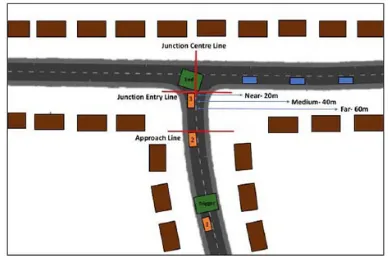
Each scenario started with the participant placed 135 m from the junction entry line; there-fore, as participants were instructed to approach the junction at 20 mph, it took approximately 15 seconds to drive from the start position to the junction entry line. On the approach to the junc-tion, participants drove over a trigger box, which was a point that triggered the target vehicle to start moving. The trigger box was 50 m from the junction entry line; therefore, it took approxi-mately 5 seconds to drive from the trigger box to the junction entry line. At this point, no target vehicle was yet visible to the driver (see Figure 1). Once the participant had reached the junction entry line, the near, medium, and far distance target vehicles had always come into sight but differed in the amount of time it would still take them to reach the center of the junction, travel-ling at a speed of 15 mph (typically, near = 3 seconds, medium = 6 seconds, far = 9 seconds). This meant that the starting points of the target vehicles were 20 m, 40 m, and 60 m, respectively. It must be noted that these timings may differ slightly, as these depend on the exact approach and stopping behavior of the participant. Although
it was technically possible to pass in front of the oncoming vehicle, attempting to do so when the vehicle was at a near distance did not normally make it possible to come to a complete halt at the junction before pulling out.
On the approach to the junction, the full junc-tion and the target vehicles became visible approx-imately 20 m from the junction entry line, known as the start of the “approach zone”; therefore, it took approximately 2 seconds to reach the junc-tion entry line. Before this point, the juncjunc-tion was occluded by houses on either side of the road (see Figure 1). In regards to the dynamics of the junc-tion, more of the right-hand side of the junction was visible earlier on; however, as the right-hand side vehicles were approaching in the closer lane, they were initially less visible compared with the vehicles approaching from the left-hand side of the junction, in the further lane. As this is a natu-ralistic junction, whereby the right- and left-hand side of the junction are slightly different and there-fore are imitating a real-life situation, any differ-ences in drivers’ visual attention between left and right may be due to the specific parameters of the junction. For this reason, right and left traffic were not analyzed separately.
Each target vehicle (pedal cycle, motorcycle, and car) was placed at all three distances (near, medium, and far) and appeared from the left and right with equal frequency, all traveling at 15 mph. These scenarios only contained the target vehicle, with no other traffic. There were 18 experimental trials. As the target vehicle’s movement was trigged before the start of the “approach zone,” the participants always saw the vehicles moving.
A further 12 general traffic scenarios that had no target vehicles but included general traffic were included to ensure that participants did not always expect a target vehicle and were scan-ning for traffic on the left and right side of the junction. Each scenario terminated the moment the driver pulled out into the junction (irrespec-tive of whether this was before or after the approaching vehicle crossed the junction). This scenario termination point was positioned after the participant had committed to the right-hand turn maneuver, still allowing for a crash to occur if he or she had pulled out unsafely.
trials in a random order. Both studies included the same randomized orders, with seven partici-pants in each study completing Orders A, B, C, and D and six participants completing Orders E and F.
stimuli and Apparatus
The experiment took place in the Nottingham Integrated Transport and Environment Simula-tion (NITES) facility’s high-fidelity driving simulator. This simulator comprises a full BMW Mini, housed within a projection dome and
mounted on a six-degree motion platform with a 360-degree projection screen (see Figure 2). For the current studies, the motion base was turned off because the short trial lengths and abrupt terminations of each trial made the motion cues confusing. The scenarios were formed on the screens using six projectors. The simulator was equipped with two linked FaceLAB 5.0 eye-tracking systems (four cameras and two infrared sources), which allowed participants’ eye move-ments to be tracked continuously over a range of approximately 120 degrees in front of the driver.
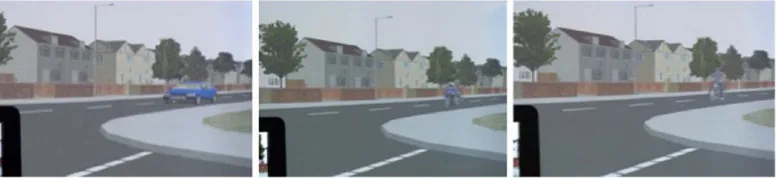
XPI (XPI Simulation, London, UK) driving simulation software was used to create 30 sce-narios. All scenarios took place at the same T-junction. As the experiment was conducted in the United Kingdom, all driving was conducted on the left-hand side of the roads. Figure 3 shows an example of all three vehicles used in the experiment (car, motorcycle, and pedal cycle) from the view of the driver, approaching from the right. These vehicles are placed at the near distance, from the point where the driver had reached the junction entry line. In regards to the pedal cycle, the simulated rider had a pedaling motion when moving.
Procedure
Following a 5-minute practice drive, which was purposely more demanding than the experi-mental drive, participants completed a short “Driving & Cycling Experience” questionnaire with a main purpose of understanding how often the participant drove and cycled. The primary task was explained to every participant by the experimenter reading out the following system-atic instructions:
[image:5.495.41.235.66.194.2]In this experiment, you will encounter a T-junction 30 times. Your task is to drive up to the T-junction at a speed of 20 mph and perform a maneuver at the end of the junction when it is deemed to be safe. An audio message will instruct you to turn right prior to stopping at the junction. Once you start to pull out of the junction, the scenario will immediately end and the next one will begin shortly after. You must try and drive as naturally as possible throughout the experiment.
For Study 2, which included a Stop sign, there was a slight change in the instructions: “An audio message will instruct you to turn right when approaching the junction.”
For all junctions, the audio clip contained the instruction “at the junction, go right.” A right turn was used as this was a more difficult and balanced task, compared with the alternative left turn. In order to make a right turn, drivers had to scan for oncoming traffic from both the left- and right-hand side of the junction.
Participants’ eye movements were recorded throughout each scenario. Each scenario was around 20 seconds long, and the whole experi-mental procedure lasted around 40 minutes.
results driving experience and Age
Drivers’ reported experience and ages were subject to a 2 × 2 between-groups ANOVA with
factors of Road Sign (Give Way vs. Stop) and Group (pedal cyclists vs. nonpedal cyclists). Drivers’ licensure (in months), annual mileage, and age range were subject to a log transforma-tion due to positive skew. These analyses con-firmed that there were no significant differences in drivers’ licensure between groups, F(1, 76) = .34, MSE = .14, p > .05, n2
p = .004) or
experi-ments, F(1, 76) = .05, MSE = .14, p > .05, n2 p =
.001; in drivers’ annual mileage between groups,
F(1, 76) = .03, MSE = .57, p > .05, n2
p = .001,
or experiments, F(1, 76) = 1.26, MSE = .57,
p > .05, n2
p = .02; and in age between groups,
F(1, 76) = 4.00, MSE = .01, p > .05, n2
p = .04,
or experiments, F(1, 76) = .02, MSE = .01, p > .05, n2
p = .001.
data Analysis
[image:6.495.88.410.65.220.2]Most behavioral and eye movement measures were subject to a 2 × 2 × 3 × 3 mixed design Figure 2. The NITES facility’s high-fidelity driving simulator. The simulator consists
of a full BMW Mini, housed within a projection dome and mounted on a six-degree of freedom motion platform.
[image:6.495.57.445.284.373.2]ANOVA with factors of Road Sign (Give Way vs. Stop), Group (pedal cyclists vs. nonpedal cyclists), Vehicle Type (pedal cycle, motorcycle, and car), and Distance (near, medium, and far). For the factor of Target Vehicle, two a priori orthogonal contrasts were specified. The first contrast compared data from pedal cycle trials with that of motorcycle and car trials together to assess any overall effect of cycling experience toward pedal cycles. The second contrast com-pared motorcycle trials with car trials to assess any overall effect between these two motor vehicles. For the factor of Distance, contrasts were specified that tested for linear trends in the data. Each target vehicle approached at each distance from the left and right of the junction at equal frequency; however, for the purpose of analysis, the vehicle direction was aggregated to increase the number of trials contributing to each cell.
Behavioral Measures
Driver behavior was measured by looking at Approach Behavior. Approach Behavior was obtained by calculating how long it took driv-ers to travel through the “approach zone.” The “approach zone” started 20 m from the junction entry line and finished at the moment where the front of the drivers’ car had entered the junc-tion by crossing the juncjunc-tion entry line. The “approach zone” thus started when the left and right side of the junction first became visible, the target vehicles were visible, and at the point where approaching traffic may start to alter the approach behavior of the driver.
Approach behavior. In regards to drivers’
approach behavior, a main effect of Vehicle Type was found, F(2, 152) = 3.54, MSE = 18.06, p < .05, n2
p = .05, with contrasts revealing a
signifi-cant difference between pedal cycles compared with cars and motorcycles, F(1, 76) = 5.67, MSE = 31.23, p < . 05, n2
p = .07. Participants
approached the junction faster when a pedal cycle was approaching compared with a car or motorcycle. There was also a main effect of Dis-tance, F(2, 152) = 12.25, MSE = 19.74, p < .001, n2
p = .14, with contrasts revealing a linear trend,
F(1, 76) = 17.19, MSE = 7.85, p < . 001, n2 p =
.18. Participants approached the junction faster when vehicles were approaching from a closer
distance—for cars (near = 10.32 seconds, medium = 10.39 seconds, far = 10.87 seconds), for motorcycles (near = 9.52 seconds, medium = 10.47 seconds, far = 10.64 seconds), and for pedal cycles (near = 7.32 seconds, medium = 9.93 seconds, far = 11.23 seconds).
There was also an interaction between Vehi-cle Type and Distance, F(4, 304) = 2.89, MSE = 36.37, p < .05, n2
p = .04, with contrasts revealing
a linear difference between pedal cycles com-pared with cars and motorcycles, F(1, 76) = 13.18, MSE = 29.43, p < . 01, n2
p = .15.
Partici-pants approached the junction faster when vehi-cles are approaching from a nearer distance. The combination of these two main effects and the interaction highlights the finding that drivers approached the junction fastest when there was a pedal cyclist approaching from a near distance.
eye Movement Measures
With drivers making big rapid head move-ments and fixations at wide eccentricities, it was difficult to always be sure of the quality of the eye tracking. This was particularly problematic at wide eccentricities where fixations were often made toward the target vehicle, but because of calibration difficulties, we could not be sure that the target vehicle was actually fixated. If we had chosen to adopt a very strict criterion for deter-mining whether a vehicle was fixated, there is a danger that we would falsely conclude that far vehicles were rarely fixated simply because cali-bration was poorer at wide eccentricities. Because of this, we adopted a very conservative approach, focusing on the broad direction of fixation (toward or away from the target vehicle, rather than requir-ing an unambiguous fixation on the vehicle) and choosing dependent variables that would not be systematically affected by differences in calibra-tion quality between individuals. This approach has the additional advantage that the visual angle subtended by the target vehicle has no direct effect on whether a fixation is regarded as being on the vehicle. Choosing to aggregate between left and right approach directions also ensures that none of the reported differences can be influenced by differences in calibration quality for extreme left and right angles.
interest: Proportion of Fixations, Proportion of Gaze, and Mean Fixation Duration. A custom-built MatLab script was used to automatically analyze drivers’ eye movements, with a fixation dispersion threshold of 0.1 of a radian for 100 ms, to regard a fixation to be in progress. The Proportion of Fixations was calculated by mea-suring the number of fixations toward and away from the target vehicle side of the junction. The tolerance for fixations toward the target vehicle was any fixation made to the side of the junc-tion center line where the target vehicle was approaching (see Figure 1), after the participant had crossed the approach line, and the target vehicle was still approaching the junction. This did not include any fixations toward the target vehicle when the vehicle had crossed the junc-tion center line. Fixajunc-tions away from the target vehicle were any fixations made to the side of the junction center line where the target vehicle was not approaching. The proportion of all these fixations toward the target vehicle side of the junction was then calculated. The Proportion of Gaze was calculated in the same way as the pre-vious measure with total gaze duration rather than number of fixations. Total gaze duration is the total time spent on fixations to the target vehicle side of the junction, so Proportion of Gaze gives a general measure of how much visual attention was biased toward the oncoming vehicle. The Mean Fixation Duration was calcu-lated by the total gaze duration toward the target vehicle side of the junction, divided by the num-ber of fixations made toward the target vehicle side of the junction.
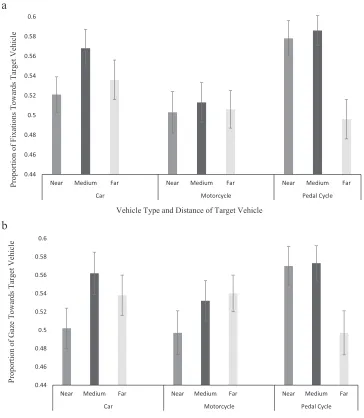
Proportion of Fixations and Proportion of Gaze were subject to an arcsine transformation due to a leptokurtic distribution. Mean Fixation Duration was subject to a log transformation due to a positive skew in the data. The reported sta-tistics for these measures are from the trans-formed data. However, Figure 4 shows the untransformed data in order to present propor-tion units between 0 and 1.
Proportion of fixations. A main effect of
Vehi-cle Type was found, F(2, 152) = 3.39, MSE = .05,
p < .05, n2
p = .04, with contrasts revealing a
sig-nificant difference between pedal cycles com-pared with cars and motorcycles, F(1, 76) = 3.27, MSE = .05, p < .05, n2
p = .05. Participants had a
higher proportion of fixations on the target side of the junction when the approaching vehicle was a pedal cycle compared with a car or a motorcycle.
There was an interaction between Vehicle Type and Distance, F(4, 304) = 2.54, MSE = .04,
p < .05, n2
p = .03, with contrasts indicating a
lin-ear difference between pedal cycles compared with cars and motorcycles, F(1, 76) = 7.35, MSE = .06, p < .01, n2
p = .09. Participants’ proportion of
fixations toward the target vehicle was greater when cars and motorcycles were approaching from a far distance compared with pedal cycles but greater when pedal cycles approached from a medium or near distance compared with cars and motorcycles (see Figure 4a).
There was also a main effect of Road Sign,
F(1, 76) = 10.55, MSE = .01, p < .01, n2 p = .12,
with participants having a higher proportion of fixations toward the target vehicle when a Stop Sign was present compared with a Give Way Sign. There was no main effect of Group, F(1, 76) = .19, MSE = .01, p = .66, n2
p = .01.
Proportion of gaze. An interaction between
Vehicle Type and Distance was found, F(4, 304) = 2.57, MSE = .05, p < .05, n2
p = .03, with
con-trasts indicating a linear difference between pedal cycles compared with cars and motorcy-cles, F(1, 76) = 7.66, MSE = .08, p < .01, n2
p =
.09. Again, participants’ proportion of gaze toward the target vehicle was greater when cars and motorcycles were approaching from a far distance compared with pedal cycles; however, it was greater when pedal cycles approached from a medium or near distance compared with cars and motorcycles (see Figure 4b).
There was also a main effect of Road Sign,
F(1, 76) = 9.79, MSE = .02, p < .01, n2
p = .11,
with participants having a higher proportion of gaze toward the target with a Stop Sign com-pared with a Give Way Sign. There was no main effect of Group, F(1, 76) = .59, MSE = .02, p = .45, n2
p = .01.
Mean fixation durations. A main effect of
Distance was found, F(2, 152) = 4.29, MSE = .05, p < .05, n2
p = .05, with contrasts revealing a
significant linear trend, F(1, 76) = 3.27, MSE = .05, p < .05, n2
p = .12. Participants had higher
There was a main effect of Road Sign, F(1, 76) = 11.23, MSE = .15, p < .01, n2
p = .13, with
drivers fixating toward the approaching vehicle for longer with a Stop Sign present than a Give Way Sign. There was no main effect of Group,
F(1, 76) = 1.14, MSE = .15, p = .29, n2 p = .02.
dIscussIon
The first immediate finding from the study is that drivers’ attention was not associated with pedal cycling experience at junctions. Despite previous research suggesting that experience with a certain vehicle may change drivers’
0.44 0.46 0.48 0.5 0.52 0.54 0.56 0.58 0.6
Near Medium Far Near Medium Far Near Medium Far Car Motorcycle Pedal Cycle
el
ci
he
V t
eg
ra
T s
dr
a
wo
T s
noi
ta
xi
F f
o
noi
tr
op
or
P
Vehicle Type and Distance of Target Vehicle
0.44 0.46 0.48 0.5 0.52 0.54 0.56 0.58 0.6
Near Medium Far Near Medium Far Near Medium Far Car Motorcycle Pedal Cycle
el
ci
he
V t
eg
ra
T s
dr
a
wo
T
ez
a
G f
o
noi
tr
op
or
P
Vehicle Type and Distance of Target Vehicle
a
[image:9.495.66.430.67.485.2]b
visual attention toward this vehicle (Crundall et al., 2012), this does not seem to be the case for pedal cyclists when pulling out of a junction as a driver. The second immediate finding is that, in general, drivers do not look toward pedal cycles approaching from a far distance as much as they look toward motorcycles and cars. In contrast, at closer distances, they may actually look more toward pedal cycles than either motorcycles or cars. Both of these results occurred irrespective of the sign present at the junction, implying that the differences in visual search are present in cases both where the driver generally pulls out in front of the target vehicle and where they wait for it. The manipulation of the change in road sign was conformed to by participants, with drivers pulling out in front of the target vehicle on significantly more occasions with a Give Way Sign present compared with a Stop Sign. It should be noted that these differences have been observed despite the fact that speed of travel for target pedal cycles was identical to that of motorcycles and cars.
In regards to the first finding, although previ-ous literature has established findings indicating that drivers with specific motorcycle experience (Crundall at al., 2012) and pedal cycling experi-ence (Beanland & Hansen, 2017) have more efficient visual attention toward motorcycles and pedal cycles compared with drivers only, this does not seem to be the case when scanning a junction in order to complete a maneuver. This contradictory finding may be explained by the difference in task requirements between our study and previous ones performed by driver-cyclists—passively watching video clips does not require additional demands such as vehicle control and does not require participants to com-plete a maneuver.
These contradictory results may be a result of the difference between the factors that promote motorcycle and pedal cycle use. Motorcyclists’ views about why and how they ride have been seen to be related to the social context of rid-ing, including social- and identity-related influences relating to the group, as well as self-identity (Tunnicliff, Watson, White, Lewis, & Wishart, 2011). In contrast, cycling may not play such an important role in the self-identity of a cyclist, using a pedal cycle for reasons such
as efficiency, flexibility, cost, economy, and health (Levulytė, Baranyai, Török, & Soko-lovskij, 2016).
In addition, it may be possible that pedal cyclists are not as aware as motorcyclists about the dangers surrounding junctions. Crash statis-tics show that motorcyclists are much more likely to be involved in crashes, with motorcy-cles accounting for 21% of UK road deaths and pedal cyclists accounting for 6% in 2015 (Department of Transport, 2015). Current edu-cational campaigns such as the UK Department for Transport’s Think! Bike are also heavily associated with motorcyclists’ rather than pedal cyclists’ safety. For this reason, it may be the case that pedal cyclists do not have a heightened awareness of the dangers associated with cycling on road compared with that of motorcyclists, which in turn may result in cyclists not having an increased detection of oncoming pedal cyclists compared with that of nonpedal cyclists.
In the absence of differences between pedal cyclists and nonpedal cyclists on all eye move-ment measures, we conclude that the specific pedal cycling experience of the pedal cyclist group is not associated with changes in drivers’ visual attention toward oncoming pedal cycles or motorcycles at controlled simulated junc-tions. Given that our sample size provided enough power to detect the effect (medium effect size for within-between interaction, Cohen’s f = 0.25, 1-β = 0.80) if it was present, this suggests that pedal cycling experience does not make drivers’ visual attention strategy safer at junctions.
Poulter, & Purcell, 2011), and a driver’s ability to detect the motion of an object decreases, the smaller the object is. Although this behavior seems plausible, it is surprising given that the visual parameters of the approaching pedal cycles in this simulation environment, in terms of distance and speed, were identical to the far-approaching motorcycles and cars. This may suggest that drivers are terminating their gaze away from far-approaching pedal cycles too early, not fully forming a representation of the pedal cycle’s speed and distance. It must also be noted that although drivers’ eye movements were aggre-gated across left- and right-approaching vehicles, drivers’ proportion of fixations (left = .54, right = .51) and proportion of gaze (left = .48, right = .56) did not significantly differ whether the far pedal cycle was approaching from the left or the right.
In addition, drivers approached the junction faster when a pedal cycle was approaching from a near or medium distance compared with a motorcycle or car. These different approach dynamics again suggest that the appraisal of threat from the pedal cyclist may be different, with less time needed to make a decision at the junction. Conversely, drivers’ approach behav-ior for far-approaching pedal cycles was slower compared with a motorcycle and car, suggesting that drivers took more time to make a decision, possibly due to the perceived low threat of a far-approaching pedal cycle compared with a motor vehicle. Previous research has found that when countermeasures are in place to reduce drivers’ speed on the approach to a junction, this changed drivers’ visual search toward pedal cycles for the better, simply providing more time to look at the approaching vehicle (Summala et al., 1996).
Although pedal cyclists will often be travel-ling slower than cars or motorcyclists, in urban environments there are plenty of occasions where recreational cyclists can achieve the local speed limit. The current research suggests that such situations may present a particular prob-lem, with drivers failing to pay sufficient atten-tion to distant but relatively fast-moving pedal cyclists. With previous studies demonstrating that drivers are poor at determining the speed of other vehicles, particularly when travelling at high speed (Dommes, Cavallo, Vienne, &
Aillerie, 2012), this is particularly relevant to the increase in the use of E-bikes (pedal cycles that provide electrical support). These bikes have been seen to reach higher speeds than conven-tional pedal cycles; therefore, drivers may mis-judge their approaching speed (Schleinitz, Pet-zoldt, Krems, & Gehlert, 2016).
The subtle differences found in drivers’ everyday visual attention can be used in the development of in-car technologies. As a start-ing point, this study demonstrates how much visual attention drivers distribute to vulnerable road users dependent on vehicle type and dis-tance at a junction. These eye movement mea-sures can help in the understanding of drivers’ cognitive mechanisms involving the distribution of visual search at a junction in simulated driv-ing environments. The visual information that drivers obtain at junctions, which inevitability informs their behavior, is important for the development of in-car technical assistive sys-tems for drivers, making drivers safer. One par-ticular source of information that may be impor-tant for such systems to provide would be warn-ings related to distant pedal cycles that are nonetheless approaching the driver at relatively high speeds. In regards to road safety, this in turn could help prevent the high proportion of crashes at junctions involving these road users.
there were marginal, Cochran’s Q(2) = 5.20, p = .074, n = 80, differences in the frequency of “near crashes” as a function of oncoming vehi-cle type—pedal cyvehi-cle (4 participants), motorcy-cle (1 participant), and car (0 participants). This tendency, combined with the relatively high approach speeds for near and medium pedal cycles, provides support for the idea that drivers may be more likely to “take a chance” in front of a pedal cyclist than an oncoming motorcycle or car, even though the approach speeds are matched.
In conclusion, this study provides important and novel information, indicating that drivers who pedal cycle frequently do not show any dif-ferences in their visual attention toward pedal cycles on the road compared with nonpedal cyclists, despite previous research finding this in other settings. We found that drivers do not dis-tribute as much visual attention toward pedal cycles approaching from a far distance despite them approaching at identical speeds to motor-cycles and cars. These subtle differences in driv-ers’ visual attention shed light on drivdriv-ers’ every-day visual search at junctions as a function of vehicle type, which can have important implica-tions for vulnerable road users’ safety.
AcknowledgMents
We are particularly grateful to Lauren Furlong, who helped with participant recruitment and testing. The NITES facility provided the simulator used to conduct this research.
This work was supported by the Economic and Social Research Council (Grant ES/J500100/1), an ESRC postgraduate studentship to Chloe Jade Robbins.
key PoInts
• Previous studies have found that specific motor-cycle experience enhances drivers’ visual atten-tion toward motorcycles at juncatten-tions; however, no previous research has investigated the effect pedal cycling experience has on drivers’ visual atten-tion toward pedal cycles at juncatten-tions, despite the increase in pedal cycle use on public roads.
• Drivers’ visual attention at junctions was not asso-ciated with pedal cycling experience in a simula-tion environment.
• Drivers, in general, do not distribute as much attention toward pedal cycles approaching from far distances, despite them approaching at identi-cal speeds to cars and motorcycles.
• Subtle differences in drivers’ visual attention toward vulnerable road users at junctions are important for the future safety of these road users.
orcId id
Chloe Jade Robbins https://orcid.org/0000- 0002-6076-5983
references
Beanland, V., & Hansen, L. J. (2017). Do cyclists make better drivers? Associations between cycling experience and change detection in road scenes. Accident Analysis and Prevention,
106, 420–427.
Brooks, P., & Guppy, A. (1990). Driver awareness and motorcy-cle accidents. In Proceedings of the international motorcycle safety conference (Vol. 2, No. 10, pp. 27–56). Washington: Motorcycle Safety Foundation.
Brown, I. D. (2002). A review of the ‘Look But Failed to See’ acci-dent causation factor. Behavioural Research in Road Safety XI. London, UK: Department of Transport, Local Government and the Regions.
Clarke, D. D., Ward, P., Bartle, C., & Truman, W. (2007). The role of motorcyclist and other driver behaviour in two types of seri-ous accident in the UK. Accident Analysis & Prevention, 39(5), 974–981.
Crundall, D., Crundall, E., Clarke, D., & Shahar, A. (2012). Why do car drivers fail to give way to motorcycles at t-junctions?
Accident Analysis & Prevention, 44(1), 88–96.
Department of Transport. (2015). Reported road causalities Great Britain, Annual Report 2015. Retrieved from https://www .gov.uk/government/uploads/system/uploads/attachment_data/ file/556396/rrcgb2015-01.pdf
Department of Transport. (2016). Reported road causalities Great Britain, provisional estimates: July to September 2016. Retrieved from https://www.gov.uk/government/uploads/ system/uploads/attachment_data/file/588773/quarterly-esti mates-july-to-september-2016.pdf
Dommes, A., Cavallo, V., Vienne, F., & Aillerie, I. (2012). Age-related differences in street-crossing safety before and after training of older pedestrians. Accident Analysis & Prevention, 44(1), 42–47. Hole, G. J., Tyrrell, L., & Langham, M. (1996). Some factors
affect-ing motorcyclists’ conspicuity. Ergonomics, 39(7), 946–965. Levulytė, L., Baranyai, D., Török, Á., & Sokolovskij, E. (2016).
Bicycles’ role in road accidents: A review of literature. Trans-port and Telecommunication Journal, 17(2), 122–127. Magazzù, D., Comelli, M., & Marinoni, A. (2006). Are car drivers
holding a motorcycle licence less responsible for motorcycle— Car crash occurrence? A non-parametric approach. Accident Analysis & Prevention, 38(2), 365–370.
Pai, C. W., & Saleh, W. (2008). Exploring motorcyclist injury severity in approach-turn collisions at T-junctions: Focusing on the effects of driver’s failure to yield and junction control measures. Accident Analysis & Prevention, 40(2), 479–486. Räsänen, M., & Summala, H. (1998). Attention and expectation
problems in bicycle–car collisions: An in-depth study. Accident Analysis & Prevention, 30(5), 657–666.
Schleinitz, K., Petzoldt, T., Krems, J. F., & Gehlert, T. (2016). The influence of speed, cyclists’ age, pedaling frequency, and observer age on observers’ time to arrival judgments of approaching bicycles and e-bikes. Accident Analysis & Preven-tion, 92, 113–121.
Stone, M., & Broughton, J. (2003). Getting off your bike: Cycling accidents in Great Britain in 1990–1999. Accident Analysis & Prevention, 35(4), 549–556.
Summala, H., Pasanen, E., Räsänen, M., & Sievänen, J. (1996). Bicycle accidents and drivers’ visual search at left and right turns. Accident Analysis & Prevention, 28(2), 147–153. Tunnicliff, D., Watson, B., White, K. M., Lewis, I., & Wishart, D.
(2011). The social context of motorcycle riding and the key determinants influencing rider behavior: A qualitative investi-gation. Traffic Injury Prevention, 12(4), 363–376.
Wann, J. P., Poulter, D. R., & Purcell, C. (2011). Reduced sen-sitivity to visual looming inflates the risk posed by speeding
vehicles when children try to cross the road. Psychological Sci-ence, 22(4), 429–434.
Chloe Jade Robbins holds a BSc psychology (hon-ors) degree and an MSc in psychology research methods from the University of Nottingham and is currently a PhD candidate in the School of Psychol-ogy at the University of Nottingham.
Peter Chapman is an associate professor of psy-chology at the University of Nottingham and direc-tor of the NITES facility. He has a PhD in psychol-ogy from University College London and has previously worked at the Medical Research Coun-cil’s Applied Psychology Unit in Cambridge and at the Institute for Transport Studies at the University of Leeds.