A review of progress towards
sustainable development in the UK
– The contribution made by regional and
devolved government, the private sector
and NGOs
Environmental Resources Management Eaton House, Wallbrook Court,
North Hinksey Lane Oxford OX2 0QS Telephone 01865 384800
Facsimile 01865 384848 Email [email protected] http://www.ermuk.com
FINAL REPORT
Sustainable Development Commission
A Review of Progress Towards Sustainable
Development in the UK: The Contribution
Made by Regional and Devolved Government, the
Private Sector and NGOs
FINAL REPORT
Sustainable Development Commission
A Review of Progress Towards Sustainable
Development in the UK: The Contribution
Made by Regional and Devolved Government, the
Private Sector and NGOs
January 2001
This report has been prepared by Environmental Resources Management the trading name of Environmental Resources Management Limited, with all reasonable skill, care and diligence within the terms of the Contract with the client, incorporating our General Terms and Conditions of Business and taking account of the resources devoted to it by agreement with the client.
We disclaim any responsibility to the client and others in respect of any matters outside the scope of the above.
This report is confidential to the client and we accept no responsibility of whatsoever nature to third parties to whom this report, or any part thereof, is made known. Any such party relies on the report at their own risk.
CONTENTS
EXECUTIVE SUMMARY
1. INTRODUCTION 1
1.1STRUCTURE OF THIS PAPER 1
1.2SUSTAINABLE DEVELOPMENT 2
2. OVERVIEW OF ACTIVITIES 5
2.1REGIONAL AND DEVOLVED GOVERNMENT 5
2.2THE PRIVATE SECTOR 12
2.3NON-GOVERNMENTAL ORGANISATIONS 18
3. PARTICIPATION, LEADERSHIP AND THE RELATIONSHIP BETWEEN THE
RESPONSIBILITIES OF CITIZENS AND GOVERNMENT 23
3.1INTRODUCTION 23
3.2PROGRESS MADE TOWARDS SUSTAINABLE DEVELOPMENT 23
3.3RECOMMENDATIONS 29
4. ACCESS INCLUDING TRANSPORT, MOBILITY AND THE PLANNING / LAND USE
DIMENSION 31
4.1INTRODUCTION 31
4.2PROGRESS MADE TOWARDS SUSTAINABLE DEVELOPMENT 31
4.3RECOMMENDATIONS 41
5. IMPROVING ECO-EFFICIENCY WITH PARTICULAR FOCUS ON PRODUCTION 44
5.1INTRODUCTION 44
5.2PROGRESS MADE TOWARDS SUSTAINABLE DEVELOPMENT 44
5.3RECOMMENDATIONS 47
6. HEALTH 48
6.1INTRODUCTION 48
6.2PROGRESS MADE TOWARDS SUSTAINABLE DEVELOPMENT 49
6.3RECOMMENDATIONS 51
7. FOOD PRODUCTION AND CONSUMPTION, WITH A FOCUS ON AGRICULTURE
AND RURAL LAND USE 52
7.1INTRODUCTION 52
7.2PROGRESS MADE TOWARDS SUSTAINABLE DEVELOPMENT 53
EXECUTIVE SUMMARY
AIMS:
The recently formed Sustainable Development Commission (SDC) has
commissioned two papers to provide the Commission with an analysis of the current state of sustainable development in the UK. These papers will help the Commission identify priorities for its activities in seeking to accelerate the shift towards sustainable development in the UK.
This paper has been prepared by Environmental Resources Management (ERM) and provides a review of progress made in contributing to sustainable development by Regional and Devolved Government, the Private Sector and Non-Governmental Organisations (NGOs). The review is based on existing knowledge of work undertaken by these organisations and makes use of the Government’s sustainability indicators; the review has not involved the collection of a detailed set of new data.
CAG Consultants have been commissioned to undertake a parallel review of contribution made by central and local government.
The analysis has sought to cover five key themes identified by the SDC and listed below. The selection of these key themes was informed by a joint SDC and UNED/UK conference held in November 2000 to identify UK priorities for the 2002 Earth Summit (Rio plus 10). The five key themes:
• Participation, leadership and the relationship between the responsibilities of citizens and government.
• Access including transport, mobility and the planning / land use dimension.
• Improving efficiency with a particular focus on production eco-efficiency.
• Health, including de-coupling it from sickness treatment and the role of lifestyle and consumption choices.
SUMMARY OF FINDINGS:
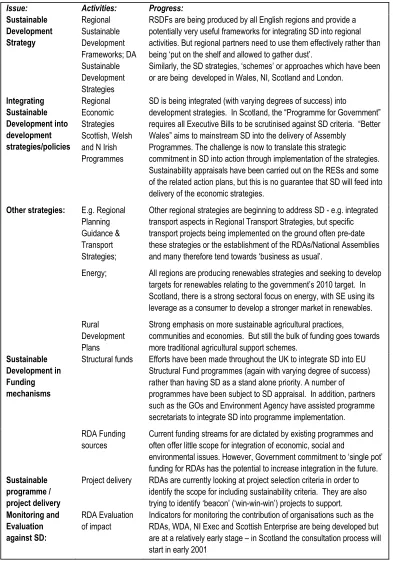
[image:6.595.141.534.182.751.2]Tables 1 to 3 summarise the progress made by Regional and Devolved Government, the Private Sector and NGOs in contributing to sustainable development. Sections 3 to 7 in the main report present findings in relation to the five key themes.
Table 1: Summary of Progress Towards Sustainable Development - Regional and Devolved Government:
Issue: Activities: Progress:
Sustainable Development Strategy Regional Sustainable Development Frameworks; DA Sustainable Development Strategies
RSDFs are being produced by all English regions and provide a potentially very useful frameworks for integrating SD into regional activities. But regional partners need to use them effectively rather than being ‘put on the shelf and allowed to gather dust’.
Similarly, the SD strategies, ‘schemes’ or approaches which have been or are being developed in Wales, NI, Scotland and London.
Integrating Sustainable Development into development strategies/policies Regional Economic Strategies Scottish, Welsh and N Irish Programmes
SD is being integrated (with varying degrees of success) into
development strategies. In Scotland, the “Programme for Government” requires all Executive Bills to be scrutinised against SD criteria. “Better Wales” aims to mainstream SD into the delivery of Assembly
Programmes. The challenge is now to translate this strategic
commitment in SD into action through implementation of the strategies. Sustainability appraisals have been carried out on the RESs and some of the related action plans, but this is no guarantee that SD will feed into delivery of the economic strategies.
Other strategies: E.g. Regional Planning Guidance & Transport Strategies;
Other regional strategies are beginning to address SD - e.g. integrated transport aspects in Regional Transport Strategies, but specific transport projects being implemented on the ground often pre-date these strategies or the establishment of the RDAs/National Assemblies and many therefore tend towards ‘business as usual’.
Energy; All regions are producing renewables strategies and seeking to develop targets for renewables relating to the government’s 2010 target. In Scotland, there is a strong sectoral focus on energy, with SE using its leverage as a consumer to develop a stronger market in renewables. Rural
Development Plans
Strong emphasis on more sustainable agricultural practices,
communities and economies. But still the bulk of funding goes towards more traditional agricultural support schemes.
Sustainable Development in Funding mechanisms
Structural funds Efforts have been made throughout the UK to integrate SD into EU Structural Fund programmes (again with varying degree of success) rather than having SD as a stand alone priority. A number of programmes have been subject to SD appraisal. In addition, partners such as the GOs and Environment Agency have assisted programme secretariats to integrate SD into programme implementation. RDA Funding
sources
Current funding streams for are dictated by existing programmes and often offer little scope for integration of economic, social and
environmental issues. However, Government commitment to ‘single pot’ funding for RDAs has the potential to increase integration in the future.
Sustainable programme / project delivery
Project delivery RDAs are currently looking at project selection criteria in order to identify the scope for including sustainability criteria. They are also trying to identify ‘beacon’ (‘win-win-win’) projects to support.
Monitoring and Evaluation against SD:
RDA Evaluation of impact
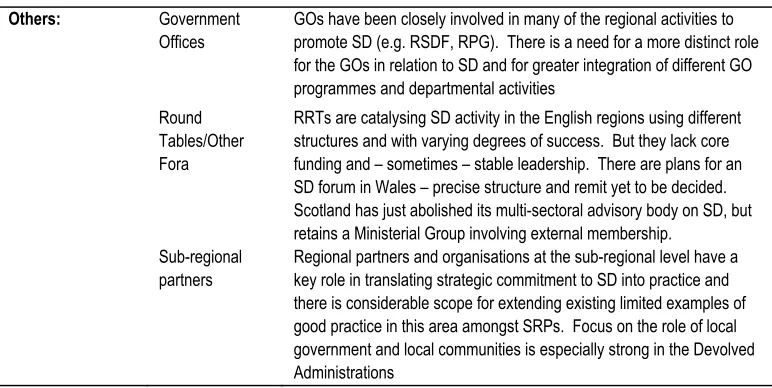
Table 1 continued:
Others: Government
Offices
GOs have been closely involved in many of the regional activities to promote SD (e.g. RSDF, RPG). There is a need for a more distinct role for the GOs in relation to SD and for greater integration of different GO programmes and departmental activities
Round Tables/Other Fora
RRTs are catalysing SD activity in the English regions using different structures and with varying degrees of success. But they lack core funding and – sometimes – stable leadership. There are plans for an SD forum in Wales – precise structure and remit yet to be decided. Scotland has just abolished its multi-sectoral advisory body on SD, but retains a Ministerial Group involving external membership.
Sub-regional partners
Table 2: Summary of Progress Towards Sustainable Development - Private Sector
Issue: Activities: Progress:
Sustainable Development Strategy
Corporate vision statements and goals
A small minority of companies are embedding SD into corporate strategies and goals – but the majority of businesses are still not engaged, especially SMEs.
Some companies are seeing a business case for SD, particularly those with international operations or who see reputational risk attached to their performance in re. SD. However, behaviour of the majority of companies is not being driven by government or market drivers for SD - these drivers remain undeveloped. Overall business awareness of SD is low.
Integrating SD into policies
Corporate social responsibility
More companies are addressing single aspects e.g. corporate social responsibility, environmental sustainability.
Climate change and energy
Most activity is amongst high energy users / companies in the energy sector. Many companies appear to be against the use of economic instruments for promoting a reduction in greenhouse gas emissions.
Transport & distribution
A small number of companies are pursing green transport plans / non-road freight transport initiatives.
At present much of this activity is at the single company or single site level, this is indicative of the lack of any framework for industry to follow on sustainable transport issues.
Eco-efficiency There are a number of initiatives (sectoral and across industries) to look at what eco-efficiency means in practice in areas such as production and packaging. Groups such as WBCSD are attempting to develop basic frameworks for assessing and implementing eco-efficiency, such as ‘eco-efficiency metrics’. There does not appear to be a common understanding of what eco-efficiency or concepts such as ‘Factor 10’ or ‘Factor 4’ really mean or signs of more fundamental reductions in resource use. Participation and
stakeholders
Some examples of stakeholder engagement and consultation as a reputational risk management tool and license to operate.
Integrating sustainability into operations
Processes and site management
Increasing uptake of environmental management systems (e.g. ISO 14001), but still limited to a small minority of companies.
Products In most product groups and amongst larger producers there are ‘environmentally friendly product’ niches but product labelling and claims are still problem areas and producers are not really addressing product durability and still tend to focus on selling more products.
Procurement There are good opportunities for encouraging companies to change behaviour through supply changes. Some major retailers are responding to customer pressure on product traceability and are providing more information on product sourcing, processing etc. But in other sectors there are no real exogenous drivers to change procurement practices.
Reporting Environment and social
Sustainability reporting is still in its infancy. Participants in initiatives such as the Global Reporting Initiative tend to be limited to larger companies. The vast majority of companies do not produce even environmental reports and there seems to be no mechanism for changing this situation.
There is a need to assess the real impact of reporting in terms of promoting SD.
Company performance
[image:8.595.142.527.81.782.2]Table 3: Summary of Progress Towards Sustainable Development - NGOs
Level: Activities: Progress:
Involvement in national/internatio nal Sustainable Development Strategies
Many different NGOs are involved in activities to promote SD - focusing on single issues or integration of social, environmental and social issues. Their activities include public, industry and government awareness raising, lobbying, community programmes and direct delivery of projects and services to promote SD. These activities have generated significant results in some issues (e.g. GMOs), but in other areas public behaviour and government policy appear relatively unaffected (e.g. transport issues).
Participation NGOs play an important role in encouraging and providing a means of participation by the public in sustainability issues. This role is recognised by the public and business.
Transport and access NGO activities have raised the profile of SD issues on the transport policy agenda, but appear to have had limited impact on public attitudes and government policy.
Eco-efficiency In general, little attention has been given to this issue by NGOs in the UK. However, activities by a number of NGOs (e.g. Forum for the Future’s ‘Natural Step’) have sought to assist companies improve eco-efficiency. NGOs have lobbied Government to adopt a national indicator of eco-efficiency.
Food and rural land use
[image:9.595.143.530.70.377.2]RECOMMENDED ACTIONS FOR ACCELERATING PROGRESS:
The study identifies a range of actions for accelerating progress towards sustainable development. In a number of cases there appears to be
considerable scope for the SDC to become involved, either as a catalyst for action by others or as a leading partner in specific projects and initiatives.
Recommendations relating to Regional and Devolved Government, Private Sector and NGO activities (taken from Section 2 of the main report) are shown below. Recommendations relating to the five key themes are highlighted at the end of relevant sections of the report.
Table 4: Recommended Actions for Increasing the Contribution of Regional and Devolved Government to Sustainable Development:
Action: By Whom:
Work closely with Devolved Administrations and regional organisations to ensure that SDC work programme reflects regional and national differences, and is not excessively London-centred
SDC
Encourage the establishment of sustainable development fora at sub-UK level, and develop links with these new
organisations
SDC
Support a network of Regional Round Tables in England, share best practice and act as their advocate in Whitehall
SDC
Encourage devolved and regional bodies (which include development agencies) in England, Northern Ireland, Scotland and Wales to incorporate SD into their performance indicators and encourage consistency within regions
DETR
Encourage devolved and regional bodies to undertake staff training and awareness raising regarding SD.
DETR
Support activities by devolved and regional bodies to incorporate SD into project appraisal criteria.
DETR / SDC
Provide guidance to regional development organisations on integrating sustainable development into the forthcoming ‘single pot’ funding arrangements.
DETR
Work with Regional Chambers to develop guidelines and approaches for making use of the RSDFs and reporting on progress in delivering the RSDFs.
SDC
Assist Regional Chambers develop approaches for monitoring and evaluating the performance of RDAs in relation to SD.
SDC
Encourage regional organisations to make active use of the RSDFs.
SDC / DETR
Support the development of a distinctive role for the Government Offices (GO) in the Regions in relation to SD.
DETR / GOs / SDC
Work with Development Agencies across the UK to develop methods for demonstrating the added value of their activities to SD.
SDC
Encourage devolved and regional bodies to allocate staff responsibilities for promoting SD - at senior Board level and operational levels.
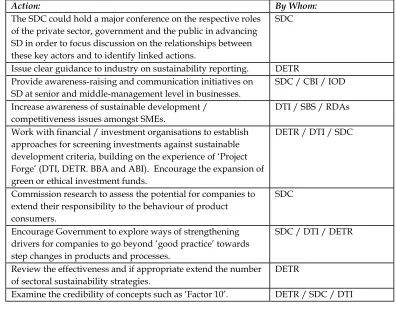
Table 5: Recommended Actions for Increasing the Contribution of the Private Sector to Sustainable Development:
Action: By Whom:
The SDC could hold a major conference on the respective roles of the private sector, government and the public in advancing SD in order to focus discussion on the relationships between these key actors and to identify linked actions.
SDC
Issue clear guidance to industry on sustainability reporting. DETR Provide awareness-raising and communication initiatives on
SD at senior and middle-management level in businesses.
SDC / CBI / IOD
Increase awareness of sustainable development / competitiveness issues amongst SMEs.
DTI / SBS / RDAs
Work with financial / investment organisations to establish approaches for screening investments against sustainable development criteria, building on the experience of ‘Project Forge’ (DTI, DETR. BBA and ABI). Encourage the expansion of green or ethical investment funds.
DETR / DTI / SDC
Commission research to assess the potential for companies to extend their responsibility to the behaviour of product consumers.
SDC
Encourage Government to explore ways of strengthening drivers for companies to go beyond ‘good practice’ towards step changes in products and processes.
SDC / DTI / DETR
Review the effectiveness and if appropriate extend the number of sectoral sustainability strategies.
DETR
Examine the credibility of concepts such as ‘Factor 10’. DETR / SDC / DTI
Table 6: Recommended Actions for Increasing the Contribution of NGOs to Sustainable Development:
Action: By Whom:
Integration of Issues: Encourage further integration of social, environmental and economic issues in the work of UK NGOs.
NGOs / SDC
Partnership Working: There are an increasing number of
partnerships between NGOs and other sectors (notably business). It is important that the effectiveness of these partnerships is debated and reviewed, to establish greater understanding among NGOs (and other groups) of the criteria for successful partnerships.
NGOs / SDC
Increased co-operation between NGOs: UK NGOs may be able to exert greater influence on government, and indeed others, by uniting on issues of common interest. Organisations should examine the scope and likely benefits of further co-operation - for example, on issues such as climate change, which are being addressed by a large number of NGOs.
NGOs
Public Attitudes to Sustainable Development: The SDC could assess strategies for shifting public attitudes towards sustainable development, and the role that can be played by government, business, NGOs and others.
[image:11.595.145.530.445.685.2]1. INTRODUCTION
The recently formed Sustainable Development Commission (SDC) has
commissioned two papers to provide the Commission with an analysis of the current state of sustainable development in the UK. These papers will help the Commission identify priorities for its activities in seeking to accelerate the shift towards sustainable development in the UK.
This paper has been prepared by Environmental Resources Management (ERM) and provides a review of progress made in contributing to sustainable development by Regional and Devolved Government, the Private Sector and Non-Governmental Organisations (NGOs). The review is based on existing knowledge of work undertaken by these organisations and makes use of the Government’s sustainability indicators; the review has not involved the collection of a detailed set of new data.
CAG Consultants have been commissioned to undertake a parallel review of contribution made by central and local government.
The analysis has sought to cover five key themes identified by the SDC and listed below. The selection of these key themes was informed by a joint SDC and UNED/UK conference held in November 2000 to identify UK priorities for the 2002 Earth Summit (Rio plus 10). The five key themes:
• Participation, leadership and the relationship between the responsibilities of citizens and government.
• Access including transport, mobility and the planning / land use dimension.
• Improving efficiency with a particular focus on production eco-efficiency.
• Health, including de-coupling it from sickness treatment and the role of lifestyle and consumption choices.
• Food production and consumption, with a focus on agriculture and rural land use (environmental management of the rural landscape).
1.1 STRUCTURE OF THIS PAPER
After this introduction, the paper is structured into the following sections:
• Sections 3 to 7 - Key Themes: These sections cover the five key themes identified above. Each section outlines the progress made towards sustainable development by Regional and Devolved Government, the Private Sector and NGOs. Actions are recommended for accelerating progress in the future
1.2 SUSTAINABLE DEVELOPMENT
In line with the Government’s Strategy for Sustainable Development, “A Better Quality of Life” (DETR 1999), this paper defines sustainable development according to four broad objectives:
• Social progress which recognises the needs of everyone.
• Effective protection of the environment.
• Prudent use of natural resources.
• Maintenance of high and stable levels of economic growth and employment.
DETR Guidance1 states that “Sustainable development is about ensuring a better quality of life for everyone, now and for generations to come. It is concerned with achieving economic growth, in the form of higher living standards, while protecting and where possible enhancing the environment - not just for its own sake but because a damaged environment will sooner or later hold back economic growth and lower the quality of life. Sustainable development is equally concerned with making sure that these economic and environmental benefits are available to everyone, not just to a privileged few”.
Sustainable development is about the integration of economic, social and environmental objectives so that they are achieved at the same time. This requires new ways of working in order to uncouple economic growth from environmental impacts and related social impacts and also to extend the benefits of economic growth to all parts of society, including excluded or disadvantaged groups in the UK and internationally.
Progress towards sustainable development requires an increase in the uptake of good practice activities, such as energy efficiency, and the development of fundamentally new ways of doing things. It requires gradual incremental changes, as well as more dramatic change in order to provide benefits to broader social groups in the UK and internationally and reduce
environmental impacts, many of which have long lag-times or may be irreversible.
The challenging nature of moving towards sustainable development needs to be emphasised. Sustainable development is about establishing positive
synergies between economic, environmental and social objectives – which do not at present exist. This requires major changes by all groups, in patterns of production and consumption and, ultimately, in lifestyles. ‘Good practice’, which goes beyond compliance, is the next step after regulation, but it is only a starting point for the scale of change required. Technological advance may help to make these changes, if it is immense and positive – but, clearly, it cannot be relied upon. The use of information and communication
technologies, for example, may help to ‘dematerialise’ the way we do things, but it can also lead to increases in overall levels of economic activity and consumption – these technologies are therefore tools, the effect of which depends on how we use them.
1.2.1 Where is the UK in terms of progress towards sustainable development?
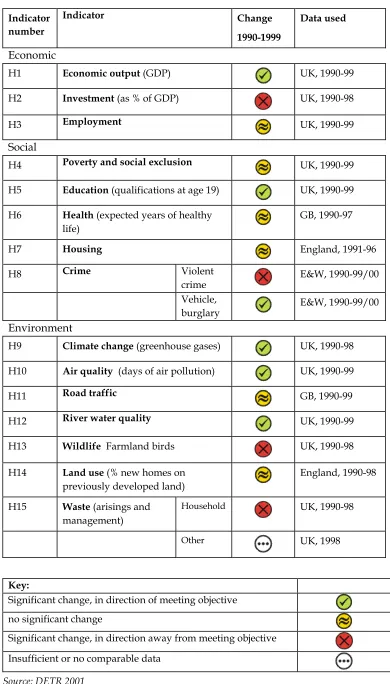
In November 1998, the DETR published its first report on UK performance against the Government’s sustainability indicators. The DETR published an update of progress against these indicators in January 2001. As shown in Figure 1.1, performance against the headline indicators varies - positive progress has been made since 1990 in areas such as economic output,
education, climate change, air quality and river water quality; but no progress or a deterioration has occurred in areas such as investment, poverty and social inclusion, road traffic, wildlife and waste arisings.
Figure 1.1: UK Headline Indicators for Sustainable Development
Indicator number
Indicator Change
1990-1999
Data used
Economic
H1 Economic output (GDP) UK, 1990-99 H2 Investment (as % of GDP) UK, 1990-98
H3 Employment UK, 1990-99
Social
H4 Poverty and social exclusion UK, 1990-99 H5 Education (qualifications at age 19) UK, 1990-99 H6 Health (expected years of healthy
life)
GB, 1990-97
H7 Housing England, 1991-96 H8 Crime Violent
crime E&W, 1990-99/00 Vehicle,
burglary E&W, 1990-99/00
Environment
H9 Climate change (greenhouse gases) UK, 1990-98 H10 Air quality (days of air pollution) UK, 1990-99 H11 Road traffic GB, 1990-99 H12 River water quality UK, 1990-99 H13 Wildlife Farmland birds UK, 1990-98
H14 Land use (% new homes on previously developed land)
England, 1990-98
H15 Waste (arisings and management)
Household UK, 1990-98
Other UK, 1998
Key:
Significant change, in direction of meeting objective no significant change
Significant change, in direction away from meeting objective Insufficient or no comparable data
2. OVERVIEW OF ACTIVITIES
2.1 REGIONAL AND DEVOLVED GOVERNMENT
2.1.1 Scope
In the last three years, there have been significant developments in the
structure of government in the UK, including the establishment of the Scottish Parliament and Scottish Executive, the Northern Ireland Assembly and
Executive, the National Assembly for Wales, Regional Development Agencies and Regional Chambers in the English regions and the Greater London Authority (the Mayor of London, the London Assembly, the London
Development Agency) (1) . As well as these new bodies, existing organisations such the Government Offices for the Regions, Scottish Enterprise and the Welsh Development Agency have also continued to play a key role in regional development activities.
These organisations have been given responsibilities for developing Northern Ireland, Scotland, Wales and the English regions and, therefore, have an important role in promoting sustainable development. Their contribution to promoting sustainable development is analysed below.
Policy Context:
The policy context in which devolved and regional government now operate has been established by a range of Government policies and guidance (2). These place a strong emphasis on the need to promote sustainable
development and on principles such as decentralised decision making, the importance of focusing on regional needs and a shared vision for developing a region, partnership, integration of economic, social and environmental goals and a strong element of accountability.
This policy context and the specific duties imposed on regional bodies to promote sustainable development (e.g. statutory duties placed on the RDAs 3, the Greater London Authority and the National Assembly for Wales4) provide a strong impetus and significant opportunities for promoting sustainable development through the activities of regional bodies to develop the regions.
(1)Throughout this paper, the term “regions” is sometimes used to encompass the Devolved Administrations in Scotland, Wales and Northern Ireland, London, and the English Regions. While we recognise that Northern Ireland, Scotland and Wales are not 'regions', it is difficult to find an alternative term to encapsulate the concept of government at sub-UK level.. (2)Examples of sources of the policy context include: the White Paper ‘Building Partnerships for Prosperity’ (December 1997), the government’s sustainable development strategy ‘A Better Quality of Life’ (1998), the Performance and Innovation Unit’s report ‘Reaching Out’, the Neighbourhood Renewal Strategy, the Rural White Paper, the Urban White Paper, the Competitiveness White Paper ‘Building our Competitive Future’ (1998), guidance on regional strategies, guidance on Regional Planning Guidance and the Spending Review 2000.
(3) Under the Regional Development Agencies Act 1998, one of the RDA’s statutory purposes is to “contribute to the achievement of sustainable development in the UK, where it is relevant to its area to do so”.
2.1.2 Actions by Devolved and Regional Government to Contribute to Sustainable Development
The emergence of these organisations has been accompanied by a significant increase in attention given to sustainable development in the context of regional development. This has in part been driven by statutory duties to contribute to sustainable development, as well as driven by the expectations of many other national and regional organisations and stakeholders.
Wales: In Wales, the National Assembly for Wales has finalised a “scheme” to promote sustainable development. A consultation process is now underway on an “action plan” to implement this scheme, as well as on the use of sustainability indicators. The Scheme includes a proposal to establish a new sustainable development Forum for Wales. The Welsh Development Agency (WDA) is also preparing a sustainable development policy for promoting sustainable development through its own activities. The National Assembly has also formulated a strategy for its work to develop Wales ‘Better Wales’ (2000) in which sustainable development is an underlying or cross-cutting theme.
The WDA and partners in Wales have also prepared guidance for promoting sustainable development through the Objective 1 Programme for West Wales and the Valleys (under the European Regional Development Fund).
Scotland: In Scotland, the Scottish Parliament, unlike the National Assembly for Wales, has no statutory duties relating to sustainable development and is leaving it to the Scottish Executive to give a lead. The Executive has adopted a strong sectoral focus on the issue of sustainable development, and has
identified waste, energy and travel as the Executive's key priorities for
sustainable development and is developing guidance on these three issues for public bodies. The Executive is also developing sustainability indicators and all New Bills in Scotland are required to be accompanied by memoranda explaining their implications for sustainable development.
Northern Ireland: In Northern Ireland, the Northern Ireland Executive plans to publish a strategy for sustainable development by April 2001. The
Department of the Environment, within the Executive, is responsible for integrating sustainable development into the different policies and activities of the Executive.
London: In London, the Greater London Authority has a duty to deliver sustainable development through all the Mayor’s strategies, which cover spatial planning, culture, transport, biodiversity, waste, air quality and noise. The Mayor has also added an energy strategy. The Mayor must also produce an economic development strategy, being written for him by the London Development Agency.
work. In addition, the Mayor has announced that he will be setting up a Sustainable Development Commission for London.
The English Regions: The following range of activities have been undertaken by regional organisations in order to promote sustainable development:
• Regional Economic Strategies (1) & RDAs: In the eight English regions, the RDAs and regional partners have sought to integrate sustainable
development (with varying degrees of success) into the Regional Economic Strategies (RES). The RDAs have been assisted in this by the Government Offices for the Regions and Agencies such as the Environment Agency, English Heritage, English Nature and the Countryside Agency.
In line with DETR requirements, the English regions have undertaken – though sometimes after the event - sustainability appraisals of the Regional Economic Strategies. Action plans are also being developed and appraised against sustainable development criteria. Some RDAs – eg SW RDA – have specific training programmes for staff in sustainable development.
The Regional Economic Strategies and the Action Plans to implement them contain many examples of positive actions which successfully integrate economic, social and environmental objectives and which will undoubtedly contribute to sustainable development. Examples are shown in Box 2.1.
Box 2.1: Examples of RDA Actions for Promoting Sustainable Development
• Community led regeneration activities which enhance local employment opportunities, environmental improvement, quality of life and social inclusion.
• Increased access to skills and learning for all parts of the community, particularly disadvantaged groups.
• Promotion of rural public transport services and development of integrated transport schemes.
• Activities to support the expansion of high growth, ‘clean’ industry sectors, which provide high quality jobs and relatively low environmental impacts.
• Actions to attract and embed inward investment into local economies in order to provide lasting employment opportunities and reduction of environmental impacts of inward investment.
• Actions to encourage the use of brownfield land over the use of greenfield sites.
• Support for businesses supplying environment goods and services and development of renewable energy generation capacity.
• Actions to highlight the contribution of the environment to regional economic development and the quality of life.
• Support for the development of regional and local agricultural produce and the supply of produce to markets within the region.
• The promotion of management best practice in businesses – including innovation, human resource and environmental practices.
• Regional Sustainable Development Framework: As well as work in relation to the Regional Economic Strategies, the Government has required each English region to develop a Regional Sustainable Development Framework (RSDF). These identify regional sustainability priorities, targets and indicators and have involved strong partnership working between regional organisations such as the Regional Assemblies, RDAs, the Government Offices for the Regions, Government agencies such as the Environment Agency, NHS Executives, sub-regional partnerships, local authorities, NGOs, business representatives, education associations, Regional Sustainability Round Tables and organisations such as Sustainability North West.
• Regional Planning Guidance: The Regional Assemblies and Regional Planning Conferences have also been seeking to integrate sustainable development into revised Regional Planning Guidance (RPG) during revision of RPG, including through the use of sustainability appraisal of RPG, in line with DETR guidance. Activities have also focused on integrating sustainable development into Regional Transport Strategies (which form part of RPG), particularly via regional multi-modal studies (discussed further in Section 5.2 below).
regional approach to competitiveness; sustainable development; regeneration and social inclusion both through the government
programmes over which the GO has direct control and by influencing the action of partners/partnerships”
Their activities – sometimes in partnership with local authorities1 - have included:
• preparation of Regional Sustainable Development Frameworks
• providing secretariats for Regional Sustainability Round Tables
• work to integrate sustainable development into the EU Structural Fund programmes
• delivery, funding and support of regional programmes and projects, e.g. preparation of regional food and produce strategies, programmes to support environmental businesses (e.g. promoting Government programmes such as Envirowise), waste minimisation initiatives and projects such as the GONW Support for the Mersey Basin Campaign.
• establishment of regional sustainability organisations such as Sustainability North West
• regional communication projects relating to sustainable development - for example, the South West’s ‘www.oursouthwest.com’ which
provides a clearing house on sustainability issues and organisations involved in the South West.
• Other Regional Players. Regional Round Tables on sustainable
development exist in a variety of different forms in most English Regions. They are often funded or supported in kind by GO’s, but currently lack a source of core programme funding. They focus on building cross-sectoral capacity on sustainable development, and place a high priority on
working with business.
2.1.3 How effective have these activities been in contributing to sustainable development?
Many of the activities outlined above have occurred in the last two years, and generally, the promotion of sustainable development through regional
development initiatives is at a relatively early stage. Similarly, the Devolved Administrations are still new organisations, and their sustainable
development programmes are barely at the implementation stage, if that. Efforts so far have largely focused on embracing the overall concept of
sustainable development and integrating it into high level strategic documents such as the Regional Economic Strategies, and identifying sustainable
development objectives in documents such as RSDFs, the National Assembly’s ‘scheme’ for sustainable development and the GLA’s strategy for sustainable development.
There has been mixed success in integrating sustainable development into the Regional Economic Strategies. In some cases, sustainable development is firmly embedded and the strategies have been successful in highlighting the positive linkages between economic, social and environmental objectives and stress how sustainable development is essential to the long-term success of the region.
However, in a number of other regions, sustainable development appears as something of an add-on and it is unclear how the objectives and actions will generate sustainable development. Scope exists for strengthening the
contribution of the Strategies to sustainable development in terms of further de-coupling economic growth from increased environmental impact and ensuring that the benefits of development reach all parts of society. In this respect a number of the Strategies tend to resemble traditional models of economic development rather than heralding a more marked shift towards a more sustainable growth path.
Nevertheless, the Regional Economic Strategies and the Action Plans to implement them contain many examples of positive actions which will undoubtedly contribute to sustainable development (as shown in Box 2.1 above). There is, however, considerable scope for more widespread implementation of these and other actions to promote sustainable development.
Having completed the preparation of the Regional Economic Strategies, the RDAs and regional partners now face a greater challenge of translating strategic commitments to sustainable development into practice. In
implementing the strategies, there are concerns that economic objectives will take precedence over broader sustainable development, social and
environmental objectives. Obstacles to progress towards sustainable development include the fact that:
• Many of the projects being implemented by Development Agencies in the Regions and the Devolved Administrations have been inherited from pre-existing programmes (for example, transport projects). These often contain little in the way of the integrated thinking of sustainable
development and the criteria which determine the allocation of funds do not necessarily reflect regional sustainability priorities. However, it is hoped that the move in April 2002 (1) towards integrated funding for RDAs, to replace ‘silo’ funding, will help put sustainable development into practice.
• At present, most English regions lack of clear set of regional priorities for sustainable development to guide the implementation of regional
development programmes. However, it is hoped that these priorities will be provided by the Regional Sustainable Development Frameworks.
• The current criteria and indicators used for monitoring regional
development and the success of organisations such as the RDAs tend to focus on economic measures of development, rather than sustainable development. This is a particular concern because of the competition between regions in the UK and internationally for jobs and inward investment. The eagerness to attract these jobs and investment may override broader sustainable development objectives.
• It will be important to continue to build experience and awareness of sustainable development amongst personnel in regional organisations with responsibilities for implementing regional development programmes (including in RDAs, regional partners and sub-regional partnerships). Individuals will need to develop further experience in ways of promoting economic, social and environmental objectives at the same time. It is therefore important that good practice in designing projects in order to promote sustainable development is identified and disseminated.
• There are limited resources in organisations such as the RDAs available or allocated for the promotion of sustainable development. The RDAs also have limited resources available to encourage and assist regional partners promote sustainable development (as opposed to delivering existing programmes in a way which promotes ‘business as usual’).
• Regional bodies are, arguably, relatively powerless in addressing some major sustainable development issues. For example, promotion of more sustainable transport is to a large degree dependent on national policies and funding, rather than regional actions.
• The Regional Economic Strategies often give significant weight to the development of certain high growth, high-tech sectors, and it is unclear how the development of these sectors will provide benefits for
disadvantaged groups, traditional industry sectors or for rural areas.
On a more positive note, Regional Development Agencies and regional
partners are increasingly aware of these issues and are now seeking to address them.
2.1.4 Recommended Actions for Increasing the Contribution of Regional and Devolved Government to Sustainable Development:
Action: By Whom:
Work closely with Devolved Administrations and regional organisations to ensure that SDC work programme reflects regional and national differences, and is not excessively London-centred
SDC
Encourage the establishment of sustainable development fora at sub-UK level, and develop links with these new organisations
SDC
Support a network of Regional Round Tables in England, share best practice and act as their advocate in Whitehall
SDC
Encourage devolved and regional bodies (which include development agencies) in England, Northern Ireland, Scotland and Wales to incorporate SD into their performance indicators and encourage consistency within regions
DETR
Encourage devolved and regional bodies to undertake staff training and awareness raising regarding SD.
DETR
Support activities by devolved and regional bodies to incorporate SD into project appraisal criteria.
DETR / SDC
Provide guidance to regional development organisations on integrating sustainable development into the forthcoming ‘single pot’ funding arrangements.
DETR
Work with Regional Chambers to develop guidelines and approaches for making use of the RSDFs and reporting on progress in delivering the RSDFs.
SDC
Assist Regional Chambers develop approaches for monitoring and evaluating the performance of RDAs in relation to SD.
SDC
Encourage regional organisations to make active use of the RSDFs.
SDC / DETR
Support the development of a distinctive role for the Government Offices (GO) in the Regions in relation to SD.
DETR / GOs / SDC
Work with Development Agencies across the UK to develop methods for demonstrating the added value of their activities to SD.
SDC
Encourage devolved and regional bodies to allocate staff responsibilities for promoting SD - at senior Board level and operational levels.
DETR / SDC
2.2 THE PRIVATE SECTOR
2.2.1 Scope
The private sector is basically defined as ‘businesses’. This category clearly covers a very broad range of organisations undertaking an equally broad range of activities, from: primary industries, such as agriculture, oil and gas and utilities; to manufacturing; and services sectors covering activities such as banking and finance, marketing and media.
2.2.2 What Actions have been Undertaken?
issued by the likes of Shell, BP-Amoco and British Telecom. However, as indicated in Box 2.3, these companies are a small minority, and of these, even fewer have got as far as turning strategic commitments to sustainable
development into hard action that fundamentally change the ways in companies operate.
Box 2.3 Indicators of Corporate Progress towards Sustainability
• A recent survey 1 questioned environmental health and safety managers in European and North American companies on what they were doing to promote sustainable development. The survey found that:
“…to a surprising degree many companies have now accepted the business value of the sustainable development pathway. 95% of the sample believed sustainable development to be important, and 82% felt it offers business value…But the survey found that action is much “thinner on the ground. Only 17% of the sample felt they were "well down the road" in integrating sustainable development into their business strategies or operations….The survey found "surprisingly little 'out of the box' thinking in current practice. Even companies in the vanguard were busiest in traditional areas of environmental action, such as pollution prevention, environmental auditing and improved energy efficiency….More novel tools and concepts such as full cost accounting, life-cycle assessment, eco-efficiency and closed loop manufacturing remain very much the province of a minority.
“…there remains a mismatch between executives' perceptions of the importance of sustainable development and their companies' actions…One reason for this is that "uncertainty about the timing of the threats and opportunities in sustainable development makes it hard for many companies to engage intensively in it. If 'the crunch' may be 50 years off, why make space on today's already crowded agenda? Related to this uncertainty is the difficulty companies have in seeing what sustainable development means for them."
• The 1999 BiE survey1 of corporate environmental engagement amongst the FTSE top 100 and top 350 companies reported that “the majority of companies said they had taken the initial steps of preparing environmental policies and allocating
responsibility for the environment to a board member. But a different picture emerged when firms were questioned on operational issues. Only a minority could claim to have well developed environmental management systems or consider their suppliers' environmental impacts”.
• The number of businesses in the UK adopting environmental management systems also indicates that only a minority of businesses have taken action to change their operations beyond making strategic and policy commitments to improved
performance. Despite environmental management systems having been promoted vigorously by the Government and others for several years, and despite evidence that they improve efficiency and help to ensure compliance, by May 2000, only around 1,200 ISO14001 certificates had been issued to companies in the UK and fewer than 100 sites were registered under the EC eco-management and audit scheme (EMAS).
• Whilst substantial increases have occurred in the numbers of firms reporting on their environmental performance, reporting remains a minority activity - and the quality of reports is highly variable – for example, it is often difficult for stakeholders to draw meaningful comparisons between firms.
During the mid-1990s a number of larger companies (particularly global players in the energy and mining sectors) began to explore the issue of ‘social responsibility’ in relation to their operations. In most cases, the catalyst for including social issues was the recognition of the risk to reputation and brand as a result of an increase in NGO campaigning and media interest.
Companies such as Shell, BP and Nike became embroiled in public battles after accusations that they were failing to consider the social impacts of their operations. The concept of ‘corporate social responsibility’ has since grown, from its origins in corporate philanthropy to the direct impacts of business policies on workers and local communities. For companies in the highly sensitive sectors with connections to developing countries (eg oil & gas, mining, retail with extensive global sourcing operations), the management of social issues has had to be more closely integrated into day-to-day operations. Eg, clothing retailers which manufacture or source products globally often task technical, quality, or purchasing staff with managing the social impacts of purchasing decision.
Other companies who are looking at their social impacts have tended to restrict this to employee health and safety and community involvement programmes and for many, these are still managed from the corporate affairs or communications department (albeit in conjunction with health and safety managers at the operational level). This underlines the corporate
understanding that these issues are reputational risk or PR challenges.
A great deal of research has been carried out into business attitudes towards issues such as the environment, climate change and corporate social
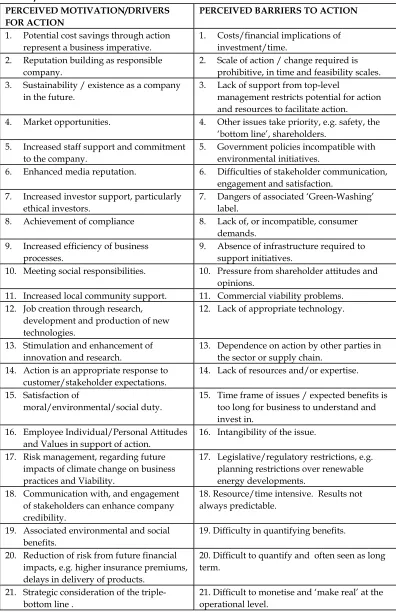
responsibility. In all of these areas a number of commonly perceived business advantages and opportunities as well as perceived barriers emerge. Both the perceived business advantages and the barriers are clearly important in understanding the extent to which business has engaged with sustainable development to date and factors which may influence the on-going
development of the engagement process. Table 2.1 highlights some of these drivers and barriers.
One important issue is that much of industry’s efforts to date have focused on compliance with environmental and other regulations. Compliance in itself is only a very small component of moving towards sustainable development.
The Global Dimension: Many UK companies are increasingly working in a globalised marketplace: selling and producing or sourcing products and services internationally, and responding to market pressures and regulations outside the UK. As a result these businesses have a global ‘footprint’,
affecting progress towards sustainable development in countries outside the UK. This global footprint has several implications.
• The UK, like any other Westernised economy, consumes a greater proportion of natural resources per head of population than most
developing countries. It is using more than its ‘fair’ share of world
resources. The private sector is inextricably linked to the UK’s consumption of resources and the global impact of this.
• UK companies that source products for UK markets are increasingly under pressure from consumers and NGOs to adopt progressive labour / social policies.
• UK companies are responding to the multiple agendas of other countries as well as the UK, with differing levels of enthusiasm for sustainable
development. This can result in considerable divergence in corporate concepts of sustainable development and in corporate priorities.
• It needs to be recognised that there is an imbalance in power and resources between the UK, as well as other Western countries, and their trading partners in the developing world. Campaigners accuse Western countries of using their power to create deals that benefit themselves at the expense of developing countries.
• There are concerns that the opening up of markets around the world will lead to the homogenisation or ‘westernisation’ of cultures.
Some companies are responding positively to their global footprint. For example, BP, Shell, Rio Tinto, Marks & Spencer, and B&Q are spreading corporate environmental and social good practice throughout their businesses and suppliers worldwide, involving adoption of better environmental
technology, more advanced manufacturing techniques, higher labour standards etc, in their international operations.
SMEs: Much of the discussion above relates to large, often multi-national companies. The picture amongst SMEs is somewhat different. While some contend that many SMEs are actively involved in their local communities - recent research by MORI found that over 60% of SMEs describe themselves as being involved in the community (1). - they generally do not see this as part of a wider sustainable development activity. On the whole SMEs are unlikely to have a formal sustainable development strategy and it is unlikely to feature as a high priority. Scarce management resources is a key factor in this.
Clearly there is an important role for the Small Business Service (SBS) in advising and training SMEs in sustainable development issues as a critical part of business competitiveness. It is important to underline that SMEs are more likely to respond positively to approaches which focus on improved economic performance and their future viability than on approaches which focus on sustainable development per se.
Research has also emphasised that SME behaviour is significantly influenced by the attitudes and awareness of key company personnel / owners and also their key clients (supply chain effects). This highlights that consumer demand
and client pressure are likely to be the determining factors in SME responses to sustainable development.
Table 2.1: Perceived Company Drivers & Barriers for Engaging with Sustainable Development
PERCEIVED MOTIVATION/DRIVERS FOR ACTION
PERCEIVED BARRIERS TO ACTION
1. Potential cost savings through action represent a business imperative.
1. Costs/financial implications of investment/time.
2. Reputation building as responsible company.
2. Scale of action / change required is prohibitive, in time and feasibility scales. 3. Sustainability / existence as a company
in the future.
3. Lack of support from top-level
management restricts potential for action and resources to facilitate action. 4. Market opportunities. 4. Other issues take priority, e.g. safety, the
‘bottom line’, shareholders. 5. Increased staff support and commitment
to the company.
5. Government policies incompatible with environmental initiatives.
6. Enhanced media reputation. 6. Difficulties of stakeholder communication, engagement and satisfaction.
7. Increased investor support, particularly ethical investors.
7. Dangers of associated ‘Green-Washing’ label.
8. Achievement of compliance 8. Lack of, or incompatible, consumer demands.
9. Increased efficiency of business processes.
9. Absence of infrastructure required to support initiatives.
10. Meeting social responsibilities. 10. Pressure from shareholder attitudes and opinions.
11. Increased local community support. 11. Commercial viability problems. 12. Job creation through research,
development and production of new technologies.
12. Lack of appropriate technology.
13. Stimulation and enhancement of innovation and research.
13. Dependence on action by other parties in the sector or supply chain.
14. Action is an appropriate response to customer/stakeholder expectations.
14. Lack of resources and/or expertise.
15. Satisfaction of
moral/environmental/social duty.
15. Time frame of issues / expected benefits is too long for business to understand and invest in.
16. Employee Individual/Personal Attitudes and Values in support of action.
16. Intangibility of the issue.
17. Risk management, regarding future impacts of climate change on business practices and Viability.
17. Legislative/regulatory restrictions, e.g. planning restrictions over renewable energy developments.
18. Communication with, and engagement of stakeholders can enhance company credibility.
18. Resource/time intensive. Results not always predictable.
19. Associated environmental and social benefits.
19. Difficulty in quantifying benefits.
20. Reduction of risk from future financial impacts, e.g. higher insurance premiums, delays in delivery of products.
20. Difficult to quantify and often seen as long term.
21. Strategic consideration of the triple-bottom line .
21. Difficult to monetise and ‘make real’ at the operational level.
2.2.3 Recommended Actions for Increasing the Contribution of the Private Sector to Sustainable Development
There are clearly a plethora of different actions which could be undertaken to promote sustainability. However, ones which the SDC might consider being involved in, include the following. Issues specific recommendations are provided in Section 3 to 7.
Action: By Whom:
The SDC could hold a major conference on the respective roles of the private sector, government and the public in advancing SD in order to focus discussion on the relationships between these key actors and to identify linked actions.
SDC
Issue clear guidance to industry on sustainability reporting. DETR Provide awareness-raising and communication initiatives on
SD at senior and middle-management level in businesses.
SDC / CBI / IOD
Increase awareness of sustainable development / competitiveness issues amongst SMEs.
DTI / SBS / RDAs
Work with financial / investment organisations to establish approaches for screening investments against sustainable development criteria, building on the experience of ‘Project Forge’ (DTI, DETR. BBA and ABI). Encourage the expansion of green or ethical investment funds.
DETR / DTI / SDC
Commission research to assess the potential for companies to extend their responsibility to the behaviour of product consumers.
SDC
Encourage Government to explore ways of strengthening drivers for companies to go beyond ‘good practice’ towards step changes in products and processes.
SDC / DTI / DETR
Review the effectiveness and if appropriate extend the number of sectoral sustainability strategies.
DETR
2.3 NON-GOVERNMENTAL ORGANISATIONS
2.3.1 Scope
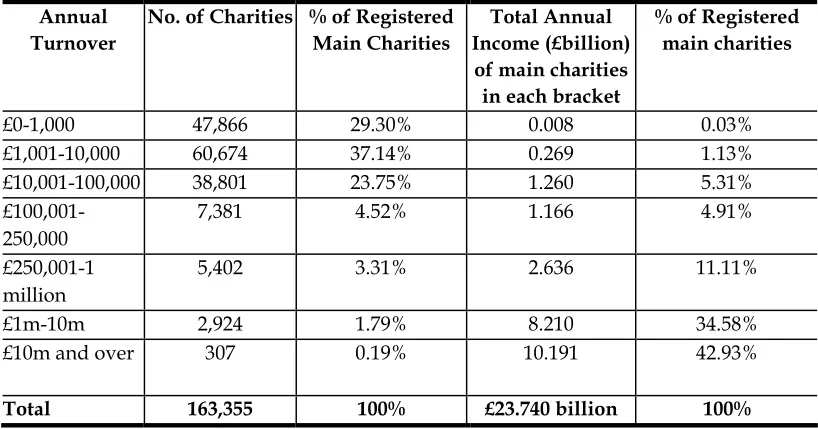
This sub-section provides an overview of the contribution made towards sustainable development by NGOs in the UK. The UK has a large and tremendously diverse NGO sector. There are over 160 000 charities in the UK, that are registered by the Charities Commission. This total excludes the
community groups that are not registered by the Commission. Over 100 000 of these organisations have an annual turnover of under £10 000. At the other extreme, 300 organisations have an annual turnover of over £10 million. Table 2.2 provides a breakdown of the relative size of NGOs in the UK and shows that the total turnover of organisations registered by the Commission is over £23 billion. This makes the sector a powerful economic force in its own right.
Table 2.2: Size of UK Charity Sector
Annual Turnover
No. of Charities % of Registered Main Charities
Total Annual Income (£billion)
of main charities in each bracket
% of Registered main charities
£0-1,000 47,866 29.30% 0.008 0.03% £1,001-10,000 60,674 37.14% 0.269 1.13% £10,001-100,000 38,801 23.75% 1.260 5.31%
£100,001-250,000
7,381 4.52% 1.166 4.91%
£250,001-1 million
5,402 3.31% 2.636 11.11%
£1m-10m 2,924 1.79% 8.210 34.58% £10m and over 307 0.19% 10.191 42.93%
Total 163,355 100% £23.740 billion 100%
2.3.2 What Actions have been Undertaken?
Types of NGO Activity:
As indicated by Box 2.4, there is a very broad range of NGO activities which relate to sustainable development. In terms of ‘types’, these can be divided into four broad areas outlined below.
• Public Awareness Raising: NGOs raise public awareness of issues through campaigns that are directly targeted towards influencing public opinion, and also indirectly by encouraging the public to lobby government, business and others.
[image:29.595.128.537.299.514.2]Box 2.4: Examples of NGO Activities Relating to Sustainable Development
• Community Regeneration, Social exclusion and poverty - for example, activities by the Joseph Rowntree Foundation, the Community Development Foundation, Groundwork, the Urban Forestry Unit and Shelter.
• Health issues in the UK and overseas – for example, activities of the Kings Fund, Green Gyms run by the British Trust for Conservation Volunteers (BTCV), Oxfam, Action Aid, Save the Children, the Tearfund and many medical charities.
• Recreation and sustainable development – For example, the BTCV’s Green Gym programme, activities by Surfers Against Sewage.
• Youth programmes – for example, Peacechild International, Going for Green, Joseph Rowntree Foundation, Save the Children, Tearfund.
• Education and Learning for sustainable development – for example, Forum for the Future and FoE.
• International trade, poverty and sustainable development. For example, programmes by the Fairtrade Foundation concerned with trade with marginalised producers in the South. It ensures that producers are paid enough to manage farms and production sustainably, despite often low world prices; the Friends of the Earth (FoE); Tearfund; Action Aid; Oxfam, Save the Children and Water Aid.
• Agriculture, forestry, food and rural issues relating to sustainable development in the UK and in developing countries – for example, the role of the Soil Association in promoting organic produce and links to rural community development, activities by the Council for the Protection of Rural England (CPRE), the Woodland Trust, Sustain and FoE.
• Industry and Commerce – Assistance to companies in developing sustainability strategies and actions, including helping businesses achieve cost effective environmental
improvements (e.g. Groundwork); publicising poor corporate performance (e.g. FoE); developing corporate strategies for sustainable development (e.g. Forum for the Future); and promoting energy efficiency and renewable energy (e.g. FoE, Sustainability North West and The Northern Energy Initiative).
• Regional Development and sustainable development, working with organisations such as the Regional Development Agencies and the Welsh Development Agency to promote sustainable development. For example, activities by Forum for the Future, the New Economic Foundation, the Groundwork Trust, Wildlife Trusts, RSPB, Sustainability North West and Sustainability South West.
• Sustainable Economic Development – For example, activities, research and campaigns by FoE, the Green Alliance and Forum for the Future.
• Eco-efficiency and consumer behaviour – For example, activities by the Commission for Sustainable Consumption and Forum for the Future.
• Wildlife conservation, protection and enhancement of the natural environment. For example, activities of the Wildlife Trusts, the RSPB, WWF, BTCV, Greenpeace, FoE and the Woodland Trust.
• Sustainable Transport – for example, activities by Sustrans, Transport 2000, FoE.
• Community Programmes: NGOs work with communities in a host of ways, to identify community needs, develop and manage projects, and act as a catalyst for change. At this level, NGOs can provide a voice for the views of communities.
partnership with government at different levels. NGOs also enter into partnerships with other organisations, such as industry groups and individual businesses.
Changes in Overall Role of NGOs:
There have been subtle but important shifts in the balance of activities carried out by NGOs during the past three to five years. These have been caused by shifts in NGO strategies, and also by changes in the approach of government to the charitable sector. The main shifts have been as follows:
• Service Delivery: The government has sought to increase the involvement of NGOs in service delivery, as evidenced, for instance, by the
Government’s future plans for New Deal; 200 of the first 600 computer learning centres are to run by community groups as well as the healthy living centres.
• Community Partnerships: The present government has placed increased emphasis on involving NGOs in community regeneration projects. Both the voluntary sector and community organisations have been encouraged to play a leading role in urban regeneration, most recently via participation in local strategic partnerships. This has been driven in part by the findings of the Social Exclusion Unit, that concluded that the failure to establish community ownership has been a primary cause of previous failures in community regeneration. This trend has led to a concern in some quarters that the independence of the NGOs is reduced as a result.
• Integrated and Collaborative Working: There is some evidence that NGOs are increasingly integrating environmental, social and economic issues - for example, environmental NGOs such as Friends of the Earth and WWF have placed increased emphasis on the social impacts of environmental
problems in their public advocacy work; and the work of organisations such as Groundwork involved in regeneration make strong links between environmental improvement, community development and employment opportunities for disadvantaged groups.
• Partnership Initiatives between NGOs and business: There has been a notable increase in the number and scale of such initiatives since the mid 1990’s. This has been led by existing and new NGOs in the environmental movement i.e. the World-Wide Fund for Nature and Forum for the Future.
argued the case for these partnerships.1 The impact of these partnerships is currently the focus of “Innovation through Partnership”, a research project led by the Institute of Social and Ethical Accountability, and supported by the Department of Trade and Industry.
• NGO Co-operation: Given the tremendous diversity of the NGO sector, one issue that should be briefly considered is the extent of co-operation between them on issues of common interest. The Jubilee 2000 initiative on Third World Debt demonstrated that joint activities can be much more effective than individual action. While the national environmental NGOs in the UK have co-operated on issues such as traffic reduction, there is no evidence that there is a significant shift towards increased co-operation. Climate change is perhaps the primary example of an issue where a joint initiative could capture greater public and political attention than
fragmented action.
2.3.3 The Contribution to Sustainable Development:
Given public confidence in the role of NGOs on environmental and other issues and their increasing emphasis on forming innovative partnerships and in carrying out service delivery, there would seem to be considerable scope for expanding the contribution of NGOs in delivering sustainable development.
If we are indeed moving to an age of ‘active citizenship’ and an ’enabling state’ (and) if one of the pre-conditions for this is the renewal of civic society both of which are clearly fundamental to sustainable development, then the role of NGOs and the wider voluntary sector is clearly fundamental.
(1) 1 Partnership Alchemy: New Social Partnerships in Europe, Jane Nelson & Simon Zadek.