Simulation fails to replicate stress in trainees performing a technical procedure in the clinical environment.
Abstract Introduction
Simulation based training (SBT) has become an increasingly important method by
which doctors learn. Stress has an impact upon learning, performance, technical, and
non-technical skills. However, there are currently no studies that compare stress in the
clinical and simulated environment. We aimed to compare objective (heart rate
variability, HRV) and subjective (state trait anxiety inventory, STAI) measures of
stress theatre with a simulated environment.
Methods
HRV recordings were obtained from eight anaesthetic trainees performing an
uncomplicated rapid sequence induction at pre-determined procedural steps using a
wireless Polar RS800CX monitor © in an emergency theatre setting. This was
repeated in the simulated environment. Participants completed an STAI before and
after the procedure.
Results
Eight trainees completed the study. The theatre environment caused an increase in
objective stress vs baseline (p=0.004). There was no significant difference between
average objective stress levels across all time points (p=0.20) between environments.
and environment (p=0.045). There was no significant difference in subjective stress
(p=0.27) between environments.
Discussion
Simulation was unable to accurately replicate the stress of the technical procedure.
This is the first study that compares the stress during SBT with the theatre
environment and has implications for the assessment of simulated environments for
use in examinations, rating of technical and non-technical skills, and stress
Keywords Simulation
Anaesthetics
Assessment
Introduction
The master-apprenticeship ‘see one, do one’ approach to medical education (WS
Halsted 1904) has stood for some time. The potential impact of this approach upon
patient safety is unacceptable. Trainees must now climb the ‘learning curve’ without
exposing patients to preventable errors. Simulation based training (SBT) is ‘a
technique to replace or amplify real-patient experiences with guided experiences,
artificially contrived, that evokes or replicates substantial aspects of the real world in
a fully interactive manner’ (Gaba 2004). SBT has become increasingly important
within medical education and now often forms a mandatory part of training and
examinations, pioneered by anaesthesia (Gaba & DeAnda 1988; Holzman et al.
1995).
High-fidelity simulation has previously been defined as simulations that look like the
criterion context and present realistic performance characteristics and scenarios
(Grierson 2014). However, there is a lack of evidence for the assumption that
high-fidelity simulations lead to better learning (Norman et al. 2012), and some have
suggested that the term ‘fidelity’ is abandoned altogether (Hamstra et al. 2014),
instead focussing on specific factors that impact upon educational effectiveness
enabling educators to consider the value of a particular simulation for learners of
varying experience who have different ‘learning curves’ (Aggarwal et al. 2010).
Stress is described as a physical and psychological response to environmental
demands and is best recognised as the ‘Fight or Flight’ response (Selye 1973). The
insufficient to meet the demands of the situation (Harvey et al. 2010).
Socio-evaluative stressors (when behaviour is potentially being judged by others) and
situations beyond the perceived control of the participant are more likely to induce
stress, and this may be relevant in formative and summative assessment. Studies
demonstrate improved performance during crisis simulation is associated with lower
levels of stress (Wetzel et al. 2010). In addition, significantly increased levels of
stress can potentially impair learning in the simulated environment (Harvey et al.
2012), and lead to adverse events in theatre (Arora, Hull, et al. 2010). Stress is known
to adversely affect both technical and non-technical skills (Doleman et al. 2016),
which has implications for the assessment of these skills in trainees within simulated
environments. The airline and military industries have pioneered the use of SBT to
prepare individuals for stressful situations. They have acknowledged that even the
performance of experienced operators can deteriorate with stress and have training
programmes to mitigate these effects (JE Driskell & E Salas 1991; R Flin et al. 2008).
An understanding of the effect of stress in clinical contexts is critical as performance
impairment could impact upon patient care. Furthermore, it has been suggested that
SBT may be used in stress management training (Arora et al. 2009; Harvey et al.
2010) for acute clinical scenarios.
There are no published studies directly comparing stress in a clinical environment
with SBT. Evaluation of SBT in this regard is currently based on learner outcomes
and subsequent performance. Altering aspects of simulated environments and
scenarios will impact upon levels of stress in participants. The ability to assess
whether levels of stress are commensurate with the clinical environment has
summative assessment. Optimisation of stress management training requires the
ability to compare the stress generated by the training delivered with the clinical
environment. This proof of principle study proposes a methodology by which this
may be achieved.
Heart Rate Variability (HRV) is a measure of the fluctuations in the interval between
consecutive heart beats (R-R interval). Assessment of these fluctuations allows for the
relative contribution of the sympathetic and parasympathetic nervous systems to be
calculated (Jones et al. 2015). Mental stress results in an increase in sympathetic
output, which is reflected in HRV recordings (Akselrod et al. 1985; Malliani et al.
1991; Mølgaard 1991). HRV has been used previously in multiple studies to
demonstrate increases in intra-operative stress in surgeons (Böhm et al. 2001; Song et
al. 2009; Jones et al. 2015), and for the assessment of training effectiveness and
simulator realism in simulated flight (Jorna 1993). HRV can be measured
dynamically, non-invasively, and remotely, allowing stress to be measured
objectively at defined time points with no interruption during the accomplishment of a
given clinical or technical procedure.
The State Trait Anxiety Inventory (STAI) is a is a six-item, 4-point Likert style
questionnaire for use in quantifying subjective levels of stress in the clinical
environment (RL Metzger 1976). A short version developed by Marteau and Becker
was used in this study (1992). Scores range from 6 to 24; higher scores signify greater
Due to the adoption of SBT within medical education, and the known effects of stress
on learning, performance, technical and non-technical skills, we aimed to compare the
stress induced by simulation with clinical environments. To our knowledge this is the
first published direct comparison of stress induced in SBT with that induced in the
theatre environment, and propose that this is a reproducible methodology that may be
used to optimise SBT for learning, assessment, and stress management training.
Methods
Ethical approval was gained from the University of Nottingham Medical School
Research Ethics Committee (LTf15082013 SoM Med Sci GEM).
Participants and conditions
After providing written informed consent, eight anaesthetic core trainees participated
in our study (trainees in the first three years of specialist training). Participants did not
take part in vigorous activity within 30 minutes of the control recording and did not
consume caffeine for 12 hours prior to performing the procedure in theatre or in the
simulated environment. None of the participants had any medical conditions that
could influence HRV and none took any regular medications. All were non-smokers.
Rapid sequence induction (RSI) is the preferred method of achieving emergency
endotracheal intubation as it results in rapid unconsciousness and neuromuscular
blockade. This is important in patients who have not fasted and are at high risk for
regurgitation and aspiration. RSI was chosen as the criterion procedure as trainees are
performed in an emergency situation, the pathway is usually reproducible between
patients, infrequently complicated, and requires minimal levels of physical activity by
the performer that may otherwise affect HRV recordings. All RSIs performed in the
theatre environment were uncomplicated cases on the emergency theatre list.
Heart rate variability
Heart rate recordings were obtained using a wireless Polar RS800CX monitor (©
Polar Electro 2011, Warwick UK). The equipment comprises a wireless chest strap
that remotely transmits data to a watch device operated by the researcher so that there
is no interference during the procedure. Polar devices have been validated for
recording HRV in humans (Gamelin et al. 2006). The electrocardiogram recorded
R-R intervals for a period of five minutes according to guidelines published by the Task
Force of the European Society of Cardiology and the North American Society of
Pacing and Electrophysiology (Heart rate variability 1996) at each of the
pre-determined steps of the procedure. All data were electronically transferred to a
computer using Polar Protrainer® software version 5.40.170 and analysed offline. In
order to obtain frequency domain measures a computerised fast Fourier
transformation calculated the power spectral density. Low frequency (LF)
(0.04-0.15Hz) and high frequency (HF) (0.15-0.4Hz) components were analysed. An
increase in the LF component reflects increased sympathetic tone, and an increase in
the HF component reflects increased vagal tone. The LF/HF ratios were subsequently
calculated, as this is considered to be the most sensitive marker of overall
sympathovagal tone (Pagani et al. 1989; McCraty et al. 1995; Heart rate variability
Data collection
HRV recordings were taken at pre-determined procedural steps, derived from the
Royal College of Anaesthetists Direct Observation of Procedural Skill (RCoA DOPS)
proforma, routinely performed during RSI (1=Control, 2=Preparation,
3=Pre-oxygenation-endotracheal tube placement with proof (intubation), 4=Post-intubation
management). A STAI assessment was obtained immediately prior to and following
the procedure, and trainees were asked to identify what they perceived to be the most
stressful component. The supervising consultant anaesthetist was asked to complete
an RCoA DOPS proforma immediately following the procedure to validate that an
RSI had taken place. This process was also performed with the same participants in
the simulated environment. Recordings from 50% were taken in the theatre
environment prior to the simulated environment, with the reverse true for the
remaining participants. An identical uncomplicated clinical scenario was provided to
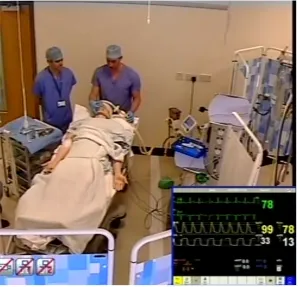
all participants. The simulated environment was matched as closely as possible to the
operative environment in the presence of an operating department practitioner (ODP)
and consultant anaesthetist on SimMan3G version 2.3_020304 (Figure 1). A trained
technician using a multidirectional camera and microphone system controlled
SimMan. All participants were required to wear theatre clothing, use equipment
identical to that of the operative environment, and interact with the SimMan. The
physiological parameters of SimMan were visible throughout.
Statistical analysis
Sample size calculations determined a sample size of 8 was required assuming a
level of two (theatre versus simulation) and the other with a level of four (procedure
step). We assumed a correlation coefficient of 0.50 and a non-sphericity correction of
1. This analysis had a power of 0.9 and an alpha level of 0.05. To evaluate whether
rapid sequence induction increased objective stress we used a one-way repeated
measures ANOVA with post-hoc Bonferroni test to adjust for multiple comparisons.
To identify the interaction of environment (theatre versus simulation) with stress, we
performed a two-way repeated-measures ANOVA with a test for interaction. We
tested the assumption of sphericity using Mauchly’s test with p<0.1 regarded as
evidence of non-sphericity. We analysed STAI before and after the procedure using
Wilcoxon signed rank test and when comparing environments used Friedman’s
ANOVA. We regarded a p<0.05 as significant (two-tailed). All analyses were
Results
Seven male and one female anaesthetic core trainees completed the study. They were
all familiar with the equipment in the theatre and their ODP. An RSI procedure was
validated as having taken place on every occasion by a consultant anaesthetist.
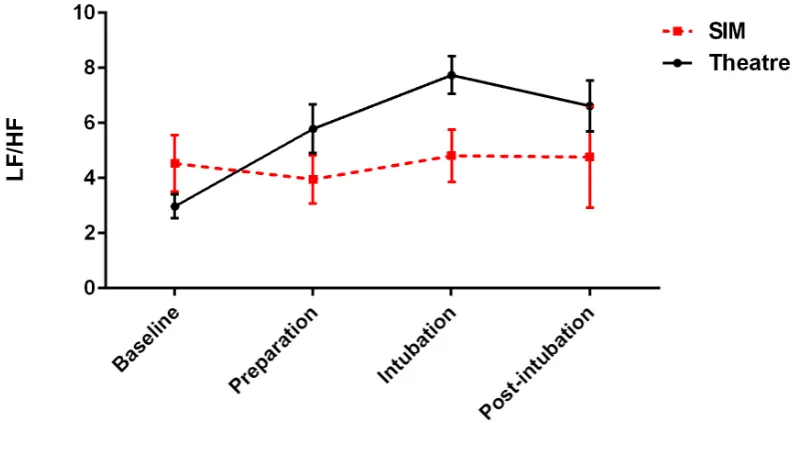
The theatre environment caused an increase in LF/HF ratio from baseline (p=0.004).
However, post hoc tests revealed the only significant difference was between baseline
and intubation (mean 2.97 versus 7.74; p=0.006). There was no significant increase in
STAI in theatre from baseline to post-procedure (p=0.11). Simulation did not increase
stress from baseline when measured objectively (p=0.86) or subjectively (p=0.16).
When comparing the theatre and simulated environment, there was no significant
difference between the average LF/HF ratios when compared across all time points
(p=0.20). When examining the test for interaction, there was a significant interaction
between the variables of objective stress and environment (p=0.045). For example,
baseline LF/HF ratio was higher with simulation and did not significantly increase
throughout the procedure (Figure 2). However, in theatre, at baseline the LF/HF ratios
were lower but sharply rose during the procedure, peaking at intubation. On post hoc
testing, significant interactions occurred with baseline versus preparation (p=0.01)
and baseline versus intubation (p=0.027). When examining stress by STAI in theatre
versus simulation there was no significant difference (p=0.27).
In the theatre environment 6/8 trainees subjectively identified intubation as the most
simulated environment 4/8 trainees subjectively identified intubation as the most
stressful procedural step, 3/8 identified preparation and 1/8 identified post-intubation
management. Matched with their physiologically most stressful component on an
individual basis, 6/8 participants correctly identified their most stressful component in
Discussion
Our SBT replicated the physical and procedural form of the clinical scenario as
accurately as possible. We were able to observe real-time dynamic changes in the
HRV at different procedural steps of the RSI. There was no significant difference in
the average levels of stress induced by the differing environments across the entire
course of the procedure.
Our results suggest there was a greater physiological stress response seen in the
theatre environment during the procedure when compared to baseline measures. The
physiological stress in trainees was greater at baseline in the simulated environment
than in the theatre environment but demonstrated little variation throughout the
procedure. This suggests that SBT was unable to accurately replicate the stress of the
technical procedure, but the environment may induce a level of pre-performance
anxiety. There was a poor correlation between the component of the procedure that
participants perceived as, and physiologically was, the most stressful component,
particularly in the simulated environment.
Undoubtedly, the most striking difference between the environments is the presence
of a live patient. The potential for harm to occur if mistakes are made in theatre may
account for the physiological stress response seen during the technical procedure in
theatre. Previous studies have found that activity patterns are comparable between
simulated and theatre environments for the same procedure (Manser et al. 2007).
Therefore it is most likely that other factors may have affected the objective
interruptions, being on call, or a heavy workload, all of which are commonly
recognised stressors in the operative environment (Arora, Sevdalis, et al. 2010), but
are difficult to replicate in SBT. Pre-performance anxiety may have contributed to the
higher baseline physiological stress of trainees in the simulated environment.
Participants may have expected a negative outcome or event during the simulation
since it is a commonly used method of exposing trainees to rare or life threatening
scenarios. In the simulated environment participants were away from their normal
working environment, and were unaware of the scenario they were about to face,
factors that could have created a degree of apprehension (Steel 2005).
Our findings are consistent with previous studies that have also demonstrated a
significant variation in levels of stress using HRV between procedural steps in a
clinical environment (Song et al. 2009; Jones et al. 2015). HRV has been previously
been well correlated with STAI by our group in consultant surgeons performing
elective colorectal resections (Jones et al. 2015) and in consultant anaesthetists during
intubation (Doleman et al. 2016), but this study suggests that this may not be the case
in the simulated environment. Given that 6/8 participants identified their most
physiologically stressful step correctly in the theatre environment (vs 1/8 in the
simulated environment), it would appear that participants are less in tune with
physiological changes that occur with stress when in an unfamiliar environment. The
variation in subjective appreciation of stressful events in SBT is consistent with a
previous study demonstrating experience of SBT differs among participants
Voluntary participation in this study may have introduced an element of selection
bias, as those agreeing to participate may have been inherently more comfortable with
either theatre or simulation environments. The lack of female participants meant that
gender differences could not be observed and this may reduce the external validity of
our findings. All trainees were of a similar seniority, although some may have been
exposed to a higher number of RSIs in theatre than others prior to taking part in the
study; using the same trainee in both environments should have controlled for this
variable. Finally, the relatively small sample size limits the conclusions, and
confirmatory results in larger samples are required.
A significant effort was made to ensure that the simulated environment replicated that
of theatre. SimMan 3G is designed to deliver the most realistic training possible
whilst remaining easy to set up and simple to operate (Laerdal Medical). HRV
measurements using the Polar RS800CX monitor are non-invasive, can be done
remotely by the operator without procedural interruption, and require minimal
expertise to perform. Data can be recorded from multiple members of the team
simultaneously, and this has been demonstrated by our group (Bhalla et al -
unpublished data).
Despite the limitations of our study, our findings may have important implications for
future medical education and research. Our finding that simulation was unable to
recreate the stress of performing the technical procedure has implications for the
ability of SBT to contribute towards the mastery of clinical procedures in trainee
clinicians. Stress may have positive (Smeets et al. 2009) or negative effects (Harvey
(Arora, Sevdalis, et al. 2010) and non-technical skills (Doleman et al. 2016). SBT is
frequently used to assess these domains in medical education and the research arena
(Yee et al. 2005); therefore the validity of such assessments and the application of
findings from research studies in the simulated environment to clinical practice may
be questioned. Future studies may wish to evaluate participant stress in different
simulated environments to assess stressful triggers and provide feedback as a learning
tool, and to optimise SBT for assessment and stress management training. Assessing
the impact of stress on learning and performance of technical or non-technical skills
in simulated environments also warrants further investigation.
In conclusion, we have demonstrated a real-time non-invasive method to compare the
stress in trainees performing a procedure in a simulated versus clinical environment
by both objective and subjective measures. Moreover, our results suggest that SBT
was unable to accurately replicate the stress of the technical procedure performed in
theatre, but the environment may induce a level of pre-performance anxiety.
Importantly, this study has implications for the objective assessment of simulated
environments for use in examinations, rating of technical and non-technical skills, and
stress management training. To our knowledge this is the first published direct
Practice points
• We have demonstrated a real-time non-invasive method to compare the stress
in trainees performing a procedure in a simulated versus clinical environment.
• To our knowledge this is the first published direct comparison of stress
induced during simulation compared with the theatre environment.
• Our simulated environment was unable to replicate the stress of the technical
procedure in the clinical environment.
• Our simulated environment induced a level of pre-performance anxiety.
• This has implications for the objective assessment of simulated environments
for use in examinations, rating of technical and non-technical skills, and stress
Declaration of interest
The authors report no declarations of interest.
References
Aggarwal R, Mytton OT, Derbrew M, Hananel D, Heydenburg M, Issenberg B, MacAulay C, Mancini ME, Morimoto T, Soper N, et al. 2010. Training and simulation for patient safety. Qual Saf Health Care. 19 Suppl 2:i34-43.
Akselrod S, Gordon D, Madwed JB, Snidman NC, Shannon DC, Cohen RJ. 1985. Hemodynamic regulation: investigation by spectral analysis. Am J Physiol. 249:H867-875.
Arora S, Hull L, Sevdalis N, Tierney T, Nestel D, Woloshynowych M, Darzi A, Kneebone R. 2010. Factors compromising safety in surgery: stressful events in the operating room. Am J Surg. 199:60–65.
Arora S, Sevdalis N, Nestel D, Tierney T, Woloshynowych M, Kneebone R. 2009. Managing intraoperative stress: what do surgeons want from a crisis training program? Am J Surg. 197:537–543.
Arora S, Sevdalis N, Nestel D, Woloshynowych M, Darzi A, Kneebone R. 2010. The impact of stress on surgical performance: a systematic review of the literature.
Surgery. 147:318–330, 330–6.
Bakeman R. 2005. Recommended effect size statistics for repeated measures designs. Behav Res Methods. 37:379–384.
Böhm B, Rötting N, Schwenk W, Grebe S, Mansmann U. 2001. A prospective randomized trial on heart rate variability of the surgical team during laparoscopic and conventional sigmoid resection. Arch Surg Chic Ill 1960. 136:305–310.
Dieckmann P, Manser T, Wehner T, Rall M. 2007. Reality and Fiction Cues in Medical Patient Simulation: An Interview Study With Anesthesiologists. J Cogn Eng Decis Mak. 1:148–168.
Doleman B, Blackwell J, Karangizi A, Butt W, Bhalla A, Lund JN, Williams JP. 2016. Anaesthetists stress is induced by patient ASA grade and may impair non-technical skills during intubation. Acta Anaesthesiol Scand.
Gaba DM. 2004. The future vision of simulation in health care. Qual Saf Health Care. 13 Suppl 1:i2-10.
Gaba DM, DeAnda A. 1988. A comprehensive anesthesia simulation environment: re-creating the operating room for research and training. Anesthesiology. 69:387–394.
Gamelin FX, Berthoin S, Bosquet L. 2006. Validity of the polar S810 heart rate monitor to measure R-R intervals at rest. Med Sci Sports Exerc. 38:887–893.
Hamstra SJ, Brydges R, Hatala R, Zendejas B, Cook DA. 2014. Reconsidering fidelity in simulation-based training. Acad Med J Assoc Am Med Coll. 89:387–392.
Harvey A, Bandiera G, Nathens AB, LeBlanc VR. 2012. Impact of stress on resident performance in simulated trauma scenarios. J Trauma Acute Care Surg. 72:497–503.
Harvey A, Nathens AB, Bandiera G, Leblanc VR. 2010. Threat and challenge: cognitive appraisal and stress responses in simulated trauma resuscitations. Med Educ. 44:587–594.
Heart rate variability. 1996. Circulation. 93:1043–1065.
Holzman RS, Cooper JB, Gaba DM, Philip JH, Small SD, Feinstein D. 1995. Anesthesia crisis resource management: real-life simulation training in operating room crises. J Clin Anesth. 7:675–687.
JE Driskell, E Salas. 1991. Overcoming the effects of stress on military performance; human factors, training and selection strategies. Oxford: Wiley.
Jones KI, Amawi F, Bhalla A, Peacock O, Williams JP, Lund JN. 2015. Assessing surgeon stress when operating using heart rate variability and the State Trait Anxiety Inventory: will surgery be the death of us? Colorectal Dis Off J Assoc Coloproctology G B Irel. 17:335–341.
Jorna PG. 1993. Heart rate and workload variations in actual and simulated flight. Ergonomics. 36:1043–1054.
Laerdal Medical. SimMan 3G [Internet]. [cited 2015 Nov 2]. Available from: www.laerdal.com
Lin LY, Wu CC, Liu YB, Ho YL, Liau CS, Lee YT. 2001. Derangement of heart rate variability during a catastrophic earthquake: a possible mechanism for increased heart attacks. Pacing Clin Electrophysiol PACE. 24:1596–1601.
Malliani A, Pagani M, Lombardi F, Cerutti S. 1991. Cardiovascular neural regulation explored in the frequency domain. Circulation. 84:482–492.
Manser T, Dieckmann P, Wehner T, Rallf M. 2007. Comparison of anaesthetists’ activity patterns in the operating room and during simulation. Ergonomics. 50:246– 260.
Marteau TM, Bekker H. 1992. The development of a six-item short-form of the state scale of the Spielberger State-Trait Anxiety Inventory (STAI). Br J Clin Psychol Br Psychol Soc. 31 ( Pt 3):301–306.
McCraty R, Atkinson M, Tiller WA, Rein G, Watkins AD. 1995. The effects of emotions on short-term power spectrum analysis of heart rate variability. Am J Cardiol. 76:1089–1093.
Norman G, Dore K, Grierson L. 2012. The minimal relationship between simulation fidelity and transfer of learning. Med Educ. 46:636–647.
Pagani M, Furlan R, Pizzinelli P, Crivellaro W, Cerutti S, Malliani A. 1989. Spectral analysis of R-R and arterial pressure variabilities to assess sympatho-vagal interaction during mental stress in humans. J Hypertens Suppl Off J Int Soc Hypertens. 7:S14-15.
R Flin, P O’Connor, M Critchon. 2008. Safety at the sharp end: a guide to non-technical skills. Aldershot, UK: Ashgate.
RL Metzger. 1976. A reliability and validity study of the state-trait anxiety inventory. J Clin Psychol. 32:276–278.
Selye H. 1973. The evolution of the stress concept. Am Sci. 61:692–699.
Smeets T, Wolf OT, Giesbrecht T, Sijstermans K, Telgen S, Joëls M. 2009. Stress selectively and lastingly promotes learning of context-related high arousing information. Psychoneuroendocrinology. 34:1152–1161.
Song M-H, Tokuda Y, Nakayama T, Sato M, Hattori K. 2009. Intraoperative heart rate variability of a cardiac surgeon himself in coronary artery bypass grafting surgery. Interact Cardiovasc Thorac Surg. 8:639–641.
Steel GD. 2005. Whole lot of parts: stress in extreme environments. Aviat Space Environ Med. 76:B67-73.
Wetzel CM, Black SA, Hanna GB, Athanasiou T, Kneebone RL, Nestel D, Wolfe JHN, Woloshynowych M. 2010. The effects of stress and coping on surgical performance during simulations. Ann Surg. 251:171–176.
WS Halsted. 1904. The training of the surgeon. Bull Johns Hopins Hosp. 15:267.