Reliability in Electronic Data Processors
· .. William B. Elmore
Numerical Representation in Fixed-Point Computers
· .. Beatrice H. Worsley
Automation -
-
A Report to the UAW-CIO Economic and
Collective Bargaining Conference
The Skills of the American labor Force
· .. James P. Mitchell
Automation Puts Industry on Eve of Fantastic Robot Era
· .. A. H. Raskin
The Monkey Wrench
the small relay that's
\j~QL <GJ3l-r~]
I-~
~lbDD
Class
Z
relay outperforms miniatures, costs less
S P I I C I ' I C A T I O N t i Standard Types-ZOA (quick-acting), ZSO (slow-operating), ZSR (slow-releasing), ZSA (slow-acting), and ZFA (for a-c operation). Operating Voltage-Series ZOA and ZSA, up to 135 volts, de; Series ZSO and ZSR, up to 115 volts, dc; Series. ZFA, up to 115 volts, ac. Contact Spring Capacity-Series ZOA, ZFA, and ZSO, 13 springs; Series ZSA and ZSR, 6 springs.
Contacts-Normally single. Load-carrying ca-pacity, 150 wafts.
Dimensions-Overall length, 2%"; height, 1V2" to 23/./'; width, 1~" for single' pile-ups, 1 %" for double pile-ups.
Net welght-4-6 oz.
Can be p/ug-mounted-ask for Circular J 804
Automatic Electric's Class Z relay exactly fits many applications where -relays of extremely small size cannot match its service and operating charac-teristics. Take these typical cases:
Machine tool manufacturer-needed a relay that was small, but carried a good-sized contact load.
Computer manufacturer-needed an inexpensive relay with large bearing surfaces for long life.
For airborne equipment-maker needed a compact relay capable of with-standing shock, vibration, and extreme temperatures.
All three selected Automatic Electric Class Z relays-and all three are, highly pleased!
Surprisingly low cost.
You'll find, as many manufacturers have, that the Class Z-made to Automatic Electric's usual standards of high quality-actually costs less than most so:called ((cheap" relays! Here's a relay you can consider for all your relay applications!
Write for recommendations, prices and delivery schedules. Delivery is prompt. Automatic Electric Sales Corporation, 1033 West Van Buren Street, Chicago 7, Illinois. In Canada: Automatic Electric Sales (Canada) Ltd., Toronto. Offices in principal cities.
RELAYS
\
SWITCHES ,.,,"''' 0, '~'"".'" "CO"'""'"'
AIJTDMATI[
ELE[TRI[
®
COMPlTTE,R.S
AND AUTOMATION
CYBERNETICS
•
ROBOTS
•
AUTOMATIC CONTROL
Vol. 4," No. 4
April, 1955
- ESTABLISII.ED SEPTE~.'BEn. 1951 -
NI:D
CI-IAPIN
ARTICLES
Reliability in Electronic Data Processors
••• William B. Elmore
Automation -- A Report to the UAW-CIO Economic and Collective
Bargaining Conference
Automation Puts Industry on Eve of Fantastic Robot Era
A.H. Raskin
The Skills of the American Work Force
••• James P. Mitchell
FICTION
The Monkey Wrench
••• Gordon R. Dickson
PAPERS
6
14
27
29
21
Numerical Representation in Fixed-Point Computers
10
Beatrice H. Worsley
REFERENCE INFORMATION
Books and Other Publications
Gordon Spenser
FORUM
Electronic Computers and Related Topics -- Four Special Summer
Courses
Arvid Jacobson
Recent Remarks
First Supersonic Flight Simulator
Cost Allocation
The Editor's Notes
Index of Notices
Advertising Index
Neil Macdonald
Bill Danch
33
20
36
40
44
4
37
50
Editor: Edmund C. Berkeley Advisory Committee: Samuel R. Williams. Assistant Fditors: Eva Di Stefano. Neil Macdonald, Jack Herbert F. Mitchell. Jr .• Justin
Moshman. Gordon Spenser. F. L. Walker Oppenheim
Contributing Editors: Andrew O. Booth. John M. Breen. John W. Carr. III. Alston S. Householder. Fletcher Pratt
Publisher: Berkeley Enterprises. Inc.
36 West 11 St., New York 11, N.Y. -Algonquin 4 7675
815 Washington St., Newtonville 60. ~lass. -Decatur 2 5453 or 2 392R
Effective September I, 1954, mMPUTERS AND AUm1ATION is published monthly, twelve times a year. Copyright, 1955, by Edmund Callis Berkeley. Subscription rates: $4.50 for one year. $8.50 for two years, In the United States: $5.00 for one year, f,9.S0 for two years, in Canada; $5.50 for one year, $10.50 for two years else-Bulk subscription rates: see page B. Advertising rates: see page SO.
Entered as second class matter at the Post Office, New York, N. Y.
-THE EDITOR'S NOTES
ECONOMIC CHANGES FROM AUTOMATIONIn the few days before this issue of "Com-puters and Automation" went to press, General Motors Corporation and the United Automobile Workers, C.I.O., began to bargain in Detroit for a new contract in regard to the company's
325,000 production workers. The New Yorklll~
said, "The union has made clear that it intends to obtain some form of a guaranteed an n u a 1
wage, or i1 will strike •••• Under the union's proposal, workers 'would be guaranteed fifty-two weeks of pay each year; the plan would be geared into state unemployment compensation. One of, the developments in the auto industry that has caused the union to emphasize the guaranteed annual wage is the spectacular ad-vance of automation -- increased use of auto-matic machines in industry."
The question of how and to what relative extent stockholders, management, labor, con-sumers' and other sections of the people will share in the gains from computers and aut 0
-mation is naturally of great interest to every-body. There is at least another _q u e s ti 0 n raised: how should a man earn his living if a machine takes his job away? For this reas-on we are giving a good deal of space in this issue to three current reports: "Automation", the report of the UAW-CIO Committee on Automa-tion; "The Skills of the American Labor Fb~e",
an address by James P. Mitchell, Secretary of the Department of Labor; and "Automation Puts Industry on Eve of Fantastic Robot Era", a re-port by A. II. Raskin, reprinted from "The New' York Times". We hope that these three reports may stir some ideas in the thoughts 0 f 0 u r readers, and reveal more of the applications and implications of computers and automation.
COMPUTER DIRECTORY
The n'ext issue of "Computers and Automa-tion", June, 1955, will be a "Computer Direc-tory".
Part 1 of the'directory is the sec 0 n d edi tion of "Who's Who in the Computer Fie 1 d " which we published in 1953-54. It con t a ins names and some information about all persons
whom we know of who are really interes ted in
computers.
Part 2 of the direct_ory is a cumulati v e "Roster of Organizations in the Com put e r Field" based on the roster regularly pubLished in "Computers and Automation", with entries ex-panded to some extent.
Part 3 of the directory is the first edi-tion of "The Computer Field: Products and Ser-vices for Sale". It is a compendium of brief
descriptions and information about machinery, systems, components, services, etc., for com-puting and data-handling.
We hope our readers will find the Co m-puter Directory useful. We shall be grateful for comments, corrections, or suggestions, to be incorporated in the next edition,which will be not later than June 1956.
I) - ~D -
*
MANUSmIPTS
We are interested in articles, papers, and
fiction relating to computers and automation. To be considered for any particular issue, the manuscript should be in our hands by the fifth of the preceding month.
Articles. We desire to publish articles that are factual, useful,- understandable, and inte-resting to many kinds of people engaged in one part or another of the field of computers and
automation. In this audience are many people
who have expert knowledge of some part of the field, but who are laymen in other parts of it. Consequently a writer should seek to explain his subject, and show its context and
signifi-cance. IJe should define unfamiliar terms, or
use them in a way that makes their meaning un-mistakable. He should identify unfamiliar per-sons wi th a few words. He should use examples,
details, comparisons 0 analogies, etc.,whenever
they may help readers to understand a difficult
point. I~ should give data supporting his
ar-gument and evidence for his assertions. We look particularly for 'articles that explore ideas in the field of computers and automation,
and their applications and implications. An
article may certainly be controversial if the subject is discussed reasonably. Ordinarily,
the length should be 1000 to 4000 words, and
payment will be $10 to $40 on publication. A suggestion for an article should be submitted to us before too much work is done.
Technical Papers. Many of the foregoing r e-quirpments for articles do not necessarily ap-ply to technical papers. Undefined technical terms, unfamiliar assumptions, mathematics, circuit diagrams, etc., may be entirely appro-priate. Topics interesting probably to only a few people are acceptable. No payments will
be made for papers. If a manuscript is bor~
line, it may be returned to the author to be modified to become definitely either an article or a paper.
Mathematical Analyst Keith Kersery loads jet transport flutter problem into one of Lockheed's two 701's. On order: two 704's to help keep Lockheed in fore-front of numerical analysis and pro-duction control data processing.
New 701's speed
Lockheed research in
numerical analysis
The first airframe manufacturer to order and receive a 701 digital computer, Lockheed has now received a second 701
to handle a constantly increasing computing work load.
It gives Lockheed the largest installation of digital computing machines in private industry.
Most of the work in process is classified. However, two significant features to the career-minded Mathematical Analyst are: 1) the wide variety of assignments caused by Lockheed's diversification and 2) the advanced nature of the work, which consists mainly of developing new approaches to aeronautical problems.
/
Career Opportunities for Mathematical Analysts
Lockheed's expanding development program in ~lUc1ear energy, turbo-prop and jet transports, radar seaTch planes, supersonic aircraft and other classified projects has created a number of openings for Mathematical Analysts to work on the 701 'so
Lockheed offers you attractive salaries; generous travel and moving allowances; an opportunity to enjoy Southern California life; and an extremely wide range of employee benefits which add approximately 14% to each engineer's salary in the form of insurance,
retirement pension, sick leave with pay, etc.
Those interested are inyited to write E. W. Des Lauriers for a brochure describing life and work at Lockheed and an application form.
LOC K HE E
D
A IRe R AFT COR P 0 RAT IONBURBANK
CALI-FORNIA
-Reliability in Electronic Data
Processors
William B. Elmore Senior Systems Specialist, Price Waterhouse
&
Co., New YorkThe question of reliability inevi tab I y
arises in any consideration of electronic data
processing equipment. The fact that these
pro-cessors can do so much without human
interven-tion makes us all the more concerned that they
should be deserving of our complete confidence.
"Reliability,"-in the context of this
equip-ment, is generally used as a rather broad
ter~including at least two aspects:
0)freedo m
of the machine from breakdown due to component
failure and (2) freedom of the machine's
out-put data from error. This paper is concerned
primarily with this second aspect which will
here be called accuracy.
No machine, is completely infallible. In
order to get some idea of just how much we can
\ trust these machines, let us look briefly at
the accuracy of electronic processors from two
quite different viewpoints. First, how
accu-rate are they from an engineering standpoint?
IImlT
likely are they to make a
~istakeof any
sort? This can, for the sake of discussion,
be more or less arbitrarily called
dependabil-ity. Secondly, how adequately can these
ma-chines check their own results - how likely
are they to make an error undetected by their
own circuits? This we may call self-checking
ability. It should be emphasized that these
two factors - dependability and self-checking
ability - are quite distinct from each other.
A desk calculator, for example, is quite de
-pendable but it has no ability to check itseli.
A human with pencil and paper, on the other
hand, has an ability to check himself which is
limited only by his knowledge of checking
meth-ods.
Computational Dependability
In regard to both of these considerations
- dependability and self-checking ability - it
is important first to determine the yardstic k
by which these factors should be measured.
1h~can be measured in terms of the frequency of
errors in time - the number of errors per hour,
per day, per week. Or they can be measured in
terms of the amount of work done between errors
- the number of errors per million operations,
for example.
It is certainly an impressive foct
that some of the Bell Telephone relay computers
at the Aberdeen Proving Grounds have opera ted
for five years without any error undetected by
the machines themselves. But these are slow,
machines by today's standards. Five year's for
these computers correspond, workwise, to less
than an eight-hour day for the electronic
com-puter of the present. And this five-year
per-iod is one, not of error-free operation, but
of operation free from undetreted errors - err<rs
that get through the machine's own checking
cir-cuits. These relay computers made many
self-detected errors during that period. An
electronic computer today can operate many hours
-many days even - without
~error. That
cor-responds to decades for the relay computers or
a thousand lifetimes for a human-mathematical
wizard.
A user of one of the smaller-scale
scien-tific electronic computers has also had some
impressive experience. This computer was
manu-factured by the Underwood Corporation and i s
known as the Elecom 100. The uses for which
it was designed did not require any checking
circuits and, consquently,
built~inself-check-ing ability is essentially nonexistent in this
machine. But its dependability is quite
strik-ing. It often runs for periods up to 300
ho~in solving a problem without any error. During
such periods it operates on a 24-hour day,
be-ing completely unattended durbe-ing 16 of those
hours. Furthermore, the routine preventive
maintenance is very haphazard. This
particu-lar user of the equipment employs the Eleco m
IUD simply to verify the computational results
of an analog computer and for this reason gives
it a back seat in maintenance priority. It is
not unusual for anywhere from one to three
months to pass without any preventive
mainten-ance whatsoever being carried out on it.
Three hundred hours of continuous
opera-tion without error is an impressive
dependability record for an electronic computer
-measuring dependability in terms of time
fre-quency of errors. And it is no reflection on
the Elecom 100 to point out that the Univac,
for example, in its internal operations, i s
about 100 times as fast. In other words, 300
hours on the Elecom 100 corresponds to about
three hours on the Univac, and between eight
and ten years for a desk calculator. Though
three hours without error is routine for the
Univac, eight to ten years without error i s
simply impossible for a human being operating
a' desk calculator. When dependability is
meas-ured in terms of work done between errors,
el-ectronic processors are more accurate by
sev~reliability in Electronic Data Processors
human or mechanical, that we have ever had. chine has never added, multiplied, ilivided, etc. and obtained an erroneous res ul t in all th a t The performance of various physical
com-ponents, such as vacuum tubes, has a funda-mental effect on operating reliabili ty and, consequently, on accuracy. Some interes ti n g statistics have been gathered at Mass. Ins t. of Technology on vacuum tube reli a b i I i t y. These figures were presented to an Amer. Man-agement Assoc'n seminar on electronics in Oc-tober 1954 by Dr. Jay Forrester, the Director of the Digital Computer Laboratory at M. I. T. During 10,000 hours of operation in a syste m employing 8,000 vacuum tubes there were 100 tube failures which necessitated stopping the machine. During this period' (about five years of 40-hour weeks) preventive maintenance was carried out periodically and during this main-tenance an additional 1,180 tubes were replac-ed. Considering only those tube failures whidl necessi tated an unscheduled closing down 0 f
the system, we can note first that such failures occurred only about once every two-and-a-half weeks on the average. Secondly, it is inter-esting to compute for the system the averag e tube life between failures that caused thes e 100 instances of unscheduled closing dow n • Such a computation - 8,000 tubes times 10,000 hours divided by 100 unscheduled tube failures -- gives an average tube life of 800,000 hours or about 400 years of forty-hour weeks. And-that 400-year figure is based on actual exper-ience. Note that no claim is made that a v~u um tube can be made to last 400 years. But M. 1. T's experience over a five-year perio d did indicate a rate of, unscheduled failure in anyone tube socket of once every four centur-ies. Such reliability cannot be matc he d b y human calculators or by electromechanical de-vices.
On November 1, 1954 an official of Inter-national Business Machines Corp. wr 0 t e the
following statement for the public record:
"We have worked wi th the 702 on m u 1-tiple shifts since April 1, 1954, us-ing programs with self-containedchecks and balances and have never had a n error chargeable to the Ari th met i c Uni t or the counters."
(Reference here is to the laboratory model of the Type 702 at Poughkeeps ie.) T hat i s a period of seven months, mUltiple shifts. Now one 702 can keep up with about 8,500 p eo pIe operating desk calculators. Can anyone imagine one person, much less 8,500 people, operating desk calculators for seven months wi tho u t a single error? (Just to keep the record straight, it should be made very clear that IBM does not claim to have operated the 702 in its experi-mental stages for seven months with 0 u t a n y
errors at all. There have been no arithmetic errors in that time. In other words, the
ma 7 ma
-time.
Dependability of Magnetic Tape Recording
Before leaving this general subj e c t 0 f
dependabili ty let us look at magnetic tap e i n this regard. This is the medium for stor age of main files when an electronic system is used and is, therefore, of considerable importance. Whether we measure reliability in terms of time or in terms of work accomplished, it seems safe to say that the most crucial link in the chain as far as electronic processors are concern e d is in reading from and recording on tape.
There is a paucity of statistics in thi s area for the simple reason that to date ther e is but Ii ttle experience to draw upon in jobs that involve massive records maintained on mag-netic tape. Among the data that are obtainabre are some results of IBM's laboratory rese a rc h on their own 702 tape units. The 702 uses two so-called "parity" checks on tape -- a vertical check and a ho-rizontal check. Of the seven bits which comprise an alphanumeric characte r o n e bit is a check bit and its value (0 or 1) is determined by the other six bits ~n such a way as to make the sum of all the seven bi t s a n even number. This seventh bit check is use d throughout the entire 702 system. (The Univac employs this same vertical parity check, bot h on tape and throughout the entire system, ex-cept that the sum of the seven bits is made an odd number in the Remington Rand system.) In recording on tape in the 702 machine, anothe r similar parity check, not found in the rest of the system, is used. Data are recorded on the tape in seven channels across the width of the tape: characters are recorded in parallel. For this second parity check (the horizontal check) a bit is recorded in each of the seven channels at the end of a tape record and the val u e 0 f
this bit is determined by the other bits in the record in that same channel in such a way as to make the sum of all the bi ts in that ch ann e 1 an even number.
Using these checks for detecting erro rs, IBM has carried out a number of experimentswith the 702 tape. Hundreds of reading and record-ing passes have been made wi th sample reels 0 f
tape selected at random from their inve n to ry, varying record lengths being used for different passes. The results of these tests showed that the frequency of errors detected by the parity checks is about one error per 500,000,000 char-acters. And 500,000,000 characters is the e-quivalent of 6,250,000 fully punched eig h t y-column cards. Furthermore, 9-;0/0 of the err 0 r s
Peliability in Electronic Data Processors
is between the reading head and the ta p eon the first reading and an error results, asec-ond at tempt at reading the same information is generally successful. If we ignore those er-rors eliminated by rereading (and they do not, of course, necessitate shutting down the sys-te~ we arrive at a figure of about one error per 22 forty-hour weeks,' or less than t h r e e errors per year of one-shift operation.
Such reliability in tape reading and re-cording is, of course, dependent upon the use of perfectly good tape with no defects in the magnetic coating. The progress in the achieving of such flawle5s tape is itself quite remark-able. The tape used with the 702 is manufac-tured for IBM by the Minnesota Mining and Man-ufacturing Company. Upon delivery, IBM tests the tape for defects. In April, 1952 the r e were, on the average, 25 defects per 2400feet of tape as delivered by the manufacturer. In July, 1952 this figure was reduced to 11 d e-fects per 2400 feet; in September 1952, to 1.9 defects; and in May 1954, to 0.5 defects per 2400 feet of tape. Exhaustive tests are made and corrective procedures are carried 0 u t by
IBM to enable them to guarantee the tap e a s delivered to their customers to be completely flawless.
As for the permanency of recordi n g, IBM tapes have been stored for three years and read back without error. From one original record-ing 6,000 successive readrecord-ings have been rna de without any loss of signal strength and the test readings are still underway. Univac tape has also been subj ected to severe tests in this regard. The Univac uses a metal bas e t a p e rather than the plastic base tape used by IBM. -At the time the Univac was built metal tape was considered superior to plastic tap e fo r providing a high resolving power in th e mag-netic coating. Since that time plastic tap e has been improved tremendously and both types of tape are quite suitable at present.
Messrs •. H. F. Welsh and H. Lukoff reported the results of fire tests on Univac ta p e a t the Joint AlEE - IRE - ACM Computer Conference in December, 1952, as follows:
"A fire test was conducted i n w h ic h six reels of metal tape were pIa c e d in a -safe •••• The safe was placed in a furnace and the temperature in sid e the safe allowed to rise to 550 degrees Fahrenhei t •••• The six reels of metal tape were read on a lfniservo wi th 0 u t
error of any kind, although theoscil-loscope revealed that the pulses had suffered a deterioration of abou t 10 per cent."
In regard to dependability, it might be worth pointing out that no degree of equipment
dependability can correct numan errors made in the transcription of raw data to punched cards, paper tape, magnetic tape or any other machlne-readable medium. This, of course, is true for any machine, whether electronic or not.
Built-In Self---Ghecking
The second factor for consideration has to do with self-checking ability. This abilityis of two sorts: the so-called bui 1 t-in c he c k s ; and the programmed checks. The extent of buil t-in checks varies from macht-ine to macht-ine and is determined both by the philosophy~ the de-signing engineers and by considerations of eco-nomics. The engineers tell us that the y can give us all the built-in reliability we are willing to pay for. But they all agree t hat there is some point -- where that point is, is a matter of disagreement - beyond whichfurther built-in checks are so unnecessary as to be es-sentially worthless.
Of the commercial machines on the market today, the Univac has probably the largest per-centage of its circuits devoted exclusively to buil t-in checking operations. All ari thmet i c and logical operations are done twice i n the Uni vac by different circuits, and the two resul ts are automatically compared for equality. Whether duplicated circuitry is required to pro vi d e reliable self-checking ability is one 0 f the matters of disagreement among the engine erin g experts. Necessary or not, it is certa in 1 y effe~tive in insuring accuracy in the Univac. M. E. Davis, in reporting the experience of the first few months' use of the Metropolitan Life Insurance Company Univac, writes of the remark-able accuracy of the central computing unit of the system:
"An error in results which can be a t -tributed to faulty operation 0 f the
computer itself has not yet been found. A few instances of nonreadable record-ings on answer tapes did arise ••• (but) if a readable answer is produced,it is correct."
And the users of the Univac at New York Un i -versi ty report that in a year and a hal f 0 f
operation, there has been only one instance of undetected errors, and that arose because of a radical breakdown which could not possibly have been overlooked by the operator.
char-Reliability in Electronic Data Processors
acters, the 10 decimal digits and whatever other Progranuned Self-Checking symbols and characters are desired. The us e
of a seventh bit for this parity check, or the "odd-even" check as it is sometimes call ed, can be had for very little additional expense of design effort or equipment. And though it is a very simple check it is also an extremely powerful one. And it furthermore is a chec k for just those errors which are most dUficult to detect: the so-called intermittent errors which result from the operation of a margin a 1
vacuum tube, for example. If a tube burns out completely, or works properly only a sma 1 1
part of the time, the errors caused by itsfaul-qr operation are so glaring that they can hardly be overlooked. The troublesome tube i s the one that just misses amplifying a p u 1 s e suf-ficiently once an hour, say. And the parity check will catch just such an intermi t ten t, random error every time.
A few years ago, a mathematical statist-ics expert determined the probability 0 f th e
pari·ty check's failing to catch a random error in an electronic computer. His work indicated that for a random error occurring once an hour, several centuries will pass before an e r ro r undetected by the parity check will 0 c cur.
-This (1) ignores programmed checks, (2)ignores any other built-in checks and (3) is based on a random error rate that simply does not occur with the highly developed preventive mainten-ance techniques of today. The freq u e n c y 0 f
of random errors is much lower th a none per hour. And the parity check has proved itself a very reliable safeguard against undetected random errors.
In addi tion to duplicated circuitry checks and the parity check, there are several other built-in checking devices which have been in-corporated in the design of electronic d a t a processors. The recording currents in the mag-netic tape heads can be tapped and sent b a c k to the central unit for a parity check or for comparison with the data in the memory which is being recorded. The inverse of each arithmet-ic operation can be carried out automatarithmet-ically and the inverse result compared with the orig-inal factor for equality. In a machine using a fixed _ tape record length, a count of the num-ber of characters read from a tape record 0 r
block can be made to insure that all charac-ters have been read. Coded ins tructions can be examined for "forbidden" codes. The entire memory can be periodically parity checked. These and many other checking devices h a ve been incorporated in one or more of the var-ious machines. which have been built. And, to repeat something that was stated before, t'h e engineers claim that they can give us all the buil t-in reliabili ty we are willing top a y for. It is simply a matter of finding a rea-sonable stopping point in incorporating suc h features.
9
-Programmed checks provide the second means for a processor's self-checking. If our earlier statement (that a human being has an ability to check himself which is limited only by his kmwl-edge of checking methods) is accepted. then it follows that an electronic processor has a n abi 1 i ty to check itself by programmed operation which is limited only by the programmer'sskill. This is so because as far as calcul a t ion i s concerned an electronic processor is as flexible as a skilled mathematician. Programmed checks can be as exhaustive as desired. Every t hi n g can be done twice by entirely different methods us ing entirely different parts of the me m 0 r y
and the results compared in two entirely d i f-ferent ways. For nearly all problems. however, such untrusting use of the equipment's capabil-ities is simply not necessary. More reasonable, realistic, and economical checks can be readily devised. Batch totals can be accumulated and checked to insure accuracy of reading i n put data. A count of the number of records and the totals of certain values within each record for a reel of tape can be stored on the tape and checked at each reading of that reel. And, of course, adequate accounting controls can and should be maintained.
Conclusions
On the basis of these considerations, i t seems reasonable to make the unequivocal state-ment that the modern electronic data processor is by far and by several orders of magn i t u de the most reliable method of machine calculation yet devised by man. In the realm of more gen-eral data processing, the only area which seems at all questionable is the use of inv~ible re-cordings on magnetic tape as the me diu m, for storage of vitally important records which are frequently reproduced in their entirety in the process of updating a file. And that area is questionable perhaps only for the present. If; for example, the results of IBM's laboratory testing of tape are confirmed in actual opera-tions on extended commercial applicaopera-tions, any further concern in that regard should be allay-ed.
In the unlikely event that the par i t Y check spould prove inadequate for tape and un-detec ted errors were thereby permitted to get through, duplicate recording on tape can be employed for checking. The National Cash
Reg-ister CRC 102D already has this feature. Eve~ thing is recorded twice and read twice. And on the simultaneous readings of the duplicate re-cordings, comparisons are automatically carried out to insure that identical d a t a- have bee n
read.
-The manufacturers have certainly left n 0
Numerical Representation in
Fixed
-Point CO,mputers
Beatrice H. Worsley
Computation Centre, university of Toronto Toronto, Canada
The majority of the universal dig i t a 1
calculators constructed wi thin the pa s t ten
years normally handle numbers represented in
fixed-point form. This form has been imposed
largely by engineering considerations. Ailliough
it permits considerable mathematical
flexjbil-ity through coding, yet it is this very
flex-ibility-which often leads to extremely tedious
detailed work. Clearly defined
~odingtech-niques have been established to surmount this
source of inefficiency. To understand tiles e
techniques, certain principles of n urn eric al
representation must first be considered.
Restrictions on Numerical
Representation
Two restrictions apply to any n u m b e r
stored in a register of a digital calculator.
Its magnitude is bounded above and below, and
there is an upper limit to the number of its
significant digits. Thus, f.or example, co
n-sider a Ferut register; Ferut is the Ferranti
Mark I calculator installed at the Computation
Centre, University of Toronto, Canada, in 1952.
In the signed fractional convention, this
com-puter stores a 40-bit word, in which one bit
represents the sign, and 39 bits represent the
number, and the binary point is fixed between
the sign digi t and the left-most numer i c a l
digi t. Any number stored in this register must
be between
~~and
~~and can contain at most
39 significant bits. An attempt to store any
other number in the register will result either
in overflow or in loss of significant digits.
A number which never overflows in a registe r
and which never contains less than a requisi te
number of significant digits will be said to
~'satisfy
the requirements of the
representa-tion".
IFixed Pre-Scaling
For some problems it is possible to d
e-termine both upper and lower bounds t
0a 11
parameters or functions which may be put in,
or calculated as intermediate results, or put
out. Let us call such a parameter or function
F.
It may further be possible to at ta c h
a
definite scaling factor "s" to the quantity F,
so that sF always satisfies the requirements
of the representation. For example, suppose
that F is known to lie between 200 and 0.0002
and must contain at least six significant
dec-imal digi ts. If it is to be stored in a Ferut
register, then
"s"can be chosen as 1 / 1000 •
If all the quantities F occuring in the
prob-lem can be scaled in this manner, then it
is
possible to pre-scale the entire calculation.
[r/106 -
(m/
103)
2 ]xl0
2/2 x
m/
10
3x 10 '
which equals
1
• The initial settings
,
4m
(p
-lII2)
to be made for each
p
and a run of m from Ito
100 then cons is ted of planting
m/
103
=
0 i n
one working location and
Jl/
lOb in ano the r •
Ad~ustingconstants, namely 1/103 , 10 -
6/ 8 ,10
/2
and 10, next had to be made availabl e
to the program. The loop of the calcula t ion
contained the following sequence of operations:
1. Increase m/l03 by 1/10
3 •2. Mul
tip~ym/
103 by
-m/
10
3and add i n
r/
lO •
3.
Multiply the result, by 10
2/2.
4.
"
"
"
m/
103•
5.
"
"
10.
6.
Divide the result into
10~)/8,
using
a library routine which ass umes that
both the arguments as well a s the
answer can be represented i n th e
signed fractional convention, and
which retains the same accuracy as
is provided in the denominator.
Numerical Representation in Fixed-Point Computers
0.000 000 125 and the denominator lies-between Alternative Numerical 0.000 000 4 and 0.5. Hence the quotient al- Representations ways satisfies' the requirements of the
repre-sentation, namely it lies between -1 and+
J..
2
2
and retains at least five significant decimals.
Certain limitations to the fix e d pre-scaling scheme are obvious. Suppose tha t i t is desired to extend the programmed calculation to include new parametric cases. These may not fit into the scaling scheme already worked out, and so a new one, and consequently a new program, must be devised. Then again, fixe d pre-scaling requires careful analysis and sup-plementary calculation, which can con sum e programmer time far in excess of thatjusti[ied by the problem.' Sometimes in the face of in-adequate preliminary analysis, the programmer may choose to insert coded detectors for over-flow or loss of significant figures. In this case, or even in the case of machines fi tted with detectors for these events, alternative paths mus t be programmed, and these m u s t be carefully devised to sui t the calculation i n hand.
Adj ustable Pre-Scaling
For some problems, a set of scaling fac-tors cannot be found to satisfy all the re-quirements of the representation simultaneously for all the parametric cases. It is thus often convenient to divide the parametric cases up into sections, choosing sets of scaling fa c-tors for each section. This invariabl y com-plicates the program, since the adjusting con-stants (e.g., 1/103 , 10-6/8, etc., in the ra-dioactive earth problem) may havetobechanged to remain consistent with the scaling factors, and the decimal point may have to be shift e d in the printed results.
Sliding Scaling
It sometimes happens that a scaling fac-tor "s" cannot be found for every quanti ty F in a problem such that sF satisfies th e r e-quirements of the representation. T his i s iJlustrated by the case of F varying between 20,000 and 0.0002 and having to ret ai n a t least six significant decimals in a Fer u t register. However, it may be possible to ad-just the scaling factor internally as the cal-culation proceeds, so that it takes on a set of values sl, s2, .••• sn. Then Sn, as well as the value of snF, must be stored ate v e r y stage of the calculation. This technique 0 f
slid~ng scaling is generally intricate to ap-ply, and only worthwhile in lengthy and strong-ly patterned calculations. An example is given in the section on matrix programs.
The programmer for a fixed point computer is by no means confined to working with numbers according to the representation built into the machine. Considerations such as speed and a-vailability of storage space, as well as th e requirements of the numerical representati 0 n ,
often arise. These suggest the use of an a 1-ternatl ve representation, of which some examples wi 11 now be given. The term "word-leng th" will be used to specify the number of digits consid-ered as an array in the arithmetical or logic a 1 functions of the computer. A storage register will normally contain one word, and, for the present discussion, it will be assumed that the word length is fixed.
Access to Half-Words
In the case of many computers (e.g., Ed-sac and Ferut) storage registers are subdivided into two parts, so that there is coded access to half words. Hence numbers may be s tor e d to half-precision, only the significant halves being retained after arithmetical or logical operations. This representation i!) use f u I when scaling presents no great difficulty but when rapid-access storage registers are at a premium. For example, in some joint-life an-nuity calculations performed on the Ferut, it was desirable to be able to store the life ta-bles for both male and female lives simultan-eously wi th the in3tructions in the electronic store. Since the tables covered all ages from
o
to 106, they were given half-word represent-ation.Double-Precision
The digits stored in a pair of registers may be interpreted as representing the lea s t and most significant parts of the same number. Thus it becomes possible to represent anumber to twice the precision built into the machine. This representation is useful in working with computers which have rather short word lengths, or when pe.rforming high-precis ion calculations such as evaluating 11' to 200 decimal plac e s • This technique can, of course, be extended to three, four or more sets or registers.
Floating-Point Form
A pair of registers may be used to r e p-resent a number in floating point form. Thus one register may be used to store the mantissa, normalized to lie, in absolute value, between say 1/4 and 1/2, and the other to store the exponent, or power to which the scale of nota-tion must be raised so as to represent
-Numerical Representation in Fixed-Point Comput~rs
ing factor, for the mantiss a. This techn i qu e "Compiler Techniques really amounts to generalized sliding scaling.
It permi ts numbers to vary over a much greater range of magnitude than that built into th e computer. Programming for a floating-p 0 i n t representation is much simplified, sin c e the problems of scaling are entirely elimi nat e d and the retention of significant figures b e-comes a mathematical rather than a cod i n g consideration. Only in the subtracti 0 n of
nearly eq~al numbers can an excessive numbe r of significant figures be lost, and this event can readily be detected by coding.
Binary-Coded Decimal Form
Another convenient form, possibly only in the case of binary computers, is to represent each number in binary-coded decimal f o r m • IIere, each set of four binary digits in a word is used to represent one decimal digit 0 f a
number. Although this does not make the most efficient use of storage space, time is saved in converting decimal numbers during input and output.
Complex Numbers
The two numbers stored in a pair of reg-isters may be interpreted as the real and im-aginary parts of a complex number.
Combinations
Numerous combinations of the above repre-sentations are possible. Thus, one could have a variety of floating-point representations by varying the relative precisions of the mantissa and exponent parts.
Coding Techniques
All such artificial representations must inevitably be supplemented by arithmeticalop-erations coded in terms of the available m a-chine instructions,. Thus, in double-precision work, a dozen machine instructions rna y b e needed to perform each of the operations 0 f addition, subtraction, mUltiplication and s 0
forth. For coding purposes, pseudo--instructions' are usually invented to represent the equivalent of the machine instructions. In order to econ-omize on human effort, generalized sequen c e s of machine instructions should be programmed to handle all the usual arithmetical operations for numbers in a given representation. These sequences should be available in the~gh-speed store simultaneously with the master routi n e which is guiding the course of the calculation. Two principal, techniques have been develope d to cope with this situation.
The first could be called a compiler tech-nique. Access to the ari thmetical seque n c e s is on the multiple entry-point principle. The master program then degenerates into
a
set 0 f dialling-in segments. In the case of computers wi th a large permanent internal store, the r e is no reason why these segments should not b e fabricated by the computer in the co u r s e of translating pseudo-instructions into the master program.Interpretive Techniques
The second technique is generally k no w n as interpretive. Here the psuedo,-instructions, sui tably coded, are stored directly in the mas-ter program. Each time they are obeyed, th e y are decoded by a special routine which in turn dials in the arithmetical sequence. This second technique is not as efficient as the f i r s t, since de-coding must take place each tim e a · pseudo-instruction is obeyed. It may lead t 0
a more streamlined master routine, although the pseudo-code is often even more artificial and unintelligible than the machine code.
Whether the compiler or the interpreti v e--technique is used however, a complete set 0 f
sub-routines must be written to correspond to each type of numerical representatio nus e d • Since input and output as well as funct ion a I routines must be included in each set, i t i s evident that the library for a fixed-p 0 i n t
computer can become quite extensive indeed.
Types of Problems
Al though all Turing machines are universal, their practical counterparts are special i zed to cope with one or other of some general class of problem.
For problems which consist essentially of data-handling and involve little or no cal c u-lation, scaling usually presents few complica-tions. Such problems can be run quite effi c-iently on machines with decimal or bin a r y-coded-decimal representations, in which the decimal point is fixed but in which the w 0 r d
length might conveniently be varied by coding. The characteristics of the IBM 702 should b e studied in this respect.
Numerical Reprt·sentation in Fixed-Point Computers
By sufficiently fast is meant that not mo r e the solution of a set of linear algebraic equa-than the equivalent of 1/10 of a milliseco nd tions as an intermediate step. Floating-point is required to obey a single-address instruc- is useful for solving the equations by s u c h tion, and by a large storage capacity is meant . methods as that of pivotal condensation,while not less than the equivalent of 1,000 wo r d s fixed point is adequate for evaluating the co-of 40 bits each. efficients for the equations, and again for
For slower computers wi th limi ted storage, say, single-address instruction speeds of less tllan I millisecond and storage capaci ty of less than 250 words of 20 or 30 bits each, floating-point representation is generally 0 u t 0 f the
question. The class of problem sui table for such a computer is seriously restricted. The programmer may have to resort to frequent out-put and re-inout-put of intermediate results,with subsequent loss of efficiency.
Experience with Ferut
Ferut falls into the class of "slow high-speed" computers with large internal storage. The single-address instructions average about 1 millisecond each. The time ratio of a coded 3-address floating ari thmetical instruction to the corresponding set of single-address machine instructions averages about 14 to
1.
However, organizing instructions are n 0
s lower for floating-point programs t han for fixed, if the compiler techniques are use d • Furthermore, input and output speeds are com-parable for the two representations. Th usa ratio of 5 or 6 to I can be expected in the overall timing of floating-point programs t 0
fixed. For a problem requiring one hour 0 f production runs, this ratio is tolerable; for a fifty hour job it is out of the question.
Now that adequate floating-point routines are available, including an automatic compil-ing system known as Transcode, the followcompil-ing trend is becoming apparent. For s ingle-s hot problems of varying degrees of mathemati'ca 1 complexity which require only a few hours 0 f
production, Transcode is used. For s imp 1 e calculations requiring many hours of mach in e time, fixed-point techniques are usedo I f there is any difficulty in scaling such prob-lems, however, exploratory floating-p 0 i n t
calculations are performed, to determine upper and lower bounds of relevant functions and so forth. ~ This approach often saves the program-mer many days of hand-calculation or prelimin-ary analysis. For calculations, which are both elaborate and extensive, more individual treat-ment must be given. Sometimes ther e . is n 0
escape from a complete floating-point treat-ment. Sometimes it is poss ible to wor k 'partly in fixed-point and partly in floating, us i n g suitable liprary routines to make the conver-sion between the two representations. Th i s can be illustrated by programs which involve
carrying the solution forward into fur the r calculation.
Routines for handling large matrice s 0 r
systems of equations always require individual attention. Double-precision is adequat e for sol ving large systems of linear equati 0 n s by
the iterative Gauss-Siedel process, where the kernel of the calculation simply consists 0 f
evaluating a sum of terms like aij xi /aii • Here, the reciprocals of the diagonal coeffic-ients, l/aii should be determined and scale d in a preliminary run. To invert a 1 arge
ma-trix by the Choleski method, one Ferut routine parti tions the matrix into sub-mat ric e s 0 f
order 4 x 4, and a power of ten is as s i g ned in advance to each sub-matrix. This is treat-ed as a scale-factor, which is later adjusttreat-ed in a sliding manner at critical stages by the program. Each subsection of the in ve r s e is then printed out, together wi th its dec i mal scale factor. This technique of sliding scal-ing is certainly more economical of rna chi n e time than a complete floating oper at ion at every stage.
- l'NJ)
-~:~--- ~::---~::
BULK SUBSCRIPTION RAlliS
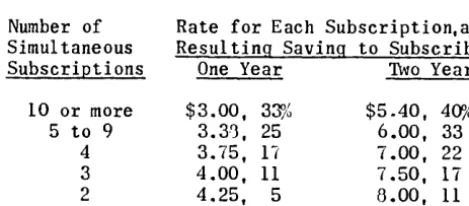
These rates apply to subscriptions coming in together direct to the publisher. For example, if 5 subscriptions come in together, the sav-ing on each one-year'subscription will be 25 percent, ,and on each two-year subscription will be 33 percent. The bulk subscription rate s , depending on the number of s imul taneous sub -scriptions received, are shown below:
Table 1 -- Bulk Subscription Rates (United States)
Number of Simultaneous Subscriptions
10 or more
5
to9
4
3
2
Rate for Each Subscription,and Resulting Saving to Subscriber.
One Year TWo Year
$3.00, 3.313, 3.75, 4.00, 4.25,
33% 25
I i
11
5
$5.40, 6.00, 7.00, 7.50, 8.00,
40%
33 22 17 11
For Canada, add 50 cents for each year; out-s ide of the Uni ted Stateout-s and Canada, add $1.00 for each year.
[image:13.621.328.563.573.676.2]-Automation-A Report to the UAW - CIO Economic and Collective
Bargaining Conference
November 12, 13, 1954·
The dictionary, as yet, does not contain a de f ini tion of "automation", but already it is making striking changes in our industrial sys tern. Some management spokesmen say aut
0-mation is "the automatic handling of par t s between progressive production pro ces s e s "; others claim it is "a new philosophy of design , a new manufacturing method." Rega r dIe s s of definition, however, technological develop-ments involving the greater use of automa tic machinery and the automatic regul at ion and control of this machinery are giving rise to radical changes in the factory. These changes, sporadic at the outset, are now cons tan t 1 y increasing in velocity and volume. The Repub-lican tax bill changing the basis for the cal-culation of depreciation may tend to accelerate the scrapping of existing plant and machinery and their replacement with new and more effic-ient equipment and facilities. The manager of the new Ford foundry in Cleveland g a v e a graphic idea of the kind of changes which are taking place when he stated:
"Ours is the only foundry in the world where the molding sand used to rna k e castings is never touched by hum a n hands except maybe out of curiosity."
Automation may be the forerunner of a sec-ond "industrial revolution" which will have a greater impact throughout the world tha nth e first. Or, technological developme n t sma y come more slowly and gradually without causing maj or changes in economic and political insti-tutions and relations. The experts disagree on what the future holds. One says automation is only
" •••• a new chapter in the contin u i n g story of man's organization and mech-anization of the forces of nature."
Another says that automation
" •••• will produce an unemployment si t-uation, in comparison with which •••• the depression of the thirties w i l l seem a pleasant joke."
A third, who believes that the new elec-tronic computors will be linked with automatic machinery to produce robot machines, believes
that .
" •••• we should set up a Robot Machine wi th the duty of formulating soc i a 1
policy on the speed and circumstances of the introduction of robot machme~ and with power to speed up or del a y its introduction according to what the public welfare demanded."
Already there are examples where relative-ly few men do the work which formerrelative-ly was done by many. According to Newsweek:
"Ford's automatic engine plant turn s out twice as many engines as an 0 1
d-sty Ie plant, with one:"'tenth the m a n-power."
Approximately 10,000 men in the found r y and engine divisions of a maj or auto compa n y now turn out the same production which forme~ ly required more than 23,000 men. Only a large increase in total output prevented wide-scale layoffs in those divisions.
These developments are not confine d to the industries with which the UAW bargains but extend throughout the economy. News pap e r articles revealed that
" •••• a radio assembly line geared t 0
produce 1,000 radios a day, with only two workers needed to run the line (is replacing) standard hand ass em b 1 Y
(which) requires a labor force of 200."
Automatic controls have been widely i n-~roduced ~n the petroleum industry. One i
n-dustry spokesman .stated:
"The average refinery which would em-ploy 800 people without instrume n t a-tion would employ 12 people were i n-strumentation utilized to the fullest extent possible."
Automation -- A Report to the UAW-CIO