---~
T
scs
t
s
o
'ill
'
~:
i;
2& S
iliL
..
computers--and
tomation
A Computer Market
Survey: The Bank
i
n
g
Industry
Automatic
Data Processing
i
n the Internal
Revenue Service
The Spectrum o
f
Information
Processin
·
,.,
A Report on
The I F I P Con
g
ress 62
Management Decision Tester:
Not "people talk," of course. It's "machine
talk"-made possible by Bell System
DATA-PHONEservice.
This new service gives business machines a "voice."
Itconverts machine data (like that on the tape) into a
tone lclllguagewhich is sent over telephone lines, then
is reconverted instantly into its original form at the
receiving end.
Vast quantities of business data can be transmitted
this way - billing information, inventories, sales orders,
payroll and production figures-at incredible speed.
Data handled in 10 minutes by DATA-PHONE service would take the average secretary seven hours to type!
What's more,
DATA-PHONEservice enables you to
send business data over regular telephone lines
at reg-ular telephone rates.This dramatic, new service is saving time and cutting
costs for companies all over the country.
Could it do as much for your firm?Talk with one of our
Communi-cations Consultants and find out. Just call your Bell
Telephone Business Office and ask for him.
BELL TELEPHONE SYSTEM
T
A
"
·3
J.
.,.EX
At
sys~
pen
per
inte
15
mer
mer
T
teri:
·(51-6
Offie
• CI
• H
Hk /
lhaca, "l". Y.,
core
ingers York, gnelic
:-:lolly,
N .
.1.
Seere-Reset19c1es,
1C., a ratus.
l"ham-~John .B.~I.
N. Y. tn.
.es P. Endi-York,
ansfer eeton,
corp.
y
sys-leord, Inc., ire /
Cove,
Inc.,
ark /
Day
rville,
r Co., Data
,nics,
l3 / Div.,
17 /
n 9, illow
Juys,
~n 8,
Jury,
ling-1962
• every computer be bound by the principles established
for the first computers
16years ago?
• the split-second reaction of a computer be forever
limited by the time-consuming necessity for operator
intervention?
• computer users be content with a conventional
com-puter which was NOT designed or built to make effective
use of higher level languages?
• the language of computers be irrevocably oriented more
to machine than to man?
• computer users, hearing about the advantages of
problem oriented hardware from computer experts, be
satisfied with anything less?
NO to all five questions. Because Burroughs B 5000
Information Processing System has blasted the
16-year-old m16-year-old that has shaped all computer concepts up
to now.
The B 5000 schedules its own jobs, assigns its own
peripheral units and handles its own interrupt
condi-tions.
Itprocesses several programs at the same time,
handles its own file identification, and generally saves
user, programmer and operator the cost and bother
of the
tho~sandand one details for which other systems
are so often criticized.
In addition, the B 5000 was specifically designed to
utilize the higher level languages of ALGOL and
COBOL. The B 5000 is the first-and so far the only
-American computer to integrate ALGOL and
COBOL compilers into basic system design.
Must you have more ddails for a seriolls consideration
of the B 5000? By all means. Call our local branch and
let our Systems Counselor give them to you. Or first
read our booklet "The B 5000 Concept." Address
your request to us at Detroit 32, Michigan.
Burroughs-TM
Burroughs Corporation
;0))
COMPUTERS
and
AUTOMATION
COMPUTERS AND
DP~'rAPROCESSORS, AND THEIR CONSTRUCTION,
APPLICATIONS, AND IMPLICATIONS, INCLUDING AUTOMATION
Volume XI
Number
10OCTOBER,
1962
Established
September,
1951EDMUND C. BERKELEY
Editor and Publisher
PATRICK J. MCGOVERN
. Associate Publisher
MOSES M. BERLIN Assistant Editor NEIL D. MACDONALD Assistant Editor L. LADD LOVETT Assistant Editor
ANN B. BAKER Production Manager
CONTRIBUTING EDITORS
ANDREW D. BOOTH
NED CHAPIK JOHN \V. CARR, III
ALSTON S. HOUSEHOLDER PETER KUGEL
ADVISORY COMMITTEE
GEORGE E. FORSYTHE
RICHARD W. HAMMING ALSTON S. HOUSEHOLDER
HERBERT F. MITCHELL, JR.
SALES AND SERVICE DIRECTOR
ROGER BARNARD
815 Washington St. Newtonville 60, Mass.
DEcatur 2-5453
ADVERTISING REPRESENT ATIVES
Los Angeles 5 WENTWORTH F. GREEN
439 So. Western Ave. DUnkirk 7-8135
San Francisco 5
605 Market St.
Eisew/Jere
815 Washington St. Newtonville 60, Mass.
A. S. BABCOCK
YUkon 2-3954
THE PUBLISHER
DEcatur 2-5453
COMPUTERS and AUTOMATION is published monthly at 815 Washington St., Newtonville 60, Mass., by Berkeley Enter-prises, Inc. Printed in U.S.A.
SUBSCR IPTION RATES: United States, $15.00 for 1 year,
$29.00 for 2 years, including the June Directory issue; Canada,
add 50c a year for postage; foreign, add $1.50 a year for post-age. Address all Editorial and Subscription Mail to Berkeley Enterprises, Inc., 815 Washington St., Newtonville 60, Mass.
ENTERED AS SECOND CLASS MATTER at the Post Office at Boston, Mass.
POSTMASTER: Please send all Forms 3579 to Berkeley Enter-prises, Inc., 815 Washington St., Newtonville 60, Mass.
Copyright, 1962, by Berkeley Enterprises, Inc.
CHANGE of ADDRESS: If your address changes, please send us both your new address and your old address (as it appears on the magazine address imprint), and allow three weeks for the change to be made.
4
A Computer Market Survey:
The Banking Industry .
I-'RONT COVER
The Owl and the Computer.
ARTICLES
Automatic Data Processing in the Internal Revenue Service, by WILLIAM H. SMITH .
The Spectrum of Information Processing, by A. W AL THER
The IFIP Congress 62, Munich, Germany, by EDMUND C. BERKELEY
Management Decision Tester: Computer Used to Simulate Operations of Small Business, by ALFRED G. DALE
READERS' AND EDITOR'S FORUM
American Computers-A View from Poland FJCC 62 Features Announced
Computer Financing
Two Locations Changed for JCC's-One Cancelled Call for Papers for 63 SJCC .
New Puzzle Book Available Calendar of Coming Events.
ACROSS THE EDITOR'S DESK
New Applica tions Automation New Products Software News
New Firms, Divisions & Mergers New Installations
Computing Centers People of Note New Contracts Business News
REFERENCE INFORMATION
Monthly Computer Census
Books and Other Publications, by MOSES M. BERLIN . New Patents, by RAYMOND R. SKOLNICK
INDEX OF NOTICES
Advertising Index
14
1, 8
10
38
40
47
20
42 42 42
50
21
23 24
27 28
29
30 31
32
33
35
44 51
54 51 54 Computer Directory and Buyers' Guide
Glossary of Computer Terms Manuscripts.
Who's Who Entry Form.
see Sept., page 45 46
---~
•
•
The far-reaching possibilities
of NCR's amazing new
reading machine!
Consider the promise of NCR's revolution-ary optical scanner.
Now, it makes possible the direct processing of printed data without having to convert that data into "machine language" such as punched cards or punched tape.
It saves time and money by processing data that was obtained automatically in making
orig ina I entries.
It reads and analyzes cash register tapes at the speed of 520 characters per second. It processes printed data from adding mao chines and accounting machines as well. Optical Scanning unlocks a whole new di· mension in the simplification of paper work -for businesses large or small. NCR's
read-ing machine shortens the time required to prepare reports ... and helps answer
to-day's problems today.
This exciting new development is another example of NCR's dedication to providing the finest in Total Systems to make your business life better. Let your local NCR rep-resentative explain how this can help your business.
NCR PROVtDES TOTAL SYSTEMS-FROM ORIGINAL ENTRY TO FINAL
REPORT-THROUGH ACCOUNTING MACHINES, CASH REGISTERS OR ADDING MACHINES, AND DATA PROCESSING
IN
WIl
Bas
A
an
DIRI
Tb
ers' ( June ANI the j Roster Roster to t
Sur vel Survel Descri Survel Survel and Auton List Compl
Mac
Over CampI Roster Can Robot Roster
GLOS SIC
Dve
definit
BACt
For except 1961,
SUBS
u.s
add 5 elsewb
BULl<
The to ( comin
Num Simult
Subsci
7 or IT
4 to
3 2 For C
side ( $1.50
c~
815 1/ no.
ihort
lllo1-lce) ,
:lark,
mca-~eles,
Irnrn.
itute
olly-253
f the
:ork,
)ora-itary
con-Los
:=on-ania,
Clen- :=ali-ltact
stru-:l by
terns Bilt-
lero-Col.
Base,
:oli-ltact
St., inear
con-Bell
:e on
lOrna larIes
.RM,
En- Ilica-,riz.;
12,
~ncc,
, ].
I. O.
~nce,
ohn-
:hal-1962
RCA ADDS NEW
SCIENTIFIC CAPABILITY
TO THE LOW COST,
HIGH CAPACITY 301
RCA's 301, today's best investment in low-cost
com-mercial EDP, is now the best buy for comcom-mercial
and
scientific computer power at low cost.
TOTAL EDP CAPABILITY.
The new RCA 301 gives you
total EDP capability.
With this capability you get greater
efficiency for your rental dollars, can schedule time for
both
technical and business assignments. Use the 301 for
all your routine EDP business accounting needs. And
use it for statistical, analytical and control problems.
Assign mathematical tasks to the new 301 and free
professional time for creative work.
MANY NEW WAYS TO USE RCA 301.
Open up new
possi-bilities in your day-to-day data processing with this new
301. For instance-replace several smaller, less efficient
computers with one 301. Or-if you have conflicts with
time-sharing a large computer, give critical departments
their own 301. Or-if you have an outdated computer
that's slowing down work, replace it with a 301. You may
well save half the cost to do the same job!
EXTENSIVE SOFTWARE COVERAGE.
RCA makes
avail-able a variety of scientific sub-routines-for matrix
operations, linear programming, statistical analysis,
curve-fitting, double precision floating point, etc., plus
Scientific and Bell Interpreter systems, UMAC (an
Algebraic Compiler which employs Fortran
mathemati-cal statements), .and 301 Fortran.
Check the specifications below and find out what the
new 301 features can do for you. Then contact RCA
Electronic Data Processing, Cherry Hill, Camden 8, N.J.
• An entire family of new fast circuitry arithmetic instructions, including:
fixed point floating point
16 digit accumulator manipulation and shifting facilities
• This new instruction format allows the use of bit indicators for
storage of operands and for address field modification.
• Approximately 6000 floating or fixed point eight digit add/subtract an d 2000 floating or fixed point multiply/divide operations per second. (With 2 digit exponent in floating point.)
• Three index fields for address modification.
~
·
ders'and,
m
Rea
Editor s Foru
FRONT COVER: THE OWL
AND THE COMPUTER
The scrubby little barnyard owl on the cover is leaming with a modern electronic computer to study some of the mysteries of the nervous system. The owl's name is Orpheus; the computer, a GE-225.
Dr. Lawrence Stark, a neurologist at the Massachu-setts Institute of Technology, is using Orpheus, an OLus asio owl, in a pioneering study of pupillary sys-Lems. This and other' experiments are aimed at de-velopment of a clearer understanding of human nerve and brain disorders such as Parkinson's disease.
Dr. Stark's specific interest in Orpheus is in the servomechanism controlling the pupil of the eye. His neurology group selected the eye for study because it is representative of other body systems and because it is externally located and easily observed.
The General Electric computer records the experi-mental data and takes complete closed-loop control of the problems introduced by Dr. Stark and his as-sociates in the school's Electronics Systems Laboratory. The computer reacts faster-it can take a reading every
1/
1000 of a second-than nature's servomechanism linking the eye wi th the brain.For the experiments, the owl is carefully and com-fortably placed in a pupillometer harness. Two devices, one a tiny light source and the other an infrared photocell, are trained on the pupil of the subject's eye.
The computer is programmed to direct a light beam of a certain intensity on the pupil. The beam causes no discomfort or damage to the eye. After the light passes through the pupil, it stimulates the photo-sensitive cells of the retina, sending electric nerve impulses to the brain.
The br~in, then, analyzes the disturbance and sends
a signal back to the pupil, causing it to contract. The time required for this circuit to be completed and the degree of dilation or constriction are recorded and analyzed by the computer.
As the reading from the photocell enters the com-puter and is recorded, the comcom-puter automatically introduces a different light intensity and starts the process again.
Through these experiments Dr. Stark and his as-sociates arc working toward the development of clearer definitions of some of the design principles which occur in the natural evolution of nature. It is his hope that they can then transfer these principles to man-designed electronic and mechanical systems.
AMERICAN COMPUTERS-A VIEW
FROM POLAND
International computer crosstalk was promoted by the presence of a leading Polish computer expert at
8
the National Meeting of the ACM last month. Dr. Wladyslaw Tarski of the Computer Center at the Polish Academy of Sciences came to the meeting pri-marily to present a paper on an external language for the Soviet-built URAL-II computer. L
However, Dr. Tarski, in an interview with an editor of C&A had some provocative things to say about the American computer industry. He commented, for instance, that "there are presently in Poland a total of 10-20 computers, but we expect that there will be about 50 in 1965. There are two foreign computers: a URAL-II of which two more are on order, and the National Elliott 803 of which one more is on order. We are unable because of trade restrictions to buy any American-made computers directly. However, we are too poor to choose anything but the best, and the Europeans have some fine competition for you.
"Why don't you Americans, with your fine technical capability, make such a fine computer as the Danish Disadec. This computer has a working ALGOL com-piler, 1,024 words of core storage, and 12,000 words of drum storage. The access time from the drum is only 23 usee. It can perform 20,000 operations per second, and it has a total weight of only 1,100 Ibs. And the Disadec only costs $110,000, without magnetic tape units.
"The Swedish people are also making some fine memory systems that are comparable with your own, and far more economical."
On the role that computers are playing in Poland's economic development, Dr. Tarski noted, "There is about to be some significant advances in the applica-tion of computers in economic planning in Poland. A 'sensation' report is soon to be released on the use of computers to control housing development, and in the general construction industry. You know, we are about to suffer from a demographic peak due to a high rise in population soon after the war and before there was an active interest in birth control. To find hous-ing and schools for this peak of people has to be a thoroughly planned operation, and a computer will be used to schedule this development. In fact, at the Warsaw computer center, the bread and butter group is the econometrics group who have been doing fine work in the field."
FJCe 62 FEATURES ANNOUNCED
A varied program, offering 35 papers on the latest EDP developments by over 60 international authori-ties, has been arranged for the 1962 Fall Joint Com-puter Conference, December 4-7, Sheraton Hotel, Philadel phia.
The conference will be keynoted by Robert C. Sea-mans, Jr., associate administrator of NASA, who will
(Please turn to Page 42)
COMPUTERS and AUTOMATION for October, 196:.:!
Dollars
30
29
28
27
26
25
24
23 22
21
20
19
18
17
16
Quarter
10
11
12 '
Fil of ct firm. tend
IS me
erosil pIes and the ~ estim
pants ently,
1S be
~SSlOn
local
,I, to deci-)le of
harts. loped erage ,eriod
Ipeti-tV the
intro-Ly.
me 5. with ng to iginal
~ new
utset, Inous Ip of
e the
ene!.
more Nhole
: that 'plied Tams. bility :tivity l, sec-pants
Even )nths,
st.
ystem larger ng in ly de-
anlZa-time.
n the
ta for
lation
lships
orma-: and .:eived
r, 1962
OUR SPECIALTY
Since 7952, EAt ploUing equipment has been applied to a steadily lengthening list of data reduction
applica-tions - from simple, manual point plotting to high-speed magnetic tape input contour plotting. Again and
again, the flexibility, speed and extreme accuracies of EAt plotters have dictated their selection over
compet-ing instruments.
0EAI standard plotters include 7
rtf
x 77", 30" x 3D",
and 45" x60" boards. Operation can
be
either off-line from punched cards, punched tape and magnetic tape, or on-line with various computers. Output
modes include point, line, symbol, and contour plotting. Plotting speeds up to 4500 line segments per minute
can
be
provided. Reliability is assured
by
solid-state circuitry and superior mechanical design.
0You can draw
upon EAl's wide application and design knowledge
by
describing your requirements. Write for information,
detailing your needs, today.
EAI
See this product demonstrated at our Booth No. 1372 at the ISA Show in New York City, October 15-18ELECTRONIC ASSOCIATES, INC.
Long Branch) New Jersey
Automatic Data Processing
In
The
Internal Revenue Service
William H. Smith
Assistant Commissioner Internal Revenue Service U. S. Treasury Dept. Washington 25, D. C.
How ADP is putting a sharp probe into the
paper-work, pocket, and conscience of the
taxpayer-as it helps to close the tax administration gap.
The mission of the Internal Revenue Service IS to
administer the Federal 'tax laws.
The art of administering Federal tax laws is doing a job which is almost unlimited in scope-with lim-i ted resources.
The special function of automatic data processing (ADP) in the Internal Revenue Service-in tax ad-ministration-is to enlarge and strengthen these lim-ited resources, to give us the means and the capacity to make the job of tax administration one of manage-able proportions.
Our ADP system was conceived about 4 years ago, and it came to life early this year. Although it is not scheduled to reach operational maturity for about 5
years, we believe that the objectives involved in strengthening our resources will be realized in full measure-and with extra dividends besides.
Our experience with ADP to date has been very gratifying. Apart from those situations ordinarily ellcoull tered in launching a computer system, our greatest difficulty has been to resist the temptation
to overload the system. There is a continuing need
to practice restraint and to hold off the conversion of applications until the system gains strength and is ready to absorb with facility operations now per-formed manually.
Need for ADP
'IVith ,this as an introduction, let's provide a per-spective with a few words about the forces in Federal tax administration that gave rise to our ADP system. The major physical ·or tangible factor was paper-hundreds of millions of documents annually moving in and out of the" Service. Specifically, the Service receives a torrent of paper that includes
-61 million individual income tax returns; -96 million tax returns of all kinds; -350 million information returns; and much more. The Service mails
-90-odd million blank forms; -'10 million refunds; and -millions of bills and notices.
,\11<1 the volume grows every year.
Ollr limited resources, which I mentioned earlier', were hopelessly inadequate to cope with, and exploit, this kind of volume. "Ve were forced to do what we
could, and leave the rest undone. Under this kind of pressure, our tax administration gap-representing what we couldn't accomplish-widened year after year.
A related and perhaps more critical problem in tax administration was lack of a master file of tax-payers-a single, central point at which we could identify every taxpayer, and record all transactions
10
reflecting his current tax status. I'll have more to say about the master file later, but the point should b2 made here that it was a practical impossibility to
build a master file without an ADP mechanism. We had the raw material, then-these hundreds of millions of documents-in over-abundance, but be-cause of the staggering proportions of the processing and association job, we lacked the resources with which to do anything about it.
Out of these conditions grew the idea and then the design and organization of our ADP system.
Organization for ADP
The over-all structure of the Internal Revenue Service was well suited to accommodate an ADP or-ganization.
Very briefly, we have 62 district offices where the main enforcement job of the Service is performed-collection, tax audit, and intelligence. In addition, there are 9 regional offices for the general supervision and support of the districts, and for the performance of certain operating functions (alcohol and tobacco tax supervision and the appeal of tax determinations) which can best be performed at a semi-centralized level. Then, capping the structure, we have our N a-tional Office in Washington, D. C., which is organized by functions: Compliance, Technical, Planning and Research, Administration, Inspection and, now, Data Processing. Each function is headed by an Assistant' Commissioner who reports to the Commissioner and his Deputy.
Onto this structure, we have grafted several elec-tronically equipped regional service centers and a
National Computer Center. The entire operation is headed by an Assistant Commissioner for Data Processing who provides broad program and systems direction.
In broad terms, our main paper processing opera-tion is to be transferred to these regional service centers. These centers, working in tandem with the National Computer Center-and we'll see some ex-amples of how they'll work later-will perform a complete processing and revenue accounting opera-tion for the district offices, and provide the personnel of these offices with up-to-date intelligence of a kind and quantity which was a practical impossibility be-fore ADP.
In designing the ADP system and organization, we had to provide for easing it into our over-all opera-tion by stages. The system represents such a complete change that Servicewide installation in a single stroke could have produced crippling dislocations in organi-zation, systems, and personnel.
CO~IPUTERS a1ld AUTOMATION for October, 1962
M
Alfre
Burea Colleg Univel Austill
Exi pose signe( slOn 1 are u alloca makil cally may thetic withil <!uate corpo of
m,
Both locati quest ends. tion isarily part i
and t
mInIS
ClslOn
Th const1 cal sn whid can b
Th
a Ina
manu $250,1 ducin metal ing tc regiOl exten comp largel ing p panie
enVIn
comp positi Int
Base( for Cor
IE
[)N,
will ative the
com-wing
may Iper) free 1 the their vho's ! edi-ltries vho's
.s?
d? ....
,
dis-this t\Tho's
Auto-itreet,
r, 1962
On January 1 of this year our first regional service center "vent into operation-in Atlanta. The Atlanta Center is servicing our district offices in
7
South-eastern states. At the same time, the National Com-puter Center went into operation in J\[artinsburg, \;\Test Virginia, with an IBwI7070
and peripheral equipment; and it is here that the wIaster File o( taxpayer accounts will be maintained. The next re-gional center scheduled to come off the planning board and into operation is the one that, beginning on January 1, 1963, will service the 7 district offices making up our Philadelphia Region in the States of Pennsylvania, New Jersey, Delaware, and :Maryland. Over the next few years the remaining centers will be gradually phased into the system-and ADP will have become an accomplished Internal Revenue Servicewide fact.Accounting Under ADP
lVIoving in now for a closer look at the system, I
believe that its impact on our internal accounting methods would be of some interest. To begin with, under ADP the major revenue and refund accounting operations will move from the district offices to the regional service centers. The move will shift revenue accountability from our 62 district directors to our regional service center directors. Some idea of what this means in dollar terms can be gathered from the fact that in 1961 our district director in the Anchor-age District collected and was accountable (or about $66 million; the figure (or the wIanhattan District came to $13.6 billion, with the other districts coming in between these extremes for a grand 19{) 1 total of ,~94.4 billion.,
Under ADP, the general ledger, supporting jour-nals, and data control accounts will be maintained at each regional service center instead of at each district office. Data for posting these accounts will come from two sources: From district offices will come a flow of summarized predetermined totals, as in the case of certificates of deposits made by district offices. Also from the district offices to the service centers will come a continuing stream of returns and documents reflecting transaction data affecting taxpayers' tax lia-bility-prepayments, payments, audit adjustments, and the like. These data will be recorded on mag-netic tape, and the summary print-outs posted to data control accounts, including the general ledger. From the National Computer Center will come recapitula-tions of totals of detailed registers and vouchers pro-duced on tape by the computer from input trans-actions or from computer-generated data printed as outputs for posting to control accounts. Also from lVfartinsburg will come reels of magnetic tape peri-odically bringing each taxpayer's account up to date in terms of his total outstanding tax liability, includ-ing penalties, refunds and all other pertinent tax settlement information.
Districts now maintain unit ledger cards (or ac-counts receivable-a separate card (or each taxpayer, for each tax period, and for each type of tax. As accounts become delinquent, a transcript of pertinent data is prepared and distributed to revenue officers [or follow-up action. This entire receivable
mainte-CO~rPlJTERS (lnd AUT01\L\TION for October, 1962
nance operation will be transferred to one point, :Martinsburg, where the whole operation will be elec-tronically telescoped-and where for the first time, through the master flle, all receivable records will be pulled together.
The entire detail accounting operation, in fact, which is now done manually in district offices-by typewriter, adding machine, and bookkeeping ma-chine-will be performed electronically at the centers, except for final postings of totals to the ledger and journals, and except for some miscellaneous accounts which will still be maintained in the districts. The nature and characteristics of the computer system will also make it possible to do away with many sectional controls now manually hand-posted, without affecting the internal control aspects of the accounting system.
Advances in Tax Management
Although ADP's contribution toward a streamlined accounting operation is quite important, it means a
great deal more to us than a mechanism for effi-ciency-a device which can perform electronically tasks that used to be performed manually. The cen-tral significance of ADP to the Revenue Service is· its capacity to produce data and intelligence which will enable us to achieve broad, across-the-board advances in tax management of a character and degree we could not heretofore hope for.
Let's look at a few.
Master File
I referred earlier to the master file-the master file of taxpayers. ,\lthough it would he dearly overstating it to say that without a master file the Service was operating blindly, I believe it would be fair to say that we have been operating myopically. Consider just part of the picture-practices in filing returns: --62 million individual and fiduciary returns, and 6 million declarations of estimated tax, being filed in 62 districts-with many individuals, be-cause of population mobility and for other rea-sons, filing in one district one year, another district in the next year, and even a third dis-trict in the third year.
-One million partnership returns filed in 62 districts, with partners often filing their indi-vidual income tax returns in districts other than the one in which their partnership Forms 1065
are filed.
-Over 1 million returns for corporations, many of them closely held, filed in 62 districts, with the principal officer-stockholders filing their Form 1040 in districts other than the one in which the corporation filed its Form 1120.
Consider next the recei pt hy the Scrv ire of 100 million information retllrns a year report ing pay-ments to individuals of dividends, interest, and cer-tain other income hy names of individuals, and the virtually impossible job of processing and matching an information ret urn for
J.
Randolph Doe with his tax return filed under the name of John R. Doe-and perhaps difreren t. addresses.Consider" finally, the problems involved in asso-ciating data (rom all these documents and a system of internal accounting under which the tax liability
of a single individual or corporation [or different types of taxes, and for different tax periods, was maintained separately-in separate accounts.
Consider, then, these oversimplified statements of just these situations (there are others), and there may be little difficulty in visualizing the operational handi-caps under which we have had to function without ADP-and what a master file of taxpayers created by ADP can mean to the tax administrator.
The concept of the master file is simple. Through association of data electronically, we will have a re-vealing tax profile of every individual and business tax entity in terms of:
-How much he owes the Government by type 01
tax and tax year;
-How much the Government owes him;
-What returns he must file, and when, and whether he has in fact filed them;
-His payments to the Government, and refunds to him;
-His income during the year as reported to the Service on information returns; and
~Similar and related data.
The file, when we complete it, will contain some 78 million taxpaying entities, about 6 million of them business establishments. It will be maintained on magnetic tape, will be updated weekly, and will
lll-clude in each record-tax base and tax settlement In-formation for each entity's most recent 3 years of tax history, thus showing us significant patterns and trends about each taxpayer.
In summary, the other than professional operations of the Service-processing, matching, bookkeeping, and many other tasks-will have been performed by machine, leaving district office staffs free [or personal contact with the taxpayers.
Other Uses
There are other benefits to be derived [rom the system. The identification of those who fail to file returns is one. Still another is represented by a long forward stride in the processing of refund claims, all of which henceforth will be passed against the master file before being approved to determine whether the claim is a duplicate, or perhaps even fraudulent, or whether the taxpayer's record shows an unsatisfied indebtedness for the same or another tax for the same or a prior tax period.
Selection of Returns for Audit
A third will involve the automatic selection of re-turns for audit by revenue agents. The selection or classification process is now done manually-by ex-perienced agents who scan returns for apparent irregularities. Under ADP, the computer will be used to identify returns that suggest a need for audit exami-nation and to print out for the revenue agent's use apparent irregularities that caused selection-such as, under-reported income; excessive deduction for depre-ciation, or dependents, or charitable contributions; inventory discrepancies; and many other questionable items.
Fourthly-the Service will have a capability to asso-ciate data from a variety of sources on a scale hereto-fore unavailable.
I~
Tax Model
Data processing has already made it possible for us to bring into being, on magnetic tape, a very useful device which we call our Tax .Model. The tape con-tains about 50 items taken each year from each of 100,000 Forms 1040 and 1040A. The returns are care-fully and scientifically selected to make sure that, com-positely, they represent the universe-a microcosm of the indiviciual taxpayer community.
The Tax lVIodel, in one sense, is to tax administra-tors what a wind tunnel is to aircraft designers.
Assumed or hypothetical changes in tax law and other factors can be cranked into the Model which can then be quickly manipulated by computer to measure the revenue effects of the hypothetical changes. The special usefulness of the Tax Model is its capacity simultaneously to compute revenue effects of several assumptions-e.g., changes in tax rates, exclusions, certain types of deductions, etc.-by taking into consideration the interplay of these assumptions on each other as well as on factors that remain constant.
The Model in use today is built on 1960 tax year data; next year we'll have one covering the 1961 tax year. It is small, flexible, and quite inexpensive and easy to work with. It should reduce the degree of guesswork in estimating. And it represents a very useful advance in tax research.
The Anomaly of ADP
For tax administration, ADP presents some inter-esting contrasts. For example, the processing and other related operations we perform manually will be performed with much greater efficiency with ADP. At the same time that the system reduces our paper-work burdens, it will expand our enforcement capa-bility and narrow our tax administration gap. Among other things, for example, ADP will give us the ca-pacity, to a much greater extent than we now have, to identify not only the universe of taxpayers but to provide the names and addresses of the people who aren't taxpayers-but should be. It should be able to produce [or us a multitude of leads to tax irregulari-ties, and in that way very substantially enlarge our enforcement scope.
The result will not be, as some suspect, an uneven contest between machine and man. The system's end product will be placed in the hands o[ people-Revenue Service people-who will go on from there to deal directly and personally with taxpayers, just as before, except that ADP will enable our staff to deal with taxpayers on a much more informed basis.
Benefits to Taxpayers
The benefits of ADP are not limited to the Internal Revenue Service. Th~ public-our whole society-has a vital stake in Federal tax administration, and to the extent ADP strengthens tax administration the taxpaying public benefits by assurance of a fairer, more equitable, and more even distribution of its tax responsibilities under the laws enacted by the Congress.
In terms that are perhaps more recognizable and immediate to much of the public, ADP also means refunds that reflect all the facts . . . more accurate
CO~IPUTERS (ll1d AUTO~l:\TION for October, 19G2
macliin misceli< bagc's 1
Amber, Anat,
]nc.,
'lhe
InatlOtl panied a picto of auto control intende ness ad tel'S ill( Areas ( and 0
back," "Auton dude e Index.
Van T nlum
M.].~
Caml $4.00 This sis of n
funetio feedba( approa, not uri chapter Problel pensati fixed "Cl'itiq an ina ported by the and U.
Quartel Auto don
150 1962,
936 « lish an nal Ian lished.
lists of are givl anel rr France, Czecho~ measul"l puting, ards, tc
tion, bi
lion is
~Icmbe
Bibliog tiunal anel th, and Ex
Wilf, ] l'hvsi
]nc.,
N. Y This
Oil mat
sents f
malherr which ( cdge of "Vector FlInctio Eqllati( C\inary ~lappir which «
the firs
t ions, ~ Solntior index.
'ercep-lthex:
uman [usic," . Into cd in
spon-Corp.,
IBM Sons, rk 16, 'ations 'ies of aimed lot
in-The on to
'unda-"~lis
Access ing a tional ndices
1401 )pcra-)ssary, Hi an rrans-ion /
New 6 pp, n the
)f the , i.e.,
func-nples.
[lathc-
~nowl-full lpters:
~trical
spaces of the
and.
ies of devel-?m to A
sec-, and alion, I, are Tison,
5 Cal-gs by
Dover New Japer-varied
scien-lating ditors , and maties )nsists
from Bab-,n his boldt,
hints elated anters ;," in , the llating , 1962
billings . . . and, because the system relieves our staff of so many routine operations, more personal atten-tion of a higher, more professional, quality. For large business and other organizations with computer sys-tems of their own, ADP in the Revenue Service even-tually will make it possible for them to communicate with us, so to speak, by tape instead of by millions of forms. We see the day, not too far off, when large corporations will be able to send to us, in magnetic tape form, data covering payments of salaries, divi-dends and interest, and other items instead of report-ing these data to us on Forms W-2, 1099, and other documents, as they do now.
At this point, I should note, before it is assumed that all the problems of the Revenue Service have been solved, that there is and always will be essen-tial operations in tax administration which are be-yond the scope of ADP. The computer cannot hear and judge appeals . . . interpret laws and regulations assist taxpayers . . . set up part-payment sched-ules for hard-pressed taxpayers . . . conduct audits . . . and it cannot collect tax.
At its core, tax administration is, and must remain, a very human business, requiring reason and judg-ment and understanding and evaluation in human terms. These and many gray areas of tax administra-tion are, and will continue to be, safely beyond the reach of any ADP system.
The system is extremely efficient and useful in identifying areas of apparent audit irregularities and under-reporting and non filing. The rest-the
follow-MATHEMATICIANS
PROGRAMMERS
We are engaged in the development of an interesting variety of programs for research and real-time operations.
Expansion of our technical staff offers substantial growth opportunities for profes-sional advancement in the areas of mathe-matical analysis and programming, systems design, and data handling.
up-requires manpower: revenue officers to contact delinquent or nonfilers; internal revenue agents and auditors to examine taxpayers' books and records and make technical and professional judgments on tax liability; special agents to investigate suspected tax fraud.
That, then, is the sober, or the balancing, side of the over-all ADP picture. This view sometimes has to be communicated with almost as much force as the other side, although the plus side needs no elabora-tion or eloquence. A well conceived and implemented system speaks for itself.
Conclusion
I want to conclude this rundown on ADP in the Revenue Service by pointing up what it means in the much broader context of Federal tax administra-tion. The mission of the Revenue Service extends beyond the literal administration of the tax laws and the collection of revenues. Our tax system is grounded in a spirit of self-assessment-voluntary compliance with the law. In this country millions of taxpayers go through an annual ritual, in the privacy of their homes and offices, equipped with blank returns, in-structions, paper and pencil-and their consciences-to determine their tax liability and then pay it. The resources that contribute to the strength and economic stability of the United States certainly include the asset of people's voluntary compliance with tax laws. The thrust of tax administration, in large part, is
(Please Turn to Page -/9)
Senior positions currently available for mathematicians and physicists in program development and mathematical analysis. Please send resume in complete confidence to:
Mr. W. E. Daly.
We are located just two hours from San Francisco on the Monterey Peninsula . . . one of the most desirable living and working areas in the West. Monterey enjoys a temperate, smog-free climate year round and offers an unmatched professional, cultural and recrea-tional environment.
LFE
ELECTRONICS
A DIVISION OF LABORATORY FOR ELECTRONICS, INC. MONTEREY LABORATORY 305 WEBSTER STREET MONTEREY, CALIFORNIA An Equal Opportunity Employer
A Computer Market Survey: The Banking Industry
Prepared
by
the Editors of Computers and AutomationAn analysis of the present use of electronic
bank-ing aids, and a projection of the size of this market
for computers during the coming half decade.
If the days are gone when the bearded miner hoarded his nuggets beneath the floorboards, gone too are the days when a bank was a stuffy, imposing in-stitution overstuffed with human calculators laboring over adding machines. The modern commercial bank is a revolutionary institution despite its image of im-perturbably stolid conservatism.
Growth of Banking
These innovations have not come without strong motivations. In the last decade the banking industry has enjoyed tremendous and remarkable growth. As the economy expanded in the post-war years, demand deposits grew. New activities and services heightened the administrative load. Large sums of money were wooed by salary deposit plans, accounting services, and research and advisory services. Simultaneously, banks have increased their retail lending, with the figure for loans, as a percentage of assets, more than doubling since 1946. The banking industry therefore today faces challenges that were unknown fifteen years ago.
These challenges are typified by the tremendous surge in checking popularity over the last decade. Ten years ago 8 billion checks were written in the United States. By 1960 the number had rocketed to 13 bil-lion, and today hovers close to 15 billion. If the trend continues, by 1970 there will be 22 billion checks written each year, almost 43,000 checks a minute.
What's more, an average check must pass through 2.3 banks; during this financial sojourn it will be handled from 7 to 20 times. \!\Tithin a decade, check-ing activities alone may require of the bankcheck-ing in-dustry up to almost 440 billion handlings each year.
Moreover, external developments offer banks no hope of a respite.
Our population is presently increasing by approxi-mately 2% a year.
By 1970, it is expected that our gross national prod-uct, or GNP, will have risen by 45%. The effects of this growth have already registered on the nation's banks. Since \!\T orld \!\Tar II, savings accounts have increased by more than 33%, checking account ac-tivity has grown by IG3%, commercial loans are up II
g(l;"
mortgages are up 290%, while consumer In-stal1mcnt credit is up an amazing 850%.Functions of Bank Increase
Banks have gone out aggressively to meet these new demands. They have become increasingly responsive to the needs and interests of their customers. A subur-ban housewife enjoys the drive-in facilities of a new branch office. Holiday Clubs bring an affluent Santa to more and more children each year. The new cus·· tomer is offered a spectrum of financial services, from bill paying plans to revolving check credit, from col-lege loan plans to low tax "living trusts," from home
14
improvement loans to investment counselling. The number of services is growing; the magnitude of each service is on the upswing, and the complexity of each activity sets new demands each day for more records and information.
The result is that the successful urban bank is en-gaged in a grandiose retail operation involving:
Special money handling: coins, money orders,
traveler's checks, bills of credit, handling of foreign currency, foreign bonds.
Savings: savings bonds, Xmas clubs, school savings
programs, savings clubs, banking by mail, night, and outdoor services.
Collect and disburse: coupons, drafts, rent payments,
mortgage payments, bills, dividend disbursement, service payrolls, act as escrow agent. (Even merchan-dising of coupons and stamps!)
Protective services: rent safe deposit boxes,
main-tain night depository, custody of securities.
Special aids to business and individuals: assist in
income tax preparation, financial advice, business as-sistance, credit information, statistical information, provide 'customer conference rooms,correspondent bank facilities, operate business-aid library, provide letters of introduction, stock transfer, investment ad-vice, handles securities.
Trust Services: estate planning, management of
es-lates.
During this rapid expansion in activity, banks are finding it difficult to obtain all the trained personnel they need, and still keep payrolls under control. While national nonagricultural employment has increased only 20% since the end of the war, employment within the banking industry has risen 65%. If the industry is to attract still more workers, while maintaining a minimum level of employee competence, the econom-ics of supply and demand will require higher wage levels, aggravating the costs situation. The costs as-sociated with a 20% annual turnover in the industry, and the training of new employees, make the em-ployee problem a vital factor in a bank's economic survival. Since 1950, banks' gross earnings per dol-lar of assets have increased by nearly 50%. Yet bank profits have failed to show a similar rise, having . stayed fairly constant at about 8% of total capital
ac-counts. An increase of 98% in labor costs over this period seems to be a major factor in this profit ri-gidity.
The'result of all this is an increasing and almost general acceptance of sophisticated electronic aids within the banking industry. Ledger clerks on high stools are extinct in this impending age of the com-puterized bank. Already, the first groundswells of this change are evident to the casual observer in the mechanization of vital bank functions.
COMPUTERS and AUTOMATION for October, 1962
BENI
From e sense. prograr straigh use of 650 Sin matical prograr Bendix
rhich
rans-that from
r :10t
lnce,
~ [or iable most n he
[l he
the 5'ant,
rafts-hing
ltion
o
sq. lbers 1 thehibi-llibit ,000, )Oms
, the [<IPS . full , the
was
o be [gan, their n or
lreas acial sing,
'e
In- luisi-ieval rs of
ding pro-racts
lard, troit
Jlem
tat a
been ,k1et, ions,
1962
Nature of Survey
To get an up-to-date picture of the present state of bank automation, the editors of Computers and Au-tomation queried the top management of 1,500 banks, picked at random from among the 13,500 that exist in the United States today. We asked for a descrip-tion of the data processing machines presently being lIsed in banks, an indication of what devices are pres-ently on order, and an estimation of the amount 01
money that would be invested in the coming years in data processing machines to mechanize banking op-erations. The rest o[ this article summarizes the [acts we gathered from this survey.
Types of Electronic Aids
The survey showed that modern banks are now en-joying six major types of data processing aids: window posting machines, proof machines, bookkeeping ma-chines, electronic bookkeeping mama-chines, punch card tabulators, and electronic computers.
Description of Electronic Aids
vVindow posting machines are well known to every bank depositor. These are basically adding machines which record the deposit or withdrawal and strike the new balance. Shuffled piles of documents are sorted, and the ordered material is dropped into sep-arate slots by the proof machines. Typical bookkeep-ing machines combine the features of addbookkeep-ing machines and typewriters. Like the window posters, these ma-chines can enter dates; unlike the posters, they can use symbols and keep track of checking accounts. The first of the truly electronic aids, however, are the elec-tronic bookkeepers, nicknamed "elec-tronics." \!\There they are used,
%
inch black strips on the monthly state-ments carry powdered iron, which stores information ill the form of magnetic pulses. vVhen a clerk inserts a ledger card into this machine, the machine compares the account number with that written on the black strip. If these match, the machine records the new balance on the ledger card, and stores it magneticallyOIl the black strip as well. Of a still higher order of
sophistication are the punch card tabulators. Punched cards, with supporting arrays of collators, verifiers, and card reproducers, have assumed an important role in the storage of masses of financial data.
Use of the Electronic Computer
Yet the most comprehensive solution to the prob-lell
t
of banking mechanization is the electronic com-puter. In 1956, the first computer went to work for the bqn~ing industry with the installation of an ERIVIA cprpputer by the Bank of America. Its re-markable e£tici~ncy and potential was soon recognized. In processing ch~cks, for example, the ERlVIA could sort according to destination, run check totals, pass along information ~nd operate continuously at a rate of from 750 to 1,500 checks per minute.As more and more banks organize for computer use, the experience of th~ Dime Savings Bank of Brooklyn may become fairly typical. The Dime Sav-ings is the third largestfinancfal institution in the country, and its assets are in the billions. It carries 600,000 depositor accounts on 'lP automated basis. All accounts are handled by a National Cash Register
COJ\IPUTERS a1ld A UTOMA TION for October, 1962
Size Distribution of Banks by Alllount
of Deposits
7000 - r - - - - r - - - - r - - - , . - - - , - - - - r - - - .
6500
GOOO
5500
5000
4500
-+---::::::00--1:.----4000
3500
3000
2500
2000
1500
1000
500
Under :$2 $2 - 10 $10 - 50 $50 - 250 $250 - 1000 Over $1000
[image:15.612.336.577.44.530.2]Al\IOUNT OF DEPOSITS ($ l\IILLIONS)
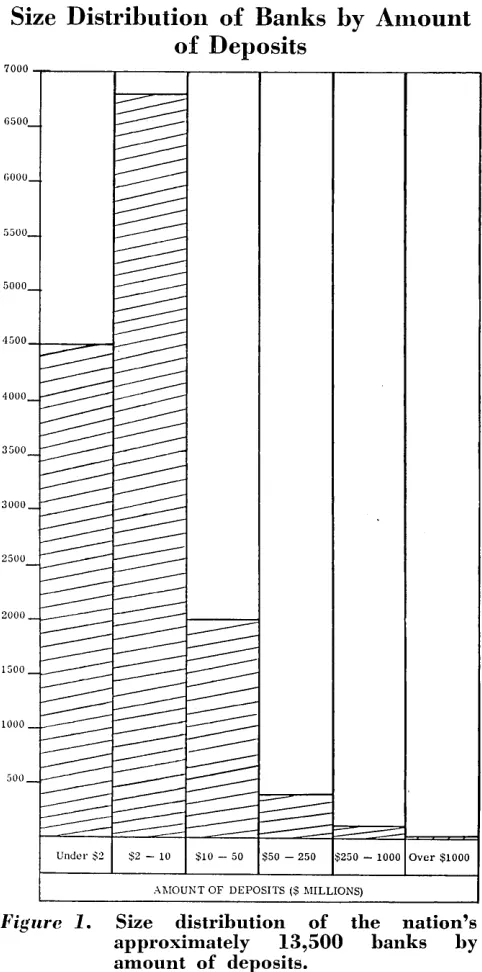
Figure 1. Size distribution of the nation's approximately 13,500 banks by amount of deposits.
:315 system, which has brought "a 93% saving in nor-mal eHort, and with the highest accuracy," in the words of the bank's president.
\IVhen the Dime installed NCR class 42 window posting machines in 1957, it had begun its transition
to automation. These machines, equipped with punched paper tape, keep a record of all window transactions. By processing- the information contained in these tapes on the NCR :HH system, the hank was able to obtain in twelve minlltes all the data from 30,000 savings accounts on a peak day. In three hours, the entire day's bllsilless cOllld he proc('ssed from in-itial entry to final tahlllation.
\Vith the installation of the NCR 1H5, the bank operates at all evell higher level of automation. The NCR 315 COlllpllter has a random access card mem-ory, permitting trallsition to an on line system with NCR teller IIlachines linked directly to the computer. I t is lIot sllrprising- that large banks like Dime Sav-ings have accepted automation SoO enthusiastically. One
NUlnbering of Accounts
%
1 0 0 - r - ' r - . - - ' - - . - - . - - . - - . - - r - - . - . - - ' - - . __ ~ __ ~
90
80
70
60
50
40
30
20
10
DEPOSIT SIZE ($ MILLIONS)
[image:16.612.294.548.39.758.2] [image:16.612.35.274.47.404.2]o
No plans~
Plan toIII
Already numberingFigure 2. Percentage of banks numbering
accounts, or planning to number accounts.
bank with 500 employees, and deposits of $125 million, is now ordering a second IBlVI 1401 computer system ..
It reported being able to reduce its employees by five per cent. Another bank notes that it has halved its employee costs, while still another reports savings of over one million dollars.
However, the plans and facilities of the Dime Sav-ings and other large banks are far from typical. No small bank will ever rival the computerized giants in efficiency. Automation costs money; and small banks have limited budgets. Yet these banks are faced with the same costs problems, and the same competitive needs for high speed processing of information as their larger sisters. ,;\Thile they must automate to compete and grow, the lack of funds make the process very gradual. Once past the superbank's, however, com-puter manufacturers should find a fertile opportunity for equipment rentals alllong these smaller banks.
Structure of the Banking Industry
To lInderstand this situation, we must examine the structure of the banking industry. Today, there are approximately 13,500 banks in the nation. Although 20 of these have deposits in excess of $1 billion, a look at Figure 1 shows that the deposits of very few banks exceed $10 million, and practically none ex-ceeds $50 million. Deposits of more than half the nation's banks lie between $2 and $10 million. In general, these banks have few employees and little inclination to automate.
The largest banks tend to be concentrated in the same areas. Of the twenty banks whose deposits
ex-Magnetic Ink Imprinting
%
100 .---r---,r---.---r~~~~
90
80
70
60
50
40
30
20
10
DEPOSIT SIZE ($ MILLIONS)
Figure 3. Banks planning to begin magnetic ink imprinting (light hatch), and banks already imprinting (dark hatch) •
%
100
90
80
70
60
50
40
30
20
10
•
Window Posters
Under $5 $5 - 10 $10 - 20 $20 - 100 Over $100:
DEPOSIT SIZE ($ MILLIONS)
Figure
4..
Percentage of banks now usingwindow posters.
COMPUTERS and AUTOMATION for October, 1962
simp stru( Obj( won lean graIT am If
sent(: prog chinl thin: mad the 1
chinl thin] talke Tl accm coeffi IVIax ing 1 ance
O.
Artif in Ie whic artifi natu: but ( In ar chin( like' coun stage [or e perh:
mad
to H) them still ( yet e have this 1
A.
Salvi that form inqu patte fies t ing i the d quin mach ing t
chim the c possi progl Viron
nled 1 the
m to )e as lting
lS of
even Inge, rt in 10lce
l
pic- ,truc-tlieb
conl-'king
101 is
nuch
uire-Hher se of 'cling
:hine
com-~pose rpre-g in-luces
tl III
line
ozzle line, rator Iuces
: the
'Y
40 ~ffectrmal
~r 40
lmer-1 the
11 in
con-lV1.
peri-t the
on a
19 of
1962
ACHPHENOMENON
Somewhere between the problem' of for'ming ~ix matches into four equilateral tri-angles andseeing the solution asatetrahedron ... '" Achphenomenonoccurs. Call it insight, inspiration, or' perception. Jt is that sudden impulse to think in another direc-tion.Suchimpulses have produced our greatest achievements.
, Wewelcorneengineerswhothink. in new dimensions, 'who form uncommon con-clusions'VVh0ctr-epotafraicl togo outside the confines of accepted conce·pts. Insightfulthinkersareinvited to send a resume to Mr. Don B. Krause, Manager Pro-, fessional and Scientific Staffing. You may expect prompt attention.
[8
LITTON SYSTEMS, INC.
GUIDANCE AND CONTROL SYSTEMS DIVISION
5500 CANOGA
AVENUE,
WOODLAND HILLS, CALIF.Leed $1 billion, 5 are in California and 8 are in New York. Ohio has 16 banks with deposits over $100 million; Massachusetts has 15, and Illinois, 14. On the other hand, while South Dakota has but two banks with deposits over $50 million, \l\Tyoming has none.
Banks Use of Electronic Aids
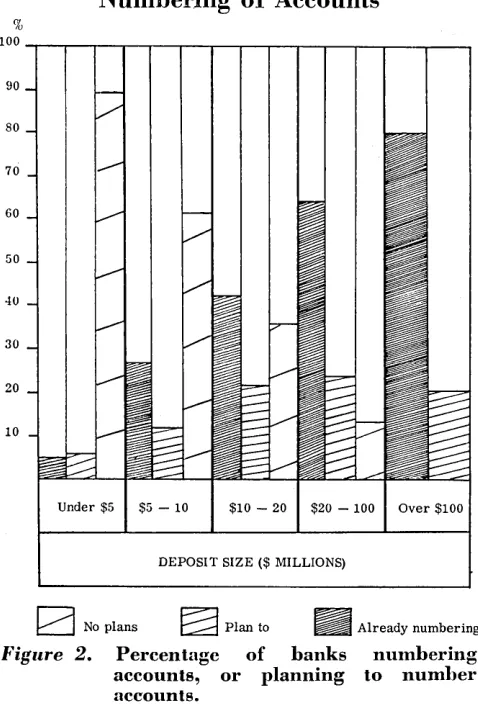
Evidence is clearly at hand that smaller banks are beginning to follow the lead of the larger institutions in the mechanization of their information processing procedures. Both numbering of accounts and mag-netic ink imprinting, the two preliminary steps to final automation, are either planned or in use in all banks with over $100 million in deposits. Although only a few per cent of the banks in the $5 million range are using these techniques, Figure 2 and Figure
3 show that the percentage rapidly increases with the size of the bank. Figures 4, 5, and 6 show similar pat-terns for the utilization of window posters, proof ma-chines, and electronic bookkeepers.
Punched card tabulators are not in use in any of the banks surveyed with deposits under $50 million, and only 10% of the banks in the $50-100 million range have this equipment. However, virtually all (92%) of the banks with over $100 million have this equipment already in operation. The major change planned by the bigger banks is the introduction of sorter readers. Seventy-seven per cent of the big banks plan to use these machines.
However, 95Cj~ of the banks with deposits over $100 million have punched card tabulators already in operation. The major change planned by the bigger banks in improving this use is the introduction of sorter-readers. Seventy-nine per cent of the banks with deposits between $50-100 million plan to use these machines.
Degree of Computer Use
At the present time, use of electronic computers is confined to banks with deposits over $20 million. Of banks within the $20-100 million range, six per cent presently rent, or lease a computer. Banks with de-posits over $100 million represent an exclusive fra-ternity where 4% own part or all of an electronic computer, and 15% rent or lease one.
Methods to Computer Ownership
This level of computer ownership is cause for neither optimism nor pessimism. Computers are ex-pensive creatures, and banks have been making pur-chasing decisions with studied caution. If a bank feels that it may have difficulty utilizing a computer full time, it is reluctant to purchase. However, there arc two ways around this situation. One is by rent-ing time on the bank-based computer to outside or-ganizations. The other is to share the costs of a com-puter with a number of other organizations, especially other banks.
An example of the first approach is the Bank of America. It is presently processing payrolls for the 40,000 employees of 104 companies. It expects. the number of firms contracting for this service to in-crease sixfold within the year. Similarly, the Water-bury National Bank of Connecticut has established a computer division which handles for outside clients
18
Proof Machines
%
100~ ______ ~ ________ ~ ______ ~ __ -= __ .~-=
____
~90
80
70
-
...---60
50
40
30
20
10
Under $5 $5 - 10 $10 - 20 $20 - 100 Over $100
[image:18.612.299.535.46.366.2] [image:18.612.298.538.418.749.2]DEPOSIT SIZE ($ MILLIONS)
Figure
5. Percentage of banks using proof machines.%
100
90
80
70
GO
50
40
30
20
10
•
Electronic Bookkeeping Machines
Under $5 $5 - 10 $10 - 20 $20 - 100 Over $100
DEPOSIT SIZE ($ lVIILLIONS)
Figure
6. Percentage of banks now using elec-tronic bookkeeping machines.COMPUTERS and AUTOMATION for October, 1962
Sui
is the: bel's num} years Illal ( the I
ther ters c man· A.H
comF
hight havir An such; freigl mum of co ertie5
SUI time of III trolli eond data has t
In re: an el
SUI and don term~
SUI latiOl stitut putel govel partil
Lil tactic and t
Sui
ampl pape] elect! typev aboUi will I
readi autor in th proce will I
Sui
pIe, t
ferrit metre fast <: films, sec) f