A Thesis Submitted for the Degree of PhD at the University of Warwick
Permanent WRAP URL:
http://wrap.warwick.ac.uk/98786/
Copyright and reuse:
This thesis is made available online and is protected by original copyright. Please scroll down to view the document itself.
Please refer to the repository record for this item for information to help you to cite it. Our policy information is available from the repository home page.
THE PROCESS OF TRANSITION:
BECOMING LEGITIMATE PERIPHERAL
PARTICIPANTS IN THE PRACTICE OF SEAFARING
by
Ila S. Bharatan
A thesis submitted in partial fulfilment
of the requirements for the degree of Doctor of Philosophy
Table of Contents
Acknowledgements ... V
Declaration ... VI
Abstract ... VII
Abbreviations ... VIII
1 Introduction ... 1
1.1 Theoretical Underpinning of the Research ... 2
1.2 Methodological Approach ... 3
1.2.1 Background to Research Sites ... 5
1.2.2 Employing the Data Collection Tools ... 7
1.3 Research Objectives ... 8
1.4 Intended Theoretical and Practical Contributions ... 10
1.5 Thesis Structure ... 11
2 Literature Review ... 14
2.1 Legitimate Peripheral Participation ... 14
2.2 Communities of Practice ... 17
2.3 Actions, Performances, and Practices ... 24
2.4 Sites of Practice ... 27
2.5 Learning in Practice ... 29
2.6 Participating in Practice ... 35
2.7 Learning between Sites of Practice ... 40
2.8 Negotiating Access to Practices ... 43
2.9 Research Questions ... 47
3 Research Methods ... 49
3.1 Philosophical Underpinnings ... 49
3.2 Research Design ... 51
3.2.1 Ethnography ... 52
3.3 Background to Industry ... 56
3.4.1 Access to the Organization ... 61
3.4.2 Background to Crewco Training Center (CCTC) ... 62
3.4.3 Access to CCTC ... 67
3.4.4 Background to Ship as a Site of Practice ... 69
3.4.5 Access to MV Sea-line ... 73
3.5 Ethics ... 74
3.6 Data Collection Methods ... 75
3.6.1 Observations ... 77
3.6.2 Interviews ... 81
3.7 Data Analysis ... 86
3.7.1 Organizing the Data ... 88
3.7.2 Analyzing the Data ... 88
3.8 Reflections on the Research Process ... 92
3.9 Summary ... 97
4 Learning Through Movement between Sites of Practice ... 98
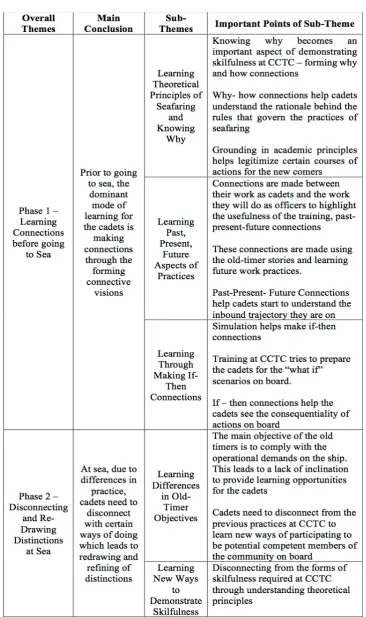
4.1 Phase 1 - Learning Connections Before Going to Sea ... 100
4.1.1 Learning Theoretical Principles of Seafaring and Knowing Why . 100 4.1.2 Learning through Connecting Past, Present, and Future ... 106
4.1.3 Learning through Making If–Then Connections ... 111
4.2 Phase 2 - Disconnecting and Re-Drawing Distinctions at Sea ... 116
4.2.1 Learning Differences in Old-Timer Objectives ... 117
4.2.2 Learning New Ways of Demonstrating Skillfulness ... 125
4.2.3 Learning New Ways of Doing ... 129
4.3 Phase 3 - Reflecting after Returning from Sea ... 135
4.4 Conclusion ... 143
5 Negotiating Access to Participation through Proactivity ... 147
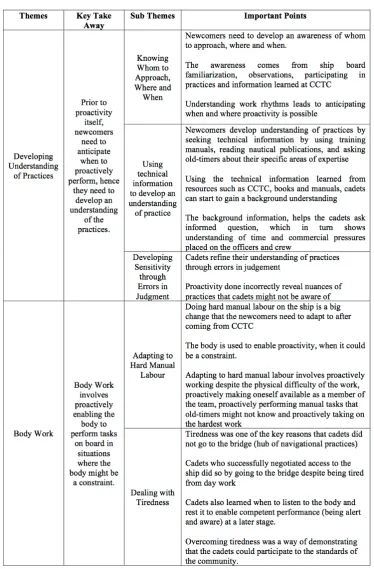
5.1 Developing Understanding of Practices on Board ... 148
5.1.1 Knowing Whom to Approach, Where and When ... 149
5.1.2 Seeking Technical Information ... 152
5.1.3 Developing Sensitivity through Errors in Judgement ... 154
5.2 Body Work ... 157
5.2.1 Adapting to Hard Manual Labor ... 158
5.2.2 Dealing with Tiredness ... 164
5.3 Spatiotemporal work ... 172
5.3.1 Seeking opportunities to participate in spatial territories ... 173
5.3.2 Seeking opportunities to participate at specific times ... 182
5.4 Conclusion ... 186
6 Discussion ... 191
6.1 Transitioning as an Episodic Process ... 192
6.1.1 Becoming a Legitimate Peripheral Participant through Making Connections ... 194
6.1.2 Becoming a Legitimate Peripheral Participant through Disconnecting and Redrawing Distinctions ... 206
6.1.3 Becoming a Legitimate Peripheral Participant through Reflecting 215 6.1.4 Conclusion ... 219
6.2 Negotiating Access to Participation through Proactivity ... 221
6.2.1 Understanding, Anticipating and Initiating ... 223
6.2.2 Body work ... 229
6.2.3 Spatiotemporal work ... 236
6.2.4 Eliciting Willingness to Allow Participation from Old-timers ... 242
6.2.5 Conclusion ... 245
6.3 Summary ... 247
7 Conclusions and Implications ... 248
7.1 Summary of Key Contributions ... 248
7.2 Practical Implications ... 252
7.3 Scope of the Study ... 256
7.4 Avenues for Future Research ... 258
7.5 Concluding Words ... 260
Reference List ... 261
Appendix A – Research Access Information ... 280
Appendix B Raw Data Samples ... 283
List of Tables
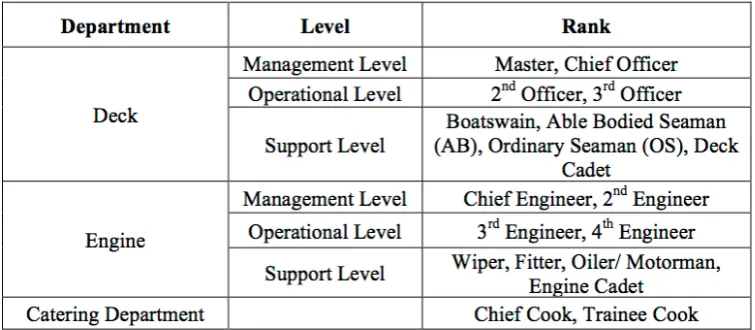
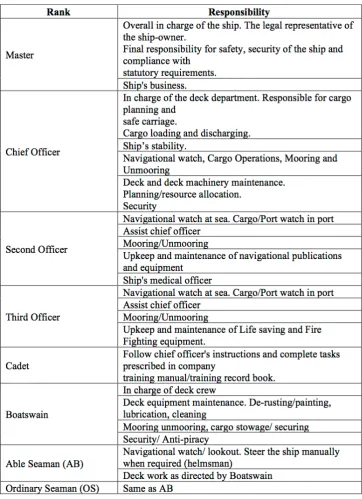
Table 3-1 List of Positions On-board ... 58
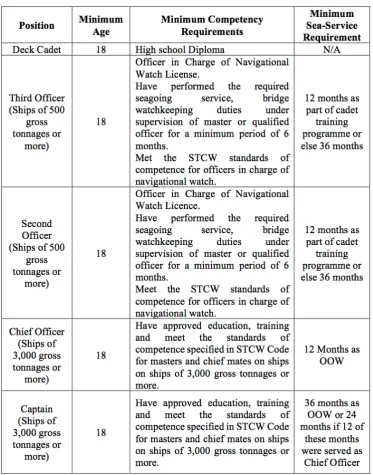
Table 3-2 Minimum Requirements for Position in Deck Department (International Maritime Organization, 2011) ... 59
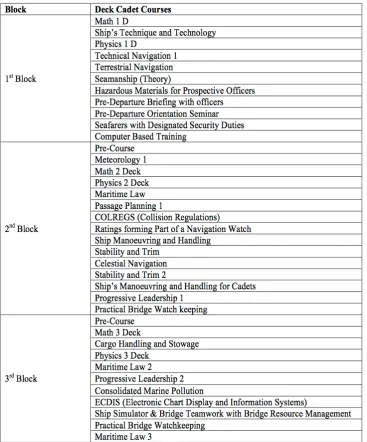
Table 3-3 Deck Cadet Training Program ... 66
Table 3-4 Deck Department Work Practices ... 70
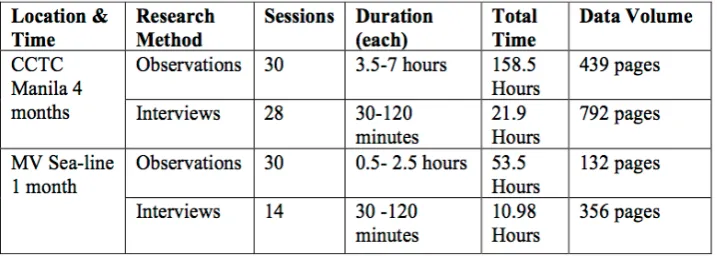
Table 3-5 Overview of Data Collection ... 76
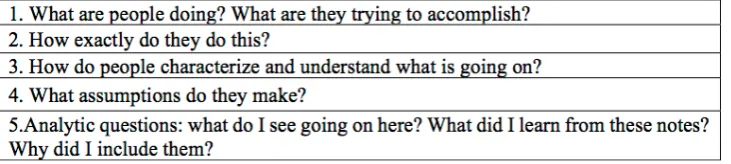
Table 3-6 Questions to Guide Field-Notes ... 78
Table 3-7 Data Structure 1 – Learning through Movement between Sites of Practice ... 90
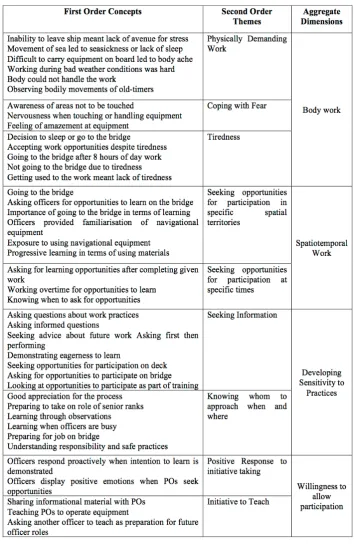
Table 3-8 Data Structure 2 – Negotiating Access to Participation ... 91
Table 4-1 Learning Through Movement between Sites of Practice ... 144
Table 5-1 Negotiating Access to Participation through Proactivity ... 188
List of Figures
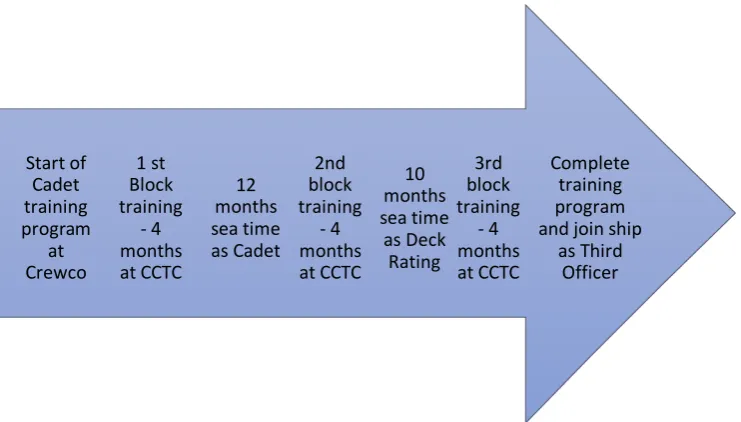
Figure 1 Deck Cadet Training Program ... 67Figure 2 Transitioning as an Episodic Process ... 193
Figure 3 Access Negotiation through Proactivity ... 222
Acknowledgements
The process of undertaking the PhD has been one of my most fulfilling and challenging learning experiences. While the journey is conventionally thought of as a solitary one, I had the good fortune and privilege of being surrounded by people who offered me counsel, inspiration, and motivation during this time. Without them this journey would not have been possible. I would like to extend sincere thanks to my two supervisors, Professor Jacky Swan and Professor Eivor Oborn, they were the best mentors that I could have asked for during this process, providing me with invaluable guidance and support. Their critical insights and remarks throughout the research process were the guiding blocks for this research. I also extend thanks to other members of the OHRM department and the IKON research group for giving me advice and help when I needed it.
The journey would not have been possible without the love and support of my parents Neeta Bharatan and Shridhar Bharatan, as well as my sister Tanaya Bharatan. I would like to thank them for giving me the confidence to continue on days when it seemed impossible, for motivating me, for listening to long and winding conversations about the research and for always believing in me.
My fellow doctoral colleagues and the many friends I made along the way are also owed a debt of gratitude. They helped make the PhD a fun, fulfilling and interesting process and without them, it truly would have been a long lonely road. There are too many people on this list to thank individually however, a special note of thanks to Lauren Shrock, Victoria Jelicic, Asma Bagash, Laure-Emmanuel Leguy, Sonya Liu and Anne Antoni who provided generous support and counsel along the way. Additionally, to Dr. Radka Kadnarova and Dr. Mario Ramotar for valuable guidance on the PhD process as well as on the research itself.
I would like to thank Uday Yellapukar and Hans Van Der Zijde for helping make the entry into maritime industry as smooth as possible. Finally, sincere gratitude to all the research participants and the organisers for giving me a chance to share their world for a while. They provided excellent opportunities for studying them as well as support and guidance when I needed it in the field.
Declaration
This thesis is submitted to the University of Warwick in support of my application for the degree of Doctor of Philosophy. It has been composed by myself and has not been submitted in any previous application for any degree. All data collection and analysis was performed by me.
Ila S. Bharatan
Abstract
My thesis seeks to develop the theory of legitimate peripheral participation by focusing on how it is accomplished in practice, through exploring the process of transition from novices to (relative) masters. In doing so, the study opens the black box of participation in studies of situated learning and focuses on two aspects that lead to a further development of legitimate peripheral participation. First, it looks at how newcomers undergo legitimate peripheral participation at two sites of practice and how movement between the sites influences the process of transition. Second, it focuses on the ways in which newcomers negotiate access to participation at a site where such access is not readily available.
Abbreviations
COP Community of Practice
COLREGS Collision Regulations
CCTC Crewco Training Center
ECDIS Electronic Chart Display and Information Systems
EMSA European Maritime Safety Agency
ETA Estimated Time of Arrival
GMDSS Global Maritime Distress and Safety System
IMO International Maritime Organization
ITTD Interview to the Double
LPP Legitimate Peripheral Participation
MV Motor Vessel
STCW Standards of Training, Certification and
Watch-keeping for Seafarers
1
Introduction
My thesis seeks to develop the theory of situated learning by focusing on the process of transition and how this is practically accomplished (Gherardi, Nicolini & Odella, 1998). It was empirically conducted over five months as a multi-sited ethnographic study (Marcus, 1995) in the maritime industry. Situated learning has tried to provide an alternative to cognitive theories of learning (Levine, 1975; Scribner & Cole, 1978) and, in doing so, has opened the arena for thinking of learning as a social phenomenon. Situated learning theory explains the learning through legitimate peripheral participation (LPP) in traditional apprenticeships (Lave & Wenger, 1991; Fuller & Unwin, 2004; Marchand 2008).
1.1
Theoretical
Underpinning
of
the
Research
Learning as LPP is a way of learning within a community of practice (COP) and becoming a member of the COP (Wenger, 2009). It is seen as a form of achieving mastery that is expressed through practices (Nicolini, 2013: 5). Here the identity of becoming a master is closely tied to the ‘capacity to carry out a social and material activity’ (Nicolini, 2013: 5). The research explores learning from a practice perspective (Gherardi, 2001; Orlikowski, 2002) in order to understand the period of transition within the LPP process from a newcomer to the practice towards a fuller participant of the practice.
as the ways of doing that are embedded in practice. The process of transition refers to the ways of doing which enable newcomers to progress through LPP within a COP.
The key aspect of learning in practice is the notion of participation because it is through legitimate peripheral participation that newcomers can engage in the practices of a COP (Lave & Wenger, 1991; Billet, 2004; Gherardi 2016). Yet, participation has become something of a “black-boxed” concept within theories of situated learning. That is to say, scholars of situated learning (Gherardi et al., 1998; Handley, Fincham, Clarke & Sturdy, 2007, Tanggaard, 2007; Chan, 2015) have been content to use the formulation of participation understood by Lave and Wenger (1991) that newcomers learn through observing, imitating, peripheral participation requiring small amounts of responsibility, and progressing to larger levels of responsibility, rather than critically reflecting on the concept of participation. There has been a move, recently, to develop critical insight into participation. For example, Ribeiro (2012) and Ribeiro and Lima (2015) look at different forms of participation and levels of immersion in practice. However, there remains space for further exploration on how participation in practice is accomplished. It is through delving further into the concept of participation and how it is done in practice that my thesis hopes to make its contributions. Prior to that, it is important to also gain an understanding of the methodological foundations of my study.
1.2
Methodological Approach
routinely made and re-made in practice using tools, discourse and our bodies.’ This focus on the routine and the day-to-day activities calls for a methodological approach suited to bring the practices to the fore. Hence, studies using the practice lens prefer using ethnographic methods to gather and present data. As Gherardi and Nicolini (2002: 198) state ‘the capacity of observing learning-in-practice cannot be separated from the choice of ethnography as the method of inquiry.’ This sentiment is also echoed in Lave’s (2011: 22) work on critical ethnography where she states that the ‘everyday conduct of inquiry into everyday practice offers critical resources to the ethnographer so minded that are more difficult to arrange in other methodological genres.’ Ethnography as a choice in my study becomes a valuable tool to try and understand the transition from a novice to relative-master through participation in the COP. In the LPP process, this transition takes place through participation in the day-to-day work, socio-cultural and socio-material practices. Hence, in order to study LPP, one must be able to get close to the sites of practice where newcomers participate.
Casting a critical eye on our surroundings reveals traces of an industry that is largely unnoticed in our everyday lives, the clothes we wear, the furniture in the room, the coffee we have in the morning, the computers on which we work. At least one thing that we consider as a regular part of our daily existence has at some point in time been at sea on a merchant vessel. In understanding the process of transition, this research also seeks to tell the story of the young novices to this community who, through want or necessity, have decided to head to sea in order to make a living, as they progress towards becoming masters of their practice. Accounting for almost ninety per cent of global goods trade (International Maritime Organization, n.d.) the maritime industry makes for an interesting site to conduct an ethnographic study of situated learning. The international nature of the industry and the dangers of life at sea have made learning and formal training in this industry critical. Furthermore, there is a spatial containment of work practices, especially on board the ship, which makes it marginally easier to observe the, usually difficult to capture, nuances of practices.
1.2.1 Background to Research Sites
The research draws on a detailed study of the practices of navigational officers training and working on container vessels within the maritime industry. In particular, it analyses how deck cadets (newcomers) gain access to participation in the on-board practices on the ship as they seek to become officers (fuller participants). Because of the nature of the research parameters and the practice lens a multi-sited ethnography was the best-suited choice of method (Marcus, 1995). The research was conducted as a five-month multi-sited ethnographic study within a shipping organization at two research sites, a training center, CCTC, and a ship, MV Sea-line.
Crewco Training Center (CCTC, pseudonym) and a ship, MV Sea-Line (pseudonym). Crewco acts as a third-party crew manager. They take on the responsibility of sourcing, managing, and looking after the crew while on board the ship and get them safely home once they finish. Currently, Crewco manages the crew of 1,100 ships and 13,000 seafarers, approximately. Considering that one of the industry statistics is that eighty per cent of all accidents on board are caused by human error, the company has to ensure safe working environments on board (Dhillon, 2007). Therefore, learning and training is a large part of what they do in the organization.
CCTC is a maritime training center in Manila that provides training courses for the Filipino Crewco cadets and officers. Crewco initially created CCTC to address training deficiencies within the national maritime training system in the Philippines. The cadets who come to CCTC are selected from maritime colleges around the Philippines. They are enrolled in the three-year deck cadet program at the CCTC training center in Manila where they undergo ten months of shore-based training interspersed with two periods of sea-time training lasting between eight-ten months. At CCTC cadets learn the theory of the practices of navigation, such as Bridge Resource Management, Cargo Management, Practical Seamanship, Ship Simulator Training and Chart-work among others.
training officer on board (chief officer) as per the Standards of Training, Certification and Watchkeeping (STCW) regulations and the daily training record books. If the cadets complete their sea-service contracts, they receive letters of recommendation from the captain on board and can continue to next phase of their training at CCTC.
1.2.2 Employing the Data Collection Tools
At CCTC the focus of observations was on the training courses that the cadets undertook during their three- or four-months’ stints at the training center. Initially, the training sessions were observed from 0800-1700 every day, and this gradually decreased as data saturation was reached. The focus of the observation sessions was to look at the theoretical information that the cadets needed to know, as well as their participation opportunities. During the interviews; the focus was on their learning and training experiences. The semi-structured interview format allowed the cadets and the officers to share their experiences and what they thought to be important in the learning process. The interviews focused both on their training experiences at CCTC, at the maritime colleges and if they were in the second or third block, then also their sea-service experiences.
to understand the process of transition from a cadet towards becoming an officer.
The data were collected using non-participant observation and interviews. Formal observations were supplemented with informal observations that look place through spending 24/7 at the research sites for five months. Additionally, interviews were carried out with seafarers from all ranks. The data gathered, was analyzed using inductive thematic analysis (Thomas, 2006). Accordingly, during and after the data collection phase, two years were spent, iteratively analyzing data and conducting a review of the literature.
1.3
Research Objectives
world operates…how on earth are students expected to develop their own initiatives and critical senses if they are being trained in a system devoid of uncertainty.’ My study seeks to explore how newcomers navigate their transition through learning at these different sites of practice by looking at the influence of movement between sites of practice on learning. Hence it seeks to explore the differences, tensions, and conflicts that arise from the movement and how these influence the process of transition.
Second, theories of legitimate peripheral participation state that it is through access to resources, old-timers, and participation that newcomers can transition from peripheral to full participation (Lave & Wenger, 1991, Wenger, 1998, Gherardi & Nicolini 2002). In this sense, access to participation seems to underpin legitimate peripheral participation. That is, if access to participation is made possible, newcomers can progress through legitimate peripheral participation, and if access is not available, newcomers are unable to become legitimate peripheral participants (Lave & Wenger, 1991; Handley et al., 2007). Yet, typically, access to participation is treated as ‘given’ (Lave, 1991), or conferred by the situation; quite how newcomers practically accomplish access to participation in complex organizational settings is not well understood. My study problematizes this aspect of participation by looking at how newcomers negotiate access to participation in a site where such access is not ‘given’. My study presents a site of practice such participation opportunities were not given. Hence, it explores how newcomers in such a site negotiated access to participation. Through multi-sited ethnographic research, two empirically driven research questions form the guiding parameters of the study:
2. How do newcomers gain access to increasing levels of participation in a community of practice?
1.4
Intended Theoretical and Practical
Contributions
Regarding practical contributions, this research hopes to explore how cadets/trainees develop seamanship. Furthermore, it seeks to understand how transition is accomplished in their day-to-day practices and their interactions with other members of the community of practice, be it at the maritime institutes, or on board ships. Following the career trajectory of cadets from the maritime institutes through to the ships will also help better understand the debate and tensions between onshore and traditional on-board training to see the effectiveness of training on skill development. This will contribute to understanding the influence of the experts in the COP, mentors, teachers and captains on the participation and learning of the cadets. Right now, the maritime industry, as with many others, is facing the challenge of employability and retention of new officers. With a rapidly changing workforce, it is important to understand how the skills of seamanship are developed and I hope that my research can contribute to exploring this topic further at a crucial time. The analysis has the potential of helping shipping companies and maritime institutes to steer their training programs towards improving the employability of cadets.
1.5
Thesis Structure
The rest of thesis is structured as follows:
aspects in LPP theory that require further exploration before reiterating the research questions.
Chapter 3 explains the methodological logic of the research and how aspects of the methodology such as research design, data collection, and analysis were used in practice. The research is grounded in Heideggerian existential onto-epistemology which forms the philosophical underpinning of the research. Using this basis, the research design of the multi-sited ethnography is explained. The research setting of the maritime industry and its suitability to explore the process of transition is developed. Issues of ethics are touched upon, and then the chapter focuses on the operationalizing of the research. It gives a background of the organization and the two sites of practice used to conduct the empirical study and reflects on how access was negotiated by me at each site. Next, the chapter explains how the research methods were used to carry out the study and how the data were analyzed using inductive qualitative analysis. Finally, the chapter touches upon the reflections of the research process itself.
newcomers enact different forms of proactivity to negotiate access to participation.
Chapter 6 - the discussion chapter - theorizes the concepts developed in the two findings chapters and builds the theoretical contributions of the study. First, it theorizes movement between sites of practice and its influence on them to develop the concept of transition as an episodic process. Second, it theorizes the process of access negotiation and develops the concept of proactivity from a practice perspective and how this concept of proactivity is useful to develop a more nuanced understanding of LPP.
2
Literature Review
This chapter aims to provide a review of the literature on situated learning and, in doing, so it highlights the theoretical point of departure for the empirical study that follows subsequently. There are two main literature streams that form the theoretical base for the study. The first, is literature on situated learning that theorizes LPP in a COP which underpins the process of transition (section 2.1 & 2.2). The second is the related practice theory which helps understand where the process of transition takes place that is within and through practice (section 2.3). Within these theoretical frames, aspects of situated learning and practice such as sites of practice (section 2.4), learning in practice (section 2.5) and participation in practice (section 2.6) help focus on the where, what, and how that are used to explore the process of transition. The concept of participation is crucial to the practical accomplishment of LPP through the process of transition, and there are two aspects of participation that require further investigation. These are, learning through movement between sites of practice (section 2.7) and negotiating access to participation in practice (section 2.8). Hence, the review focuses on these aspects to highlight the usefulness of further exploration on these fronts in order to understand the practical accomplishment of LPP through the process of transition. Revealing these areas for further exploration leads to the formulation of two research questions that underpin my study (section 2.9).
2.1
Legitimate Peripheral Participation
Yanow, 1993; Gherardi et al., 1998; Wenger, 1998). They state that knowing and learning is context-dependent, they are situated and, indeed, one cannot treat context as separate from the learning. Theories of situated learning, then, move away from the notion of knowledge as possession, toward a view of knowing and learning ‘as engagement in changing processes of human activity’ (Lave, 1993/2010: 12). Theories of situated learning came to the fore in organizational studies mainly through the work of Lave and Wenger (1991) when they theorized the concept of LPP; they (1991: 29) describe LPP as the following:
‘By this we mean to draw attention to the point that learners inevitably participate in communities of practitioners and that the mastery of knowledge and skill requires newcomers to move toward full participation in the sociocultural practices of a community.’
Learning, then, is a way of being in the world rather than knowing about it (Lave & Wenger, 1991: 24). LPP is seen as a type of social practice, which involves three key features; the first is legitimacy, that is, a way of belonging to the community. Lave and Wenger state, that when individuals learn an occupation, ‘sponsorship into a community’ becomes an issue (Lave & Wenger, 1991: 92). This sponsorship seems to signify the shift from non-member to newcomer. Learning does not take place in isolation. Instead, members of the community constantly negotiate their relations to be considered legitimate members. Hence, once newcomers gain primary sponsorship into the community, they need to engage in practices in a way that maintains legitimacy (Lave & Wenger, 1991:50).
periphery to the relative core. Hence, the periphery could be seen as a route that could potentially be taken by newcomers as they engage in the practices of the community and gain legitimacy with the members of the community (Gherardi & Nicolini, 2002: 197). Here, the notions of periphery and core have to remain relative because, according to Lave and Wenger, there is no designated periphery and no single core (Lave & Wenger, 1991: 36).
The third aspect is participation, that is, engagement in the socio-cultural practices of the COP (Lave & Wenger, 1991: 36). Lave and Wenger (1991: 36) state:
‘Newcomers’ legitimate peripherality provides them with more than an “observational” lookout post: It crucially involves participation as a way of learning – of both absorbing and being absorbed in – the “culture of practice.”’
In other words, it is not possible to engage in or progress through a COP without participating in the practices. As newcomers transition from the periphery to the core their participation in the COP increases. LPP, then, ‘refers to the progressive involvement of new arrivals in the community as they acquire growing competence in its practices’ (Gherardi & Nicolini, 2002: 197). In the LPP theory, while we can divide the three aspects of it for further clarification, we cannot separate the three as they are intrinsically linked; one cannot participate without legitimate peripherality, one cannot be legitimate without the peripheral participation, and one also cannot be peripheral without legitimate participation.
to becoming competent practitioners. Hence, we can draw some initial insights into how seafarers learn their practice from Hutchins’ (1993/2010, 1995) ethnography of navigational practices at sea. In this, Hutchins moves away from a purely individualistic notion of cognition and learning. Instead, he argues for the cultural nature of cognition to be better understood and reflects on the cognitive aspects embodied by the system, that is, the navigation team. He focuses his analysis on the learning and change that occurs in these cognitive systems Hutchins (1995). Here, he highlights the interactional process by which new members of the quartermaster corps move towards full membership through increasing levels of participation.
My study also seeks to explore the practices of seafaring by focusing on the process of the transition of merchant seafarers as they move from being cadets towards becoming officers. In doing so, it focuses on two aspects not explored in Hutchins’ (1993/2010, 1995) work: first, the movement between the pre-sea training and the ship and how it influences the process of transition, which is possible through focusing on new entrants to the COP. Second, while Hutchins’ concentrates on the role of interactions in the learning of novice quartermasters he does not explore how the novices gain access to this learning. Both these points need to be explored to build further understanding of the process of transition. Having briefly explained the phenomenon under investigation, that is LPP, it is important to focus on the boundaries within which LPP takes place. Hence, we turn our attention to the concept of a COP.
2.2
Communities of Practice
1998: 5). The second is practice, that is, ‘shared historical and social resources, frameworks, and perspectives that can sustain mutual engagement in action’ (Wenger, 1998: 5). As Lave and Wenger (1991: 98) maintain, ‘A COP is an intrinsic condition for the existence of knowledge.’ They further state that although there is centripetal movement in COPs, given their complexity there is no ‘uniform or univocal “center”’ and no ‘designated periphery’ (Lave & Wenger, 1991: 36). The aim of going through the process of LPP is to go through an identity change – from a novice of practice to its master (Lave & Wenger, 1991: 53).
Learning as LPP is a way of learning the practices of a COP and becoming a member of the COP (Wenger, 2009). Nicolini (2013: 5) maintains that ‘from a practice perspective, knowledge is conceived largely as a form of mastery that is expressed in the capacity to carry out a social and material activity.’ From this point of view knowledge, or rather knowing, takes place through participation in day-to-day work and activities. As Gherardi (2016: 521) notes, ‘People engaged in a working practice acknowledge a set of social positions which are interrelated, which make sense, and which are enacted. Practices impart identities and selves that are displayed on appropriate occasions.’ Hence, practice and identity are interlinked; the identity of practitioners is formed through and displayed within practices. This means that for newcomers to develop their identity as master practitioners gaining participation to practices that allow for this progression is fundamental to LPP; however, how newcomers gain access to participation is less clearly understood.
always considered as a ‘person-in-the-world’ (Lave & Wenger, 1991: 52). Therefore, LPP theory takes into account the relationships between the individuals and the community, moving away from other theories of apprenticeships that advocate a dyadic master–apprentice relationship. Furthermore, the learning from this perspective is not simply learning the practices of a community, but also learning to be a certain kind of person – a master of the practice. As Lave and Wenger (1991) have shown, there is a very close link between learning, practice, and identity. They state,
‘learning thus implies becoming a different person with respect to the possibilities enabled by these systems of relations. To ignore this aspect of learning is to overlook the fact that learning involves the construction of identities’ (Lave & Wenger, 1991: 53).
For them, LPP is a process of identity transformation from a non-participant to a newcomer and then to a full non-participant – a practitioner. While LPP shows the process of identity transition, it does not highlight the contestations, differences, and power dynamics that need to be traversed for newcomers to become full participants (Contu & Wilmott, 2003). In looking at the movement between sites of practice and access negotiation, my study highlights these aspects of the process of transition. As this research is interested in the process of transition that newcomers undergo to become full participants, it is also important to understand what is meant by newcomers and old-timers. Lave and Wenger (1991: 56) reflect,
‘Thus, we have begun to analyze the changing forms of participation and identity of persons who engage in sustained participation in a COP: from the entrance as a newcomer, through becoming an old-timer with respect to new newcomers, to a point when those newcomers themselves become old-timers.’
been engaged in the practice for a while. On the other hand, as newcomers engage in practices they become relative old-timers, who can be perceived as relative newcomers by old-timers who are fuller participants (Lave & Wenger, 1991: 93). Furthermore, practices themselves can change, hence old-timers can be perceived as relative newcomers within changing practices. Take, for example, the changes in practice with relation to technology. New entrants to a practice who are familiar with a piece of technology can be more skillful at using the technology than practitioners who have engaged with older modes of practice. Another example is when relative newcomers or old-timers (the journeymen in apprenticeship terms) gain access to new levels of responsibility. In this case, while they might be old-timers in certain aspects of the practice, they might be newcomers in others (Lave & Wenger, 1991; Gherardi et al, 1998). Furthermore, there could be a situation where the (relative) old-timer is a newcomer to a different site of practice while being an old-timer within a community. Hence, the terms newcomers and old-timers can be seen as fluid concepts within a COP.
For the purpose of this research, identity as a concept is implied within the terms of newcomers and old-timers. Newcomers are peripheral participants in a community of practice. The term newcomer, then, suggests this peripheral position. Old-timers refer to the relative old-timers within the community; this includes both journeymen and masters of the practice. They are participants who have transitioned to fuller participation in the COP. In undergoing the process of transition, this position of fuller participation is where the newcomers are headed; going through the process of transition means a change in identity from newcomer to old-timer. Hence, the terms newcomer and old-timer imply both the change in participation and, therefore, the change in identity.
selves, or Ronfeldt and Grossman’s (2008) work on possible selves, Wenger (1998) describes the different ways in which newcomers engage in a COP as trajectories, that is, ways of thinking about what newcomers can potentially become in the future. He states that trajectories are not set paths; rather, they are ways of ‘sorting out what matters and what does not, what contributes to our identity and what remains marginal’ (Wenger, 1998: 155). Furthermore, he describes five types of trajectories: peripheral trajectories, that is, those trajectories that do not lead to full participation, where the newcomers stay on the periphery. Insider trajectories, that is, the changes in identities once someone has reached full participation, which are caused due to the evolution of the practice itself; boundary trajectories, that is, the trajectories of those who span the boundaries of different communities of practice; and outbound trajectories, those that lead out of a COP (Wenger, 1998). For my research, the most significant trajectory is the inbound trajectory; that is, when newcomers join a COP with the intention of becoming full participants. The inbound trajectory is significant because my research is interested in the process of transitions of newcomers toward fuller participation; hence, focusing on the trajectory that leads towards fuller participation becomes necessary. It also becomes a way of understanding what kind of practices the newcomers need to participate in, such that the participation puts them on an inbound trajectory.
account of COPs maintaining that COPs help add value to the organization. They then set out guidelines for organizations to foster and sustain COPs. Others have critiqued these more normative accounts of COPs within the field, arguing that focusing on the normative accounts of COPs leads to a romanticizing of COPs which glosses over the contestations, conflicts, and tensions that arise within a community of practice (see Contu & Wilmott, 2003; Cox 2005).
In sum, the definition of COPs has changed from the time when Lave and Wenger (1991) first noted the term. For the purpose of my research, COP will be used from Gherardi et al’s (1998) understanding as a form of organizing. It places emphasis on practices rather than as an informal community (Brown & Duguid, 1991); it is through engaging in shared practices that practitioners gain a sense of community with the conflicts and power dynamics that are entailed in it. Here, the COP is taken as the COP of operational deck officers. Hence, the newcomers are taken as the new entrants to the COP – cadets; the relative old-timers are taken as deck officers; and the masters of the practice are taken as master mariners, hereafter referred to as captains to avoid confusion with masters in the LPP theoretical sense of the term. My research is interested in understanding the practical accomplishment of LPP. Hence, the focus is on the ways in which newcomers (cadets) in a community of practice undergo the process of transition towards fuller participation (deck officers) through movement between sites of practice and how they negotiate access to the participation required to put them on the inbound trajectory towards becoming (relative) old-timers.
performance of emergent, creative and autonomous actions often required of individual emergency personnel in crisis situations.’ Their study of Norwegian firefighters expands the theory of situated learning to include individual cognitive aspects of learning alongside the process of LPP. Zukas and Kilminter (2014), in their study of doctors’ transitions, also state that LPP creates problems when used to explain doctors’ learnings. The transitions that doctors face during their work are not the same as an apprenticeship. There are discontinuities among levels of responsibility according to time, spatial setting and specialties (Zukas & Kilminser, 2014: 208). In this case, Zukas and Kilminster (2014: 211) conceptualize transitions as ‘critically intensive learning periods’ which lead to transformations. Johnston (2015) analyses the learning of student teachers during placements and states that Lave and Wenger’s (1991) notion of situated learning is inadequate to analyze student teachers’ difficulties in participating in school communities. Through his analysis, Johnston (2015) warns against the romanticizing of COPs.
on the concept practice and its subcomponents, performances, and actions, to answer the question.
2.3
Actions, Performances, and Practices
Lave and Wenger’s theory of LPP along with other seminal works such as Brown and Duguid (1991) has been noted to shift the focus in organizational studies towards practices (Corradi, Gherardi & Verzelloni, 2010). These theories, coupled with the interest in a knowledge society, and knowledge economy have led to a ‘renewed interest in practical knowledge’ (Corradi et al. 2010:267). This viewpoint perceives practices as a focus to study the activities of practitioners (Corradi et al. 2010, 268). From this perspective, practice is the place of learning and knowledge leading to social learning theories (Elkjaer, 2003), work-based learning theories (Raelin, 1997) and fields such as strategy as practice (Jarzabkowski, 2003). These perspectives, while differing in focus, all take practice as an essential element and share the notion that practice can be the empirical object used to study the social phenomenon. According to Gherardi (2001), situated practices produce knowledge. Hence, knowledge is ‘enacted – every day and over time in people’s practices.’ (Orlikowski, 2002: 250). Another way of understanding this is through Schatzki’s (2012: 14) statement,
‘If what a person does, thinks, believes, desires, etc., presupposes the practices that s/he carries on, social phenomena cannot consist simply of people’s actions but must consist of these actions together with, or in the context of, these practices.’
Watson (2017) delineates practices, performances, and actions as the following, ‘practice is an entity with continuity across the instances of its performance,’ ‘performance is an enactment of practice,’ ‘actions are the doings (of skilled, reflective practitioners) that comprise performances.’ The relationships between practices and their components are ways of answering the question, what are practices? It must be stated, beforehand, that there is no single definition of practice, just as there is no single practice theory (Schatzki, 2001). The understandings of practice detailed, subsequently, are the ones I used to build my understanding of practices. The understanding of practice is necessary to explore the process of transition because it is practices that form the basis for situated learning. As newcomers go through the process of LPP, they are involved in the practices of a community and, in order to move towards fuller participation, they need to go through the process of becoming competent practitioners.
‘Practices are meaning-making, order-producing and reality-shaping activities. That is orderly sets of materially mediated doings and sayings aimed at identifiable ends. We call such regimes of activity practices when they have a history, a constituency, and normative dimension. With a ‘real’ purchase in the regulated manufacturing of reality, practices contrast with hidden forces other social theories talk about.’
Practices are made up of performances that make sense in relation to other performances, which are done for a reason. They have been performed in a historically recognizable way by a group of practitioners who have a shared sense of the correct and incorrect ways of performing in practice. It is this understanding of practices that underpin the practices of seafaring that are being investigated in my study. This understanding of practice forms the basis of the study because to understand the process of transition there is a need to focus on what the newcomers are learning to do. Learning makes sense only in light of the practices of the community in which the newcomers are transitioning. That is, the newcomers learn doings and sayings which makes sense because members of the practice have negotiated these doings and sayings as the correct ways to perform within a practice. These meanings are historically negotiated. For example, the performances that make up the practices of seafaring make sense within those practices. If someone says, “raise the anchor” on land, it does not make sense, however on board a ship, within the context of the practice, this saying and related doings have a purpose. This purpose is an identifiable end for the community because raising the anchor might mean the ship is ready for her voyage or she is ready for berthing at the port. The process of transition involves learning these doings and sayings in the context of a practice so that newcomers learn how to perform as competent practitioners.
share with process studies the notion that ‘social and organizational life stem from and transpire through real-time accomplishments of ordinary activities’ (Nicolini & Monteiro, 2017: 110) While practices are sustained, they are not static; they are constantly performed and re-performed every time anew. This repeated performance takes place not only between individuals but also between individuals and material objects. Depending on the practices and other influences, individuals may ‘adapt, transform or even reject practices’ (Handley et al. 2007). Hence, from a practice perspective, things are always in a state of becoming.
Taking a processual approach involves focusing on the suffix “-ing’’ that is, focusing on the emergent, fluid, temporal and spatial aspects of the organizational phenomenon (Langley & Tsoukas, 2017). Thus, we move from the notion of knowledge to knowing, from being to becoming and from organizations to organizing (Orlikowski, 2002). This fluidity is important to keep in mind because process theories focus on questions of “how”, that is, the processes through which something happens. In my study, while I adopt a practice lens, there is a process element involved, because the study focuses on the process of transition in the practices of seafaring. Here, processes are understood as the ways of doing things embedded in practice. Furthermore, the transition is understood as the progressive change or becoming that newcomers go through as they move towards fuller participation. Hence, understanding the practical accomplishment of LPP involves focusing on the ways of doing things, that is, the process of transition embedded in practice.
2.4
Sites of Practice
and have a specific “location.”’ For Nicolini (2011: 605), a site ontology implies that ‘phenomenon at hand and its conditions are strictly related and mutually implicated.’ In other words, sites indicate the situated nature of the social phenomenon. Here, location is not the spatial location of the social phenomena but, rather, the context within which the phenomena transpire (Schatzki, 2005). This context is not an empty box, “out there,” within which practices occur, rather it is used as convenient shorthand to describe the sociocultural, historical and material arrangements that enable or constrain practices and are expressed through practices (Kemmis, Wilkinson, Edwards-Groves & Hardy, Grootenboer & Bristol; 2014).
Schatzki (2002) states that the site of the social is made up of bundles of practice. A site, as denoted by Schatzki (2005: 468) is a ‘type of context,’ which is not necessarily spatial but which governs and is governed by the activities within it. For example, practices, from site ontology, can be seen as sites, as regimes of actions that determine and are in turn defined by the actions of the socio-material doings and sayings that take place within them. For Schatzki (2005; 471), ‘the site of the social is composed of nexuses of practices and material arrangements.’ According to Schatzki, social orders are related to practices because they are established in practices. The way in which things are arranged is done through organized regimes of doings and sayings (Schatzki, 2002; Nicolini & Monteiro, 2017). These practice-order meshes are entwined with each other in ‘tight or loose multi-layered webs’ (Schatzki, 2002: 155). This is an important aspect to keep in mind when looking at the movement between sites of practice. In looking at the influence of the movement of the process of transition, we need to be aware of the connections and alignments between the sites to understand how the sites relate to each other and the influence of this relation on the learning of the newcomers.
‘cultural-discursive resources, material-economic resources and social-political resources’ (Kemmis et al., 2014: 33) that enable the unfolding of practices. For Nicolini (2011), practices are sites of knowing, because what counts as knowledge is closely linked to sites of practice. Furthermore, Schatzki (2005: 471) relates this notion of knowledgeability, or ‘pursuing certain stakes’ to Bourdieu’s (1990) concept of habitus and field; stating that once acquired, habitus (‘batteries of dispositions’) perpetuates the field’s practices and conditions. From this, Schatzki (2005: 471) states that ‘the site of the social is these possibility space-carrying fields.’ Sapir, Drori, and Ellis (2016: 20) state, ‘most of what people do is part of some practice or another, and such social phenomena as institutions and power can be understood via the structures of relations among practices.’ Furthermore, Grootenboer, Edwards-Groves & Choy (2017: 10) state that practices in certain sites emerge because they are enabled, constrained and shaped ‘by conditions that exist in particular sites at that time.’
To understand how newcomers transition towards fuller participation, it is important to realize aspects of the arrangement of practices and the practices of the particular sites in which newcomers seek to participate. This is because learning in practice is situated within the contextually bounded arrangements that make up the site of practice. To transition towards fuller participation newcomers need to do so in ways that are in line with the situated practices of a particular site. Having looked at the concept of sites of practice, the attention turns, now, to what learning in practice means.
2.5
Learning in Practice
participation in practice (Gherardi et al., 1998; Gherardi, 2008). Gherardi et al. (1998) further an argument in their paper on learning in the workplace as both a cognitive and social activity. They state ‘to know is to be capable of participating in with the requisite competence in the complex web of relationships among people and activities’ (Gherardi et al., 1998: 274). Gherardi (2001: 133) states that ‘in practice, knowledge is mediated by social relations and knowing is part of a surrendering to a social habit’. Learning from a practice perspective is a form of situated practice, and practice is always social (Wenger, 1998; Handley, Fincham & Clarke, 2007). From the practice perspective ‘knowledge resides in social relations, and knowing is part of becoming an insider in a COP’ (Gherardi, 2001: 133).
The acquisition of performative skills has received recent attention by Schatzki (2017) who states that theories of LPP do not promote a new concept of learning; they still hold the learning as acquisition of knowledge. From his understanding of practice, learning in practice ‘involves both the acquisition and subsequent development of a regime of competence’ (Schatzki, 2017: 27). This acquisitive learning, that is, knowing how to go on in practice is what Gherardi, Wenger, and Kemmis et al. mean by participation in practice (Schatzki, 2017: 28). However, he states, the key difference between situated and traditional forms of learning is practices. From a practice perspective knowing and learning always occur in practices. For example, Tsoukas & Vladimirou (2001) state that knowledge is the individual ability to draw distinctions. Furthermore, drawing distinctions is the ability to split the world into this and that. When looking at organizational knowing Tsoukas and Vladimirou (2001: 979, emphasis in original) state,
individuals draw and act upon a corpus of generalizations in the form of generic rules produced by the organization.’
In the above quote, we see the importance of contextuality of actions. That is, the understanding that the social world is composed of practices and learning occurs within these social practices (Schatzki, 2017). Explaining the notion of learning, Schatzki (2017: 44) maintains, learning occurs,
‘When a person is capable of flexibly coping with rules— obeying them, interpreting them, ignoring them, and taking them into account. And yet another form of learning is a person becoming better able to articulate general understandings that imbue practices she carries on, thereby enabling these practices to proceed more clairvoyantly, focusedly, and confidently (cf. Taylor 1985).’
Specifically, learning occurs through knowing how to go on within practices. Through participating in practices, practitioners learn the rules of the practices, and through further participation, they master the flexibility of the rules. Moreover, learning in practice focuses on how practitioners proceed in practices and how this proceeding changes over time. It is important, then, to understand how learners learn to proceed in practices (Nicolini & Monteiro, 2017).
a rejection of the Cartesian mind-body dualism. Instead, situated learning theories see the mind as part of the body (Lave & Wenger, 1991; Lindkvist, 2005; Hislop, 2008).
There has not been much emphasis on the maritime industry in mainstream organizational studies, however, there are elements noted from other works on seafaring that can augment the situated literature in organizational studies. For example, Mack (2007) focuses on the aesthetics of seascapes to explore the relationship between passion and knowledge through the place of the sea. ‘Aesthetic knowledge is always involved whenever flesh-and-blood human beings act’ (Gherardi, 2011: 54). With her work on the aesthetics of seascapes, Mack calls for an increased awareness of organizational studies on the maritime industry. Understanding learning as an embodied activity is important in the understanding of the process of transition because it helps focus on the way in which the body enables and constrains participation and how, in going through the process of transition, newcomers learn through their bodies to become competent practitioners. While previous literature has focused on embodied learning, it has not explored in depth, the role of the body in enabling and constraining participation.
Furthermore, learning in practice is also spatiotemporally situated. Hence, space and time both play a role in enabling and constraining what is possible in practice. While there is a general understanding that when speaking of the situated nature of learning in practice, theorists are not focusing on the physical situatedness (Schatzki, 2005), that is, practices are not situated because of their location in certain spaces. Others have directed attention to the importance of space when considering practices. For example, Yanow (2006: 1752) notes,
organizational spaces and human action, the ways in which spatial elements communicate organizational meanings.’
The attention to the spatial dimension of work practices means that there is a focus on the influence of space on actions, and how spaces act as communications tools. Take, for example, a lecture theatre with a podium for the speaker and rows of seats and tables for the students. Looking at the spatial design one can note the possibilities for action – the lecturer due to her position at the front of the room on the podium, acts accordingly, she stands, she talks, and the focus of the room, per the spatial design, is on her. The students, on the other hand, sit, their role is more passive in the spatial design. Additionally, looking at the space communicates the intent of the practices that take place in the room; it is a room for lecturing. The notion of space guiding actions is also furthered by Gherardi (2006: 132) who maintains:
‘An organized space – a workplace – is a ‘situational territory’ (Goffman, 1971; Suchman, 1996) in which objects remind subjects of what they must do, prevent humans from doing things that may harm them, guide action according to intentions inscribed in their design, and make work and life comfortable, both materially and socially.’
Practices are also spatiotemporally situated, which means that ‘practices always occur in physical space-time. Practices, therefore are temporally situated, locally influenced, locally produced, locally enacted, locally accomplished and locally comprehended’ (Grootenboer, et al, 2017: 9). Practices, then, are situated; hence, learning in practice is a situated activity bounded by space and time. It is within these spatiotemporally bounded practices that newcomers transition; they need to learn how to go on in these situated practices. Hence, to understand the practical accomplishment of LPP through the process of transition it is important to focus on the spatiotemporal dynamics. Although the above-mentioned studies have explored the role of space in learning, there is still room for expansion on how newcomers negotiate participation in spatial territories. This is important to understand in the process of transition because practices are spatially situated and consequently access to these spaces is required for the accomplishment of LPP.
Practice theories are sensitive to materiality (Orlikowski & Scott, 2008; Orlikowski, 2009). This is because practices themselves are socio-material and this socio-materiality accounts for the situated nature of practice, or the ‘situational territories’ described above by Gherardi (2016). To be skillful, then, individuals need to mediate not only with the COP but also with the material artefacts of the practice. Hence, LPP and practice theory are intrinsically intertwined. From the LPP perspective, individuals participate in the practices of the community to become full participants. As this research is interested in the transition of newcomers in the LPP process, the practice-perspective provides a suitable analytical lens to focus on the practices of seafaring.
how to get things done is both collective and distributed, grounded in the everyday practices of organizational members.’ Here Gherardi (2012 follows other practice theorists, such as Orlikowski (2002) in emphasizing that from a practice perspective, competence is demonstrated through performance and human actions; that is, knowing how. Orlikowski (2002: 250) notes that knowledge is ‘enacted –every day and over time—in people’s practices.’ Furthermore, Orlikowski (2002: 253) draws on Lave (1988) and states that knowing how emerges from ‘the situated and ongoing interrelationships of context (time and place), activity stream, agency (intentions, actions), and structure (normative, authoritative, and interpretive).’ From this perspective, knowing and skillfulness are not stable properties; rather, they are seen as emerging, enacted and embedded in situational practices. The concepts of knowing and skillfulness in practices are learned by newcomers through participating in practice. Learning in practice requires participation, this means that to study the ways in which LPP is accomplished in practice, we have to focus on participation and, how participation is accomplished in practice is less understood. Therefore, the next section focuses on participating in practices and what it means.
2.6
Participating in Practice
community. Here, participation involves ‘taking part in a professional language game, mastering the rules and being able to use them’ (Gherardi & Nicolini, 2002: 196). As newcomers seek to participate in the practices of the community, they engage in the process of LPP (Corradi et al., 2010: 268-269). Learning then becomes a way to participate in ongoing practices, to negotiate relations with members of the community and with materials while engaging with and contributing to the shared activities (Gherardi & Nicolini, 2002). Furthermore, Gherardi and Nicolini (2002: 197) state that because knowledge is distributed in ‘the life of the community, and because learning is an act of belonging, learning necessarily requires involvement in and contribution to the community’s activity and development.’
performance.’ While the importance of participation for learning has been noted in previous studies, how participation is accomplished is less well understood.
Konopaski, Jack & Hamilton (2015) look at LPP in the setting of the family firm and highlight the link between legitimacy and participation. They state that as participation in practices increases so does legitimacy to a point where the participation of the members becomes essential for the COP. Through participation, members of the COP go through an identity change as they seek to master the practices of the COP (Handley, Sturdy, Fincham & Clark, 2006). Here the ‘mastery resides not in the master but in the organization of the COP’ (Lave & Wenger, 1991: 94). Hence, it is through involvement or engagement with practices that newcomers are able to transition into masters of the practice. According to Handley et al. (2007: 175) ‘Participation enables or constrains opportunities to develop identities and practice.’ Furthermore, it is through participation at different levels ‘core’, ‘peripheral’ ‘marginal’ that one is also able to understand where within the COP the individual is located (Wenger, 1998). In order to study the transition of newcomers to masters of the practice, participation becomes key.
(2007) looks at the move of newcomers from a vocational training center to a trade to show how, through participation, newcomers gain increasing familiarity with the practices of the trade. Again, he does not focus on the forms of participation required for gaining familiarity.
Ribeiro (2007; 2012; 2013) opens the “black box” of participation when he notes the different types of immersion one can undergo as part of a life or collectivity. These five types of immersion are ‘‘non-immersion (e.g., machines)’, ‘self-study (e.g., just reading)’, ‘linguistic socialization [alone], Collins 2004b’, ‘physical contiguity’ (Ribeiro, 2012) and ‘physical immersion [i.e., practice] (Collin & Evans, 2007: 59)’ (Ribeiro & Lima, 2016: 288). The above-mentioned types of immersion can also be looked at as ‘levels’ of immersion (Ribeiro, 2012: 368), which means that the higher the level of immersion, the ‘more experiences it encompasses’ (Ribeiro, 2012: 368).
had physical contiguity and linguistic socialization. Therefore, Ribeiro (2012) shows different levels of participation within a practice.
There are two aspects of participation in the above-mentioned studies that require further exploration. First, in all the studies there is continuity participation. Gherardi et al. (1998), following Lave and Wenger (1991), state that learning in a situated curriculum follows progression and regression as newcomers move from one task to another; however, there is a continuity in the tasks performed by the newcomers. In Ribeiro’s (2012) studies, the movement from linguistic socialization to physical immersion shows that each form of participation builds on the previous forms of participation. This works when the focus is on a single site of practice. However, it is useful to explore how participation is influenced by movement between sites of practice. If sites contextually bind practices (Schatzki, 2005) movement between sites helps explore how the ways in which newcomers navigate different contextually bound practices at different sites, and how this movement influences their transition.
2.7
Learning between Sites of Practice
Studies of situated learning have focused on learning between different communities of practice (Wenger, 2000; Yanow, 2004; Oborn & Dawson, 2010) learning across different sites within the same COP has not been the focus. Furthermore, the literature on brokering and translation focuses on how members of the community translate or broker knowledge across boundaries of the community (Carlile, 2002; 2004; Nicolini, 2010b). However, it is important to consider how newcomers undergoing the transition as legitimate peripheral participants learn to navigate between different sites of practice within the same community and how this movement influences the process of transition.
Lave and Wenger’s account of learning is that it does not include a role for formal education institutions in the newcomer’s learning process.’
My research hopes to focus on the process of transition by including the formal training undergone by cadets. In doing so, it hopes to treat the training center at a different yet connected site of practice to see how the movement between sites influences the process of transition. In this case, the cadets are novices in the practices of the training center as well as novices in the practices on board. The idea, then, is to see how they engage through participation in different practices, which practices are translated, which are dropped and how they participate in this constellation of interconnected sites of practice (Gherardi & Nicolini, 2002; Mork, Aanestad, Hanseth & Grisot, 2008).
Studies of situated learning within organizational studies that focus on both traditional and modern apprenticeships focus on two types of apprenticeships. The first is the process of LPP within a single site (Gherardi & Nicolini, 2002; Marchand, 2008). For example, Gherardi and Nicolini focus on the learning safety practices at a construction site. Marchand (2008) concentrates on the embodied learning of trade in craft apprenticeships. While he looks at three sites, the minaret builders in Yemen, the mud masons in Mali, and the fine-woodwork trainees in London, each of these sites is treated as separate; he does not focus on the movement of the newcomers between these sites of practice.