© 2019, IRJET | Impact Factor value: 7.211 | ISO 9001:2008 Certified Journal | Page 3550
Performance Improvement of Single Cylinder Diesel Engine using
Variable Compression Ratio
Department of Mechanical Engineering, D.Y. Patil Institute of Technology, Pimpri, Pune -411018,
Maharashtra, India.
---***---Abstract
-
As seen by the title, performance improvement is our main goal here. To fulfill this goal, we took the “Variable Compression Ratio Engine” as our topic to study and research. Our research provides higher Efficiency, Better Fuel economy, Emission control & increased power output for the engine. As Compression ratio can be varied in VCR engine, to find out optimum compression ratio experiments were carried out on a single cylinder four stroke variable compression ratio diesel engine. Tests were carried out at compression ratios of 12.38, 13.69, 15.55, and 17.5 at different loads of 3kg, 4kg, 5kg, 6kg, 7kg, and 8kg. The performance characteristics of engine like Brake power, Brake mean effective pressure, volumetric efficiency, A/F ratio, mechanical Efficiency Brake thermal efficiency, brake specific fuel consumption. As per our tests, the best performance of the engine is obtained at 13.69.1. INTRODUCTION
Now a days due to continuous rise in fuel costs and considering increasing demands of fuel , as fuel is non-renewable so it is our first priority to increase fuel efficiency. Since heat losses are major part of losses so thermal efficiency should be increased to improve parameters like CV, QLV, Specific heat.
1.1 Why VCR ?
Now to achieve our goal as per research , theoretically variable compression ratio offers number of benefits for Diesel Engine such as reduced time losses (at lower loads , greater CR , the shorter is the combustion time) , increased fuel efficiency , thermal efficiency , emission control (as it lower down NOx ,SOx ,CO2) , power output, allows tolerance to piston at head,
Now there are various methods to achieve variable compression ratio such as By varying length of connecting rod or by adjustment of cylinder head in order to achieve VCR. due to various advantages Moving Head VCR engine is used.
1.2 OBJECTIVES:
1. To obtain optimum compression ratio (ratio for which the engine will perform its best) for VCR by testing the engine for different loads.
2. To obtain maximum possible efficiency for the engine such as mechanical efficiency and thermal efficiency
3. To minimize the losses
4. To achieve the goal of emission control.
2. EXPERIMENTAL SETUP:
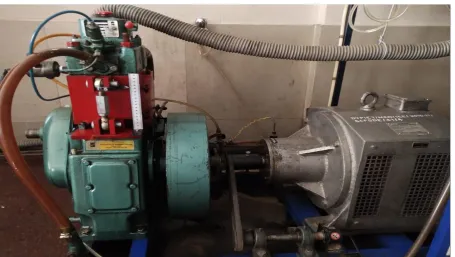
This setup consist of single cylinder four stroke VCR head diesel engine connected to eddy current type dynamometer for loading purpose. As shown in fig.
© 2019, IRJET | Impact Factor value: 7.211 | ISO 9001:2008 Certified Journal | Page 3551
Parts of VCR Head:1. Base Plate 2. Pressure bolts
3. Compression ratio adjuster with lock nuts 4. Support plate
5. Compression ratio indicator 6. Bearings
This setup is used to study performance parameter of VCR engine such as brake power, indicating power,
mechanical efficiency, specific fuel consumption, A/F ratio, brake thermal efficiency.
3. EXPERIMENTAL PROCEDURE:
The experiment is started by turning ON the water jacket cooling system. This is followed by the adjustment of compression ratio which can be calibrated by tweaking the power screw arrangement.
The initial adjustment for compression ratio is done by uplifting the Variable Compression Head installed on the engine by 1mm and creating an offset. While the offset is to be created, initially all the fasteners are loosened to allow the free adjustment for VCR head. After the adjustment all the fasteners are again fastened to fix the setup properly. After all this adjustment the engine is started and readings are obtained through a computerized system for that particular CR for different loads. All the graphs are software generated using LABVIEW 14.0 developed by National Institute Banglore. This procedure is repeated for adjustment for CR each time it has to be changed.
Above procedure are to be repeated for different loads at different CR.
© 2019, IRJET | Impact Factor value: 7.211 | ISO 9001:2008 Certified Journal | Page 3552
[image:3.595.72.528.376.633.2]Figure 1: VCR head assembly.
© 2019, IRJET | Impact Factor value: 7.211 | ISO 9001:2008 Certified Journal | Page 3553
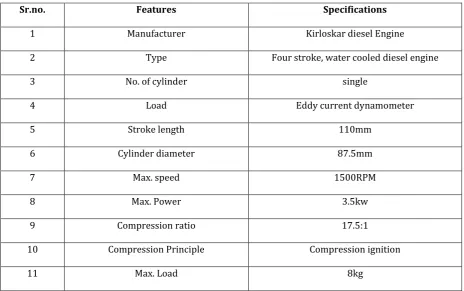
TABLE 1: VCR ENGINE SPECIFICATION:Sr.no. Features Specifications
1 Manufacturer Kirloskar diesel Engine
2 Type Four stroke, water cooled diesel engine
3 No. of cylinder single
4 Load Eddy current dynamometer
5 Stroke length 110mm
6 Cylinder diameter 87.5mm
7 Max. speed 1500RPM
8 Max. Power 3.5kw
9 Compression ratio 17.5:1
10 Compression Principle Compression ignition
11 Max. Load 8kg
4. THEROTICAL CALCULATIONS
:
The engine performance is indicated by the efficiency. Various efficiencies & power used in I.C engines practices are defined below.
Compression ratio: Compression Ratio can be defined as the ratio of sum of swept volume & clearance volume to that of clearance volume.
Compression ratio = {VS+VC}/VC
Indicating power(IP) : The rate of energy developed on the piston head by combustion of fuel to push the piston is called Indicating power.
Brake Power (BP) : The rate of energy developed on the output shaft of the engine is called Brake Power (BP)
Mechanical efficiency : mechanical efficiency is gives the effectiveness of the engine & transforming its input energy to output energy.
M.E.= B.P./I.P.
1. Thermal efficiency : Thermal efficiency of an engine is the indicator of conversion of heat supplied into work energy .it is either based on I.P. or on B.P. we have two types of thermal efficiencies :
1) Indicated thermal efficiency = I.P./ (m*C.V.)
© 2019, IRJET | Impact Factor value: 7.211 | ISO 9001:2008 Certified Journal | Page 3554
2. Volumetric efficiency : It is measures of the degree to which the engine fills to its swept volume.It is defined as the ratio of actual mass of change inducted during suction stroke to the mass of charge corresponding to swept volume of the engine at atmospheric pressure and temperature
3. Specific fuel consumption :
Specific fuel consumption is defined as the amount of fuel required to be supplied to an engine to develop 1KW power per hours.
B.S.F.C = (mf/B.P)*3600
4. Air fuel ratio : It is defined as the ratio of relative mass of air and fuel in engine.
(A/F) ratio = ma/mf
5. CALCULATIONS:
Given Data:
Bore Diameter=87.5mm =0.0875m
Stroke length =0.11m
Compression Ratio at normal position= 17.5:1
We know that
Compression ratio,
Where,
b = Cylinder bore
s = Piston stroke length
Vc = Clearance Volume
Now,
I. Swept Volume, Vs=
Vs=
Vs= 6.61 ………..(1)
© 2019, IRJET | Impact Factor value: 7.211 | ISO 9001:2008 Certified Journal | Page 3555
Therefore Vc = 4.006
Now, Clearance Volume, Vc =
4.006 =
Therefore, lc = 6.66* m
I.
For 1mm offset:
Swept Volume, Vs=
Vs=
Vs= 6.61 ………..(1)
We know that,
For normal position,, lc=6.66* m
Therefore, For 1mm Offset Add 1* in lc
Now, lc = (6.66* +(1*
Lc = 7.66* m
Now, Clearance Volume, Vc =
Vc =
Therefore, Vc = 4.61* m
© 2019, IRJET | Impact Factor value: 7.211 | ISO 9001:2008 Certified Journal | Page 3556
Therefore, CR=15.55
II.
For 2mm offset:
Swept Volume, Vs =
Vs =
Vs = 6.61 ………..(1)
We know that,
For normal position,, lc=6.66* m
Therefore, For 2mm Offset Add 2* in lc
Now, lc= (6.66* +(2*
lc= 8.66* m
Now, Clearance Volume, Vc =
Vc =
Therefore, Vc = 5.207* m
Therefore, CR=13.69
III.
For 3mm offset:
© 2019, IRJET | Impact Factor value: 7.211 | ISO 9001:2008 Certified Journal | Page 3557
Vs =Vs = 6.61 ………..(1)
We know that,
For normal position,, lc=6.66* m
Therefore, For 3mm Offset Add 3* in lc
Now, lc= (6.66* +(3*
Lc= 9.66* m
Now, Clearance Volume, Vc =
Vc =
Therefore, Vc = 5.808* m
Therefore, CR=12.38
TABLE 2: CALCULATIONS OF CR:
Sr.No.
V
s(m
3)
Clearance length(l
c)
V
C(m
3)
CR
1 0.000662591 0.00666 4.006 17.5
2 0.000662591 0.00766 4.61* 15.55
3 0.000662591 0.00866 5.207* 13.69
© 2019, IRJET | Impact Factor value: 7.211 | ISO 9001:2008 Certified Journal | Page 3558
6. Result and performance analysis :
COMPAIRE THE GRAPH OF COMPRESSION RATIO OF
17.5 :1
TO
15.5:1
THEN FOLLOWING RESULT
ARE OBTAINED :
0 5 10 15 20 25 30 35
0 2 4 6 8 10
load vs mechanical efficiency
M.E(%)without VCR M.E. (%) with VCR
Chart-1 : Load vs mechanical efficiency
0 0.1 0.2 0.3 0.4 0.5 0.6 0.7 0.8 0.9
0 5 10 15 20 25 30 35
B.P. vs M.E(%)
© 2019, IRJET | Impact Factor value: 7.211 | ISO 9001:2008 Certified Journal | Page 3559
2030 40 50 60 70 80
V.E.VS B.P
Chart -3: V.E vs B.P.
1 2 3 4 5 6 7 8
BRAKE T. E.(%)VS B.P.
Chart -4: Brake thermal efficiency vs Brake power
Conclusions:
I. The optimum compression ratio for the given engine is 13.69. Maximum fuel efficiency obtained at the compression ratio of 13.69.
II. Rate of fuel consumed is highest at compression ratio 12.38.
III. Moderate temperatures of exhaust gas are obtained at compression ratio 17.5.
IV. For more power at high loads the engine should operate at compression ratio 13.69 due to less specific fuel consumption.
© 2019, IRJET | Impact Factor value: 7.211 | ISO 9001:2008 Certified Journal | Page 3560
References:
I. “Study of Variable Compression Ratio Engine (VCR) and Different Innovations to Achieve VCR”, IbraheemRazaKhan1 ,Mayur Kailas Takalkar. (https://www.ijraset.com/fileserve.php?FID=11344)
II. “A Comparative Study of Recent Advancements in the Field of Variable Compression Ratio Engine Technology”,
ShikharAsthana, Shubham Bansal, ShubhamJaggi, and Naveen Kumar,
(https://www.researchgate.net/publication/299640373_A_Comparative_Study_of_Recent_Advancements_in_the_Field _of_Variable_Compression_Ratio_Engine_Technology\)
III. “Variable Compression Ratio Diesel Engine Performance Analysis”. K.Satyanarayana, Vinodh Kumar, T.V Hanumantha
Rao, S.V. Umamaheswararao,
(https://www.researchgate.net/publication/288855845_Variable_Compression_Ratio_Diesel_Engine_Performance_An alysis)
IV. “Effect Of Compression Ratio On The Performance Of Diesel Engine At Different Loads.”Abhishek Reddy G, Nirmal
Pratap Singh, Kolluri R V Sai Krishna, Anurag
PriyedarshiSNSingh,(https://pdfs.semanticscholar.org/39c5/ac10e62925f1cfd20282dd02f8cb3ac56594.pdf)
V. (https://www.researchgate.net/publication/260144394_On_the_compression_ratio_definition)