Planning future professional development
Effecting innovative approaches to practice
Don Passey
Department of Educational Research Lancaster University
Lancaster, UK [email protected]
Angela Lee Siew Hoong
Department of Computing and Information Systems Sunway University
Kuala Lumpur, Malaysia [email protected]
Abstract—A contemporary challenge for education is to develop
sustained, long-term, effective enactment of teacher practices with current and future digital technologies. Some people, throughout their lives, adapt to technological change; they apply technologies not just for social or leisure purposes, but also to their learning, training, or employment needs. This study explored this issue, gathering evidence from interviewees who have sustained uses of digital technologies for teaching, learning, and training for many years. Findings highlight how individuals in the United Kingdom and Malaysia maintain and apply uses of technologies for teaching and learning, in spite of continuous technological change. An approach to innovation was found to be essential. From these findings, recommendations for future support of teacher professional practice and a radical model for future development are offered.
Keywords— technology innovation; sustained technology uses; teacher professional development; workplace learning; professional development model
I. INTRODUCTION
Evidence, replicated from studies undertaken over the past 20 years or more (e.g., [1-3]), shows lack of long-term uses of digital technologies by teachers to support effective enactment, for their teaching and for student learning. While studies have identified drivers and barriers (e.g., [4, 5]), studies exploring the reasons for long-term sustained uses have been sparser (e.g., [6]). Developing effective teacher enactment [7, 8] requires a detailed knowledge about relationships of factors and features that enable teachers to understand how and why they can use technologies in classrooms. Features and factors enabling use not only concern professional attitudes and understanding, but also attitudes and understanding towards technologies and, importantly, innovation. If uses are to develop over time, to accommodate rapid technological changes, then enactment should be concerned not just with short-term and project-based uses, but with long-term uses where adaptation and change facility are inherent to professional practice.
The rationale for this study, therefore, was the need to address a contemporary challenge that many countries face - developing teachers’ sustained future enactment, in terms of effective uses of technologies. Some people, throughout their lives, are able to adapt to technological change, and to apply technologies not just for social or leisure purposes, but also to their learning, training, or employment needs. This quality of
applying continued innovative approaches is signaled to become an increasing requirement for individuals (including teachers) in the future. This study gathered evidence of key features enabling individuals to do this, so that recommendations for future professional practice might be offered, to better support current and future development. From those factors and features identified, recommendations for a radical approach to teacher development and enactment are offered.
The study gathered qualitative in-depth evidence both in the United Kingdom (UK) and in Malaysia, from a selected sample of long-term users in different current occupations: students; parents; teachers; employers; policy makers; and managers. Structured interviews were used, to identify key factors or reasons for how these individuals established and maintained their long-term uses, based on an existing theoretical framework [9]. Individuals selected for participation in the study had been using technologies for learning, teaching, training, or employment purposes for at least 5 years, in many cases up to 20 or 30 years, and in some even more.
II. ABACKGROUND FROM THE LITERATURE
resources are, because of pressures of curricular demands in developed countries, underused [14].
Having said this about the wider picture, many innovative and implementation practices exist in education and are enacted by teachers, both inside and outside classrooms [15, 16]. Potential users of an innovation must themselves be innovatory; to be able to accurately determine how to adapt and implement that innovation (and its affordances) to their setting and whether sufficient conditions for success might exist [17]. However, studies demonstrate that initial successes in the adoption of digital technologies are not enough in themselves to lead to long-term enactment [18, 19]. Long-term implementation studies reveal that conditions change, that new challenges arise, and that more continuous adaptation is a requirement for continued enactment [20-22]. For such continued enactment, users need to review their challenges in the context of technology adaptation over time; long-term adaptability from technological, pedagogical, cultural, social and learning perspectives all need to be considered and in place.
Fundamentally, introducing an element such as ICT into practice, to support both teaching and learning, is effectively concerned with innovation change and its management. Conceptualizing that change is clearly important, as the form of conception that is chosen or developed can determine the nature of processes that might be needed to support it, both in the shorter- and longer-term. Weick and Quinn [23] distinguished between two types of change, “episodic” and “continuous”. In education, if digital technology enactment is considered an “episodic” change, then support and development would perhaps be more appropriately focused on identified “episodes” that occur at intervals. On the other hand, if enactment is considered a “continuous” change, then support and development might need to be more consistently focused. Even taking these two different patterns into account, there are clear implications for education and for teachers, since the pattern of change is then distinguished or determined by the perceptions or approaches of those implementing ICT into practice. Similarly, Pennington [24] distinguished between change that could be considered “radical” (perhaps implying more shorter-term focus) or “incremental” (implying longer-term focus) versus “core” or “peripheral”; again, there are implications for development and successful sustainability.
Changes in ICT need to be considered within a wider change management context. Major hardware changes occur about every 5 years, while software changes occur about every 18 months [25]. The latter changes not only include software updates and upgrades, but the emergence of new software. Additional factors that affect change concern enactment more directly; for example, initial teacher enactment of ICT into practice can lead to an initial downturn in performance. Mevarech [26] described this as a U-curve, while Leung, Watters and Ginns’s [27] case study of younger teachers also reported that their perceptions of ICT abilities and self-efficacy decreased during the first year of a project, with a subsequent lowering of uses of ICT during the second year. There are clear implications arising; if teachers are identifying innovative outcomes in terms of learning benefits arising within that same period of downturn from their early enactment of ICT, and if
benefits accrue only after a certain period of time once the downturn has been overcome, then persistence in use is an important factor. Even so, the identification of forms of benefits needs to match the forms of technologies and their uses [28, 11], matching applications of technological affordances, uses and outcomes for teaching and learning when identifying benefits and impacts. Such factors imply the need for appropriate reviewing, monitoring, regular updating and potentially support for professional development.
Long-term change requires a concern for the many factors affecting sustainable enactment. However, sustainability in this sense should not be considered as a move to a stability, or lack of change; it should be considered as a way to manage and handle ongoing and successive change. Long-term sustainable enactment requires adaptability on the part of teachers and students. With technologies changing over time, teachers require periods of adaptation to those changes, developing attitudes to becoming familiar with differences, identifying additional benefits or disadvantages, or innovative practices that enable effective outcomes.
Traditionally, models of technology integration (or adaptation) have focused on implementation and enactment in a number of ways. One is through stages or phases (such as the model developed by Hooper and Rieber [29]), an approach also suggested when considering pedagogical enactment or change (e.g., [30]). A second way focuses on conceptual approaches, on the context of the change through which it is developed (e.g., [31]). This approach has identified important factors beyond the technologies themselves (including political and cultural factors), and indeed, some authors (e.g., [32, 33]) have argued that implementation models need to move away from concerns with technological determinism. A third way focuses more on factors that influence individual take-up of technology uses, such as the widely-recognized Everett Rogers’s Diffusion of Innovations Model [34], and the Technology Acceptance Model (TAM) of Davis [35]. While these models consider an individual user and their initial acceptance, other models have been more concerned with ongoing adoption and enactment, such as the Concerns-Based Adoption Model (CBAM) of Hall, Wallace and Dossett [36] and the post-acceptance model of Bhattacherjee [37].
In contrast to models based on elicitation of factors or features, Todnem By [38] discusses the crucial importance of conceptualizing change when considering its management. Factors such as technological change, teacher practice, stakeholder influence, and contextual factors affecting long-term enactment and sustainability suggest that approaches for professional change with ICT should consider a management of continuous and incremental change. Coupled with the findings of Mevarech [26] and Leung, Watters and Ginns [27], this suggests a visualization of the conception of change as one having periods of downturn followed by benefit, with perhaps short periods of time where performance again dips prior to successive cycles arising (see [9]).
III. THE RESEARCH STUDY APPROACH
adaptability as being more critical than intrinsic motivation itself. Continued enactment clearly needs to take account of previous experience in building new knowledge, focused on content, pedagogical and technological features for teaching and learning [40]. Many studies have looked at new knowledge development, uses and outcomes of ICT in the short-term, perhaps over a period of 1 year, or 2 years at the most (e.g., see the many highlighted in this category [11]). Studies that look to explore experiences and factors that lead to enactment over long periods are clearly worthy of exploration. To undertake such a study, whilst design-based implementation research is especially suited to longer study periods [41], the study reported here elicited self-reported experiences from selected individuals.
Evidence was gathered in two countries (the UK and Malaysia), and experiences of users were identified and analyzed. Interviewees were asked about: hardware changes in education (since about 1995); software changes (since about 1995); their perceived performance following ICT introductions; benefits they had experienced from particular uses; how their uses had been updated; the systemic actors within their contexts that were considered important, and the roles they played; contextual factors that had been present, and those felt to favor or hinder changes with ICT; how sustainable enactment had been and still is being considered; and how adaptability had been and is being introduced.
IV. METHODOLOGICAL DESIGN AND TECHNIQUES
The study took an existing theoretical framework ([9]) as its base. It gathered qualitative evidence, interviewing representative long-term users about technologies for their learning, teaching, and training. The data-gathering instrument was developed from the theoretical framework, and the framework was also used to structure some of the subsequent analysis (all data within a specific question was subject to a grounded analysis approach). The outcomes of this analysis were then used to inform recommendations and a model for future professional enactment development.
In the UK, 14 participants were involved, two from each of the following seven categories: teachers; learners in university; parents; school managers; third party organization managers; national policy makers; and employers. In Malaysia, 10 participants were involved, two from each of the following five categories: policy makers; school managers; parents; teachers; and third party organization managers. The sampling involved was purposive, to match the focus of the research on sustained enactment (5 years or more of use). Data collection relied on an interview, which was audio-recorded. Potential participants were contacted through email invitation, and if they indicated interest in being involved, they were sent a participant information sheet to inform them about the study, with a consent form to complete. After completion, they were sent a follow-up email of instructions; interview questions were attached if these were requested in advance.
For interviewees, anonymity was assured. Participants were able to read the transcripts of their interviews before those data were used, and could at that point delete any points they considered confidential. No data from
the interviews were used without participants’ agreements. Pseudonyms were used in interview transcripts to ensure that individual participants could not be identified.
The analysis of individual questions from the interviews adopted a grounded approach (which provided thematic categories). Charmaz [42] and Bryant and Charmaz [43] reviewed relevant practices using a grounded approach, and this was the approach taken for this study. The grounded theory approach used different subsequent coding methods: open coding, to identify specific elements of the interview texts that offered insights or details; axial coding, where relationships between the open coding elements were considered; and selective coding, where core categories were identified. Axial and selective coding outcomes are provided in this paper. Overall, coding was approached using a process of constant comparison [44].
Subsequently, axial and selective coding outcomes were subject to a further analysis, that placed these outcomes within a thematic grouping, to identify the focus of the participants in terms of the elements of enactment [11]: affordances (identifying the features of technologies that could be used and support their teaching or learning); uses (the ways they were concerned with developing activities for them or for their learners to use); outcomes (their focus on what arose from the uses, both for them as teachers and for their learners); and impact (how the outcomes were of value and subsequently used by them, or by learners).
V. RESULTS OF THE STUDY
In total, 24 participants provided evidence. About half were women (6 from the UK and 5 from Malaysia) and half were men (8 from the UK and 5 from Malaysia). Most participants were aged between 41 and 60 years (11 from the UK and 4 from Malaysia). Some were younger (2 from the UK and 4 from Malaysia) and one was older (1 from the UK). Many of the interviewees had been using technologies for learning, teaching, training, or employment for more than twenty years (6 from the UK and 5 from Malaysia between 21 and 30 years, and 4 from the UK and 1 from Malaysia for 31 years or more). Some had used technologies for between 5 and 20 years (1 from the UK and 3 from Malaysia for up to 10 years, and 3 from the UK and 1 from Malaysia for between 11 and 20 years).
environments (VLEs) and the intranet). It was noted that some reported changes were concerned more with software than they were with hardware per se. Respondents from Malaysia tended to report mobile device changes – 6 reported mobile telephones, 5 reported iPads, and 5 reported laptops. The only other changes reported by interviewees from Malaysia were interactive whiteboards, the Internet, and CD-ROMs/floppy disks (each in 1 case only).
When asked about software changes, and when these were first used, some respondents from the UK indicated general software changes or features, while others identified specific software changes. Respondents did not, however, relate these changes to specific years, or even periods or times when they were used. General forms of software identified were interactive technologies, more intuitive software, software becoming available on devices and online, connecting with work from home, and shared work. Generic software identified was the Internet, cloud storage and access (2 respondents), email (2 respondents), Microsoft (2 respondents), and social networking. More specific software was also mentioned, such as Microsoft (MS) Excel (2 respondents), MS Word, Net Learn, Moodle, Google Hangouts, Dropbox, and Box. Respondents from Malaysia reported more MS-related software changes – 5 reported MS as a whole, 2 MS Word and 1 MS Excel. Additionally, they mentioned storage in the cloud (2 respondents), shared work (2 respondents), and Dropbox (1 respondent).
Performance with new hardware or software can be affected when change occurs. Responses from UK interviewees fell within four main categories: increased efficiency; enhanced access; improved performance; and enhanced ease of use. Examples of increased efficiency were reacting to things much faster, saving lots of time, increasing productivity, getting the information in real time very quickly, and putting a presentation together in a very short space of time. In terms of enhanced access, examples reported were accessing documents anywhere on any device, being able to work anywhere at any time, and being able to post to students online. Reported examples of improved performance were the quality of documents being far better, and customers appreciating increased visibility. For enhanced ease of use, reported examples were making life easier, and delivering content very easily. Only 2 respondents indicated that they recognized a change in their performance over a short period of time, saying: there is always a drop in performance when they start; they make mistakes initially; learning improves the more it is used; it depends on complexity of the program, and how often it is applied and used; and, more than performance, it is about the expectation. Respondents from Malaysia reported largely on their recognition of changes in productivity and efficiency arising. They stated that productivity increases (in 5 cases), performance increases significantly (in 2 cases), it is far more efficient and effective (in 1 case), and learning improved the more it was used (in 1 case). However, they also indicated challenges in terms of low productivity and it being time-consuming (in 1 case), and the need to provide training and having to re-train people (in 1 case).
In terms of benefits that they had experienced, responses from the UK interviewees fell within six main categories. The
first was information access: convenient not to search in books; and can access free books online and do revisions). The second was access at a more general level: enhanced accessibility and usability; connectivity; and ease of not having to carry ‘stuff’ around. The third was collaboration: staff can come together; and work can be shared with others. The fourth was self-empowerment: liberating and empowering; can monitor everything; simple to review policy just by deleting or changing the wording; and the reach is different. The fifth was greater levels of understanding: use a much broader variety of multimedia, audio, video clips, discussion forums and other type of information; and send video clips to watch and comment. Lastly, the sixth was communication: the customer has the possibility to give feedback; communicate with people very quickly; finding shortcuts to make things easier; can communicate and reach people all over the world; and can communicate and work more easily. Responses from Malaysia indicated a narrower range of benefits, but focusing also on productivity and communication. These ranged from improving productivity (in 4 cases), saving time (in 3 cases), facilitating relationships (in 1 case), and connectivity, access and collaboration (in 1 case).
Interviewees were asked how they had managed to maintain uses and address challenges of technologies when software or hardware changed, and what they did so that they could use the new or updated software or hardware. The responses from the UK fell within four main categories. The first was exploring uses themselves and practicing as needed: starting by using it; teaching yourself to use them; and confidence coming through practice, the more you use, the more confident you become. The second was using advice and guidance provided with the updates: it normally comes with some sort of advice. The third was going on training courses: go on training courses when the programs are very sophisticated; and went on a lot of courses, and read books. Lastly, the fourth was using help from those around them: pioneers and ambassadors; looking at what others do; a spouse’s use of technology; finding out what other people are using; and asking somebody or just trying it out. The only respondent from the UK who commented on how often updating happened said that they “update on the basis that we need”. Respondents from Malaysia indicated that they went on training courses when the programs were very sophisticated (in 2 cases), went on a lot of courses and read books (in 2 cases), or updated on the basis that they needed (in 1 case).
computer networking. Lastly, the fourth was the more general work environment: people around using it; surrounded by people who are interested in technology; and seeing it and practicing it). Respondents from Malaysia mentioned specifically somebody who already had new technology (in 2 cases), another teacher in school (in 1 case), their IT support (in 1 case), and organizations they worked with on IT (in 1 case). Additionally, they mentioned that they were surrounded by people who talked about technology and its developments in the future (in 1 case), they embraced new technologies (in 1 case), and worked with entrepreneurs (in 1 case).
In terms of responses about contextual factors, it is interesting to note that the factors not felt to be particularly influential were technical support (in the cases of the UK and Malaysia), equitable access and the ability to choose when to use the technologies (in the case of the UK), and assessment and evaluation of practices (in the case of Malaysia). When asked about factors that hindered the ability to adapt to technology changes over time, respondents from the UK highlighted time to learn and to adapt as a main issue (in 4 cases), but interestingly, not lack of technical support. Other hindering factors were the need to be convinced that using technology is worthwhile (in 2 cases), and funding (in 2 cases). Additional factors mentioned were colleagues or superiors not understanding what technologies did, not having adequate resources, not being able to use the same device for all aspects of work, and the fear factor. The difficult language often used around technology, anxiety when contacting technical services, lack of funding to send staff to learn, the need to sometimes have to create things from scratch, and technical failure in the system, were also reported. The cost of replacing specific hardware, time to upload new versions of applications (apps), and time to try out and learn by playing, were also mentioned. Respondents from Malaysia highlighted funding (in 4 cases), the fear factor (in 2 cases), the time it takes to learn and to adapt (in 1 case), technical failure in the system (in 1 case), and management decisions (in 1 case) as hindering factors.
How interviewees from the UK considered technology overall was largely very positive: essential or necessary to work (in 5 cases); ‘phenomenally’ useful, ‘amazing’ (in 3 cases); and a very important complement (in 2 cases). Other positive views expressed were that it was ‘phenomenally’ transforming, it drives most processes in the business, it makes life easier (‘which was easy to say after spending four days without it’), and part of life and not only a working tool. Some respondents indicated more neutral views, saying being IT literate is important to fully participate in modern society, not being dependent upon it, and expecting everybody coming into the workforce to do it naturally. Some, however, expressed concerns and more negative views, saying it could be deeply problematic, intrusive when you are not allowed to switch off from the job, losing connectivity throwing everything into chaos, both being an enabler and a poison chalice, that expectations of access and immediacy can be potentially stressful, and empowering and potentially disempowering at the same time. Respondents from Malaysia were perhaps more neutral in their responses. They stated that they felt there was a requirement to adapt to new technology (in 3 cases), it was both an enabler and a poison chalice (in 1 case), it supported
competitiveness and collaboration (in 1 case), and it led to the ability to multitask (in 1 case). The importance of needing to understand concerns as well as taking a positive attitude is clear here, and suggests that training and development in this field need to accommodate both of these needs.
Crucially, when asked about the main personal factors or characteristics that they felt enabled them to adapt to technology changes over time, the most commonly arising factors stated by respondents from the UK were: seeing its value, its use, and having a positive attitude to technology (in 7 cases); being very inquisitive (in 5 cases); liking to learn new things (in 4 cases); being very adaptable (in 3 cases); and always looking for short cuts, for easier ways to do things (in 2 cases). Other factors stated were: being flexible in approach; regarding it as a necessity; being interested in what it can do in all fields of work; some determination; it is just about trying to keep up-to-date with it; and liking to play with new technology. Respondents from Malaysia identified similar personal factors or characteristics. They indicated the need to be humble and a willingness to learn things (in 5 cases), to be open-minded (in 3 cases), to be very adaptable (in 2 cases), and to have a curiosity for new technology (in 2 cases). Additionally, they mentioned seeing its value, its use, and to have a positive attitude to technology (in 1 case), liking to play with new technology (in 1 case), and patience (in 1 case).
VI. DISCUSSION OF THE FINDINGS
Considering the findings from the perspective of the interviewees’ focus on affordances, uses, outcomes, or impact, an interesting pattern emerges. When asked about hardware changes, participants did not give a highly detailed account of the changes, and these tended to be hardware changes that had been fairly recent, or those that were linked to major benefits that they reported. This was also the case with software; software changes were not identified as being problematic or causing challenges, but were related to benefits arising. Performance was related much more to outcomes and impact, than it was to affordances or uses. Increased efficiency and improved performance related to impact; enhanced access related to uses; and enhanced ease of use related to affordances. Even though some respondents reported that there was a lowering of their performance after changes had occurred, nevertheless this was placed in the context of longer-term positive outcomes and impact. When asked about benefits, although affordances such as information access were identified, these were nevertheless linked to outcomes and impact (e.g., interviewees stated how technologies enabled access to free books online and enabled revisions, as well as the ease of not having to carry ‘stuff’ around). Collaboration and self-empowerment certainly related to uses and outcomes, as did greater levels of understanding and communication. But again, links were made to impact (such as how technologies were helping in terms of feeling reassured about where children were, the speed with which work could be done, and being able to communicate and work more easily).
environment were also clear. It is an environment of uses, outcomes and impacts that comes to bear, rather than an environment that focuses on affordances. Factors that hinder also did not relate to affordances; they were concerned with funding and time, and not the technologies or technology support per se.
How these respondents considered technologies overall was also focused largely on impact, outcomes and uses, and not on affordances. Statements such as it makes life easier (which was stated as being ‘easy to say after spending four days without it’), and necessary to work, highlighted this point. However, some respondents were clear that there was a need to consider the negative potential those technologies could bring, and that it was necessary to accommodate these. This did not mean that their focus on impact, outcomes and uses had been diminished; it meant that individuals had recognized where impact and outcomes were important, and to call for technology development to help them address these negative concerns.
Some respondents highlighted the importance of maintaining contact with others or with sources of advice in order to sustain enactment. However, the importance of personal factors or characteristics was strongly related by many respondents. They highlighted the need for a positive attitude to technology, inquisitiveness, liking to learn new things, liking to play with new technology, being humble and a willingness to learn things, being open-minded, adaptable, looking for short cuts and for easier ways to do things, being flexible in approach, having determination, but being impatient as well as having patience. These are qualities of innovative approaches.
Key points arising from the findings and the analyses are:
• Major hardware changes were seen as providing advantages rather than obstacles.
• Software changes were seen as offering increased ease of use rather than creating increased complexity.
• Using technologies to move to a position of advantage was generally recognized as a given.
• Enhanced efficiency and productivity were regular outcomes or impacts identified.
• Enhanced communication and cloud access were focal contemporary outcomes highlighted.
• The work environment was important in terms of engagement, and was a driving factor.
• Others around who could offer support were important, but they might be in different environments – in the home, office, at work, or online.
• Time to learn and adapt, and funding to support technologies and training were important factors that could hinder.
• Having a positive attitude was very important, but also the need to be aware of concerns about intrusiveness that new technologies could bring, and how to address these. • Maintaining contact with developing technologies was
considered important, but doing this online seemed to be overtaking doing this through personal contact.
In terms of innovative approaches, the personal characteristics that could drive sustained enactment commonly
reported were positive attitudes to technology, being inquisitive, liking to learn new things, being adaptable, and looking for short cuts and easier ways to do things.
VII. CONCLUSIONS AND RECOMMENDATIONS
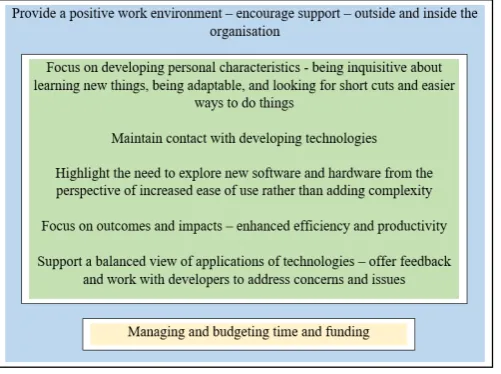
New technologies are enabling a range of innovations in education. Online provision, asynchronous discussion, virtual realities, and game-based learning are all examples that highlight this. Innovation can happen in different ways, but the important and crucial roles of teachers is clear; however, gaining teachers’ positive involvement and enactment in educational practices using technologies appears from the current study findings to suggest a range of recommended approaches that focus on empowering personal innovation.
If sustained and effective uses of technologies are to be developed, then institutions concerned with developing and supporting teachers and learners, whether they be initial teacher training institutions, schools, colleges, universities, or local or regional centers, should consider a focus on:
• Developing positive personal characteristics to drive sustained enactment - positive attitudes to technology, being inquisitive about learning new things, being adaptable, and looking for short cuts and easier ways to do things.
• Enabling the maintaining of contact with developing technologies – and increasingly online more than personal contact.
• Supporting a balanced view of technologies - a positive attitude is very important, but the need to be aware of concerns about intrusiveness that new technologies can bring is similarly important.
• Managing and budgeting for time to learn and adapt, and funding to support technologies and training.
• Encouraging others around to offer support – in the home, as well as in the office, at work, or online.
• Focusing on enhanced communication and cloud access, enhanced efficiency and productivity – on identifiable outcomes or impacts.
• Using technologies to enable individuals to move to a position of advantage.
• Considering software changes as offering increased ease of use rather than creating increased complexity, and major hardware changes as providing advantages rather than obstacles.
Fig. 1. Proposed model for future development of sustained effective uses of technologies
These research findings suggest that institutions that have focused on providing technical support alone should rethink their positions. Rather than a single focus on technical support and affordances, the evidence here indicates that institutions should focus on developing personal characteristics concerned with enquiry and inquisitiveness, highlighting outcome and impact support. Fundamentally, this suggests moving away from technical support that focuses on affordances to a focus on outcome and impact support, or developing units or individuals that have a different and complementary focus. While an essential technical maintenance and implementation unit to interface with the institutional foundations ensuring infrastructure and accessibility is needed, it is also important for outcome and impact support personnel to interface with users from a developing personal characteristics perspective. It can be argued that some support is now provided in this way; a distinction between infrastructure and network support, and user interface support. However, this paper argues for a focus of the user interface support being the development of creative and innovative personal characteristics that are applied to technologies.
VIII. LIMITATIONS AND SUGGESTIONS FOR FURTHER
RESEARCH
This research gathered evidence from a limited range of participants, selected specifically to identify features of sustained and effective uses of technologies. Whilst this approach might be considered as leading to limitations, it should be recognized that the focus of the research was not to produce a statistical view across a population, but to identify features of a specific population. In this regard, a future study to substantiate the findings of this study would be valuable, but this should also seek to highlight features within more specific populations, so that a more contextualized developmental model might focus on the requirements of an individual group. Additionally, a new avenue of research would be to explore whether current practices do enable distinction in support between technical needs and user interface needs, and to what extent.
ACKNOWLEDGMENT
The authors thank Dr Joana Zozimo for recording and transcribing interviews for the UK element of the study, and Wong De-Yi and Yap Mun-Yee for recording and transcribing interviews for the Malaysian element of the study.
REFERENCES
[1] P. Gao, A.F. Wong, D. Choy, and J. Wu, “Beginning teachers’ understanding performances of technology integration,” Asia Pacific Journal of Education, vol. 31, pp. 211-223, 2011.
[2] OECD, Students, computers, and learning: Making the connection. Paris, France: OECD, 2015.
[3] A. Tatnall, and B. Davey, Eds., Reflections on the History of Computers in Education: Using Computers and Teaching about Computing in Schools from the late 1970s to the early 1990s. Heidelberg, Germany: Springer, 2014.
[4] G. Conole, “MOOCs as disruptive technologies: strategies for enhancing the learner experience and quality of MOOCs,” Revista de Educación a Distancia, vol. 50(2), 2016. DOI: http://dx.doi.org/10.6018/red/50/2.
[5] WW. Porter, and C.R. Graham, “Institutional drivers and barriers to faculty adoption of blended learning in higher education,” British Journal of Educational Technology, vol. 47(4), pp. 748-762, 2016. [6] S. Mumtaz, “Factors affecting teachers’ use of information and
communications technology: a review of the literature,” Journal of Information Technology for Teacher Education, vol. 9(3), pp. 319-342, 2000.
[7] M. Heitink, J. Voogt, L. Verplanken, J.V. Braak, and P. Fisser, “Teachers’ professional reasoning about their pedagogical use of technology,” Computers and Education, vol. 101, pp. 70-83, 2016. [8] M.S.H. Khan, S. Bibi, and M. Hasan, “Australian technical teachers’
experience of technology integration in teaching,” SAGE Open, vol. 6(3), pp. 1-12, 2016.
[9] D. Passey, T. Laferrière, M.Y.A. Ahmad, M. Bhowmik, D. Gross, J. Price, P. Resta, and M. Shonfeld, “Educational digital technologies in developing countries challenge third party providers,” Educational Technology and Society, vol. 19(3), pp. 121-133, 2016.
[10] N. Selwyn, “Looking beyond bearning: notes towards the critical study of educational technology,” Journal of Computer Assisted Learning, vol. 26, pp. 65-73, 2010.
[11] D. Passey, Inclusive technology enhanced learning: Overcoming Cognitive, Physical, Emotional and Geographic Challenges. New York, NY: Routledge, 2014.
[12] R.M. Tamim, R. M. Bernard, E. Borokhovsi, P.C. Abrami, and R.F. Schmid, “What forty years of research says about the impact of technology on learning: a second-order meta-analysis and validation study,” Review of Educational Research, vol. 81(1), pp. 4–28, 2011. [13] P. Attewell, “The first and second digital divides,” Sociology of
Education, vol. 74(3), pp. 252-59, 2001.
[14] L. Cuban, The lack of evidence-based practice: The case of classroom technology, 2015. Retrieved on 20 April 2016 from: https://larrycuban.wordpress.com/2015/02/05/the-lack-of-evidence-based-practice-the-case-of-classroom-technology-part-1/.
[15] J. Steyn, J.-P. van Belle, and E. Villanueva Mansilla, ICTs for Global Development and Sustainability: Practice and Applications.Hershey, NY: IGI Global, 2011.
[16] J. Voogt, T. Laferrière, A. Breuleux, R. Itow, D.T. Hickey, and S. McKenney, “Collaborative (re-)design as a form of professional development: teacher learning by design,” Instructional Science, vol. 43(2), pp. 259-282, 2015.
[17] C.-K. Looi, and L.-W. Teh, Eds., Scaling educational innovations. Heidelberg, Germany: Springer, 2015.
[19] A. Labonté-Hubert, Les manifestations de transformation dans l’activité d’intégration du Knowledge Forum et de VIA dans la classe pléthorique burkinabè. Mémoire de maîtrise, Université Laval, QC, Canada, 2013.
[20] T. Laferrière, C. Hamel, and M. Searson, “Barriers to successful implementation of technology integration in educational settings: a case study,” Journal of Computer Assisted Learning, vol. 29(5), pp. 463-473, 2013.
[21] D. Passey, “Implementing learning platforms into schools: an architecture for wider involvement in learning,” Learning, Media and Technology, vol. 36(4), pp. 367-397, 2011.
[22] J. Sandholtz, C. Ringstaff, and D. Dwyer, Teaching with technology: creating student-centered classrooms. New York, NY: Teachers College Press, 1997.
[23] K.E. Weick, and R.E. Quinn, “Organisational change and development,” Annual Review of Psychology, vol. 50, pp. 361-86, 1999.
[24] G. Pennington, Guidelines for Promoting and Facilitating Change. Learning and Teaching Support Network, 2003. Retrieved 20 April
2016 from: https://www.heacademy.ac.uk/sites/default/files/id296_promoting_and
_facilitating_change.pdf.
[25] D. Passey, “Strategic evaluation of the impacts on learning of educational technologies: exploring some of the issues for evaluators and future evaluation audiences,” Education and Information Technologies, vol. 4(3), pp. 1-28, 1999.
[26] Z.R. Mevarech, “The U-curve process that trainee teachers experience in integrating computers into the curriculum,” in Proceedings of the IFIP TC3 WG3.1/3.5 joint working conference on Information Technology Supporting Change through Teacher Education, D. Passey and B. Samways, Eds. London: Chapman and Hall, 1997.
[27] K.P. Leung, J.J. Watters, and I.S. Ginns, “Enhancing teachers’ incorporation of ICT in classroom teaching”. Paper presented at the 9th
Annual Global Chinese Conference on Computers in Education. Brigham Young University, Hawaii, USA, 2005.
[28] S. Higgins, Z. Xiao, and M. Katsipaki, The Impact of Digital Technology on Learning: A Summary for the Education Endownment Foundation, 2012. Retrieved on 20 April 2016 from: https://educationendowmentfoundation.org.uk/uploads/pdf/The_Impac
t_of_Digital_Technology_on_Learning_-_Executive_Summary_(2012).pdf.
[29] S. Hooper, and L.P. Rieber, “Teaching with technology,” in Teaching: Theory into practice, A.C. Ornstein, Ed. Needham Heights, MA: Allyn and Bacon, 1995, pp. 154-170.
[30] R.R. Puentedura, The SAMR Ladder: Questions and Transitions, 2013. Retrieved on 20 April 2016 from: http://www.hippasus.com/rrpweblog/archives/2013/10/26/SAMRLadd er_Questions.pdf.
[31] H. Corbett, and G.B. Rossman, “Three paths to implementing change: a research note,” Curriculum Inquiry, vol. 19(2), pp. 164-179, 1989.
[32] M. Oliver, “Technological determinism in educational technology research: some alternative ways of thinking about the relationship between learning and technology,” Journal of Computer Assisted Learning, vol. 27, pp. 373-384, 2011.
[33] J.R. Pannabecker, “Technological impacts and determinism in technology education: alternate metaphors from social constructivism,” Journal of Technology Education, vol. 3(1), 1991. Retrieved on 20 April 2016 from: http://scholar.lib.vt.edu/ejournals/JTE/v3n1/html/pannabecker.html. [34] E. Rogers, Diffusion of Innovations, 5th ed. New York, NY: Simon
and Schuster, 2003.
[35] F.D. Davis, “Perceived usefulness, perceived ease of use, and user acceptance of information technology,” MIS Quarterly, vol. 13(3), pp. 319–340, 1989.
[36] G. Hall, R. Wallace, and W. Dossett, A developmental conceptualization of the adoption process within educational institutions (Report No. 3006). Austin, TX: Research and Development Center for Teacher Education, University of Texas at Austin, 1973.
[37] A. Bhattacherjee, “Understanding information systems continuance: an expectation-confirmation model,” Management Information Systems Quarterly, vol. 25(3), pp. 351-370, 2001.
[38] R. Todnem By, “Organisational change management: a critical review,” Journal of Change Management, vol. 5(4), pp. 369-380, 2005.
[39] C. Rogers, “Digital skills and motivation in young people in transition,” in Key competencies in ICT and informatics: implications and issues for educational professionals and management, D. Passey and A. Tatnall, Eds. Heidelberg, Germany: Springer Verlag, 2014. [40] P. Mishra, and M.J. Koehler, “Technological pedagogical content
knowledge: a framework for teacher knowledge,” Teachers College Record, vol. 108(6), pp. 1017–1054, 2006.
[41] W.R. Penuel, B.J. Fishman, B. Haugan Cheng, and N. Sabelli, “Organizing research and development at the intersection of learning, implementation, and design,” Educational Researcher, vol. 40(7), pp. 331–337, 2011.
[42] K. Charmaz, Constructing Grounded Theory: A Practical Guide through Qualitative Analysis. Thousand Oaks, CA: Sage Publications, 2006.
[43] A. Bryant, and K. Charmaz, The SAGE Handbook of Grounded Theory. Thousand Oaks, CA: Sage Publications, 2007.
[44] B.G. Glaser, and A.L. Strauss, The Discovery of Grounded Theory: Strategies for Qualitative Research. Chicago, IL: Aldine Publishing Company, 1967.