© 2019, IRJET | Impact Factor value: 7.211 | ISO 9001:2008 Certified Journal
| Page 7360
EFFECT OF LIGHT WEIGHT AGGREGATE AND SUPER ABSORBENT
POLYMER AS INTERNAL CURING AGENT ON SCC
Christena Neethu Priya C Alex
11
student
,M Tech structural engineering and construction management. M A college of engineering,
Kothamangalam, Ernakulam, India
---***---Abstract -
According to American concrete institute (ACI)internal curing was defined as “internal curing refers to the process by which the hydration of cement occurs because of the availability of additional internal water that is not part of the mixing water”. Internal curing of concrete can be ensured in two ways. One is by using light weight aggregate (LWA) and other by adding chemical curing admixtures. These are incorporated into the concrete as an admixture hence known as internal curing compounds. They inhibit moisture loss and thereby improve long term strength and reduce drying shrinkage. Internal curing through concrete can be used in the places were compaction and curing is difficult. This self compacting concrete is the best solution for curing and compacting process. In this study the effect of internal curing determined through natural light weight aggregates and chemical curing agent on SCC were investigating. Mechanical and fresh properties of concrete with curing agents were examining. Super absorbent polymer used as chemical curing agent and light expanded clay aggregates as light weight aggregates.
Key Words: internal curing , self-compacting concrete , super absorbent polymer, light expanded clay aggregates.
1. INTRODUCTION
In the 21st century, internal curing has emerged as a new technology that holds promise for making concrete with increased strength, resistance to early-age cracking and enhanced durability. Internal curing provides a positive contribution to increasing the sustainability of our nation’s infrastructure. In 2010, American concrete institute (ACI) defined internal curing as “Supplying water throughout a freshly placed cementitious mixture using reservoirs, via pre-wetted light weight aggregates, that readily release water as needed for hydration or to place moisture lost through evaporation or self-desiccation”. In 2013, ACI changed the definition of internal curing to “A process by which the hydration of cement continues because of the availability of internal water is not a part of mixing water”.
Fig.1.convetional curing verses internal curing
In conventional curing process concrete slab surface is cured to endeep with strong,crack free faces but more curing of the slab only affects a very thin layer at the surface. Its more important in the case of wearing surface. But what is happening below the surface is also important, so surface curing is having little effect on the interior.
The objective of internal curing is to provide a source of readily-available additional water so that the capillary porosity of the hydrating cements paste remains saturated, thus minimizing the autogenous stresses and strains. This additional water will also promote a maximization of the hydration of the cement and pozzolans in the mixture, potentially contributing to increased strengths and reduced transport coefficients. Conventionally, some of this additional water has been provided by external curing techniques such as ponding, fogging, misting, and the application of wet burlap.
Internal curing gives most concrete needs and conventional curing cannot provide:
It provides additional water that helps the concrete to prevent early age shrinkage.
This curing increases hydration of cementations materials throughout the concrete.
© 2019, IRJET | Impact Factor value: 7.211 | ISO 9001:2008 Certified Journal
| Page 7361
The reported study was undertaken to examine the effect of internal curing determined through natural light weight aggregates and chemical curing agent on SCC. Super absorbent polymer used as chemical curing agent and light weight aggregate as light expanded clay aggregates. This study discusses the experimental results of performance of internal curing agents in self-compacting concrete.
1.1 LITERATURE SURVEY
In literature, several techniques are reported that can be used for incorporation of internal water reservoirs. The most prominent technique is using saturated lightweight aggregates (LWA). More recently, superabsorbent polymers (SAP) are investigated for water entrainment.
[1] M.M Kamal et al. (2017)The investigation was conducted to study the effect of normal and high strength self-compacting concrete using shrinkage reducing admixtures and lightweight aggregates. From this research it was observed that, the main fresh properties of curing self-compacting concrete depends on the types of curing agent. That is the normal strength concrete shrinkage reducing admixture is more efficient than LWA. But in case of high strength self-curing self-compacting concrete it was found that LWA gives more efficiency than chemical curing agent.
[2] Saili Yang et al. (2017) The research focused on using fine and coarse light weight aggregate in SCC for internal curing, here effectiveness of internal curing was evaluated in terms of workability, compressive strength etc. From this study they concluded that fine lightweight aggregates were decrease the flow ability of concrete.
[3] Nada Aljalawai et al. (2018) this paper investigated the effect of internal curing technic on properties of concrete. This paper suggests that the use of internal cured self-compacting concrete has best workability and hardened properties.
[4] JoAnn Browning et al. (2011) study focused on use of light weight aggregates as internal curing agent in concrete. Here partial replacement of normal weight aggregate with prewetted vacuum saturated light weight aggregate (PVS LWA)used. From this study demonstrates the positive
impact of extended curing on concrete.study
providedinternal curing ,PVS LWAresults in smallreduction in concrete density.
[5] D.cusson (2007) this research focused on case studies of using internal curing in concrete. A large number of case studies have been conducted, especially in the past 50 years on light weight concrete structures, including bridges, buildings, and offshore platforms. In the wellington stadium, New Zealand, this stadium is New Zealand’s first major structures built with lightweight aggregates concrete. They used pre-soaked expanded shale coarse aggregate.it found that it has superior durability performance similar to light weight concrete structures. Fifa World Cup Pavilion, Germany is the example for use of internal curing agents. here Super absorbent polymers were used to entrain internal curing water in concrete mixtures containing normal density aggregates.it found that the early age autogenous shrinkage was greatly reduced by internal curing, however total shrinkage was only found to decrease slightly at older age and 28 day strength compression,direct tension, bending of SAP cured concrete were approximately lower than those of reference concrete made without SAP. This reduction in strength due to porosity which can be regarded as additional macro pores.
[6] Arnon Bertur et.al(2001) conducted experiement on high strength concrete with partial replacement of normal light weight aggregate . its observed that concrete with saturated light weight aggragate showed no autogenous shrinkage compared to normal weight concrete.partial replacement of normal aggregate by 25% by volume of saturated aggregate is very effective in gain strength and reducing autogenous shrinkage
2. EXPERIMENTAL WORK
2. 1 MATERIALS USED
2.1.1. Ordinary Portland cement
Ordinary Portland cement of 53 grade is used in this study. The result of various test conducted on cement as per IS recommendations are tabulated in table 1.
Table 1 physical properties of cement
Properties Value
1 Specific gravity 3.15
2 Standard consistency (%) 31
3 Initial setting time (in minutes) 44
4 Final setting time (in minutes) 384
© 2019, IRJET | Impact Factor value: 7.211 | ISO 9001:2008 Certified Journal
| Page 7362
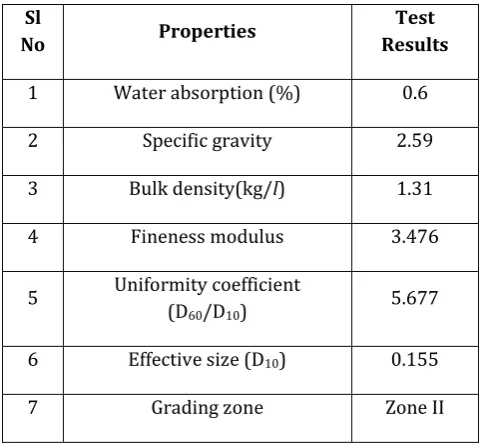
2.1.2 Fine Aggregate [image:3.595.41.285.196.420.2]Natural fine aggregate used for the experimental study was manufactured sand. The physical properties of fine aggregate are given in Table2
.
Table 2 physical properties of fine aggregate
Sl
No Properties
Test Results
1 Water absorption (%) 0.6
2 Specific gravity 2.59
3 Bulk density(kg/l) 1.31
4 Fineness modulus 3.476
5 Uniformity coefficient
(D60/D10) 5.677
6 Effective size (D10) 0.155
7 Grading zone Zone II
2.1.3 Coarse Aggregate
Coarse aggregate of 12mm maximum size is used in this study. Various tests were conducted on coarse aggregate according to IS recommendations and results are reported in table 3.
Table 3 physical properties of coarse aggregate
Sl No Properties Test Results
1 Water absorption (%) 1.3
2 Specific gravity 2.69
3 Bulk density 1.5g/cc
4 Fineness modulus 4.309
5 Uniformity coefficient
(D60/D10) 1.29
6 Effective size (D10 ) 15.523
2.1.4 fly ash
Fly ash (FYA) class F, known also as pulverised fuel ash is the by-product obtained by electrostatic and mechanical means from the flue gases of power station furnaces fired with pulverised coal. Fly ash used was ASTM Class F fly ash with specific gravity 2.14
2.1.5 superplasticizer
Master Glenium Sky 8233 is the high range water reducer used.
Table 4 chemical properties of super plasticizers
2.1.6 Super absorbent polymer (SAP)
Super absorbent polymer (SAP) from Poblo company limited used as internal curing agent in this experiment.
Table 5 chemical properties of super plasticizers
2.1.7 Light expanded clay aggregate (LECA)
Table 6 physical properties of LECA
Aspect Light brown liquid
Relative density 1.08
pH >6
Chloride ion content <0.2%
Chemical name Sodium polyacrylate
Specific gravity 1.4
Particle size 150micron
Particle shape Round
Specific gravity 1.64
density 772Kg/m3
© 2019, IRJET | Impact Factor value: 7.211 | ISO 9001:2008 Certified Journal
| Page 7363
2.1.8 WaterWater used in the study was portable water. The water used for concreting should have a pH value varying in between 6 and 8 and it should be free from organic matter.
2.2 METHODOLOGY
Stage 1: In the first stage, all the ingredients for concrete are to be collected and necessary material test are to be conducted in the laboratory as per relevant Indian standard code to check their suitability for making self-compacting concrete.
Stage 2: Perform the mix design for M30 grade self-compacting concrete and conduct necessary test to confirm.
Stage 3: Prepare self-compacting concrete as per mix design by adding super absorbent polymer as internal curing agent. 0.2%, 0.3%, 0.4%, 0.5%, 0.6% of cement content.
Stage 4. Prepare self-compacting concrete as per mix design by replacing coarse aggregate with lightweight aggregate as internal curing agent. The replacement considered are 10%,20%,30%,40% of coarse aggregate.
Stage 5. Find the rheological properties and mechanical properties like compressive strength, split tensile strength of self-compacting concrete with the use of super absorbent polymer and replacement of coarse aggregate as internal curing agents. Compare their effects.
Stage 6: Finally the result obtained are analysed and discussed.
2.3 RESULTS AND DISCUSSIONS
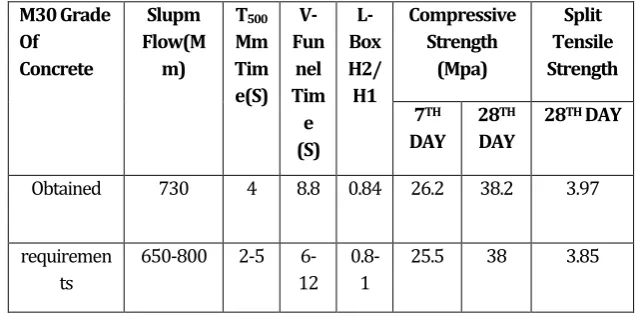
2.3.1 CONTROL CONCRETE
[image:4.595.137.456.438.597.2]2.3.2 TEST RESULTS FOR VARIOUS ADDITION OF SAP
Table 7 Fresh properties of SAP
M30 Grade Of Concrete Slupm Flow(M m) T500 Mm Tim e(S) V-Fun nel Tim e (S) L-Box H2/ H1 Compressive Strength (Mpa) Split Tensile Strength 7TH DAY 28TH DAY
28TH DAY
Obtained 730 4 8.8 0.84 26.2 38.2 3.97
requiremen ts
650-800 2-5
6-12
0.8-1
25.5 38 3.85
Mix ID
Slum
p
flow(
mm)
T500
(sec)
V-funnel
time(s
ec)
L-box
h2/h1
CM
730
4
8.8
0.84
SAP 0.2% 720
4.1
8.9
0.86
© 2019, IRJET | Impact Factor value: 7.211 | ISO 9001:2008 Certified Journal
| Page 7364
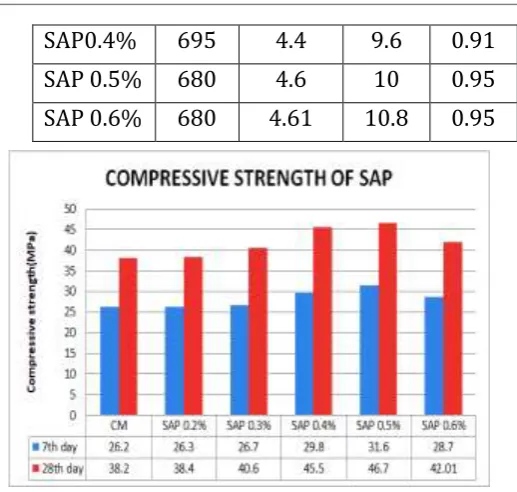
figure 1 compressive strength of SAP
figure 2 tensile strength of SAP
2.3.3 TEST RESULTS FOR VARIOUS REPLACEMENT OF LECA
Table 8 Fresh properties of SAP
Mix ID Slump flow(mm) T500 (sec) V-funnel time(sec) L-box h2/h1
CM 730 4 8.8 0.84
LWA 10%
600 3.2 8.2 0.88
LWA20 %
660 3.3 7.8 0.85
LWA 30%
687 3.4 7.1 0.81
LWA40 %
685 3.4 7 0.77
SAP0.4%
695
4.4
9.6
0.91
SAP 0.5%
680
4.6
10
0.95
[image:5.595.161.410.362.553.2]© 2019, IRJET | Impact Factor value: 7.211 | ISO 9001:2008 Certified Journal
| Page 7365
figure 3 compressive strength of LECA
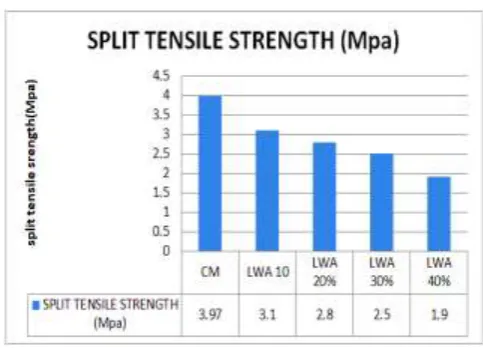
figure 4 tensile strength of LECA
3. CONCLUSIONS
1. The fresh properties of self compacting concrete were found to be satisfactory for all the mixes.
2. Workability of concrete for various percentage of SAP was founded to be less when compared with normal self compacting concrete,but it satisfies all the fresh state properties easily.
3. The compressive strength of SAP 0.5% at 7thday is about 20% of SCC made with mix CM and at 28th day is about 22% of SCC made with mix CM. Hence there is gradual increase in the compressive strength, so the super absorbent can be used effectively in SCC.
4. Split tensile strength for SAP 0.5% was found to be 23% increment of that with mix CM.
5. In LECA the fresh property decreased when replacement increases.
6. The compressive strength of LECA 10% at 7th day is decrease about 11% of SCC made with mix CM and 28th day is decrease about 15% of scc made with control mix. hence there is an increase in the initial stage .
7. Split tensile strength for LWA was found to be decrease of that with mix CM
REFERENCES
[1] M.M Kamal et al. (2018), “Experimental investigation on
the behaviour of normal strength and high strength
[image:6.595.175.417.291.465.2]© 2019, IRJET | Impact Factor value: 7.211 | ISO 9001:2008 Certified Journal
| Page 7366
[2]. Suhair Al.Hubboubi et al.(2018), “performance of super-absorbent polymer as internal curing agent for self-compacting concrete”,MATEC web of confrences162,02023.
[3]. Nada Algalita et al. (2018), “effect of internal curing on performance of self –compacting concrete by using sustainable materials”, MATEC web of confrences162,02017.
[4]. JoAnn Browning et al. (2011), “Light weight aggregate as internal curing agent to limit concrete shrinkage”, ACI materials of journal, V.108, NO.6.
[5] D.Cusson(2007), “ Benefits and case studies using internal curing of concrete”, RILEM TC 196-ICC: State of the Art Report ,2007.
[6] IS:12269 (2013) –“ Ordinary Portland Cement, 53 Grade – Specification, Bureau of Indian standards”, New Delhi, India
[7] IS:383 (1970 ) –“Specification for coarse and fine aggregates from natural source for concrete”, Bureau of Indian standard, New Delhi, India
[8] EFNARC, “Specification and guidelines for selfcompacting concrete”,UK,February 2002