Arbitrary View Action Recognition via Transfer
Dictionary Learning on Synthetic Training Data
Jingtian Zhang,
Student Member, IEEE,
Hubert P. H. Shum,
Member, IEEE,
Jungong Han,
Member, IEEE,
and Ling Shao,
Senior Member, IEEE
Abstract—Human action recognition is crucial to many prac-tical applications, ranging from human-computer interaction to video surveillance. Most approaches either recognize the human action from a fixed view or require the knowledge of view angle, which is usually not available in practical applications. In this paper, we propose a novel end-to-end framework to jointly learn a view-invariance transfer dictionary and a view-invariant classifier. The result of the process is a dictionary that can project real-world 2D video into a view-invariant sparse representation, as well as a classifier to recognize actions with an arbitrary view. The main feature of our algorithm is the use of synthetic data to extract view-invariance between 3D and 2D videos during the pre-training phase. This guarantees the availability of training data, and removes the hassle of obtaining real-world videos in specific viewing angles. Additionally, for better describing the actions in 3D videos, we introduce a new feature set called the
3D dense trajectories to effectively encode extracted trajectory information on 3D videos. Experimental results on the IXMAS, N-UCLA, i3DPost and UWA3DII datasets show improvements over existing algorithms.
Index Terms—Action Recognition, 3D Dense Trajectories, View-invariance, Transfer dictionary learning.
I. INTRODUCTION
2
D video based human action recognition has attracted a lot of attention in security surveillance and human-computer interaction. Various spatio-temporal appearances generated from the movements can be considered as the feature descrip-tors for action recognition. These include spatio-temporal pat-tern template [1], spatio-temporal interest points [2]–[5], shape matching [6], [7] and motion trajectories based descriptors [8]–[11]. Among them, dense trajectories based methods have achieved state-of-the-art results by extracting densely sampled trajectories-aligned descriptors in the optical flow fields. Deep learning networks have also achieved significant success in the 2D action recognition area [12]–[15]. These methods can automatically learn spatial-temporal feature representations and identify different action categories. However, [12]–[15] are only effective for single view action recognition and the recognition performance degrades significantly when the view-point is changed. The reason behind is that the appearances of a particular action from different viewpoints vary dramatically, which results in dissimilar trajectories.J. Zhang and H. P. H. Shum are with the Department of Computer and Information Sciences, Northumbria University, Newcastle Upon Tyne NE1 8ST, U.K. (e-mail: {jingtian.zhang, hubert.shum}@northumbria.ac.uk).
J. Han is with the School of Computing and Communications, Lancaster University, Lancaster LA1 4YW, U.K. (e-mail: [email protected]).
[image:1.612.313.563.183.353.2]L. Shao is with Inception Institute of Artificial Intelligence, Abu Dhabi, United Arab Emirates. (e-mail: [email protected]).
Fig. 1: Leveraging view-invariance from 3D model is a popular idea to tackle arbitrary-view and cross-view action recognition. (a) Existing works [16], [17] project a simplified 3D cylindri-cal model into as many viewpoints as possible to produce 2D training videos and extract 2D dense trajectories from these projections. However, some human appearance information could be lost due to the unrealistic 3D reconstruction and the simplified cylindrical model. The discrete projection angles also inevitably result in the loss of 3D geometric information. (b) The proposed 3D dense trajectories are extracted direct-ly from high-quality 3D human surface model without any projection.
transfer probabilities of the visual words from the source to target views [21]. Huang et al. built a correlation subspace to produce joint representation from different views by using canonical correlation analysis [22]. In spite of discovering the correspondence between codebooks from two or more different views, the above approaches cannot guarantee that videos captured from different views share similar features. Also, all these methods require viewpoint information for both source view and target view, which is usually not available in practical applications.
As a solution, arbitrary-view action recognition is proposed, in which viewpoint information is not required during testing and action from unseen views can be recognized. The main idea is to remove view-dependent information from the fea-ture representation. Previous attempts to realize arbitrary-view action recognition have met with varying levels of success. Lv et al. use a graphical model to calibrate 2D key poses of actors to represent 3D surface models for arbitrary view action recognition. However, the motion information for recognizing actions may not be well captured [7]. Weinland et al. propose to recognize human actions by estimating 3D exemplars from a single 2D view angle using the hidden Markov model [23]. However, reconstructing these 3D exemplars from a single view is unreliable. Also, detailed action information may be lost as only discrete samples of silhouette information are used. Yan et al. present a 4D (i.e., 3D spatial and 1D temporal dimensions) action feature using the time-ordered 3D reconstruction of the actors from multi-view video data [24]. The recognition accuracy depends heavily on the performance of the 3D reconstruction, and the framework requires training data to be captured from carefully designed viewpoints. Gupta et al. propose to project the 3D motion capture sequence in the 2D space and explore the best match of each training video using non-linear circular temporary encoding [16]. However, since discrete 2D projection, instead of full 3D information, is used for training, the accuracy depends on the number of projected views. Rahmani et al. propose R-NKTM to transfer knowledge of human actions from any unknown view to a shared high-level virtual view by finding a non-linear virtual path that connects the views [25]. They generate the training data by projecting the 3D exemplar to 108 virtual views. The use of so many projected views results in enhanced system performance, but result in a computationally expensive training process. Ideally, we would like to have a framework that relies on easy-to-obtain training data and performs robustly in runtime.
Most of the existing works leverage view-invariance provid-ed by 3D models to realize cross-view or arbitrary-view action recognition. Traditionally, simplified cylindrical models are used [16], [17], which does not generate realistic movement appearance. High-quality reconstruction models are proposed by calculating them from multi-view 2D videos [24]. In order to increase the system robustness to viewpoint changes, train-ing data is forced to cover as much 2D data projected along as many viewpoints as possible. All these approaches suffer
3D reconstruction and the simplified cylindrical model; (2) Despite the effort to project the 3D model into as many viewpoints as possible, these discrete projection angles will inevitably result in the loss of 3D geometric information. A large amount of 2D projections also requires larger system capacity and training cost.
To solve the problems, we proposed to synthesize training data using high-quality human models with captured 3D motion data. We employ primary deformation [26] to drive the movement of the models, and motion retargeting [27] to adjust the movement based on the body sizes of the models. We further propose a new 3D feature set called the
3D dense trajectories including 3D trajectories, 3DHOF and 3DMBH. This allows us to extract the feature directly from 3D videos and avoid geometric information loss due to discrete projection. Finally, we propose a new view-invariant trans-fer dictionary learning framework, which extracts the view-invariance between 3D and 2D video, to perform arbitrary view action recognition. We pre-train the system with a large number of automatically synthesized 3D and 2D videos. This allows us to train a view-invariant action classifier using only a small number of real-world 2D videos, in which the view information is not annotated. Experimental results show that our system achieves better accuracy when compared with previous work in arbitrary-view and cross-view action recognition.
This paper has three main contributions:
• We propose a new transfer dictionary learning framework that utilizes synthetic 2D and 3D training videos generat-ed from realistic human models to learn a dictionary that can project a real world 2D video into a view-invariant sparse representation, which allows us to train an action classifier that works in an arbitrary view.
• We release our synthetic 2D and 3D dataset for public usage. This is the first structured action dataset built with realistic human models for high-quality action classifica-tion.
• We propose a new 3D feature set called the 3D dense trajectories consisting of 3D trajectories, 3DHOF and 3DMBH for a better description of motion in 3D. This can be considered as a 3D counterpart of the popular 2D feature dense trajectories [21].
datasets: i3DPost and UWA3DII.
The rest of this paper is organized as follows. In Section II, we introduce some related applications and approaches for the view-invariant action recognition. In Section III, we give an overview of our view-invariant human action recognition frame. In Section IV, we present the synthesis and feature extraction process on our 2D and 3D video data. Section V provides the details of our view-invariant dictionary learning algorithm. Section VI presents the experimental results, and Section VII concludes the paper.
II. RELATEDWORK
The general process for view-invariant action recognition can be divided into three major parts. (1) Synthesized 3D exemplars are used for producing the 2D videos covering as many viewpoints as possible. (2) Then, the feature extraction methods, especially some interest points and trajectory-based feature extraction methods, are developed for describing the action on the 2D videos. (3) At last, transfer learning algo-rithms are used to transfer the action information across differ-ent views in order to realize view-invariant action recognition. Therefore, in this part, some previous works related to these three major processes will be introduced respectively.
A. 3D Exemplar-based Methods
One popular idea is to utilize 3D exemplars for view-invariant feature extraction and description. Some researchers are only using the static 3D exemplars. For example, Ankerst et al. propose the histogram of shape [29] which is very similar to the 3D shape context proposed by Korgen et al. [30]. Subsequently, Huang et al. combine the histogram of shape with color information [31]. All these methods are mainly based on static descriptors such as poses and shape while the state-of-the-art descriptors integrate static descriptors with motion information.
Instead of relying on the static feature only, some re-searchers utilize the changing of static descriptors over time in order to capture the temporal information by simply accumu-lating static descriptors, applying sliding windows, or tracking human pose information [23], [32]–[34]. Cohen et al. [35] present a 3D human shape model for view-invariant human i-dentification. Later, this 3D human shape model was developed by Pierobon et al. [34] for human action recognition. Weinland et al. propose the Motion History Volume (MVH) as a 3D extension of Motion Histogram Images (MHIs) [33]. MHV is calculated by accumulating human postures over time in cylindrical coordinates. A different strategy is proposed by Yan et al. [24], where they develop a 4D action feature model (4D-AFM) for arbitrary view action recognition based on spatio-temporal volumes (STVs). However, the performance of the above 3D exemplars-based systems is strictly limited to the result of 3D reconstruction. Normally, the reconstructed 3D exemplars are not very realistic.
Some other researchers construct the 3D exemplar with the aid of depth sensors. Zhang et al. present a low-cost descriptor called 3D histogram of textures (3DHoTs) to ex-tract discriminative features from a sequence of depth maps
[36]. They combine depth maps and texture description by projecting depth frames onto three orthogonal Cartesian planes to describe the salient information of a specific action. Liu et al. presents a multi-scale energy-based Global Ternary Image (GTI) representation, which efficiently encodes both the spatial and temporal information of 3D actions [37]. Skeleton information can be easily collected from the depth map. Liu et al. propose a sequence-based transform method, which maps skeleton joints into a view-invariant high dimensional space [38]. Then, they use color images to visualize this space and adopt CNN to extract deep features from these enhanced color images. Wang et al. realize non-rigid reconstruction and motion tracking without any template using a single RGB-D camera [39]. Jia et al. present a tensor subspace, whose dimension is learned automatically by low-rank learn-ing for RGB-D action recognition [40]. Kong et al. propose a discriminative relational feature learning method for fusing heterogeneous RGB with depth modalities and classifying the actions in RGB-D sequences [41]. Even though the depth information has a superior descriptive ability on 3D exemplars, most videos in the real world are captured without depth information. Therefore, we focus on techniques for extracting 3D information from RGB only videos, which have more prospective applied areas.
B. Interest Points and Trajectory-based Methods
To better describe the spatio-temporal interest points, Dollar et al. build the descriptors upon brightness, optical flow and gradient information [2]. The SIFT descriptor is extended to the spatio-temporal interest points by Scovanner et al. [42]. Willems et al. extend the SURF descriptor to the video domain by computing weighted sums of response of Haar wavelets [43].
Due to the fact that spatio-temporal interest points are at fixed location in the video, only interest points based descriptor cannot capture motion information in the video. In contrast, trajectory tracks the given interest point over time so that it can capture the motion information. Messing et al. extract trajec-tories by tracking Harris3D interest points with a KLT tracker [44]. They use a sequence of log-polar quantized velocities to represent trajectories. Matikainen et al. extract trajectories with a standard KLT tracker, then they cluster these trajectories for the action classfication [45]. Sun et al. match SIFT descriptor between two frames to compute trajectories [46]. Later, they combine both SIFT matching and KLT tracker to extract long-duration trajectories [47]. Wang et al. compute trajectories by tracking the interest points in the optical flow field, then they compute Histogram of Gradient (HOG), Histogram of Optical Flow (HOF) and Motion Boundary Histogram (MBH) to model the action in the video [9]. However, the optical flow field is just a 2D approximation of the 3D motion field and cannot accurately describe the 3D motion information.
C. Transfer Learning and Dictionary Learning
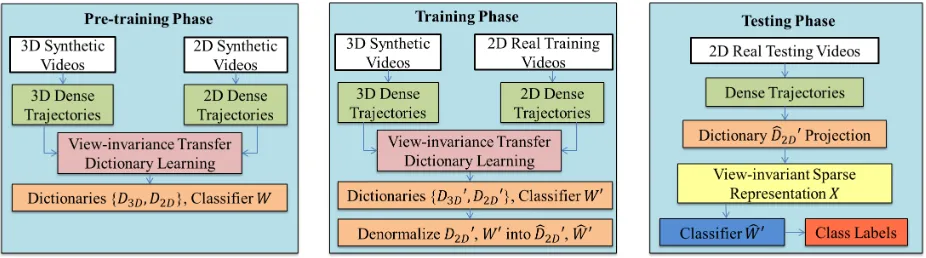
Fig. 2: The overview of our view-invariant transfer dictionary learning system. (Left) In the pre-training phase, we learn the dictionaries D3D, D2D and a linear classifier W simultaneously from the synthetic 3D videos and the synthetic 2D videos.
(Middle) In the training phase, we replace the synthetic 2D videos with 2D real training videos for adapting the dictionaries
D3D0,D2D0 and the classifierW0. The 2D dictionary and the classifier are denormalized intoDb2D0 andWb0 respectively. (Right)
In the testing phase, given any real 2D video, we applyDb2D0 to encode the features into a view-invariant sparse representation
X, and useWb0 for classification.
al. present a simple-to-complex action transfer learning model (SCA-TLM) for complex human action recognition [48]. It improves the performance of complex action recognition by leveraging the abundant labeled simple actions. In particular, it optimizes the weight parameters, enabling the complex actions to be learned and to be reconstructed by simple actions. Xu et al. propose a novel dual many-to-one encoder architecture to extract generalized features by mapping raw features from source and target datasets to the same feature space [49]. Rahmani et al. propose R-NKTM to transfer knowledge of human actions from any unknown view to a shared high-level virtual view by finding a non-linear virtual path that connects the views [25].
Recently, dictionary learning for sparse representation has been successfully applied in many computer vision applica-tions, such as image de-noising [50] and face recognition [51]. With an over-complete dictionary, input signal can be approximately represented by a sparse linear combination of items in the dictionary. Previously, many methods [52] have been presented to learn such a dictionary based on different criteria. Among them, the K-Singular Value Decomposition (K-SVD) [53] is a typical dictionary learning method that uses the K-means clustering algorithm for optimizing dictio-nary items to learn an over-complete dictiodictio-nary. Even though the K-SVD method has the re-constructive ability, due to the unsupervised learning process, the discriminative ability has not been considered. Later, [54] proposed a dictionary transformation method to transform the dictionary from one domain to another. It can handle the problem that the testing instances are different from the training instances. In addition, they use correspondences between the source view and the target view to construct pairwise dictionaries for the cross-view action recognition problem. Zheng et al. represents the videos in each view using a view-specific dictionary and the common dictionary. More importantly, it encourages the set of videos taken from different views of the same action to have the similar sparse representations [55].
Unlike the above approaches, our approach simultaneously learns pairwise dictionaries and a classifier while
consider-ing re-constructive ability, discriminative ability and domain adaptability during the dictionary learning process. The data in 3D source domain and 2D target domain are with com-pletely different formats. View-invariance from 3D data can be smoothly transferred to 2D data with jointly optimizing the pairwise dictionaries.
III. SYSTEMOVERVIEW
As illustrated in Fig. 2 Left, in the pre-training phase, we synthesize 3D video sequences using motion capture data. We propose a new 3D dense trajectories feature extracted from a source 3D synthetic video, andY3D= [yyy333DDD1, ...,yyy333DDDK]∈RS×K
denotes theK S-dimensional features. The synthetic 3D video is projected into different viewpoints to create multiple syn-thetic 2D videos.Y2D= [yyy222DDD1, ...,yyy222DDDK]∈RT×K denotes theK
T-dimensional features extracted from a target synthetic 2D video. We build 3D videos and 2D videos pairwisely in order to train the correspondence between them. We useKto denote both the numbers of 2D videos and 3D videos used in the pre-training phase.
We then train the 3D and 2D dictionaries simultaneously from the synthetic 3D and 2D videos respectively, which projects the respective video data into a common view-invariant sparse feature space. They are represented asD3D=
[ddd333DDD1, ...,ddd333DDDN]∈RS×N and D2D= [ddd222DDD1, ...,ddd222DDDN]∈RT×N,
whereNis the dimension of the sparse feature space. Records belonging to the same action class in both 3D and 2D data are constrained to share the same sparse representation. We construct the action classifier W in an end-to-end manner for better accuracy, by jointly minimizing the classification error rate and the dictionary quantization error. This improves training efficiency and system accuracy.
Then, as illustrated in Fig. 2 Middle, in the training phase, we replace the synthetic 2D videos with the 2D real training videos and perform system fine-tuning. This allows us to adapt the dictionaries (D3D0,D2D0) and the classifier (W0) originally
Fig. 3: (a) Some example frames from the synthetic 3D video. Using motion retargeting techniques, we can retarget the captured motion to 3D models of different body sizes to increase the database diversity. (b) The interest points obtained according to the vertices of the 3D models.
videos are needed. We finally denormalize the 2D dictionary and the classifier into Db2D0 andWb0 respectively.
In the testing phase illustrated in Fig. 2 Right, given any real 2D video, we apply Db2D0 to encode the features into a
view-invariant sparse representation X = [xxx1, ...,xxxK]∈RN×K. We then apply Wb0 to identify the class label of the video.
Due to the use of the view transfer dictionary, our system can identify actions from an arbitrary 2D view.
IV. VIDEOSYNTHESIS ANDFEATUREEXTRACTION
In this section, we explain how we synthesize 3D videos and project them to generate synthetic 2D videos. We then explain how we extract a corresponding set of 3D and 2D features.
A. Synthesizing 3D and 2D Videos
Here, we explain the process of synthesizing 3D and 2D video data.
To synthesize the 3D motion models, we utilize the motion capture data from the Carnegie-Mellon Graphics Lab [56] and the Truebones dataset [57]. The motions are represented with 3D joint angles in a skeletal body hierarchy at 25 frames per second (FPS). Instead of using simplified cylindrical model to represent surface information as in past research [16], [28], we use different high-resolution 3D human models instead. This requires a process known as primary deformation [26] to deform the human models based on the skeletal movement over time. The advantage of using 3D motion data is that we can applymotion retargetingtechniques to synthesize the motion performed by human models of different body sizes, as shown in Fig. 3a. Such an automatic process enhances the diversity of the database by adjusting the movement according to the bone length.
In order to produce synthetic 2D video, we project the synthesized 3D videos uniformly in a set of pre-defined view-points. Fig. 4 shows example frames of 2D videos projected
Fig. 4: (a) Example frames of synthetic 2D videos obtained by projecting a 3D video into different viewpoints. (b) Virtual cameras are placed on the hemisphere looking towards the center of the sphere to generate different viewpoints.
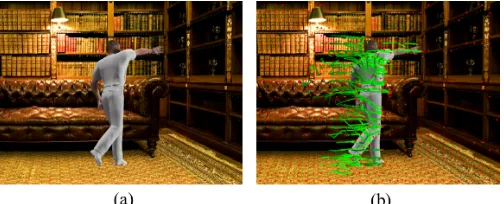
Fig. 5: (a) Synthesized 2D video (b) Extracted dense tra-jectories (red points are interest points, green curves are trajectories)
from various viewpoints. Notice that in our system, we do not require any information about the viewpoints to perform classification.
B. 2D Dense Trajectories
For both 2D synthetic videos and 2D real videos, we em-ploy dense trajectories [10], a powerful action representation, for feature extraction. It considers both holistic and local information of 2D motion by combining dense sampling and trajectory tracking. Specifically, it consists of a set of low-level descriptors, including trajectory descriptor, Histogram of Oriented Gradients (HOG), Histogram of Optical Flow (HOF) and Motion Boundary Histogram (MBH). Among them, HOG can extract the static appearance of the videos while HOF and MBH can extract the motion information. Fig. 5 shows an example of dense trajectories extracted from a synthetic 2D video.
C. Proposed 3D Dense Trajectories
Our transfer learning involves transferring 3D and 2D features into a common sparse feature space, and hence it is preferable that both of them have similar logical meanings. Therefore, we propose a 3D version of dense trajectories that corresponds to the 2D one. The proposed feature consists of three components: 3D trajectories, 3DHOF and 3DMBH. Notice that HOG is not included here, as the surface texture of a 3D model remains unchanged over time.
[image:5.612.310.561.52.143.2] [image:5.612.61.289.52.218.2] [image:5.612.313.565.208.310.2]Fig. 6: The 14 3D velocity bins visualized with a 3D cube. 6 directions point towards the faces of the cube, and 8 directions point towards the corners of the cube.
Fig. 7: The 3DMBH components in X, Y and Z directions are quantized into 8 bins each. The 3DMBH is defined as the concatenation of 3DMBHx, 3DMBHy and 3DMBHz along each vertex trajectory.
set of interest points over time according to the surface vertices of the 3D models, as shown in Fig. 3b. For each point, we extract the motion trajectory across frames (Pt,Pt+1,Pt+2, ...),
wherePt is the 3D Cartesian coordinate of the vertex at frame
t, as shown in Fig. 1b.
The 3D trajectory is defined as:
Tr0=(∆Pt, ...,∆Pt+L−1)
∑tj+=Lt−1k∆Pjk
(1)
whereLis a user-defined value that represents the number of frames to be considered in a trajectory, and∆Pt= (Pt+1−Pt)
indicates the displacement across two frames. The denomi-nator is the total length of the trajectory, which is used for normalization.
2D HOF is the pattern of apparent motion of objects and surface in a visual scene caused by the relative motion between an observer and a scene. A logically similar representation in 3D, which we named the 3D Histogram of Optical Flow (3DHOF), is the velocity field of the surface vertices. We first define the velocity of a vertex as:
Vt=
∆Pt
1/FPS (2)
whereFPSis the frame rate of the 3D video, and is set to 25 in our experiments. We then quantize the 3D velocity orientations into 14 bins H(h1,h2, ...,h14) as shown in Fig. 6. 3DHOF is
defined as the binned histogram along each vertex trajectory:
hi=
∑t∈TikVtk ∑tj+=Lt−1kVtk
(3)
where Ti is a set that contains the frame’s number in which
the velocity direction of the interest point belongs to i on aL -frame trajectory.kVtkis the magnitude of the velocity, which
is used for weighting.
The 2D MBH (motion boundary histogram) is the derivative of the optical flow field computed separately for the horizontal and vertical components to encode the relative motion between pixels. This is to compensate the HOF descriptor, which can only compute absolute motion information. Inspired by this, we proposed the 3DMBH that encodes the relative motion between neighbour interest points on our 3D model. Similar
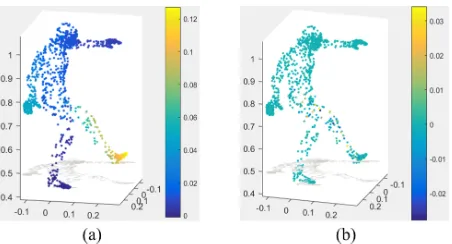
[image:6.612.50.304.54.95.2]Fig. 8: (a) The Y component of 3D velocity field for the example frame. (b) 3DMBHy is obtained by computing the gradient of Y component of 3D velocity field.
Fig. 9: The algorithm for transferring view-invariance from 3D video to 2D video by transfer dictionary learning.
to the 2D MBH implementation, we compute the derivatives separately along the X, Y, Z axes in the 3D velocity field. We quantize each 3DMBH component into 8 bins and the 3DMBH is defined as the concatenation of 3DMBHx, 3DMB-Hy and 3DMBHz along each vertex trajectory. The process is visualized as in Fig. 7. For example, the Y component of 3D velocity field is shown in Fig. 8a, and we compute its gradient to describe the relative motion between neighbouring interest points of that frame as shown in Fig. 8b.
V. VIEW-INVARIANTACTIONCLASSIFICATION
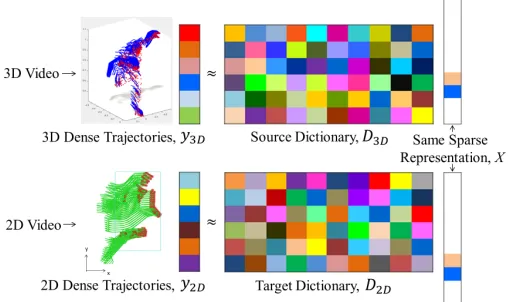
[image:6.612.45.303.147.182.2] [image:6.612.310.565.229.496.2]Fig. 10: Optimizing the 3D (source) and 2D (target) dictionar-ies to constraint that the same action in synthetic 3D and 2D videos has the same sparse representations.
A. The Pre-training Phase
Here, we introduce the basic theory of dictionary learning [58], and explain how we learn the view-invariant transfer dictionary for the 3D and 2D synthetic videos.
Dictionary learning generates a sparse representation for a high dimensional signal using linear projection with a projec-tion dicprojec-tionary. Letyyy∈RPdenote aP-dimensional input signal that can be reconstructed by the Q-dimensional projection coefficient xxx∈ RQ via a linear projection dictionary D= [ddd1, ...,dddQ]∈RP×Q. To obtain an over-completed dictionary,
Pshould be much larger thanQ. Assuming the reconstruction error to be E(xxx), the projection process is formulated as:
yyy=Dxxx+E(xxx) (4)
The objective function is defined as:
argminxxx,Dkyyy−Dxxxk22 s.t.kxxxk0≤M (5)
where kyyy−Dxxxk2
2 denotes the reconstruction error.s.t.kxxxk0≤ M denotes the sparsity constraint. M is the L0-norm sparsity
constraint factor that limits the number of non-zero elements in the sparse codes.
Due to the different number of trajectories across action videos, we use a bag-of-words descriptor to ensure that the features extracted from the action videos share the same dimension, following [8]–[11]. Specifically, we use K-means to cluster the trajectory-based descriptors in each action video into a fixed number of visual words. This allows us to repre-sent the action videos with histograms of the same dimension. We design a transfer dictionary learning system to transfer the view-invariance of the synthetic 3D videos to the synthetic 2D videos. We train two dictionaries simultaneously, with one for 3D (i.e. source - D3D) and one for 2D (i.e. target -D2D).
The main idea is to optimize the dictionaries such that the same action in both 3D and 2D videos has the same sparse representations, as visualized in Fig. 10. Upon successful training, D2D is able to project the feature vector of a 2D
video into a sparse representation that is similar to that of a 3D video. In other words, such a sparse representation is view-invariant.
We divide the dictionary into a number of disjoint subsets, and each of these is used exclusively for one action category. 3D and 2D videos with the same action category are therefore represented by the same subset of the dictionary. Those with different action categories are represented with disjoint subsets of the dictionary. This design enables the 3D and 2D videos with the same action category to share the same sparse representation pattern. Conversely, those with different action categories tend to have different representations.
Specifically, the dictionary optimization function is designed as:
argminX,D3D,D2D,A
αkY3D−D3DXk22+kY2D−D2DXk22+βkQ−AXk22 s.t∀i,kxxxik0≤M
(6)
whereα andβ are trade-off parameters, kY3D−D3DXk22 and kY2D−D2DXk22 are two terms to minimize the error of the
3D and 2D dictionaries respectively, andkQ−AXk2
2is a label
consistent regularization term to minimize the difference in sparse representation for the same class of action as intro-duced in [59], [60]. A is a linear transformation matrix that maps the original sparse codes X to be consistent with the discriminative sparse codes Q= [qqq1, ...,qqqK]∈RN×K of input
signal (yyy333DDDj,yyy222DDDj), in which the index j indicates the index of 2D and 3D action video pairs. Specifically, each vector
q
qqjjj= [qqqjjj1, ...,qqqjjjN] = [0...1,1...0]∈RN, and the non-zero occurs at those indices where the input signal (yyy333DDDj,yyy222DDDj) and the
dictionary items(ddd333DDDn,ddd222DDDn)share the same label. In our
dic-tionary design, dicdic-tionary itemddd333DDDnandddd333DDDnalways have the
same label. For example, assuming theY2D= [yyy222DDD1, ...,yyy222DDD6]
andD2D= [ddd222DDD1, ...,ddd222DDD6], whereyyy222DDD1,yyy222DDD2 andddd222DDD1,ddd222DDD2
are from class 1,yyy222DDD3,yyy222DDD4andddd222DDD3,ddd222DDD4are from class 2,
yyy222DDD5,yyy222DDD6 and ddd222DDD5,ddd222DDD6 are from class 3, then Q can be
defined as:
Q=
1 1 0 0 0 0
1 1 0 0 0 0
0 0 1 1 0 0
0 0 1 1 0 0
0 0 0 0 1 1
0 0 0 0 1 1
(7)
Inspired by [60], we propose to include the action classi-fication error of a linear prediction classifier into the object function to build an end-to-end system. This enhances the system training efficiency and results in better classification accuracy. The new objective function is therefore updated as
argminX,D3D,D2D,A,W
αkY3D−D3DXk22+kY2D−D2DXk22+βkQ−AXk22 +γkH−W Xk22 s.t.∀i,kxxxik0≤M
(8)
wherekH−W Xk2
2 is the proposed action classification error
term, W ∈RC×N denotes the classifier parameters and H= [hhh1, ...,hhhK]∈RC×K are the class label of input signals Y2D.
h
Since the three terms on the right hand side of Eq. 8 have the same format, we first rewrite Eq. 8 as follows:
argminX,D0kY0−D0Xk
2
2 s.t.∀i,kxxxik0≤M (9)
whereY0= √
αY3D Y2D √
βQ
√
γH
!
,D0= √
αD3D D2D √ βA √ γW ! .
Such an objective function shares the same form as Eq. 5, which can be optimized using the K-SVD algorithm [53]. Specifically, Eq. 9 is solved through both dictionary atom updating and sparse representing.
For the dictionary atom updating stage, each dictionary atom is updated sequentially to better represent both 3D videos and 2D videos. When pursing the better dictionaryD0, the sparse
representationX is fixed, and each dictionary atom is updated by tracking down a rank-one approximation to the matrix of residuals.
Following K-SVD, the kth atom of dictionary D0 and its corresponding coefficients are denoted as dddkkk and xxxkkk
respec-tively. Let Ek=Y0−∑j6=kdddjjjxxxjjjand we further denoteexxxkkk and e
E as the result obtained when all zero entries in xxxkkk and Ek
are discarded respectively. Each dictionary atom dddkkk and its
corresponding non-zero coefficientsexxxkkk can be computed by:
argmindddkkk,exxxkkkkEek−dddkkkexxxkkkk 2
2 (10)
The approximation in Eq. 10 is achieved through Singular Value Decomposition (SVD) onEek:
SV D(Eek) =U
∑
VTdddkkk=U(:,1)
e
xxxkkk=
∑
(1,1)V(1,:)(11)
where U(:,1) indicates the first column of U while V(1,:)
indicates the first row ofV.
At the sparse representation stage, we compute the best matching projection X of the multidimensional training data for the updated dictionary D0 using Orthogonal Matching Pursuit (OMP) algorithm.
1) Initialization: D3D, D2D, A and W are required to be
initialized before pre-training. In our system, forD3DandD2D,
we run a few iterations of K-SVD within each action class and initialize the label of the dictionary items based on the corresponding action labels. To initializeAandW, we use the multivariate ridge regression model [61] with the L2-norm:
A=argminAkQ−AXk22+ϕ1kAk22 W=argminWkH−W Xk22+ϕ2kWk22
(12)
where ϕ1 and ϕ2 are manually defined constants and are
empirically set as 0.5 in our system. The equation yields the following solutions:
A= (X Xt+ϕ1I)−1 W= (X Xt+ϕ2I)−1
(13)
whereX is calculated with the initializedD3D orD2D.
dk
responding coefficients ˜xk minimize the objective function, while the rest of dictionary atoms are updated iteration by iteration. Therefore, the Mean Squared Error (MSE) of the reconstruction error should be monotonically decreasing. At the sparse representation stage, the MSE is also reduced due to the computation of the best matched coefficients under the L0-norm constraint of the OMP algorithm. In addition,
since MSE is non-negative, the optimization process should be monotonically reducing and bounded by zero. Therefore, the convergence of the proposed transfer dictionary learning method is guaranteed.
C. The Training Phase
Here, we explain how to adapt the pre-trained dictionaries and classifier into real video.
We fine-tune the dictionaries and the classifier pre-trained by the synthetic data in order to adapt them into real-world data. Specifically, we useD3D,D2D,A,W in the pre-training
phase to initialize the training phase. We also replace the 2D synthetic videos with 2D real training videos. Then, we follow the same optimization strategy in Section V-B and apply the same number of iterations as the pre-training phase. After the optimization, we denote the trained dictionaries and classifiers as (D3D0,D2D0) andW0 respectively.
Since D3D0, D2D0,W0 are jointlyL2-normalized during the
optimization process, we need a step of de-normalization before they can be used for classification. Following [60], the denormalized 2D dictionary Db2D0 and the classification
parameterWb0 are calculated as:
b D2D0=
ddd 2 22DDD_1110 kddd222DDD_1110k2
, ddd222DDD_222
0
kddd222DDD_2220k2
, ..., ddd222DDD_NNN
0
kddd222DDD_NNN0k2
b W0=
www 1110 kwww1110k2
, www222
0
kwww2220k2
, ..., wwwNNN
0
kwwwNNN0k2
(14)
whereddd222DDD_nnn0denotes thenth atom of the dictionaryD2D0,wwwNNN0
denotes thenthatom ofW0. Notice that we do not denormalize
D3D0 as it is no longer needed in the next phase.
D. The Testing Phase
Here, we explain how we apply our trained dictionary to perform view-invariant action classification.
Given a real 2D video query sample yyy222DDD0, its sparse rep-resentation xxx0 can be computed with Db2D0. With the linear
classification parameterWb0, the labellll can be predicted as:
lll=Wb
0
xxx0 (15)
The label of yyy222DDD0 is the index corresponding to the largest element oflll.
VI. EXPERIMENTALRESULTS
public multi-view datasets including the IXMAS, N-UCLA, UWA3DII and i3DPost datasets.
The synthetic 3D and 2D datasets we used for transfer dictionary learning are open to the public. They can be found at our project website. All experiments were performed on a desktop computer with an Intel i7-4790k CPU, a NVIDIA Quadro K2200 graphics card and 16GB RAM.
A. Implementation Details
We used the software package Poser 2014 to retarget 3D motion capture data files in BVH format, animate 3D human models, and project the 3D scenes into 2D videos. We employed 5 high-quality 3D characters to synthesize the 3D video. For each action class, we synthesized 18 3D videos per character with 18 randomly selected motion files within the class. For each action class, we synthesized the 2D videos per character by projecting a randomly selected 3D video into 18 uniformly sampled viewpoints. The az-imuthal angle of the projection was uniformly sampled as {0◦, 60◦, 120◦, 180◦, 240◦, 300◦} and the polar angle of the projection was sampled as {0◦,−30◦,−60◦}. This setup allowed us to generate the same number of 3D and 2D videos (number of characters×number of views×number of action classes)as required by K-SVD for transfer dictionary learning. During pre-training, for the experiments on the IXMAS dataset (11 action classes), the N-UCLA dataset (10 action classes), the i3DPost dataset (10 action classes) and the UWA3DII dataset (30 action classes), we synthesized 990, 900, 900, 2700 pairwise 3D and 2D videos, respectively. From our experience, a larger synthetic dataset resulted in better accuracy. The size used was chosen considering the trade-off between system accuracy and training complexity.
We extracted dense trajectories from 2D synthetic videos, as well as 2D real videos from the IXMAS, N-UCLA, UWA3DII and i3DPost datasets. Afterwards, we constructed a codebook for each of the four descriptors in the dense trajectories separately. For each 2D descriptor, we applied k-means to cluster a subset of 100,000 dense trajectory features into 375 visual words. This resulted in a 2D feature Y2D of 1,500
dimensions. For 3D synthetic videos, similar to [23], we set the trajectory sample step to 5 frames, and the trajectory length to 15 frames. We constructed codebooks for 3D trajectories, 3DHOF and 3DMBH descriptors respectively. For each 3D descriptor, we applied k-means to cluster a subset of 100,000 3D dense trajectories into 500 visual words. This resulted in a 3D featureY3D of 1,500 dimensions.
When training the transfer dictionaries, to initialize the dictionary pairD3DandD2D, we employed k-means 5 times on
the featuresY3D andY2D respectively. For IXMAS, N-UCLA,
UWA3DII and i3DPost datasets, we set the dictionary sizes N to 1180, 1150, 2500 and 1150 respectively, for both D3D
and D2D. The 3D dictionary trade-off parameter α was set
to 1.5. The label consistent trade-off parameter β was set to
be 2.0. The classification error trader-off parameter γ was set
[image:9.612.325.549.66.165.2]to be 4.0. Finally, the numbers of iterations for the K-SVD algorithm in both pre-training and training phases were set to 60, 65, 100 and 65 for IXMAS, N-UCLA, UWA3DII and i3DPost datasets respectively.
[image:9.612.314.564.221.364.2]Fig. 11: Sampled frames from the IXMAS dataset.
Fig. 12: Cross-view recognition accuracy per action class in IXMAS.
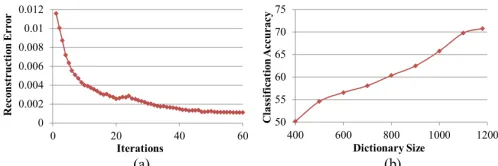
Fig. 13: Parameter analysis on the cross-view action recogni-tion in IXMAS dataset. (a) The optimizarecogni-tion process of the objective function with 50 iterations. (b) Performance with varying the dictionary size.
[image:9.612.312.561.433.516.2] [image:9.612.349.527.618.708.2]Hankelets [64] 83.7 59.2 57.4 33.6 84.3 61.6 62.8 26.9 62.5 65.2 72.0 60.1 57.1 61.5 71.0 31.2 39.6 32.8 68.1 37.4 56.4
Zhang et al. [28] 91.7 70.2 84.7 44.4 92.3 81.4 84.1 45.4 66.5 87.3 75.5 58.7 84.3 80.9 66.7 45.8 32.4 48.9 74.8 53.3 68.5
Without pre-training 86.1 68.8 74.7 34.6 81.4 74.6 78.4 37.9 68.4 78.6 73.5 58.3 76.5 72.3 64.3 48.7 31.7 37.1 67.8 41.1 62.7
[image:10.612.48.590.52.128.2]Ours 96.2 71.3 85.2 41.5 90.6 80.7 89.7 47.5 74.2 85.3 82.1 60.5 85.1 84.9 73.5 57.6 41.6 52.8 71.6 50.8 71.1
TABLE I: Cross-view recognition accuracy of all possible viewpoint combinations on IXMAS database. The horizontal axis labels are formatted as “source view|target view”.
Methods C0 C1 C2 C3 C4
DVV [62] 44.7 45.6 31.2 42.0 27.3
CVP [63] 50.0 49.3 34.7 45.9 31.0
nCTE [16] 72.6 72.7 73.5 70.1 47.5
Hankelets [64] 59.7 59.9 65.0 56.3 41.2
NKTM [17] 77.8 75.2 80.3 74.7 54.6
R-NKTM [25] 78.4 78.0 80.7 75.8 57.8
Zhang et al. [28] 70.8 76.5 72.6 71.9 50.5
[image:10.612.325.551.180.329.2]Ours 73.2 78.5 74.9 76.1 52.9
TABLE II: Average accuracy on the IXMAS dataset for each camera, e.g. C0 is the average accuracy when camera 0 is used for training or testing. Each time, only one camera view is used for training and testing.
B. Experiments on the IXMAS Dataset
The IXMAS dataset [33] contains 11 daily-life actions including check watch, cross arms, scratch head, sit down, get up, turn around, walk, wave, punch, kick, and pick up. Each action was performed three times by 10 subjects captured from 5 different viewpoints. Fig. 11 shows some examples.
In order to compare with existing works on cross-view action recognition that utilize view labels including DVV [62], CVP [63], nCTE [16], Hankelets [64], and our preliminary work [28], we conducted an experiment considering view labels. Here, we grouped the videos in the IXMAS dataset into different views and evaluated the accuracy of transferring one view to another. We followed the leave-one-action-out cross-validation strategy from [16], [64]. Table I shows that our algorithm outperforms the state-of-the-art method nCTE in most cross-view pairs, as well as the average system accuracy. It also demonstrates that our proposed methodology enhancements over [28] have resulted in superior accuracy. We also compare with a baseline setup of our system that does not include the pre-training phase, which demonstrates the effectiveness of utilizing synthetic 2D and 3D videos for pre-training. Fig. 12 shows that our algorithm outperforms nCTE in most action classes, thereby indicating that our system can can realize cross-view action recognition by transferring the view-invariance from 3D models. Notice that in our default setup, the system does not require any view information. This experiment was designed for the sake of comparison only.
In order to analyze the effect of the hyperparameters (i.e.α, β andγ), we experiment with 27 different settings within the
searching range ofα in [1, 2] on every 0.5 interval,β in [1,
2] on every 0.5 interval andγ in [2, 4] on every 1.0 interval.
The result is visualized in Fig. 14.
Since the orientation of the actors is arbitrary in the
IX-Fig. 15: Sampled frames from the N-UCLA dataset.
Methods {1,2}|3 {1,3}|2 {2,3}|1 Mean
DVV [62] 58.5 55.2 39.3 51.0
CVP [63] 60.6 55.8 39.5 52.0
nCTE [16] 68.6 68.3 52.1 63.0
Zhang et al. [28] 67.3 74.2 61.8 67.8
Ours 69.1 74.4 61.8 68.5
TABLE III: Accuracy on the N-UCLA dataset (two views for training and one for testing).
MAS dataset, we compare with existing works on arbitrary view action recognition by calculating average accuracy for each camera. For example, C0 is the average accuracy when camera0 is used for training or testing. Table II shows that our algorithm outperforms most of the previous methods in some viewpoints. It is worth mentioning that NKTM [17] and R-NKTM [25] are deep learning based methods, at the core of which is the use of neural networks to transfer videos from different views to a canonical view. However, their method requires the generation of 2D training video by projecting the 3D exemplar to 108 virtual views, while ours only needs 18 different views. Due to the lower amount of training data required, our method can save computation resources especially when constructing the system.
C. Experiments on the N-UCLA Dataset
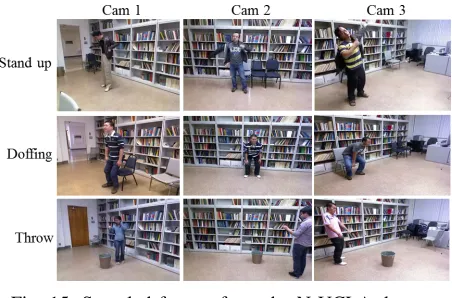
The N-UCLA dataset [21] contains 10 action classes cap-tured from 3 different viewpoints with 10 different actors. The action categories include pick up with one hand, pick up with two hands, drop trash, walk around, sit down, stand up, donning, doffing, throw, and carry. Fig. 15 shows some sample frames from the N-UCLA dataset.
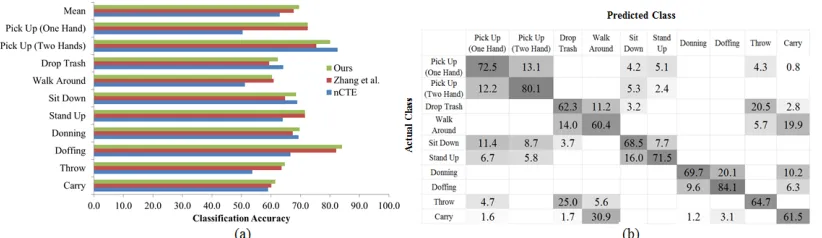
[image:10.612.74.279.181.266.2] [image:10.612.338.540.349.407.2]Fig. 16: (a) Cross-view recognition accuracy per action class in N-UCLA. (b) The confusion matrix of N-UCLA.
Fig. 17: Sampled frames from the UWA3DII dataset.
recognition and in comparison with existing work including DVV [62], nCTE [16], CVP [63], and our preliminary work [28]. We followed the experimental setup in [16], [63], which utilizes videos captured from two cameras for training and the other one for testing. The accuracy was calculated using leave-one-action-out cross validation. As shown in Table III, our method outperforms existing algorithms in most of the cross-view setups and the overall result. Fig. 16 shows that our algorithm outperforms nCTE in most action classes. This demonstrates that our system can realize cross-view action recognition by transferring the view-invariance from 3D mod-els. Notice that in our default setup, the system does not require view information. This experiment was designed for the sake of comparison only.
On the N-UCLA dataset, some actions are quite difficult to differentiate, such as “Drop Trash” vs. “Throw”, “Carry” vs. “Walk around”, as they both consist of similar body movement.
D. Experiments on the UWA3DII Dataset
This dataset [65] consists of a variety of daily-life human ac-tions performed by 10 subjects with different scales. It includes 30 action classes: one hand waving, one hand punching, two hand waving, two hand punching, sitting down, standing up, vibrating, falling down, holding chest, holding head, holding back, walking, irregular walking, lying down, turning around, drinking, phone answering, bending, jumping jack, running, picking up, putting down, kicking, jumping, dancing, moping floor, sneezing, sitting down (chair), squatting, and coughing.
Fig. 19: Sampled frames from the i3DPost dataset.
Each video is captured from one of four predefined viewpoints. This results in variations in actions across different viewpoints within the same action class. This dataset is challenging because of varying actor orientations, self-occlusion and high similarity among actions. Fig. 17 shows four sample actions from different viewpoints.
As shown in Table IV, our method outperforms existing algorithms in most of the cross-view setups and the overall result. Fig. 18 shows that our algorithm outperforms our baseline in most action classes.
E. Experiments on the i3DPost Dataset
[image:11.612.72.276.213.359.2] [image:11.612.334.537.215.393.2]Zhang et al. [28] 50.6 56.8 48.6 43.7 53.2 59.7 66.8 48.9 56.8 50.4 68.3 51.7 54.6
[image:12.612.48.574.52.110.2]Ours 59.3 57.9 50.2 48.1 59.9 63.4 65.1 67.1 68.2 55.5 73.5 53.4 60.1
[image:12.612.76.538.150.236.2]TABLE IV: Accuracy on the UWA3DII dataset (two views for training and one for testing).
Fig. 18: Cross-view recognition accuracy per action class in the UWA3DII dataset.
Methods Mean
Holte et al. [68] 92.2 Iosifidis et al. [69] 90.9 Gkalelis et al. [65] 90.0
Zhang et al. [28] 93.8
[image:12.612.122.227.277.333.2]Ours 94.6
TABLE V: Average accuracy for arbitrary view recognition on the i3DPost dataset.
Features IXMAS N-UCLA UWA3DII i3DPost
3D Trajectories 58.1 57.1 48.6 90.1
3DHOF 67.8 62.4 58.4 87.5
3DMBH 66.3 56.3 53.2 81.6
All Features Combined 70.8 68.5 60.1 94.6
TABLE VI: Comparison of cross-view action recognition results on the IXMAS, N-UCLA, UWA3DII and i3DPost dataset by using different features.
19 shows multi-view actor/action examples from the i3DPost dataset.
We use leave-one-actor out strategy followed by [68]. This means that we use the 2D videos of one actor for testing, while using the rest of the dataset for training. Table V shows that our system achieves better result than previous methods.
F. Evaluation of our 3D Dense Trajectories
In this section, we evaluate our 3D dense trajectories by using 3D trajectories, 3DHOF and 3DMBH independently.
Table VI shows the comparison of cross-view action recognition results on the IXMAS, N-UCLA, UWA3DII and i3DPost dataset by using each descriptor independently and combining them together. Among the three descriptors, 3D-HOF outperforms the other two in the most of dataset. However, it is clear that the combined feature produces far superior results that cannot be achieved by any single feature. This shows that our proposed features are complementary to each other.
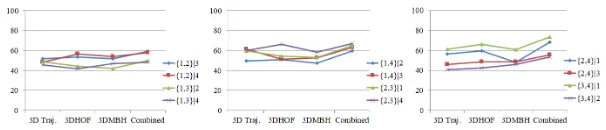
[image:12.612.338.535.281.367.2]Fig. 20 and 21 show the performance of different descriptors according to different view transfer pairs on the IXMAS
Fig. 22: 2D HOG evaluation of the UWA3DII dataset accord-ing to different view transfer pairs.
and UWA3DII datasets respectively. In all pairs, combining all the descriptors achieves better result than using them independently.
G. Evaluation of 2D Features Used in Our System
While appearance information and movement information are both very important for describing the 2D action videos, such appearance information is quite different for 2D action videos captured from different points. We build a transfer learning framework to transfer 3D and 2D features into a common sparse feature space, and hence it is preferable that both of them have similar logical meanings. Therefore, any useful information on the 3D and 2D action videos such as appearance will assist our system. The reason we do not propose 3DHOG is that the surface texture of a 3D model remains unchanged over time. We conduct an experiment on the UWA3DII dataset to show the importance of appearance feature 2D HOG.
[image:12.612.51.300.379.428.2]Fig. 20: Feature evaluation on IXMAS dataset according to different view transfer pairs.
Fig. 21: Feature evaluation on UWA3DII dataset according to different view transfer pairs.
VII. CONCLUSION ANDDISCUSSIONS
In this paper, we have proposed a view-invariant human action recognition framework. Unlike previous work, we con-struct a synthetic 3D and 2D video database using realistic human models, which is used to obtain the view-invariance through transfer dictionary learning. The trained dictionary is used to project real world 2D video into a view-invariant sparse representation, facilitating an arbitrary view action classifier. The use of synthetic data for initial training reduces the need for carefully captured video with view information. The synthetic dataset created in this project is open to the public, it is the first structured action dataset built with realistic human models for classification purposes. To enhance the quality of 3D motion description, we propose a new set of features known as the 3D dense trajectories, which consists of 3D trajectories, 3DHOF and 3DMBH. These features are complementary to each other and the combined feature set is highly effective for action classification. We demonstrate su-perior results in comparison to existing works in the IXMAS, NUCLA, UWA3DII and i3DPOST datasets.
In our system, we project the 3D and 2D videos into a common view-invariant sparse representation with the 3D and 2D dictionaries respectively. Theoretically speaking, it is possible to learn a dictionary that directly projects 2D video into 3D space, and consider the 3D space to be view-invariant. However, this is not practically possible. This is because 2D to 3D projection requires information that is not available in the 2D video. Even if a project matrix can be trained, the projected results will suffer from a large reconstruction error. In this research, we solve this problem by extracting the common view-invariant features in the 3D and 2D videos instead.
A main advantage of our framework is that the view-invariant transfer dictionary is pre-trained with a full synthetic dataset and fine-tuned with a small amount of real data. It is possible to include a large number of views in the synthetic dataset to learn a better view-invariant representation, even if the real data does not cover all of these views. Also, it is possible to introduce variations within each action class using computer graphics techniques such as motion style transfer to improve the richness of the dataset, which can enhance the classification accuracy. While existing work requires encoding
and pooling parts to aggregate the local features, we use bag-of-words to effectively aggregate the local trajectories based features, motivated by the promising results from [8]–[11]. Specifically, we train a dictionary by using K-means to cluster the local features (e.g. HOG, HOF) into some visual words and then encode these local features by counting the occurrence of different visual words.
During the implementation, we found that the quality of the synthetic video could affect the classification accuracy of the system. This was the main motivation for us to utilize high-quality human models instead of simplified cylinder-based models as in previous works. In the future, we are interested to explore if more realistic rendering (such as photorealistic rendering with global illuminations) and more realistic character movement (such as introducing secondary deformation to simulate the involuntary movement of body fat and clothings) would further improve the system performance. In many datasets, the facing angles of the actors are not aligned with that camera viewpoints. As a result, the same action may appear differently for the same viewpoints de-pendent on the faced direction. As a future direction, we are interested in introducing the facing angle into the classification framework, such that the system can understand how the action may appear dependent on the orientation of the actor. Furthermore, when creating synthetic 2D videos, our current system samples projection viewpoints uniformly. With the facing angle, we may explore an optimal way of projection sampling that can optimize classification accuracy with a minimal number of synthetic 2D views.
Dictionary learning can be considered as a linear projec-tion algorithm and can be limited in representing the view-invariance of 2D and 3D videos. In the future, we are interested in applying non-linear algorithms such as Neural Networks with synthetic training data to achieve better results. The potential challenges in using Neural Networks to learn the complex view-invariance is the need to tune a large number of hyper-parameters, as well as the need to design an optimal network architecture.
ACKNOWLEDGEMENT
[image:13.612.151.454.146.211.2]REFERENCES
[1] M. Blank, L. Gorelick, E. Shechtman, M. Irani, and R. Basri, “Actions as space-time shapes,” inComputer Vision (ICCV), 2005 IEEE Interna-tional Conference on, vol. 2. IEEE, 2005, pp. 1395–1402.
[2] P. Dollár, V. Rabaud, G. Cottrell, and S. Belongie, “Behavior recog-nition via sparse spatio-temporal features,” inVisual Surveillance and Performance Evaluation of Tracking and Surveillance, 2005. 2nd Joint IEEE International Workshop on. IEEE, 2005, pp. 65–72.
[3] I. Laptev, “On space-time interest points,” International journal of computer vision, vol. 64, no. 2-3, pp. 107–123, 2005.
[4] J. Liu and M. Shah, “Learning human actions via information maxi-mization,” inComputer Vision and Pattern Recognition (CVPR), 2008 IEEE Conference on. IEEE, 2008, pp. 1–8.
[5] J. Liu, Y. Yang, and M. Shah, “Learning semantic visual vocabularies using diffusion distance,” inComputer Vision and Pattern Recognition (CVPR), 2009 IEEE Conference on. IEEE, 2009, pp. 461–468. [6] Z. Lin, Z. Jiang, and L. S. Davis, “Recognizing actions by shape-motion
prototype trees,” inComputer Vision (ICCV), 2009 IEEE International Conference on. IEEE, 2009, pp. 444–451.
[7] F. Lv and R. Nevatia, “Single view human action recognition using key pose matching and viterbi path searching,” inComputer Vision and Pattern Recognition (CVPR), 2007 IEEE Conference on. IEEE, 2007, pp. 1–8.
[8] S. Wu, O. Oreifej, and M. Shah, “Action recognition in videos acquired by a moving camera using motion decomposition of lagrangian particle trajectories,” in Computer Vision (ICCV), 2011 IEEE International Conference on. IEEE, 2011, pp. 1419–1426.
[9] H. Wang, A. Kläser, C. Schmid, and C. L. Liu, “Dense trajectories and motion boundary descriptors for action recognition,”International journal of computer vision, vol. 103, no. 1, pp. 60–79, 2013. [10] H. Wang, A. Klaser, C. Schmid, and C. L. Liu, “Action recognition by
dense trajectories,” inComputer Vision (CVPR), 2011 IEEE Internation-al Conference on. IEEE, 2011, pp. 3169–3176.
[11] H. Wang and C. Schmid, “Action recognition with improved trajecto-ries,” inComputer Vision (ICCV), 2013 IEEE International Conference on, 2013, pp. 3551–3558.
[12] A. Karpathy, G. Toderici, S. Shetty, T. Leung, R. Sukthankar, and L. Fei-Fei, “Large-scale video classification with convolutional neural networks,” inComputer Vision (CVPR), 2014 IEEE International Con-ference on. IEEE, 2014, pp. 1725–1732.
[13] K. Simonyan and A. Zisserman, “Two-stream convolutional networks for action recognition in videos,” inAdvances in neural information processing systems, 2014, pp. 568–576.
[14] D. Tran, L. Bourdev, R. Fergus, L. Torresani, and M. Paluri, “Learning spatiotemporal features with 3d convolutional networks,” inComputer Vision (ICCV), 2015 IEEE International Conference on. IEEE, 2015, pp. 4489–4497.
[15] L. Wang, Y. Xiong, Z. Wang, Y. Qiao, D. Lin, X. Tang, and L. Van Gool, “Temporal segment networks: Towards good practices for deep action recognition,” inEuropean Conference on Computer Vision. Springer, 2016, pp. 20–36.
[16] A. Gupta, J. Martinez, J. J. Little, and R. J. Woodham, “3d pose from motion for cross-view action recognition via non-linear circulant tem-poral encoding,” inComputer Vision and Pattern Recognition (CVPR), 2014 IEEE Conference on, 2014, pp. 2601–2608.
[17] H. Rahmani and A. Mian, “Learning a non-linear knowledge transfer model for cross-view action recognition,” in Computer Vision and Pattern Recognition (CVPR), 2015 IEEE Conference on, 2015, pp. 2458–2466.
[18] A. Kovashka and K. Grauman, “Learning a hierarchy of discriminative space-time neighborhood features for human action recognition,” in
Computer Vision and Pattern Recognition (CVPR), 2010 IEEE Con-ference on. IEEE, 2010, pp. 2046–2053.
[19] A. Farhadi and M. K. Tabrizi, “Learning to recognize activities from the wrong view point,” inEuropean conference on computer vision. Springer, 2008, pp. 154–166.
[20] J. Liu, M. Shah, B. Kuipers, and S. Savarese, “Cross-view action recognition via view knowledge transfer,” in Computer Vision and Pattern Recognition (CVPR), 2011 IEEE Conference on. IEEE, 2011, pp. 3209–3216.
[21] J. Wang, X. Nie, Y. Xia, Y. Wu, and S.-C. Zhu, “Cross-view action modeling, learning and recognition,” in Computer Vision and Pattern Recognition (CVPR), 2014 IEEE Conference on, 2014, pp. 2649–2656.
[23] D. Weinland, E. Boyer, and R. Ronfard, “Action recognition from arbitrary views using 3d exemplars,” inComputer Vision (ICCV), 2007 IEEE International Conference on. IEEE, 2007, pp. 1–7.
[24] P. Yan, S. M. Khan, and M. Shah, “Learning 4d action feature models for arbitrary view action recognition,” inComputer Vision and Pattern Recognition (CVPR), 2008 IEEE Conference on. IEEE, 2008, pp. 1–7. [25] H. Rahmani, A. Mian, and M. Shah, “Learning a deep model for human action recognition from novel viewpoints,”IEEE Transactions on Pattern Analysis and Machine Intelligence, 2017.
[26] N. Iwamoto, H. P. H. Shum, L. Yang, and S. Morishima, “Multi-layer lattice model for real-time dynamic character deformation,”Comp. Graph. Forum, vol. 34, no. 7, pp. 99–109, Oct 2015.
[27] C. Hecker, B. Raabe, R. W. Enslow, J. DeWeese, J. Maynard, and K. van Prooijen, “Real-time motion retargeting to highly varied user-created morphologies,”ACM Transactions on Graphics (TOG), vol. 27, no. 3, p. 27, 2008.
[28] J. Zhang, L. Zhang, H. P. Shum, and L. Shao, “Arbitrary view action recognition via transfer dictionary learning on synthetic training data,” in
Robotics and Automation (ICRA), 2016 IEEE International Conference on. IEEE, 2016, pp. 1678–1684.
[29] M. Ankerst, G. Kastenmüller, H.-P. Kriegel, and T. Seidl, “3d shape histograms for similarity search and classification in spatial databases,” inInternational Symposium on Spatial Databases. Springer, 1999, pp. 207–226.
[30] M. Körtgen, G.-J. Park, M. Novotni, and R. Klein, “3d shape matching with 3d shape contexts,” in The 7th central European seminar on computer graphics, vol. 3. Budmerice, 2003, pp. 5–17.
[31] P. Huang and A. Hilton, “Shape-colour histograms for matching 3d video sequences,” in Computer Vision Workshops (ICCV Workshops), 2009 IEEE 12th International Conference on. IEEE, 2009, pp. 1510–1517. [32] S. Pehlivan and P. Duygulu, “A new pose-based representation for recognizing actions from multiple cameras,”Computer Vision and Image Understanding, vol. 115, no. 2, pp. 140–151, 2011.
[33] D. Weinland, R. Ronfard, and E. Boyer, “Free viewpoint action recog-nition using motion history volumes,” Computer Vision and Image Understanding, vol. 104, no. 2, pp. 249–257, 2006.
[34] M. Pierobon, M. Marcon, A. Sarti, and S. Tubaro, “3-d body posture tracking for human action template matching,” in Acoustics, Speech and Signal Processing, 2006. ICASSP 2006 Proceedings. 2006 IEEE International Conference on, vol. 2. IEEE, 2006, pp. II–II.
[35] I. Cohen and H. Li, “Inference of human postures by classification of 3d human body shape,” inAnalysis and Modeling of Faces and Gestures, 2003. AMFG 2003. IEEE International Workshop on. IEEE, 2003, pp. 74–81.
[36] B. Zhang, Y. Yang, C. Chen, L. Yang, J. Han, and L. Shao, “Action recognition using 3d histograms of texture and a multi-class boosting classifier,”IEEE Transactions on Image Processing, vol. 26, no. 10, pp. 4648–4660, 2017.
[37] M. Liu, H. Liu, C. Chen, and M. Najafian, “Energy-based global ternary image for action recognition using sole depth sequences,” in3D Vision (3DV), 2016 Fourth International Conference on. IEEE, 2016, pp. 47–55.
[38] M. Liu, H. Liu, and C. Chen, “Enhanced skeleton visualization for view invariant human action recognition,”Pattern Recognition, vol. 68, pp. 346–362, 2017.
[39] K. Wang, G. Zhang, and S. Xia, “Templateless non-rigid reconstruction and motion tracking with a single rgb-d camera,”IEEE Transactions on Image Processing, vol. 26, no. 12, pp. 5966–5979, 2017.
[40] C. Jia and Y. Fu, “Low-rank tensor subspace learning for rgb-d action recognition,”IEEE Transactions on Image Processing, vol. 25, no. 10, pp. 4641–4652, 2016.
[41] Y. Kong and Y. Fu, “Discriminative relational representation learning for rgb-d action recognition,”IEEE Transactions on Image Processing, vol. 25, no. 6, pp. 2856–2865, 2016.
[42] P. Scovanner, S. Ali, and M. Shah, “A 3-dimensional sift descriptor and its application to action recognition,” inProceedings of the 15th ACM international conference on Multimedia. ACM, 2007, pp. 357–360. [43] G. Willems, T. Tuytelaars, and L. Van Gool, “An efficient dense and
scale-invariant spatio-temporal interest point detector,” in European conference on computer vision. Springer, 2008, pp. 650–663. [44] R. Messing, C. Pal, and H. Kautz, “Activity recognition using the
[45] P. Matikainen, M. Hebert, and R. Sukthankar, “Trajectons: Action recog-nition through the motion analysis of tracked features,” inComputer Vision Workshops (ICCV Workshops), 2009 IEEE 12th International Conference on. IEEE, 2009, pp. 514–521.
[46] J. Sun, X. Wu, S. Yan, L.-F. Cheong, T.-S. Chua, and J. Li, “Hierarchical spatio-temporal context modeling for action recognition,” inComputer Vision and Pattern Recognition (CVPR), 2009 IEEE Conference on. IEEE, 2009, pp. 2004–2011.
[47] J. Sun, Y. Mu, S. Yan, and L.-F. Cheong, “Activity recognition using dense long-duration trajectories,” inMultimedia and Expo (ICME), 2010 IEEE International Conference on. IEEE, 2010, pp. 322–327. [48] F. Liu, X. Xu, S. Qiu, C. Qing, and D. Tao, “Simple to complex
transfer learning for action recognition,”IEEE Transactions on Image Processing, vol. 25, no. 2, pp. 949–960, 2016.
[49] T. Xu, F. Zhu, E. K. Wong, and Y. Fang, “Dual many-to-one-encoder-based transfer learning for cross-dataset human action recognition,”
Image and Vision Computing, vol. 55, pp. 127–137, 2016.
[50] M. Zhou, H. Chen, L. Ren, G. Sapiro, L. Carin, and J. W. Paisley, “Non-parametric bayesian dictionary learning for sparse image represen-tations,” inAdvances in neural information processing systems, 2009, pp. 2295–2303.
[51] J. Wright, A. Y. Yang, A. Ganesh, S. S. Sastry, and Y. Ma, “Robust face recognition via sparse representation,”IEEE transactions on pattern analysis and machine intelligence, vol. 31, no. 2, pp. 210–227, 2009. [52] Y. Wang and G. Mori, “Hidden part models for human action
recogni-tion: Probabilistic versus max margin,”IEEE Transactions on Pattern Analysis and Machine Intelligence, vol. 33, no. 7, pp. 1310–1323, 2011. [53] M. Aharon, M. Elad, and A. Bruckstein, “rmk-svd: An algorithm for designing overcomplete dictionaries for sparse representation,” IEEE Transactions on signal processing, vol. 54, no. 11, pp. 4311–4322, 2006. [54] Q. Qiu, V. M. Patel, P. Turaga, and R. Chellappa, “Domain adaptive dictionary learning,” in European Conference on Computer Vision. Springer, 2012, pp. 631–645.
[55] J. Zheng, Z. Jiang, and R. Chellappa, “Cross-view action recognition via transferable dictionary learning,”IEEE Transactions on Image Pro-cessing, vol. 25, no. 6, pp. 2542–2556, 2016.
[56] R. Gross and J. Shi, “The cmu motion of body (mobo) database,” Pittsburgh, PA, Tech. Rep. CMU-RI-TR-01-18, June 2001.
[57] J. Tilmanne, R. Sebbe, and T. Dutoit, “A database for stylistic human gait modeling and synthesis,” inProceedings of the eNTERFACE 2008 Workshop on Multimodal Interfaces, Paris, France. Citeseer, 2008, pp. 91–94.
[58] J. Mairal, F. Bach, J. Ponce, and G. Sapiro, “Online dictionary learning for sparse coding,” in Proceedings of the 26th annual international conference on machine learning. ACM, 2009, pp. 689–696. [59] F. Zhu and L. Shao, “Weakly-supervised cross-domain dictionary
learn-ing for visual recognition,”International Journal of Computer Vision, vol. 109, no. 1-2, pp. 42–59, 2014.
[60] Z. Jiang, Z. Lin, and L. S. Davis, “Learning a discriminative dictionary for sparse coding via label consistent k-svd,” inComputer Vision and Pattern Recognition (CVPR), 2011 IEEE Conference on. IEEE, 2011, pp. 1697–1704.
[61] G. H. Golub, P. C. Hansen, and D. P. O’Leary, “Tikhonov regularization and total least squares,”SIAM Journal on Matrix Analysis and Applica-tions, vol. 21, no. 1, pp. 185–194, 1999.
[62] R. Li and T. Zickler, “Discriminative virtual views for cross-view action recognition,” inComputer Vision and Pattern Recognition (CVPR), 2012 IEEE Conference on. IEEE, 2012, pp. 2855–2862.
[63] Z. Zhang, C. Wang, B. Xiao, W. Zhou, S. Liu, and C. Shi, “Cross-view action recognition via a continuous virtual path,” inComputer Vision and Pattern Recognition (CVPR), 2013 IEEE Conference on, 2013, pp. 2690–2697.
[64] B. Li, O. I. Camps, and M. Sznaier, “Cross-view activity recognition using hankelets,” inComputer Vision and Pattern Recognition (CVPR), 2012 IEEE Conference on. IEEE, 2012, pp. 1362–1369.
[65] N. Gkalelis, H. Kim, A. Hilton, N. Nikolaidis, and I. Pitas, “The i3dpost multi-view and 3d human action/interaction database,” inVisual Media Production, 2009. CVMP’09. Conference for. IEEE, 2009, pp. 159– 168.
[66] G. Gkioxari and J. Malik, “Finding action tubes,” inComputer Vision and Pattern Recognition (CVPR), 2015 IEEE Conference on, 2015, pp. 759–768.
[67] J. Donahue, L. Anne Hendricks, S. Guadarrama, M. Rohrbach, S. Venu-gopalan, K. Saenko, and T. Darrell, “Long-term recurrent convolutional networks for visual recognition and description,” inComputer Vision and Pattern Recognition (CVPR), 2015 IEEE Conference on, 2015, pp. 2625–2634.
[68] M. B. Holte, T. B. Moeslund, N. Nikolaidis, and I. Pitas, “3d human action recognition for multi-view camera systems,” in 3D Imaging, Modeling, Processing, Visualization and Transmission (3DIMPVT), 2011 International Conference on. IEEE, 2011, pp. 342–349.
[69] A. Iosifidis, N. Nikolaidis, and I. Pitas, “Movement recognition exploit-ing multi-view information,” inMultimedia Signal Processing (MMSP), 2010 IEEE International Workshop on. IEEE, 2010, pp. 427–431.
Jingtian Zhang is currently a Ph.D. student with the Department of Computer and Information Sci-ences at Northumbria University, U.K. He received his B.Eng. degree in Information Engineering from Nanjing University of Aeronautics and Astronautics, China, and M.Sc. degree in Electrical and Elec-tronic Engineering from the University of Sheffield, U.K. His research interests include computer vision, computer graphics, motion analysis and machine learning.
Hubert P. H. Shum is an Associate Professor (Reader) in Computer Science at Northumbria Uni-versity, U.K., as well as the Director of Research and Innovation of the Computer and Information Sciences Department. Before this, he worked as a Senior Lecturer at Northumbria University, U.K., a Lecturer in the University of Worcester, U.K., a post-doctoral researcher in RIKEN, Japan, as well as a research assistant in the City University of Hong Kong. He received his Ph.D. degree from the School of Informatics in the University of Edinburgh, U.K., as well as his M.Sc. and B.Eng. degrees from the City University of Hong Kong. His research interests include computer graphics, computer vision, motion analysis and machine learning.
Jungong Hanis a tenured Senior Lecturer (Asso-ciate Professor) of Data Science Institute at Lancast-er UnivLancast-ersity. Previously, he was a faculty membLancast-er with the Department of Computer and Information Sciences at Northumbria University, U.K. His re-search interests include computer vision, image pro-cessing, machine learning, and artificial intelligence.
![Fig. 1: Leveraging view-invariance from 3D model is a popularidea to tackle arbitrary-view and cross-view action recognition.(a) Existing works [16], [17] project a simplified 3D cylindri-cal model into as many viewpoints as possible to produce 2Dtraining v](https://thumb-us.123doks.com/thumbv2/123dok_us/9356965.437786/1.612.313.563.183.353/leveraging-invariance-popularidea-recognition-existing-simplied-viewpoints-dtraining.webp)