(
SAI
2) Framework
Angelos K. Marnerides1, Dimitrios P. Pezaros2, Joemon Jose2,
Andreas U. Mauthe1, and David Hutchison1
1
InfoLab21, School of Computing & Communications, Lancaster University, UK {angelos.marnerides,a.mauthe,d.hutchison}@lancaster.ac.uk
2 School of Computing Science, University of Glasgow, UK
{dimitrios.pezaros,joemon.jose}@glasgow.ac.uk
Abstract. Computer network infrastructures constitute the critical back-bone of every socio-economic ICT system. Consequently, they are be-coming increasingly mission-critical in our society since they provide always-on services for many everyday applications (e.g., Cloud Data Cen-tres), safety-critical operations (e.g., Air Traffic Control networks), criti-cal manufacturing services (e.g., Utility networks and Industrial Control Systems), and critical real-time services (e.g., Financial Trading Sys-tems). The resilience and ability of such systems to remain operational in the face of threats is therefore paramount; this needs to be done by taking remedial action and intelligently reshaping their resources. At the same time, current communication architectures do not allow for such informed and adaptive provisioning. In this paper, we introduce the con-cepts, principles and current research activities related to a new Situation Aware Information Infrastructure (SAI2) framework being developed for next generation ICT environments.
Key words: Situation awareness, network resilience, security, computer networks
1 Introduction
Undoubtedly, the adequate functionality of todays’ society relies heavily on the efficiency and performance of services deployed by mission-critical socio-economic ICT systems that operate over networked infrastructures. With the rapid emergence of new areas such as the IoT, it is anticipated that future mission-critical as well as everyday end-user applications will essentially require intelligent and autonomic principles to be adhered to by the underlying net-worked infrastructures. Such properties will enable future underlying netnet-worked infrastructures to deploy the necessary intelligence to dynamically self-protect and self-manage their own operation, hence improve their resilience and resource provisioning.
2 Angelos K. Marnerides et al.
e.g., fault-tolerance, security, or survivability [2, 3]. At the same time, cross-layer resilience schemes tend to insufficiently serve the application layer end-user QoS requirements since they architecturally fail to control and manage their various embedded protocols in a scalable manner [5]. Moreover, situation-awareness un-der a synergistic use of contextual and operational information has been partially applied in the context of resilience for explicit services and mobile networks but never in the context of mission-critical ICT environments that engage a number of diverse networked infrastructures and services [6].
In general, current communication architectures do not allow for such in-formed, adaptive and intelligent resource provisioning since there does not exist a generic resilience framework that considers the overall impact of simultaneous challenges manifest in several inter-dependent physical infrastructures. For in-stance, legacy strategies are bespoke and monolithic (e.g., static firewalls) since they are deployed to protect specific services over specific locations of the in-frastructure, against specific and mostly known threats (e.g., signature-based intrusion detection) [6]. Furthermore, network provisioning mechanisms do not incorporate situation awareness or intelligence from the system’s evolution to profile infrastructure-specific behaviour, nor do they harness any local or global context (e.g., prior network attack at another facility) which would aid proac-tive response to adversarial events. Current anomaly detection practices operate solely on aggregate context-agnostic statistical data over long timescales and are isolated from network control and provisioning algorithms (e.g., routing) [6].
Given the aforementioned limitations, this paper introduces the notion of a Situation Aware Information Infrastructure (SAI2) framework that is
cur-rently an on-going collaborative effort between two UK academic institutions (Lancaster University and the University of Glasgow), driven by pragmatic re-quirements and input by four industrial partners (The UK National Air Traffic Service - NATS, Solarflare Communications, Jisc, and Airbus Group). The pro-posed architecture aims to detect and remediate resilience challenges by enabling a deeper understanding of the dynamic evolution of mission-critical ICT systems through harnessing and correlating diverse internal and external network con-text. In this context of operation, the overarching goal ofSAI2 is to create an
adaptive, situation-aware information infrastructure for future mission-critical networked environments. Hence, a range of processes derived out of network resilience, anomaly detection, content-awareness, network instrumentation and measurement, information retrieval, and filtering and semantic processing are merged in order to vertically integrate data, information, measurement and con-trol mechanisms from different layers of the communications stack.
The remainder of this paper is structured as follows: Section 2 introduces the
SAI2conceptual framework, while Section 3 and Section 4 present two schemes
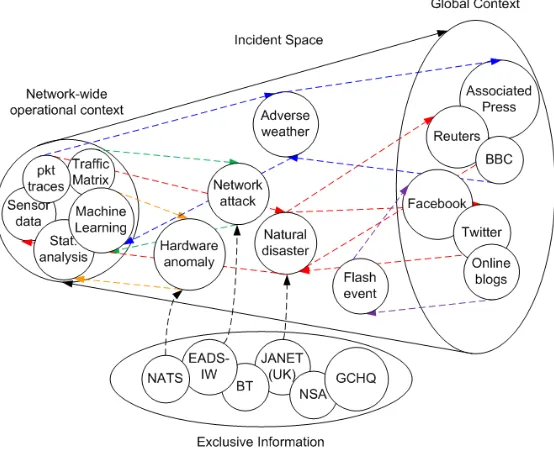
Fig. 1. TheSAI2 Framework
2
SAI
2Framework
The main hypothesis underpinning the development ofSAI2 is that the legacy static provisioning of networked infrastructures will not be sustainable; this is because it is content and context-agnostic, and therefore cannot adapt at the onset of adversarial events. This is particularly amplified when one considers the growing trend in co-locating critical and commodity services over converged ICT (e.g., Cloud) environments and the consequent centralisation that constitutes the actual and meta-cost of infrastructure failures and outages simply not affordable. Fig. 1 illustrates theSAI2 conceptual framework that enables the
composi-tion of situacomposi-tion awareness mechanisms from harnessing diverse data sources. In general, the main scientific and technical objectives behind this framework are:
– Development of new statistical techniques derived from machine learning, signal processing and information theory to profile normal network-wide be-haviour and detect incidents from aggregating diverse and distributed opera-tional data.
– Compose modelling methods that depend on content analysis in order to ad-equately map infrastructure-specific context.
– Construction of an an always-on, instrumentation and measurement infras-tructure.
– Development of network-wide situation-aware resilience mechanisms.
Based on the above objectives, the on-going activities inSAI2have identified
4 Angelos K. Marnerides et al.
and developed(e.g., [1, 2, 3, 7]). For the purpose of this paper we restrict ourselves to briefly describing two such studies in the following sections.
3 Arbitrary Packet Matching in Openflow for enabling
Situation Aware Applications
In its current form, OpenFlow [4], the de facto implementation of Software-Defined Networking (SDN), separates the networks control and data planes al-lowing a central controller to alter the match-action pipeline using a limited set of fields and actions. Even though SDN can in principle facilitate a programmable control plane capable of monitoring the network operation and of alerting the central controller at the onset of adversarial events, Openflow’s inherent rigidity prevents the rapid introduction of custom data plane functionality that would enable the design of high-speed, in-band packet processing modules for, e.g., custom routing, telemetry, debugging, and security.
We argue that packet matching should be designed independently of any (control) protocol implementation, and allow the control plane to specify the matching process through a set of platform-independent instructions designed to match packets at every layer (rather than protocol version-specific and in-flexible hard-coded match fields). Through such instruction set, the execution of the matching could be left as an implementation detail relying on software optimisations (such as Just In Time (JIT) compilation) or hardware acceleration using, e.g., FPGAs or ASICs.
0.672 12.224
0 5 10 15 20 25 30
512 1024 1536 2048 2560 3072 3584 4096
Time (
µ
s)
# BPF Instructions libpcap
[image:4.612.179.432.406.584.2]Linux JIT Linux
Fig. 2. Performance of different BPF engines
have defined a new OpenFlow eXtended Match field (OXM) to match packets using BPF at the switches [1]. We show that our proposed match scheme re-duces the number of flow entries, allows matching on fields and protocols not supported by current OpenFlow, and mitigates the use of the SDN controller for the classification of packets unmatchable by the switch. Using diverse pro-totype and compiler implementations on a software switch platform, we have demonstrated the feasibility of BPF matching for line-rate processing, as shown in Fig. 2. We have further developed example programs that can be executed as part of this BPF-based arbitrary packet matching engine that include network telemetry (e.g., real-time packet size and inter-arrival time distributions compu-tation), and lightweight (e.g., EWMA) anomaly detection that can form the basis (infrastructure-support) for natively resilient and self-managed networked envi-ronments. Such functionality is not possible using today’s SDN/Openflow tech-nology since packet matching rules are restricted to a protocol version-specific set, and do not allow for, e.g., arbitrary functionality, or even port range match-ing to be implemented.
4 Situation Awareness in the SmartGrid
A part of the activities within SAI2 has placed a strong emphasis on
compos-ing solutions for the adequate profilcompos-ing of power consumption in SmartGrids and further relating such measurements with diverse sources of information. In particular, we have developed and introduced short term power load forecasting schemes that rely on Deep Learning Neural Network models [8] and enable the correlation of power consumption with external data feeds such as weather con-ditions and basic human-oriented behavioral aspects (e.g. holidays, work hours etc.). Hence, it was possible to provide a deeper understanding on how, why and when the power load demand was distributed and in parallel how it will be distributed in immediate time periods (e.g. next day or next week forecast).
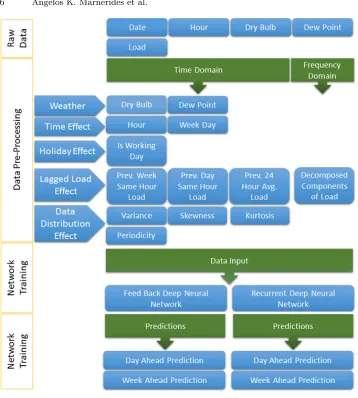
As already mentioned, we employ Deep Neural Network models and in partic-ular we exploit the principles of Feed-froward Deep Neural Networks (FF-DNN) and Recurrent Deep Neural Networks (R-DNN) in order to predict short term electricity load. Achieving higher accuracy in forecasts requires to include all the related features that affect the overall electricity consumption that go beyond the raw power measurements but also consider external data sources that can also provide an insight regarding the status (i.e. current state of a given situation) of the SmartGrid. We accomplish the latter by employing the methodology de-picted in Fig. 3 that considers power measurements as well as external datasets gathered by 6 US states in New England1.
The methodology depicted in Fig. 3 initially treats the gathered data on the time and frequency domain independently and subsequently frequency do-main components are transformed back to the time dodo-main. The resulted time-frequency (TF) features efficiently capture dominant effects i.e. weather, time,
1
6 Angelos K. Marnerides et al.
Fig. 3. Visual Description of Load Prediction Methodology
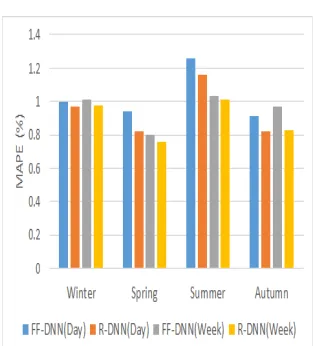
Fig. 4.MAPE error comparison using Time domain features.
Fig. 5. MAPE error comparison using joint Time-Frequency domain features.
Thus, they can be definitely considered for future situation aware mechanisms that ideally can be instrumented in modern SmartGrid control centres.
Apart from identifying the correlations between the non-power related fea-tures with the actual power consumption distribution, this study has also demon-strated the usefulness of considering a joint time-frequency (TF) representation of data features. In fact, we have compared the prediction errors in the scenario where strictly time domain features were used with the scenario where join TF features were used.
Fig. 4 and Fig. 4 present the comparison conducted between the prediction errors obtained when strictly using time domain features with those achieved with the use of TF data metafeatures of the original raw datasets. The com-parison was performed for predictions generated for the ”next day” and ”next week” power consumption from data sampled randomly in the various seasons (i.e. winter, autumn, spring and summer) of the year 2011 throughout all the 6 US states in New England, USA. As evidenced, the MAPE metric resulted to hold much smaller values in the scenario of using TF features rather than those obtained when time domain features were used. Thus, the prediction accuracy was much more improved.
[image:7.612.134.291.88.261.2]8 Angelos K. Marnerides et al.
the period. Overall, our generated outcomes reveal that the synergistic use of TF feature analysis with DNNs enables to obtain higher accuracy by capturing dominant factors that affect electricity consumption patterns and can surely contribute significantly in the context of situation awareness for the recently introduced SmartGrid.
5 Conclusions
Situation awareness is acknowledged as a critical property in which next gen-eration, mission-critical ICT environments are required to possess in order to confront the dynamic and unpredictable behaviour of their use as well as to maintain their overall resilience. In order to achieve situation awareness that will essentially offer societal and economical benefits, it is quite important to devise mechanisms that are not strictly dependent on the explicit properties of a given system but rather consider external and diverse sources of information. Therefore, in this paper we have briefly presented the main principles and some of the on-going activities conducted within theSAI2 project. We have introduced
theSAI2framework and initially described an SDN-based scheme that can aid
towards the dynamic deployment of applications that can serve situation aware-ness. In addition, we have presented a use case study that aims on strengthening situation awareness in the SmartGrid scenario by exploiting the regression ca-pabilities of Deep Neural Networks by harnessing diverse sources of information. We argue that the work reported herein can set concrete foundations towards the refinement of situation aware mechanisms and further establish a strong ba-sis for future design of resilience mechanisms for next generation mission-critical ICT systems.
Acknowledgments
The work has been supported in part by the UK Engineering and Physical Sci-ences Research Council (EPSRC) grants EP/N033957/1, EP/L026015/1, and EP/L005255/1. The authors are grateful to Simon Jouet, Long Chen, Noor Shi-razi, Steven Simpson and Ghulam Mohi Ud Din for their valuable input.
References
1. S. Jouet, R. Cziva, and D.P. Pezaros, “Arbitrary Packet Matching in OpenFlow”, 16th IEEE International Conference on High Performance Switching and Routing (IEEE HPSR), Budapest, Hungary, 1-4 Jul 2015.
3. M. A. M., Ariffin, A. K. Marnerides and A. U. Mauthe, “Multi-level Resilience in Networked Environments: Concepts & Principles”, to appear in IEEE CCNC 2017, Las Vegas, NV, USA, 2017
4. N. McKeown, T. Anderson, H. Balakrishnan, G. Parulkar, L. Peterson, J. Rexford, S. Shenker, and J. Turner, “OpenFlow: Enabling Innovation in Campus Networks”, ACM SIGCOMM, March 2008.
5. J. Sterbenz, D. Hutchison, E. Cetinkaya, A. Jabbar, J. Rohrer, M. Schoeller, P. Smith: “Redundancy, Diversity, and Connectivity to Achieve Multilevel Network Resilience, Survivability and Disruption Tolerance”, Journal Telecommunications Systems, vol. 56, no. 1, May 2014
6. A.K. Marnerides, A. Schaeffer-Filho, A. Mauthe, “Traffic anomaly diagnosis in In-ternet backbone networks: A survey”, Computer Networks, Volume 73, 14 Novem-ber 2014, Pages 224-243, ISSN 1389-1286,http://dx.doi.org/10.1016/j.comnet. 2014.08.007.
7. M. R. Watson, N. u. h. Shirazi, A. K. Marnerides, A. Mauthe and D. Hutchison, “Malware Detection in Cloud Computing Infrastructures,” in IEEE Transactions on Dependable and Secure Computing, vol. 13, no. 2, pp. 192-205, March-April 1 2016.
8. G. M. Ud Din, and A. K. Marnerides, ”Short Term Power Load Forecasting Using Deep Neural Networks”, to appear in IEEE International Conference on Computing, Networking and Communications (ICNC) 2017, Silicon Valley, USA, Jan. 2017 9. S. Fan and R. J. Hyndman, “Short-term load forecasting based on a semi-parametric