warwick.ac.uk/lib-publications
Original citation:Mj, Mahan and Series, Caroline. (2017) Limits of limit sets II : geometrically infinite groups. Geometry and Topology, 21 (2). pp. 647-692.
Permanent WRAP URL:
http://wrap.warwick.ac.uk/79495
Copyright and reuse:
The Warwick Research Archive Portal (WRAP) makes this work by researchers of the University of Warwick available open access under the following conditions. Copyright © and all moral rights to the version of the paper presented here belong to the individual author(s) and/or other copyright owners. To the extent reasonable and practicable the material made available in WRAP has been checked for eligibility before being made available.
Copies of full items can be used for personal research or study, educational, or not-for-profit purposes without prior permission or charge. Provided that the authors, title and full bibliographic details are credited, a hyperlink and/or URL is given for the original metadata page and the content is not changed in any way.
Publisher’s statement:
First published in Geometry and Topology in 21 (2). pp. 647-692 by Mathematical Sciences Publishers.
A note on versions:
The version presented in WRAP is the published version or, version of record, and may be cited as it appears here.
Limits of limit sets II:
Geometrically infinite groups
MAHANMJ CAROLINE SERIES
We show that for a strongly convergent sequence of purely loxodromic finitely generated Kleinian groups with incompressible ends, Cannon–Thurston maps, viewed as maps from a fixed base limit set to the Riemann sphere, converge uniformly. For algebraically convergent sequences, we show that there exist examples where even pointwise convergence of Cannon–Thurston maps fails.
30F40, 57M50
1 Introduction
Given an isomorphism between Kleinian groups, a Cannon–Thurston map is a contin-uous equivariant map between their limit sets. It is by no means obvious that such a map always exists; however, as the culmination of a long series of developments, it was shown by the first author[35]that given a weakly type-preserving (see below) isomorphism between any geometrically finite group and any Kleinian group G, a Cannon–Thurston map always exists.
This paper is the second of two dealing with convergence of Cannon–Thurston maps, or CT-maps, considered as a sequence of continuous maps from the limit set of a fixed ge-ometrically finite group to the sphere. The main questions addressed in both papers are:
(1) Does strong convergence of finitely generated Kleinian groups imply uniform convergence of CT-maps?
(2) Does algebraic convergence of finitely generated Kleinian groups imply pointwise convergence of CT-maps?
In the present paper, we study the situation in which the limit group is geometrically infinite. We show that, in the absence of parabolics and with incompressible ends, the answer to question (1) is always positive, but, in what is the most unexpected outcome of our investigations, we provide a counterexample to question (2) by exhibiting a sequence of geometrically finite groups converging algebraically but not strongly, for which the corresponding CT-maps fail to converge pointwise at a countable set of points. The class of limit groups in question are Brock’s partially degenerate examples[9], described in more detail below. Thus our second main result answers in the negative the second part of Thurston’s problem 14 in his seminal paper[41]. In these examples, both the algebraic and geometric limits of the Gn are geometrically infinite. We do not know whether there exist examples of nonconvergence in which the algebraic limit is geometrically finite but the geometric limit is not.
Recall that an isomorphism W !G between Kleinian groups isstrictly type pre-servingif. /2G is parabolic if and only if 2 is also parabolic; it isweakly type preservingif the image of any parabolic element is parabolic. Since CT-maps preserve fixed points, is easy to see that a necessary criterion for the existence of a CT-map ˆ
{W ƒ !ƒG between limit sets is that be weakly type preserving.
Our first main result, largely answering question (1), is:
Theorem A Let be a geometrically finite Kleinian group without parabolics which does not split as a free product. Let nW ! Gn be a sequence of strictly type-preserving isomorphisms to geometrically finite Kleinian groupsGn which converge strongly to a totally degenerate purely loxodromic Kleinian group G1D1./. Then
the sequence of CT-maps ˆ{nW ƒ!ƒGn converges uniformly toˆ{1W ƒ!ƒG1.
This result was proved by Miyachi[30] in the case in which is a surface group without parabolics and the injectivity radius is uniformly bounded below along the whole sequence. The condition that does not split as a free product is equivalent to requiring that all ends of the manifoldH3= are incompressible; see Bonahon[5].
Theorem A of[38], which is essentially the above result in the geometrically finite case, does not have any of the restrictions (absence of parabolics, not splitting as a free product, strictly type preserving, totally degenerate) imposed above. We introduce these restrictions largely because of technical issues concerning the model for the ends of the limit manifold H3=G1. With a bit more work, similar techniques to those used here can be used to prove the theorem in the general case; see[31]by the first author.
sets ƒGn converge in the Hausdorff metric to the limit set of thegeometriclimit in the Hausdorff metric; see[38]for further discussion. As far as we know, the question of pointwise convergence in this situation has not previously been addressed. In answer to question (2), we have:
Theorem B Let be a Fuchsian group for which H2= is a closed surface of genus at least 2. Then there exists a Kleinian group G1, together with an isomorphism
1W !G1D1./and a sequence of representationsnW !Gn to geometri-cally finite groups converging algebraigeometri-cally toG1, such that the sequence of CT-maps ˆ
{nW ƒ !ƒGn fails to converge pointwise to ˆ{1 at a countable set of points inƒ.
Implicit in the statement of Theorem A is the existence of the CT-map from ƒ to ƒG1. This result has a long history which we do not intend to repeat in detail here. The most general result, in which GDG1 is an arbitrary torsion free nonelementary Kleinian group, can be found in [35]. The restricted case, in which is a surface group and G is singly or doubly degenerate, is the main result of [36]by the first author; seeSection 4below. The original seminal case in which M DH3=G is the cyclic cover of a 3–manifold fibering over the circle with fibers a closed surface is of course due to Cannon and Thurston[14]; this was extended to the case in which G is a surface group with a lower bound on the lengths of loxodromics in Bowditch[6] and Mitra[29], or more generally whenM is an arbitrary hyperbolic manifold with incompressible boundary in[32]by the first author. The older history in the case in whichG is geometrically finite is discussed in[38].
In[38], we introduced general criteria for uniform and pointwise convergence of CT-maps, called UEPP and EPP respectively. These compare the geometry of the obvious embedding of the Cayley graph of the base group into H3, to the corresponding em-beddings for the groupsGn and G1. The main work in this paper consists in verifying
that these criteria hold (in the case ofTheorem A) or understanding why they do not (in the case ofTheorem B). After slightly reformulating the condition UEPP, we see that for the case of strictly type-preserving maps of surface groups, the needed condition has essentially already been proved in[36]. In order to explain this, we give inSection 4.2 a brief outline of the relevant parts of the arguments in[36]. For the benefit of readers who have not gone through all of this previous work, which in turn depends heavily on the Minsky model of degenerate Kleinian groups, we preface this by briefly sketching inSection 4.1how the argument goes in the case of groups of bounded geometry, thus reproving Miyachi’s theorem [30]. Our proof in this case follows easily using the method explained by Mitra[29]and the first author[34], and is independent of[36].
inTheorem Barises from Brock’s examples of a sequence of quasi-Fuchsian groups Gn converging algebraically but not strongly to a partially degenerate group G1. More precisely, we prove the following, which immediately impliesTheorem B:
Theorem C Fix a closed hyperbolizable surfaceS, together with a separating simple closed curve dividingS into two piecesL andR. Let˛ denote an automorphism ofS such that˛jL is the identity and ˛jRDis a pseudo-Anosov diffeomorphism of R fixing the boundary . Let X be a hyperbolic structure on S and let Gn be the quasi-Fuchsian group given by the simultaneous uniformization of .˛n.X/;X/. Let G1 denote the algebraic limit of the sequence Gn, suitably normalized by a basepoint in the lift of the lower boundary ofX. Let ˆ{nWƒG0!ƒGn,n2N[ 1, be the corresponding CT-maps and let 2ƒG0. Then{ˆn./ converges to ˆ{1./ if and only if is not the endpoint of the lift toH2 of a boundary leaf, other than, of the crown domain of the unstable lamination of, viewed as a lamination on the surfaceR.
An alternate direct proof ofTheorem Busing the interplay of algebraic and geometric limits was provided by the anonymous referee. We incorporate this inSection 5.4. The reader interested primarily in the counterexample given byTheorem Bcan go directly toSection 5.4if (s)he is familiar with Brock’s example.
The outline of the paper is as follows. InSection 2, we set up background and notation, in particular reviewing briefly what we need from the theory of hyperbolic spaces and electric geometry inSection 2.6. These techniques are central in[36]and are also used here in the discussion ofTheorem C.
In Section 3, we recall results from[38] on Cannon–Thurston maps; in particular, we explain our convergence criterion UEPP. InSection 4, we prove Theorem A. As discussed above, we first give a brief discussion of a proof in the case of bounded geometry, that is, when the injectivity radius of all manifolds in the sequence is uniformly bounded below. This is essentially Miyachi’s theorem referred to above. We then turn to the general situation, outlining as we go the relevant steps in the proof for a single CT-map as in[36]. Finally inSection 5, we explain the counterexamples to pointwise convergence, explaining the Brock examples and then provingTheorem C. We note that these examples only require the bounded geometry case ofTheorem A.
Acknowledgments This work was done in part while Mj was visiting Université Paris-Sud XI under the Indo-French collaborative programme ARCUS. He gratefully acknowledges their support and hospitality. We also thank the referee for providing the direct alternate route toTheorem Bdescribed above.
2 Background
2.1 Kleinian groups
AKleinian group G is a discrete subgroup of PSL2.C/. As such it acts as a properly discontinuous group of isometries of hyperbolic 3–space H3, whose boundary we identify with the Riemann sphereCy DC[ 1. As in[38], all groups in this paper will be finitely generated and torsion free, so that M DH3=G is a hyperbolic 3–manifold. Thelimit set ƒG yC is the set of accumulation points of any G–orbit.
A Kleinian group isgeometrically finiteif it has a fundamental polyhedron in H3 with finitely many faces; a group which is not geometrically finite is also calleddegenerate. The point of this paper is to investigate the extension of[38]to the degenerate case. We say a group istotally degenerateif it is not geometrically finite and ƒGD yC. The structure of degenerate groups has recently been elucidated by the work of Minsky et al. [28;10]on the ending lamination theorem and the tameness theorem of Agol[1] and Calegari and Gabai[11]. This paper rests heavily on these results.
A Kleinian groupG is asurface group, if there is a hyperbolic surfaceS, together with a discrete faithful isomorphism W 1.S/!G. The corresponding manifold H3=G is homeomorphic to SR; see[5]. It is singly or doubly degenerate according as one or both of its ends are geometrically infinite with filling ending laminations.
2.2 Balls and geodesics
We will be working in hyperbolic space Hn for nD2;3. We denote the hyperbolic metric on Hn by dH or occasionally dHn; sometimes we explicitly use the ball model B with center O and denote by dE the Euclidean metric on B[ yC. For
P 2 Hn, write B.PIR/, or when needed BH.PIR/ or even BHn.PIR/, for the hyperbolic ball center P and radius R. Let ˇ be a path in Hn with endpoints X and Y. We writeŒˇ or ŒX;Y for theHn–geodesic from X toY.
2.3 The Cayley graph
Choose a basepoint OG2H3 which is not a fixed point of any element of G. One may if desired assume the basepoint is the center O of the ball model B as above. For simplicity, we do this throughout the paper unless indicated otherwise. ThenGG is immersed in H3 by the mapjG which sends g2G tojG.g/DgO and which sends the edge joining g and g0 to the H3–geodesic joining jG.g/ and jG.g0/. In particular, jG.1/DO. Note that using the ball model ofH3, the limit set ƒG may be regarded as the completion of jG.GG/ in the Euclidean metric dE on B[ yC.
2.4 Algebraic and geometric convergence
Let be a geometrically finite Kleinian group. A sequence of group isomorphisms
nW !PSL2.C/;nD1;2; : : : is said to converge to the representation 1W !
PSL2.C/ algebraicallyifn.g/!1.g/, for eachg2, as elements of PSL2.C/. The representations convergegeometricallyif .GnDn.G// converges as a sequence of closed subsets of PSL2.C/ to GgPSL2.C/. Then Gg is a Kleinian group called the geometric limit of .Gn/. The sequence .n/ converges strongly to 1.G/ if
1.G/DGg and the convergence is both geometric and algebraic. If a sequence of groups converge algebraically, they have a geometrically convergent subsequence; see [22, Theorem 4.4.3].
Alternatively, following Thurston[40](see also[12, Chapter 3], for example) we say that a sequence of manifolds with base-frames .Mn; !n/ convergesgeometrically (or in the C1–Gromov–Hausdorff topology) to a manifold with base-frame .M1; !1/ if for each compact submanifold C M1 containing the base-frame !1, there are smooth embeddings nWC !Mn (for all sufficiently large n) which map base-frame to base-frame and such that nconverges to an isometry in theC1–topology. Kleinian groups Gn are said to converge geometricallyto G1 if the corresponding framed
manifolds .Mn DH3=Gn; !n/ converge geometrically to .M1 DH3=G1; !1/,
where the base-frames!n; !1 are all the projection of a fixed base-frame inH3. The
sequence..Mn; !n// convergesstronglyto.M1; !/if the convergence is geometric
and in addition the convergence of .n/ to1 is algebraic. We remark that changing
the basepoints in the above discussion may result in a different geometric limit.
The relation between these definitions is the following. Fix once and for all a standard base-frame in H3, with basepoint at the origin O in the ball model of hyper-bolic 3–space. Given a framed manifold .M; !/, there is a unique developing map
.M;!/z !H3 (where M is the universal cover of M) which sends a fixed lift !z
that convergence of manifolds in the sense of Thurston is equivalent to geometric convergence in the first sense defined above; see, for example,[22, Chapter 4]or[21, Theorem 8.11]. In particular, the map nW C !Mn is the projection to the quotient manifolds of a bi-Lipschitz embedding znW B.OIR/!H3where B.OIR/H3 is a large ball whose projection to H3=G1 containsC; see, for example,[3, Lemma 9.6].
2.5 Scott cores
Recall that a Scott core of a 3–manifoldV is a compact connected3–submanifoldKV such that the inclusion KV ,!V induces an isomorphism on fundamental groups. The Scott core is unique up to isotopy [23]. Note that in general, the Scott core may be much smaller than the convex core, even when the group is convex cocompact. We shall need the following relationship between the Scott core and the ends of V.
Lemma 2.1 [5, Proposition 1.3; 21, Theorem 4.126] Let KV be a Scott core of a 3–manifold V. There is a bijective correspondence between the ends of V and boundary components ofVnKV. Hence each component of@KV bounds a noncompact component of V nKV, and each of these components is an end of V.
Let nW !PSL2.C/ be a sequence of representations converging strongly to1.
Fixing the base-frames as the projections !n of the frame in H3 to MnDH3=Gn, n2 N[ 1, we obtain a corresponding sequence of framed hyperbolic manifolds
.Mn; !n/ converging geometrically toM1DH3=G1. Set N DH3= and letKN be a Scott core of N, chosen such that the base-frame !N for N has basepoint oN 2KN. The representations n induce homotopy equivalences nW KN !Mn. We can lift n to maps znW zKN !Mn for n2N[ 1 and note that by our choices thatzn.!zN/ converges to z1.!zN/.
In general the homotopy equivalences n may not be homeomorphisms. However in the situation of strong convergence, the proof of[13, Proposition 3.3]or[3, Lemma 9.7] (see also Lemma 3.6 and the first part of the proof of Theorem A in[4]) gives:
We remark that the hypotheses in[13]and[3]that all groups be purely hyperbolic, or indeed that the convergence be strictly type preserving, are not needed for this lemma. Also note that as remarked above, in general n.K/ may be much smaller than the convex core of Mn. If the convergence is not strong,Lemma 2.2may fail even when the limit group is geometrically finite, as is shown by the well-known Anderson–Canary examples[2].
Lemma 2.2shows that, in the situation of strong convergence, we may take the homotopy equivalences n to be homeomorphisms between Scott cores of the relevant groups. It also allows us to identify the ends ofM1 with the ends of the approximating groups. We have:
Corollary 2.3 Let be a geometrically finite group and let n be a sequence of dis-crete faithful representations of converging strongly to1. Then, up to replacing by the group Gn0 for some n02N, we can pick a Scott core K ofH
3= such that
there are bi-Lipschitz embeddings nW K!H3=Gn which inducen, and such that
n.K/ is a Scott core of Mn for n2N[ 1. Moreover, suppose that E is an end of M1 and thatU is the component ofM1n1.K/ which is a neighborhood ofE.
Let F D@U, and letUn be the component ofMnnn.K/ bounded by n11.F/. ThenUnis a neighborhood of an endEn ofMn, and we say thatUncorrespondsto E.
Proof Set KD1.K/. Take n0 large enough that the conclusion of Lemma 2.2 applies. Replacing N DH3= byMn0, by Gn0 and n by 0nDnn01, we have a sequence of representations as before. The core of Mn0 can be taken to be n0.K/. Noting that n0 is induced by n n01W n0.K/!Mn, we can replace the homotopy equivalences nW KN !Mn by the homeomorphisms n n01W n0.K/ ! n.K/ between the cores of Mn0 andMn, n>n0. These converge to the homeomorphism
1
n0W n0.K/ ! K. In other words, we may as well assume that the homotopy equivalences n are actually embeddings of the coreKN ofN into Mn andM1.
The idea of the final statement follows[13, Section 8]. That Un is a neighborhood of an endEn ofMn follows fromLemma 2.1.
2.6 Relative hyperbolicity and electric geometry
We summarize the facts we need on relative hyperbolicity and electric geometry. For further details, we refer the reader to[18;7]; see also[33, Section 3].
is preferable they have diameter 1 (or 2). Precisely, let XelDXSH2H.HŒ0;1/
with H f0gidentified toH X. We define the electric (pseudo)metricdel on Xel
as follows. First equip HŒ0;1 with the product metric and then modify this to a pseudometric by quotienting so that H f1g is equipped with the zero metric. The metric on HŒ0;1 is the path metric induced by horizontal and vertical paths. This means that in the space .Xel;del/, any two points inH are at distance at most 2.
Definition 2.4 [18; 7] Let X be a metric space and H a collection of mutually disjoint subsets. IfXel is also a hyperbolic metric space, then X is said to beweakly hyperbolicrelative to the collectionH.
The collection H is said to beuniformly separated if there exists C >0 such that d.Hi;Hj/C for allHi¤Hj 2H. It isuniformly quasiconvexif there existsC >0 such that if for anyH 2H and for any pointsx;x02H, any geodesic joining them lies within the C–neighborhood ofH. It ismutually coboundedif there exists C >0 such that for allHi¤Hj 2H, i.Hj/ has diameter less than C, wherei denotes a nearest point projection of X ontoHi.
Lemma 2.5 [7;18, Proposition 4.6] Let X be a hyperbolic metric space andH a collection of uniformly quasiconvex mutually cobounded uniformly separated subsets. ThenX is weakly hyperbolic relative to the collection H.
A typical example is whenX is hyperbolic space H3 andH is the collection of lifts to H3 of the thin parts of a hyperbolic 3–manifold.
Following Farb, we need to understand some finer details of the relationship between geodesics in X and in Xel. Recall that a K–quasigeodesicin a metric space Y is
a K–quasi-isometric embedding of an interval into Y, that is, a map fWŒa;b!Y such that
1
Kjt1 t2j K dY.f .t1/;f .t2// Kjt1 t2j CK
for all t1;t22Œa;b. Aquasigeodesicis a path inY which is a K–quasigeodesic for some K>0. If X and H give rise to an electric space .Xel;del/, then an electric (quasi)geodesicinX is a path inX which is a (quasi)geodesic for the electric metricdel.
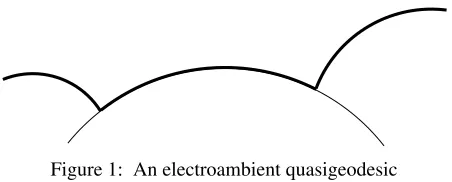
We say that a pathdoes not backtrackif it does not reenter any H2H after leaving it. Suppose that is an electric quasigeodesic in .Xel;del/ without backtracking and with endpoints a;b2XnH. Keeping the endpointsa andb fixed, replace each maximal subsegment of lying within someH2Hby a hyperbolicX–geodesic with the same endpoints. The resulting connected path is called an electroambient quasigeodesic
Figure 1: An electroambient quasigeodesic
Lemma 2.6 [33, Lemma 3.7] Let X be a hyperbolic metric space and let H be a collection of mutually cobounded uniformly separated uniformly quasiconvex sets. Let be an electroambient quasigeodesic with endpointsa;b2XnH. Then is a quasigeodesic inX and lies within bounded distance of anyX–geodesic with the same endpoints.
In the case in which X is hyperbolic spaceH3 andH is the collection of lifts to H3 of the thin parts of a hyperbolic 3–manifold, the proof ofLemma 2.6is straightforward and was done from first principles in[38, Lemmas 7.15 and 7.16].
Remark 2.7 One can introduce a further property of a metric space X beingstrongly hyperbolicrelative to a collectionH; see[33, Section 3]and also[7]. This condition concerns how paths penetrate the sets in H. If X is itself aı–hyperbolic space, then the conditions that the sets in H be mutually cobounded, uniformly separated and uniformly quasiconvex are enough to imply thatX is strongly hyperbolic relative toH; see[18, Section 4]and[33, Section 3]. Since all that we needed here is the result of Lemma 2.6, we do not digress to give the precise definition here.
3 Cannon–Thurston maps and convergence criteria
Let be a Kleinian group and letW!PSL2.C/ with./DG. Letƒ and ƒG be the corresponding limit sets. A Cannon–Thurston or CT-map is an equivariant continuous map ˆ{W ƒ !ƒG, that is, a map such that
ˆ
{.g/D.g/{ˆ./ for allg2; 2ƒ:
Recall fromSection 2.3the natural embedding j of the Cayley graph ofG into H3. The CT-map ˆ{D{ˆ./ can also be defined as the continuous extension to ƒ@H3 of the obvious map iW j.G/!H3 defined byi.j.g//D.g/O.
any liftingzW zKN!M, since any fixed orbit of the action ofGon.z KzN/can serve as
a substitute for the orbit of the basepointO. Notice however that the careful discussion inSection 2.4is needed to fix basepoints if we are dealing with a sequences of groups.
In[38], we reproved Floyd’s results[20]on the existence of CT-maps for geometrically finite groups:
Theorem 3.1 [38, Theorem 4.2] Let andG be finitely generated geometrically finite groups and let W !G be a weakly type-preserving isomorphism. Then the CT-mapˆ{W ƒ !ƒG exists.
Note that the examples in [2] show that there exist geometrically finite noncusped manifolds which are homotopic but not homeomorphic; see also Lemma 2.2. We deduce from the above that the CT-map between their limit sets nonetheless exists and is a homeomorphism.
3.1 Criteria for convergence
We now collect some criteria for the existence and convergence of CT-maps from[38].
Theorem 3.2 [38, Theorem 4.1] Let W !G be a weakly type-preserving isomor-phism of finitely generated Kleinian groups and suppose that is geometrically finite. The CT-map ƒ!ƒG exists if and only if there exists a functionfW N!N such that f .N/! 1 as N ! 1, and such that whenever is a d–geodesic segment lying outsideB.1IN/in G, theH3–geodesic joining the endpoints ofi.j.//lies outside BH.OIf .N// inH3.
In[36], the criterion was used in an alternative form which involves geodesics inH3for the domain group also. Recall that a geometrically finite group is convex cocompact if its convex core is compact. In this case we can take the Scott core to be the convex core.
Theorem 3.3 Let W !G be a strictly type-preserving isomorphism of finitely generated Kleinian groups, and suppose that is convex cocompact. Suppose thatKN is the convex core ofNDH3= and thatW KN!H3=G is a homotopy equivalence. Then the CT-mapƒ!ƒG exists if and only if there exists a nonnegative function
Note that to make a sensible statement here we need to insist that, in addition to being compact, the core KN ofN should also be convex. If is a Fuchsian group corresponding to a closed surface, the main case in[36], then this is not an issue.
If is convex cocompact, then to compare geodesics inG and H3, one can use that anyd–geodesic inG is a quasigeodesic inH3; see, for example,[38, Corollary 3.8]. Moreover, any geodesic in H3 can be tracked at bounded distance by a path which is geodesic inG (with bound depending only on); see[38, Lemma 3.6]. This shows the equivalence of the criteria in Theorems3.2and3.3in this case.
Remark 3.4 If is not convex cocompact then the comparison between geodesics in G and H3 is not quite straightforward since a geodesic path in G can track round the boundary of a horosphere. This can be dealt with but requires more care. In Theorem Aof this paper, is always convex cocompact, and in any case, we shall mainly stick to the first version of the criterion.
Now let be a fixed geometrically finite Kleinian group and suppose that nW ! PSL2.C/ is a sequence of discrete faithful weakly type-preserving representations converging algebraically to 1W !PSL2.C/. Let Gn Dn./;n2N[ 1 and writeƒn forƒGn. To normalize, we embed all the Cayley graphs with the same base-pointODOGn for allnand setjn.g/Dn.g/O,g2G. DefineinW j.G/!H
3
byin.j.g//7!n.g/O,g2G, so that theCT-map ˆ{nW ƒ!ƒn is the continuous extension of in to ƒ. Assuming they exist, we say that theCT-maps ˆ{nW ƒ!ƒn converge uniformly (resp. pointwise) to ˆ{1 if they do so as maps from ƒ to Cy. If is anyd–geodesic segment inG with endpoints; 02, then we also writeŒj./ for theH3–geodesic Œj. /;j.0/.
In[38]we introduced two properties UEP (uniform embedding of points) and UEPP (uniform embedding of pairs of points) of the sequence.n/. The first was shown in [38]to be equivalent to strong convergence, and the second is our criterion for uniform convergence of CT-maps. We summarize these definitions and results here.
Definition 3.5 Let nW !Gn be a sequence of weakly type-preserving isomor-phisms of Kleinian groups. Then .n/ is said to satisfy UEP if there exists a nonneg-ative function fW N !N, with f .N/! 1 as N ! 1, such that for all g 2, d.1;g/N impliesdH.n.g/O;O/f .N/for all n2N.
Definition 3.6 Let nW !Gn be a sequence of weakly type-preserving isomor-phisms of Kleinian groups. Then .n/ satisfies UEPP if there exists a function
f0W N ! N such that f0.N/ ! 1 as N ! 1, and such that whenever is a
Proposition 3.7 [38, Proposition 5.3] Suppose that a sequence of discrete faithful weakly type-preserving representations.nW !PSL2.C// converges algebraically to1. Then .n/ converges strongly if and only if it satisfies UEP.
Theorem 3.8 [38, Theorem 5.7] Let be a geometrically finite Kleinian group, and let nW !Gn be weakly type-preserving isomorphisms to Kleinian groups. Suppose thatn converges algebraically to a representation1. If.n/satisfies UEPP, then the CT-mapsˆ{nW ƒ!ƒn converge uniformly to{ˆ1. If is nonelementary, the converse
also holds.
Inverting the function f0 in the definition of UEPP gives a slight modification of the criterion inTheorem 3.8convenient to our purposes. Note that in the statement which follows, we do not need to assume that f1.N/! 1 asN ! 1.
Corollary 3.9 Let be a geometrically finite Kleinian group and letnW !Gn be weakly type-preserving isomorphisms to Kleinian groups. Suppose that n converges algebraically to a representation1 and that there exists a function f1W N!N such that for anyL2N, wheneveris ad–geodesic segment lying outsideB.1If1.L// in G, the H3–geodesic Œjn./ lies outside BH.OIL/ for all n2 N. Then the CT-maps{ˆnW ƒ !ƒn converge uniformly toˆ{1.
Proof In view ofTheorem 3.8, it is enough to see the given condition implies UEPP. We do this by inverting the function f1. Precisely, say L0>L. If is a d–geodesic segment lying outside B.1If1.L0// in G, the H3–geodesic Œjn./ lies outside BH.OIL0/and hence certainly outsideBH.OIL/. Thus we may modifyf1 if needed so thatf1.L0/ > f1.L/. Hence without loss of generality using an inductive argument we may assume that f1 is strictly increasing, so that in particular f1.N/ ! 1 as n! 1.
Now, given N 2N, definef0.N/DL, where L is the unique positive integer such that N 2Œf1.L/; f1.LC1//. Note that with this definition,f0.N/! 1 as N! 1.
Suppose given N and that f0.N/ DL. We are given that whenever is a d– geodesic segment lying outside B.1If1.L// in G, the H3–geodesic Œjn./ lies outside BH.OIL/ for all n2N. Thus whenever is a d–geodesic segment lying outsideB.1IN/in G, it also lies outsideB.1If1.L//and hence theH3–geodesic
Œjn./ lies outside BH.OIL/DBH.OIf0.N// for all n2N. This is exactly the condition UEPP.
Corollary 3.10 Let be a geometrically finite Kleinian group and let W !G be a weakly type-preserving isomorphism to a nonelementary Kleinian group G for which a CT-map exists. Then there exists a function f1WN !N such that for any L2N, wheneveris a d–geodesic segment lying outsideB.1If1.L//in G, the H3–geodesicŒj./ lies outsideBH.OIL/.
4 Strong convergence
In this section, we proveTheorem A. To set the scene, we begin with a brief discussion in the case of strong convergence and bounded geometry, that is, when the injectivity radii of all manifolds in the sequence are uniformly bounded below. We then turn to the general situation ofTheorem A, outlining as we go the relevant steps in the proof for a single CT-map as in[36].
4.1 The bounded geometry case
In this section, which is not necessary for the general result, we illustrate how to use the criteria ofSection 3to proveTheorem Ain the case of a singly or doubly degenerate surface group with bounded geometry. This is essentially Miyachi’s result[30]. The brief sketch below is a reprise of the first author’s original arguments in[29;34]. This sketch may also be useful to clarify the flow of the arguments from[36]which are the basis of our proof ofTheorem A.
Recall that if M is a hyperbolic3–manifold, theinjectivity radius r.MIx/ of M at x 2M is 12r, where r is the length of the shortest loop based at x. The manifold is said to havebounded geometryif there exists a>0 such that r.MIx/afor all x2M; in this case, theinjectivity radiusofM is infx2M r.M;x/.
Theorem 4.1 Let be a Fuchsian group such that H2= is a closed hyperbolic surface. Let nW !Gn be a sequence of strictly type-preserving isomorphisms to geometrically finite groupsGn which converge strongly to a singly or doubly degenerate surface group G1D1./. Suppose moreover that the injectivity radii of Mn are uniformly bounded below by some a> 0 for n 2N[ 1. Then the sequence of CT-maps{ˆnW ƒ !ƒGn converges uniformly to{ˆ1W ƒ !ƒG1.
Proof It is sufficient to show that the sequence .n/ satisfies UEPP. That is, we have to show that there exists a function f0W N!N such that f0.N/! 1as N ! 1 and such that whenever is ad–geodesic segment lying outside B.1IN/ in G, the H3–geodesic Œjn./ lies outside BH.OIf0.N//for all n2N.
as N ! 1, and such that whenever is a d–geodesic segment lying outside B.1IN/ in G, theH3–geodesic joining the endpoints of i1.j.//lies outside BH.OGIf .N// in H3. What we have to do is to show that the same function f works uniformly for the representations n for all sufficiently largen.
Finding the function f in[29]was based on the following construction. For simplicity, suppose that G1 is doubly degenerate; the singly degenerate case is similar. Let S be a topological surface homeomorphic to H2= . By results of Minsky[25;26], one can pick a sequence of pleated surface maps S !SnM1DH3=G1, n2Z such that
the distance between Sn and SnC1 is uniformly bounded above and below, and such that, with respect to the induced hyperbolic metrics on the Sn, there are uniformly bounded quasi-isometries Sn !SnC1. One deduces that the universal cover M1
of M1 is quasi-isometric to a “tree” of Gromov hyperbolic metric spaces. This is a Gromov hyperbolic space X equipped with a map P onto a simplicial treeT , which, in the case of a doubly degenerate surface group, can be taken to be the tree whose vertices are the integers, with a unit length edge joiningnto nC1,n2Z. The inverse image of each vertex is itself a Gromov hyperbolic space; these spaces are uniformly properly embedded into X. Moreover, for each pair of adjacent vertices v and v0, there is a quasi-isometry between the spaces P 1.v/andP 1.v0/, again assumed to have quasi-isometry constants uniform over vertices v.
In the present case, each space P 1.n/ is quasi-isometric to the universal cover ofSn. In particular the map PW P 1.0/!X should be thought of as the lift to universal covers of the map S0!M1. Since S0DH2= is by assumption a closed surface, its universal cover is quasi-isometric to the Cayley graph of . If we assume that the liftO2H2 of the basepointo2S0 maps to the lifted basepoint O2H3DM1, then
we can replace a geodesic as in the statement of the theorem with a geodesic in the hyperbolic space P 1.0/; see the comments followingTheorem 3.3.
We have to comparewith the hyperbolic geodesicŒinMDH3joining its endpoints.
The key idea is to construct a “ladder”LX by flowing up the levels inX using the quasi-isometries between the levels; see[29]for details. By constructing a coarse Lipschitz projection from X to L, it is shown that L is uniformly quasiconvex inX. That is, there exists k >0 such that any X–geodesic with ends in L lies within distance k ofL. A short argument given in the proof of[29, Theorem 3.10]shows that this is sufficient to construct the required function f for the manifold M. This function f depends on the quasi-isometry betweenM and X, and it is not hard
The problem with directly extending this proof to the situation of unbounded geometry, is that it requires a ladder and projection whose constants depend on the injectivity radius of the whole end. This is clearly not possible in the case of unbounded geometry. However we note that the same methods can be extended to the case of a surface with punctures; see[34, Section 5.5]. (Essentially, this uses similar arguments about crossing horoballs to those in[38].) This gives the following result, which we use in the proof ofProposition 5.12inSection 5.
Theorem 4.2 Let be a Fuchsian group such thatH2= is a finite-area hyperbolic surface. Let nW ! Gn be a sequence of strictly type-preserving isomorphisms to geometrically finite groups Gn which converge strongly to a singly or doubly degenerate surface group G1D1./. Suppose moreover that the injectivity radii
of Mn outside cusps are uniformly bounded below for nD1;2; : : : ;1. Then the sequence of CT-maps ˆ{nWƒ !ƒGn converges uniformly to{ˆ1W ƒ!ƒG1.
4.2 Unbounded geometry
Our proof of Theorem Ais based on the method in[36], which effectively verifies the condition of Theorem 3.2 for a single group. To show that UEPP holds for a sequence converging strongly to such a limit, we need to examine the argument carefully to understand the dependence of the constants on the limit group. We simplify by explaining the first part of the proof in the case of surface groups, discussing extensions to general manifolds with incompressible boundary later.
The proof ofTheorem Afollows very closely that of the main result of[36], which can be roughly stated as:
Theorem 4.3 [36, Theorem 7.1] Cannon–Thurston maps exist for simply or doubly degenerate surface Kleinian groups without cusps.
The actual result on which we base the proof ofTheorem Ais[36, Corollary 6.13], which we restate in an equivalent formulation asLemma 4.8 below. To give more insight into what is involved, we begin by sketching the relevant parts of the proof of Theorem 4.3. For this, we first require a brief digression on split geometry as introduced in [36], which we do in Section 4.2.1. In Section 4.2.2, we sketch the proof ofTheorem 4.3. InSection 4.2.3, we explain the main technical result we use, Corollary 4.11. Finally, inSection 4.2.4, we proveTheorem A.
is homeomorphic toSŒ0;1, split by annuli round Margulis tubes corresponding to short curves.
Asplit subsurface Ss of a hyperbolic surface S is a (possibly disconnected) proper subsurface with boundary, whose components are all essential and nonannular, and whose complement in S is a nonempty family of nonhomotopic annuli which are k–neighborhoods of nonperipheral geodesics on S. Moreover Ss is required to have bounded geometry, in the sense that there exists some universal 0>0 such that each boundary component of Ss is of length 0.
Asplit block Bs BDSŒ0;1 is a topological product SsŒ0;1 for some split subsurface Ss of S, with the qualification that its upper and lower boundaries are only required to be split subsurfaces of Ss. Split blocks are glued along their boundaries to build up model manifolds in the spirit of[28]. Asplit componentis a connected component of a split block; see the discussion following[36, Definition 4.11].
Suppose M is a model manifold obtained by gluing finitely or infinitely many split blocks along their boundaries. Section 4.3 in[36]introduces a so-calledgraph metric
dgraph on the universal coverM. (This metric is denoted dG in[36]; the notation here is used to distinguish it from the word metric on the Cayley graph.) Roughly speaking, dgraph is obtained by first electrocuting the lifts of Margulis tubes in each split block,
and then by electrocuting the lifts of connected components of each split block. A (Gromov) hyperbolic manifold is said to be ofsplit geometry(see[36, Definition 4.31]) if each split component is quasiconvex (not necessarily uniformly) in the hyperbolic metric on M and if in addition, the hyperbolic convex hull of the universal cover of
any split component has uniformly bounded diameter in the graph metric dgraph. This
uniform bound is called thegraph quasiconvexity constantand plays a crucial role in the discussion.
Given a singly or doubly degenerate hyperbolic manifoldM whose fundamental group is a surface group, a large part of the work in[36]is to construct a model manifoldMof split geometry whose universal cover M is bi-Lipschitz homeomorphic to the universal
cover M of M. The model M is made by consistently gluing finitely or infinitely
many split blocks Bi so that Bi 1 is glued toBi along their common boundary split surfaceSi. The existence of the sequence of split level surfaces and split blocks exiting the end is a consequence of the Minsky model[28]for a degenerate end. The detailed construction is intricate and involves a careful selection of the split level surfaces using the Minsky hierarchy; see[36], especially Sections 3 and 4, for details.
The part of this result which assertsuniformgraph quasiconvexity of the blocks is[36, Proposition 4.23]. We note the point, key for our purposes here, that the graph quasi-convexity constant is a combinatorial quantity which depends only on the topological convexity of the surface defining the end, and is thus also uniform across all degenerate ends of any hyperbolic manifold defined by the same topological surface S.
4.2.2 Rough sketch of Theorem 4.3 Let S D H2= be a compact hyperbolic surface and let W !G be a type-preserving isomorphism to a singly or doubly degenerate surface group G. The criterion used in [36]to prove the existence of a CT-map for is that given inTheorem 3.2, but it will be convenient for our purposes to use the alternative formulation of Corollary 3.10. In view of Theorem 4.4, we may work either withM DH3=G, or with a quasi-isometric model manifold of split geometry M. Lifting to universal covers, we obtain an identification of the universal cover M of Mwith H3, and in particular, we can identify a basepoint O2H3 with
a point, also denotedO, in M.
Here is the statement we need:
Proposition 4.5 LetGbe a totally degenerate surface group corresponding to a strictly type-preserving representation W 1.S/!G where S is a closed surface as above, and let Mbe a model manifold of split geometry corresponding to M DH3=G. Let B0S0Œ0;1be a fixed base block, and let W S !M be the embedding which identifiesS withS0f0g B0. Fix a basepointO2 zS in the universal coverSzDH2. Denote byz the lift of such that.z O/is the basepointO2H3DM.
Then for any L 2 N, there exists f .L/2 N such that whenever is a geodesic segment in .Sz;dS/lying outside an f .L/–ball aroundO2 zS (wheredS is the lifted hyperbolic metric onSz), the hyperbolic geodesicŒ./z inM joining the endpoints
of./z lies outside the L–ball around O2M.
Proposition 4.5follows from[36, Lemma 6.12], which is restated asLemma 4.8below. Theorem 4.3follows immediately fromProposition 4.5on applyingCorollary 3.10. The condition that G1 be totally degenerate is introduced simply to avoid the annoyance of having to deal with geometrically finite ends.
Remark 4.6 We refer to the discussion inSection 3for the equivalence of the condition as stated here with the condition on geodesics in the Cayley graph G.
welded split blocksin which the ends of the Margulis tubes deleted in the split blocksBi are reglued. Gluing the welded split blocks along their boundaries gives awelded model manifold Mwel homeomorphic to SRor SŒ0;1/according as M is doubly or singly degenerate; see[36, Section 4.3]for details. For simplicity, we will ignore this distinction in the discussion below.
The essence ofProposition 4.5is contained inLemma 4.8below, whose proof occupies [36, Sections 5 and 6]. As in the bounded geometry case, the first step is to use (or more precisely, the image ./z of in M) to construct a “ladder” L by “flowing
up” through the blocks ofM. By constructing a coarse retraction ontoL, it is shown
[36, Corollary 5.8]to be quasiconvex in the graph metricdgraph. The constants here
are independent not only of , but also of the particular modelM, depending in fact only on the topological type of the surface S. Starting from , this allows one to construct an “admissible” path joining the endpoints of which follows the levels L and which, after a controlled sequence of alterations using a succession of different metrics, is ultimately modified into an electroambient quasigeodesic in .M;dCH/
joining the endpoints of . HeredCH is the metric onM obtained by electrocuting the
hyperbolic convex hulls CH.Kz/ of the extended split componentsKz of M. (Recall
that an electroambient quasigeodesic in .M;dCH/ is an electric quasigeodesic whose
intersection with each electrocuted component is geodesic in the hyperbolic (or model) metric; seeSection 2.6.) This finally leads to the following key statement, which we once again formulate in the modified form appropriate toCorollary 3.10:
Lemma 4.8 [36, Lemma 6.12] Let M be a model manifold of split geometry and without cusps for a fixed compact hyperbolizable surface S. Let B0 S0Œ0;1 be a fixed base block, and let W S !M be an embedding which identifies S with S0 f0g B0. Let o2S0M be a basepoint and fix a liftO in the universal cover
z
S DH2. Let be the liftzW zS!M DH3 so that .z O/DO as inProposition 4.5.
Then for any L>0, there exists f .L/ >0 such that for any geodesic segment in
.Sz;dS/lying outside BH2.O; f .L// zS, there is an electroambient quasigeodesic in.M;dCH/joining the endpoints of ./z which lies outsideBH3.O;L/M.
To get fromLemma 4.8to the statement ofProposition 4.5, we have now to only to show that one can replace electroambient quasigeodesic in .M;dCH/ by the hyperbolic
geodesic Œi./ joining the endpoints of . This can be done in virtue ofLemma 2.6; see also[36, Lemma 2.5]and the short argument in the proof of[36, Theorem 7.1].
First, suppose that we have a single type-preserving discrete faithful representation
W !G where is geometrically finite purely loxodromic group and G is a totally degenerate Kleinian group with incompressible ends. As discussed in[36, Section 4.7], Theorem 4.4extends to any simply degenerate end of any hyperbolic manifold with incompressible ends. Thus one can easily modifyLemma 4.8to apply in this more general situation.
The essence of the proof ofTheorem Ais therefore to understand the dependence of the constants involved on the manifold M DH3=G. The manifold, and hence the ladder L (really one ladder for each end of M), may not have bounded geometry, since its construction depends on the whole of each infinite end of M. However as already noted, the Lipschitz constant for the coarse projection to L in the graph metric dgraph depends only on the topological type of the surfaces defining the ends and is
thus uniform over any approximating sequence n.
Next, we need to look into the effect on the constants involved of the modifications needed to get from thedgraph–electroambient geodesic joining the endpoints of./z as
in[36, Section 6.1](calledˇe in[36]) to adCH–electroambient geodesic with the same
endpoints as inLemma 4.8and hence to a hyperbolic geodesic as inProposition 4.5. Suppose we have a bounded segment of such an electroambient geodesic which passes through a given finite collection of split blocks. Close examination of the proof in[36]shows that the modifications made in the course of replacing with the corresponding segment y of the required hyperbolic geodesic, depend only on the geometry of the hyperbolic convex hulls of the split components traversed by . The number N. /of convex hulls traversed is bounded uniformly in terms of the graph quasiconvexity constant. Thus the modifications made to, which control how much nearer y approaches the basepoint than, depend only the geometry of N. / blocks, whereN. /depends only on the topology of the ends of M.
This leads to an equivalent reformulation ofLemma 4.8, which is essentially the same as [36]Corollary 6.13 in the context of a general hyperbolic manifold M without cusps. We begin with some more notation. Suppose that M has ends E1; : : : ;Er, that eachEk is homeomorphic toSkŒ0;1/for some closed hyperbolic surfaceSk, and that each end is simply degenerate. Let K,!M be a Scott core cutting off the ends Ek, so that the boundary components of K are the surfaces Sk f0g, kD1; : : : ;r. Theorem 4.3asserts that each end EDEk of M has split geometry and has a model made by consistently gluing split blocks Bi DBik, i 2N, so that Bi 1 is glued to Bi along their common boundary split surface SiDSik. Forq2N, letB.q/DK[Sr
kD0
Sq
iD0B k
We also change our formulation so as to be in accordance with the criterion in terms of G; see the explanation inSection 3. Given an isomorphismW !G, we have an embedding jW G!H3;j. /D. /O of the Cayley graph of into H3. Recall also that if is any d–geodesic segment in G with endpoints ; 02, then we writeŒj./ for theH3–geodesic Œj. /;j.0/.
Remark 4.9 We also have the map iW j.G/!H3 defined by ij. /Dj. /, whose extension to ƒ is the CT-map ˆ{. Note that i is morally the same as the embedding zW zS !M ofProposition 4.5, and as long asS is closed, the map j is a
quasi-isometry so that i is also morally equivalent toj.
Proposition 4.10 Let be a geometrically finite convex cocompact Kleinian group and letW !G be a strictly type-preserving isomorphism. Suppose thatMDH3=G is a hyperbolic3–manifold without cusps, with Scott coreK and incompressible ends E1; : : : ;Er as above. Then there exists D 2 N, depending only on the topology of the ends of M, with the following property. Suppose given q2N and that the submanifold B.q/ is defined as above. Then for all L >0 there exists f .L/ >0, depending only on the geometry of the submanifold B.qCD/, such that if is any d–geodesic segment in G which lies outsideB.1; f .L//, thenŒj./\B
e
.q/ lies outside B.O;L/, where Be
.q/ is the lift toM ofB.q/.Thus the proposition asserts that, independent of the geometry ofM outside B.qCD/, we can control Œj./ inside B
e
.q/ with constants which depend only on the first qCD blocks in each end, whereD is a universal constant which depends only on the topological types of the ends.We immediately deduce the following Corollary, which will be used in the proof of Theorem A.
Corollary 4.11 Let M, Kand D be as inProposition 4.10. Let q2N. Then there exists fW N !N with the following property. Suppose that V is any hyperbolic manifold such that there is a bi-Lipschitz embedding ˇW B.qCD/!V, and such that the ends of V nˇ.B.qCD// have split geometry and correspond bijectively and homeomorphically to the ends of M nB.qCD/. Let ˇzW zK ! zV be the lift of ˇ to the universal covers. Suppose that L> 0 and that is any d–geodesic segment in G which lies outside B.1; f .L//. Then Œˇ.z j.//\ zˇ.B
e
.q// lies outside B.ˇ.O/;L/ zV, where Œˇ.z j.//denotes the geodesic whose endpoints are the images underˇzıj of the endpoints of.strongly to a purely loxodromic Kleinian group G1 D1./. Our aim is to use
the criterion ofCorollary 3.10to show that the corresponding sequence of CT-maps ˆ
{nW ƒ !ƒGn converges uniformly to ˆ{1W ƒ!ƒG1.
Since the representations n converge strongly to G1, byLemma 2.2we may as well
assume that we have a compact core K of N DH3= together with embeddings
nWK,!MnDH3=Gn,n2N[1such thatKnDn.K/is a Scott core ofMn and KD1.K/ is a Scott core of M1. We may also choose the lift O of the basepoint
o2K and liftszn of n so thatzn.O/lies in a uniformly bounded neighborhood of O2H3 for all n.
We need to show that there exists a function f1WN !N such that whenever is a d–geodesic segment lying outsideB.1If1.L//in G, the H3–geodesicŒjn./ lies outside BH.OIL/ for all n2N, where as usualjnWG!H3,jn. /Dn. /O.
As inSection 4.2.3 above, let Ei, i D1; : : : ;r, be the ends of M DM1. Given L2N, choose compact submanifolds E1i Ei homeomorphic to SiŒ0;1 such that dM..EinE1i/;K/2L, where dM denotes the metric induced by shortest paths in M. IdentifyingM with the modelM, pick q2N so that E1i is contained in the union of the first q blocks of Ei for each i D1; : : : ;r. Then with the notation of Proposition 4.10, we have dM.MnB.q/;K/2L.
By strong convergence, there existsn0Dn0.L/2Nsuch that for allnn0, there exists a 2–bi-Lipschitz embedding nWB.qCD/!Mn, and such that n.B.qCD// KnD n.K/ cuts off the ends of Mn; seeLemma 2.1. Let o2K be a base-point which lifts toO2H3. Up to adjusting by a bounded distance, we may assume that n lifts to a map zn with zn.O/DO, and that zn.O/projects to the base-pointon2Mn and n.o/Don.
Now applyCorollary 4.11with M DM1 and the integer q, and with V DMn and
ˇD n, to see there exists a functionfW N!N, independent ofn, with the following property. Let be a d–geodesic segment inG lying outside B.1; f .2L//. Since
. n/ı1 Dn we have znıj1 Djn. Let Œjn./ be the H3–geodesic segment with the same endpoints as jn./. Then byCorollary 4.11, Œjn./\ zn.B
e
.q// lies outside BH3.O;2L/H3, where Be
.q/M1 is the lift toM1DH3 of B.q/.Let WH3!Mn be the covering projection so that in particular .O/Don. Since n.B.q// cuts off the ends of Mn, and since n is 2–bi-Lipschitz, any point in
It remains only to deal withn<n0. ByCorollary 3.10, for eachn2 f1; : : : ;n0g, there existsNnDNn.L/2N such that ifis adG–geodesic outsideB.1;Nn.L//in G, then Œjn./ lies outside B.O;L/H3. Choosing
f1.L/Dmaxff .L/;N1.L/; : : : ;Nn0.L/g;
we have verified the criterion ofCorollary 3.10. This completes the proof ofTheorem A.
5 Algebraic limits and nonconvergence of limit points
In this section, we proveTheorem C, of whichTheorem Bis an immediate consequence. The sequence of groupsGn inTheorem Cis that described by Brock in[9], in which the convergence is algebraic but not strong. Note that the proof ofTheorem Conly requires the bounded geometry case ofTheorem A, that isTheorem 4.2; see the proof ofProposition 5.12.
We begin with a brief description of the examples and Brock’s bi-Lipschitz models for the manifolds involved.
5.1 Brock’s examples
The groupsGn inTheorem Care a sequence of quasi-Fuchsian surface groups converg-ing algebraically but not strongly to a partially degenerate geometrically infinite surface groupG1 with an accidental parabolic. The examples are also discussed briefly in[27].
5.1.1 Teichmüller space and the mapping class group Let S be an oriented hy-perbolizable surface. The Teichmüller space Teich.S/ ofS parametrizes finite-area hyperbolic structures on S up to isotopy. Thus a pointX 2Teich.S/is a hyperbolic surfaceX equipped with a homeomorphismfW S!X which marksX. The mapping class group Mod.S/ acts on Teich.S/: If ˛2Mod.S/, then.S; f /D.S; f ı˛ 1/. The map on surfaces induces an action on the space of representationsW1.S;x0/! PSL2.C/ by ˛./Dı˛ 1.
If W Œ0;1!S is a path in S, we denote by ˛./ the path ˛ıW Œ0;1!S. Thus defining a hyperbolic surface X in terms of the lengths `X. /of the simple closed curves on X and identifyingX withS by takingf Did, we can write
(1) `˛.X/. /D`X.˛ 1. //:
Hence the map˛W X!˛.X/is an isometry. The action on curves extends to an action on the space of measured laminations ML.S/ on S: For 2ML.S/, the lamination
˛./is defined by (geometric) intersection numbers:
(2) i.; ˛.//Di.˛ 1. /; /
for all 21.S/. Thus if ˛ 2Mod.S/; 2ML.S/ and X 2 Teich.S/, we have
`˛.X/./D`X.˛ 1.//, where `X./denotes the length of the lamination in the surface X.
5.1.2 Quasi-Fuchsian groups A quasi-Fuchsian groupG is the image of a discrete faithful representation W 1.S;x0/!PSL2.C/, whose domain of discontinuity has two simply connected components ˙. By convention we take C to be the compo-nent whose orientation is the same as that of S. By Bers’ simultaneous uniformization theorem, a pair of points X;Y 2 Teich.S/ parametrize quasi-Fuchsian groups: if GDG.X;Y/D.1.S;x0//, then Q.X;Y/ denotes the manifold for which C=G is conformally equivalent to X and =G is anticonformally equivalent to Y. Strictly this only defines G.X;Y/ up to conjugation.
which descends to a mapS!Q.X;Y/which sendsS to a pleated surface inQ.X;Y/ at uniformly bounded Teichmüller distance to Y. We use this marking to induce the representation W 1.S;s0/!G.X;Y/. We fix the basepoint o2QDH3=G to be the projection of the pointO2H3.
5.1.3 Iteration of pseudo-Anosovs For details on measured laminations and pseudo-Anosov maps, see[19;39]. Here is a summary of what we need. Let 2Mod.S/ be pseudo-Anosov. Then has two fixed points in the space PML.S/ of projective measured laminations onS: thestable laminations and anunstable laminationu. (If necessary, we distinguish the underlying lamination jjfrom its transverse measure.) This means there exists c>1 so that .s/D.1=c/s and .u/Dcu. From(2) this givesi. 1. /; u/Di.; .u//Dci.; u/. Thus limn!1i.n. /; u/!0,
so (since u is uniquely ergodic)
(3) Œn. /!Œu in PML.S/;
whereΠdenotes the projective equivalence class of 2ML.S/ in PML.S/.
Let X be a fixed surface in Teich.S/. The boundary leaves of laminations juj and jsj decompose X into a collection of rectangles in each of which we have a metric p.u/2C.s/2 (or more simply the equivalent metric uCs). Putting these together gives a metric quasi-isometric to the hyperbolic metric on X. Then
`X. /i.; u/Ci.; s/, and for any arcT, we have`X.T/i.T; u/Ci.T; s/, where denotes equality up to multiplicative bounded constants. In particular, ifT is an arc along an unstable leaf, then`X.T/i.T; s/, so`.X/.T/i. 1.T/; s/D c 1i.T; s/c 1`X.T/. In other words, contracts along unstable leaves. Also observe that since
(4) `n.X/. /D`X. n. //i.; ns/Ci.; nu/Dcni.; u/Cc ni.; s/;
it follows by taking ratios of lengths that n.X/!Œu in PML.S/, viewed as the Thurston compactification of Teich.S/.
5.1.4 The algebraic limit for iteration of pseudo-Anosov maps Given a surface S and ˛ 2Mod.S/, the mapping torusof .S; ˛/ is the manifold T˛DSŒ0;1=, where is the equivalence relation.x;0/.˛.x/;1/. Let N˛DSRbe the cyclic cover of T˛, corresponding to the subgroup 1.S/. The manifold N˛ is naturally oriented by the orientation of S.
the limit manifold M has one positive degenerate end E which is asymptotically isometric to the positive end ofN. (Note that the positive end ofNis, up to complex conjugation, the negative end of N 1; see[24, Proposition 3.10].)
The endEDE.†; / consists of successive sheets which are mapped one to the next by . More precisely, we have a sequence of pleated surfaces hjW S !E exiting E such that the jth level surface is marked by the mapf ı nW S !M
. In particular, h0W S!† f0gis the map h0.x/D.f 1.x/;0/ forx2†; loosely,h0 identifiesS with†0D† f0g. Up to quasi-isometry,E is modeled by†Œ0;1/with the image of the jth level pleated surface †j identified with † fjg. The hyperbolic structure of †j is the pointn.†/2Teich.S/. Now put a metric on†Œ0;1 which smoothly interpolates between †0 and †1 and then transport this metric to†Œi;iC1 using the isometry i. This gives a uniformly bi-Lipschitz homeomorphism fromE to the model manifold†Œ0;1/. The model is marked by the map h0ıf which sends a base-point s02S to a base-point oD.f .s0/;0/2†0
The convex cores of the approximating manifoldsQ.n.†/; †/ are equally modeled by †Œ0;nwith the restriction of the above metric. The above marking is, up to a uniformly bounded discrepancy, the same as the one described inSection 5.1.2, and hence determines the limit representationW 1.S;s0/!1.M;o/.
Lemma 5.1 [9, Lemma 4.4] The ending lamination of the end E of M is the unstable laminationu of.
Proof This is proved in[9]. Here is a variant which will serve as a check we have the correct conventions. Think of the model ED†Œ0;1/ as quasi-isometrically embedded in M. Lets0 be the base-point in S. As above, with.†; f /2Teich.S/ we have base-point oD.f .s0/;0/2 †0 M. A loop 21.S;s0/ defines a path .f ı;0/†0 and hence a homotopy class Œ. /21.M;o/. Now consider the path n. /Dnı 21.S/. To find the approximate length of the geodesic in the class Œ.n. // in M, let n be the path t 7!.f .s0/;t/, t 2Œ0;nE. Note that .f ın. /;0/ is homotopic in M to the loop n.f ın. /;n/n1 and hence freely homotopic to the path .n. /;n/†n.
Now by (1), `†n. n. //
D`n.†/.n. //D`†. /. Thus the sequence of curves
.n. /;n/ on the pleated surfaces†
n exit the positive end of M and have uniformly bounded length. This means they converge to the ending lamination ofM. On the other hand, by(3),Œn. /!Œuin PML.†/. Hence the ending lamination ofM isu.
as described inSection 5.1above. ThusS is now a closed surface separated into two components R andL by a simple closed curve and ˛2Mod.S/ is such that ˛jL is the identity and ˛jRDis a pseudo-Anosov diffeomorphism of R preserving . Given X 2Teich.S/ we set GnDG.˛n.X/;X/ and MnDQ.˛n.X/;X/, so that Mn is the manifold such that C=Gn is conformally equivalent to ˛n.X/ while
=Gn is anticonformally equivalent to X. In particular, G0 is a Fuchsian group uniformizing X, and our sequence of representations are the mapsnW G0!Gn. Brock showed[9, Theorem 5.4]that the representations n converge algebraically to a representation 1W G0!G1 where G1 is a geometrically infinite surface group
with corresponding manifoldM1. The regular set1 of G1 has oneG1–invariant
simply connected component1 such that 1=G1 is conformally equivalent to X. The positive end (corresponding toC) has degenerated: If g 21.S/ corresponds to the separating curve , then1.g/is an accidental parabolic and C1 collapses to a countable collection of simply connected components C;i whose stabilizers are each conjugate to 1.1.L//. So C;i=G1 is a Riemann surface topologically
equivalent to IntL for eachi, with 1.g/ representing a loop encircling a puncture. Correspondingly, the upper end of M1 is partially degenerate; the part corresponding toL is geometrically finite while the part corresponding toRis degenerate with ending lamination the unstable lamination of .
Let H be a horocyclic neighborhood of the cusp corresponding to1.g/ in M1. The assertion of[9, Theorem 5.4]is that the end of M1nH cut off by the surface R is asymptotically isomorphic to the end E.†; / described in the previous section, where†is a hyperbolic surface with the same topology as IntR but equipped with a complete hyperbolic structure so that the boundary D@R is replaced by a cusp on† and D˛jR.
5.1.6 Models of the approximating manifolds Minsky[28, Section 6.5]contains a description of the convex core of MnDQ.˛n.X/;X/ in terms of a uniformly bi-Lipschitz model for its convex core Cn. FixX 2Teich.S/ such that `X./ < 0 for some 0 less than the Margulis constant. As above separates X into surfaces R and L; when needed we distinguish between the topological surfaces R and L, and the hyperbolic structures XR and XL induced from X.
Also pick a complete hyperbolic surface†with the same topology as IntRbut so that the boundaryD@Ris replaced by a cusp on†. Let†c denote†with a small (open) neighborhood of the cusp removed so that the boundary curve, which we denote c, has length 0.
cyclic n–fold cover of N, ie the manifold whose fundamental group is the kernel of the homomorphism 1.N/!1.S1/DZ!Zn. Let Nnc denote Nn with a small (open) neighborhood of the cusp removed so that the boundary curve of each fiber has length 0. Let Nync be the manifold obtained by cutting Nnc open along a lift of some fiber and completing metrically to a manifold with boundary. Then just as described in Section 5.1.4, there is a uniformly bi-Lipschitz homeomorphism from Nync to a model manifoldBnD†cŒ0;n, in which the block †cŒi;iC1 is isometric to†cŒ0;1 by a map homotopic to i. In the model metric on Bn, the boundary loop c ftg has length 0 for eacht 2Œ0;1and the boundary cylinder cŒ0;n has the obvious product of the Euclidean metrics on c and the interval Œ0;n. (The discussion in[6, Section 8], especially Proposition 8.6 for the discussion of @†, explains the model for Nnc in a neighborhood of a puncture.)
The model of the part ofCn corresponding toL is essentially the product metric on C DXLŒ0;1. We modify the metric on XL slightly to ensure the boundary circles
@L ftgall have length 0 and take the standard Euclidean metric of length one on the second factor.
Now we can make model Kn for the whole of Cn. Glue the circle @L f0g Cn to the circle @R f0g Dc f0g Bn, and likewise glue the circle @L f1gto the circle
c fng. Let Kc
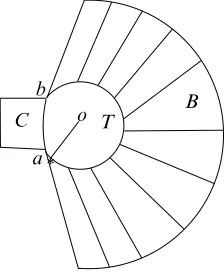
n denote the resulting space. Let denote a circle of length nC1 obtained by moving in the direction of the second factor in Knc. Finally, letKn be the manifold (with boundary) obtained by (hyperbolic) Dehn fillingKnc with a Margulis tube Tn with meridian and longitude c, smoothing out at the boundary if needed. Figure 2shows a “cross-section” of Kn. Note that the manifolds Kn have uniformly bounded geometry away fromTn.
The lower boundary ofKn, denoted @Kn , is obtained by gluing@L f0gto @R f0g. Thus we have an obvious map nW S!@Kn which we use to mark Kn. If s02 is the base-point of S, we denote the image n.s0/D.s0;0/2@L f0gby on. Lifting everything to universal covers, identifyingSz with H2, and thinking of KznH3, we can arrange that s0 lifts to O2H2 andon lifts toOnDO2H3.
The upper boundary ofKn, denoted @KnC, is obtained by gluing@L f1gto@R fng. This gives a second obvious embedding nCW S!@KnC and we writeoCn DnC.s0/, with liftOnC2H3. Occasionally we writeon foron,On forOnDO and n forn for clarity.
C a
b
o T B
[image:30.412.150.262.51.188.2]
Figure 2: A schematic picture ofKbuilt up ofB,C andT. The pointsa
andb are the base-pointsn.s0/Don andnC.s0/DoCn , respectively.
of the ending lamination theorem show that there are bi-Lipschitz homeomorphisms betweenCn andKn, with constants uniform in n. These are the models we will use.
5.1.7 The limit manifolds In the algebraic limit, the tube Tn becomes a rank-one cusp; see also[27]. The lower boundary @Kn ofKn stays fixed but the upper bound-ary @KnC develops into a partially degenerate end in which L becomes a surface with a puncture. The part of the surface corresponding toR becomes the degenerate end E described inSection 5.1.6.
In the geometric limit, the distance from on 2 @Kn to oCn 2@Kn stays bounded, because we can always travel through the bounded half C DLŒ0;1. However to reach a point on a “middle” layer †c˚1
2n of Bn we have to travel ever further, either going directly “up” through Bn or through LŒ0;1, crossing @L f1g, and then “down” from †c fngthrough Bn to†c˚12n . Thus in the geometric limit, Kn converges to the manifold SRnR f0gwith two geometrically infinite ends, each asymptotically quasi-isometric to E. This is discussed in detail in[9], but is not important for us here.
5.2 Absence of uniform convergence
Since the sequence Gn does not converge strongly, by Proposition 3.7, it must fail to satisfy UEP. In fact it is easy to exhibit a sequence of points gk 2G0 such that jgkj ! 1 whiled.O; n.gk/O/c for all n;k and some fixedc>0. (To see that this is equivalent to violating UEP, see[38, Lemma 5.2].)
joins o˙n going the “long” way round @Tn in Bn, while the path nW t 7!.s0;t/, t 2Œ0;1, goes the “short” way round in Cn.
Let s7! .s/be a based loop homotopic to a fixed generator of 1.S;s0/ and lying entirely on R. As in the proof of Lemma 5.1, the path nW Œ0;1!Kn, n.s/D
.n .s/;n/2†c fng @KC
n has the same length ` say as the path s7!0.s/D
. .s/;0/2†c f0g @Kn .
Now the loops nnn1 and nnn1 are homotopic in Kn, moreover from the above observation, nnn1 has length 2C` inKn. On the other hand,nnn1 is homotopic in Kn to the loop n.0/†c f0g @Kn, where by n.0/we mean the path s7!.n.s/;0/2†c f0g. By(4), the geodesic length ofn.0/on†c f0g increases exponentially with n; hence by the usual comparison of word length and geodesic length on †c f0g, if gn2G0 represents the loopn. /21.S;s0/, then jgnj ! 1 inG0. Sincen is induced by the marking nW s7!.s;0/2Kn, the loop
n.
0/ is in the homotopy class ofn.gn/21.KnIon/.
Let O be the lift to H3 of on 2Kn as above. Lifting the paths nnn1, we have found a sequencegn2G0for whichdG0.1;gn/! 1but for whichdH3.O; n.gn/O/ is uniformly bounded. As noted above, this violates UEP.
5.3 Pointwise nonconvergence
Let DG0 be the Fuchsian group for whichX DH2= . Recall that corresponds to a loxodromic g 2 whose image under 1 is parabolic. Let Pƒ denote the endpoints of axes which project to , equivalently, the set of images under of the fixed points of g. The counterexamples we seek forTheorem Coccur in the case of
2ƒ for which62P but ˆ{1./Dˆ{1.p/ for some p2P. Precisely which points
these are is given by the following theorem of Bowditch.
Theorem 5.2 [6, Theorem 0.2] LetH2= be a punctured hyperbolic surface. Let M DH2=G be a simply degenerate hyperbolic manifold corresponding to a faithful type-preserving isomorphism W !G, and suppose that there is a lower bound to the length of all loxodromics in M. Suppose that M has ending lamination and let {ˆW ƒ !ƒG be the corresponding CT-map. Then {ˆ./Dˆ{./ for ; 2ƒ if and only if andare either ideal endpoints of the same leaf of , or ideal boundary points of a complementary ideal polygon of .