Early Arthritics
Morelia Nuñez-Sotelo1, Luis Arturo Gutierrez-Gonzalez1*, Nancy Gonzalez2, Benito Losada1
1Centro Nacional de Enfermedades Reumáticas (CNER), Hospital Universitario de Caracas,Caracas, Venezuela; 2Cátedra de Salud
Pública, Universidad Central de Venezuela, Caracas, Venezuela. Email: *[email protected]
Received June 12th, 2012; revised July 20th, 2012; accepted August 3rd, 2012
ABSTRACT
To determine which patients with Early Inflammatory Polyarthritis (EIP) with less than a year of evolution of the dis- ease without a definitive diagnosis, progressed to rheumatoid arthritis according to ACR1987 criteria, we developed a predictive model for classification of early rheumatoid arthritis, based on clinical characteristics by observation of the onset of the disease and to relate with certain laboratory variables. A total of 54 patients with arthritis of less than one year of evolution were evaluated. We conducted a physical examination and the following parameters were determined: DAS 28, HAQ, Rheumatoid Factor (RF), Citrullinated Peptide (anti-CCP) and C-Telopeptide (CTx-II); radiology of hands and feet was also carried out, and was assessed by the Sharp method modified by van der Heijde. The patient follow-up was performed every 3 months for 12 months, classifying them according to the development of self-limiting, persistent non-erosive, and persistent erosive arthritis, and according to definite diagnosis. We estimated the relative risk and 95% confidence intervals for the predictor variables considered. Overall, 80.4% of patients with EIP evolved to persistent arthritis. Most persistent arthritis was diagnosed as rheumatoid arthritis (67.4%). However 51.6% (16/31) were anti-CCP positive, 21/31 (67.7%) were RF, and 11/31 (35%) were CTx-II positive. The basal nodes and RF were able to predict the persistence of activity and symmetry; rheumatoid nodules predict the development of erosions. It is important to note that patients who had an high initial average by the Sharp method modified by van der Heijde tend to have a greater increase in erosion at 6 months compared to those who had an initial low average (Pearson correlation coefficient 0.40, p < 0.015). An initial erosive disease increases the risk of radiological progression.
Keywords: ACR Criteria; Early Arthritis; Anti-CCP; CTx-II; DAS28
1. Introduction
The Early Inflammatory Polyarthritis concept (EIP) is not yet standardized, however consensus defined as the pre- sence of arthritis of 3 or more joints in a period >6 weeks but less than 1 year and still not complete the criteria for a specified arthritide. Saraux and colleagues showed that the criteria of the American College of Rheumatology (ACR), developed in 1987, are not enough sensitive (66%) for the diagnosis of rheumatoid arthritis in the first two years of disease.
Researchers seek tools to predict precociously which patients with Early Inflammatory Polyarthritis (EIP) will develop rheumatoid arthritis; however, it has to be noted that initially the disease is not clinical, radiological and immunological characteristic [1].
Clinical, radiological and serological criteria for pre- dicting the severity and persistence of the EIP have been explored. Several factors appear to influence the disease, but there is no consensus because the results are contra- dictory. [2]
It is noteworthy that in 70% of patients radiological
damage develops in the first two years of the disease and the rate of progression is higher in the first year than in the second or third year. This suggests that the opportu- nity to change the course of the disease occurs early [3]. As noted, early intervention with drugs in order to inter- fere on the natural progression of the disease has been advocated [3-5].
The interest in developing new treatment strategies is a consequence of the negative impact of disease on func- tional capacity and moropne diagnostic test was limited, because these antibodies could only be detected by im- munofluorescence. Subsequently a synthetic peptide con- taining citrulline, an amino acid in the filaggrin, which can be determined by analysis of enzyme-linked immu- nosorbent assay (ELISA), was developed [6]. A sensiti- vity of 76% and a specificity of 95% - 100% for the diag- nosis of rheumatoid arthritis have been reported by this method [7].
Goldach-Mansky and colleagues showed that antibo- dies anticitrulline were the best marker to predict the diagnosis and erosions in the first year of the disease [8]. Visser et al., in their model for the diagnosis of early
rheumatoid arthritis, included antibodies anticitrulline, which showed a strong association for persistence and were the best variable to predict erosions [9].
Other markers used to predict long-term progression of joint damage in early rheumatoid arthritis patients are the C-Telopeptide I and II (CTx-I and CTx-II) in urine, which are markers of bone destruction in bone and carti- lage, respectively. Garnero and colleagues showed that high levels of CTx-I and CTx-II were independent pre- dictors and increase the risk of radiological progression at 4 years of evolution in patients with EIP [10].
2. Methodology
To determine with EIP patients progressed to rheumatoid arthritis, we develop a longitudinal cohort study, with pa- tients referred to triage of rheumatology service at the Hospital Universitariode Caracas (HUC). All patients at- tending the rheumatology clinic of HUC from May 2004 to November 2004 and who met the following inclusion criteria were included in the study:
1) Patients with an age equal to or greater than 18 years.
2) Patients with arthritis of three or more joints, as evi- denced by the doctor with a duration equal to or greater than 6 weeks and less than 1 year.
3) Morning stiffness >30 minutes.
4) Bilateral compression pain in both feet (MTP: meta- tar-sophalangeal)
We excluded patients who showed: 1) Crystal disease.
2) Reactive arthritis. 3) Septic arthritis.
4) Arthritis due to sarcoidosis.
5) Lupus erythematosus or other collagen disease clearly defined.
6) Who had received disease-modifying drugs at the start of follow-up.
7) Presence of mono arthritis
Protocol was evaluated by a technical committee and ethics committee of the HUC, all patients signed the consent form. Patients were evaluated at baseline, at 3 months and 6 months.
To calculate the sample size the analysis was based on survival using the Log Rank Test, and was intended to achieve a power of 80% for which the sample size should be 59 individuals; however, only a sample of 54 patients was achieved [11].
For the evaluation of pain to symmetrical compression of MTPs, interobserver variability was measured by Co-
hen’s Kappa coefficient which applies to dichotomous qualitative variables [12] and two researchers were train- ed in the determination of this sign for the existence of a maximum match, each observer was blind to the results of the other. The patient was placed in supine or sitting position with feet in neutral position and each foot was examined by palpation separately. The Kappa correlation was 0.88 (standard error 0.14) for bilateral compression of the MTPs, of 0.71 (standard error 0.16) for the vari- able “points out”, 0.71 for the variable “gestures” (stan- dard error 0.16) and 1.0 for the variable “remove at pain” (standard error 0.0), which revealed a good correlation between the two observers.
At baseline and every 6 months PA and oblique radio- graphs of hands and feet were done and were analyzed by the Sharp method modified by van der Heijde [13].
3. System Variables
Main outcome measures are remission, persistence, and severity. This will define the clinical course: the nominal variable where classified as:
1) Natural remission: absence of arthritis in patients not taking disease-modifying drugs or steroids during the last 3 months of one-year follow-up period.
2) Persistence: the presence of arthritis in at least one joint and/or treatment with disease-modifying drugs or ste- roids in the last 3 months of one-year follow-up period.
3) Severity: erosive disease in at least one of the areas assessed by the Sharp method modified by van der Hei- jde (average greater than or equal to 1) after one year of follow-up.
This will generate three possible diagnoses:
1) Self-limiting arthritis: these correspond to patients who meet the criterion of natural remission.
2) Persistent non-erosive arthritis: these include patients meeting the criteria for persistence, but not for severity.
3) Persistent erosive arthritis: these include patients meeting the criteria for persistence and severity.
4. Statistical Analysis
As patients were enrolled in the study, data were stored in a database contained in the statistical program SPSS Version 10.00. At the end of sample collection a quanti- tative analysis of the information was performed, for which we applied descriptive statistical methods such as averages, percentages and standard deviations, preva- lence rate, among others, as well as measures of associa- tion of risk with odds ratio and Fisher’s exact test.
5. Results
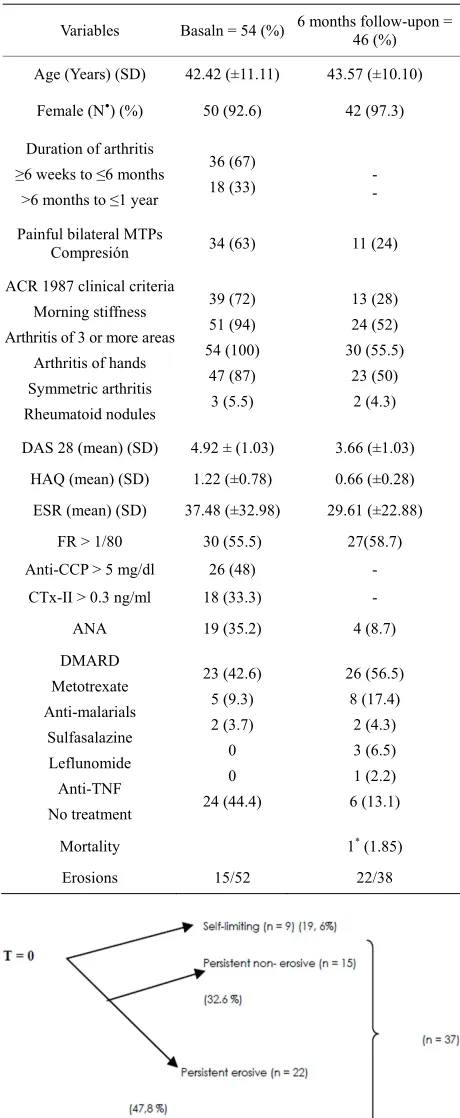
A prospective study in rheumatology service at the Uni- versity Hospital of Caracas during a period of twelve months, whose objective was to reveal predictors of per- sistence and severity in patients with EIP was conducted. During the sample collection period (August, September, October and November 2004), 54 patients with EIP at- tend the out-patient clinic, of whom 92% (50 patients) were female, mean age 42 ± 11.11 (1SD), 67% of pa- tients had disease progression less than 6 months (Table 1).
Out of 54 patients included in the study, 8 were lost to follow-up (14.81%), 2 patients expressed their desire not to continue in the study and the other six patients were telephoned 3 times by cutoff date (at 6 months) and did not attend the clinic. One diabetic patient died from hy- poglycemia while receiving a sulfonylurea (1.85%), but the 6 months evaluation was performed just before his death. The characteristics of the 54 patients at the begin- ning of the study revealed that 100% had arthritis of the hands and 94% had arthritis of three or more areas.
Bilateral painful compression was present in 63% of patients at the start and was only 24% for the cutoff date. 72% had morning stiffness, only 3 patients (5%) had rhe- umatoid nodules. The initial DAS 28 was 4.92 (SD 1.03) and decreased to 3.66 at 6 months. The HAQ and ESR decreased from 1.22 (SD 0.78) to 0.66 (SD 0.78) and 37.48 (SD 32.98) to 29.61 (SD 22.88) at 6 months follow up respectively.
With respect to laboratory tests, RF was the most fre- quently positive parameter with 55.5%, followed by anti- CCP with 48% and CTx-II with 33.7%.
Of the 46 patients who completed the study, 19.6% had self-limiting arthritis, and 80.4% had persistent arthritis. Of the patients with persistent arthritis 32.6% had noner-osive disease and 47.8% had ernoner-osive disease (Figure1).
Regarding the use of DMARDs, the most used drug was methotrexate. At the start of follow-up methotrexate was prescribed to 42.6% of patients and 6 months were receiving up to 56.5%; the second most used type of drugs at 6 months were antimalarial followed by leflunomide and sulfasalazine. Only one patient received therapy anti- TNF- (Table1)
[image:3.595.307.537.110.669.2]Most of the population showed a persistent arthritis (80.4%). Of the 37 patients with persistent arthritis 31 (67.4%) had rheumatoid arthritis and 4 (8.7%) had sero- negativespondyloarthropathy, being these two patholo- gies the most common diagnoses for this group. Of the 9 patients with self-limiting EIP, 6 (13%) had a transient undifferentiated arthritis, the other three had nodular os- teoarthritis, fibromyalgia and mixed connective tissue disease (Table2).
Table 1. Characteristics of the population at baseline and at 6 months follow-up.
Variables Basaln = 54 (%) 6 months follow-upon = 46 (%)
Age (Years) (SD) 42.42 (±11.11) 43.57 (±10.10)
Female (N˚) (%) 50 (92.6) 42 (97.3)
Duration of arthritis ≥6 weeks to ≤6 months
>6 months to ≤1 year
36 (67)
18 (33) - -
Painful bilateral MTPs
Compresión 34 (63) 11 (24)
ACR 1987 clinical criteria Morning stiffness Arthritis of 3 or more areas
Arthritis of hands Symmetric arthritis Rheumatoid nodules
39 (72) 51 (94) 54 (100)
47 (87) 3 (5.5)
13 (28) 24 (52) 30 (55.5)
23 (50) 2 (4.3)
DAS 28 (mean) (SD) 4.92 ± (1.03) 3.66 (±1.03)
HAQ (mean) (SD) 1.22 (±0.78) 0.66 (±0.28)
ESR (mean) (SD) 37.48 (±32.98) 29.61 (±22.88)
FR > 1/80 30 (55.5) 27(58.7) Anti-CCP > 5 mg/dl 26 (48) -
CTx-II > 0.3 ng/ml 18 (33.3) -
ANA 19 (35.2) 4 (8.7)
DMARD Metotrexate Anti-malarials
Sulfasalazine Leflunomide Anti-TNF No treatment
23 (42.6) 5 (9.3) 2 (3.7)
0 0 24 (44.4)
26 (56.5) 8 (17.4)
2 (4.3) 3 (6.5) 1 (2.2) 6 (13.1)
Mortality 1* (1.85)
Erosions 15/52 22/38
Figure 1. Diagram of the evolution of patients with EIP at cutoff date, T = 12 month n = 46.
anti-CCP with 61.5% and CTx-II with 61%. There were 6 patients without rheumatoid arthritis who had rheuma- toid factor and anti-CCP positive and only 4 had an in- creased CTx-II. Of the patients with CTx-II positive, three had a seronegativespondyloarthropathy. Patients who had any positive test were not considered, but lost to follow up because we were not able to establish the definitive di- agnosis (Table3).
The basal rheumatoid nodules and positive rheumatoid factor were enough to predict which patients would pre- sent persistence of disease activity. A duration of symp- toms longer than 6 months, basal symmetry, anti-CCP and CTX-II positive, increased the relative risk for persistent activity for patients who did not have these risk factors, although this difference was not statistically significant (Table4).
[image:4.595.57.286.360.513.2]Symmetry, rheumatoid nodules and basal erosions al- low predicting which patients will develop erosive disease at 6 months. The evolution of more than six months, the RF, and CTx-II increased the relative risk of developing
Table 2. Frequency and percentage distribution according to final diagnosis at 12 months follow-up.
Diagnosis N (%)
Self-limiting EIP Transient undifferentiated
Nodular OA Fibromyalgia
MCTD
9 (19.6) 6 (13) 1 (2.2) 1 (2.2) 1 (2.2) Persistent EIP
Rheumatoid arthritis Spondilo arthritis Sjögren Syndrome
Sclerodermia
37 (80.4) 31 (67.4) 4 (8.7) 1 (2.2) 1 (2.2)
[image:4.595.59.286.560.735.2]Total 46 (100)
Table 3. Frequency and percentage distribution according to Anti-CCP values, RF, CTx-II positive and type of diag- nosis at 12 months follow-up.
DIAGNOSIS
Anti-CCP ≥ 5 mg/dl N
(%)
RF > 1/80 N (%)
CTx-II > 0.3 ng/ml N (%)
Rheumatoid arthritis 16 (61.5) 21 (70) 11 (61)
Fibromyalgia 1 (3.8) - -
Sjögren Sx 1 (3.8) 1 (3.3) -
Spondiloarthritis 1 (3.8) 2 (6.7) 3 (16.7)
Sclerodermia (N˚) (%) 1 (3.8) 1 (3.3) -
Transient undifferenciated
polyarthritis 2 (7.7) 2 (6.7) 1 (5.6)
Lost at follow-up 4 (15.4) 3 (10) 3 (16.7)
Total 26 (100) 30 (100) 18 (100)
erosions at 6 months compared with patients who did not meet these conditions; however this difference was not statistically significant. The positivity for the three sero- logical markers (RF + AntiCCP + CTx-II) or at least the presence of two thirds of them increased the risk of per- sistent disease in addition to predict the development of erosions (Table4).
6. Discussion
The diagnosis of early rheumatoid arthritis often pre- sents difficulties. The biggest problem is that the disease reveals typical clinical features and radiological damage over time and not in the initial stages. Therefore, it is necessary to sharpen on the clinical, serological detection of different antibodies and early radiographic changes [2]. The evaluation of factors or predictive tests for a defined condition requires that general population have a rea- sonable proportion of patients with the disease. The pre- valence of rheumatoid arthritis is low, therefore studies should be carried out in groups at high risk of developing the disease, as the sample evaluated in this trial.
Most of the patients in our sample had arthritis for more than 6 weeks and less than 6 months, which reveals that a high percentage of patients with early polyarthritis were included in the study. With respect to ACR 1987 clinical criteria, it is note- worthy that at baseline 100% of patients had arthritis in their hands, 94% arthritis of three or more joints and 87% symmetrical arthritis, which made it a sample with high potential to develop rheumatoid arthritis, but not so in all cases. These findings suggest that the initial population showed more affection of the hands than the feet.
To our knowledge, this is the first study that simulta- neously evaluates an antibody as the rheumatoid factor and the anti-CCP and a marker of cartilage degradation as the CTx-II. At the start of the investigation the paraclini- cal examination most often reported was RF with 55.5%, followed by anti-CCP with 48% and CTx-II with 33.3%. In other populations with undifferentiated arthritis the detection of antibodies was much lower, with 21% for both rheumatoid factor and anti-CCP [14]. In the study of Charnie and colleagues, only 14.08% (89 patients out of 632 patients) had a high value of urinary CTx-II [15].
Table 4. Persistence of the activity and severity by radio- logical damage at 12 months follow-up.
RR IC 95% RR IC 95%
Duration of symptoms
≥6 weeks <6 months 0.84 (0.67 - 1.06) 0.93 (0.37 - 2.27)
≥6 months 1.19 (0.94 - 1.52) 1.08 (0.44 - 2.68)
Painful bilateral
compression of MTPs 0.96 (0.64 - 1.44) 0.59 (0.30 - 1.15)
Basal symmetry 1.42 (0.68 - 2.93) 1.95 (1.41 - 2.68)*
Basal rheumatoidnodules 1.24 (1.07 - 1.43)* 2.31 (1.60 - 3.40)*
Radiologicalerosions in hands and feet 0.99 (0.76 - 1.62) 2.67 (1.17 - 6.09)*
RF ≥ 1/80 1.44 (1.05 - 1.97)* 1.29 (0.57 - 2.92)
Anti-CCP > 5 mg 1.08 (0.72 - 1.62) 0.89 (0.44 - 1.81)
CTx-II > 0.3 ng/ml DAS 28 > 4.19 2.15 (1.65 - 3.42)* 3.65 (2.11 - 5.08)*
RF (+) plus Anti-CCP (+) plus CTx-II (+) 1.36 2.67 (0.71 - 1.61)* 3.77 (2.08 - 4.58)*
RF (+) plus Anti-CCP (+) plus CTx-II (–) 2.72 (0.93 - 1.99) (1.75 - 3.78)* 2.65 (2.10 - 5.03)*
RF (+) plus Anti CCP(–) plus CTx-II (+) 2.31 (1.71 - 3.61)* 1.36 3.11 (1.19 - 5.09)*
RF (–) plus Anti CCP (+) plus CTx-II (+) 2.45 (1.60 - 3.40)* 3.88 (0.68 - 2.73) (2.89 - 4.11)*
*p ≤ 0.05, MTPs: Metatarsophalangeal. RF: Rheumatoid Factor. Anti-CCP: Antibodies against citrullinated peptides. Tx-II: C-telopeptide.
The study shows that 13% of patients with undifferen- tiated arthritis acted in the evolution of the disease as a self-limited arthritis. Of 313 patients with self-limiting arthritis evaluated by Visser and colleagues, 33% had undifferentiated arthritis [9]. These differences could be explained by the dissimilar sizes of the samples, different follow-up time or the provenance of the studied popula- tions.
It was interesting to note the comparison between the antibodies studied and the cartilage degradation marker investigated. Among patients who developed rheumatoid arthritis at 6 months it was determined that the RF was positive in 70%, anti-CCP in 61.5% and CTx-II in 61% of the patients. The study by Gossec et al. of patients with
early rheumatoid arthritis found a 68% of RF-IgM and 58.9% of anti-CCP. [16] These similarities show that in properly selected patients with a clinical signs and symptoms of EIP, serological markers are presented in a high percentage of patients and can be very useful for establishing a definitive diagnosis.
It has been widely published that the anti-CCP sur- passes in specificity to rheumatoid factor [17]. In this stu- dy there were 6 patients without rheumatoid arthritis who were RF and anti-CCP positive. By contrast, the study highlighted that the CTx-II was present in only four pa- tients without rheumatoid arthritis, of whom 3 had a se- ronegative spondyloarthropathy and 1 had a transient un- differentiated polyarthritis. Patients with seronegative spondyloarthropathy recorded the highest titers of CTx-II; this may be the subject of further study.
These results could promote the identification of mar-
kers of cartilage degradation in EIP, as there are studies that concluded that high levels of CTx-I and urinary CTx-II predict an increased risk of radiological progres- sion at one year and 4 years in patients with early rheu- matoid arthritis [10,15]. In our study the determination of CTx-II also showed an increased risk in the persistence and the development of the disease, although this differ- ence was not statistically significant. In our study the determination of this marker was in blood, which could facilitate their use in clinical practice.
The presence of bilateral compression pain of the MTPs was not statistically significant, and did not show an in- creased risk for persistence of disease activity, or the radiological damage; on the contrary, in the study of Vis- ser et al. bilateral metatarsophalangeal compression it did
predict both the persistence as erosions in a span of two years [9].
In our study, examining the X-ray of hands and feet, we found that patients had a greater and significant radio- logical damage in hands than in feet. This is opposed to observe in European populations, where early rheumatoid arthritis erosions are more frequent in the small joints of the feet [18-20].
While the greatest initial radiological damage was at hand, the progression was greater in feet at 6 months. Van der Heijde et al. observed similar behavior in patients with
flammation in the joints of the hands in contrast with 63% who reported pain on bilateral compression of the MTPs. Verifying the initial condition of the joints of the hands seems to be more important than feet examination in our region.
While not a goal in our study we emphasize that basal symmetry increased relative risk for persistent activity; but did not achieved statistically significance. On the other hand, the basal symmetry did allow the prediction of erosion on radiographs at 12 months follow up.
Van Gaal and colleagues in a multivariate analysis that included the ACR 1987 criteria to predict evolution of undifferentiated arthritis to rheumatoid arthritis in one year, the symmetry presented an OR (Odds Ratio) of 2.6 (1.1 to 60); p < 0.028. Therefore, the symmetry may be a clinical variable to consider as predictor of EIP [14].
Although basal rheumatoid nodules were able to predict both persistence of the activity and development of ero- sions at 6 months, their presence is rare in early arthritis. In fact, only 5.5% of the patients in the study had rheu- matoid nodules in the first assessment and this percentage did not increase during the first 6 months after follow-up. Radiological erosions at the start of the disease failed to predict persistence of activity, but logically it increased the relative risk for the severity. Likely, the low number of patients in whom the radiological study was done and the short follow-up period of time did not provide opportunity to establish the statistical significance of this variable. However, it is important to note that patients who had a high initial average by the Sharp method modified by van der Heijde tend to have a greater increase in erosion at 6 - 12 months compared to those who had an initial low ave- rage (Pearson correlation coefficient 0.40, p < 0.015). This is consistent with other studies where it has been estab- lished that the presence of erosions in hands and feet are able to predict which patients will develop rheumatoid arthritis [6,22].
With regard to laboratory test results, the RF allowed to predict which patients were to persist with symptoms of disease activity. There was an increased relative risk to determine which patients will develop erosion, although this value was not statistically significant. A large group of studies have found that the RF is a predictor of persis- tence, development of erosion and useful in predicting which patients will progress to rheumatoid arthritis [6- 14].
Serological markers separately were inefficient in pre- dicting the persistence or radiological erosions at 6 months, not even the new marker anti-CCP, in contrast to the studies of Visser et al., where the anti-CCP increased the
OR to 4.58 for persistence and was the best predictor of erosion at two years [9]. Other studies demonstrate that the anti-CCP does predict which patients will develop rheu- matoid arthritis. [21,23]
The CTx-II increased the RR of persistence of disease activity and development of erosions at 6 months, al- though this difference was not statistically significant. The urinary CTx-II has been shown to predict increased risk of radiological progression in 89 patients with rheumatoid arthritis less with than 3 years of evolution [15]. Type II collagen represents the major cartilage collagen fiber, constituting 30% - 90%. The degradation of collagen type II is considered an excellent marker of cartilage degrada- tion and is considered an early sign of disease in rheu- matoid arthritis. [21]
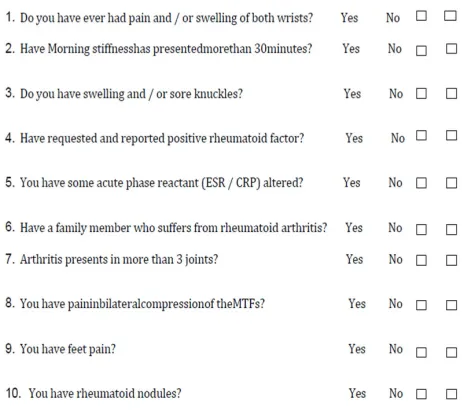
In the light of the results obtained, the CTx-II seems an interesting marker to be considered in patients with EIP. This confirms the result that shows that up to 61% of the 13 patients with CTx-II positive developed rheumatoid arthritis at 12 months follow-up. Due to the extensive choice in the exclusion criteria for this cohort allowed us to differentiate the patient with EIP who would develop chronic, which is why we developed a simple but practical screening test to discriminate patients who consult pri- mary care physicians, family doctors or non-specialist practitioners (Figure2).
In EIP about 40% of patients going to self-limiting ar- thritis, in this study we added 2 clinical variables (mor- ning stiffness and bilateral compression) with it, get a larger number of patients who developed arthritis persis- tent.
7. Conclusions
[image:6.595.307.538.519.724.2]The highest percentage of patients with EIP developed a persistent arthritis, where rheumatoid arthritis was the most common pathology. The RF, anti-CCP and CTx-II
were present at baseline in most patients with EIP who developed rheumatoid arthritis at 6 months.
In the EIP population studied, the initial clinical and radiological condition of the hand was more important than those of the feet.
Most patients with EIP were treated early with a DMARD, improving at 6 months in clinical and laborato-
ry parameters, but progression of erosive disease contin-ued. Basal nodules and RF were the variables that could predict early persistence in patients with EIP.
Symmetry and rheumatoid nodules at baseline were able to predict which patients would develop an erosive disease at 6 months. The patients with basal erosive dis- ease are more likely to suffer an increase in average number of erosions measured by the Sharp method mo- dified by van der Heijde, compared with patients without the disease.
REFERENCES
[1] A. Saraux, J. Berthelot, G. Chalès, C. Lehenaff, J. Thorel, S. Hoang, et al., “Ability of the American College of Rheumatology 1987 Criteria to Predict Rheumatoid Arth- ritis Patients with Early Arthritis and Classification,” Arthritis Rheuma, Vol. 44, No. 11, 2001, pp. 2485-2491.
doi:10.1002/1529-0131(200111)44:11<2485::AID-ART42 8>3.0.CO;2-S
[2] P. Emery and D. Symmons, “What Is Early Rheumatoid Arthritis, Definition and Diagnosis,” Bailliére’s Clinical Rheumatology, Vol. 11, No. 1, 1997, pp. 13-26.
doi:10.1016/S0950-3579(97)80030-1
[3] M. Weinblatt, “Rheumatoid Arthritis: Treat Now, Not La- ter,” Annals of Internal Medicine, Vol. 124, No. 8, 1996, pp. 773-774.
[4] T. Möttönen, P. Hannonén, M. Leirisalo-Repo, M. Nissila, H. Kautiainen, M. Korpela, et al., “Comparison of Combi- nation Therapy with Single—Drug Therapy in Early Rheu- matoid Arthritis: A Randomised Trial,” Lancet, Vol. 353, No. 9164, 1999, pp. 1568-1573.
doi:10.1016/S0140-6736(98)08513-4
[5] M. Boers, A. Verhoeven, H. Markusse, M. Vandelaae, R. Westhovens, J. van Dendere, et al., ”Randomised Com- parison of Combined Step-Down Prednisolone, Metho- trexate and Sulphasalazine with Sulphasalazine Alone in Early Rheumatoid Arthritis,” Lancet, Vol. 350, No. 7094, 199, pp. 309-318. doi:10.1016/S0140-6736(97)01300-7 [6] D. L. Scott, “The Diagnosis and Prognosis of Earlyarthritis:
Rationalefor New Prognosticcriteria,” Arthritis & Rheu- matism, Vol. 46, No. 2, 2002, pp. 286-290.
doi:10.1002/art.10134
[7] C. Reparon-Schuijt, W. J. E. Van Eschw, C. Kooten, G. Schellekens, B. Jong, et al., “Secretion of Anti-Citrulline— Containing Peptide ANTIBODY by B Lymphocytes in Rheumatoid Arthritis,” Arthritis & Rheumatism, Vol. 44, No. 1, 2001, pp. 41-47.
doi:10.1002/1529-0131(200101)44:1<41::AID-ANR6>3.0
.CO;2-0
[8] H. Doyle and M. Mamula, “Post Translational Protein Mo- difications: New Flavours in the Menu of Autoantigens,” Current Opinion in Rheumatology, Vol. 14, No. 3, 2002, pp. 244-249. doi:10.1097/00002281-200205000-00009 [9] H. Visser, S. le Cessie, F. Breedueld, J. Hazes, et al.,
“How to Diagnose Rheumatoid Arthritis Early. A Predic- tion Model for Persistent (Erosive) Arthritis,” Arthritis & Rheumatism, Vol. 46, No. 2, 2002, pp. 357-365.
doi:10.1002/art.10117
[10]P. Garnero, R. Landewé, M. Boers, A. Verhoeven, S. van Linden, S. Christgau, et al., “Association of Baseline of Markers of Bone and Cartilage Degradation with Long- Term Progression of Joint Damage in Patients with Early Rheumatoid Arthritis,” Arthritis & Rheumatism, Vol. 46, No. 11, 2002, pp. 2847-2856. doi:10.1002/art.10616 [11]L. Freedman, “Tables of the Number of Patients Required
in Clinical Trials Using the Logrank Test,” Statistic in Medicine, Vol. 1, No. 2, 1982, pp. 121-129.
doi:10.1002/sim.4780010204
[12]J. Cohen, “A Coefficient of Agreement for Nominal Class,” Educational and Psychological Measurement, Vol. 20, 1960, pp. 37-46. doi:10.1177/001316446002000104 [13]D. van der Heijde, T. Dankert, F. Nieman, R. Rau and M.
Boers, “Reliability and Sensitivity to Change a Simplifi- cation of Sharp/van der Heijde Radiological Assessment in Rheumatoid Arthritis,” Rheumatology, Vol. 38, No. 10, 1999, pp. 941-947. doi:10.1093/rheumatology/38.10.941 [14]F. A. van Gaalen, S. P. Linn-Rasker, W. T. van Verooij, B.
A. de Jong, F. C. Breedveld, C. L. Verweij, et al., “Auto- antibodies to Cyclic Citrullinated Peptides Predict Pro- gression to Rheumatoid Arthritis in patients with Undif- ferentiated Arthritis. A prospective Cohort Study,” Ar- thritis & Rheumatism, Vol. 50, No. 3, 2004, pp. 709-715.
doi:10.1002/art.20044
[15]Charni, F. Juillet and P. Garnero, “Urinary Type II Colla- gen Helical Peptide (HELIX-II) as a New Biochemical Marker of Cartilage Degradation in Patients with Oste- arthritis and Rheumatoid Arthritis,” Arthritis & Rheuma- tism, Vol. 52, No. 4, 2005, pp. 1081-1090.
[16]L. Goosec, M. Dougados, P. Goupille, A. Cantagrel, J. Sibilia, O. Meyer, et al., “Prognostics Factor for Remis- sion in Early Rheumatoid Arthritis: A Multiparameter Pro- spective Study,” Annals of the Rheumatic Diseases, Vol. 63, No. 6, 2004, pp. 675-680.
doi:10.1136/ard.2003.010611
[17]G. Schellekens, H. Visser, B. A. W. de Jong, F. H. J. van den Hoogen, J. M. W. Hazes, F. C. Breedveld, et al., “The Diagnostic Properties of Rheumatoid Arthritis Antibodies Recognizing a Cyclic Citrullinated Peptide,” Arthritis & Rheumatism, Vol. 43, No. 1, 2000, pp. 155-163.
doi:10.1002/1529-0131(200001)43:1<155::AID-ANR20> 3.0.CO;2-3
[18]P. Brennan, B. Harrison, E. Barrett, K.Chakravarty, D. Scott and A. Silma, “A Simple Algorithm to Predict the Early Rheumatoid Arthritis: Prospective Cohrte Study,” British Medical Journal, Vol. 313, 1996, pp. 471-476.
[19]D. van der Heijde, M. A. van Leeuwen, P. L. van Riel, A. M. Koster, M. A. van Hof, M. H. van Rijswijk, et al., “Biannual Radiographic Assessment of Patients with Early Rheumatoid Arthritis,” Arthritis & Rheumatism, Vol. 35, No. 1, 1992, pp. 26-34. doi:10.1002/art.1780350105 [20]D. Scott and A. Silma, “A Simple Algorithmto Predict the
Development of Radiological Erosions in Patients with Early Rheumatoid Arthritis: Prospective Cohort Study,” British Medical Journal, Vol. 313, No. 471, 1996, pp. 471- 476.
[21]A. van der Heide, C. Remme, D. Hofman, J. Jacobs and J. Bijlsma, “Prediction of Progression of Radiologic Da-
mage in Newly Diagnosed Rheumatoid Arthritis,” Arth- ritis & Rheumatism, Vol. 38, No. 10, 1992, pp. 26-34. [22]L. M. A. Jansen, I. E. van der Horst-Brwinsma, D. van
Schaardenburg, P. D. Bezemer and B. A. C. Dijkmans, “Predictors of Radiographic Joint Damage in Patients with Early Rheumatoid Arthritis,” Annals of the Rheumatic Diseases, Vol. 60, No. 10, 2001, pp. 924-927.
doi:10.1136/ard.60.10.924
[23]J. Fries, P. W. Spit, R. G. Kraines and R. H. Holman, “Mea- surement of Patient Outcome in Arthritis,” Arthritis & Rheu- matism, Vol. 23, No. 2, 1980, pp. 137-145.