MULTI-USER TEXT EDITORS
A Thesis
submitted in partial fulfilment of the requirements for the Degree
of
Master of Science in
Computer Science in the
University of Canterbury by
Mostafa Rajabian
I would like to express my deepest grati~ute~ to my supervisor, Dr. M. A. Maclean, for his continuing guidance and very valuable suggestions and comments throughout this project.
I would also like to thank other staff of Computer Science Department who were helpful during the project. In particular, I thank Dr. R. E. M. Cooper who initiated this project and encouraged me to do it, and Dr. B. J. McKenzie for his useful suggestions during the period he was my supervisor. My tha'nks are also due to Professor J. E. L. Peck for his fruitful discussions
project.
about this
CHAPTER PAGE
ABSTRACT 1
1. INTRODUCTION 3
2. THE HISTORICAL DEVELOPMENT OF EDITOR DATA STRUCTURES 8 2.1 Batch editing systems
2.2 Sequential editing systems 2.3 Direct editing systems
2.4 Data structures using linked list of pages 2.5 Data structures using random access pages
2.6 Data structures using an array of line pointers 3. THE CHEF EDITOR DATA STRUCTURE
3.1 General description of the data structure 3.2 The implementation of the main commands
3.2.1 Accessing a line 3.2.2 Insertion
3.2.3 Deletion
9
11 13 19 25 28
31 31 35 35 37
39
3.3 The implementation of other important commands 41 3.4 The interface with the underlying file system 45
4. A NEW EDITOR DATA STRUCTURE 50
4.1 General characteristics 50
4.2 General structure 52
4.3 Detailed description of the data structure 55 4.4 The implementation of the main commands 60
4.4.1 Accessing a line 4.4.2 Insertion
4.4.3 Deletion
5.2 Stacking of the unused blocks 5.3 Garbage collection
5.4 Recovery from system failure
6. IMPLEMENTATION OF THE NEW DATA STRUCTURE AND THE RESULTS
6.1 Implementation of the new data structure 6.2 Experimental results and comparisons 7. CONCLUSION AND THE FUTURE
7.1 CONCLUSION 7.2 THE FUTURE . REFERENCES
APPENDIX
72 74 77
80 80 87
FIGURE 2.1 2.2 2.3 2.4 2.5 2.6 3.1 3.2 3.3 3.4 3.5 4.1 4.2 4.3
Changes on the map after inserting an string Structure of a page in ATS Editor
Movement of lines in ATS Editor
System lists after initialization of storage Structure of a file list during editing
Workfile structure in GODOT Editor
Conceptual view of the CHEF data structure Creating a gap for an insertion in CHEF Layout of the pointer place in CHEF
Structure of a DAM file on the PRIME 750 Structure of a Random file on the ECLIPSE Conceptual view of the new data structure Pointer blocks Directory
Current window with its current information
PAGE 17 20 22 24 25 29 32 39 44 46 47 53 60 61
4.4a Changes in current and old windows for insertion 65 4.4b
4.5
5.1
Directory and Pointer blocks before and after insertion
Directory and Pointer blocks before and after deletion
Structure of Backup blocks for undo command
65
67
TABLE PAGE
I Number of new entries created for insert and
delete 18
I I Maximum Workfile sizes for different line
spacings 34
III Number of i/o calls for an access in CHEF 37
IV A pointer bit allocations and its effects in
file size and map_table size 58
v
Results for typical access commands in a1000-line file 90
VI Results for typical access commands in a
3000-line file 90
VII Results for inserting an external file in a
1000 and 3000-line file 92
VIII Results for inserting from another region of
Workfile for a 1000-line file 93
IX Results for inserting from another region of
Workfile for a 3000-line file 94
X Results for delete commands in a 1000-line file 95
XI Results for delete commands in a 3000-line file
with detailed number of i/o 95
XII Results for undo commands in a 1000-line file 98 XIII Results for undo command in a 3000-line file 99
XIV Effect of Garbage Collection in pointer values 100
XV Overheads of Garbage Collection in a 1000-line
file 102
XVI Overheads of Garbage Collection in a 3000-line
[image:6.600.78.512.200.706.2]GRAPH
I
II
Deleting a single line at different locations of a 3000-line file
inserting the last line in the middle of different size files
PAGE
96
ABSTRACT
This thesis describes the design and implementation of a new and efficient data structure used for the workfiles of multiuser line-oriented text editors. One of the design objectives is the ability to use. the editor (i.e. CHEF) as an editing server in a local ring network with a dedicated. disk for the storage of users' workfiles. This objective is facilitated because the data structure allows random disk blocks to be used for the workfiles. This allows the editor to exist stand-alone without the need for an underlying file system.
The structure of the workfiles is a determining factor for the efficiency of storage and speed of any editor and it is just as important as the command language and other user level features of editors. historical development of such data structures in a number of editors is described, and 6 general catagories are developed. The advantages and disadvantages of each catagory are discusssed and the main problems in the design of editor data structures are distinguished. The CHEF editor data structure, which solves most of these problems, is studied in detail. The new data structure, which is in fact a logical development of the CHEF data structure, brings further improvements and increases the performance. This is shown by experimental results.
pointer values, and a recovery technique.
CHAPTER 1
INTRODUCTION
The original stimulus for this thesis was the idea of having an 'editing server' in one node of the local ring network being developed at the Department of Computer Science.
The editing server would consist of a small computer (probably a microprocessor), which would be responsible for servicing the editing ·requests of all users from any node of the network. At the begining of the editing session, after the user requested to edit a file, the editing server would get a copy of the original file from the 'file server', which would be responsible for the storage and maintenance of all network users and systems files, and store it in its own 'dedicated disk' as the user's 'work file'. At the end of th~ editing session, with the user's request, this edited work file would be sent back to the file server, replacing the original file.
The idea of the editing server was first suggested by the designers of the Cambridge Ring Network, following their successful development of a file server for the network. But, to the knowledge of the author, there has been no
' /:: \ ,_}
attempt to develop such a /server.
a most important consideration in the adaptation of CHEF (or any other editor) as the editing server is the data structure used for the users' work files.
It is highly desirable for this data structure to have the following characteristics:
1.
\
It shouhd)provide a faster response time to the \ . . /
editing commands, compared to the existing data structures, under similar environments.
2. It should have the capability of utilizing its own disk space (a dedicated disk), without any
requirement for an underlying file system.
3. In a multiuser environment, with the absence of a sophisticated operating system, the data structure should be:
--Easy to implement
--Feasible with a limited main memory.
In this thesis, we will concentrate on the editor data strucfures, and will present the design-and implementation of a new data structure for this application.
With the development of on-line computing, and the advent of inexpensive terminals, the idea of on-line creation and modification of programs and texts has become widely accepted and used in the computer industry. Interactive text editors have now become an essential component of any small or large computing system.
So the convenience of the user, and the power of the command language have become the most important design objectives. The implementation level objectives and techniques have been either ignored, or given less importance by the designers. As a result, there are numerous 'functional descriptions' of text editors in the literature, and little has been said about the implementation level. This has led to the development of advanced techniques and facilities at the user level. These include powerful command language facilities such as the use of macros, jumps, undo facilities, etc. There have even been some attempts to develop a design methodology for the command language. In this respect the language is divided into three parts: semantic(.)syntactic, and lexical components.
On the other hand only a few editor designers have realized the importance of the implementation level in the design of the editor. The most important element at this level is the structure of the text to be edited, or the 'work file', which is the manner in which the text is stored, accessed, and manipulated. Unlike an ordinary 'permanent' file, an editor work file is dynamically changing in an unpredictable way. Any portion of the file may be accessed at any time for editing. It grows quickly in size and complexity, expanding and contracting dynamically along its entire length. The data structure of an editor work file is important, since it affects the performance of the editor in the following ways:
1. The speed of the editor
2. The maximum allowable size of the text to be edited. 3. The number ofrthe disk input/output operations.
4. Main memory usage.
5. The facilities provided at the user level.
In the study of a number of editor data structures, it was realized that most of them suffer from the problems that stem from ignoring one or more of the above factors in the design and implementation of the data structure. For example, the delete and insert commands may be very slow due to the extensive movement of the text within the work file, or the limit on the size of the file to be edited may be unacceptably small for some users.
The CHEF Editor, described in chapter 3, uses a data structure which solves most of these problems. The basic access, delete, and insert commands are implemented efficiently in this structure, so the general speed of the editor is fast. The maximum file size is only limited by the number of bits in a line pointer, rather than by memory capacity. The number of disk i/o operations is relatively small for most commands. The main memory usage with this structure is very economical, i.e. only 4 blocks of the file are resident at any time. At the user level, there are
'
powerful and flexible commands and the data structure facilitates the implementation of some features such as the Undo command, and macro facilities.
effectively decreased. The main memory usage is slightly higher (7 blocks). The inherent structure of the new design also facilitates the implementation of backup for the Undo command, and increases its efficiency. It also uses a garbage collection algorithm which returns two garbage areas to the system: the unused text area, and more important, the unused logical block numbers. The latter gives the user the possibility of spending much longer time in a single editing session.
CHAPTER 2
THE HISTORICAL DEVELOPMENT OF EDITOR DATA STRUCTURES
In this chapter the historical development of editor data structures is studied. As mentioned earlier, while there are numerous behavioural descriptions of editors in the literature, there are only a few describing editor data structures. An attempt is made to study the da~~ structure
\
( /
of some well known editors. General cat'~gqries are presented for the historical development of these data structures, and it is believed that the dat~ structures not
~·,
discussed here fall into one of these categories. The data structures are discussed with respect to the following factors, as mentioned before:
1. The speed of the editor, which is directly dependent on the speed of the three basic commands of an editor: access, delete, and insert.
2. The maximum allowable size of the text to be edited. This is another important factor directly dependent on the data structure used.
3. The number of the disk input/output transfers. This is an important factor for editors which utilize the disk for the storage of the work file.
5. The data structure is also important, to some extent, in imposing restrictions or allowing extensions to the command language, and the facilities provided at the user level.
The three commands access, delete, and insert, mentioned in '1' above, are considered the most important commands of an editor for implementation purposes. The reason for this selection is that, with a close examination of an editor's commands, it can be seen that majority of the commands are translated to these three basic commands. Since these commands are directly operating on the text, the speed of the operations depends very much on the data structure employed. So one can realize the effect of the data structure on the performance of the editor. The efficiency of these commands will be used in this thesis as an important criterion for the evaluation of the data structures. From now on we will sometimes refer to these commands as 'primitive commands' or briefly 'primitives'.
2.1 BATCH EDITING SYSTEMS
Computerized editing started with the non-interactive editing systems. The earliest
inserted in the deck to handle the overflow. After any single change in the text, the whole card deck had to be re-read by the card reader.
'Batch editing' systems were created in the early 1960's to solve the problems associated with punched cards. Here, the user's card deck was stored on a tape or disk as a card-image file. Each card was referenced by a unique reference number. Corrections were made by running the 'edit deck', which contained very elementary editing commands, through the batch editor. The input file was read sequentially, and written in an output file after modifications. The commands that referred to line numbers in the text had to be sorted in ascending order of the line numbers within the edit deck. Since the changes were normally done to only a small proportion of the file, these kinds of editors spent most of their time in copying the text from one file to another.
disk input (and possibly an output) call for every line. The commands available in this editor were the elementary forms of the basic commands insert, delete, and replace. After editing the file, it was stored in an output stream. It was necessary to produce a line-numbered listing of the text after each editing, so that the line numbers were in the most updated form.
The development of true data structures starts with the development of interactive editors. The following sections give a detailed description of this development.
2.2 SEQUENTIAL EDITING SYSTEMS
The early interactive systems still processed the files in a sequential manner similar to the previous batch editors. So there were the same limitations as with the batch editors. Normally, there was one input and one output file. The command lines had to be entered from the terminal in ascending order of the line numbers. So only forward motion in the text was allowed. Most of the editing time in these editors also was spent in copying the text from one file to the other.
moved from one place to another. The 'ZED' Editor, developed Cambridge (Hazel 1980), allowed
at the University of a limited backward motion within the file by keeping some of the previous lines in the main memory as long as possible before writing them in the output file. The backward distance that could be accessed depended on the buffer area used for the file.
To avoid the unnecessary copying of text from one file to another, some sequential editors used only one file for editing. One such editor was designed for a CDC 6600 at the Institute for Defence Analyses (Irons and Djorup 1972). In this editor, all the editing commands operated on the original copy of the file. It was possible to move both forward and backward within the file. With this method the insert and delete commands were very slow, since the file had to be expanded or contracted. For this, the editor relied on the fast copying capabilities of the CDC 6600.
Another editor 1977); implemented
2.3 DIRECT EDITING SYSTEMS
The editors studied above were simple editors that did not need any special structure for their work files. The editing commands directly modified the original file in a sequential manner. With the development of more advanced interactive editors, it became necessary to use a copy of the file with a special structure suitable for the editing commands. Probably the first editor which used a different copy of the file to be edited was the original version of the well known 'QED' Editor, developed at the University of California at Berkley (Deutsch and Lampson 1967}. In this editor, the whole file is copied into the main memory and is considered as a large string of characters. The only structure imposed in this string is by storing and interpreting the carriage returns as line delimiters. There are only three pointers showing the state of the current text buffer: one to the start of the first line, one to the end of the last line, and one to the start of the current line.
character string, all the characters to be inserted are stored in temporary storage. When they are completely typed in, all the characters after the point of insertion are shifted right, far enough to make room for the new string, which is copied into the space created for it (this procedure will be called 'expansion').
As can be seen, the speed of these commands is dependent on two factors: the place in the text where the operation is done, and the size of the file being edited. It can be shown that for a file of 'N' characters, the average number of shifts, for single delete or insert commands at random positions, is N/2. For this reason the performance of the editor is decreased rapidly with an increase in the file size. Another major disadvantage of this structure is that the size of the file to be edited is limited to the size of the available main memory.
Following is the description of some other editors which use a variation of the above structure to overcome the disadvantages.
most of the text can be kept out of the main memory most of the time. But again, since the segments are organized sequentially, there may be a large amount of disk i/o for some operations.
The next editor described here is 'QUIDS' developed at the university of London (Coulouris et al 1976). This editor basically uses the same structure as QED, with some extra control information stored with the text. QUIDS is in fact a document editing system. so the basic unit of the stored text is a paragraph rather than a line. The whole text is read into the main memory at the beginning of the editing session. The maximum buffer size for the text is 16000 characters. There are simple facilities for the segmentation of larger files.
The text and other information are stored as 'items'. There are three basic types of items: paragraphs, which are the basic units of text manipulated by the editor, format specifications, which affect the layout of the paragraphs, and non-sequential text, such as page titles and footnotes. Each item is stored with three pieces of control
The 'CMS' Editor, designed for an IBM/360 (Rice and Van Dam 1972), makes use of the virtual memory facilities of its host operating system. At the beginning of the editing session, the whole text is copied into the (virtual) main memory, so the maximum file size is limited by the maximum virtual memory size of an IBM/360. The lines are of fixed length, and they are linked together (forward and backward links) by absolute virtual address pointers. Access to a line is done sequentially by following these pointers. The delete and insert operations are more efficient in this structure, but after· doing some editing operations, accessing the text lines may become a very slow operation, due to the numerous i/o activities. For example, if logically contiguous lines are not kept close enough to each other in the virtual memory, this will increase the number of i/o transfers required for sequential line accesses.
s.
Pramanik and E. T. Irons suggest a data handlingalgorithm for on-line the problems mentioned
manipulating the map as follows: for inserting a new character string into the text, it is directly moved into a main memory buffer, and is considered as a new substring. Then the entries in the map are updated. If the new insertion splits an existing substring, two entries are created in the map, otherwise only one entry is created. The former case, however, occurs most of the time. After an insertion, if the buffer in the main memory is filled, it is stored in disk storage. The following figure shows the necessary changes on the map, after inserting an string:
address length· address length
La 6 La
4
LX 3
map for string 'ABCDEF'
La+4 2
after inserting XYZ (after D) Figure 2.1
Changes on the map after inserting an string
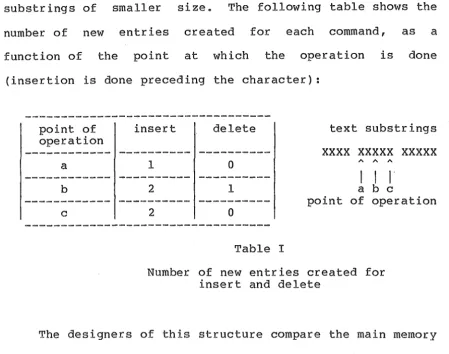
To delete a character string, only the entries in the map are updated, and there is no change in the actual text. If the string to be deleted lies between the first and the last characters of an existing substring (excluding both), a new entry is created on the map. This situation occurs most of the time.
substrings of smaller size. The following table shows the number of new entries created for each command, as a function of the point at which the operation is done
(insertion is done preceding the character):
point of operation
_____
""""______
a
---b_ _ _ _ _ _ _ GOa _ _ _ _
c
insert delete text substrings
--- ---
xxxx
XX XXX XXX XX1 0
" "
"---
____
....,_____
I
,.
2 1 a b c
--- ---
point of operation2 0
Table I
Number of new entries created for insert and delete
[image:25.600.79.528.90.444.2], I
2. 4 DATA STRUCTURES USJiNG LINK,ED LIST OF PAGES
The next stage in the historical development of editor data structures started when the designers realized that to increase the efficiency of the editor, it is necessary to divide the whole text into several small 'pages' or 'blocks', and employ an elaborate and complicated mechanism for handling these pages. This would increase the efficiency of the primitive commands, and also decrease the number of disk i/o operations. For example, the access command becomes a more complicated operation: the designer must consider the access to pages in the secondary store, as well as to the lines or strings. Although some of the data sructures described earlier used some sort of page structure, these pages were stored sequentially on disk file and did not have any logical relation to each other such as links.
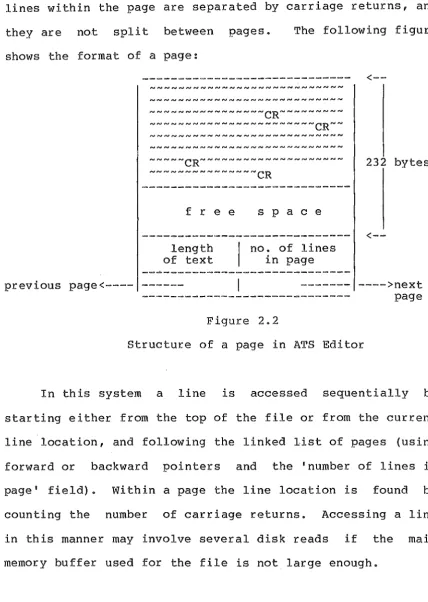
lines within the page are separated by carriage returns, and they are not split between pages.
shows the format of a page:
The following figure
previous
page<---
<--
--~---cR---
---cR---
---cR---
232 bytes---cR
f r e e
s
pa c e
--- <--length
of text
I
no; of lines 1n page
Figure 2.2
---->next page
Structure of a page in ATS Editor
In this system a line is accessed sequentially by starting either from the top of the file or from the current line location, and following the linked list of pages (using forward or backward pointers and the 'number of lines in page' field). Within a page the line location is found by counting the number of carriage returns. Accessing a line in this manner may involve several disk reads if the main memory buffer used for the file is not large enough.
[image:27.598.77.505.88.690.2]of text within a page is only done when a line is altered. If the altered line would cause the page to overflow, a new page is created and linked to the other pages. To insert a new line, it is stored in a new page and this page is linked with the other pages in the desired location. This may split an existing page, where the new line is to be inserted, into two pages, creating a total of two new pages for a single insert.
1. 1 1. 2 3. 3 3. 1 2 1 2
---
---
<---
---
---,u-shift
---
--->
---N-
here---
N---
<---
---before operation
---
---.
.
. 1. 13. 2
after
Figure 2.3
N.l
-1.2
---...
---
---
2---
---
---
---11'04-._..._ ... ... [image:29.600.88.514.72.567.2]3. 1
... ..-.,...,..
---operation
N. 2 .,..
____
Movement of lines in ATS Edior
The solution to this problem adopted by the designers of the ATS Editor is that the system compacts the pages,
from time to time, by moving them to a new file.
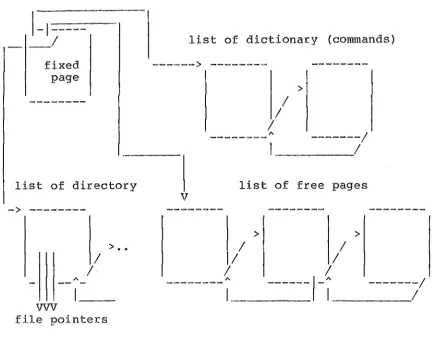
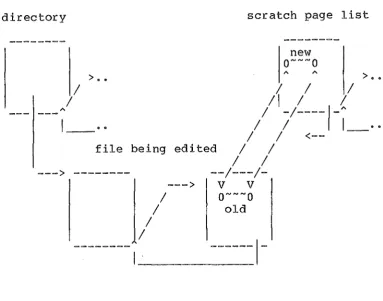
of the conventional file system functions are specially tailored and incorporated in the editor in order to create an efficient editing system for a small single user machine. The files are created and maintained by the editor itself. There are two sets of files in the system. For 'stable files', whose structure and contents are not being modified, the text is stored sequentially within the disk pages. The second types are 'temporary files'. A file becomes temporary after the first editing change is made and becomes stable again after the editing session.
1-1---_ /
fixed page
list of directory ->
---> ••
A
vvv
file pointers
list of dictionary (commands)
--->
---v
I
I
I
>
---A
I _ _ _ _
---/
;
list of free pages
I
I
I
A
>
Figure 2.4
>
System lists after initialization of storage
[image:31.598.81.516.91.428.2]directory
A
I
I
> ••
scratch page list
I
I
I
/I
I
I
> ••
I _
..
II
~/----~-~
..
I
I
<---I
I
--->
file being edited
I
I .
I
I
I
I
I
--1---1---->
v
v
a~~~a
old
---~-Figure 2.5
Structure of a file list during editing
The insert and delete commands are efficient with this structure, since extensive movement of text is eliminated, even within a page. But as modifications are made, the scratch list grows, and hence the sequential format of a stable file is lost. As a result, access to the lines becomes increasingly slow. To solve this problem, it is sometimes necessary to reconstruct this file, and change it to a stable file. This may be an expensive operation.
2.5 DATA STRUCTURES USING RANDOM ACCESS PAGES
[image:32.598.94.478.103.404.2]using this structure is a multiuser editor called 'WYLBUR' developd at Stanford University {Fajman and Borgelt 1973}. In this editor the text is stored in fixed size pages. Each page contains a variable number of characters. No linked list of pages is maintained by this editor. To manage the storage of the pages in secondary store, the editor depends on the underlying file system. But it gets a list of {absolute} disk addresses of the pages from the file system and keeps them in a table in main memory {called the work file directory}. Each entry of this table contains two values: The first line number on the page, and the address of the page. So accessing a line is now done efficiently by searching this list and finding the the address of the page which contains the desired line. This page is read into memory and is searched ·sequentially for the line. In WYLBUR, each line is assigned a line number which serves as an identifier for the line. The numbers range from 0 to 9999.999, with three digits after the decimal point. When creating the text only the integer line numbers are used, and the fractional line numbers are kept for the later insertion of new lines.
With this structure the primitive commands, especially accessing a line, are implemented efficiently for small files. For large files the size of the directory is big, and since primitives operate on this directory (search, expansion, and contraction}, the speed of these commands will be slow . The question of how much free space must be kept in each page for later insertions
unanswered by the designers.
also remains
David E. Rice and A. Van Dam present a theoretical discussion of editor data structures in their article , which is one of the few articles written on this subject
(Rice and Van Dam 1972}. They distinguish the following parts in a data structure:
a. The external divisions which the user deals with, such as lines, superlines, paragraphs, etc.
b. The internal divisions of the text (pages or blocks} for storage purposes in the main memory and secondary storage.
c. The internal representation of the text and the techniques used for performing the primitive commands. They compare the traditional program and data paging strategies with the paging for an editor work file. They realize the more dynamic and complex environment of an editor work file. Based on the traditional techniques, the authors develop new paging strategies for user working sets, placement and replacement algorithms, and the determination of the page size and the size of the main memory paging area for an editor.
distinguish the following methods:
1. Text stored with no control information for structuring or formatting, i.e a continuous string of characters. 2. Text stored together with control information. For example when the size of the line or the pointer to other lines is stored with each line.
All the editors described so far are in the above two catagories.
3. Text and control information are stored separately. In this case a pointer to the actual line is always a part of the control information. Other information may be the size of the line, the page address, and so on.
Editors which use the last method above have proven to be more efficient editors. In the rest of this chapter one such editor will be described. The CHEF editor, and the new data structure, explained in the next two
combination of methods 2 and 3 above representation.
chapters, use a for the internal
2.6 DATA STRUCTURES USING AN ARRAY OF LINE POINTERS
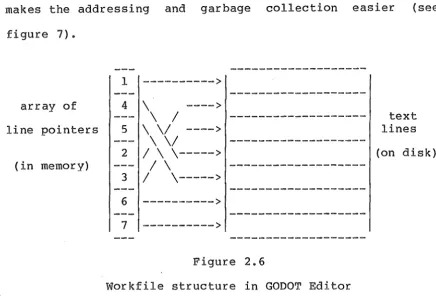
makes the addressing and garbage collection easier (see figure 7).
1
--->
array of
4 \
---->\
I
---
textline pointers 5 \
\1
----> lines\ \I
---2
I \
\--->
(on disk) (in memory)I \
---3
I
\--->
6
--->
7
--->
Figure 2.6
Workfile structure in GODOT Editor
This structure has a major impact on the efficiency of the primitive commands as follows:
To insert a new line, the actual line text is added to the end of the file, and a pointer is created at the corresponding position in the array of line pointers by expanding it.
To delete a line, only the array of line pointers is contracted. Access to any line is made by indexing the array entries. This allows random access to the desired line without any need for searching.
[image:36.600.76.513.88.394.2]is no movement of the actual text for any command, and thus the text structure remains sequential and simple all the time. As a result, there is no need to reconstruct the text frequently, as was necessary in most of the previous structures.
The structure used in the GODOT editor is the simplest form of those using an array of line pointers. There are a number of disadvantages as follows:
1. Since the array is kept in the main memory, there is a limit to the size of the file to be edited. This is a particular disadvantage in small systems with static memory allocation.
2. Manipulation of the array (expansion and contraction) will be slow for large files.
3. Since there is a maximum length reserved for every line of text, a considerable amount of space is wasted.
CHAPTER 3
THE CHEF EDITOR DATA STRUCTURE
In this chapter the CHEF editor data structure is described in detail. There are a number of reasons to assign a whole chapter to this data structure:
i. The new data structure, presented in the next chapter, is based on the CHEF data structure.
ii. CHEF has one of the most advanced data structures as mentioned in the historical development.
iii. CHEF is to be used as the editing server of the Department of Computer Science network.
3.1 GENERAL DESCRIPTION OF THE DATA STRUCTURE
The CHEF work space data structure consists of two distinct parts:
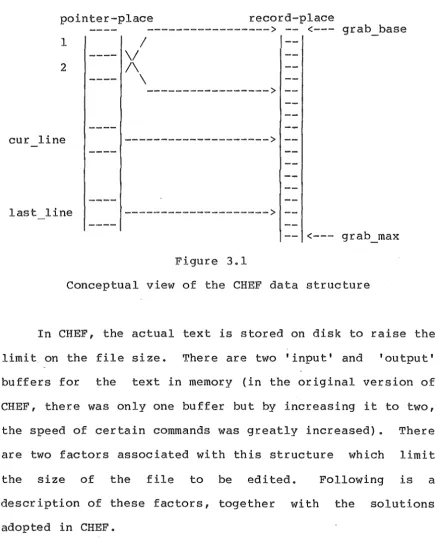
i. A linear array of line pointers, called the 'pointer-place', numbered from 1 to 'last line'. Each entry of this array indicates the starting position of the corresponding text line.
ii. A one-dimensional storage area for text, called the 'record-place', where the variable length lines are stored one after another without gaps. The size of each line is also stored with the line.
and then following the pointer to the text. The following figure shows this data structure with some of the variables indicating its current status:
pointer-place record-place
---> --
<--- grab_baseI
1--1
\1
2
/\
\
--->
cur line
--->
last line
--->
<--- grab_max Figure 3.1
Conceptual view of the CHEF data structure
In CHEF, the actual text is stored on disk to raise the limit on the file size. There are two 1 input 1 and 1 output 1
buffers for the text in memory (in the original version of CHEF, there was only one buffer but by increasing it to two, the speed of certain commands was greatly increased) . There are two factors associated with this structure which limit the size of the file to be edited. Following is a description of these factors, together with the solutions adopted in CHEF.
[image:39.600.77.517.162.704.2] [image:39.600.84.498.168.442.2]memory. In this case a limit has to be put on the size of the array, which limits the number of lines allowed for the work file. To solve this problem, CHEF uses secondary storage· for the pointer-place as well. There are only two blocks of pointer-place in the memory at any time. A simple virtual memory technique with a 'least recently used' algorithm is used for swapping the blocks in and out.
2. The second limiting factor is the characters in the file. Since in CHEF a
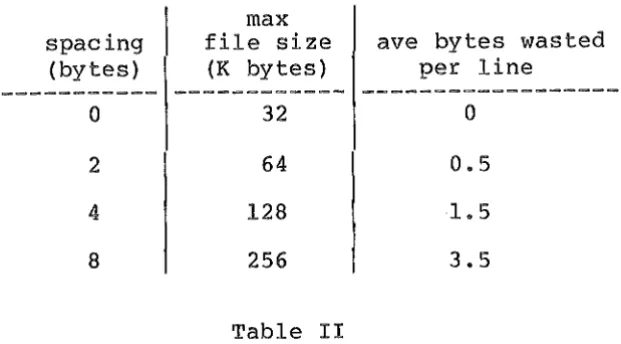
number of line pointer indicates the starting character position of the line in the record-place, any limit to the bit size of the line pointer will create a limit to the character size of the file. The pointer is limited by the word length of the machine used. For example for a 16-bit computer, with two's complement representation, the limit is 32767. In CHEF, this problem is eased by storing the start of each text line in the record-place at discrete addresses spac~d by a fixed number of bytes apart. This wastes a small number of bytes between
max
spacing file size ave bytes wasted (bytes) (K bytes) per line
______
... _...,.___
______
""""'___
, __
---~---~-~---0 32 0
2 64 0.5
4 128 1.5
8 256 3.5
Table II
Maximum workfile sizes for different line spacings
In the CHEF terminology, the number of bytes used for spacing is called a 'grab'. A grab size of 4 is used for most of the CHEF implementations on 16-bit computers, enabling a file of 128 K bytes to be addressed.
[image:41.598.128.439.98.270.2]pointer block and one backup block to every 6 text blocks. So the numbering of the blocks of the merged file is as follows:
file blk. 0 1 2 3 4 5 6 7 8 9 10 11 12 13 14 15 16 17 18 pointer blk.
backup blk. text blk.
0
0 •
0 1 2 3 4 5 1 •
1
6 7 8 9 10 11
2 2
12
The mapping of the pointer block number (Bp}, backup block number, and the text block number (Bt} onto the corresponding (merged} file block numbers (Fp, Fb, and Ft respectively} is done·in CHEF using the following relations:
Fp
=
Bp*
8Fb = Bp
*
8 + 1Ft
=
(BtI
6}*
8 + Bt REM 6 + 2('REM' is BCPL operator corresponding to 'MOD' in Pascal}
3.2 THE IMPLEMENTATION OF THE MAIN COMMANDS
In this section, the implementation of the three primitive commands in CHEF is described in detail.
3.2.1 Accessing a Line
calculated by:
Bp
= (
i + line baseI
block cszwhere 'line base' is one less than the first line of the current work file, and 'block csz' is the (fixed) number of pointers in each block section 3.3 discusses the need for the variable 'line_base').
The pointer block number obtained above (Bp) is mapped onto the file block number as shown in the previous section. The file block, which contains the desired line pointer, is then read into memory, if it is not already there.
The value of the pointer obtained in this way shows the starting position of the line within the record-place (in grabs). This value is converted into two values, a text block number (Bt) and the offset of the line within the block, by the following relations:
Bt
=
pointer valueI
block_gszoffset
= (
pointer value REM block_gsz*
4 Where 'block_gsz' is the number of grabs in a disk block.This text block number is mapped onto a file block number by the relations shown in the last section and the block is read into memory, if it is not already there. The desired line, which is stored in this block from the position shown by 'offset', is copied into the buffer 'line', and passed to the calling program. Accessing a line in CHEF is carried out by a procedure called
'fetch_line (i) '.,
calls for block 'read', and 0 or 1 call for block 'write'. The exact number depends on two factors: whether the desired block (pointer or text) is in memory, and whether the old block to be replaced has been changed since being read in (only for pointer blocks, since there are separate input and output buffers for the text blocks). This is shown in the following table:
block in memory? old pointer no. of calls
pointer text block changed? read write total --~---
---
---~---~---y y X 0 0 0
y N X 1 0 1
N y N 1 0 1
N y y 1 1 2
N N N 2 0 2
N N y 2 1 3
where: Y
=
Yes, N=
No, X=
no effect Table IIINumber of i/o calls for an access in CHEF
3.2.2 Insertion
[image:44.600.72.529.84.512.2]insert here
I
v
before 0 1 2 3 4 5
\
\
\
pointer block no.
\
\
\
\
\
\
after 0 1 2 3 4 5 6
A
new gap Figure 3.2
Creating a gap for an insertion in CHEF
When the new lines come from another region of the work file and the modifier is 'D' ('ID' command which is used for moving a group of lines within the workfile), the operation is performed as follows: the source lines are inserted in the new location and then they are deleted from the original place (by performing a delete operation as described below). So movement of lines is done by two separate operations of insert and delete.
3.2.3 Deletion
To delete one or more lines from the work file, since the number of lines to be deleted is known in advance, all the succeeding pointers in the pointer-place are shifted to the left (contracted), by an amount equal to the number of lines deleted. There is no change in the 'record-place', and the text of the deleted lines is simply abandoned. For contracting the pointer-place, all the pointer blocks from the point of delete command must be read into memeory and modified.
influence on the implementation of the pointer-place. In the original version of CHEF, with the realization that most editing operations are sequential or within a small region of the work file, there was only one 'window' of the pointer-place in the memory, that could move up or down the array of pointers as required. This mechanism worked satisfactorily for most of the editing operations. But when a large number of pointers had to be moved a distance greater than the width of the window, it became very slow. One example of this situation is when the editor is required to delete the first 600 lines of a 1000-line file. For this, the pointers in·positions 601 to 1000 must be moved to the positions 1 to 400. If the width of the window is less than 600 lines, the window must move up to fetch one pointer and down again to store it. This must be repeated 400 times, which requires at least 400 calls for block reads and 400 calls for block writes.
block have been changed since it has been in memory. If they have, it must be written on disk before being replaced, otherwise it is simply ignored.
3.3 THE IMPLEMENTATION OF OTHER IMPORTANT COMMANDS
In this section, the implementation of the commands that affect the data structure is described. These include: Undo, Replace, Execute, Justify, Tag, Change, New, and the control lines. As will be seen, in the implementation of these commands they are translated to the primitive commands access, insert, and delete. It is also important to realize that in CHEF, since the changed lines (replaced, tagged, justified, etc.) are always stored at the end of the record-place, the original lines are never destroyed and can be recovered by the mechanism explained below for the Undo command.
a. Undo Command (U): For undoing a command in CHEF, the inverse of the command is computed for those commands that only move or copy the line pointers, and saved in a buffer called 'trail line'. If the next command is 'U', the inverse command is executed. For example, the inverse of '4ID7,8' is '8ID5,6'. For the commands that destroy the line pointers, such as 'D' (delete), or 'R' (replace), the lost pointers are saved in the appropriate 'backup block' mentioned before. In this case a new command, unavailable
the backup-store to pointer-store. The respect to U into
their original commands in CHEF 3 catagories: a
positions in the are classified with 'willing' command modifies the workspace and can be reversed with 'undo'. An 'unwilling' command can not be undone. a 'neutral' command is used merely to examine the workspace and any number of these can follow a willing command before it is undone.
b. Replace Command (R): The replacement of a substring of a line by a new string is done by the 'R' command. The implementation of this command is done in the following order:
i. The specified line is accessed through the procedure 'fetch line'.
ii. The line text is searched for the pattern. If the pattern is found, it is replaced by the new string.
iii. The altered line is stored at the end of the record-place, and its old pointer in the array is simply replaced by the new pointer.
c. Execute Command (X): command proceeds as follows:
The All
d. Justify Command (J): For implementing the 'J' command, the old text lines to be justified are accessed one by one, justified, and stored at the end of the record-place. The pointers to these lines are inserted in the pointer-place, after the last line of the region being justified. At the end, the old line pointers are deleted.
e. Tag Command (T): It is possible to tag one or more work file lines with a single character, so that they can be picked out later. This is done by the 'T' command. To implement this command there is an extra character, called 'tag_char', associated with each line text in the record-place. When a line is tagged its text is accessed, the specified tag character is placed, and the line is stored at the end of the record-place. As with the replace command, the old pointer in the pointer-place is replaced with the new one.
f. Change Command (C): The 'C' command is used to replace one or more lines with new lines either from the terminal (if there is no modifier and no operand), ano~her region of the work file (if there is a 'D' modifier or an operand), or another file (if there is a 'F~ modifier). When the modifier is 'D', the source region lines are deleted after the operation. The implementation of this command is done by translating it directly to delete and
insert commands.
important status information of the work space, such as 'grab_base', 'last_line', and 'cur line' are stored in a special record at the end of the record-place. Stacking the pointer-place is done by adding the value of 'last line' to a variable called 'line base' (initially zero). In the new work file, access to line ' i ' is performed by first increasing ' i ' by the value of 'line base'. The layout of the pointer-place is indicated in the following figure:
line base
T
-27 0 1 100 101 150
I
controlsI
work space 1 (100 lns) ws 2 (50)Figure 3.3
Layout of the pointer place in CHEF
On unstacking the current work space, all the space used for the line pointers and text for this work space is returned to the system by restoring the status information to its previous values.
[image:50.600.84.518.80.421.2]they can be addressed as lines -1 to -27. For the actual implementation, a memory resident array of 27 cells is used for the control line pointers.
3.4 THE INTERFACE WITH THE UNDERLYING FILE SYSTEM
Since CHEF is primarily studied in this thesis as the basic editor of the editing server, it is necessary to study its interface with the underlying file system. This will help the understanding of the underlying file structure and its relationship with the CHEF data structure, in order to be able to design a single data structure at the editor level with the same overall effect. It also helps to highlight the disadvantages of implementing an editor data structure on top of a file system.
An editor is in fact a piece of utility software. It depends on the host system for providing facilities such as a multiuser environmenb and disk space management. The latter is performed by the file system. Ordinary editors are particularly dependent on this component, i.e. their data structure is built on top of the file system. They call the file system, whenever required, to create and manipulate the work files. This makes the logical design and implementation of an editor data structure easier, but it may produce considerable overheads in terms of disk input and output. It also creates inefficiency in main memory usage, since the file system utilizes its own internal buffers for i/o to files.
work space. These ordered blocks are mapped onto the actual random disk blocks by the file system. The mapping is done differently depending on the underlying file system and the file organization used for the work space. The file organization is selected by the CHEF implementor from one of those made available by the operating system. The following is a description of two systems at the University of Canterbury on which CHEF was implemented.
a. On the PRIME 750 computer, CHEF uses a DAM (Direct Access Method) file organization for its work space. With this organization, the system creates a tree structure of disk blocks for the storage and maintenance of user files. The actual user 'data blocks' (i.e. the CHEF work space blocks) are stored in random disk blocks, and there are one or more levels of 'index blocks' pointing to these blocks. This is shown in the following diagram:
I I I I I . · . .
I I
1---
--\---1
\
____ I
\. ______________ _
v
v
v
I I I I · ..
I ...
-
--\--\---\
\
\
__ _
I .•.
v
v
v
chef block 0 1 2
Figure 3.4
index blocks
I ...
I ..
3 data blocks
Structure of a DAM file on the PRIME 750
[image:52.602.79.520.332.702.2]the ECLIPSE S/130. In this system CHEF uses an RDOS 'random file' organization. Here the user's 'data blocks' are stored in random disk blocks, and there is a linked list of 'index blocks' containing pointers to these blocks, as the following diagram shows:
->1
I
I
I···
1-->1
-
--\--\---
I · · .
I --
>I
I · · · ·
1-\
\
____________ __
\
I •..
index blocksv
v
v
I ....
0 1 2 3
data blocks Figure 3.5
Structure of Random file on the ECLIPSE S/130
From the above description, it can be seen that a block 'read' or 'write' call performed at the CHEF level is in fact a call to the file system to traverse its own blocks structure (e.g. a tree or linked list) to read or write the required block. This creates considerable overheads for the operation of the main editing commands. To demonstrate this, the actual implementation of these commands is' described in the following paragraphs for the version of CHEF implemented on the ECLIPSE.
a. Accessing a Line
Accessing a line proceeds in the following order:
[image:53.600.79.517.221.366.2]2. If the pointer block is not in one of the two windows in memory, the RDOS file system is called to read it in.
3. The file system follows its linked list of index blocks to find the index block containing the actual address of the required block.
4.
The block is accessed a CHEF pointer block) , and passed to the CHEF buffer area (one of the two windows).5. The appropriate pointer to the desired line is retrieved from the pointer block. The pointer gives a sequential text block number and the offset of the line within the block. The text block number is converted
to a work space block number, as shown earlier.
6. The file system is called again to retrieve the desired block. For a second time, the file system follows its linked list of index blocks to access the text block. 7. The block is read and passed to the CHEF input buffer
for text.
b. Insertion
The insertion of a line (or lines), which may involve a large number of disk i/o operations, is carried out in the following order:
1. All the steps for accessing a line are performed to store the new line text in the work space.
positions. For each 'read' and 'write' carried out, steps 2, 3, and 4 for 'access' must be repeated.
3. After inserting the new pointer(s) in the gap, the gap is closed up which involves accessing all disk blocks containing the tail portion of the pointer-place. As above, steps 2, 3, and 4 are repeated for each block
'read' and 'write'.
c. Deletion
To delete a line pointer, all the pointers after the point of operation are read, shifted to the left, and written out on disk. ·Again this requires steps 2, 3, and 4 to be repeated for each read or write.
The exact number of disk i/o operations for performing the main commands depends on the following factors: the size of the workfile, the 'distance' of the current line from the desired line, the number of file system internal buffers and whether the operating system.maintains a 'cashe' of blocks, and if a linked list is used (e.g. on ECLIPSE) whether the index blocks can be traversed both forward and backward.
CHAPTER 4
A NEW EDITOR DATA STRUCTURE
In this chapter, the basic concepts of the new structure are described.
4.1 GENERAL CHARACTERISTICS
data
As shown in chapter 2, there was a logical development of editor data structures. In the direct editing systems, the whole text was stored in memory and the operations directly affected the text. It was later decided to store the text on several disk pages (blocks) to be able to edit larger files with possibly better performance. The early page structures utilized the pages sequentially. Later, a linked list structure was used for the pages. It was then realized that, by keeping the page addresses in memory, the performance could be improved. With the ·development of data structures which utilize
phase started in which the
structure for the pointer array as well as the stored most of it on disk. On CHEF, the
(pointer blocks) are utilized sequentially.
text, and array pages one would expect that
would have a suggested by
a linked better
Dr. M.
list structure of the pointer blocks performance and this structure was A. Maclean in 1982. It was later decided that further improvements were possible by utilization of a memory resident table for the access and manipulation of the pointer blocks. This further shifts the operation of the main commands from the array to a much smaller resident table. This makes the new data structure inherently more efficient for editing purposes than the earlier structures studied in chapter 2.
Another advantage of the new data structure is that it is capable of handling its own de,dicated disk space for several users' work files. This makes it possible for the editor (CHEF) to be implemented in the editing server without the need for a file system. And in this case, since there is no underlying file structure, a higher performance is expected for the editor.
[image:57.600.64.529.96.751.2]4.2 GENERAL STRUCTURE
The new data - structure consists of at most components as follows:
four
1. An internal table, called the pointer block
2.
'directory', used for accessing and manipulation of the pointer blocks. Each entry of the directory has two values: The address of the corresponding pointer block, and the number of pointers in the block.
The array of line pointers, stored in randomly allocated blocks of disk (in a dedicated environment) , or a file (in a file system environment). Each pointer block contains a variable number of pointers (between reasonable bounds) to allow for efficient insertion and deletion.
3. An optional memory resident 'map-table' used for accessing the text blocks. This table is only required when the data structure is used in an editing server on a 16-bit computer.
4. The actual text, stored in randomly allocated blocks of disk or a file. The format of the lines stored in the blocks is basically the same as in CHEF. All the new or altered lines are stored at the end
record-place (in the last text block).
of the
of the pointer within the block) is accessed through the directory, and then the desired text block (and the offset of the line within the block) is accessed through the pointer, either directly or through the internal map-table. The same virtual memory technique used by CHEF is used for both the pointer and text blocks. There are two windows of the pointer-place in memory. A 'least recently used' mechanism is used for swapping the blocks in and out. There
are also two input and output buffers for the text blocks. The following figure shows a conceptual view of the new data
structure:
count
I . • . I
address
I
I
I I I I . · · I I
directory (memory)
v
I
_ _ _ _ _ _
I
II
I
I I I I . . .
I
XXI
\--\--\---\
\
\
\
-\
\
\ \ -v
\
- v ...
v
v
v
--\---\
\
\
\
__
I I I ... I
xxxxI
__
,__
,
_________ _
v
I ...
lxxxxxxxl<- <- pointer blocks (disk)
I I I I I I I . . .
I I
1--\---\---I
v
I
I
I
111111111···
\
\
\
\
\
\
__
v
I I I I I I I I I I ...
map-table (memory)
v
1--> 11111111111 •••
text blocks (disk) Figure 4.1
[image:59.598.81.511.357.711.2]4.3 DETAILED DESCRIPTION OF THE DATA STRUCTURE
The four components of this data structure are further elaborated in this section.
1. The Pointer Block Directory: The directory is the most important component of the data structure for two
reasons:
i. It makes it possible to store the pointers in random disk blocks.
ii. It is the main component increasing the efficiency of insert and delete commands. This is done in two ways. First, by avoiding extensive movement of the pointers, since most of the operations performed on the array of line pointers are now done on the directory which has a much smaller size and can always be kept in memory. Second, by avoiding a large number of disk i/o operations for manipulation of the pointer blocks.
a block size of 256 words and an average of 218 pointers per block.
2. The Pointer Blocks: The pointer blocks contain a variable number of pointers each. At the beginning of editing, when the blocks are created, an initial number of pointers is stored in each block. This value is optional and can be set by the implementor. Although it has no major effect on the performance, a value between 75 to 85 percent of the total capacity is recomended. As editing proceeds, this allocation of the pointers is changed, but there are always a minimum and'maximum number of pointers that can be stored in each block. These values are commonly set to 100 (for minimum) of the total capacity. As an example, for the ECLIPSE Computer where a block size of 256 words is used, the values are 128, 218 minimum, average, and maximum respectively). The experimental results (presented in chapter 6) show that these values are satisfactory.
the rest can be allocated for addressing the text blocks. For 32-bit and larger computers this problem disappears for all practical purposes, since there are at least 22 bits available for addressing the text blocks. This can address a disk space of up to 2000 Megabytes (a block size of 512 bytes is assumed). For a 16-bit computer, there are fewer bits available for addressing the text blocks. In a dedicated disk environment, it becomes necessary to address them indirectly through the internal 'map-table'. This will be further described in the next sub-section.
3. The map-table: As mentioned, this map is,only used when the data structure is implemented in a 16-bit computer with a dedicated disk. The bit allocation of a line pointer in a 16-bit computer is as follows:
one bit for the operation of the 'X' command.
6 bits for addressing the offset of the line within the text block.