14
©IJRASET: All Rights are Reserved
Energy Efficient Routing in Wireless Sensor
Network using a Modified LEACH based Protocol
Akanksha Goel1, Anamika Tiwari2
1, 2
M.Tech Student, Deptt. Of CSE, Bhabha Institute of Technology, Kanpur
Abstract: Modelling and developing energy-efficient routing methods have thus become one of the most significant approaches in wireless sensor networks (WSNs) in a Wireless Sensor Network sensor nodes have restricted hardware resources. In a distributed sensor network, a common aspect of routing technology, cluster-based heterogeneous routing protocols have proved efficient in topology management, energy consumption, information collection or fusion, reliability, or stability. In this article, which utilizes threshold requirements to select cluster heads, a heterogeneous clustering method based on distributed energy effective clustering is suggested. In this paper, a modified version of LEACH protocol has been discussed and the network simulation has been performed. Simulation results indicate that the suggested model is more effective than the other protocols and considerably improves the service life of the sensor network as compared to LEACH.
Keywords: Wireless Sensor Networks, Energy Efficient Routing, LEACH, Network Lifetime.
I. INTRODUCTION
Wireless sensor networks (WSNs) include tiny sensor nodes that can transmit information via information processing, computing, and wireless channels of communication[1]. One of the WSN's biggest issues is that the sensor nodes have restricted battery energy. The routing of protocols around the job fields of the WSN is an significant area. A homogeneous distribution of the current energy to the WSN is also appropriate in addition to prolonging the life of the sensor nodes. Due to the restricted power supply in the sensor nodes, the power consumption of the power source is an significant idea in the WSNs. Maximum energy is used when information is transferred via sensor nodes to other nodes. For all these purposes, a number of research were performed to create routing algorithms to extend a sensor network's life. Compared to other types of wireless networks that affect network performance, the Wireless Sensor Networks have some distinct features. These features such as node density make Wireless Sensor Networks unique in algorithms and protocols. For example, the amount of sensor nodes can be highly greater in Wireless Sensor Networks than ad hoc networks and densely deployed nodes. Wireless Sensor Networks ' deployments of nodes, node density, energy limitations are all particular characteristics that influence network design and efficiency. Besides the node fatalities often happen owing to the depletion or failure of the battery and this leads to modifications in topology.
The three communication kinds are accessible in Wireless Sensor Networks viz. are: Cluster Head member node, Cluster Head to Cluster Head, Cluster Head to sink. The first is called communication within the cluster. In this form, the member node sends sensed information to the head of the cluster or to the head of the cluster. The second is called communication between clusters. Cluster heads send their aggregated information to sink with multi-hop communication via the intermediate cluster head. The cluster head sends aggregated information straight to the base station in the last type.
In the Wireless Sensor Networks, the grouping sensor nodes into the clusters were commonly used to achieve goals such as load balancing, preserving connectivity scalability, energy efficiency etc. Clustering technique is used in mobile ad hoc to create stable clusters in mobile node environments to preserve node accessibility and path stability. On the other side, Wireless Sensor Networks clustering techniques concentrate on network longevity and coverage. Sensor network is divided into groups called clusters and each cluster has a coordinator node called cluster head.
15
©IJRASET: All Rights are Reserved
II. LITERATUREREVIEW
The literature on energy efficient protocol clustering for WSNs contains many research. In one study, a routing algorithm with LEACH clustering adaptation is provided for homogeneous WSNs, where sensor nodes are randomly determined as CHs (Cluster Heads) and the power load of the device is shared with the WSN[4]. A fresh LEACH-based energy optimization routing protocol is suggested in[5]. It is recognized that this algorithm is more effective than the LEACH algorithm by choosing cluster heads equally. The paper presents a modified LEACH extracted from the LEACH algorithm[6]. In[7], an enhanced portable sink energy-efficient algorithm is provided in comparison with mod-LEACH and PEGASIS[8]. A fresh energy-efficient (EE) clustering technique is suggested in[9] for single passes, heterogeneous WSNs. Simulations from MATLAB indicate that the above technique is 1.62-1.89 times more stable than established protocols such as LEACH, DEEC and SEP. Cluster stability is lowered in[10] as the LEACH protocol on an uneven network leads to a reduction in aggregate data efficiency. Therefore, this article[10] indicates a technique to select a cluster head to enhance the LEACH protocol to boost the cluster head's stability. In conjunction with the HEED and LEACH protocol, a LEACH variant is suggested for this purpose and this technique is endorsed by simulation. Two energy-efficient route planning protocols for three levels of heterogeneous WSNs are suggested in[ 11], namely Central Energy Efficiency Clustering (CEEC) with knowledge of Two-Hop Heterogeneity (THCEEC) and Advanced Equalization (ACEEC). Comprehensive simulation findings for CEEC, ACEEC, and THCEEC core cluster deployments have enhanced reliability and energy efficiency performance, offering better network life and effective data transmission than traditional distributed routing protocols from LEEC, SEP, ESEP, and DEEC. Analytical evaluation demonstrates that for CEEC, ACEEC and other current road planning, THCEEC conducts routing protocols. The study[12] indicates an efficient technique of using a support vector to collect information in the WSN. In[13], performance evaluation of the clustering protocol is provided in WSNs. Clustering of sensor nodes is an efficient method for achieving these objectives. This method was used to evaluate and compare other clustering models (LEACH, LEACH-C, and HEED). Clustering techniques are ultimately likened to various criteria such as convergence velocity, cluster stability, cluster overlap, location awareness, and node mobility assistance. In another study[14], a classification survey on behalf of model kinds is offered by the research of distinct sensor network routing models. Data-centric, hierarchical, and location-based are the three primary categories examined. Routing techniques and algorithms have a common purpose for improving performance and extending the sensor network's helpful life. A comparison was created between flood and direct diffusion, two network-and lifetime-based routing protocols. In three-dimensional heterogeneous WSNs, the study[15] provides random assessment of coverage and connectivity.
III. METHODOLOGY
The nodes are randomly deployed in the network. Initially, all the nodes are having intial energy, Eo. Before start of each round the threshold energy of each nodes is calculated and based on it the nodes are denoted as either active nodes or the sleep nodes.
1) Case 1: E0 > Eth: When remaining energy is greater than the threshold energy, the node is in active mode and ready for communication.
2) Case 2: E0 < Eth: When remaining energy is less than the threshold energy, the node moves towards sleep position.
The node regions are divided into clusters and data is aggregated and sent to cluster heads (CH’s), these cluster heads then forward this data to the base station. The selection of Cluster head is done as described:
16
©IJRASET: All Rights are Reserved
Scheduling is an important concept in clustering. When some nodes are elected as cluster heads and other nodes become member of their corresponding cluster head, member node starts communication with cluster heads. So, it can become fairly impossible for the cluster heads to respond to each and every node in the cluster. Thus a time division is assigned by the cluster heads to all the nodes. All the associated nodes transfer data to cluster heads in its own scheduled time slot. While a particular node is transmitting, all other nodes stay idle. Nodes thus can know their own transmission schedule and need to be turned on only at times its transmission time. This method thus saves lot of energy for the individual nodes and for the network as a whole.
The steady state phase refers to the actual operational phase of the network. The cluster heads receive data packets from their respective associated nodes and forward this data packet to the base station. The process continues until the nodes die out of their energy after a certain number of rounds, called the lifetime of the network.
IV. RESULTS & DISCUSSIONS
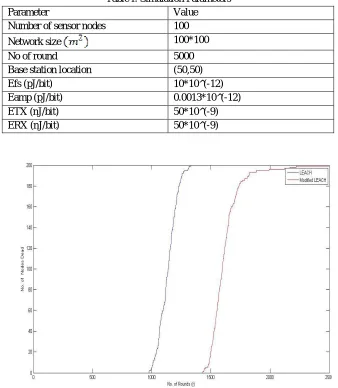
[image:3.612.138.476.308.696.2]The software has introduced the different equations that define the energy dissipation process in the wireless sensor network. Table 1 below shows the different network modeling parameters with their values. The network area is 200mx200 m for this simulation. The base station is located in the network region at x=100, y=100. The division demonstrates the network area's distinct cluster formation. It takes the amount of nodes to be 200. For 2500 rounds, the network is simulated. A certain time scale is equal to the rounds. In order to calculate the average energy remaining in each node, the energy dissipation factor from distinct sources is collected after each round.
Table I: Simulation Parameters
Parameter Value
Number of sensor nodes 100
Network size 100*100
No of round 5000
Base station location (50,50)
Efs (pJ/bit) 10*10^(-12)
Eamp (pJ/bit) 0.0013*10^(-12)
ETX (nJ/bit) 50*10^(-9)
ERX (nJ/bit) 50*10^(-9)
17
©IJRASET: All Rights are Reserved
[image:4.612.151.475.185.414.2]The above figure 1 shows the comparison of the modified LEACH protocol proposed in this research work with that of the LEACH protocol. As shown from the figure 1 the modified LEACH method has a considerable improvement in terms of nodes getting inactive or dead. The first dead node in the LEACH protocol under similar simulation parameters and network parameters occurs at around 941 rounds whereas in the modified LEACH algorithm the first dead node occurs at around 1395 rounds. This is a notable improvement in the lifetime of the network. Similarly, the nodes die out completely at around 1400 rounds in LEACH protocol whereas in the modified LEACH protocol the network dies out a t round number 2247. This further affirms the effectiveness of the modified LEACH protocol. The below figure shows the number of alive nodes plotted against the number of rounds.
Figure 2: Alive Nodes vs Rounds
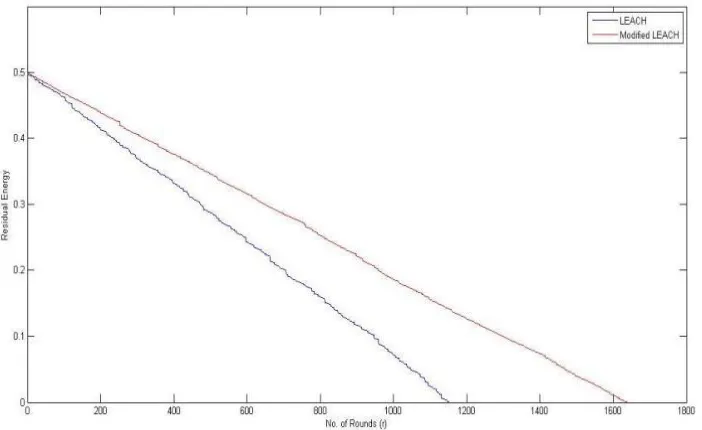
The residual energy graph giving a comparison between the LEACH protocol and the modified LEACH protocol is shown in the figure 3. As shown in the graph the energy of the networks is increased in the proposed protocol and hence the network lifetime.
[image:4.612.139.490.490.705.2]18
©IJRASET: All Rights are Reserved
V.CONCLUSION
The present study work also focuses on the suggestion of a protocol based on node activity data and the identification of inactive nodes or sleep nodes. The inactive nodes are held out of the process of transmitting information, thus saving energy that would otherwise have been wasted. They pursue a conventional clustering based on LEACH to send their data packets to the corresponding cluster heads which in turn send them to the Base Station on MATLAB software instrument, the algorithm has been effectively applied, with some normal parameters available in different prior study methodologies. The outcomes were compared with the LEACH protocol and showed a significant improvement.
REFERENCES
[1] G. Vijayalakshmi, S. Hema and S. Geethapriya, “Secure Data Aggregation & Query Processing in Wireless Sensor Networks using Enhanced Leach Protocol”, International Journal of Emerging Science and Engineering, Vol. 2, No. 1, pp. 51-56, 2013.
[2] M. Umashankar and C. Chandrasekar, “Energy Efficient Secured Data Fusion Assurance Mechanism for Wireless Sensor Networks”, European Journal of Scientific Research, Vol. 49, No. 3, pp. 333-339, 2011.
[3] Kumar Padmanabh and Sunil Kumar Vuppala, “An Adaptive Data Aggregation Algorithm in Wireless Sensor Network with Bursty Source”, Wireless Sensor Network, Vol. 1, No. 3, pp. 222-232, 2009.
[4] V. Bhoopathy and R. M. S. Parvathi, “Energy Efficient Secure Data Aggregation Protocol for Wireless Sensor Networks”, European Journal of Scientific Research, Vol. 50, No. 1, pp. 48-58, 2011.
[5] Vaibhav Pandey, Amarjeet Kaur and Narottam Chand, “A review on data aggregation techniques in wireless sensor network”, Journal of Electronic and Electrical Engineering, Vol. 1, No. 2, pp. 1-8, 2010.
[6] Nandini. S. Patil and P. R. Patil, “Data Aggregation in Wireless Sensor Network”, IEEE International Conference on Computational Intelligence and Computing Research, 2010.
[7] Kiran Maraiya, Kamal Kant and Nitin Gupta, “Wireless Sensor Network: A Review on Data Aggregation”, International Journal of Scientific & Engineering Research, Vol. 2, No. 4, pp. 1-6, 2011.
[8] Sung-Hwa Hong, Jeong-Min Park and Joon-Min Gil, “Performance Evaluation of a Simple Cluster-Based Aggregation and Routing in Wireless Sensor Networks”, International Journal of Distributed Sensor Networks, Vol. 2013, Article ID: 501594, pp. 1-9, 2013.
[9] A. Manjeshwar and D. P. Agarwal, "TEEN: a routing protocol for enhanced efficiency in wireless sensor networks," In 1st International Workshop on Parallel and Distributed Computing Issues in Wireless Networks and Mobile Computing, April 2001
[10] A. Manjeshwar and D. P. Agarwal, "APTEEN: A hybrid protocol for efficient routing and comprehensive information retrieval in wireless sensor networks," Parallel and Distributed Processing Symposium., Proceedings International, IPDPS 2002, pp. 195-202.
[11] U. Sajjanhar, P. Mitra, ―Distributive Energy Efficient Adaptive Clustering Protocol for Wireless Sensor Networks‖, Proceedings of the 2007 International
Conference on Mobil Data Management, pp. 326 - 330, 2007.
[12] Elbhiri Brahim,Saadane Rachid,Alba-Pages Zamora, Dris Aboutajdine, ―Stochastic Distributed Energy-Efficient Clustering (SDEEC) for heterogeneous wireless sensor networks‖, ICGST-CNIR Journal, Volume 9, Issue 2, December 2009.
[13] Inbo Sim, KoungJin Choi, KoungJin Kwon and Jaiyong Lee,―Energy Efficient Cluster header Selection Algorithm in WIRELESS SENSOR NETWORK‖,
International Conference on Complex, Intelligent and Software Intensive Systems , IEEE, 2009.
[14] Ma Chaw Mon Thein, Thandar Thein ―An Energy Efficient Cluster-Head Selection for Wireless Sensor Networks‖, International Conference on Intelligent
Systems, Modeling and Simulation, IEEE 2009
[15] Dilip Kumar, Trilok C. Aseri, R.B. Patel, ―EEHC: Energy efficient heterogeneous clustered scheme for WIRELESS SENSOR NETWORKs‖, ELSEVIER,
Computer Communications, 32 (2009) 662–667
[16] Yingchi Mao, Zhen Liu, Lili Zhang, Xiaofang Li, ―An Effective Data Gathering Scheme in Heterogeneous Energy WIRELESS SENSOR NETWORKs, International Conference on Computational Science and Engineering,2009.
[17] E.M. Petriu, N.D. Georganas, D.C. Petriu, D. Makrakis, and V.Z. Groza, “Sensor-based information appliances,” IEEE Instrumentation and Measurement Magazine (December 2000) 31–35.