1
Simulating the complexity of the classroom
2
Title Simulating the complexity of the classroom
Subtitle Helping student teachers creating an effective and
positive learning environment in the classroom
Author Laura Ruitenberg
Student number: 1131737
Master Educational Science & Technology Educational Design and Effectiveness Twente University, Enschede
Graduation committee First supervisor: Susan McKenney Second supervisor: Joke Voogt
Faculty of Behavioral Sciences at Twente University
External client Windesheim University, Zwolle
Margreet van Oudheusden
3
ForewordThis thesis is the result of my final project at Windesheim University in Zwolle, which is also my completion of the Master Educational Science and Technology. I have enjoyed working on this final thesis, even though I had occasionally setbacks. I Hope you read my thesis which much pleasure, as much I had while I was working on this.
Before you start reading, in the first place I would thank some people, who have helped me during my final project. First of all I would like to thank my second supervisor (at the start of my final project mine first supervisor), Joke Voogt for the critical look at my research and the proper feedback, this has helped me in conducting my research. I would also like to thank my first supervisor, Susan McKenney, for the critical look at my research and the proper guidance
I would also like to thank my external supervisor Margreet van Oudheusden, for the clear expectations if I just did not get it, the proper guidance, helping searching for suitable literature and the excellent cooperation. I would like to thank Wim Trooster for the help in the statistical part of my research and the guidance he offered when Margreet van Oudheusden could guide me only via Skype, due to her illness. In addition, I would like to thank Geert Holwerda, master student at the University of Twente and working at Windesheim University, for selecting teachers and student teachers for my focus group, interview and questionnaire.
Finally, I would like to thank two people. Judith Dijk for helping me to calculate Cohen’s Kappa and the last person I would like to thank is my mother, for always be there for me, listen to my experiences during my research and when I had a setback, she was the one who could motivate me again.
Zwolle, 30 May 2014
4
SummaryIn teacher training seems to be a gap between teacher training and practice (Scheeler, 2008). According to Scheeler (2008) this way teachers, who just start work have a limited repertoire of teaching strategies. They have difficulties transferring the obtained teaching techniques into the real classroom and they find it hard to maintain the learned teaching skills and teaching techniques over time (Freiberg, 2002; Scheeler, 2008). Beginning teachers feel not adequately prepared when they start teaching in the real classroom (M.A. van Oudheusden, personal communication, February 26, 2014). Therefore Windesheim University wonders if a simulation can contribute to reduce the gap between teacher training and practice. The selected context for this study is the teacher training institute of Windesheim University in Zwolle.
This study is a part of a small scale project at the teacher training institute of Windesheim
University of Applied Sciences in the Netherlands. The goal of this study is to identify the content and pedagogical characteristics of a simulation that contribute to the acquisition of the necessary
competences need to create a positive and effective learning environment in the classroom. The method used for this study is the analysis phase of Educational Design Research. The analysis phase consists of three activities, (1) initial orientation, (2) literature review, and (3) field-based investigation (McKenney & Reeves, 2012). In the initial orientation the problem statement is described. After that, the conceptual framework is described, in which the concepts are explained. The last activity, field-based investigation, consists of a document analysis, focus groups, questionnaire and observations.
The results show that student teachers have several problems with the six research-based elements of Marzano, Marzano and Pickering (2003), (1) rules, expectations and procedures, (2) disciplinary interventions, (3) teacher-student relationship, (4) mental set, (5) student’s responsibility for management, and (6) getting off to a good start. The results showed that student teachers experience less or no difficulties with building up positive teacher-student relationship, with the other five research-based elements they experience more problems. Student teachers and university teachers indicated a few similarities in problems looking at the other research-based elements, such as problems with the consequences of the rules, problems with the pace and alignment, problems with giving positive and negative feedback, problems with giving space to pupils and problems with relying on the power of the pupils. When looking at the needs, the most student teachers and university teachers found that, the teacher education pays sufficient attention to all these points, a few needs are appointed. The PBS approach can be used as a possible framework to overcome these problems. All the PBS-principles could be related to all seven competences of the teacher training institute. To practice solving these problems, a simulation could be developed.
The conclusion shows that a simulation could be developed for student teachers to be used during teaching training, taking several content characteristics into account, to respond to the advantages, disadvantages and to connect to the problems and needs of the student teachers and the university teachers. A simulation should be, (1) personalized, (2) motivating, (3) resembling reality, (4)
6
Table of ContentsForeword ... 3
Summary ... 4
List of figures ... 10
List of Tables ... 11
1. Introduction ... 12
1.1 Problem Statement ... 13
1.2 Context ... 13
1.3 Purpose of the study ... 13
1.4 Practical and scientific relevance ... 13
1.5 Overview of the Thesis ... 14
2. Theoretical framework ... 15
2.1 Positive and effective learning environment in the classroom ... 15
2.1.1 Rules, expectations and procedures ... 16
2.1.2 Disciplinary interventions ... 17
2.1.3 Teacher-student relationship ... 18
2.1.4 Mental set ... 18
2.1.5 Student’s responsibility for management ... 19
2.1.6 Getting off to a good start ... 19
2.1.7 Problems... 20
2.2 Positive behaviour support ... 21
2.2.1 Working school wide ... 22
2.2.2 Prevention... 23
2.2.3 Positive approach, effective rules, teaching behavioural expectations and consequences 24 2.2.4 Decision-making on the basis of data ... 26
2.2.5 Collaboration with parents and chain partners ... 26
2.2.6 The benefits of positive behaviour support ... 27
2.3 Simulation ... 27
2.3.1 Types of simulations ... 28
2.3.2 Components in simulations in teacher education ... 29
2.3.3 Simulations in teacher education ... 29
2.3.4 SimSchool... 30
2.3.5 Advantages and disadvantages of a simulation in teacher education ... 32
2.3.6 The concept and characteristics of a simulation in teacher education ... 34
2.4 Summary ... 35
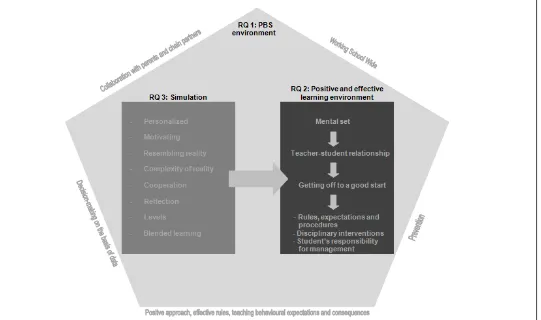
2.5 Theoretical framework and its application to the current study ... 35
2.6 Research questions ... 37
3. Method ... 38
3.1 Research design ... 38
7
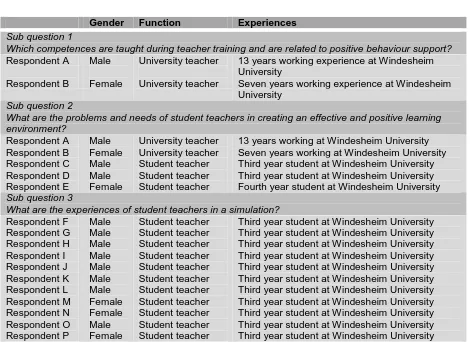
3.2.1 Respondents for sub question: Which competences are taught during teacher training andare related to positive behaviour support? ... 39
3.2.2 Respondents for sub question: What are the problems and needs of student teachers in creating an effective and positive learning environment? ... 39
3.2.3 Respondent for sub question: What are the experiences of student teachers in a simulation? ... 40
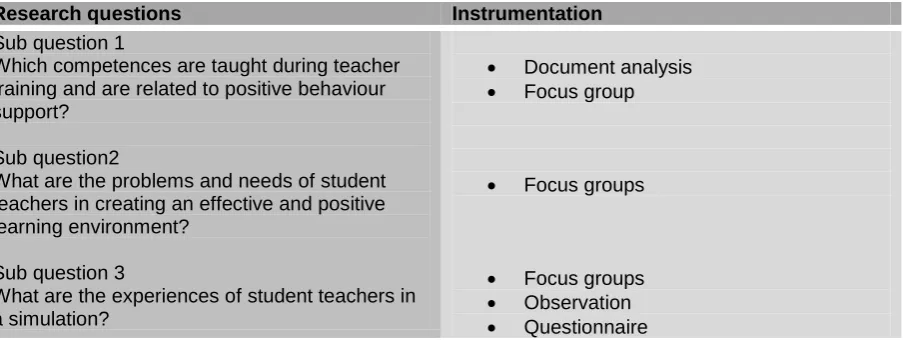
3.3. Instrumentation ... 40
3.3.1 Document analysis ... 41
3.3.2 Focus group ... 41
3.3.3 Questionnaire ... 42
3.3.4 Observation ... 43
3.4 Procedures ... 43
3.4.1 Procedure for sub question: Which competences are taught during teacher training and are related to positive behaviour support? ... 43
3.4.2 Procedure for sub question: What are the problems and needs of student teachers in creating an effective and positive learning environment? ... 44
3.4.3 Procedure for sub question: What are the experiences of student teachers in a simulation? ... 44
3.5 Data analysis ... 44
3.5.1. Document analysis ... 44
3.5.2 Focus group ... 45
3.5.3 Questionnaire ... 45
3.5.4 Observation ... 45
4. Results ... 46
4.1 Which competences are taught during teacher training and are related to positive behaviour support? ... 46
4.1.1 Describing each competence ... 47
4.1.1.1 Interpersonal competence ... 47
4.1.1.2 Pedagogical competence ... 48
4.1.1.3 Professionally competence... 48
4.1.1.4 Organizational competence ... 48
4.1.1.5 Collaboration with colleagues ... 48
4.1.1.6 Collaboration with the environment ... 49
4.1.1.7 Reflection and development ... 49
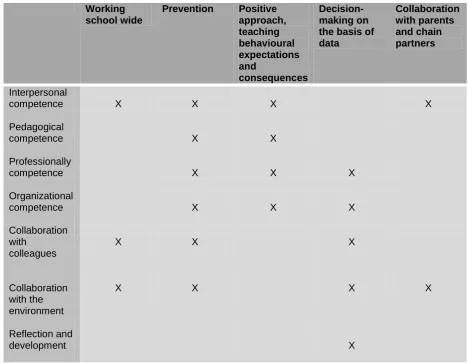
4.1.2 PBS-principles and competences ... 49
4.1.2.1 Working school wide ... 49
4.1.2.2 Prevention... 49
4.1.2.3 Positive approach, effective rules, teaching behavioural expectations and consequences ... 50
4.1.2.4 Decision-making on the basis of data ... 50
4.1.2.5 Collaboration with parents and chain partners ... 50
8
4.2.1 Rules, expectations and procedures ... 51
4.2.1.1 University teachers ... 51
4.2.1.2 Student teachers ... 52
4.2.2 Disciplinary interventions ... 53
4.2.2.1 University teachers ... 53
4.2.2.2 Student teachers ... 53
4.2.3 Teacher-student relationship ... 54
4.2.3.1 University teachers ... 54
4.2.3.2 Student teachers ... 55
4.2.4 Mental set ... 55
4.2.4.1 University teachers ... 55
4.2.4.2 Student teachers ... 56
4.2.5 Student’s responsibility for management ... 56
4.2.5.1 University teachers ... 56
4.2.5.2 Student teachers ... 56
4.2.6 Getting off to a good start ... 58
4.2.6.1 University teachers ... 58
4.2.6.2 Student teachers ... 58
4.3 What are the experiences of student teachers in a simulation? ... 60
4.3.1 General information about the experiences of student teachers in the simulation simSchool ... 60
4.3.2 Communication ... 60
4.3.3 Connection simulation – practice ... 61
4.3.4 Usability, clarity and understand-ability ... 63
4.3.5 Opportunity to practice and critical reflection on complex educational situations ... 64
4.3.6 Analyzing teacher and student behaviour by using data ... 66
4.3.7 Motivation ... 69
4.3.8 Opportunity to provide guidance/support from the teacher training institute by fellow ... 70
students and teachers ... 70
4.3.9 Influence on designing simulation ... 71
4.3.10 Pedagogy of teaching and vision ... 73
4.3.11 Simulation as an important learning tool ... 74
5. Conclusions and Reflections ... 75
5.1 Summary of the findings ... 75
5.1.1 Which competences are taught during teacher training and are related to positive behaviour support? ... 75
5.1.2 What are the problems and needs of student teachers in creating an effective and positive learning environment in the classroom? ... 76
5.1.3 What are the experiences of student teachers in a simulation? ... 77
5.2 Conclusions ... 82
9
5.3.1 Reflection on the research methodology ... 89
5.3.1.1 Reflection on the design ... 89
5.3.1.2 Reflection on the instruments ... 89
5.3.1.3 Reflection on the data ... 90
5.3.2 Reflection on the results ... 91
5.3.2.1 Positive and effective learning environment in the classroom ... 91
5.3.2.2 Positive behaviour Support... 92
5.3.2.3 Simulation ... 93
5.4 Recommendations ... 94
5.5 Closing remarks ... 95
6. References ... 96
7. Appendices ... 103
Appendix1. Method conceptual framework ... 104
Appendix 2. Focus group University teacher ... 105
Appendix 2. Focus group University teacher ... 105
Appendix 3. Focus group student teachers ... 109
Appendix 4. The simSchool Feedback Survey from Knezek and Christensen ... 113
Appendix 5. Coding Scheme ... 115
Appendix 6. Calculating Cohen’s Kappa focus group ... 120
Appendix 7. Questionnaire lesson simSchool ... 123
10
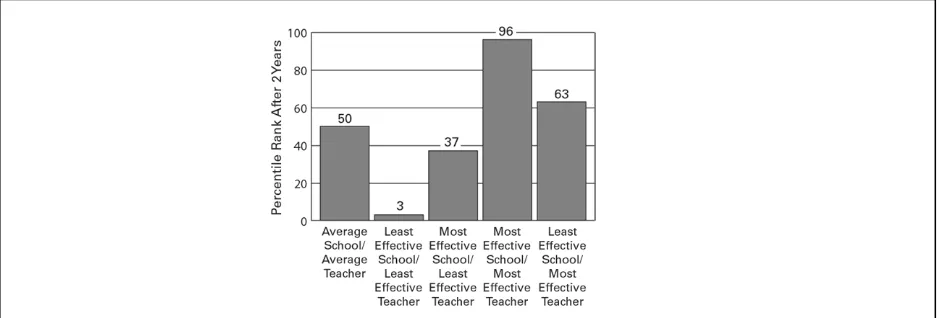
List of figuresFigure 2.1 Effects of a School vs. A Teacher on Student Entering at 50th Percentile...16
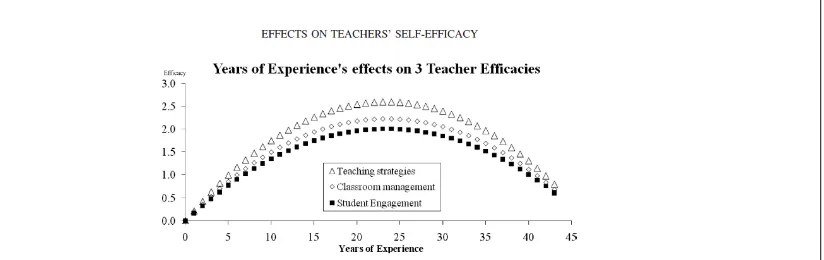
Figure 2.2 Relationship of years of experience with three teacher self-efficacy variables (teaching strategies, classroom management and student engagement) based on the structural equation model results...20
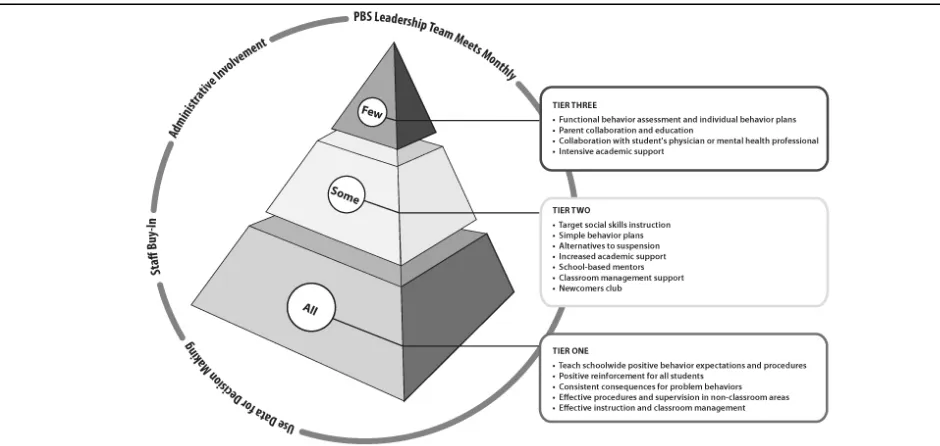
Figure 2.3 PBS Pyramid...24
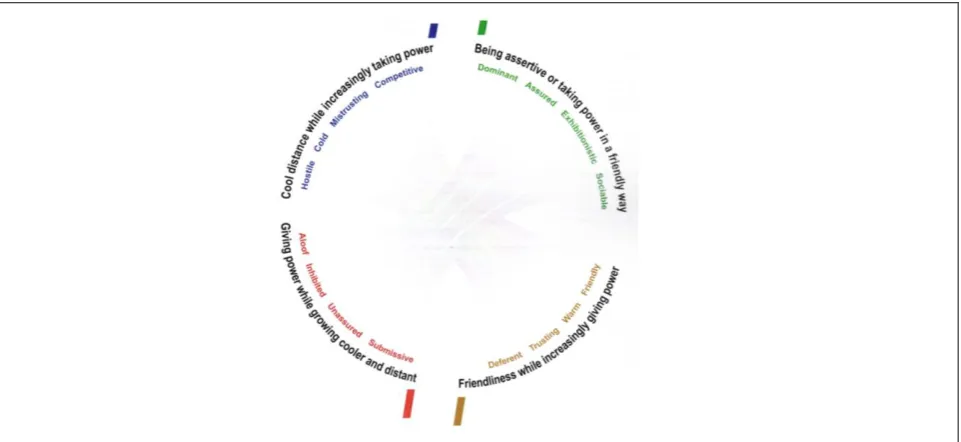
Figure 2.4 The Circumplex-Comments in simSchool...31
Figure 2.5 Research-based elements surrounded by PBS, which is entered in a simulation...36
11
List of TablesTable 3.1 Respondents...39
Table 3.2 Instrumentation...41
Table 4.1 The seven competences related to the five PBS-principles...47
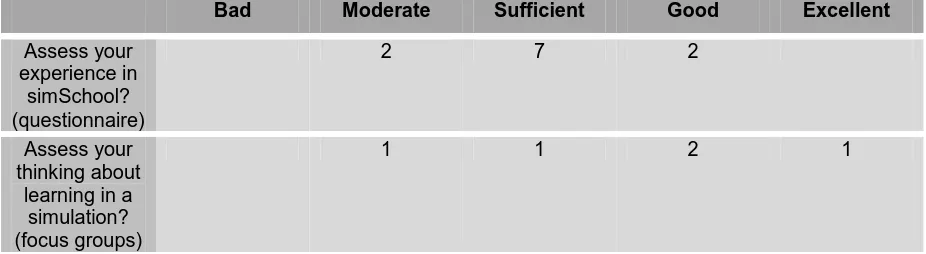
Table 4.2 Experience and thinking about a simulation...60
Table 4.3 Connection with practice...62
Table 4.4 Usability of the simulation...63
Table 4.5 Opportunity to practice/experiment...64
Table 4.6 Have your actions affects on pupils in the simulation simSchool?...67
Table 4.7 The graphs during the lessons...67
Table 4.8 How important is working together with a fellow student teacher?...70
Table 4.9 To what extent do you think simSchool is an important learning tool for student teachers?...74
Table 4.10 To what extent do you think a new simulation (customized with your suggestions and/or comments) is an important learning tool for student teachers? ...74
Table 5.1 The problems and needs of student teachers per research-based element...76
Table 5.2 The advantages and disadvantages of the simulation simSchool and characteristics for a new simulation per code...78
12
1. IntroductionChapter 1 introduces the topic of this study: why this study and how this study is done. This chapter is organized in six sections. The first section describes the background of this study. Thereafter in section 1.1 the problem statement is described. Section 1.2 is the context, in which the study is performed, followed by section 1.3 the purpose of the study. Section 1.4 describes the practical and scientific relevance, this section is followed by the overview of the thesis, described in section 1.5.
Children need highly effective and qualified teachers in education, because effective and qualified teachers are essential to pupils’ success (Reinke, Herman, & Stormont , 2013; Scheeler, 2008). At this moment teacher education institutes are under high pressure to ensure that student teachers have prepare them for the actual world of teaching (Freiberg, 2002; Goh & Matthews, 2011). The teacher education institutes are not only under high pressure, but are also the centre of debate, because research shows that the teacher education institutes are not adequately preparing student teachers for the profession (Ferry, Kervin, Cambourne, Turbill, Puglisi, Jonassen, & Hedberg, 2004).
Teachers who have just completed the teacher training programme have a limited repertoire of teaching strategies. They have difficulties in transferring the acquired teaching techniques into practice and maintaining the acquired teaching skills and teaching techniques over time (Freiberg, 2002; Scheeler, 2008). Research shows that this is due to a gap between acquiring effective pedagogical skills in student teacher preparation and the transmission of these skills to the classroom (Scheeler, 2008). According to Freiberg (2002) “they are not taught how to establish the positive, organized learning environment necessary for them to teach and for students to learn” (p56). Through trial and error teachers develop their repertoire of teaching strategies. This may take several years, which often results in losing these teachers for the profession in an early stage (Freiberg, 2002). Many student teachers experience also a medium level of stress during teaching practice (Malik & Ajmal, 2010). High levels of stress for student teachers can be lead to problems in class control and disturbance in the classroom (Malik & Ajmal, 2010). Student teachers are facing a big challenge: how to teach and learn in a complex class situation, with groups of varying size and abilities and available materials (Christensen, Knezek, Tyler-Wood, & Gibson, 2011; Melnick & Meister, 2008)?
One of the main elements of the teacher training programmes are practical experiences in
13
1.1 Problem StatementLiterature discussed in the introduction states that there seems to be a gap between teacher training and practice (Scheeler, 2008). Teachers have a limited repertoire of teaching strategies, have difficulties transferring the obtained teaching techniques into the real classroom and maintaining the learned teaching skills and teaching techniques over time (Freiberg, 2002; Scheeler, 2008). This is complemented by the fact that student teachers are often overwhelmed by the complexity of the classroom, during their internships and when they just start working. Student teachers often feel insufficiently prepared for the actual classroom (M.A. van Oudheusden, personal communication, February 26, 2014). According to Scheeler, Bruno, Grubb and Seavey (2009) the student teachers “know what to teach and how to teach it but we may be missing a critical component in teacher preparation, i.e., teaching future teachers to apply their newly acquired skills to their own classrooms” (p. 190). Windesheim University would like to know how to reduce this gap between the student teacher programme and everyday complexity of the classroom.
1.2 Context
This study took place at the teacher training institute Windesheim University in Zwolle, because this problem statement is applicable in this specific setting. This university offers a four year study for student teachers who would like to become a teacher at a primary school. During this study two university teachers are involved in this study and 14 student teachers, including 13 third-year student teachers and one fourth-year student teacher. Within the teacher training institute of Windesheim University, student teachers are actively using and/or integrating ICT in education. In addition, during this study PBS is one concept which is discussed. University of Windesheim has a centre of expertise on Positive Behaviour Support, which aims to support the implementation of PBS in the Netherlands and in doing so to improve the quality of education. The Centre tries to achieve this goals by training and supervising school personnel in the school, conducting practical research and by developing of knowledge and sharing the knowledge that is discussed (Expertisecentrum PBS, 2014).
1.3 Purpose of the study
This study is part of a small scale pilot project at the teacher training institute of Windesheim University of Applied Sciences in the Netherlands. Windesheim University would like to know, as mentioned in the problem statement, if the teacher training programme contributes enough to narrow the gap between teacher training and practice. Due to this, Windesheim University poses the question if a simulation can contribute to reduce this gap. Therefore, the purpose of the study is to identify the content and pedagogical characteristics of a simulation that contribute to the acquisition of the
necessary competences for student teachers for creating a positive and effective learning environment in the classroom.
1.4 Practical and scientific relevance
As discussed in the introduction, teachers seem not always adequately prepared for the
14
is important to keep the teachers in the educational field. To work on this, teacher needs to beadequately prepared for the profession, so if more known about the concerns that student teachers are facing during their training and practicum, the larger the opportunity for reducing stress and improving success in practicum (Goh & Matthews, 2011). Therefore at University Windesheim raises the question if a simulation could contribute to reduce the gap between what is learned at the teacher training institute and transfer this to the real classroom. Further, the research of Goei and Kleijnen (2009) show that teachers have difficulty in handling pupils with behavioural problems, which may lead in some cases to burn outs. Prevention is therefore important.
There is a lot of evidence for the effectiveness of using the framework of Positive Behaviour Support for creating an effective and positive learning environment, but limited research is done about the use of a simulation in student teacher education (Hixon &So, 2009). Nothing is known about applying PBS principles for creating a simulation. Therefore it is important to do more research into the subject of using the framework PBS for creating an effective and positive learning environment in a simulation that might help student teachers, to reduce the gap between teacher training and practice. In addition it is also important to do more research into the use of a simulation during teacher training and if a simulation can provide opportunities to practice the competencies that are necessary to deal with the everyday classroom complexity. Studies on the use of simulation in teacher training are just emerging, so there is limited literature about it (Christensen et al., 2011; Clarke, 2013 as cited in Dieker Rodriquex, Lignugaris/Kraft, Hynes, & Hughes, 2014; Dieker et al., 2014; de Jong, Lane, & Sharpt., 2012; Hixon & So, 2009; Judge, Bobzien, Maydosz, Gear, & Katsioloudis, 2013; Sawchuk, 2011 as cited in Bush, Hall, Scott-Simmons, & Saulson, 2012).
1.5 Overview of the Thesis
15
2. Theoretical frameworkChapter 2 is organized in five sections. Section 2.1 describes the six research-based elements of Marzano, Marzano and Pickering (2003). This is followed by section 2.2 which represents the PBS framework, that can be used as a framework for learning this research-based elements. Section 2.3 describes the definition of the simulation, types of simulations, the current state of the simulation, simSchool and advantages and disadvantages of a simulation This is followed by section 2.4 which represents a model in which all the three concepts are operationalized. Section 2.5 describes the main research question and the three sub questions for this study.
2.1 Positive and effective learning environment in the classroom
16
Figure 2.1. Effects of a School vs. A Teacher on Student Entering at 50th Percentile. Adapted from “Classroom management that works: research-based strategies for every teacher,” by R.J. Marzano, J.S. Marzano and D.J. Pickering, Association for Supervision and Curriculum Development,Alexandria.
The results from a meta-analysis, that is based on the results of more than 100 research reports between 1967 and 1996, of Marzano, Marzano and Pickering (2003) show that there are six major research-based elements for teachers to create an effective and positive classroom learning environment in the classroom: (1) rules, expectations and procedures, (2) disciplinary interventions, (3) teacher-student relationship, (4) mental set, (5) student’s responsibility for management, (6) getting off to a good start (Marzano, Marzano, & Pickering, 2003; Reinke, Herman, & Stormont, 2013). These elements are elaborated below in depth. When teachers are aware of these six elements and are trained to use these techniques, this can positively influence teacher behaviour, which may lead to positive changes in pupil behaviour and has also a positively influence on pupils performance (Marzano, Marzano, & Pickering, 2003).
2.1.1 Rules, expectations and procedures
Developing a set of rules, expectations and procedures in the classroom is fundamental for
classroom management (Marzano, Marzano, & Pickering, 2003; Newcomer, 2009; Reinke, Herman, & Stormont, 2013). According to Reinke, Herman and Stormont (2013) “these rules need to be
developmentally appropriate, stated positively, and systematically taught” (p. 40). Newcomer (2009) adds to these criteria that rules should be observable, measurable, simple and kept to a minimum. Rules communicate the desired behaviour in the classroom, which are necessary for order in the classroom and a functioning learning environment. The rules should be in line with the expectations of the school (Newcomer, 2009). Expectations refer to general standards of behaviour (e.g. be
[image:16.595.67.537.74.233.2]17
feedback on it. This should lead to appropriate behaviour and this appropriate behaviour should be encouraged. The procedures should be in line with the school wide expectations (Newcomer, 2009). In the end procedures will turn into routines (Lane et al., 2011). Clear routines ensure that pupils are able to complete tasks and that inappropriate behaviour in the classroom is minimized (Morgan & Ellis, 2011; Newcomer, 2009). It is important for common activities and transitions to establish routines (Newcomer, 2009).This research-based element is a crucial aspect of creating an effective and positive learning environment in the classroom, because pupils behaviour and pupils performance are influenced by the rules and procedures (Marzano, Marzano, & Pickering, 2003). This creates possibilities for positive interactions between pupils and teachers and it will contribute to the feeling that the classroom is a safe place to learn (Marzano, Marzano, & Pickering, 2003).
The average effect size by design and implementing rules and procedures is -.76 (Marzano, Marzano, & Pickering, 2003). According to Marzano, Marzano and Pickering this means “that across the various grade levels the average number of disruptions in classes where rules and procedures were effectively implemented was 28 percentile points lower than the average number of disruptions in classes where that was not the case” (p. 14). These data from the meta-analysis of Marzano, Marzano and Pickering (2003) indicate that designing and implementing rules and procedures have a large effect on pupils behaviour.
2.1.2 Disciplinary interventions
Disciplinary interventions refers to the interventions that can be used when pupils follow or do not follow the established rules, procedures and expectations (Marzano, Marzano & Pickering, 2003). If the rules, procedures, expectations, disciplinary interventions and consequences are developed and shaped to the needs of their own classrooms, this can lead to the development of a positive
relationship between teachers and pupils and can help to create a productive and positive learning environment (Marzano, Marzano, & Pickering, 2003).There should be a balance between
consequences for inappropriate behaviour and consequences for appropriate behaviour (Marzano, Marzano, & Pickering, 2003). A compliment is a consequence for appropriate behaviour, this can be verbal or non-verbal (Lane et al., 2011). Another consequence for appropriate behaviour is a reward, a reward system could be an effective way to shape and support positive behaviour (Lane et al., 2011) It is essential to have clear consequences for inappropriate behaviour. These consequences need to be established in advance and the pupils need to be aware of the consequences (Lane et al., 2011). A reminder helps the pupil to exhibit appropriate behaviour, so that the teacher does not need to use disciplinary interventions (Lane et al., 2011). A teacher who combine effective disciplinary measures with other elements of classroom management, loses no time in responding to inappropriate
behaviour. The teacher creates more time to teach (Lane et al., 2011).
18
deviations less than the average number of disruptions in classrooms that did not effectively employ disciplinary procedures” (p. 8).2.1.3 Teacher-student relationship
The relationship between teachers and pupils is important for creating a positive and effective learning environment (Hattie, 2009; Marzano, Marzano, & Pickering, 2003). Without a positive teacher-student relationship, the chances are that pupils will oppose against the developed set of rules, expectations, procedures and disciplinary interventions (Marzano, Marzano, & Pickering, 2003). When the teacher is person-centred, the teacher will notice more involvement, more respect and less
resistant behaviour from the pupils. The pupils are more likely to perform better academically (Cornell & Mayer, 2010; Hattie, 2009). Trust and respectful teacher-student relationship is the start of higher pupil performance (Cornell & Mayer, 2010; Hattie, 2009). The teacher-student relationship will also improve when teachers work in an environment where the teacher self-efficacy is promoted (Goei, van Oudheusden, Bosma, Klein, & Blok, 2013).
The average effect size of teacher-student relationship is -.87 (Marzano, Marzano, & Pickering, 2003). This means that in classes where the teacher-student relationship is good, the average number of classroom disruptions is .869 standard deviations less than the average number of disruptions in classrooms that have no good teacher-student relationship. Hattie (2009) agreed to this, because according to Hattie (2009) “building relations with students implies agency, efficacy, respect by the teacher for what the child brings to the class (from home, culture, peers), and allowing the experiences of the child to be recognized in the classroom” (p. 118). In order to build this relationship, teachers must master skills like listening, ability to empathize, being supportive and have positive attention to others (Hattie, 2009).
2.1.4 Mental set
According to Marzano, Marzano and Pickering (2003) “effective managers approach the classroom with a specific frame of mind, a specific mental set” (p. 65). It is, therefore, about the way the teacher is thinking and behaving in the classroom (Marzano, Marzano, & Pickering, 2003). According to Marzano, Marzano and Pickering (2003) "the mental set necessary for effective classroom
management requires teachers to cultivate a mindful stance relative to their withitness and emotional objectivity" (p.66). Withitness is about being alert, and identifying quickly and adequately misbehaviour of the pupils, trying to prevent it and if present respond to it effectively. It is not about how the teacher deals with disruptive behaviour (Marzano, Marzano, & Pickering, 2003). Emotional objectivity refers to the various aspects of classroom management, in which the teacher becomes not emotionally
19
suggested therefore that teacher preparation programmes should focus on effective research-based practice, such as Positive Behaviour Support, in order to respond appropriately to pupils at risk. The meta-analysis of Marzano, Marzano and Pickering (2003) shows an average effect size of -1.29 (Marzano, Marzano, & Pickering, 2003). This is the largest effect size in comparison with rules and procedures (-.76), disciplinary interventions (-.91) and teacher-student relationship (-.87). This means that in classes where teachers have a positive mental set, the average number of classroom disruptions was .1.294 standard deviations less than the average number of disruptions in classrooms that did not effectively employ mental set (Marzano, Marzano, & Pickering, 2003).2.1.5 Student’s responsibility for management
In the previous four points the actions teachers must take to ensure an effective and positive learning environment are addressed. Not only the teachers are responsible for creating a positive and effective learning environment in the classroom, but also the pupils (Marzano, Marzano, & Pickering, 2003). Self-discipline, self-management, self-regulation, self-control and social skills are concepts that covered student’s responsibility for management (Marzano, Marzano, & Pickering, 2003). Providing choices for class activities to pupils creates positive behaviour in the classroom (Lane et al., 2011). Pupils can also make their own choices in relation to the way they want their behaviour to be reinforce. This ensures pupil independency, productivity and inclusion (Ruef, Higgins, Glaeser, & Patnode, 1998).
The average effect size of teaching pupil general responsibility strategies is -.69 (Marzano, Marzano, & Pickering, 2003). According to Marzano, Marzano and Pickering (2003) “this means that responsibility strategies are associated with a decrease of 25 percentile points in disruptive behaviour” (p. 77).
2.1.6 Getting off to a good start
At the beginning of the school year teachers can use techniques and considerations to getting off to a good start (Marzano, Marzano, & Pickering, 2003). At the beginning of the school year, it is important to introduce rules and procedures and to allow pupils understanding of the rules and procedures (Marzano, Marzano, & Pickering, 2003). Finding shows that teachers also spend time to ensure that management activities were: (1) understood by pupils, (2) generally accepted by pupils, and (3) practiced until they became routine (Marzano, Marzano, & Pickering, 2003). This is also confirmed by Lane et al. (2011) and Horner, Sugai, Todd and Lewis-Palmer (2005). They report that the expectations for the pupils should be taught in both words and actions. Both good and bad
20
2.1.7 ProblemsIn Figure 2.2 Klassen and Chiu (2010) mentioned that student teachers who have just graduated have zero efficacy on teaching strategies, classroom management and student engagement.
Figure 2.2. Relationship of years of experience with three teacher self-efficacy variables (teaching strategies, classroom management and student engagement) based on the structural equation model results. Adapted from “Effects on Teachers’ Self-Efficacy and Job Satisfaction: Teacher Gender, Years of Experience, and Job Stress,” by R.M. Klassen and M.M. Chiu, Journal of Educational Psychology, 102 (3), p. 747.
Teachers who have just completed the teacher training programme have higher chances of turnover than teachers who are older and more experienced (Curtis, 2012). This is one of the reasons why the teacher education institutes are under high pressure to ensure student teachers have high quality preparation, to prepare them for the actual world of teaching (Freiberg, 2002; Goh & Matthews, 2011). The more is known about the concerns faced by student teachers during their practicum, the higher the possibility of reducing teacher stress, improving their success and maximizing the benefits of the student teacher practicum for them (Goh & Matthews, 2011).
Veenman (1984) appoints eight problems, in rank order, that are most common among teachers that are new to the profession: (1) classroom discipline, (2) motivating pupils, (3) dealing with
individual differences, (4) assessing pupils' work, according to Veenman (1984) this is about
“accumulating reliable information and acting as an evaluator were problematic activities” (p. 156), (5) relationship with parents, this is mainly about the preparation of the novice teachers, organizing contact evenings with parents, the contacts with parents, parents does not show interest in their pupils, parents does not show interest in the novice teachers ideas and the lack of confidence of the parents toward the novice teachers, (6) organization of class work, (7) insufficient and/or inadequate teaching materials, and (8) dealing with problems of individual pupils.
Kent (2000) showed that beginning teachers have the mostly have problems with “having adequate time for planning and preparation”, “having every student work up to his or her ability”, and “providing for individual learning differences”. In addition there are twelve common problems that beginning teachers experience, who are divided into six categories, (1) classroom management, includes “maintaining order, quiet or control”, “getting students to work independently”, and “eliminating inappropriate student behaviour”, (2) motivation, includes “having all students participate in class”, “having students value learning”, “getting students to enjoy learning for its own sake”, (3)
[image:20.595.66.478.141.271.2]21
using anecdotal information about students”, (4) student-related common problems, includes “assisting students with special educational needs” and “having too many students” and (5) curricular issue, includes “finding new instructional materials and supplies” (Kent, 2000).Romano (2007) sees four major concerns that new teachers experience: (1) classroom
management, includes according to Romano (2007) “issues related to overall student behavior in the classroom and techniques used to gain participation in classroom activities and increase student motivation for learning” (p. 68), (2) external policy, includes according to Romano (2007) “external factors that the teacher had no control over that governed how the school, district, or educational system was run, including instances in which the teachers felt too many external demands had been placed on them at one time” (p. 68), (3) personal issues, includes according to Romano (2007) “teacher concerns or accomplishments that were highly personal in nature and, thus, separate from actual teaching episodes. These included issues such as feeling more secure in their surroundings, finding more time, and being organized” (p. 68), and (4) content and pedagogy, includes according to Romano (2007) problems “related to having command of a particular content area and knowing how to teach it effectively to a specific group of students, including planning and considering how to best teach what is needed in the amount of time allotted” (p. 68). These problems with new teachers are caused by several factors, according to Veenman (1984). One factor is the quality of teacher education (Veenman 1984, as cited in Kent, 2000).
The articles of Veenman (1984), Kent (2000) and Romano (2007) show that teachers who are new to the profession have the most problems with classroom management and classroom discipline. According to Romano (2007) “teacher education and induction programs might focus on classroom management prior to and throughout the first year of teaching” (p. 75).
According to Lewis (2010) “educators cannot ‘make’ pupils learn or behave. Educators can create environments that create the likelihood that pupils learn and behave. Environments that increase the likelihood are guided by a core curriculum and implemented with consistency and fidelity” (p. 5). Positive behaviour support is a way to create such an environment (Goei et al., 2013; Newcomer, 2009).
2.2 Positive behaviour support
22
behaviour (Bradshaw et al., 2009; Horner et al., 2005; Newcomer, 2009; Ruef et al., 1998; Goei et al., 2013). PBS is a preventive approach and is focused on all pupils. It is shown to reduce the frequency of problem behaviour, serious problems of at-risk pupils and enhances academic results. It also helps pupils to learn better ways to express their feelings and needs (Newcomer, 2009; Ruef et al., 1998). PBS is a framework and not a method. PBS applies five important principles guiding the PBS framework: (1) working school wide, (2) prevention, (3) positive approach, effective rules, teaching behavioural expectations and consequences, (4) decision-making on the basis of data and (5) collaboration with parents and chain partners (Bradshaw et al., 2009; Goei, Nelen, van Oudheusden, de Bruïne, Piscaer, Roozeboom, Schoorel, & Blok, 2010/2011; Goei et al., 2013; Hieneman, Dunlap, & Kincaid, 2005; Horner et al., 2005; Horner, Sugai, Smolkowski, Eber, Nakasato, Rodd, & Esperanza, 2009; Ruef et al., 1998; Warren, Bohanon-Edmonson, Turnbull, Sailor, Wickham, Griggs, & Beech, 2006).2.2.1 Working school wide
As previously described PBS needs to be implemented school wide (Bradshaw et al., 2009; Bradshaw, Mitchell, & Leaf, 2010; Goei et al., 2010/2011). Within PBS it is assumed that an approach in one classroom only is less powerful than a school wide approach, where teachers, parents and other chain partners working together (Goei et al., 2010/2011). When a school chooses to implement PBS, 80 percent of all teachers should support the implementation of PBS. If the school decides to implement PBS, a PBS team is formed with the school director, representatives of teachers, support staff and parents. First of all the vision of the school is formulated with the values and norms, from here expectations are formulated (Goei et al., 2010/2011). These expectations are general standards of behaviour (e.g. be safe, be responsible, be respectful, be cooperative) which serve as a framework (Goei et al., 2010/2011; Newcomer, 2009). From these expectations the PBS team could establish behavioural rules for the most important areas in the school, such as rules for the classroom, playground, hallway, bathroom and other rooms (Goei et al., 2010/2011). These rules should be taught to all pupils in the first week of the new school year and during the school year regularly return to these taught rules (Sprague & Golly, 2004). It is important that the teachers have the same
23
2.2.2 PreventionThe three tiered prevention model is a school wide system for prevention (Figure 2.3), this model aims to prevent disruptive behaviour by creating a three layered system of support (Bradshaw, Mitchell, & Leaf, 2010; Goei et al., 2010/2011). All pupils receive support through this model (Bradshaw, Mitchell, & Leaf, 2010; Goei et al., 2013):
Primary system of support (school wide/universal)
The intervention of the bottom level is applied to everyone and involves school, family and community (Sugai & Horner, 2006). This tier represents 80% of all pupils (Goei et al., 2010/2011; Horner et al., 2005; Sprague & Golly, 2004; Sugai & Horner, 2006);
Secondary system of support (targeted/selective)
The intervention on the middle level is applied to pupils with limited risk for developing behavioural and learning problems (Goei et al., 2010/2011). This tier represents 15% of all pupils (Goei et al.,
2010/2011; Horner et al., 2005; Sugai & Horner, 2006); Tertiary system of support (individual/indicated)
The intervention on the top level is applied to a small part of the pupils who experienced serious behavioural and learning problems (Goei et al., 2010/2011). This tier represents approximately 5% of all pupils (Goei et al., 2010/2011; Horner et al., 2005; Sugai & Horner, 2006).
According to Goei et al. (2013) “the interventions across the three tiers all have a relationship with the expected and preferred behaviour, building a predictable and sustainable learning environment” (p. 8). Every tier of the prevention model is associated with the use of evidence based interventions. By providing targeted interventions for each tier and pay attention to preventive measures that focus on all pupils, efforts are made to prevent problem behaviour (Goei et al., 2010/2011). The bottom tier of the prevention model focuses on all pupils in the school. The intervention could be effective
24
Figure 2.3. PBS Pyramid. Adapted from “Learning PBS skills and competences in a virtual learning environment,” by M.A. van Oudheusden, 2012b.2.2.3 Positive approach, effective rules, teaching behavioural expectations and consequences
PBS is characterized by the presence of positive reinforcements. The strengthening of desired behaviour is a powerful tool to bring about behavioural change. The attention to desired behaviour on a PBS school is four times greater than the attention to correcting undesirable behaviour, so 4:1 (Goei et al., 2010/2011; Sprague & Golly, 2004). To change pupils behaviour, a positive teacher-student relationships is important, because this creates a strong fundament from which behavioural changes can occur (Morgan & Ellis, 2011). This can be linked to teacher-student relationship, a research-based element for effective and positive classroom management (Marzano, Marzano, & Pickering, 2003). Clear rules and routines are necessary for teaching behavioural expectations and for classroom management (Marzano, Marzano, & Pickering, 2003; Newcomer, 2009; Reinke, Herman, & Stormont, 2013). In this way, these principle guiding the PBS framework can be associated with rules, [image:24.595.72.542.57.280.2]
25
According to Sugai and Lewis (1996, as cited in Warren et al., 2006)The teaching of behavioural expectations includes at a minimum: (a) didactic instruction on the expectations and how they apply in various settings around the school, (b) a demonstration of appropriate behavior and social skills, and (c) opportunities for students to practice these skills through role-plays and in-vivo situations in different settings within the school with a variety of people (p. 190).
Newcomer (2009) confirms the three steps of Sugai and Lewis (1996, as cited in Warren et al., 2006), but supplement it with discuss why the behavioural expectation is important and what will happen when the pupil followed and when the pupils not followed the expectation. This can be linked to disciplinary interventions, a research-based elements for creating an effective and positive learning environment (Marzano, Marzano, & Pickering, 2003). An important element is the feedback pupils received from the teachers, as well as the demonstration teachers give to pupils and teachers as a role model for the pupils, which refers to the mental set of the teacher, also a research-based element for effective and positive classroom management (Colving, Sugai, & Kameenui, 1994 as cited in Warren et al., 2006; Goei et al., 2010/2011; Marzano, Marzano, & Pickering, 2003). When pupils follow the rules and expectation, stitch energy in that, so pupils shows this behaviour often (Morgan & Ellis, 2011). According to Morgan and Ellis (2011) “do not put energy and time into inappropriate behaviour but instead deal with the situation in a calm manner, away from others, then re-direct her attentions” (p. 34).
26
mental set, a research-based elements for effective and positive classroom management (Marzano, Marzano, & Pickering, 2003).According to Horner et al. (2005) is it important to create a predictable environment that is focused on the success of the pupils. Classrooms with increasing predictability can develop and modify routines to reduce anxieties and challenging behaviour of pupils (Ruef et al.,1998). This can be done by creating a daily schedule, make pupils aware of changes in the planning and make pupils aware of transitions from one to another lesson (Ruef et al., 1998). Disruptive behaviour decreases when pupils know what to do and when pupils have to do it (Ruef et al., 1998).
2.2.4 Decision-making on the basis of data
An essential part of PBS is decision-making on the basis of data (Warren et al., 2006). For interventions in the three tiers it is important to analyse the situation in which the problem behaviour occurs, to devise a plan and perform an intervention (Goei et al., 2010/2011). In order to analyse the situation in which the problem behaviour occurs is it essential to collect the following information (a) circumstances (when, what, where, with whom) associated with behaviour incidents, including both immediate (antecedents) and more distal (setting event) variables; and (b) outcomes of behaviour (i.e., what student(s) get or avoid through their behaviour, including both planned and incidental consequences) (Hieneman, Dunlap, & Kincaid, 2005, p. 782).
To obtain the information mentioned earlier, existing data can be used, such as disciplinary, incident and academic reports (Hieneman, Dunlap, & Kincaid, 2005). It is also important to obtain new data to clarify events associated with the behaviour of the pupils, on the basis of interviewing teachers, parents and chain partners or observations and conducting observations (Hieneman, Dunlap, & Kincaid, 2005). Collected data is the basis to judge the effectiveness of the intervention and make further decisions for the intervention (Goei et al., 2010/2011; Warren et al., 2006). To respond to this, teachers can change the learning environment, by removing environmental factors that stimulate challenging behaviour (Ruef et al., 1998).
Schools in the United States use School Wide Information System (SWIS). In SWIS data is collected from pupils, teachers and the school and can help the teacher to monitor when and where the behaviour occurs most frequently (Goei et al., 2010/2011; Safran & Oswald, 2003).
2.2.5 Collaboration with parents and chain partners
27
2.2.6 The benefits of positive behaviour supportVarious studies showed several benefits of PBS, for both pupils and teachers. The benefits for pupils are reduction in problem behaviour show by significantly less office discipline referrals, less suspensions, less expulsions and improved effectiveness for intensive interventions (Bradshaw et al., 2009; Cohen, McCabe, Michelli, & Pickeral, 2009; Goei et al., 2010/2011; Horner et al., 2005; Luiselli, Putnam, Handler, & Feinberg, 2005; Newcomer, 2009; Reinke, Herman, & Stormont, 2013). Secondly, PBS can result in an increase in pupil engagement, improving of risk and protective factors and pupils experiences school as a safer and more supportive environment (Horner et al., 2005; Horner et al., 2009). And PBS can improve the academic performance of the pupils and improved family
involvement. (Horner et al., 2005; Horner et al., 2009; Luiselli et al., 2005).
The benefits for teachers are better collaboration between teachers and in support of individual pupils. PBS provides also improved classroom management, through routines in the classroom, strategies for prevention of problem behaviour and to put the emphasis on what is going well (Horner et al., 2005; Warren, et al., 2006). Schools that implemented PBS showed a higher level of teacher self-efficacy (Kelm & McIntosh, 2012). The points mentioned above will ensure that teachers see themselves as more effective, which creates improving performance, improving perceptions, increases the effective learning time and contribute to better learning (Goei et al., 2010/2011; Horner et al., 2005; Luiselli et al., 2005). PBS also reduces absenteeism and increased retention (Horner et al., 2005). Thus, PBS could provide a framework for teachers to create an effective learning environment.
Research from Romano (2007) shows that novice teachers have different needs to help them with the problems they experience in their teaching practice, one need is for more training in classroom management. With the rise and growing appreciation of games and simulation-based learning, education can therefore use simulation of digital games to prepare student teachers for the profession (Christensen et al.,, 2011). An opportunity is a simulation in which student teachers can learn through their presence and awareness (Dass, Dabbagh, & Clark, 2011).
2.3 Simulation
The major element of a simulation is that it resemble real life situations, where student teachers can practice problem solving and gain insight into effective behaviour (Devlin-Scheurer & Sardone, 2010; de Jong, Lane, & Sharp, 2012). Using a simulation gives student teachers the opportunity to practice, evaluate the results, learn from their mistakes, try again, enhancing their skills and increasing the self-confidence (Panettieri, 2006 as cited in Devlin-Scherer & Sardone, 2010; Dieker et al., 2014; Cruickshank, 1969 as cited in de Jong, Lane, & Sharp, 2012). Student teachers develop responsibility for their self-reflection to improve their practices (Dieker et al., 2014). In the simulation student
28
students who were raised on digital games and entertainment” (p. 1756). Student teachers in asimulation take defined roles and communication takes place between participants or elements in the simulation (Brown, 1999). Student teachers can work together or work alone in a simulation
(Panettieri, 2006 as cited in Devlin-Scherer & Sardone, 2010). A simulation is a controlled environment for education and entertainment purposes (Bush et al., 2012; de Jong, Lane, & Sharp, 2012).
2.3.1 Types of simulations
Simulations can be classified into two types of simulations: (1) experiential simulations, and (2) symbolic simulations (Vanlehn, Ohlssen, & Nason, 1994 as cited in Gredler, 2004; Brown, 1999; Gredler, 2004). Experiential simulations are social microcosms (Gredler, 2004). Participant should view themselves as part of a real-world scenario, in which they should react on situations and experience feelings and the questions and concerns related to their role in the simulation (Brown, 1999; Gredler, 2004). Examples of experiential simulations are pilot and astronaut simulations (Gredler, 2004). Experiential simulations can be divided in three types: (1) social process, (2) diagnostic and, (3) data management (Gredler, 2004). According to Gredler (2004) social process experiantal simulations refer to the idea that “contingencies for different actions are imbedded in the scenario and role descriptions (a group exercise)” (p. 574). An example of social process simulations is that survivors of a crash receive role cards, these information is important to survive. In order to find food, water and stay alive it is important to communicate clearly and listen well (Jones, 1982 as cited in Gredler, 2004). In diagnostic simulations people have to deal with various types of decision-making. An example is the simulation in diagnostic or patient management (Gredler, 2004). Data management simulations deal with the relationship between quantitative variables, which can be used at business or financial institutions (Gredler, 2004). Symbolic simulations are more an abstracted view (Brown, 1999). According to Gredler (2004) “a population of events or set of processes external to the learner;
individuals interact with the information in the role of researcher or investigator” (p. 575). An example of a symbolic simulation is according to Sauer, Wastell and Hockey (2000, as cited in Gredler, 2004):
the Cabin Air Management System (CAMS), a generic simulation of the automated life support system in a spacecraft. Developed to research the multiple effects of factors that influence human performance in complex systems, scenarios implemented with CAMS have
investigated human adaptive strategies in the management of varying task demands (p. 577).
29
2.3.2 Components in simulations in teacher educationAccording to Dieker et al. (2014) “three critical components must be purposefully planned for and realized in strong simulated environments: (a) personalized learning, (b) suspension of disbelief, and (c) cyclical procedures to ensure impact” (p. 22).
The first component is personalized learning. The individual development is important in learning the skills student teachers needed for their own success and for the students success in the class (Dieker et al., 2014). According to Brand (1998, as cited in Dieker et al., 2014):
cautioned against a “one size fits all” instructional model noting that the approach is not effective in changing teacher behaviour. He suggests that “teachers should identify their current interests and that training should be geared to a teacher’s needs and goals using diversified instructional strategies (p. 22).
The second component is suspension of disbelief. According to Kantor, Waddington, and Osgood (2000, as cited in Dieker et al., 2014) “that if suspension of disbelief does not occur, then the system will fail. This same lesson is important to the field of teacher education as we embark on using the power of simulated environments” (p. 23).
The third component is cyclical procedures to ensure impact. The ARC is an Action Review Cycle (Dieker et al., 2014). According to Dieker et al. (2014):
in an ARC, teachers reflect before and after the session using these three stages: (a) Before Action Review (BAR) – plan for what you hope to learn from the simulator, (b) Action – experience the simulation, and (c) AAR – teacher examines the gap between intended and actual results (p. 23).
The ARC allows for more personalized learning (Dieker et al., 2014).
When all these three components are intertwined in a simulation, this will improve the content knowledge and pedagogical knowledge of the student teachers, but also adaption to the needs of the individual student teachers (Dieker et al., 2014).
2.3.3 Simulations in teacher education
From 1960-1979 simulations were used in the form of films and videos to make teachers aware of the class environment and the multicultural issues (Cuickshank, 1988 as cited in Brown, 1999). During this period, simulations such as role play activities and board games were already. This way, student teachers could practice, make decisions, analyse and understand their emotional responses and could work in a different way with the content (Devlin-Scherer & Sardone, 2010; Cruickshank, 1969 as cited in de Jong et al., 2012). Between 1980 to 1988 the simulations were developed for microcomputers and in the 90s the microcomputers were developed into desktop computers (Brown, 1999). Over the last decades simulations have become quite popular for creating a digital environment that simulates reality (Ferry et al., 2004). Simulations are commonly used in aviation, medicine, military and business and management training, but are quite uncommon in teacher education institutes. Litte research is done on the use of simulations in teacher education institutes (de Jong et al., 2012; Hixon & So, 2009; Judge et al., 2013; Sawchuk, 2011 as cited in Bush et al., 2012). Research on simulations and
30
al., 2014). Therefore limited literature is available about simulation and training in the field of teacher education (Clarke, 2013 as cited in Dieker et al., 2014). Dieker et al. (2014) mention in their research that based on what they discovered that “as the technology of the digital puppetry-based virtual environments evolves each year, the expected outcome is even greater teacher learning gains” (p. 29). An example of a simulation used in teacher training is simSchool, which trains student teachers for the profession (Bush et al., 2012). According to Zibit & Gibson (2005) “simSchool is being developed to fill the need in teacher education for more practice time, quicker and more relevant feedback, and a reliable experiment platform for trying out new teaching methods and strategies” (p. 2). SimSchool provides training opportunities for student teachers, just like a flight simulator for pilots in training (Zibit & Gibson, 2005). SimSchool incorporates all three components of a strong simulation: (a) personalized learning, (b) suspension of disbelief, and (c) cyclical procedures to ensure impact (Dieker et al., 2014).2.3.4 SimSchool
SimSchool is an experiential simulation that can be characterized as a “social process” and “diagnostic” type of simulation. It is aimed at preparing student teachers for the real classroom
practice. The simulation simSchool is designed to practice teaching skills in a virtual classroom (Zibit & Gibson, 2005). According to Christensen et al. (2011) the goal of simSchool is “to provide learning and training opportunities that can transfer to the real classroom and if possible, improve teacher
preparation” (p. 203). Student teachers who use simSchool can gain experiences in lesson planning, instructional strategies, classroom management techniques, special education, adjusting teaching to multiple cognitive skills and practice building relationships with simStudents, leading to increased learning (Gibson, 2007; Hopper, Knezek, & Christensen, 2013). The term simStudent refers to a database profile of a pupil in the simulation (Gibson, 2007). In the simulation simSchool, student teachers serve as teachers and are responsible for the learning of all the simStudents in the virtual classroom (Bush et al., 2012; Hettler, Gibson, Christensen, & Zibit, 2008; Zibit & Gibson, 2005). Each simStudent has his own personality profile in the field of one academic-cognitive dimension, five psychological dimensions and three physical-perceptual dimensions (Christensen et al., 2011; Hettler et al., 2008). The academic-cognitive dimension consists of expected academic performance, according to Hettler et al. (2008) “simSchool uses a changing number of academic dimensions to represent content knowledge and cognitive processes highly associated with specific subject areas” (p. 26). The psychological dimension in simSchool is based on the personality profile Five Factor model (OCEAN) of McCrae and Costa (1996), openness to learning, conscientiousness toward tasks, extroversion to introversion, agreeableness and neuroticism – emotional stability (Hettler et al., 2008). These five dimensions can be either positive or negative and ranges between -1 and +1, where 1 is the norm. Therefore there are a lot of different personalities for simStudents (Christensen et al., 2011; Zibit & Gibson, 2005). The last dimension, the physical-perceptual dimension consist of visual, auditory and kinaesthetic and are based on the ”theory of multiple intelligences” (Hettler et al., 2008). These dimensions determine how a simStudent learn, behaves and perform in the classroom
31
Before the student teachers enter the virtual classroom, they can see the profile of the simStudent (Hettler et al., 2008; Zibit & Gibson, 2005). In the classroom they can choose between assigning a new task or addressing all simStudents or an individual simStudent (Bush et al., 2012; Christensen, et al., 2011; Hettler et al., 2008; Hopper, Knezek, & Christensen, 2013; Zibit & Gibson, 2005). The verbal content of the simulation is divided into sixteen categories of the interpersonal circumplex. These sixteen categories are divided into four groups (see Figure 2.4): (1) being assertive or taking power in a friendly way, (2) friendliness while increasingly giving power, (3) giving power while growing cooler and distant, and (4) cool distance while increasingly taking power (Hettler et al., 2008). ThesimStudents change their body positions and respond in reaction to the actions of the student
teachers (Bush et al., 2012; Hettler et al., 2008; Zibit & Gibson, 2005). According to Christensen et al. (2011) “each simulated student respond differently to every input, based on their current but malleable psychological and cognitive profile and how that relates to the constant settings of the task
[image:31.595.70.551.363.584.2]environment” (p. 206). During the simulation, student teachers receive feedback through charts and gauges in order to experience the consequences of their decisions. At the end of the simulation, the student teachers receive feedback through graphs on the effectiveness of their teaching (Bush et al., 2012).
Figure 2.4. The Circumplex-Comments in simSchool. Adapted from “simMentoring: Guiding Development from Virtual to Real Teaching!” by L. Hettler, D. Gibson, R. Christensen and M. Zibit, 2008, University of North Texas and CurveShift
32
2012) One student teacher noted in the research of Bush et al. (2012) that simSchool demonstrates that positive reinforcement is more effective than negative reinforcement. SimSchool results in better teaching skills and instructional self-efficacy when it is focused on learning to adjust to problem behaviour (Christensen et al., 2011). This shows that simSchool can be useful to train student teachers for the profession (Christensen et al., 2011).Suggestions to improve simSchool are resolving technical issues and the mechanics of the software, such as seeing the performance reports of every simStudent during the simulation (Bush et al., 2012). According to Bush et al. (2012) “as technology continues to mature and improve, simulators like simSchool will likely become an integral part of pre-service and in-service teacher education programs in the future” (p. 1759).
2.3.5 Advantages and disadvantages of a simulation in teacher education
A simulation should not replace the practical experience of the student teachers and the methods of the teacher training institute. It should be a complementary learning method to prepare them for the profession (Brown, 1999; Christensen et al., 2011). Student teachers who use a simulation faster gain confidence in their capabilities in comparison with the traditional preparation programme of the teacher training institute. It also makes student teachers see the link between theory and practice (Christensen et al., 2011; Cruickshank, 1969 as cited in de Jong et al., 2012; van Oudheusden, 2012a). By using a simulation, student teachers gain insight into the issues and challenges that teachers have to face in their profession (Ferry, Kervin, Cambourne, Turbill, Hedberg, & Jonassen, 2005). The study of Hopper, Knezek and Christensen (2013) and Ferry et al. (2004) show that a simulated learning environment prepares student teachers better for the profession and the requirement of the
classrooms. Student teachers make the connection between what happened in the simulation and in the actual classroom (Ferry et al., 2004). They transfer theory into practice. According to Ferry et al. (2005) “users consistently reported that their experience with the simulation helped them to make their practicum experience more focused by giving them knowledge and experience to more fully
33
2014) According to Dieker et al. (2014) "this "virtual rehearsel" has the potential to improve practice, in the simulator and the classroom" (p. 24).Student teachers directly see the consequences of the decisions they make (Brown, 1999; Ferry et al., 2004). It gives direct feedback on their actions. Other student teachers or an online mentor can give feedback how they perceive the effect of the decision (Brown, 1999; Ferry et al., 2004). Student teachers can also manipulate time and space, thesimulation can be paused, accelerated, repeated, student teachers can explore alternative decisions and gain new insights (Dass, Dabbagh, & Clark, 2011; Ferry et al., 2004; Ferry et al., 2005;
McPherson et al., 2011). This gives student teachers a better insight into the complex situation of the classroom (Ferry et al., 2005). This allows according to Ferry et al. (2005) student teachers “think critically about complex teaching situations which relied on the teacher’s ability to tune into children’s experiences, engage with them in dialogue and negotiation as well as utilise a range of indirect instructions such as questioning, modelling and prompting” (p. 22). A student teacher in the study of Ferry et al. (2005) stated she “…liked how you can go through and check your answers. You can go through and if you don’t like the consequences of your decisions you can go back and change it” (p. 30). This enables student teachers to reflect more deeply about their decisions. They can also reflect and share experiences in dialogue with other student teachers (Ferry et al., 2005; van Oudheusden, 2012a). In this way, student teachers can practice and develop teaching and classroom management techniques through replication and correcting (Judge et al., 2013). In Judge et al. (2013) a student teacher said “made me more aware of the options that I have when dealing with student disruptions,” and “shows me if I am doing a strategy correctly because negative student behaviors would diminish” (p. 95). Student teachers can learn through presence and awareness (Dass, Dabbagh, & Clark, 2011). Simulations provide the ability to support collaboration, communication and create capabilities (Dass, Dabbagh, & Clark, 2011). According to Lӧfstrӧm and Nevgi (2007):
collaborative learning and dialogue can be supported by offering synchronous and
asynchronous discussion platforms and shared file management spaces. Dialogue provides not only information about students’ learning but is also an important means by which teachers can gain instant feedback about how students learn (p. 315).
The knowledge of the personal beliefs of student teachers increase and this can affect the
development of their teaching style (Ferry et al., 2004). In the simulation student teachers have more control and therefore minimize the negative effect of actions (Brown, 1999). A final advantage, a simulation makes it possible to reduce the complexity of the PBS process into small pieces, so the student teachers can progressively master more complex skills (Sawchuk, 2011 as cited in van Oudheusden, 2012b).
The use of a simulation can also have several limitations. The first limitation is the lack of
interaction with teachers and pupils, because student teachers cannot really interact with the pupils in the class (Hixon & So, 2009). The second limitation is the limited reality and complexity (Hixon & So, 2009). Student teachers see limited value of the simulation, because they already have had
experiences in the real classroom. They see the simulation as not real enough (Brown, 1999). The third limitation is the availability of relevant cases (Hixon & So, 2009). The fourth limitation are
34
experience (Bush et al., 2012; Hixon & So, 2009). A student teachers in the study of Bush et al., (2012) stated that simSchool “still has lots of glitches, but I think the idea of giving potential teachers opportunities to try strategies for behavior management in the classroom is a great idea” (p. 1758). Some limitations encompass the broader concept of a virtual learning environment. Some student teachers experience isolation, loneliness. Lack of necessary ICT skills for working in a virtual learning environment can be another factor. Another limitation is that student teachers do not know the code of conduct when they enter a virtual learning environment for the first time (Lӧfstrom and Nevgi, 2007). According to Lӧfstrom and Nevgi (2007) “a learner who is entering a virtual environment, particularly for the first time, must first form a cognitive map of the environment and then grope towards a suitable practice (creating a script)” (p. 314). Learning in a virtual learning environment is not suitable for all student teachers, according to Lӧfstrӧm & Nevgi (2007) “studying in a web-based environment may presuppose a significant degree of student independence and tolerance for ambiguity and stress” (p. 314). The last limitation can be a lack of time and fear of change (Mishra & Koehler, 2006). All ofthese factors can be obstacles for learning (Lӧfstrom and Nevgi, 2007).Analysis of user interaction with the simulation highlights three key implications for the use of simulations in student teacher education: (1) identifying potential classroom problems, (2) new perspectives and reflecting on preconceived ideas and, (3) development of opinions and new ways of thinking (Ferry et al., 2005). According to Mahon et al. (2010) some suggestions are:
thinking of the range of options open to the teacher such as the use of the teachers physical space, for example, pulling a student aside or outside to talk. Another student student said, ‘Pricimity! Walk up to students!’ Others made a note of the difference in addressing the whole class versus the instigator, and one student teachers commented that when the simavatar were behaving appropriately they should be rewarded (p. 130).
2.3.6 The concept and characteristics of a simulation in teacher education