COMMISSION OF THE EUROPEAN COMMUNITIES
COMMISSION OF THE EUROPEAN COMMUNITIES
Regional development programme
United Kingdom
1978-1980
This publication is also available in
DE ISBN 92-825-0490-5 FR ISBN 92-825-0492-1
A bibliographical slip can be found at the end of this volume.
© Copyright ECSC-EEC-EAEC, Brussels-Luxembourg, 1978 Printed in Belgium
The articles and texts appearing in this publication may be freely reproduced either wholly or in part provided reference is made to their origin.
ISBN 92-825-0491-3
Contents
1. Introduction 5 2. Economic and social analysis 7
3. Development objectives 9 4. Measures for development 11
5. Financial resources 17 6. Implementing the programme 19
7. The situation in the individual Assisted Areas 21
(a) England - North 21 (b) England " Yorkshire and Humberside 26
(c) England - East Midlands 29 '(d) England - South-West 31
(e) England - West Midlands . 34 (f) England - North-West 35
(g) Scotland 39 (h) Wales 45 (i) Northern Ireland 52
ANNEXES
Annex 1 — The Assisted Areas (with maps) 59 Annex 2 — Assistance for industry and tourism 63 Annex 3 — Infrastructure authorities and programmes 69
Annex 4 — Employment forecasts 75
Annex 5 — Statistics 77 Annex 6 — Additional information provided in September/October
1978 at the request of the Commission, amplifying the
infor-mation contained in the regional development programme . 107 Note
The term Great Britain denotes the United Kingdom without Northern Ireland which is treated separately for certain purposes.
1. Introduction
1.1. The United Kingdom offers a wide range of incentives for the economic devel-opment of the Assisted Areas ; these include financial assistance to new or expanding in-dustry and services, the provision of infra-structure to a standard which makes these Areas attractive to industrialists and their employees and help with training costs.These are complemented by a control on new in-dustrial building in the Intermediate and non-Assisted Areas.
1.2. The Assisted Areas (shown in the map in Annex 1 — page 60) include large urban areas which expanded in conjunction with the development of industry during the nine-teenth century and both the urban areas and industry now need renewal and
2. Economie and social analysis
The regional problem
2.1. The United Kingdom's regional pro-blem stems primarily from the decline of employment in the traditional industries — coal, steel, shipbuilding, textiles and agricul-ture, the reasons for this decline varying from one industry to another. These industries tend to be concentrated in certain areas and when they contract the effect on surrounding areas is disproportionately serious. The decline has also had its effect on local sup-plying industries and to a lesser extent on services. The growth of the services sector in the country as a whole has absorbed much of the decline in employment in manufactur-ing industry, but this growth has not been on the same scale in the Assisted Areas as else-where.
2.2. In 1965,42.4% of all employment was in the main Assisted Areas (Northern Ire-land, ScotIre-land, Wales and the Northern, North-West and Yorkshire and Humberside regions of England) ; between 1965 and 1975 employment in the United Kingdom fell by 373 000, of which a disproportionate share (300 000 jobs) was in those Areas. The industries showing the greatest contraction in the main Assisted Areas were coalmining (207 000 jobs lost), textiles and clothing (221 000) and metal manufacture (91 000). 2.3. The Government would like to see these job losses made good by new employ-ment-creating industries, but dereliction and poor amenities in the Assisted Areas have deterred potential investors. Inadequate communications and in some cases remo-teness from the main centres of population have also discouraged newer consumer goods
industries from investing there. Moreover, industries which originally set up business outside the Assisted Areas have usually pre-ferred to expand at, or near, their existing sites rather than to divide their operations and set up new units in a different area. 2.4. As a result of this long-term decline in traditional industries and the shortage of new employment-creating investment, there has been a large excess of labour in relation to demand in the Assisted Areas. This has been reflected in persistently higher rates of unemployment in the Assisted Areas than in the country as a whole, levels of GDP per capita below the national average and a ten-dency for net migration to take place from the Assisted to non-Assisted Areas. Aver-age unemployment rates in the Development Areas and Special Development Areas have typically been IV2-2 times the national average in recent years. In the case of Northern Ireland unemployment was 4 times the national average in the 1960s and 2V2 times the average in the early 1970s. GDP per capita has tended to be at least 10% (in the case of Northern Ireland over 20%) be-low the national average.
suffi-cient investment in new manufacturing in-dustry to provide suitable jobs to replace those lost through the decline of the tradi-tional industries.
Past corrective actions
2.6. Recognition of the existence of a re-gional problem and the first measures to deal with it go back more than 40 years. In the post-war period, the main direct contribution to industrial development has been through the provision of financial incentives for the establishment of manufacturing industry in the Assisted Areas. For a long time the principal incentive has been a capital grant which is available as a percentage of specified types of investment expenditure. The sec-ond most important incentive, in terms of total expenditure, was the Regional Em-ployment Premium, paid in the period 1966-77 to employers in manufacturing industry, who could claim the Premium in respect of each employee at an establishment in the Development or Special Development Areas. Its value was eroded by inflation and doubt arose whether it was effective in achieving its original purpose of generating and maintaining employment in the qualify-ing areas. It was accordqualify-ingly withdrawn (except in Northern Ireland) in January 1977 as part of a progressive move towards a more selective attitude towards assistance for in-dustry. Other measures have included Re-gional Selective Financial Assistance, now the second most important incentive, and the provision of factory space at current market value rents, with important rent concessions in the initial years.
2.7. These measures have been comple-mented by the Industrial Development Cer-tificate System, which enables the Govern-ment to vet individual proposals for new in-dustrial buildings above a prescribed floor-space limit. In this way the Government can identify suitable projects for steering to the Assisted Areas.
2.8. It has long been recognized that the provision of infrastructure is a factor in
crea-ting jobs in the Assisted Areas. Since 1945 the provision of most infrastructure has be-come a public responsibility, but has been organized, according to the type of infra-structure, on a national or regional basis. 2.9. It is estimated that the operation of regional policy throughout the 1960s was responsible for raising employment in the Development Areas in 1970 by about 300 000 above what it would otherwise have been.
Development needs and prospects 2.10. In the immediate future there is likely to be only a slow decline from the prevailing high levels of unemployment and a relatively slow increase in manufacturing investment. Even when the recession has passed, unem-ployment rates may remain significantly higher than has been usual in recent years. Unemployment levels in each of the regions of the United Kingdom will obviously de-pend on the fortunes óf the industries esta-blished there: some areas may be badly af-fected by shipbuilding redundancies, others by a decrease of manpower in the steel, tex-tile and clothing industries. Some localities depend almost entirely on one or other of these and may face severe unemployment problems.
3
Development objectives
Employment and industry
3.1. The primary objective of United Kingdom regional policy is to bring the supply and demand for labour in the Assisted Areas (particularly the Development and Special Development Areas and Northern Ireland) more closely into balance by safe-guarding existing employment and creating new jobs in those Areas. The essence of the problem is the attraction of industries which will not only replace jobs lost in existing in-dustries but also broaden the base of the eco-nomy by increasing the overall number and range of jobs available. In the Intermediate Areas, encouragement is given to the mod-ernization of existing industry to prevent it from becoming uncompetitive through lack of investment. An important contribution to this objective is to raise the standard of the existing infrastructure to help make the Assisted Areas more attractive to industri-alists. "
3.2. Work is carried out continuously to assess the effects of regional policies, but no single indicator is employed and targets for the number of jobs to be produced by any of the policies pursued are not set. This was done some time ago (in the 1960s) but ex-perience in the United Kingdom at that time showed that the exercise was neither neces-sary nor worth while, and that there were significant disadvantages through raising expectations which were not fulfilled. In practice the regional problem is a continuing one, and traditional industries have shed their labour over a long period and will con-tinue to do so for some time. The structural
weaknesses in local economies, arising main-ly from their reliance on a narrow industrial base, can only be remedied over a long period of time. In these circumstances all com-mercially viable projects which create new job opportunities are welcome in the areas hardest hit. Recent experience has shown that changes in the fortunes of the national economy have a much more profound effect on the regions than can be achieved by re-gional policy itself, and that over any reason-able period for assessing the effect of regional policy target figures derived in advance would be overtaken by changed circumstan-ces in the national economic framework as well as in the individual regions. For these reasons, and because of methodological problems in defining the basic concepts and refining the analytical techniques, targets of the kind suggested by the Commission are not prepared in the United Kingdom. A more detailed explanation of the methodo-logical problems, and references to certain limited work which has been carried out by a number of bodies in the United Kingdom are contained in Annex 4.
3.4. More general considerations also af-fect decisions on investment, such as the cur-rent and prospective level of demand in the economy, the state of world trade, present and prospective levels of inflation and taxation. In the case of Northern Ireland the position is materially affected by the availability in the Irish Republic of a different range of tax and other incentives.
3.8. Fishing is a basic industry in numerous communities, of widely varying size, along the coasts in the Assisted Areas. Many of these communities are dependent for their economic survival on fishing and its ancillary occupations, such as fish processing. A high standard of infrastructure — particular-ly communications —is essential for the effective operation of the industry.
3.5. Generally speaking, the Government does not attempt to identify particular in-dustries as suitable for particular areas or seek actively to attract them there. The need for a varied industrial base is apprecia-ted but this cannot easily be attained in a recession, when the flow of 'mobile' industry diminishes noticeably.
The contribution of infrastructure
3.6. Before manufacturing and service in-dustries can be attracted to an area there must be an adequate supply of sites suitable for development with basic services (such as water, sewerage, gas, electricity, and rail or road access) either available or readily provi-ded. Longer distance communications — road, rail, air, ports and telecommunications — as well as local links to the main systems are also important, particularly in the peri-pheral areas. Development of all these is continuing despite current economic cons-traints.
Tourism
3.9. The Development and Special Deve-lopment Areas include some of the most beautiful parts of the country and many his-torical sites of interest to tourists. Some towns have conference facilities for business visitors and the improvement of facilities for visitors of all kinds can make a useful contri-bution to the economies of these areas. Since 1974 Government policy towards tour-ism has placed increased emphasis on publi-cizing the attractions of places either outside the main tourist centres or which can be visi-ted outside the main tourist season. There has been a new emphasis in Government expenditure on the development of tourism in areas which can readily absorb more visi-tors, particularly in the Development Areas.
3.10. In Northern Ireland, tourism has acor-responding role in the stimulation of econo-mic activity and the provision of employ-ment, especially in areas where the scope of industrial development is limited.
3.7. Agriculture plays an important part in the economic welfare of the Assisted Areas. The industry needs a high standard of infra-structure, particularly good communications, water and electricity supplies, to promote ef-ficient production and marketing. The great majority of the United Kingdom's 'less-favoured agricultural areas' lie within the Assisted Areas (map on page 61). These areas therefore also benefit from measures designed to benefit farmers.
Training
4. Measures for development
4.1. Regional policy measures are avail-able in Northern Ireland and those areas in Great Britain designated as Special Develop-ment Areas, DevelopDevelop-ment Areas and Inter-mediate Areas. The basis on which these areas are designated and their general char-acteristics are described in Annex 1, All except the Intermediate Areas are national priority areas for the purposes of the Euro-pean Regional Development Fund and all include hill-farming areas recognized by the Community as less-favoured agricultural areas.
4.2. There are 3 broad groups of measures in the United Kingdom designed to help provide new jobs in the Assisted Areas : (a) measures which encourage the location
and growth of manufacturing and service industry in the Assisted Areas ;
(b) provision of infrastructure to support industrial investments ;
(c) measures to assist the development of tourism in the Special Development and development Areas and in Northern Ire-land.
Industrial measures
4.3. The United Kingdom Government offers incentives — some automatic and others discretionary — to encourage industry either to establish new projects or to expand existing operations in the Assisted Areas. 4.4. The main industrial measures are available on a broadly similar basis in all the Assisted Areas. They comprise :
(a) capital grants, intended to encourage mainly manufacturing investment in the Assisted Areas and available for build-ings in all areas and for plant and machi-nery in all except the Intermediate Areas ;
(b) selective financial assistance in all Assis-ted Areas based on project needs. This normally takes the form of loans on con-cessionary terms or interest relief grants of equivalent concessionary value. A special scheme of grants is available for service industry projects ;
(c) removal grants for firms moving existing manufacturing or service industry oper-ations into the Assisted Areas ;
(d) the provision of factories in advance of need;
(e) assistance with the transfer and training of employees ;
(f) employment premiums paid on a per capita basis in respect of employees in manufacturing industry in Northern Ire-land.
The measures are described in detail in Annex 2. The assistance available in Spe-cial Development and Development Areas is significantly greater than that available in the Intermediate Areas. Because of its special problems the assistance available in Nor-thern Ireland is greater than that available in the Special Development Areas.
the Government an opportunity to identify new projects which are 'mobile' and which could make a contribution to reducing un-employment in the Assisted Areas. The legislation enables the Government to pre-vent new industrial building in those areas where the system operates, but not to direct industry to other areas. New office deve-lopment in South-East England is controlled in a similar way by a system of Office Deve-lopment Permits. The Location of Offices Bureau is responsible for promoting better distribution of office employment in the United Kingdom ; it is required to give parti-cular attention to the promotion of office employment in inner urban areas.
4.6. In July 1974 the Government announ-ced a programme for the dispersal of Government work ; this is intended primarily to improve the balance of employment op-portunities between the South-East and the rest of the country. The programme invol-ves the dispersal of some 31 000 posts, nearly 90% of which will go to the Assisted Areas. By 1 October 1977 nearly 2 500 of the posts had been dispersed and it is estimated that over the next 2 years a further 4 000 may move. In addition a further 1 000 posts may be dispersed over the next 2 years as a result of Government decisions taken apart from the programme announced in July 1974 and it is expected that over 2 000 jobs will be established in new Government offices in the regions.
Service Industry Grant Scheme
4.7. The Scheme was introduced in 1973 to encourage the greater development of ser-vice industry activities in the Assisted Areas and to stimulate the growth of employment there. All service industry projects may be considered for regional selective assistance provided that they have a genuine choice of location between the Assisted Areas and elsewhere, and produce a minimum of 10 jobs in the case of projects moving into the Assisted/Areas or 25 jobs, in the case of new
or expanding projects. In the period up to 30 September 1977, 123 projects had been offered assistance totalling UKL 11 million, which were expected to lead to the creation of 9 400 jobs in the Assisted Areas. In Northern Ireland power to assist the service industry is provided under the Industries Development Acts.
Advance factories
4.8. The Government is continuing its long-standing policy of providing industrial premises in advance of demand in the Assis-ted Areas. The programme's main purpose remains that of contributing to the diversifi-cation of industry in areas where the effects of structural unemployment are most severe. In the last few years it has also complemented measures taken by the Government to assist small firms, and in the Assisted Areas has a particular role to play in furthering the provi-sion of jobs in the inner city areas.
4.9. The first advance factories were built in the 1930s and by 1939 some 12 000 peo-ple were employed in them. From 1945 onwards the Government has authorized the construction of about 1 000 advance facto-ries in the United Kingdom, and it is estima-ted that companies which have moved into them have provided jobs for some 50 000 people. Total Government factory space in the Assisted Areas amounts to over 7 V2 million sq m, of which approximately 93% has been occupied. Advance factories are always built on sites which provide ample room for future expansion : in many cases companies have taken advantage of this after a very short time to build extensions which double or treble the space they occupy.
pro-gramme of advance factories for small firms, announced in October 1977, will be comple-ted by 1980. A further programme was announced in November 1977, mainly for Northern England. The Scottish Develop-ment Agency has announced three advance factory programmes, a significant proportion of which has been allocated to rural areas. The Welsh Development Agency has recent-ly announced 2 major programmes of advan-ce factory building, with the emphasis on building smaller units for indigenous com-panies and improving job prospects in un-employment blackspots.
4.11. The advance factory programme as a whole is expected to provide some of the additional factory capacity which will be required in areas of special need when the economy expands. The exact scale of fu-ture advance factory building is however difficult to predict, as this is determined by the economic cycle.
Other factory building
4.12. During the period 1978-80 the Gov-ernment will also continue to respond to demand for extensions to its factories which are already occupied and to companies' re-quests for factories built to their own require-ments. The scale of this building is likewise hard to predict, the ratio of advance factory building to building for immediate occupa-tion varying with the state of the economy as a whole. Nevertheless, the Government foresees a steady commitment of funds to factory building.
4.14. The provision of infrastructure by public authorities can also play an important part in the development of tourism. Pro-jects might include recreational, entertain-ment and sports facilities (often in complexes including some commercially provided facili-ties) as well as access roads and other trans-port facilities. Projects which are essential for tourism development can also bring important benefits to the local population and assist the economic development of the area.
4.15. There is considerable diversity in the organization and character of the bodies res-ponsible for infrastructure in the United Kingdom, and the level at which their control is exercised. Central government, local government, statutory corporations, public trusts and, less often, privately-owned com-panies on occasion act as infrastructure-implementing authorities : in some instances different authorities are responsible for the same type of infrastructure in different pla-ces. It follows from the diversity of organi-zation that there is diversity in the methods of financing investment. Most infrastructure authorities prepare 5-year rolling program-mes. Although the various public sector bodies are all subject directly or indirectly to the Government's own annual surveys of public expenditure, many of them have a high degree of independence in deciding the tim-ing and location of their investment and the selection of projects. A description of the authorities responsible for infrastructure and their programmes is provided in Annex 3.
Infrastructure measures
4.13. The Assisted Areas of the United Kingdom generally suffer from marked defi-ciencies in infrastructure. These are of 2 kinds : there is a widespread need to replace out-of-date infrastructure in the older towns and cities, and in some areas, mostly rural, infrastructure needs to be provided for the first time.
Tourism measures
there. (The British Tourist Authority is primarily concerned with overseas promo-tion for Britain as a whole and the 3 Regional Boards with tourism in their respective coun-tries.) Financial assistance from the Na-tional Tourist Boards is available for a wide range of suitable tourism projects, including hotels, conference centres, camp sites and tourist facilities of all kinds. This assistance is given in the Development and Special Development Areas only, at the discretion of the Board concerned, who exercise their judgment in the light of the varied tourism needs of particular localities, e.g. to add to or improve the supply of accommodation in some places, to stimulate conference tourism or activity holidays. In the next 3 to 4 years, however, part of the Boards' available re-sources will be utilized for the experimental tourism growth point schemes (see para-graph A2.19). Comparable arrangements apply to Northern Ireland where financial schemes of assistance are administered by the Department of Commerce in conjunction with the Northern Ireland Tourist Board. Details of these measures are given in Annex 2.
Industrial policy
4.17. The Government has prepared, through a dialogue with representatives of employers and trade unions, a new Industrial Strategy to provide conditions conducive to the growth and prosperity of industry in all parts of the country. The main aims of the Industrial Strategy are to improve the pro-ductivity and competitiveness of manufactur-ing industry. It is a medium to long-term programme, concentrated on 40 industrial sectors which are of critical importance. The sector working parties have recently completed reports on the second phase of the programme, setting out medium-term stra-tegies aimed at improving market penetra-tion at home and abroad.
4.18. Regional policy is part of the frame-work within which the Industrial Strategy is
being developed. They are not to be regarded as alternative policy options or options which are in competition for scarce economic resources. Although they oper-ate independently of one another, they are compatible policies offering complementary routes to rebuilding the United Kingdom's economic strength. For example, if major new investment is required in an industry, existing regional incentives are available to influence its location.
4.19. A direct stimulus to industry can also be given by the National Enterprise Board and the Scottish, Welsh and Northern Ireland Development Agencies whose functions in-clude furthering economic development, the provision, maintenance or safeguarding of employment and the promotion of industrial efficiency and international competitiveness. In the case of Wales, the Government has also established the Development Board for Rural Wales which is responsible for promot-ing the economic and social development of rural mid-Wales with the object of halting the continuing trend of depopulation. In Scot-land, the Highlands and Islands Develop-ment Board has a broad range of powers to further the economic and social development of the highlands and islands, which in the past have suffered from depopulation.
selected local authorities will be able to de-clare industrial improvement areas and to make loans and grants in them in order to modernize facilities and buildings. The Industrial Development Certificate control is operated flexibly with regard to the needs of areas of urban decay in the non-Assisted Areas and Intermediate Areas. Additional financial support — especially through the Rate Support Grant, and the Urban Pro-gramme Grant which has been revised to cover industrial, environmental and recre-ational provision as well as specifically social projects — is given to local authorities tack-ling the problems or urban deprivation.
Agricultural policy
4.21. Although United Kingdom agriculture provides about one-half of the nation's food, it is of limited importance to the economy in terms of employment — less than 3% of the working population is engaged in agriculture. Agriculture is however a more important feature of the economy of some sections of the Assisted Areas (for example, some
13V2% of the working population of Northern Ireland is engaged in agriculture and related activities). This is particularly true of the hill-farming areas where national support measures, EAGGF aid, and the provision of satisfactory infrastructure play an important part in encouraging agricultural production and sustaining the level of popul-ation.
Redundancy measures
4.22. Forthcoming redundancies involving more than 10 workers have to be notified to the Department of Employment' in accord-ance with the Employment Protection Act. When redundancies are known to be im-minent, the services of the Manpower Servi-ces Commission, the Employment Service Agency and the Training Services Agency are immediately deployed to assist those
in-volved to obtain and, where necessary, to be trained for alternative employment. Com-parable arrangements apply in Northern Ireland.
Social policies — Training
4.23. Training policies act as a useful adjunct of regional policies to which they contribute by ensuring that manpower training and re-training difficulties do not impede the move-ment of firms to Assisted Areas and the growth of existing firms in those areas. The main responsibility for training to meet the needs of industry rests with employers, who provide most of the training opportunities. They are supported in a number of industries by Industrial Training Boards responsible for the development and encouragement of training in those industries. Boards, however, operate on an industry basis and while some have a regional organization, their objectives are to meet needs of firms and industries rather than specifically re-gional requirements; as a result, statistical information on training is not available on a regional basis to any great extent.
4.25. Training under the TSA's Training Opportunities scheme provides opportuni-ties for people who have no skill or who need to acquire a new skill to take training in a wide variety of occupations. It is adaptable and responsible to the changing needs of the different areas of the country and thereby helps both to reduce unemployment and to meet the manpower requirements of local firms, including those moving into Assisted Areas. It is available at skillcentres, at colleges of further education and other edu-cational establishments, and uses spare train-ing capacity at approved employers' estab-lishments. Skillcentres provide skilled craft training, mainly in engineering and construc-tion trades, but also in occupaconstruc-tions such as electrical, plant and automotive trades. More skillcentres are being built and in-creased use of college and employers faci-lities is planned.
4.26. Broadly similar vocational training facilities are available in Northern Ireland. A major difference is the provision of direct training facilities for apprentice training for young persons, who would not otherwise have such an opportunity. As well as direct training in Government Training Centres, schemes of training for skills at all levels are either operated by the Department of Man-power Services or given substantial financial support.
The physical planning framework for
regional development
4.27. Control of land use in Great Britain is primarily the responsibility of local authori-ties. A broad framework for this control is provided by 2 kinds of documents : ' regional strategies' and local authority 'structure plans'. Regional strategies, known as
re-gional reports in Scotland, assess broadly the resources of all kinds available in each region and recommend long-term policies—econo-mic and social as well as physical and spatial — to secure the best use of these resources. One purpose of the strategies is to provide a wider background for the preparation of structure plans by the local authorities.
At the structure plan level the implement-ation of economic policies is expressed in terms of land : policies for its use and deve-lopment, the physical environment and transport. The local authorities are requir-ed to take account of current policies for the economic planning and development of the region as a whole, and to state in their struc-ture plans how they have done this.
4.28. Neither regional strategies nor struc-ture plans determine specific sites for indus-trial or any other development, or lay down requirements that particular development must take place. They provide guidance for day-to-day decisions on investment by public or private agencies, and their policies are flexible enough to accommodate consider-able variations in the rate and siting of actual development. Structure plans also provide a framework for more detailed local plans, which may be prepared to define the precise extent of acceptable development, as far as this can be firmly decided, from time to time. These local plans are required to conform generally to the structure plan.
5.
Financial resources
Budgetary constraints
5.1. Government resources available for regional development are constrained by the same considerations as public expenditure for other purposes. Nevertheless a distinc-tion can be made between aid to industry and expenditure on infrastructure.
5.2. Except for tourism, where the total amount of assistance is set year by year, and the advance factory programme, expenditure on most forms of financial aid to industry is responsive to the applications made for the various forms of assistance described in Annex 2 and the level of applications is itself affected by national economic circumstances. The provision made in public expenditure estimates is therefore an assessment of the claims on public funds which are likely to arise in those circumstances.
5.3. Infrastructure expenditure by indivi-dual authorities is governed by Central Go-vernment decisions on the level of expendi-ture acceptable in a given year. Subject to a time lapse (which may vary from a few months to as much as 2 years, according to the scale of the project and the nature of the infrastructure), the level of expenditure is regulated within this total by individual au-thorities who vary the number of new pro-jects passing from the planning stage to main construction according to the money avail-able. Within a 5-year rolling programme a high proportion of expenditure in the first 2 or 3 years relates to projects in progress.
Sources of finance
5.4. The United Kingdom Government normally expects any industrialist whose
pro-ject receives Government aid to provide a considerable part of the resources needed to finance it, either from the company's own earnings or by borrowing elsewhere.
5.5. The method of financing for infra-structure projects depends on the type of authority responsible for the project. Trunk roads are built and paid for by Central Gov-ernment. Local authority projects (e.g. roads, industrial estates) are financed by varying combinations of rate income, Central Government grants and borrowing. Au-thorities with a trading income (e.g. those responsible for the electricity, gas, telecom-munications industries and for water supply and sewerage) finance their total investment programme in the same way as industrial undertakings ; their requirements are met from their own earnings or by borrowing, usually from Central Government.
5.6. The information available about the regional distribution of infrastructure expen-diture varies according to the type of infra-structure. In some cases (e.g. railways, gas) expenditure in the Assisted Areas is an inte-gral part of investment in the development or renewal of the national network and it is not possible to identify expenditure attributable to the Assisted Areas. Consequently no in-dication can be given of the amount of infra-structure expenditure which would be eli-gible for Fund aid if all suitable projects were to be aided.
Expenditure by region
Northern Ireland (which are wholly Assisted Areas) and for the Assisted Areas of England in total (an analysis of the major items between regions is also available). Esti-mates are available for the main elements of future expenditure on the basis used by the United Kingdom Government for the control of public expenditure.
5.8. Infrastructure programmes are not generally drawn up on a regional or Assisted Area basis, as has already been explained, though many programmes are divided be-tween the 4 countries of the United King-dom. Expenditure programmes are pre-pared similarly, although it is possible to pro-vide estimates for some programmes for the English Assisted Areas as a whole. For na-tional infrastructure systems (railways, gas, electricity, telecommunications) no break-down of the Great Britain figures between Assisted Areas is possible.
Information available
5.9. Annex 5 gives figures available for in-dustrial, tourism and infrastructure expendi-ture, incorporating where possible an analy-sis for the English regions ; these relate to the financial years of the United Kingdom Gov-ernment, which run from 1 April to the following 31 March.
5.10. Because of the responsive nature of the Government's aid for industrial projects little information is available about projects likely to be carried out during the period of the programme. However, Section 7 inclu-des references to certain major projects al-ready known to the Government as well as to infrastructure projects, some of which may be the subject of applications for contributions from the ERDF.
Use of other Community Funds
5.11. The Social Fund has a significant re-gional impact, which is even more pronoun-ced in the UK than in the Community as a
whole ; approximately three-fifths of the UK's receipts are generally under the Article 5 'regions' section of the budget. The total UK share of the Fund in 1976 was UKL 44.3 million, or 24.4% of the total.
5.12. Since 1 January 1973, grants from the Guidance Section of the EAGGF have been available for projects in the UK as a whole ; aid in 1976 amounted to UKL 11.1 million. As from 1 January 1978 grants from the Gui-dance Section of the EAGGF will be made under a new regulation towards projects in-tended to develop or improve the conditions under which agricultural products are pro-cessed or marketed, on condition that these projects have first attracted national aid. In some cases UK regional aid will be used as the qualifying grant, but it is too soon to estimate what proportion of claims will be based on regional considerations. In addi-tion the UK receives Guidance Secaddi-tion reim-bursements for compensatory allowances on mountain and hill-farming and farming in certain less-favoured areas of the order of UKL 10-12 million a year.
5.13. Loans to the UK from the European Investment Bank have been increasing stead-ily since 1973, and have been largely concen-trated in the Assisted Areas. In 1976 loans totalling UKL 260 million were approved by the EIB for projects in the UK. This made the UK the largest single recipient of EIB funds within the Community. The loans were principally for the purposes of regional development and the development of the Community's energy resources. Two-thirds of the value of the loans went to pro-jects in the Assisted Areas.
6. Implementing the programme
6.1. Since 1965 the UK has been subdivi-ded into 11 economic planning regions : Scotland, Wales, Northern Ireland and 8 re-gions in England. These are North, York-shire and Humberside, North-West, west, East Midlands, West Midlands, South-East and South-East Anglia; the Assisted Areas at present include the whole of the North, Yorkshire and Humberside and North-West Regions, and parts of the South-West, East Midlands and West Midlands Regions.
6.2. In each region an Economic Planning Council and an Economic Planning Board has been established (except in Northern Ireland, where the situation is as described in paragraph 4.29). Economic Planning Councils consist of members drawn from industry, the trades unions, the local authori-ties, the social services, agriculture, etc. The Councils have no executive functions. They collaborate with regional groups of local planning authorities and with Central Government in the preparation of regional strategies (described in 4.27 and 4.28) which, provide a regional framework for national and local planning ; they also advise on the regional implications of national policies. The Economic Planning Boards consist of officials from the Regional Offices of Gov-ernment Departments. Economic planning Boards coordinate, where necessary, the regional policies and planning work of De-partments, and assist Economic Planning Councils in their work on regional strategies.
6.3. In Scotland the Scottish Economic Council, which is chaired by the Secretary of State for Scotland, advises Ministers on eco-nomic issues and provides a forum for
discus-sion of all aspects of Scottish economic deve-lopment. The Economic Planning Board for Scotland is chaired by the Scottish Eco-nomic Planning Department and coordinates the work of Government Departments and other Agencies concerned with regional planning in Scotland.
6.4. It should be emphasized however that the regional strategies are not statutory but intended only as frameworks for the local authorities structure plans. In neither case is any requirement laid down that specific development must take place.
6.5. The responsibility for carrying out industrial projects lies with the sponsor of the project to whom the regional aids are granted by the Government and there are procedures to verify that projects are either in progress or have been completed before payments are made.
6.6. Separate authorities are responsible for carrying out the infrastructure program-mes ; the institutional arrangements are described in Annex 3.
7. The situation in the individual Assisted Areas
Earlier sections of this paper have described in general terms the United Kingdom's re-gional problem, the prospects, and the policy measures in operation. In this section the situation in the individual Assisted Areas is described in more detail and some indica-tions are given of the types of investment which are particularly well suited to each re-gion. Some major projects are also identi-fied.
England is divided for economic planning and certain other purposes into eight regions. Three of these — North, Yorkshire and Humberside and North-West — are wholly Assisted Areas, and 3 more — East Mid-lands, West Midlands and South-West — are partly Assisted Areas.
The Assisted Areas are treated in the follow-ing order :
(a) England — North
(b) England — Yorkshire and Humberside (c) England — East Midlands
(d) England — South-West (e) England — West Midlands (f) England — North-West (g) Scotland
(h) Wales
(i) Northern Ireland
in most instances under the sub-headings: description — problems — prospects — de-velopment objectives — dede-velopment mea-sures.
7(a). ENGLAND — NORTH
Description
7(a) 1. The Northern Region consists of the 5 counties of Cleveland, Cumbria, Dur-ham, Northumberland and Tyne & Wear. It covers an area of 1 935 000 hectares, has a population of just over 3 million, a workforce of 1.3 million and accounts for 5.3% of the United Kingdom's gross domestic pro-duct. * There is a high concentration of population in a small number of areas, princi-pally Tyneside, Wearside and Teesside, which together account for 56% of the total. The rest of the population is found in a large number of small scattered commu-nities.
7 (a) 2. The region has Special Develop-ment Area status in east and south-west Northumberland, Tyne & Wear, most of Durham, Hartlepool and western Cumbria, and Development Area status elsewhere. Much of the rest of the region, outside the industrialized areas of the North-East and in west Cumbria, is also a less-favoured agricul-tural area.
Problems
7 (a) 3. The region's economic problems stem from a persistent decline in basic indus-tries over the last 30 to 40 years, resulting in a continuously high level of unemployment.
At June 1977 unemployment in the Northern Region was 0.12 million, 8.6% of employ-ees.
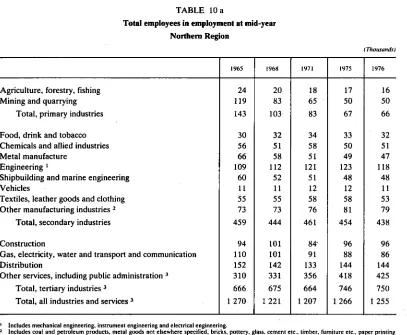
7 (a) 4. In addition to the general down-ward trend in employment in agriculture, transport and communications there was a reduction between 1965 and 1975 of
104 000 jobs, mainly male, in mining and quarrying (particularly coalmining), metal manufacturing (in this region largely iron and steel manufacture), chemicals, ship-building and marine engineering. 2 Despite the considerable success of past policies and measures in diversifying the region's manu-facturing industry, the industrial structure remains over-dependent on the traditional heavy industries of coalmining, shipbuilding and heavy electrical and marine engineering ; these still provide 25% of male jobs in the region compared with 9% in the United Kingdom as a whole.
7 (a) 5. Coalmining is now concentrated in the larger pits where modern machinery can be used to great advantage. The older pits, where reserves are largely exhausted, continue to close. Since 1965, 81 collieries have ceased operation, mainly in south-east Northumberland, west Durham and west Cumbria.
7 (a) 6. Metal manufacturing is concentra-ted in Cleveland, north-west Durham and west Cumbria. There has been a consider-able run-down in manpower in the region in recent years, with a loss of about 16 000 male jobs (around 25% of the total employ-ment in this industry in the region) between 1965 and 1975. In addition, job losses are occurring in electrical and heavy engineering, especially in Tyne & Wear, because of a fall in demand.
1 June 1977 figures are used throughout. It should
be noted that June figures are influenced by the addition of school-leavers onto the register.
2 Comparison are made between 1965 and 1975
wherever possible. It should be noted that these figures are subject to some margin of error.
7 (a) 7. In shipbuilding and marine engi-neering, rationalization and modernization have caused significant job losses in the past, with a reduction of about 12 000 (20%) in employment between 1965 and 1975. There is, moreover, increasing concern over future orders because the world trade recession is leading to reduced demand for new shipping, particularly oil tankers. The ship-repairing industry is also in a depressed state, the main areas affected being Tyne & Wear, Cleve-land and Barrow-in-Furness. In this last town, over half the work for men is provided by shipbuilding.
7 (a) 8. The production of chemicals is largely concentrated in Cleveland. This industry is basically healthy and production is likely to expand, although being capital-intensive there will probably be little increase in employment.
7 (a) 9. The level of gross domestic pro-duct per head in the North is considerably below the national average, and has been so for a considerable period. The unemploy-ment rate has tended to be well above the national average over recent years, and within the Northern Region a number of areas have significantly higher percentages than the Region as a whole, e.g. Wearside, Hartlepool and north-west Durham. Ta-ken together these 2 indices are an important symptom of the Region's continuing econ-omic difficulties.
7 (a) 10. While the 1971 census showed that the region was becoming more attractive to in-migrants, it has remained subject to heavy out-migration, leaving it with the highest rate of net migration loss of all the Assisted Areas during the period 1966-71. This trend towards very considerable out-migration has continued in recent years.
7 (a) 12. Despite considerable progress in housing through slum clearance, new building and house improvements, nearly a fifth of the total regional housing stock, at the most recent analysis, still lacked a standard amenity such as a fixed bath, inside toilet or hot water. Measures to improve hospital facilities and medical care generally are in hand.
Development objectives
1 (a) 13. The main objectives of the region are twofold : first, to continue to diversify the industrial base of those areas which are heavily dependent on industries (iron and steel manufacturing) where rationalization is likely to occur, such as north-west Durham, Hartlepool and west Cumbria, by the attrac-tion of growth industries. The second ob-jective is to encourage the region's existing industries to rationalize and modernize where necessary.
7 (a) 14. Companies which supply installa-tions and equipment for the offshore oil and gas operations in the North Sea will also be encouraged although it is unlikely that em-ployment in these activies will increase signi-ficantly over the next few years.
7(a) 15. The continued provision and deve-lopment of a wide selection of well-serviced industrial sites is necessary, particularly in those areas where rationalization of industry is taking place or is imminent. There is also scope for the development of service indus-tries and for encouraging office development to provide a greater range of opportunities for the increasing numbers of young people seeking employment.
7 (a) 16. There is good potential for the con-trolled development of tourism in the region, which possesses attractive mountainous and coastal areas. So far the potential for tour-ism has been only partially exploited in such areas as the Cumbrian coast and the Pennines. The provision of additional accom-modation can help the industry to expand.
7 (a) 17. Productivity in agriculture has been rising in recent years with a continuing, though decelerating, reduction in its labour force. It would however be beneficial to have more processing plants established locally to provide added value and generate employment. Many of the farms of the re-gion are in hill areas and suffer from physical and climatic disadvantages as well as compe-ting for the use of the countryside with tour-ism and recreation, so that in spite of finan-cial assistance and the application of new techniques their full potential is not being realized. So long as it is carefully integra-ted with agriculture, development of tourism could be of considerable financial benefit to many hill farmers.
7 (a) 18. An important role in the future of the region lies in the improvement of the environment and the economy of inner-urban areas, (where there is a high incidence of poverty and deprivation), the continued reclamation of derelict land, and improve-ment of the housing stock and social amen-ities of the region as a whole.
7 (a) 21. In order to match the needs of in-coming industry, to cater for technical chan-ges in industry and to build up a more balan-ced occupational structure, a programme of further training and retraining is necessary at all levels ; this is needed to facilitate the transfer of those affected to other work, to equip the high proportion of unskilled among the unemployed for the opportunities developing in the region, and generally to rectify the imbalance in the unskilled ratio in the labour force.
Development measures
7 (a) 22. An independent research team has recently completed a specially commissioned regional strategy report. Its proposals em-phasize the need for measures to encourage self-sustained economic growth based upon innovation and diversification in indigenous industries. The report is now being ap-praised by the commissioning parties.
7 (a) 23. Meanwhile a number of specific measures or projects are either under way or are planned so that current development ob-jectives can be achieved, at least in part.
7 (a) 24. The Government has a policy of reviewing the requirements of industry for land in the region and is currently concerned with meeting the potential needs of a number of areas, for example south Tyneside and Wearside. There have been 5 advance factory programmes for the region announ-ced since 1975, totalling over 120 000 sq. m. Most of the factories are expected to be com-pleted by the end of 1978. In addition the Development Commission is undertaking a programme which will give a total floor area of 23 500 sq.m. The local authorities have their own comprehensive factory program-mes designed to provide premises in advance of need, mainly to cater for the requirements of the smaller business.
7 (a) 25. The British Steel Corporation's plans for the creation of a new steel complex
at Redcar are at present being implemented. The latest stage (IIB) includes a new 10 000 tonnes-per-day blast furnace. An ECSC loan of UKL 150 million has been approved in respect of the full stage IIB scheme. Other plans for the complex will be announced later.
7 (a) 26. Over the last 3 years, the National Coal Board has announced plans to invest more than UKL 50 million in Northumber-land and Durham collieries, most of which will be spent on the development of pits along the coast. The biggest scheme, costing UKL 14 million, involves an underground link-up of neighbouring Horden-Blackhall collieries and will give the collieries access to more than 57 million tonnes of undersea coking coal suitable for the British Steel Cor-poration's proposed Redcar complex. In cooperation with BSC, the NCB are planning a round-the-clock rail service to keep the Redcar plant continuously supplied with high-quality coking coal. There are also plans to increase the amount of opencast coalmining.
7 (a) 27. Considerable investment is being undertaken by chemical companies in the region ; for example, Imperial Chemical In-dustries, with their petrochemical and agri-cultural divisional headquarters on Teesside (Cleveland), have over the last 3 years announced capital investment projects total-ling UKL 400 million for their Biltotal-lingham and Wilton sites, including the construction of a pipeline connecting Wilton with the BP Chemicals complex at Grangemouth in Scot-land.
7 (a) 28. Short-term prospects in the power engineering industry have improved with the bringing forward of a large power station order and the long-term competitive posi-tion has been strengthened by the formaposi-tion of Northern Engineering Industries Limited, created from the merger between Clarke Chapman and Reyrolle-Parsons Limited.
region. For example, the Government in conjunction with the English Tourist Board has agreed to provide some UKL 1 million over the next 3 to 4 years, to encourage the establishment and development of growth points for tourism in the High Pennines re-gion from Teesdale to the South Tyne Valley.
7 (a) 30. Among the measures employed by the Government to attract new industry, the continuous programme to construct factories in advance of requirements has been of spe-cial importance to the region. The New Towns of Washington, Aycliffe, Peterlee, Cramlington and Killingworth are providing focal points for new industrial growth. These and many local authorities also have factory building programmes.
7 (a) 31. Among the types of infrastruc-ture schemes already granted aid by the European Regional Development Fund are the construction of berths and quays on the Tees and at Hartlepool, the provision of ser-vices and roads to industrial estates, and the preparation of industrial sites.
7 (a) 32. Newcastle and Gateshead are pri-ority areas for action under the national pro-gramme to regenerate the inner cities. On Tyneside, Wearside and Teesside generally improvements are needed to deal with the problems of industrial obsolescence in the inner urban areas — poor access to sites and buildings, under-utilization of land, build-ings in poor structural condition, facilities for parking and loading which are inadequate for modern industrial enterprises, derelic-tion and despoiled land. Local authorities will contribute to the solution of these pro-blems. The aim is to improve the general conditions and environment of the inner in-dustrial areas and to encourage jobs back to these locations by making the older factory areas more attractive to employers and in-creasing the opportunity for new industrial development to take place in the inner city. An example of refurbishment is provided by the development of the North-East Ironmas-ters Industrial Estate on an old spoil site at
Middlesborough on Teesside, the earlier phases of which attracted European Re-gional Development Fund assistance. Ex-penditure of UKL 1 million is planned for further phases of this project during 1978-80. 7 (a) 33. It has been noted that much of the region is rural with small isolated settlements and these are often afflicted with relatively severe economic and unemployment pro-blems, although in absolute terms the indivi-dual problems are small in scale. The need to provide employment locally as an alterna-tive to a drift to the major conurbations has led to decisions to provide industrial estates and to improve communications. Most of these projects cost less than UKL 250 000 each, although there are 3 road projects to be built in County Durham costing UKL 2.6 million (1978 to 1981).
7 (a) 34. The Kielder Reservoir scherte is due for completion by 1979-80. Water stored in the new reservoir under construc-tion in the valley of the north Tyne will be used to regulate flows in the rivers Tyne, Wear and Tees to support all-the-year-round abstractions which will be needed to satisfy the forecast growth in the demand for water for industry. The construction of the asso-ciated Tyne-Tees aqueduct is designed to ab-stract water from the River Tyne near Riding Mill and convey the water south to the rivers Wear and Tees, thus regulating their flows. The scheme will provide an extra 200 million gallons of water per day and will aid the di-versification of the industrial structure of a large part of the region by ensuring water supplies are available for, new industry and the expansion of existing firms. UKL 17.5 million has been provided in loans from the EIB and UKL 10.6 million has been granted by the ERDF since 1975 towards this pro-jects.
7 (a) 36. A major public transport project is at present under construction, known as the Tyneside Rapid Transit System. This circular system will consist of 34 miles of track with 43 stations and new purpose-built electrically-powered rolling stock. The to-tal cost of the scheme is UKL 161 million at November 1975 prices and completion is expected by the early 1980s.
7 (a) 37. A major road building programme, concentrating mainly on north/south com-munications, has increased the attractiveness of the area to industrialists. Most major in-dustrial areas now .have access to the inter-urbanroad network although there are some exceptions. The overall infrastructure and environment of the region has been impro-ved but much remains to be done.
7 (a) 38. On the east, in Cleveland there are major gaps in the primary road network. On the west coast, the industrial areas in Cumbria are rather remote from the M6 mo-torway : however, improvements already being carried out and those proposed to the A66 and A590 roads will greatly help to overcome this problem.
7 (a) 39. Up to September 1977 schemes costing over UKL 28 million for reclamation of derelict land had been approved for Go-vernment grant, and further schemes are under consideration.
7 (b). ENGLAND — YORKSHIRE AND HUMBERSIDE
Description
7 (b) 1. The Yorkshire and Humberside Region consists of the counties of North, West and South Yorkshire and the country of Humberside. It covers an area of
1 420 000 hectares, has a population of 4.9 million, a workforce of 2.1 million and accounts for 8.5% of the United Kingdom's gross domestic product. Unemployment in
June 1977 was 0.12 million, 5.7% of em-ployees.
7 (b) 2. The whole of the region is an As-sisted Area. The Hull travel-to-work area and the Grimsby, Scarborough and Whitby employment office areas are Development Areas while the rest of the region has In-termediate Area status. Parts of the region in the west and north-east are less-favoured agricultural areas.
Problems
7 (b) 3. Over 70% of the population is in the heavily industrialized West Yorkshire and South Yorkshire counties, which include the cities of Leeds, Bradford and Sheffield and contain large areas of urban and mining dere-liction.
7 (b) 4. Parts of the region suffer from continued, though reduced, overdependence on the coal, steel and textile industries and from the difficulty of introducing more diver-sified job opportunities. In the textile areas of West Yorkshire, the obsolete stone-built, multi-storey factory buildings are ill-suited to modern production-line methods, but their removal is expensive and their sites are often too small for modern development. In these areas net outward migration, often of young people, remains a serious problem, although unemployment percentage rates remain deceptively low. Between 1965 and
1975 nearly 60 000 jobs in wool textiles were lost.
7 (b) 5. South Yorkshire is heavily de-pendent on the basic industries of coalmining and metal manufacture (mostly steel) where rationalization and reorganization have also resulted in considerable job losses. More diversification of industry is needed, but severe dereliction dating from the 19th cen-tury tends to discourage new modern indus-tries from settling there.
closures, the threat of further redundancies in the important fishing and associated in-dustries and the area's isolation from other industrial areas have created a serious situ-ation and more jobs are urgently needed. 7 (b) 7. North Yorkshire's main problems are those associated with slowly declining rural population in some areas and, on the coast, a tourist industry with a short season and an increasingly uncertain future in the absence of substantial investment. The Government is prepared to authorize the English Tourist Board to contribute UKL 1 million over the next 3 to 4 years towards investment in the Scarborough district. 7 (b) 8. Progress has been made on the en-vironmental front — particularly in the vir-tual completion of the clean air programme in major cities like Sheffield, and in the re-building of town centres. Dereliction and urban deprivation are however particularly severe in the inner-city areas of Leeds, Brad-ford, Hull and Sheffield.
Prospects
7 (b) 9. The region has certain advantages which, in the medium and longer term, will help to offset these disadvantages. They include a central position in the country's main communication network, a large and varied skilled workforce, a strong manu-facturing base, proximity through the Hum-ber ports to the other countries of the Com-munity and important office centres in Leeds and Sheffield.
7 (b) 10. The expanding motorway network has helped in particular to establish York-shire as a national distribution point and these motorways should assist in the esta-blishment of new industrial estates at access points.
Development objectives
7 (b) 11. The primary objective of the re-gion is to increase its long-term economic
prosperity so that it becomes capable of gen-erating self-sustained growth without exter-nal help. On the industrial side, priority will be given over the next 10 years to measu-res aimed at encouraging more industrial in-vestment, and on the infrastructure side pri-ority will be given to facilitating industrial development and to completing the basic communication network within the region. 7 (b) 12. More detailed industrial objecti-ves, which are intended to improve overall job quality and widen the range of employ-ment opportunities (particularly in those areas affected by the contraction of the tradi-tional industries) are : to reinforce and diver-sify the region's manufacturing and primary industries and services, to encourage the de-velopment of ancillary services and tourism, and to improve training for employment in industry.
7 (b) 13. As far as the environmental objec-tives are concerned, particular importance is attached to improvements in such fields as housing, public amenities, and the removal of atmospheric pollution and dereliction, with a view to attracting new industrial and commercial enterprises.
Development measures
7 (b) 14. Examples of current major indus-trial projects which will aid the region's re-covery and which are either being financed by the public sector or which are eligible for Government finance are :
(a) Public sector
(i) The Selby Coalfield
The development of major new coal deposits at Selby over the next 12 years at an estimated cost of more than UKL 400 million.
(ii) British Steel Corporation
(iii) The Manpower Services Commis-sion
The Manpower Services Commis-sion, a Government agency, will transfer its headquarters from Lon-don to Sheffield over the next few years and create about 500 vacan-cies for local people, in addition to over 1 000 mobile civil servants moving to Sheffield from else-where.
(iv) Advance factories and industrial sites
A Government programme of ad-vance-factory building costing some UKL 9 million has brought the region's stock of Government-built factories to 75 000 sq.m. (v) The Development Commission
has undertaken a limited pro-gramme of small advance-factory building in rural areas in North Yorkshire and the North Wolds District of Humberside with the aim of helping to stem rural depopu-lation.
(b) Private sector
(i) BP Chemicals International Limi-ted will build a new acetic plant at Hull in the next 2 years at a cost of more than UKL 50 million. (¡i) Reckitt & Colman Ltd
(Pharma-ceutical Division) are expanding output with a new pharmaceutical factory in Hull at a cost of UKL 7.5 million.
(iii) Lindsey Oil Refinery Company Limited will complete a fluid cataly-tic cracking plant on South Hum-berside within the next 2 years at a cost of nearly UKL 70 million. (iv) International Harvester Limited is
investing more than UKL 5 million in the expansion of tractor manu-facture at Doncaster and Bradford. (v) The wool textile industry, largely
centred in West Yorkshire, is in the
final stages of completing a major rationalization and modernization programme, involving 200 projects with an overall investment of about UKL 70 million. A second stage scheme of rationalization has be-gun.
Infrastructure
7 (b) 15. In the West Yorkshire valleys flat, serviced, industrial land is scarce. Industry will continue to be located mostly in the exis-ting urban centres. A number of suitable derelict sites will be redeveloped for indus-try in Bradford and Halifax. In the lower Calder Valley where topographical con-straints are less severe, industrial sites are being created for medium and larger-sized companies. Leeds will foster the diversifi-cation of its industrial base, especially by providing industrial units in the areas of the inner city, and in the Hemsworth/Wakefield area investment will be made to replace jobs lost in the coalmining industry.
7 (b) 16. To increase job opportunities on the South Yorkshire Coalfield a number of industrial estates are being developed in and around Barnsley, Doncaster and Sheffield. The Doncaster Carr and Carcroft Industrial Estates at Doncaster, the earlier phase of which have already attracted Fund aid, will continue to be developed and future phases proposed for the period 1978 to 1985 will cost about UKL 6 million in respect of site reclamation, drainage and the construction of estate roads.
Relief Trunk Sewers and Outfall Scheme (costing UKL 10 million between 1978 and 1983) and a reinforcement of the gas supply will help the Grimsby area to diversify from its fishing industry base.
7 (b) 18. On the North-East Yorkshire Coast Scarborough will, to enhance its attrac-tiveness to visitors, redevelop The Spa at a cost of UKL 1.3 million to provide better fa-cilities for conferences. Although the North Yorkshire area will remain predomi-nantly rural, some industrial sites will be pro-vided to create new job opportunities, nota-bly at Northallerton where there is a project to be implemented between 1978 and 1983 at a cost of UKL 500 000.
7 (b) 19. As far as transport is concerned, the completion of the main east/west road on South Humberside to Immingham and Grimsby by the early 1980s and the opening of the Humber Bridge in 1979 are the top priorities. In addition, 2 other major routes — the completion of the Ml round Leeds to join the Al North of the city and an improved road between Sheffield and Manchester — are also required. The improvement of the secondary road system — particularly in South Yorkshire — is important both for tra-vel to work and for movement of goods and raw materials ; improved facilities in the Humberside ports and other ports in the re-gion are also required. There is also a pro-posal to improve the Sheffield and South Yorkshire Navigation — a commercial waterway—at a cost of about UKL 8 million.
7 (c). ENGLAND — EAST MIDLANDS
Description
7 (c) 1. The East Midlands Region consists of the counties of Lincolnshire, Leicester-shire, NorthamptonLeicester-shire, Derbyshire and Nottinghamshire. It covers an area of 1 560 000 hectares, has a population of
3.73 million, a workforce of 1.5 million, and accounts for 6.5% of the United Kingdom's gross domestic product. Unemployment in June 1977 was 0.080 million, 5.2% of em-ployees.
7 (c) 2, Within the region 3 separate areas have Assisted Area status; all are Interme-diate Areas. They are :
(a) The North Midlands, which is essentially the area of the Nottinghamshire/Derby-shire coalfield ;
(b) North Lincolnshire ;
(c) The High Peak area of Derbyshire. The Assisted Areas of the region have a population of 0.72 million and 0.25 million employees. Unemployment in June 1977 was 0.014 million, 5.5% of employees. West Derbyshire is a less-favoured agricultural area.
Problems
7 (c) 3. Each of the 3 Assisted Areas with-in the region has different kwith-inds of problems and these are described in the following para-graphs.
North Midlands
The North Midlands has always depended on its coalmining industry. Since 1965 some 22 000 jobs — virtually half the industry's employment in the area — have been lost. Supporting industries, particularly some of those in the service sector such as railways, and some heavy engineering, have experien-ced a corresponding decline. The rundown has far outstripped the supply of alternative job opportunities and the qet result has been a fall in male job opportunities of about 17 000.