http://www.scirp.org/journal/jsea ISSN Online: 1945-3124
ISSN Print: 1945-3116
A New Vectorial Order Approach Based on the
Classification of Tuples Attribute and Relative
Absolute Adaptive Referent: Applications to
Multicomponent Images
Adles Francis Kouassi 1,2,3, Sié Ouattara1,2, Jean-Claude Okaingni1,2, Adama Koné1,2,
Wognin Joseph Vangah1,2, Georges Loum1,2, Alain Clement4
1Laboratory of Signals and Electrical Systems (L2SE)), Institut National Polytechnique Houphouë tBoigny, Yamoussoukro, Cote
D’Ivoire
2Institut National Polytechnique Houphouët Boigny (INPHB), Yamoussoukro, Cote D’Ivoire
3Ecole Supérieure des Technologies de l’Information et de la Communication (ESATIC), Abidjan, Cote D’Ivoire 4Institut Universitaire de Technologie d’Angers (IUT), Angers, France
Abstract
In this paper, we are presenting a new vector order, a solution to the open problem of the generalization of mathematical morphology to multicompo-nent images and multidimensional data. This approach uses the paradigm of P–order. Its primary principle consists, first in partitioning the multi-com- ponent image in the attribute space by a classification method in different numbers of classes, and then the vector attributes are ordered within each class (intra-order-class). And finally the classes themselves are ordered in turn from their barycenter (inter-class order). Thus, two attribute vectors (or col-ors) whatever, belonging to the vector image can be compared. Provided with this relation of order, vectors attributes of a multivariate image define a com-plete lattice ingredient necessary for the definition of the various morpholog-ical operators. In fact, this method creates a strong close similarity between vectors in order to move towards an order of the same principle as defined in the set of real numbers. The more the number of classes increases, the more the colors of the same class are similar and therefore the absolute adaptive re-ferent tends to be optimal. On the other hand, the more the class number de-creases or equals two, the more our approach tends towards the hybrid order developed previously. The proposed order has been implemented on different morphological operators through different multicomponent images. The fundamental robustness of our approach and that relating to noise have been tested. The results on the gradient, Laplacian and Median filter operators show the performance of our new order.
How to cite this paper: Kouassi, A.F., Ouattara, S., Okaingni, J.-C., Koné, A., Vangah, W.J., Loum, G. and Clement, A. (2017) A New Vectorial Order Approach Based on the Classification of Tuples Attribute and Relative Absolute Adaptive Referent: Applications to Multicomponent Images. Journal of Software Engineering and Applications, 10, 546-563.
https://doi.org/10.4236/jsea.2017.106030
Received: May 3, 2017 Accepted: June 16, 2017 Published: June 19, 2017
Copyright © 2017 by authors and Scientific Research Publishing Inc. This work is licensed under the Creative Commons Attribution International License (CC BY 4.0).
http://creativecommons.org/licenses/by/4.0/
Keywords
Multicomponent Image, P-Order Optima Adaptive Absolute Referent, Intraclass and Interclass Order, Morphological Operators, Noise
1. Introduction
Mathematical morphology (MM) is a non-linear image processing and irreversi-ble approach based on a fundamental structure: Complete lattice
(
,≤)
. Hence the construction of morphological operators needs an order between the ele-ments to be treated. Theoretically a partial order is sufficient to construct com-plete lattices, but total orders are preferred because they do not introduce false colors [1]. Equipped with the complete lattice structure, it is possible to define morphological operators for any type of lattice. Although it is well-defined for binary and grayscale images, there is no admitted absolute order supported ex-tension which enables to perform morphological operations on vector or mul-timodal images. Thus, the extension of mathematical morphology to multiva-riate images is a field which is the object of active research. Numerous different approaches have been proposed in the literature for color images and hyper spectral images [2][3][4]. Recently, we developed a new hybrid order based on an order reduced to Adaptive absolute reference [5]. We have highlighted the relevance of the morphological operators using this order as well as its robust-ness to noise. Unfortunately, this approach does not fully manage the proximity between tuples because the comparison between tuples is dependent on a refe-rent and this referefe-rent is not necessarily the optimum. In order to take into ac-count the notion of proximity as defined in the set of real, we propose in this ar-ticle a variant of order of type P-order. It is based on the partition of tuples in different classes. The vectors are ordered in each class and the groups are or-dered to obtain a total order. Contrary to the hybrid order [5], which does not support the proximity between tuples since the comparison between tuples is only a referent dependent; this reference is not necessarily the optimum. The order by classification we propose in this article has the advantage of taking into account the notion of proximity between tuples.The paper is organized as follows: in Section 2, we present the proposed ap-proach then a theoretical and experimental validation of our apap-proach is pre-sented in Section 3. We shall conclude with some perspectives for future works, which will specifically be based on morphological classification and segmenta-tion vector.
2. Research Question
vectors particularly in the case of mathematical morphology that makes it com-plex for color images application. The main of this paper is to presenting a new vector order, a solution to the open problem of the generalization of mathemat-ical morphology to multicomponent images and multidimensional data [3][4] [5][6].
3. Methodology
We present in this section the principle and algorithms for our new order.
3.1. Principle (Vector Order by Classification)
Firstly, the multidimensional compact histogram multicomponent of the image is calculated. Then the image attribute space is partitioned into a number of K- classes. After, we order each class attributes vectors (intraclass order) using the hybrid vector order we proposed recently in [5]. Finally, we propose a strategy for ordering two tuples belonging to different classes. It consists to order the centers of gravity of the relevant classes using the hybrid order. Also, the algo-rithm responding to this new order by classification is presented in Section 2.2. We emphasize that the partitioning algorithm used is the K-means method be-cause of its simplicity and its good performance. In fact, this algorithm was long used on large data sets because of its speed. The work on the K-means method was initiated by Hartigan in 1975 [7]. In its algorithmic principle it combines the pixels of an image in separate K-classes, K being set by the user. An initialization of the K centers of gravity representing the K clusters is mandatory.
Each pixel of the image is randomly assigned to a cluster and it is iterated as follows: the centers of gravity of the different groups are recalculated and each pixel is again assigned to a group according to the nearest center of gravity. Convergence is achieved when the centers are fixed.
Let n be the number of color components of the image, Xi =
(
xi1,,xin)
thevector associated with any one color of the image and N is the number of pixels of the image. At each an iteration, the vectors Xi are divided into K groups.
Note
(
y1,,yK)
all the centers of gravity of the groups, calculated byaverag-ing the coordinates of group of vectors. An attribute Xi vector pixel is group j
if:
1
min
i j u K i u
X −y = ≤ ≤ X −Y (1)
Each point is assigned to a class with the function defined as follows:
{
}
( )
1, , ,
: i, N
i i
X X X
f
X f X
→
(2)
Compact groups are then obtained by minimizing the following expression J:
( )
1 i
N
i f X i
J=
∑
= X −C (3)where
{
C1,,CK}
is the center of gravity of all the classes.3.2. Algorithm of Proposed Order
Let’s call I the image of the matrix associated with a multicomponent image N of the plan (N > 1). The compact histogram of I is divided into K-classes Ik where
1 K
k K
I =
= I and Ik the kth partition and Gk the barycenter of the Ik class. Let ki
X be the vector I of K-class and Cardinal of the class Ik. Consider
( )
n 1 ,
mi for
k k
ref i k
x = x ≤ ≤i I (4)
the minimum absolute referent vector. Where each component corresponds to the minimum per component of all elements of that class and
( )
1 .min for
ref k
G = G ≤ ≤k K (5) The minimum absolute referent vector centers of gravity and h is the bit- mixing function defined in [5].
Let’s k i
x and k j
x be two vectors to be compared (intraclass order):
(
) (
)
(
) (
)
( )
( )
, ,
, ,
k k k k
i ref j ref
k k k k
i ref j ref
k k
i j
k k
i j
d x x d x x ou
d x x d x x x x
et
h x h x
< = ≤ ⇔ ≤ (7)
To classify the vectors belonging to different classes we will introduce the no-tion of order between two classes.
Let Ik1 and Ik2 be two distinct classes to be compared.
(
)
(
)
(
)
(
)
( )
( )
/ / 1 2 1 2 1 2 1 2 , , , ,k ref k ref
k ref k ref
k k
k k
d G G d G G ou
d G G d G G I I
et
h G h G
< = ≤ ⇔ ≤ (8)
Now, let’s consider two vectors k1
i
x of Ik1 and 2 k j
x of Ik2, we admit the following proposal:
1 2
1 2.
k k
i j k k
x ≤x ⇔I ≤I (9)
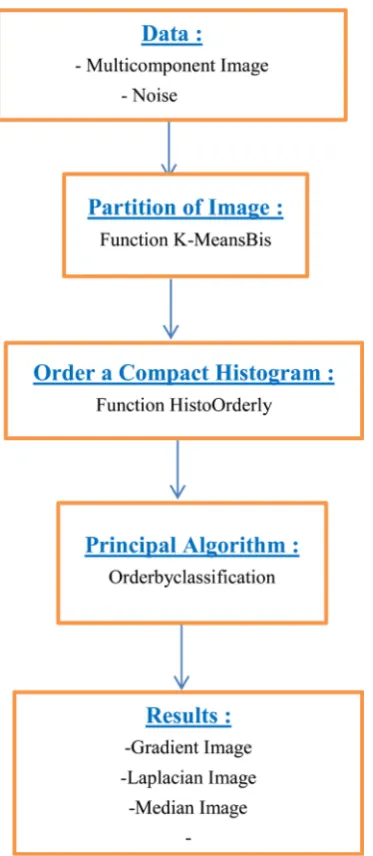
We can illustrate our algorithm by the flow chart of the Figure 1. Principal Algorithm
Let v be a neighborhood order 3 × 3 around pixel p of image I with (i,j) as coordinates. We designate L and M respectively the number of rows and col-umns of image I.
Let Hc be the compact histogram of an image, K the number of classes and Classe a struct which contains the colors by classe and the index by classes rela-tively to the compact histogram, ordred by increasing order.
[G, Classe] =K-MeansBis (Hc, K)
[HistoOrderlyFinal, IndexOrderlyFinal, ClasseFinal] =OrderByClassification (Hc, Classe, K)
Figure 1. The flow chart of our algorithm.
For j=1 to M do
Determination of the neighborhood W=(Vp) around the pixel p(i,j)
//Determination of Vmin and Vmax: //
[Pos]=FindPositions (HistoOrderlyFinal, W); // returns the position of colors in W relatively to HistoOrderlyFinal//
Vmin= HistoOrderlyFinal(Min(Pos)); Vmax= HistoOrderlyFinal(Max(Pos));
//Determination of the Gradient and the Laplacian of the pixel p(i,j): //
MedFilter_Lapl(i,j)=MedianFilter(P(i,j)) End for
End For
Function [Vmax, Vmin] = HybridOrderMaxMin(w) // W: Histogram or matrix of colors //
// Let I be the matrix associated with a multicomponent image of P plans. We note Max and Min, the conventional comparison operators that are the maxi-mum and minimaxi-mum respectively.//
// Let Vm∈W des N-tuple define VRef so as: //
( )
(
)
( )
_ , 1 1
k k
Ref min m
V = Min V ∀ ≤ ≤m length w and ≤ ≤k P (1)
( )
(
)
( )
_ , 1 1
k k
Ref max m
V = Max V ∀ ≤ ≤m length w and ≤ ≤k P (2)
// The dilated Vmax and the eroded Vmin of the histogram W are defined by the following expressions:
(
)
{
}
{
, , _}
MAX Ref max
V = X∈V Min dist X V (3)
(
)
{
}
{
, , _}
Min Ref min
V = X∈V Min dist X V (4)
// In the case of no unicity of Vmax and Vmin, the solution vectors are ordered according to the vector order by bit mixing, see the article [5] //
End
Function [IndexNewOrderly, HistoNewOrderly] = HistoOrderly (Histo-Compact, Index)
// HistoCompact: the compact histogram of an image, see the article [5]. // // Index: is a vector matric containing the position or order of colors in His-toCompact. //
N=length(HistoCompact ); // return the total number of colors in the image IndexNewOrderlymin=[ ];
IndexNewOrderlymax=[ ]; HistoNewOrderlymin=[ ]; HistoNewOrderlymax=[ ]; HistoNewOrderly=[ ]; j←0
do j←j+1
[Vmax, Vmin] = HybridOrderMaxMin(HistoCompact)
PosMin= FindPosition (Vmin) // return the position of Vmin in HistoCompact PosMax= FindPosition (Vmax)
IndexNewOrderlyMin=[ IndexNewOrdermin, PosMin ]; IndexNewOrderlyMax=[ IndexNewOrderMax, PosMax ];
position of the minimums//
HistoNewOrder =[ HistoNewOrder, Vmin]; // returns colors of the Histo-Compact ordered by increasing order//
HistoCompact(PosMin)= [ ]; Index(PosMin) =[ ]
While ( j<N) End
Function [G, Classe] =K-MeansBis (HistoCompact, K) // HistoCompact: The Compact Histogram
// K: The number of classes
// G: The matrix of the centers of gravity of the classes ordered by the function HistoOrderly//
// Classe.Index: struct of tree type. It return the list of the positions of colors with regard to HistoCompact by Class //
// Classe.Histo: struct of tree type. It return the list of colors (Histogram) with regard to HistoCompact by Class //
[G1, Index1]=kmeans (HistoCompact, K);
// kmeans: function which returns the centroids of classes in G1 and the class number which each of the color of HistoCompact belongs to, in Index1 under Matlab //
Index2=[1:K]; // Matrix vector containing the numbers in increasing order from 1 to K
[Index2NewOrderly, G]= HistoOrderly(G1, Index2); For k=1:K
Classe(k).Index=FindPositions(Index1, Index2NewOrderly( k)); // returns the positions of colors of the class number k//
Classe(k).Histo=HistoCompact(Classe(Index2NewOrderly( k)).Index)); // re-turns the positions of colors of the class number k//
end End
Function [HistoOrderlyFinal, IndexOrderlyFinal, ClasseFinal] =OrderByClassification(Hc, Classe, K)
K:// The number of classes // Hc:// The Compact Histogram//
HistoOrderlyFinal:// Compact Histogram ordered by classification order// IndexOrderlyFinal:// Positions of the colors of Compact Histogram ordered by classification order//
ClasseFinal: // struct of tree type. It return the colors and list of the positions of colors ordered by classification order, with regard to HistoCompact by Class //
IndexOrderlyFinal=[ ];
[G, Classe] =K-MeansBis (HistoCompact, K) For k=1:K
[IndexNewOrderly, HistoNewOrderly]= HistoOrder-ly(Classe(k).Histo, Classe(k).Index )
ClasseFinal(k).Histo=HistoNewOrderly; ClasseFinal(k).Index= IndexNewOrderly;
HistoOrderlyFinal= [HistoOrderlyFinal, HistoNewOrderly]; HistoOrderlyFinal=[ HistoOrderlyFinal, IndexNewOrderly]; end
End
4. Results and Discussions
In this section, the different parameters below are studied in order to highlight the relevance and robustness of our approach. They are as follows:
• The influence of the number of classes upon the proposed orders; • Statistical link between our order and other orders;
• The performance of the proposed order through the operators gradient and laplacien as compared to other orders;
• The robustness of the median filter of the proposed order face to noise regard to other orders.
4.1. The Influence of the Number of Classes on the Proposed Orders We study here the influence of the number of classes on the proposed order. To do this, we first review some mathematical quantities [8], which are useful for our study.
4.1.1. Hamming Distance
Let A be an alphabet and F the set of sequences of length n with values in A. The Hamming distance between two elements a and b of F is the number of ele-ments of the set of images of a that differ from that of b.
In other words, if d(,) denotes the Hamming distance:
( )
[1, 1]( )
[1, 1](
) {
}
, i and i , : i i
i n i n
U V F U u ∈ − v ∈ − d U V i u v
∀ ∈ = = ≠ (8)
where the notation E denotes the cardinality of the set E.
4.1.2. Mutual Information
Let (X, Y) be a pair of random variables of joint probability density given by P (X, Y) Let us note the marginal distributions P (x) and P (y). Then the mutual information is in the discrete case:
(
)
,( )
( ) ( )
( )
,
, x y , log P x y
I X Y p x y
p x p y
=
∑
(9)4.1.3. Correlation Coefficient
(finite) variance, denoted Cor (X, Y) or sometimes ρXY is defined by
( )
, cov( ) ( )
( )
x,Cor x y y
x y
ρ ρ
= (10)
where cov
( )
x y, denotes the covariance of the variables X and Y and their standard deviations.4.1.4. The Influence of the Number of Classes upon the Proposed Orders
The proposed order requires a partitioning of the multidimensional histogram of the image and therefore the influence of the corresponding K parameter should be studied.
In fact, the variation of K has been studied on many natural and synthetic color images. To illustrate our approach, an analysis was made on the synthetic image Savoise of Figure 2 with its compact multidimensional histogram. The tuples or “colors” are ordered according to the lexicographic order indicated by their index of order.
We also presented some results on real images. For fundamental reasons we made K vary between 2 and 6 K as shown in the tables below.
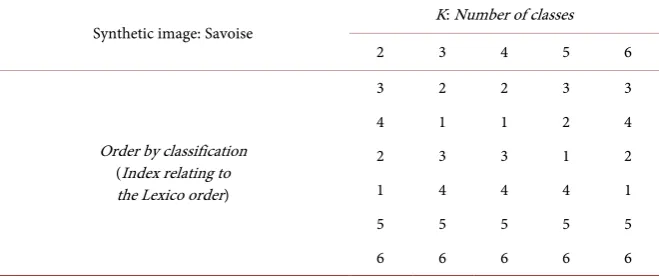
[image:9.595.231.518.370.517.2]For the proposed new order, (i.e.) order by classification, Table 1 shows the variation of the order of the tuples as a function of the number of classes of the
Figure 2. Synthetic image Savoise and its compact histogram (ordered according to the lexicographic order), and the index of tuples (position of colors in the compact histo-gram).
Table 1. Order by classification according to the number of K classes of the image Savoise.
Synthetic image: Savoise K: Number of classes
2 3 4 5 6
Order by classification
(Index relating to the Lexico order)
3 2 2 3 3
4 1 1 2 4
2 3 3 1 2
1 4 4 4 1
5 5 5 5 5
[image:9.595.209.539.592.731.2]synthetic image Savoise.
We see through this table that the order of tuples may change when the num-ber of K classes varies and stabilized itself at a certain rank, here K = 5.
The study of the influence of K was also performed on real images. Direct as-sessment is not possible because of the number (Nt) of high tuples of the multi-dimensional histogram. For example, House and Mandrill images have a respec-tive Nt 33,925 and 61,662. However, when K = 1 order by classification coincides with the hybrid reduced order. The same phenomenon is repeated when K tends to Nt.
Therefore, we have introduced in this section similarity measurements such as the generalized Hamming (DH) distance that is to say multi-symbols and the inter-class correlation coefficient (δ) and the mutual information to evaluate the the influence of K parameter when passing a number of classes K1 = I to a num-ber of classes K2 = j. Thus, the Hamming distance between two tuples of the same length measures the number of symbols or positions for which the two tuples are different. Here DH is expressed as a (%) of the length of the tuples corresponding in practice to an error rate.
We note DHij, δij, IM and the Hamming distance respectively, the coefficient of correlation and mutual information between classes i and j.
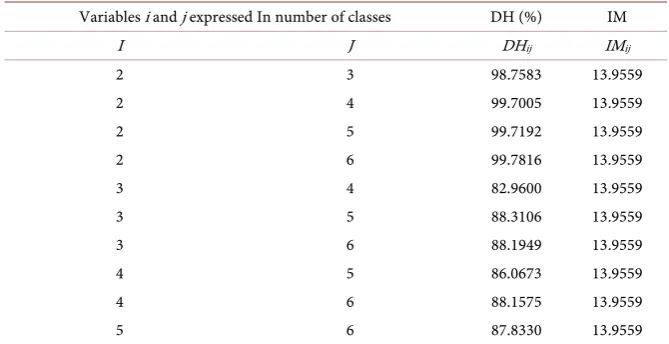
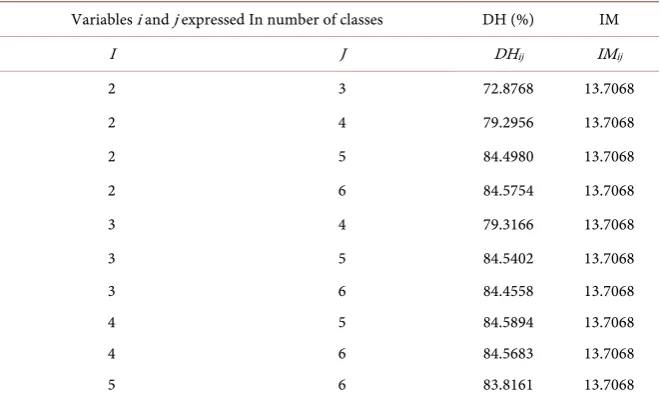
We have calculated these similarity measurements on different images. An il-lustration is made on Savoise photographs House and Lena through Tables 2-4. On the whole of the images processed and particularly the Tables 2-5 pre-sented shows that:
• The order changes with the variation in the number of K classes. This is due to the colorimetric content of the image;
• The interclass similarity of Hamming varies randomly from an image to another. This is inevitably due to the content of the images;
• When K tends to Nt, the similarity between interclass and orders is higher This has no practical interest for our application.
Indeed, the order of the tuples becomes stable when the number of classes in-creases.
Regarding the interclass correlation coefficient δij the results are not relevant and do not allow to objectively compare the orders because of the inclusion of the number of tuples.
The tests similarity measurement with mutual information IMij were unsuc-cessful because constant regardless of the combination of the number of K classes.
In addition, for i = i0 the j variation causes an increase of the Hamming dis-tance interclass orders if the difference between (i0, j) increases. In other words, the similarity of the interclass orders is greater when the interclass distance is small. As shown in Tables 3-5.
Table 2. Similarity of order by classification according to the number of classes of the image Savoise by DH.
Variables i and j expressed In number of classes DH (%) δ (%) IM
I J DHij δij IMij
2 3 66.67 0.2319 1.5248
2 4 66.67 0.2319 1.5248
2 5 50 0.9275 1.5248
2 6 0 1 1.5248
3 4 0 1 1.5248
3 5 50 0.5028 1.5248
3 6 66.67 0.2319 1.5248
4 5 50 0.5028 1.5248
4 6 66.67 0.2319 1.5248
[image:11.595.210.540.332.521.2]5 6 50 0.9275 1.5248
Table 3. Similarity of order by classification according to the number of classes of the House image by DH.
Variables i and j expressed In number of classes DH (%) IM
I J DHij IMij
2 3 75.7808 12.2584
2 4 76.1805 12.2584
2 5 79.7665 12.2584
2 6 90.4722 12.2584
3 4 51.2883 12.2584
3 5 79.5667 12.2584
3 6 90.8928 12.2584
4 5 74.5294 12.2584
4 6 88.7370 12.2584
5 6 88.6634 12.2584
Table 4. Order similarity by classification as a function of the number of classes of the Mandrill image by DH.
Variables i and j expressed In number of classes DH (%) IM
I J DHij IMij
2 3 98.7583 13.9559
2 4 99.7005 13.9559
2 5 99.7192 13.9559
2 6 99.7816 13.9559
3 4 82.9600 13.9559
3 5 88.3106 13.9559
3 6 88.1949 13.9559
4 5 86.0673 13.9559
4 6 88.1575 13.9559
[image:11.595.205.540.563.735.2]Table 5. Order similarity by classification according to the number of classes of the Lena image by DH.
Variables i and j expressed In number of classes DH (%) IM
I J DHij IMij
2 3 72.8768 13.7068
2 4 79.2956 13.7068
2 5 84.4980 13.7068
2 6 84.5754 13.7068
3 4 79.3166 13.7068
3 5 84.5402 13.7068
3 6 84.4558 13.7068
4 5 84.5894 13.7068
4 6 84.5683 13.7068
5 6 83.8161 13.7068
Savoise and Lena. One might therefore think that its results depend on the colo-rimetric content of the image.
Also, when the Hamming distance is null, the correlation coefficient equal s 1 and therefore the distributions of the interclass orders are identical (see Table 2).
4.2. Statistical Link between the Different Levels
We study in this section the statistical relationship between the classification by order (marked OD_C) proposed in this article and other existing orders in the literature that we deemed relevant [5] such orders as bit mixing (OD_E), The reduced order (OD_R) and the hybrid order (OD_H). Only the Hamming dis-tance is used here to evaluate the similarity between the different orders.
As before, for each image, the compact multidimensional histogram was cal-culated. The rank of tuples in the histogram is its index. For the different orders we have calculated each multidimensional histogram.
Using the multi-symbol Hamming distance, we have calculated the similarity rate of index ranks between orders two by two for a multitude of images for some results are recorded in the tables below.
Note that we took several different values of k for order by classification. For each given order and image the inter order mutual information is identic-al and of the same videntic-alue as that of the orders by interclass classification.
No law allows us to appreciate the distance of Hamming inter order when the class K number varies. This could be justified by the colorimetric content of the images.
when the number of class is equal to the number of color in the image, the order by classification coincides with the hybrid order.
5. Performance Analysis of the Proposed Order through the
Operators Gradient, Laplacian
Morphological Gradient and Laplacian
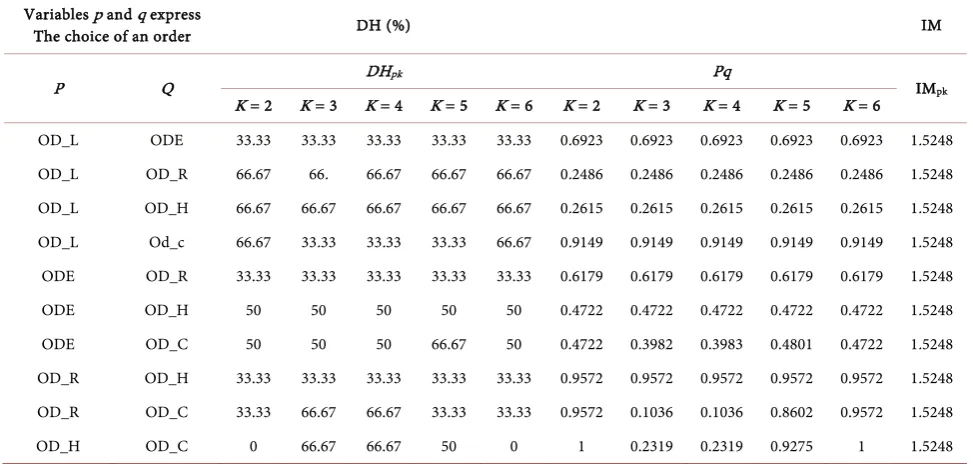
[image:13.595.55.542.243.475.2]In image processing, the Gradient and the Laplacian are operators allowing hig-hlighting the high frequency information in an image. Indeed, they perform a function of detecting contours. In discrete functional mathematical morphology,
Table 6. Similarity between orders: Case of the synthetic image Savoise.
Variables p and q express
The choice of an order DH (%) IM
P Q DHpk Pq IMpk
K =2 K =3 K =4 K =5 K =6 K =2 K =3 K =4 K =5 K =6
OD_L ODE 33.33 33.33 33.33 33.33 33.33 0.6923 0.6923 0.6923 0.6923 0.6923 1.5248 OD_L OD_R 66.67 66. 66.67 66.67 66.67 0.2486 0.2486 0.2486 0.2486 0.2486 1.5248 OD_L OD_H 66.67 66.67 66.67 66.67 66.67 0.2615 0.2615 0.2615 0.2615 0.2615 1.5248 OD_L Od_c 66.67 33.33 33.33 33.33 66.67 0.9149 0.9149 0.9149 0.9149 0.9149 1.5248 ODE OD_R 33.33 33.33 33.33 33.33 33.33 0.6179 0.6179 0.6179 0.6179 0.6179 1.5248
ODE OD_H 50 50 50 50 50 0.4722 0.4722 0.4722 0.4722 0.4722 1.5248
ODE OD_C 50 50 50 66.67 50 0.4722 0.3982 0.3983 0.4801 0.4722 1.5248
OD_R OD_H 33.33 33.33 33.33 33.33 33.33 0.9572 0.9572 0.9572 0.9572 0.9572 1.5248 OD_R OD_C 33.33 66.67 66.67 33.33 33.33 0.9572 0.1036 0.1036 0.8602 0.9572 1.5248
OD_H OD_C 0 66.67 66.67 50 0 1 0.2319 0.2319 0.9275 1 1.5248
Table 7. Similarity between orders: Case of the natural image House.
Variables p and q express
The choice of an order DH (%) IM
P Q DHpk Pq IMpk
K =2 K =3 K =4 K =5 K =6 K =2 K =3 K =4 K =5 K =6
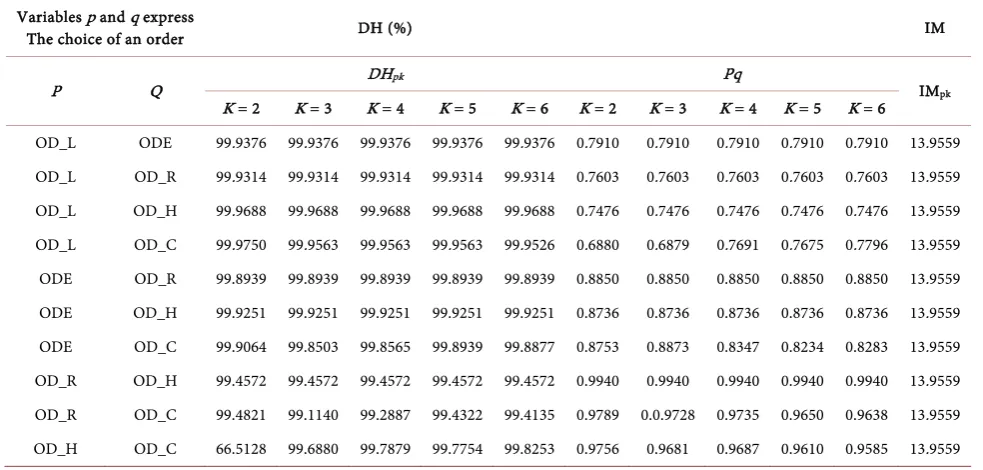
[image:13.595.55.546.507.737.2]Table 8. Similarity between orders: Case of the natural image Mandrill.
Variables p and q express
The choice of an order DH (%) IM
P Q DHpk Pq IMpk
K =2 K =3 K =4 K =5 K =6 K =2 K =3 K =4 K =5 K =6
OD_L ODE 99.9376 99.9376 99.9376 99.9376 99.9376 0.7910 0.7910 0.7910 0.7910 0.7910 13.9559 OD_L OD_R 99.9314 99.9314 99.9314 99.9314 99.9314 0.7603 0.7603 0.7603 0.7603 0.7603 13.9559 OD_L OD_H 99.9688 99.9688 99.9688 99.9688 99.9688 0.7476 0.7476 0.7476 0.7476 0.7476 13.9559 OD_L OD_C 99.9750 99.9563 99.9563 99.9563 99.9526 0.6880 0.6879 0.7691 0.7675 0.7796 13.9559 ODE OD_R 99.8939 99.8939 99.8939 99.8939 99.8939 0.8850 0.8850 0.8850 0.8850 0.8850 13.9559 ODE OD_H 99.9251 99.9251 99.9251 99.9251 99.9251 0.8736 0.8736 0.8736 0.8736 0.8736 13.9559 ODE OD_C 99.9064 99.8503 99.8565 99.8939 99.8877 0.8753 0.8873 0.8347 0.8234 0.8283 13.9559 OD_R OD_H 99.4572 99.4572 99.4572 99.4572 99.4572 0.9940 0.9940 0.9940 0.9940 0.9940 13.9559 OD_R OD_C 99.4821 99.1140 99.2887 99.4322 99.4135 0.9789 0.0.9728 0.9735 0.9650 0.9638 13.9559 OD_H OD_C 66.5128 99.6880 99.7879 99.7754 99.8253 0.9756 0.9681 0.9687 0.9610 0.9585 13.9559
they rely on two basic operators: dilation and erosion, which correspond to the maximum and minimum in a neighborhood of a pixel of the image commonly called a vectorial structuring element. We used the Symmetric Laplacian in this work. The following formulas describe these operators:
Let I be a multicomponent image with n (n> = 1) components and a B a structuring element. It is noted δB
( )
I expands I versus B and δB( )
I theeroded I. Let Max and Min respectively be the maximum and minimum ele-ments of a set.
( )
max{
( )
}
, B I = IB pδ (11)
( )
min{
( )
}
, B I = IB pε
(12) Hence the following expressions of the Gradient and the Laplacian are noted respectively Grad and Lapl:
( )
( )
( )
B I = B I − B I
Grad δ ε (13)
( )
( )
( )
2B I = B I + B I − I
Lapl δ ε (14)
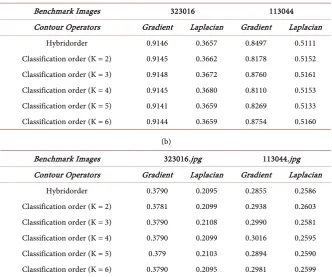
The objective in this part is to evaluate quantitatively our gradient and Lapla-cian operators through the order by proposed classification and the hybrid or-der. Due to the lack of direct methods for evaluating the results of these opera-tors, we used binary segmentation or thresholding to obtain contour segmenta-tion images. For this we used the Otsu thresholding method [9] for this purpose. At this stage, we used several methods of evaluating contour segmentation [10] to indirectly evaluate our gradient and Laplacian results. Also, in the literature the proposed evaluation methods are supervised, i.e. they require field truths or expert segmentations.
opera-tors through the two vector orders. Figure 3 shows two (02) images of the benchmark database with their ground truths.
From a quantitative point of view, different measurements of contour seg-mentation evaluation exist to evaluate the relevance of our contour detection operators. In our context we took into account distance from Pratt as well as Vinet measure.
[image:15.595.264.483.186.370.2]The results are shown in Table 9(a) and Table 9(b). From the results
Figure 3. Images of the BSDS300 Benchmark database with their expert segmentations.
Table 9. (a) Performance of gradient operators and Laplacian (Measure of Pratt); (b) Performance of gradient and Laplace operators in relation to the different vector orders (Measure of Vinet).
(a)
Benchmark Images 323016 113044
Contour Operators Gradient Laplacian Gradient Laplacian
Hybridorder 0.9146 0.3657 0.8497 0.5111
Classification order (K = 2) 0.9145 0.3662 0.8178 0.5152 Classification order (K = 3) 0.9148 0.3672 0.8760 0.5161 Classification order (K = 4) 0.9145 0.3680 0.8110 0.5153 Classification order (K = 5) 0.9141 0.3659 0.8269 0.5133 Classification order (K = 6) 0.9144 0.3659 0.8754 0.5160
(b)
Benchmark Images 323016.jpg 113044.jpg Contour Operators Gradient Laplacian Gradient Laplacian
Hybridorder 0.3790 0.2095 0.2855 0.2586
[image:15.595.206.539.454.731.2]obtained we can make the following analysises:
The Vinet measurement generally gives constant values for the different val-ues of K in the case of order by proposed classification; therefore it does not dis-criminate their performance.
- However, Pratt's measurement shows the performance of the different oper-ators.
- The set of results from the different images of the database show that the proposed classification approach is generally efficient than the hybrid order for the gradient operator.
On the contrary, the hydric order is more efficient than the order by classifi-cation for the laplacian operator.
Note that the lower the measurement, the better the contour detection opera-tor.
6. Robustness of the Order Provides Noise through the
Median Filter
To test the effectiveness of our proposal to noise, we added impulsive noise to different images of the Benchmark BSDS300 Images database to study the ro-bustness of the proposed approach and the median filter. We chose two images here for illustration (113044.jpg, 323016.jpg) and different noise powers were added to the images described by the parameter p.
[image:16.595.209.541.475.583.2]For each noisy image we applied the median filter using the proposed order and the hybrid order, and then we calculated the error rates generated by each order. The results are shown in Table 10 and Table 11.
Table 10. Comparison of median filters for different vector orders studied picture 113044.jpg.
Image 113044.jpg noise P =0.001 P =0.007 P =0.01 P =0.03 P =0.05
Hybridorder 0.8488 0.8366 0.8353 0.8488 0.8409
Classification order (K = 2) 0.9996 0.9991 0.9983 0.9996 0.9987 Classification order (K = 3) 0.9996 0.9974 0.9983 0.9996 0.9996 Classification order (K = 4) 0.9987 0.9996 0.9991 0.9987 0.9991 Classification order (K = 5) 0.9983 0.9991 0.774 0.9983 0.9991 Classification order (K = 6) 0.9991 1.0000 0.9996 0.9991 0.9996
Table 11. Comparison of median filters for different vector orders Studied we 323016.jpg picture.
Image 323016.jpg noise P=0.001 P =0.007 P =0.01 P =0.03 P =0.05
Hybridorder 0.8162 0.8170 0.8053 0.8275 0.8288
[image:16.595.208.542.629.735.2]We noted that the results obtained have the same order of magnitude for the set of images.
However the error rate median filter is lower than the proposed hybrid order. We can conclude that our proposal is less robust to noise compared to the hybr-id order. This could be explained by the fact that the classification algorithm used, in particular K-means, is sensitive to noise.
7. Conclusions and Perspectives
In this paper, we have presented a new vector order, a solution to the open problem of the generalization of mathematical morphology to multicomponent images and multidimensional data. Our proposal is a P-order. Indeed, it first parses the multicomponent image in the attribute space by the K-means classifi-cation method into different numbers of classes. Then the attribute vectors are ordered within each class (intra class order). And finally the classes themselves are ordered in turn from their barycenter (interclass order). Equipped with this order the space attribute of the image is a complete lattice.
We can conclude that on all images tested, the proposed order by classifica-tion gives better results than the hybrid order on the gradient operator, specifi-cally for edge detection. However, our order resists less noise than the hybrid order.
In our future work we intend to improve the noise resistance of our order by using a classification method rather than the K-means algorithm. Then we know that K varies theoretically from 1 to Nt. Indeed, the choice or the implementa-tion of an unsupervised evaluaimplementa-tion criterion should automatically allow us to obtain the value K = Kopt producing for each morphological operator (Gradient, Laplacian, Median filter, etc.), the optimal solution whatever the vector order may be.
What is more, we shall also focus our research on the development of new methods of Vector morphological segmentation based on scalar approaches or grayscale.
References
[1] Ronse, C. (1990) Why Mathematical Morphology Needs Complete Lattices. Signal Process, 21, 129-154. https://doi.org/10.1016/0165-1684(90)90046-2
[2] Aptoula, E. and Lefevre, S. (2009) Multivariate Mathematical Morphology Applied to Color Image Analysis. In: Collet, C., Chanussot, J. and Chehdi, K., Eds., Multiva-riate Image Processing: Methods and Applications, ISTE-John Wiley, Hoboken, 303-337.
[3] Angulo, J. (2007) Morphological Color Operators in Totally Ordered Lattices Based on Distances: Application to Image Filtering, Enhancement and Analysis. Comput-er Vision and Image UndComput-erstanding, 107, 56-73.
https://doi.org/10.1016/j.cviu.2006.11.008
[4] Aptoula, E. and Lefevre, S. (2007) A Comparative Study on Multivariate Mathemat-ical Morphology. Pattern Recognition, 40, 2914-2929.
[5] Ouattara, S., Kouassi,A., Okaingni, J.C., Koffi, A., Loum, G. and Clement, A. (2016) A New Hybrid Order Approach to Morphological Color Image Processing Based on Reduced Order with Adaptive Absolute Reference. Engineering, 8, 633-645. https://doi.org/10.4236/eng.2016.89057
[6] Valle, E. and Vicente, D.M.G. (2013) Sparsely Connected Autoassociative Lattice Memories with Implementation Year for the Reconstruction of Color Images.
Journal of Mathematical Imaging, 32, 786-796.
[7] Hartigan, J.A (1975) Clustering Algorithms. John Wiley and Sons, New York. [8] Sié, Q., Clément, A. and Chapeau-Blondeau, F. (2007) Fast Computation of
Entro-pies and Mutual Information for Multispectral Images. 4th ICINCO (International Conference on Informatics in Control, Automation and Robotics), Angers, 9-12 May 2007.
[9] Otsu, N. (1979) A Threshold Selection Method from Grey-Level Histograms. IEEE Transactions on Système Man and Cybernetics, SMC-9, 62–66.
https://doi.org/10.1109/TSMC.1979.4310076
[10] Arbelaez, P., Maire, M., Fowlkes, C. and Malik, J. (2011) Contour Detection and Hierarchical Image Segmentation. Transactions on Pattern Analysis and Machine Intelligence, 33, 898-916. https://doi.org/10.1109/TPAMI.2010.161
Submit or recommend next manuscript to SCIRP and we will provide best service for you:
Accepting pre-submission inquiries through Email, Facebook, LinkedIn, Twitter, etc. A wide selection of journals (inclusive of 9 subjects, more than 200 journals)
Providing 24-hour high-quality service User-friendly online submission system Fair and swift peer-review system
Efficient typesetting and proofreading procedure
Display of the result of downloads and visits, as well as the number of cited articles Maximum dissemination of your research work
Submit your manuscript at: http://papersubmission.scirp.org/