A Survey-Based Analysis Regarding CSR
Practices in the Romanian Tourism
Distribution Sector
Moisescu, Ovidiu-Ioan
Babes-Bolyai University of Cluj-Napoca
October 2014
Online at
https://mpra.ub.uni-muenchen.de/65310/
A Survey-Based Analysis Regarding CSR Practices in the Romanian Tourism Distribution Sector
Ovidiu-Ioan Moisescu, PhD
Babeș-Bolyai University, Faculty of Economics and Business Administration E-mail: [email protected]
Abstract: The paper investigates the extent to which the largest Romanian travel agencies, in terms of net turnover and profitability, adopt CSR practices. The analyzed data regards a set of relevant Romanian travel agencies, which during the last five years have been present at least once in an annual ranking regarding the highest net turnover and/or profits of such specialized businesses. In order to evaluate the level of CSR practices adoption in the investigated travel agencies, an online survey was conducted among their top managers mostly marketing managers (one respondent for each travel agency). The questionnaire was
adapted based on the recent European Commission’s awareness-raising questionnaire regarding CSR, and comprised several sets of items reflecting employee and workplace policies, environmental policies, marketplace policies, community policies, and, respectively, company values and their dissemination among employees, customers, business partners and other stakeholders. The results of the current research show, on one hand, a relatively high engagement of the top Romanian travel agencies in certain CSR activities, but, on the other hand, a relatively low adoption of specific practices in some domains. Although the literature regarding the impact of perceived CSR in the tourism industry suggests a significant level of
influence on corporate reputation and, indirectly, on consumers’ behavior, trust, loyalty and
other important commercial aspects, the investigated travel agencies don’t seem to pay a high
importance on communicating their CSR practices to customers, or to the general public. The paper also tries to correlate the results regarding the extent to which CSR practices are adopted and communicated with the financial/commercial performance in terms of turnover and profitability.
Keywords: CSR policies; net turnover; net profit; tourism distribution; Romania
Introduction
Despite internationally increasing emphasis on corporate social responsibility (CSR) in the tourism industry (Holcomb et al 2007; Sheldon and Park 2011), knowledge regarding how tourism distribution sector members adopt and implement CSR policies, and their relationship with business performance is rather scarce, most of such studies being focused on other tourism sectors such as the hotel industry, or the airline industry. However, little is known about how Eastern European and, more specifically, Romanian tourism industry members adopt and implement CSR policies, and how this relates to their business outcomes, the few studies conducted so far, especially in the tourism distribution sector, being either too general, or restricted to certain particular CSR aspects.
Literature review
CSR basically refers to those voluntary activities that prove the inclusion of social and environmental concerns in business operations and in interactions with stakeholders (van Marrewijk, 2003). However, despite numerous efforts to define the concept, there is still no universally accepted unique definition of CSR (Dahlsrud, 2008; Freeman et al, 2010). Considering the most relevant literature on CSR systematization, three main approaches regarding CSR can be outlined. The first approach comes from Carroll (1979) who presents a four-dimensional conceptualization of CSR, including economic, legal, ethical, and, respectively, discretionary (philanthropic) responsibilities. According to Carroll, none of the four responsibilities are optional if the firm wants to be involved in long-term relationships with its stakeholders. The second main approach regarding CSR systematization originates from the concept of sustainable development and regards CSR as a three-dimensional structure, including three facets (economic, environmental and social), companies having to
take into consideration society’s well-being, managing their impact and role in economy,
environment, and society (Pérez & del Bosque, 2013). The third relevant approach comes from Freeman et al (2010) who conceptualize CSR within a stakeholder management framework, categorizing the social responsibilities of companies based on their stakeholders: shareholders/investors, customers, employees, suppliers, the environment, the society, the local community etc. A similar approach is developed by Mandl & Dorr (2007), who consider that CSR implies that companies integrate social and environmental concerns in their business operations and in their interaction with business relevant groups on a voluntary basis, the main fields of CSR activities covering four main stakeholder categories: workplace, community, environment, and market (customers and business partners included).
CSR has strategic importance, the literature suggesting that companies which adopt and implement CSR benefit from several advantages such as better attraction and retention of employees and customers (Kim & Park, 2011; Sen & Bhattacharya, 2001; Peloza & Shang, 2011). Moreover, by adopting, implementing and communicating CSR policies companies
can “establish an industry leadership position, launch a brand, leapfrog competitors, penetrate a new market, profile a new product, engender customer loyalty, generate employee
commitment, and ultimately transform a company’s reputation” (Ogilvy 2010, p.11).
CSR has become an essential part of business strategies in the tourism industry, covering aspects such as environmental protection, fair working conditions, or contributing to the
welfare of local communities. The “European Cities Marketing” organization argues that tourism businesses have strong relationships to the local communities in which they are operating, strongly influencing the socio-economic development of these regions, while for customers and employees the integration of CSR strategies extremely important (Smith & Ong, 2014). The tourism distribution sector, alongside with other tourism industry sectors such as transportation, face environmental issues more critically than others such as accommodation providers or restaurants (Sheldon & Park, 2011). Moreover, travel agencies have a critical role in destination sustainability, due to their influence on destinations
Methodology
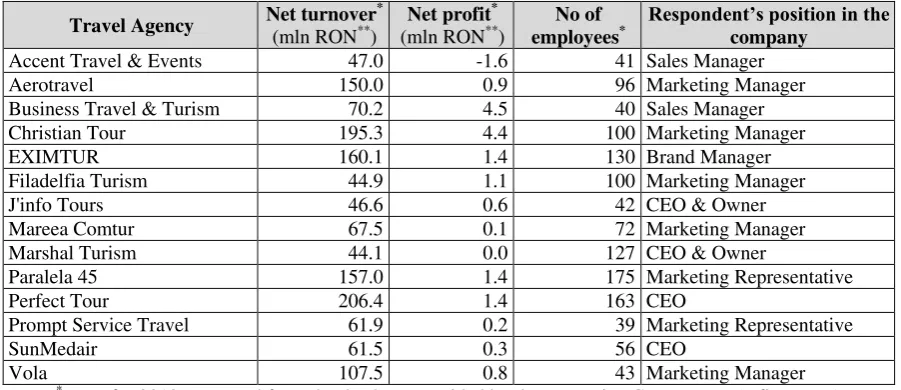
[image:4.595.73.524.305.500.2]This paper aims to investigate the extent to which the largest Romanian travel agencies, in terms of net turnover, adopt and implement CSR policies, and to correlate these findings with their business performance reflected by their net turnover and net profit. In order to accomplish the research objective, an online survey was conducted among members of the top management (CEOs, marketing managers, sales managers, brand managers) of an initial sample comprising the largest 20 Romanian travel agencies, in terms of net turnover. For each travel agency included in the initial sample, several top management members were personally and directly contacted, presenting them the research issue, asking them to complete an online questionnaire, and promising them in exchange a reward consisting in a personalized research report for their companies. Eventually, out of the 20 travel agencies included in the initial sample, after a data collection process of two months (Aug-Sep 2014), 14 (70%) provided completed questionnaires (one per each travel agency).
Table 1: Data regarding the final investigated sample
Travel Agency Net turnover
*
(mln RON**)
Net profit*
(mln RON**)
No of employees*
Respondent’s position in the
company
Accent Travel & Events 47.0 -1.6 41 Sales Manager Aerotravel 150.0 0.9 96 Marketing Manager Business Travel & Turism 70.2 4.5 40 Sales Manager Christian Tour 195.3 4.4 100 Marketing Manager EXIMTUR 160.1 1.4 130 Brand Manager Filadelfia Turism 44.9 1.1 100 Marketing Manager J'info Tours 46.6 0.6 42 CEO & Owner Mareea Comtur 67.5 0.1 72 Marketing Manager Marshal Turism 44.1 0.0 127 CEO & Owner
Paralela 45 157.0 1.4 175 Marketing Representative Perfect Tour 206.4 1.4 163 CEO
Prompt Service Travel 61.9 0.2 39 Marketing Representative
SunMedair 61.5 0.3 56 CEO
Vola 107.5 0.8 43 Marketing Manager *
Data for 2013, extracted from the database provided by the Romanian Government (mfinante.ro) **
Annual average exchange rate in 2013: 4.42 RON/EUR
The questionnaire used in order to assess CSR policies adoption and implementation was based on the awareness-raising questionnaire regarding CSR developed by the European Commission (2005). The final analyzed item pool comprised 19 indicators reflecting workplace policies (4 items), environmental policies (5 items), marketplace policies (5 items), and, respectively, community policies (5 items), respondents having to rate each item on a scale from 1 (completely false) to 5 (completely true).
Results
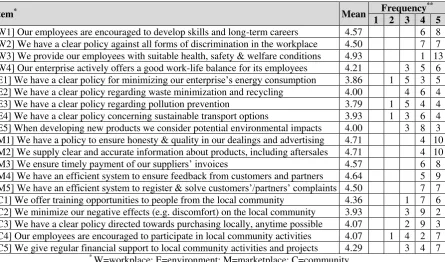
Table 2: CSR policies adoption and implementation within the investigated sample
Item* Mean Frequency
**
1 2 3 4 5
[W1] Our employees are encouraged to develop skills and long-term careers 4.57 6 8 [W2] We have a clear policy against all forms of discrimination in the workplace 4.50 7 7 [W3] We provide our employees with suitable health, safety & welfare conditions 4.93 1 13 [W4] Our enterprise actively offers a good work-life balance for its employees 4.21 3 5 6
[E1] We have a clear policy for minimizing our enterprise’s energy consumption 3.86 1 5 3 5 [E2] We have a clear policy regarding waste minimization and recycling 4.00 4 6 4 [E3] We have a clear policy regarding pollution prevention 3.79 1 5 4 4 [E4] We have a clear policy concerning sustainable transport options 3.93 1 3 6 4 [E5] When developing new products we consider potential environmental impacts 4.00 3 8 3 [M1] We have a policy to ensure honesty & quality in our dealings and advertising 4.71 4 10 [M2] We supply clear and accurate information about products, including aftersales 4.71 4 10
[M3] We ensure timely payment of our suppliers’ invoices 4.57 6 8 [M4] We have an efficient system to ensure feedback from customers and partners 4.64 5 9
[M5] We have an efficient system to register & solve customers’/partners’ complaints 4.50 7 7 [C1] We offer training opportunities to people from the local community 4.36 1 7 6 [C2] We minimize our negative effects (e.g. discomfort) on the local community 3.93 3 9 2 [C3] We have a clear policy directed towards purchasing locally, anytime possible 4.07 2 9 3 [C4] Our employees are encouraged to participate in local community activities 4.07 1 4 2 7 [C5] We give regular financial support to local community activities and projects 4.29 3 4 7
*
W=workplace; E=environment; M=marketplace; C=community
**
Answers provided on a scale from 1 (completely false) to 5 (completely true)
Analyzing each CSR domain separately, we can point out the fact that the most adopted and implemented policies in each field are: providing employees with suitable health, safety and welfare conditions (in what concerns workplace policies), minimizing waste and recycling (in what concerns environment policies), ensuring honesty and quality in dealings and advertising, while supplying clear and accurate information about products (in what concerns marketplace policies), and, respectively, offering training opportunities to people from the local community (in what concerns community policies). On the other hand, we should also emphasize the least embraced CSR policies in each CSR domain: offering a good work-life balance for employees (workplace), pollution prevention (environment), registering and
solving customers’ and partners’ complaints (marketplace), and, respectively, minimizing negative effects on the local community (community).
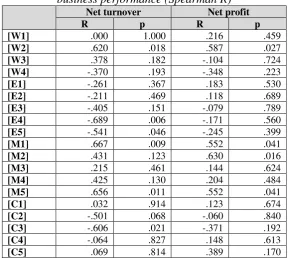
Furthermore, we investigated the relationship between adopting and implementing CSR policies and, respectively, the investigated travel agencies’ business performance. Due to the small sample size, analyzing the correlations between CSR policies adoption and implementation and, respectively, business outcomes, was not relevant using parametric correlation coefficients. Therefore, correlations were investigated using Spearman R nonparametric correlation coefficients (Table 3).
The Spearman R correlation coefficients suggest that in the case of larger travel agencies in terms of turnover (in comparison to the smaller ones comprised in the sample), several CSR policies are adopted and implemented to a larger degree, such as those regarding avoiding discrimination in the workplace, ensuring honesty and quality in dealings and advertising, and
registering and solving customers’ or partners’ complaints. However, results suggest that
profitability of travel agencies and the adoption and implementation of CSR policies such as: avoiding discrimination in the workplace, ensuring honesty and quality in dealings and advertising, supplying clear and accurate information about products, and, respectively,
[image:6.595.153.442.162.420.2]registering and solving customers’ or partners’ complaints.
Table 3: Correlations between CSR policies adoption and implementation, and, respectively, business performance (Spearman R)
Net turnover Net profit R p R p [W1] .000 1.000 .216 .459
[W2] .620 .018 .587 .027
[W3] .378 .182 -.104 .724
[W4] -.370 .193 -.348 .223
[E1] -.261 .367 .183 .530
[E2] -.211 .469 .118 .689
[E3] -.405 .151 -.079 .789
[E4] -.689 .006 -.171 .560
[E5] -.541 .046 -.245 .399
[M1] .667 .009 .552 .041
[M2] .431 .123 .630 .016
[M3] .215 .461 .144 .624
[M4] .425 .130 .204 .484
[M5] .656 .011 .552 .041
[C1] .032 .914 .123 .674
[C2] -.501 .068 -.060 .840
[C3] -.606 .021 -.371 .192
[C4] -.064 .827 .148 .613
[C5] .069 .814 .389 .170
Conclusions
Our results point out the fact that in the case of the largest Romanian travel agencies the CSR policies with the highest level of adoption and implementation are concerned with the marketplace (referring to ensuring honesty and quality in dealings and advertising, supplying clear and accurate information about products, timely payment of suppliers, ensuring feedback from customers and partners, and, respectively, registering and solving customers’
or partners’ complaints), while the CSR policies which are the least embraced refer to the environment (minimizing energy consumption, minimizing waste and recycling, pollution prevention, choosing sustainable transport options, and developing new products environmentally).
Our findings also suggest that in the case of larger travel agencies in terms of turnover (in comparison to the smaller ones comprised in the sample), several CSR policies are adopted and implemented to a larger degree, such as those regarding avoiding discrimination in the workplace, ensuring honesty and quality in dealings and advertising, and registering and
solving customers’ or partners’ complaints.
Acknowledgements
This work was supported from the European Social Fund through Sectorial Operational Programme Human Resources Development 2007-2013, project number
POSDRU/159/1.5/S/142115, project title “Performance and Excellence in Postdoctoral
References:
1. Carroll, A. B. (1979), A Three-Dimensional Conceptual Model of Corporate Performance,
Academy of Management Review, 4(4), 497–505.
2. Dahlsrud, A. (2008), How corporate social responsibility is defined: an analysis of 37 definitions,
Corporate Social Responsibility And Environmental Management, 15(1), 1-13.
3. European Commission (2005). Awareness-raising questionnaire: Corporate Social Responsibility.
http://ec.europa.eu/enterprise/policies/sustainable-business/files/csr/campaign/documentation/download/questionaire_en.pdf
4. Holcomb, J. L., Upchurch, R. S. and Okumus, F. (2007). Corporate social responsibility: What are top hotels reporting, International Journal of Contemporary Hospitality Management, 19(6). 461-475.
5. Kim, S. Y. and Park, H. (2011). Corporate social responsibility as an organizational attractiveness for prospective public relations practitioners. Journal of Business Ethics, 103(4). 639-653.
6. Mandl, I. and Dorr, A. (2007). CSR and Competitiveness: European SMEs’ Good Practice.
Consolidated European Report, Austrian Institute for SME Research,
http://www.agderforskning.no/reports/csr_and_copetitiveness-european_report.pdf
7. Ogilvy Public Relations Worldwide (2010). Communicating Corporate Responsibility,
www.ogilvypr.com/files/CSR-chap1-7.pdf
8. Peloza, J. and Shang, J. (2011). How can corporate social responsibility activities create value for stakeholders? A systematic review, Journal of the Academy of Marketing Science, 39(1). 117-135. 9. Pérez, A. and del Bosque, I. R. (2013). Measuring CSR image: three studies to develop and to
validate a reliable measurement tool. Journal Of Business Ethics, 118(2). 265-286.
10. Sen, S. and Bhattacharya, C. B. (2001). Does doing good always lead to doing better? Consumer reactions to corporate social responsibility. Journal of marketing Research, 38(2). 225-243
11. Sheldon, P.J. and Park, S.Y. (2011). “An exploratory study of corporate social responsibility in the US travel industry. Journal of Travel Research. 50(4), 392-407.
12. Smith, R.A. and Ong, J.L.T. (2014). “Corporate Social Responsibility and the Operationalization Challenge for Global Tourism Organizations. Asia Pacific Journal of Tourism Research, ahead-of-print , 1-13.
13. Tepelus, C.M. (2005). “Aiming for Sustainability in the Tour Operating Business. Journal of Cleaner Production, 13(1), 99-107.
14. Van Marrewijk, M. (2003). Concepts and definitions of CSR and corporate sustainability: between agency and communion. Journal of Business Ethics, 44(2-3), 95-105.
15. Van Wijk, J. and Persoon, W. (2006). “A Long-Haul Destination: Sustainability Reporting among Tour Operators. European Management Journal, 24(1), 381-95.